Bill Gates-backed fund aims to invest $15bn in clean tech
Breakthrough Energy Catalyst to leverage private-public capital to subsidise new markets for green technologies
A Bill Gates-backed private-public fund is preparing to invest in clean-tech projects worth as much as $15bn in the US, EU and UK, aiming to subsidise technologies at scale to help countries reach net zero emissions.
Breakthrough Energy Catalyst, which has raised $1.5bn in private capital from philanthropies and companies, will invest in four key areas: direct air capture, green hydrogen, aviation fuel and energy storage technologies.
BEC managing director Jonah Goldman told the Financial Times that the fund would mobilise as much as $15bn, or ten times the initial investment, by using innovative financial structures and partnership agreements.
“We are last-mile financing and so, we will be the most risky capital in there,” Goldman says. “We’re really trying to demonstrate which of the technological pathways are going to be most effective.”
The fund is part of the Breakthrough Energy group, started by the billionaire founder of Microsoft in 2015. Its Breakthrough Energy Ventures arm provides venture capital to green tech start-ups and includes among its board and investors other prominent business founders such as Mukesh Ambani, Jeff Bezos, Masayoshi Son and Sir Chris Hohn.
The new BEC fund will provide three types of capital — philanthropic donations, sub-market equity investments, and product offtake agreements — to fund large projects that would not otherwise be financially viable.
Its focus will be on creating markets for the green products and technologies and bringing down the cost of production for materials such as green steel and green hydrogen. This has drawn the interest of steel group ArcelorMittal and carmaker GM among the initial corporate backers.

There has been a big increase in private and philanthropic investment in clean tech since the beginning of the pandemic, according to Professor Richard Templer, director of innovation at the Grantham Institute at Imperial College, London.
“This is patient capital, it is large capital,” said Templer. “In the past, venture capitalists would just say, this is an engineering project, it is not for us . . .”. But that is changing and new funding models are being developed, he said.
One of the goals of BEC — which does not expect to generate normal financial returns — is to reduce the “green premium” for products such as sustainable aviation fuel. The green premium refers to the additional cost of a green product compared with its non-sustainable counterpart, such as regular jet fuel.
One example could be a refinery for sustainable aviation fuel, said Goldman, where the technology is proven but the economics have not supported large-scale production. American Airlines is among the corporates that have contributed to the fund.
“There’s six different ways to do sustainable aviation fuel, and we know they all work and they all have different challenges,” said Goldman.
“We just need to build a bunch of them to see where we’re able to get the green premium reductions, through things like engineering learning.”
Several governments have lent their support to the fund, including the US Department of Energy, the UK and the EU, where it has a $1bn partnership with the European Commission.
In the unusual structure, BEC-backed projects will be partly financed through long-term offtake agreements from customers willing to pay for sustainable products — contracts for green steel or for sustainable aviation fuel, for example.
“These projects are huge projects, that are going to require lots of capital,” said Goldman.
“We know you can do it. You just need to see if you can do it at scale in an economic way,” said Goldman. “That’s what all these things have in common. They all need the intervention to be able to get them to this next stage of commercial demonstration and actually start building markets.”

Stocks in Asia traded cautiously Monday as investors brace for bond-market volatility and stimulus withdrawal. The dollar rose. Shares in Hong Kong advanced as technology stocks rebounded. They fell in South Korea, while China edged higher. U.S. futures swung between gains and losses after the S&P 500 posted the worst start to a year since 2016 as expectations of faster-than-anticipated U.S. interest-rate increases roiled bond markets. The tech-heavy Nasdaq 100 had its worst week since February amid a rotation out of high-growth equities. Japan is shut for a holiday Monday.
U.S. inflation data this week will be keenly watched as concerns grow the Fed is behind the curve in tackling elevated price pressures. U.S. employers added fewer staff than expected in December, but wages rose more than forecast, boosting the Fed’s case to tighten liquidity. Markets face increasing volatility as investors grapple with how to reprice assets as the pandemic liquidity that helped drive equities to record highs is withdrawn.
At the same time, the spread of omicron is posing a fresh test for economic activity. China is seeing its first omicron cases in the community, and as the Lunar New Year festivities approach, governments in Taiwan and Vietnam prepared to intensify curbs. Elsewhere, Bitcoin traded around $42,000 as cryptocurrencies continue to struggle. Crude oil steadied around $79 a barrel after recording the biggest weekly gain in a month.
Nikkei -Closed Hang Seng +0.75% CSI +0.30% Shanghai +0.25% Shenzen +0.44%
Eur$ 1.1334 CNH 6.3797 CNY 6.3739 JPY 115.79 GBP 1.3583 CHF 0.9203 RUB 75.4479 TRY 13.8214 WTI$ 79.02 +0.15% Gold 1,792.18 -0.24% BTC 42,180 -0.32% ETH 3,180 -0.30%
S&P +0.13% Nasdaq +0.37% EuroStoxx +0.39% FTSE +0.21% Dax +0.25% SMI /
Macro :
- China Wealth Fund CIC’s Ju Sees Slow Global Growth in 2022
- Beijing Steps Up Efforts to Contain Housing Risks: China Today
- Ethereum Beats Rivals with ‘Trade-Offs,’ Pantera’s Krug Says
- U.K. to Boost Scrutiny of Cloud Firms Incl. Google, Amazon: FT
- Strategist Who Called Retail Boom Sees S&P Bull Case Near 5,500
Spacs :
- Trump SPAC Financier’s Hydrogen Fuel Deal Gets Another Shot
- Branson Hints at Setting Up a Virgin Group SPAC in Amsterdam
Keep an eye on :
- ARL GY : Aareal Bank Motions for Supervisory Board Rejected by Court: HB
- AC FP : Hotel REITs Climb, Joining Friday Rally in Travel Stocks
- AML LN : Aston Martin Gauges Ford Executive’s Interest in Becoming CEO
- ATO FP : Atos CEO Warns on Profit, to Present Reorganization End-Feb.
- BSLN SW : Basilea Prelim FY Revenue Beats Estimates
- BCART BB : Biocartis Cash Position EU53.5M End-2021, Beats EU50m Guidance
- BMW GY : BMW Tops Lexus, Mercedes in U.S. Luxury Sales for Third Year
- CGG FP : CGG 4Q Segment Revenue Expected Around $301m, Up 12%
- CPG LN : PrimaryBid Set to Close Funding Round Led by SoftBank Fund: Sky
- CINE LN : Disney Shifts Pixar Film to Streaming in Latest Blow to Theaters
- CLASB SS : Clas Ohlson Dec. Sales +9%
- COV GY : Covivio to Buy More Than 640 Homes in Berlin for EU154m
- DAI GY : Mercedes to Build E-Drive Powertrains Fully In-House: AMW
- DHER GY : Foodpanda to Invest $22 Million in Taiwan, Hire 100 Engineers
- DIC GY : DIC Says Total Transaction Volume for 2021 Up to ~EU1.9B
- DIS US : Disney Shifts Pixar Film to Streaming in Latest Blow to Theaters
- IDIA SW : Swiss Biotech Idorsia Gets U.S. Approval for Insomnia Drug
- MOLN SW : Novartis Says Ensovibep Covid Drug Trial Meets Primary Endpoint
- NOVN SW : Novartis Says Ensovibep Covid Drug Trial Meets Primary Endpoint
- PEXIP NO : Pexip Adds $6.6m in Annual Recurring Rev During 4Q
- SKAB SS : Skanska Builds Bridge Replacement in New Jersey for $1.09b
- SMCP FP : European TopSoho Holds 8.03% of SMCP Capital: AMF
- SNH GY : Steinhoff’s Mattress Firm Group Files for IPO
- SWEDA SS : Dirty-Money Ties Worried Some at Swedbank While Bosses Kept Mum
- TGS NO : TGS Prelim 4Q Net Rev. About $119M
- VIE FP : Veolia Extends Tender for Suez Shares as Takeover Gets Closer
>>> Up
* BMW Raised to Buy at Goldman; PT 123 euros
* Encavis Raised to Outperform at Oddo BHF; PT 19 Euros
* Eni Raised to Market Perform at Bernstein; PT 14.50 euros
* Galp Raised to Outperform at Bernstein; PT 14 euros
* Infineon Raised to Buy at Citi
* Orsted Raised to Buy at Goldman; PT 995 kroner
* STMicroelectronics Raised to Buy at Citi
* Vetoquinol Raised to Buy at Stifel; PT 161 euros
>>> Down
* Adidas Cut to Hold at HSBC; PT 280 euros
* Bureau Veritas Cut to Equal-Weight at Morgan Stanley
* E.On Cut to Neutral at Goldman; PT 13.25 euros
* Equinor Cut to Market Perform at Bernstein; PT 315 kroner
* Eurofins Scientific Cut to Hold at Jefferies; PT 100 euros
* Experian Cut to Equal-Weight at Morgan Stanley; PT 3,560 pence
* Hilton Worldwide Cut to Market Perform at Bernstein; PT $161
* National Grid Cut to Market Perform at Bernstein; PT 1,105 pence
* Nike Cut to Hold at HSBC; PT $182
* Persimmon Cut to Neutral at Citi
* Schneider Electric Cut to Sell at Citi
* UCB Cut to Neutral at Citi; PT 97 euros
* Vetropack Cut to Hold at Stifel; PT 63 Swiss francs
* Wise Cut to Sell at Citi
>>> Initiation
* Novartis Resumed Buy at Citi; PT 95 Swiss francs
* Unilever Resumed Buy at Citi; PT 4,500 pence
>>> Call
* Alibaba Price Targets Lowered at Citi on Soft Consumer Spending
* BMW Raised to Buy at Goldman, Sees Scope for Material Dividends
* Bureau Veritas, Experian Cut at Morgan Stanley, Hays a Top Pick
* Infineon, STMicro Upgraded, Keep Constructive View on Tech: Citi
* Unilever Offers Recovery Story Beyond 1H, Resumed Buy at Citi
Novax DjoCovid
These Are The Three Things Investors Will Focus On During Q4 Earnings Season And Into 2022
There are no two ways about it: the first full year of the year was a lousy one for stocks, with the S&P falling by 1.9% and the Nasdaq tumbling 3.5%, its biggest drop since the year 2000 - the year the dot com bubble popped.

The culprit for the plunge, of course, was the Fed, with the mid-week pivot coinciding with the release of the hawkish December FOMC minutes that hinted at not just a faster liftoff, but an even faster balance sheet drawdown. As a result, banks expect the Fed to hike either three or four times, with some expecting the Fed to announce QT in early H2, and Friday's dismal jobs report which showed just 199K gains (vs. consensus of 450K) did not deter hawkish expectations as the unemployment rate - just a few years ago viewed as a completely meaningless statistic - fell to 3.9%, down 0.3% from 4.2% in November.
Looking at the price action, Goldman's David Kostin - who is of course, head of research and not an actual trader - points to the rapid move higher in yields catalyzed by the Fed statement, and which surged as high as 1.80% last week before settling around 1.76% after ending 2021 at 1.52%, a 24 bps rise over just 5 days. This is material because as Kostin notes in his latest Weekly Kickstart note, the speed of rate moves matters (perhaps more than the actual move) for equity returns. To wit, "equities typically struggle when the 5-day or 1-month change in nominal or real rates is greater than 2 standard deviations. The magnitude of the recent yield backup qualifies as a 2+ standard deviation event in both cases."
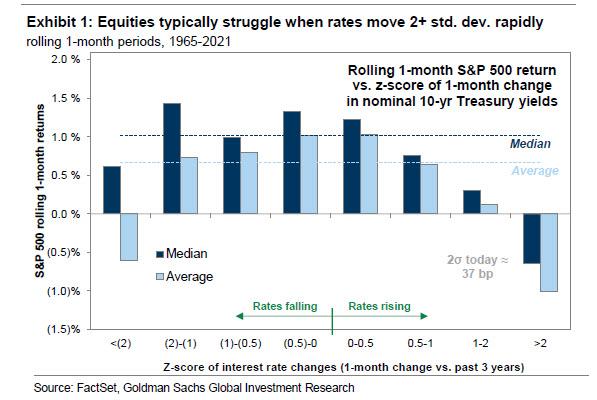
Kostin then notes that the sharp spike in rates was an obvious risk to the premium valuation accorded to the longest duration equities (high growth but low margins), something discussed here extensively. And sure enough, these stocks have been violently re-priced during the past few days, but also past few months
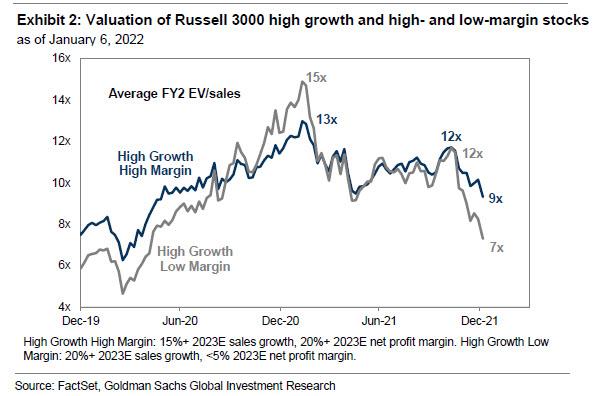
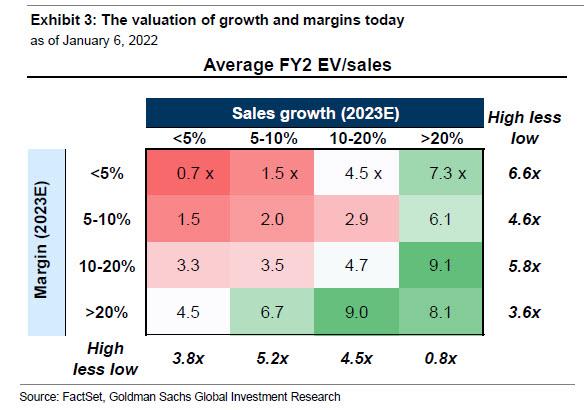
It may not feel like it, but the EV/sales multiple for these stocks has compressed from a peak of 15x in February, to 12x at the start of November, to 7x today. But if the Russell 3000 constituents traded in a well-ordered progression, the relative valuation of these stocks would be wider than the current spread.
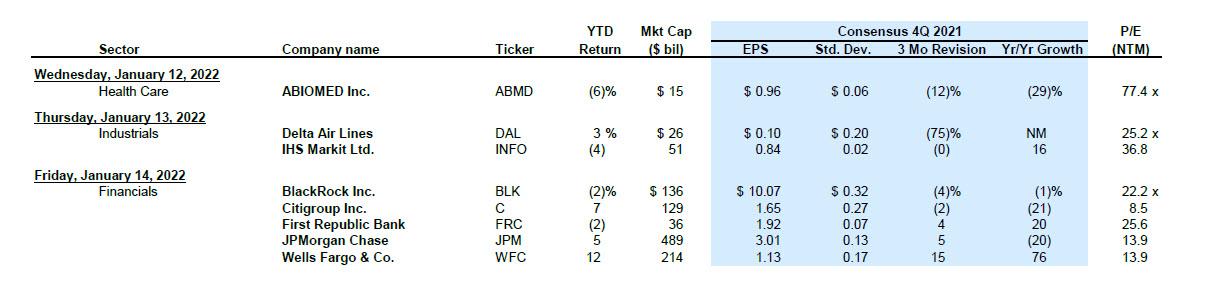
With all that in mind, and with one eye trained on macro developments, investors now await the start of 4Q 2021 earnings season that begins next week, when BLK, C, FRC, JPM, and WFC all release their 4Q 2021 results on Friday, January 14.
As Kostin calculates, between January 10 and February 11, companies representing 79% of S&P 500 market cap will report year-end results, and a list of next week's reporters is shown below.
Looking ahead, consensus expects 4Q 2021 S&P 500 EPS will grow by 20% year/year. The growth rate will represent a sharp deceleration from previous quarters that benefited from comparison with the worst quarters of Covid-plagued 2020. In 2021, the sequence of year/year EPS growth was 48% (1Q), 88% (2Q), and 39% (3Q). If the consensus expectation for 4Q is realized, it would represent a step in the direction of normalization towards trend growth. Among the sectors, energy is expected to swing from negative to positive EPS. Materials (+57%), Industrials (+47%), and Health Care (+16%) are forecast to report the highest EPS growth while Financials (0%) and Consumer Staples (+3%) are expected to barely grow earnings vs. 4Q 2020
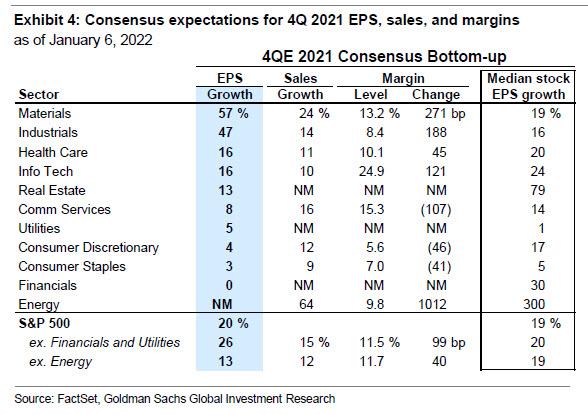
On the revenue side, consensus expects sales will grow by 15% year/year vs. 17% for the prior quarter. Energy (+64%), Materials (+24%), and Communication Services (+16%) will generate the largest revenue gains. Consumer Staples will lag (+9%).
Net margins are forecast to expand year/year by nearly 100 bps to 11.5% despite soaring inflation, suggesting that all of the input price increases and then some, have been passed on to consumers. On a rolling four-quarter basis margins will equal 12.1%. Note that in 3Q, actual results were 70 bps above analyst forecasts at the start of earnings season. Energy and Materials are anticipated to have the largest margin expansions.
In any case, as companies close their books on 2021, investors and managements are already focused on 2022. Goldman forecasts the S&P 500 will generate 8% EPS growth to $226, slightly below the median top-down forecast but above the consensus bottom-up forecast of $223. At the index level, Kostin and Co. expect sales growth of 9%, and also project a net profit margin of 12.6% which implies 41 bps of expansion and explains the bank's above-consensus EPS forecasts. As Kostin explains, his above-consensus forecast "is driven by a combination of operating leverage, pricing power, and cost management." He also notes that Goldman's expectations differ most from consensus for the Industrials and Utilities sectors, where it projects slower year/year EPS growth, and for the Communication Services, Materials, and Info Tech sectors, where the bank expects more EPS growth than bottom-up estimates.
Putting it all together, investors will focus on three items during 4Q reporting season and into 2022.
1.Threats to growth, especially those posed by Covid variants. The Omicronvariant has introduced new risks to economic activity given its heightenedtransmissibility and drag on reopening. Our economists recently slashed their USgrowth forecasts to 3.5% (from 4.2%), in part due to the effects of Omicron. Each 1pp change in GDP growth translates into roughly $7 of S&P 500 EPS.
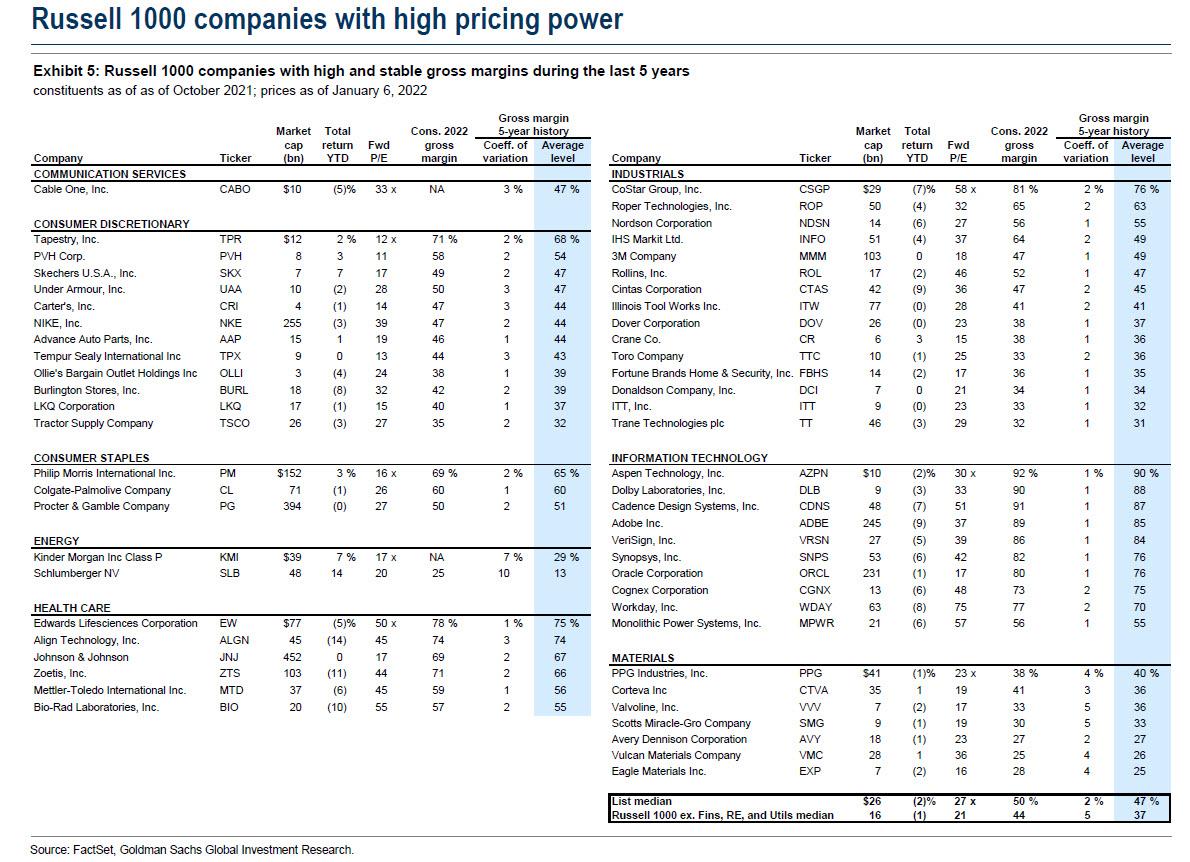
2. Expanding margins will be an uphill battle for companies in 2022, due in part to persistent labor market tightness. In earnings calls as recent as 3Q, managements bemoaned historic worker shortages, particularly for low-wage jobs in the services sector. Goldman economists expect the rapid pace of wage inflation to subside to around 4%, but this could take several quarters to achieve. Today’s jobs report showed average hourly earnings rose 4.7% year/year. Firms with high labor costs or exposure to wage inflation will face the most difficulty in preserving margins. Since the beginning of 4Q, companies with high and stable gross marginshad outperformed those with weak and variable margins by 12 pp(+4% vs. -9%), but the trade has slightly reversed in recent weeks. The next chart shows a list of stocks with high and stable gross margins.
One headwind to margin expansion that may soon improve is the resolution of supply chain bottlenecks that plagued firms in 2021 (assuming it doesn't get even worse should China's suffer an Omicron-linked lockdown of its key ports). Managements employed a mixture of price increases and cost controls to offset surging raw materials and shipping prices. Looking ahead, Goldman notes that market measures of supply chain tightness appear to be slowly easing, and shipping costs have begun to decline in recent weeks. We disagree.
3. Finally, the revival and ultimate passage of President Biden's Build Back Better bill would have mixed implications for US equities. Senator Joe Manchin’s late-December rejection of the draft legislation ruled out its passage last year. In the event that the legislation is adopted this year, Goldman estimates this tax reform would reduce S&P 500 EPS by 2-3% relative to current tax policy but only go into effect in 2023 at the earliest. By then, however, Dems will no longer have a supermajority in Congress so everything will be in flux.
Inside private equity’s race to go public
As share prices surge, a new cohort of buyout groups is preparing to list
Most of the private equity industry has been enriched during the pandemic — but a select group has had a particularly good time.
Eleven listed private equity firms collectively gained nearly $240bn in market value in 2021. Against that backdrop, a growing number of privately held buyout groups are rushing to join them on the public markets.
London-based Bridgepoint, New York-based Blue Owl and Paris-based Antin Infrastructure Partners all listed this year. One of the largest privately held buyout firms in the US, TPG, is expected to float this month at a valuation exceeding $9bn. European firms CVC Capital Partners and Ardian and US-based L Catterton have all had conversations with advisers about potential initial public offerings, people with knowledge of the talks said.
The largest listed players have used the past decade to become diversified asset managers that control multiple pools of capital worth hundreds of billions of dollars. They now dwarf their smaller, unlisted rivals, many of which are fearful of missing out.
“We decided that we wanted to be one of the global players,” said Christian Sinding, chief executive of Stockholm-based EQT Partners, which listed in September 2019. “We needed capital to grow and there were more benefits to being public than raising capital privately.”

It is easy to forget, though, that the premium valuations are a recent phenomenon. Only a few years ago private equity chiefs such as Blackstone’s Stephen Schwarzman could not hide their frustration with public markets.
“As most of you know, I’ve been racking my brain to make sense of this disconnect,” Schwarzman grumbled to Blackstone stockholders in 2017 after 10 years as a public company, most of that spent with the shares below the IPO price.
Between 2010 and 2014 KKR, Carlyle, Apollo and Ares all listed their shares and recorded lacklustre stock market performance in the early years. The mood changed in 2018 as they began to convert from partnerships into corporations with more shareholder rights, opening their shares to inclusion in stock indices and mutual fund portfolios.
The enthusiastic market reception gave a new generation of private equity firms reason to consider going public.
EQT, founded in 1993 as an investment arm for the Wallenberg banking and industrial dynasty, broke a half-decade lull in such listings in 2019. EQT’s shares have risen 630 per cent from their IPO price. Assets under management have surged from $45bn in September 2019 to $80bn, boosted by a couple of sizeable acquisitions.
“The market is consolidating and the larger platforms are getting larger,” said Michael Arougheti, chief executive of Ares Management, which has struck four large acquisitions since 2020, drawing in over $40bn in assets. “A lot of smaller managers are feeling disadvantaged.”
An executive at a large, privately held buyout firm, said: “Investment bankers have been constantly pitching us to buy something, do an IPO or a debt issuance, or all of the above.”
Bridgepoint’s decision to become the first private equity group in decades to list in the UK was rooted in a recognition that “the whole size and activity of private markets is growing”, said executive chair William Jackson. “As the industry matures, then access to capital to drive that maturity becomes pretty important.”
Going public brings a level of transparency that is not always comfortable for an industry built on operating away from the public glare. But while US-listed firms must tell shareholders how much money their top executives make in salary, bonuses, dividends and carried interest, some in Europe have been able to list without sharing total rewards.
EQT and Antin do not publish how much money their most senior executives individually make in carried interest. Bridgepoint listed in London this year without making the disclosure.
“It’s an industry, particularly in the UK, which is obsessed with secrecy,” said Alain Rauscher, chief executive of Antin Infrastructure. “People don’t want to communicate about their carried interest . . . You have some tabloid press who are going to make a big fuss about it.”
Paris-listed Eurazeo stands out for its relative transparency. It reported that in December 2016, the last time carried interest was disclosed, sums of €17m and €12.7m were handed to top executives Patrick Sayer and Virginie Morgon respectively, on top of their remuneration that year of €3.3m and €3.1m.
Information about shareholdings, however, is more easily available. Insiders at EQT own a combined $30bn in stock, with six named EQT executives, including chief executive Sinding and founder Conni Jonsson owning well over $1bn-worth apiece. Sweden’s financial regulator is investigating EQT over what it describes as “a delayed disclosure of inside information” in relation to executives’ share sales in September. EQT says these were handled correctly.
TPG’s prospectus meanwhile revealed that insiders sit on shares and units worth over $7bn at the high-end of its IPO range and a further $3.5bn in potential performance compensation to be spread among its 912 employees.
The new crop of private equity IPOs is helping executives take their firms public at high valuations while retaining the vast majority of lucrative performance fees for themselves.
Stock analysts and investors are attracted by private equity groups’ management fee income, typically a 2 per cent charge that becomes more lucrative when buyout groups accumulate more assets. They usually place less emphasis on buyout groups’ 20 per cent share of profits, which is less predictable.
EQT gives all management fees to shareholders and about two-thirds of performance fees to insiders, a structure that has given it the richest valuation in the buyout industry globally. The firm trades at more than 50 times management fee revenues over the past 12 months.
TPG said in its prospectus it will restructure its finances to give shareholders a greater claim on net management fees and its own dealmakers a greater share of performance fees, which account for the bulk of its historical earnings.
Shareholders of TPG will have a claim to just 20 per cent of the firm’s performance profits, where it has historically generated the bulk of its earnings, down from 50 per cent. In this new structure, TPG generated $505m in profits available to be distributed to public shareholders over the past 12 months, versus $1.2bn had it not changed its fee ratios.

Orlando Bravo, co-founder of San Francisco-based Thoma Bravo, said investors undervalue buyout firms by not focusing enough on incentive earnings. He has fended off approaches to sell a stake in the firm, something that has been a precursor to stock market listings for other buyout groups.
Asked whether the firm, which one senior banker estimated could be valued at more than $30bn, would list, he said: “To pursue our strategic mission, we don’t need outside capital right now.” But he added that this could change.
Other firms, such as San Francisco-based Hellman & Friedman, New York-based Clayton, Dubilier & Rice and Boston-based Advent International, have so far also preferred to remain private and focus mostly on leveraged buyouts.
The developing consensus, however, is to cash in while valuations are high.
“If there is one thing most people agree that private equity firms are good at, it is knowing when to sell,” said Peter Morris, an associate scholar at the University of Oxford’s Saïd Business School. “Why not themselves?”
Uniper’s €10bn credit call signals strains on Europe’s energy sector
State lender’s role in German utility’s dash for cash raises fears of an industry scramble for finance
German utility Uniper’s admission that it had been forced to seek €10bn in new credit lines was a stark reminder that the threat posed by Europe’s energy crisis is not limited to consumers.
The dash for cash last week by one of Europe’s largest energy companies comes as unprecedented rises in natural gas and power prices prompt a sudden swelling of it liabilities on futures contracts.
With state-backed lender KfW providing €2bn of the mammoth financing alongside €8bn from Uniper’s Finnish owner Fortum, bankers now fear a scramble for credit among the region’s smaller companies as private-sector banks back away.
“The moves have been so extreme that even the normal, most cautious day-to-day business of locking in the spread requires you to raise so much money just to hold the position to delivery,” said Lueder Schumacher, analyst at Société Générale.
“I’d be surprised if everybody in the market who needs access to credit lines will actually get it.”
European gas prices have surged more than 400 per cent over the past year, as demand rebounded from the pandemic and Asian customers snapped up additional cargoes of liquefied natural gas.
At the same, Russia’s Gazprom has restricted sales only to those covered by long-term contracts, while letting its storage facilities in Europe drop to unusually low levels. More than a third of the EU’s gas supplies come from Russia.
German energy companies say Uniper’s huge financing needs were not unique. RWE, like Uniper, has sought extra financing on expectations that gas prices would remain volatile not just this winter but even into the next as Europe seeks to refill its depleted gas storage facilities.
Regarded by analysts as one of the sector’s more conservative companies, Uniper sells most of its power production years before delivery.
Once it agrees an electricity price with one of its industrial customers or municipal utilities, Uniper hedges its variable production costs and then instructs its traders to lock in a spread, or margin, via a forward power sale on futures markets, such as Germany’s EEX. The company does broadly the same with gas, using exchanges such as ICE Futures Europe.
These forward sales are subject to a variation margin, a cash deposit that protects the buyer from the risk of default by the seller. The amount of cash collateral deposited fluctuates with the underlying commodity prices.
For example, if Uniper agrees to sell German baseload power for €50 per megawatt hour in 2023 and the forward price rises in the meantime to €100, it will have to deposit with the exchange a variation margin of €50 — the difference between the two prices.
The Düsseldorf-based utility said in November it had sold 90 per cent of its German power for 2023 at €51 a megawatt hour, leaving it heavily exposed as the price soars far beyond that level, with German power futures for that year settling on Friday at €137.3 a megawatt hour.
This does not change the economics of the original transaction, as the cash collateral is returned when Uniper delivers the power. But it can lead to a large temporary cash outflow, especially in volatile markets. In the nine months to September, Uniper reported cash outflows for collateral of €4.4bn.
This figure will have risen significantly when gas and electricity prices soared to record levels in the run-up to Christmas and in part explains why Uniper was forced to seek extra liquidity.
As private sector banks have exposure limits to individual clients and sectors — and the credit facilities required by Uniper were so large — it was easier to secure the financing through Fortum and a state-backed German lender, said one person familiar with the situation.
“No one has any doubt that the underlying business at Uniper is sound, this is just a big hiccup caused by the wild swings of electricity and commodity prices,” the person said.
Uniper says the credit line from KfW is a back-up facility in case of “further extreme commodity market developments”, something few analysts are prepared to rule out, especially if there is a cold snap in Europe — or if Russia invades Ukraine.
Should the company access that funding, executives would have to forfeit their bonuses.
Other big utilities have not been hit to the same extent as Uniper, however, either because they have large retail businesses or, in the case of RWE, have offsetting variation margin inflows from hedging carbon emissions related to its power plants that burn lignite, the lowest grade of coal.
“As the CO2 price rose another 31 per cent in the fourth quarter of 2121, the pressure on working capital should be significantly less for RWE,” Schumacher said.
For Germany, gas price volatility has sparked concerns over its energy plans — it is phasing out nuclear power by the end of 2022 even as the new government accelerates its coal exit, to 2030. That leaves the country more dependent on renewable energy and natural gas.
Michael Pahle, of the Potsdam Institute for Climate Impact Research, said the current shocks should speed up state preparations for extended volatility and high prices, which would continue during the shift to renewables.
He expects the government to plan more measures for cushioning low-income citizens, while backing research projects and businesses working on reducing consumption levels.
“As always with a crisis,” he said, “you hope something good will come out of it.”