>>> What to look at today - 3rd of January 2022

U.S. equity futures gained, while Asian stocks were mixed in thin trading as investors mulled the impact of the omicron variant on the global recovery. Shares of China Evergrande Group were suspended in Hong Kong.
S&P 500 and Nasdaq 100 contracts advanced at the start of the new year, with major markets including Australia, Japan and China all shut for holidays. Equities rallied in South Korea and Taiwan, but fell in Hong Kong, where trading in Evergrande shares were halted with no reason given, and developer and technology sectors led declines. 
There’s “a positive setup into 2022 with Fed and Covid headwinds to ease, and China policy tailwinds,” JPMorgan Chase & Co. strategists led by Mixo Das in Hong Kong, wrote in a report Sunday. “Overall, our economists see less disruption to economic activity and above trend global growth this quarter, particularly in Asia. In terms of Fed tightening, the moment of peak disruption for markets may also be passing.”
All eyes are on the omicron variant of Covid-19, which is spreading rapidly but also appears to be less severe than some earlier variants based on the rate of hospitalizations. The trajectory of policy by the Federal Reserve and other central banks in also in focus for 2022, particularly as inflation continues to present a challenge. Many strategists are predicting more volatility in the year ahead as the path forward becomes less clear.
Last year “was simply a period of ‘risk on,’” Jefferies strategists led by Sean Darby wrote in a note. “Peering into 2022, we expect volatility to rise, meaning that the return per unit of risk comes to the forefront.”
Oil edged higher as Libyan output fell before an OPEC+ meeting on Tuesday to discuss production policy.

Nikkei Closed Hang Seng -0.72% CSI Closed Shanghai Closed Shenzen Closed

Eur$ 1.1341 CNH 6.3617 CNY 6.3516 JPY 115.28 GBP 1.35 CHF 0.9146 RUB 75.1300 TRY 13.41 WTI$ 75.76 +0.73% Gold 1,825.30 -0.20% BTC 46,870 -0.30% ETC 3,797 -0.40%

S&P +0.35% Nasdaq +0.45% EuroStoxx -0.02% FTSE Closed Dax +0.12% SMI

Macro :
- German Government Promises $34 Billion in Tax Relief Measures
- U.K. Develops Plans to Help Businesses From Covid Absences: FT
- Three Monster Years in S&P 500 Set a Towering Bar for January
- Goldman Backtracks on Office Return; U.S. Surge: Virus Update
- Billionaires Turn to Crypto Just in Case Money 'Goes to Hell'

Keep an eye on :
- ACE IM : Acea, Ascopiave, Iren Win Bid for A2A Gas Distribution Assets
- AIR FP : Late Order Flurry Puts Airbus Neck and Neck With Boeing for 2021
- AMS SW : AMS Osram Convertible Bonds Repurchase Program Ends
- AMUN FP : Amundi Completes Lyxor Deal Two Months Early
- DHER GY : Delivery Hero to Acquire 39.4% Stake in Delivery App Glovo
- DWNI GY : Deutsche Wohnen Names Kanellopoulos, Urbansky as Co-CEOs
- HSHIP NO : 2020 Bulkers Names Herman Billung CEO From Feb. 1
- IVG IM : Iveco Truck Spinoff Targets Growth in Challenging Industry Shift
- TIT IM : Italy’s CDP Urges Reviving Single Grid Plan, Chairman Tells Sole
- TSLA US : Tesla 4Q Deliveries Beats Estimates (FY delivery 936k +87% vs 2020)
- ZURN SW : Zurich to Sell Italian Life, Pensions Back Book to GamaLife

FT : Evergrande shares suspended after report it was told to destroy buildings

Evergrande shares suspended after report it was told to destroy buildings
Chinese media outlet says authorities demanded indebted property company raze residential complex

Trading of Evergrande Group shares was suspended in Hong Kong on Monday, days after Chinese media reported that the indebted property developer would be forced to demolish a residential development in the southern province of Hainan.

The company, which has been at the centre of a sector-wide crisis in the country for months, disclosed in a filing to the Hong Kong stock exchange that the halt was “pending the release . . . of an announcement containing inside information”. The company did not add further details.

Evergrande missed a series of bond payments from September but had previously transferred the money owed before the 30-day grace periods ended. It was formally declared to have defaulted on its debts in December by rating agency Fitch after it failed to transfer funds due at the end of one such grace period.

The company, which has come to embody the vast debts of China’s property sector, has more than $300bn of liabilities and is in the early stages of a drawn-out and politically sensitive restructuring process. Both the government and investors have focused on its ability to maintain its hundreds of projects.

Evergrande said in a social media post on December 26 that work had resumed at 92 per cent of its projects, compared with about half in September, when its crisis sent shockwaves across global markets.

Hui Ka Yan, its billionaire chair, said in the same post that the company was in “extremely difficult circumstances” and the aim was to deliver properties to owners. Many real estate developers in China, including Evergrande, sell apartments to buyers before they are completed.

Over the weekend, Cailian, a Chinese media outlet, reported that Evergrande had been ordered to demolish 39 buildings within 10 days because its planning permit was obtained illegally and had been revoked. The article cited a document allegedly from local authorities in Danzhou, a city in the north-west of the island province.

Trading in Evergrande’s shares, which lost 89 per cent of their value last year, was also halted in October. The Hang Seng mainland properties index dropped 3 per cent in Monday trading.

Evergrande has grappled with interest payments on its international bonds, which at $19bn exceed those of any other developer. But over the coming weeks, it faces deadlines on principal payments.

In December, it unveiled a new risk committee consisting mostly of representatives of state-owned enterprises.

Chinese property developers overall were subject to record numbers of downgrades by international rating agencies last year. Citi analysts noted that, for listed developers, overall contracted sales fell 1 per cent in 2020 in their first-ever decline, while Evergrande’s sales slumped 39 per cent.

FT : ‘Stakes’ of activist investors need greater scrutiny

‘Stakes’ of activist investors need greater scrutiny
The real scale of the financial outlay of holdings is often overestimated

Some words are so misused they should be abolished from the financial lexicon. “Stake” is an example. To many readers, this is a shorthand for “shareholding”. It suggests that when sophisticated investors, such as Patrick Drahi or Elliott Management, “take a stake” in a publicly quoted business, their interests are closely aligned respectively with ordinary shareholders in BT Group or GSK.

Investors have traditionally paid to play if they want to intervene in how companies are run. Influence is deemed proportionate to their cash outlay on ordinary shares.

But that would make activism, which depends on winning support from long-term investors, an expensive business. The professionals therefore often use derivatives and leverage to get cheap voting rights. They may also avoid the disclosure of significant holdings that would otherwise apply. They do this by wielding voting rights via investment banks who enjoy important disclosure exemptions.

Their real exposure to gains and losses may be far lower than that of the so-called long funds that invest for pension schemes and insurers. Management and media can therefore overestimate activists’ real financial commitment — and thus the alignment of their interests with other investors.

Activists and other corporate raiders are broadly a good thing. They challenge complacent bosses and highlight failed strategies. To be fair, they rarely use the word “stake”, preferring vaguer phraseology. But it is time for them to face a little more challenge over their own dealings.

Elliott is the easiest example to start with. The New York hedge fund ranks as the world’s most influential activist, winning some notable victories over the likes of BHP and Alliance Trust. In the UK it is at involved with GSK and SSE, where it advocates disposals, and with Taylor Wimpey, where it has called for a management overhaul. In announcements, it has described itself as owning “a significant position” in the pharma group and of being a “top five investor” in both the energy supplier and the housebuilder.

Databases such as Bloomberg and S&P Global do not record any shareholder registry data to show Elliott has direct stakes of any size in any of these companies.

It is at such moments of doubt that PR folk rally round to explain to the poor, naive financial writer that hedge funds such as Elliott get their exposure by more efficient means. The problem with the explanation is that these exposures are rarely disclosed in any detail, so the real scale of their investments cannot be verified.

A little hygienic sunshine fell on them in 2019 via Securities and Exchange Commission filings on the abortive investment of Sherborne in Barclays. The US activist had claimed a 5.5 per cent investment in the UK bank, notionally worth about £2bn. It transpired two-thirds of this “stake”, was accounted for by a “cap-and-collar” derivatives deal with Bank of America. This limited gains and losses, and collateralised a $1.4bn loan.

French tycoon Drahi could have theoretically used similar methods to finance the 18 per cent shareholding in BT acquired by his highly leveraged telecoms group Altice. One way to raise debt to pay for part of this would be to pledge shares via an option to sell them at a fixed price in a deal involving an investment bank.

Supposing slightly less than 10 percentage points of Altice’s stake was covered by such an arrangement, its net unhedged exposure to BT would be more than 8 percentage points. The company would still wield 18 per cent of the votes on any big strategy change.

Some City of London professionals believe such an arrangement exists, or existed. Others dismiss the idea as a conspiracy theory. Altice declines to comment. However, its own European business was valued at just €5.7bn in last year’s buyout of minority shareholders, when net debts were about €30bn. Buying an unleveraged £3bn shareholding in BT might be a stretch for Altice.

It is customary at this point in a financial opinion column to demand greater statutory disclosure. But I do not think more regulation would help. Sophisticated investors and their investment banks would swiftly find ways to go on playing their cards close to their chests.

A simpler corrective would be for chief executives and long funds to be more sceptical. They should challenge activists and other sophisticated investors to state their detailed exposure to a target company with a sign-off from an investment bank. If the wheeler-dealers declined, it would be reasonable to wonder why. And we should stop throwing that silly word “stake” around.

FT : Economists anticipate slow wind-down of ECB bond-buying stimulus

Economists anticipate slow wind-down of ECB bond-buying stimulus
Forecasters polled by FT foresee extended period of purchases in contrast to other central banks

Economists expect the European Central Bank to continue its net asset purchases for two more years — well after other major central banks begin to scale theirs back — according to a Financial Times survey.

Three-quarters of the 32 economists polled by the FT said they expected the ECB to stop expanding its €4.6tn bond portfolio in 2023; only just over a quarter said they thought it would do so before that.

Many central banks around the world have already started to reduce their monetary stimulus in response to sharp rises in inflation as the global economy bounces back from the shock of the coronavirus pandemic.

The ECB has been slower than most; in December its president Christine Lagarde said its €1.85tn pandemic-response scheme would stop net bond purchases in March, while an older asset purchase scheme would undergo a “step-by-step” reduction until at least October. However she has not specified when net asset purchases would stop altogether.

In contrast, the US Federal Reserve said last month it would accelerate the tapering of its bond purchases to finish at the end of March, while the Bank of England said after it raised interest rates last month that its net purchases would stop at the end of the year.

William De Vijlder, chief economist at French bank BNP Paribas, was among those predicting the ECB would continue its net bond purchases until 2023. He said the biggest risk for the eurozone economy was that “supply disruption continues, causing inflation to remain elevated, leading to a complete reassessment of the outlook for ECB policy”.

Inflation in the eurozone soared to 4.9 per cent in November, a record high since the single currency was launched more than two decades ago, driven by soaring energy prices, resurgent demand and supply chain bottlenecks.

Last year the ECB agreed a new strategy, committing not to raise its deposit rate from the current low of minus 0.5 per cent until it was convinced inflation would reach its 2 per cent target within the next two years and stay there for a further year. It also requires underlying inflation, excluding energy and food prices, to be “sufficiently advanced” to achieve its target. It said asset purchases would stop shortly before it raised rates.

More than half of the economists polled by the FT said they expected the ECB to start raising its deposit rate by 2023. More than a quarter thought it would not do so before 2024.

Lena Komileva, chief economist at G+ Economics, predicted the ECB would halt its bond-buying this year and raise rates by late 2023. Like several others, she warned of the risk of tightening monetary policy too soon — something the ECB was criticised for doing in 2011 when it raised rates twice on the cusp of the eurozone sovereign debt crisis.

“While the effects of each new pandemic wave on growth are fading and inflation likely peaked in late 2021, a policy rush towards withdrawing fiscal and monetary support for private sector capital — industry, bank and entrepreneurial — in an ongoing pandemic is by far the biggest risk to the outlook,” she said.

Almost four-fifths of economists predicted the ECB would tighten policy in the summer by making the rate less attractive on the subsidised loans it is providing to banks, known as targeted longer-term refinancing operations. These €2.2tn of loans at rates as low as minus 1 per cent give banks an easy source of profit by effectively paying them to borrow money.

The economists were evenly split on whether the EU’s new €800bn recovery fund greatly reduces the chances of a eurozone bond market sell-off. The fund provides grants and loans from Brussels to member states to support their economic recovery in exchange for structural reforms.

“Periphery spread levels are tight, and volatility might rise as the ECB reduces its purchases,” said Alberto Gallo, portfolio manager at Algebris Investments, referring to the spread between the borrowing cost of weaker countries on Europe’s periphery such as Italy and those of stronger ones such as Germany.

“In particular, we might see volatility around French elections and potentially around Italian elections,” he warned.

WSJ : Italy’s Embattled Berlusconi Eyes the Presidency, His Biggest Prize Yet

Italy’s Embattled Berlusconi Eyes the Presidency, His Biggest Prize Yet
Beset by health and legal problems, one of the country’s most divisive figures looks to make another comeback

Silvio Berlusconi, the three-time former Italian prime minister, has been convicted of tax fraud, is currently facing charges in several court cases and has stood trial more than 70 times, including for bribing politicians.

Now the 85-year-old wants to be Italy’s next president.

Mr. Berlusconi’s political power has faded in recent years as a wave of younger antiestablishment and populist leaders swept through Italy. His Forza Italia party is polling well below 10%. He continues to be dogged by judicial problems and has struggled with health problems, including a serious bout of Covid-19.

But Mr. Berlusconi has made the political comeback an art form and now he is trying to pull off one that on first blush looks impossible for one of the most polarizing figures in modern Italian politics. He has defied the political odds over the years, and Italy’s system for voting for president—a secret ballot among more than 1,000 parliamentarians and regional politicians—has led to big surprises in the past.

In 1992, Oscar Luigi Scalfaro, who got six votes in the first round and never more than 30 votes in the first 15 rounds, emerged as a compromise candidate and received almost 700 votes in the 16th round.

“I’m skeptical Berlusconi can pull this off, but it is very difficult to guess with him because he defies all predictions,” said Daniele Albertazzi, a politics professor at the University of Surrey in the U.K. who specializes in right-wing populism in Europe and Italian politics.

To mount a successful run for a seven-year term as president, Mr. Berlusconi must ensure nobody is elected in the first three rounds of voting when candidates are selected by two-thirds of eligible electors. For Mr. Berlusconi, an early-round victory is highly unlikely because it would require the support of a large slice of center-left politicians who have vowed to oppose him.

Mario Draghi, Italy’s prime minister, is the only person pundits believe might be elected in the first three rounds. In less than a year in office, the former president of the European Central Bank has set long overdue reforms in motion, some of which are necessary for Italy to receive the almost 200 billion euros, equivalent to around $227 billion, in European Union funds earmarked to help the country bounce back from the pandemic.

Though Mr. Draghi commands a large parliamentary majority, it isn’t clear he would enjoy the same support in the vote for the presidency.

Last month, Mr. Draghi said the government could continue without him as prime minister and that he is “a grandfather at the service of the institutions,” which was widely interpreted as a declaration of interest in becoming president. Traditionally, presidential hopefuls don’t openly declare that they seek the office. Mr. Draghi declined to comment.

From the fourth round, a simple majority suffices to elect a new president, opening a possible path for Mr. Berlusconi, while also easing the road for Mr. Draghi if he hasn’t already won the vote. If Mr. Berlusconi convinces all the electors aligned with Forza Italia and the other center-right parties to choose him, he would still need to rustle up about 50 votes and avoid center-right defections.

Mr. Berlusconi, through a representative, declined to comment.

When Mr. Berlusconi entered politics in 1994, he was already well known to Italians as the owner of soccer team AC Milan. He has since sold the team, but the perpetually tanned magnate’s diverse business holdings still include Italy’s three main commercial-television networks. That has opened him up to accusations that he had a conflict of interest that made him unfit for office, something he has always brushed off.

“Having all those media assets in the family while he was prime minister was already difficult on many levels, but for the president to have those interests would be beyond the limit of acceptability,” said Paolo Natale, a professor of politics at the University of Milan.

While Mr. Berlusconi’s allies have said he is their candidate if he wants the presidency, the secret vote makes it easy for electors to defy party orders.

The leaders of the two largest center-right parties—Brothers of Italy’s Giorgia Meloni and the League’s Matteo Salvini —have said that they would support Mr. Berlusconi. However, there are tensions among the three parties that could lead some members of Brothers of Italy or the League to not vote for the former premier.

Brothers of Italy has evolved into a nativist far-right party focused on immigration and cultural identity, but it traces its roots to a neo-fascist movement born in the wake of World War II. The League has flirted with anti-EU policies that spooked financial markets and political leaders on the continent.

A spokesman for the League affirmed Mr. Salvini’s support for Mr. Berlusconi if the former premier decides to run for the presidency. A spokeswoman for Ms. Meloni declined to comment.

The president has a largely ceremonial role in the Italian political system, but can sometimes wield real power. The president picks the prime minister—who must then cobble together a parliamentary majority—and can block ministers from being appointed.

The outgoing president, Sergio Mattarella, played a pivotal role several times in recent years, including in 2018, at the height of Italy’s populist wave, when he blocked the appointment of an economy minister who had suggested Italy should ditch the euro as its currency.

Mr. Berlusconi met with Ms. Meloni, Mr. Salvini and other center-right leaders last month at his recently acquired villa on the Appian Way on the outskirts of Rome to rally support. The former prime minister wants to make a run at the presidency, but will only decide in mid-January whether he will push his candidacy, according to an adviser. The first round of voting is expected around Jan. 24.

Italy is setting Covid-19 infection records almost daily and the pandemic could potentially make Mr. Berlusconi’s path to victory harder because all voters must be present in parliament, meaning electors in quarantine won’t be allowed to vote. The quorum needed to win stays the same.

It would be unprecedented to have a president with Mr. Berlusconi’s legal baggage. Among his many cases, a court convicted him of bribing a senator with €3 million to switch political alliances. The senator admitted to the scheme. Because of Italy’s slow judicial system and stalling tactics employed by Mr. Berlusconi’s lawyers, the statute of limitations expired before the appeal process ran its course, resulting in the conviction’s cancellation.

“However the race for the presidency goes, this won’t be the political end of Berlusconi,” said Prof. Albertazzi. “The end will come when Berlusconi is underground.”

WSJ : CES 2022: Five Tech Trends to Watch in an Unusual Year

CES 2022: Five Tech Trends to Watch in an Unusual Year
Omicron might prevent some big exhibitors from attending, but over 2,000 companies are expected in Las Vegas to unveil innovations


CES, which took place entirely online in 2021, kicks off Monday with in-person press events in Las Vegas.
PHOTO: DAVID BECKER/GETTY IMAGES

Nothing about this year’s CES will be normal. That includes some of the biggest trends expected at the show.
The massive annual tech conference, which took place entirely online last year, kicks off Monday with in-person press events in Las Vegas. Despite the surge of the Omicron variant of Covid-19 over the holidays, the event’s organizer, the Consumer Technology Association, said it would proceed but end a day early as a safety measure. The organization expects up to 75,000 attendees and over 2,200 exhibitors, including Samsung Electronics Co. and Sony Group Corp.
A lengthy list of tech players have decided not to visit Las Vegas, however. Strict Covid-19 quarantine requirements in China have complicated travel for many Chinese companies—including popular exhibitor and drone maker DJI—and Israel in December barred its citizens from traveling to the U.S.
General Motors Co. Chief Executive Officer Mary Barra will give her keynote virtually. T-Mobile US Inc.’s CEO, Mike Sievert, won’t deliver his scheduled keynote at all. Event mainstays such as Intel Corp. , Lenovo Group Ltd. , LG Electronics Inc. and Panasonic Corp. have withdrawn or greatly reduced in-person staffing, and the biggest tech firms, including Alphabet Inc. ’s Google, Meta Platforms Inc. (formerly Facebook), Microsoft Corp. and Amazon.com Inc. , which typically played smaller roles, have decided to stay home. (Our own team canceled plans to be there in person.)

Yet many companies still want to be in Las Vegas to get that face-to-face contact, CTA CEO Gary Shapiro said. “You can only do so much by video chat and on the phone,” he said.
An air purifier by Bemis Manufacturing Co.
PHOTO: BEMIS MANUFACTURING CO.
While in-person demos and unveilings will be sparse, expect plenty of news and not just from the traditional TV, audio and home-appliance categories. The auto sector has become such a big part of the show, it is taking over the Las Vegas Convention Center’s new West Hall expansion. And many other tech-adjacent companies view CES, even a thinly attended one, as a chance to get some attention.
“There’s always a bunch of stuff there I would have never thought of as consumer electronics,” said Tim Bajarin, a tech analyst with Creative Strategies. “But it’s a much more diverse show than it has ever been,” he added. He said he has been to CES 45 times—missing a few in the late ’70s and early ’80s. He had planned to attend again this year before Omicron interfered.
Here is what is expected to be on tap for this year, from family tech to food, with a sprinkling of metaverse, cryptocurrency and NFTs.
Getting comfy at home
We have spent two years mostly hanging out at home, and tech companies took notice. They are introducing products designed to help users relax and decompress when they aren’t typing at a computer or Zooming into a meeting. They have designed smart beds that can nudge you when it is time to wake up, bathtubs that maintain consistent water temperature and air purifiers that also add fragrances to a room.
Developers are focusing on sensor-assisted products like lamps, toilets and bathtubs that respond based on time of day, air quality or who is in the room, the latest evolution of the Internet of Things.
A Sleep Number bed.
PHOTO: SLEEP NUMBER
“It’s a move from a connected home to a smart home that uses environmental cues to signal the sound, the lights, the overall feel of the home,” said Mitch Klein, executive director of the Z-Wave Alliance, a smart-home standards organization.
Bemis Manufacturing Co. will show off a new line of smart air purifiers designed to adjust automatically to indoor air quality and emit essential-oil aromas. At night, the gadgets sense that the lights are lowered, and reduce noise so you can sleep.
Sleep Number Corp. and Sleepme Inc. are among the companies unveiling next-generation bed tech with more-advanced sensing and response capabilities for adults. Cradlewise touts similar tech for babies, using artificial intelligence that can tell when children are waking, learn what music will soothe them and gently bounce them back to sleep.
CarePredict Inc. will show off an update to its wrist-worn Tempo device.
PHOTO: CAREPREDICT
Taking care of kids and parents
CES 2022 will have plenty of tech for the so-called “sandwich generation,” adults who care for both their kids and their parents: an AI-equipped baby monitor that can detect a covered face or a rollover, room sensors to track the movement of seniors, and health and activity wearables designed to meet the needs of every age group.
Florida-based CarePredict Inc. will show off an update to its wrist-worn Tempo that makes it easier for caregivers to communicate with their older loved ones (or make sure they are properly cared for). The new CareVoice feature lets people send audio messages to the watch wearer, whether it is greetings from a grandchild or a reminder to take medicine.
“It really is a human touch, even when you’re not there,” CarePredict CEO Satish Movva said. “Your voice on their wrist.”
The device already detects falls, and can send an alert when its wearer skips meals, sleeps less or has other activity out of the norm.
Orbisk will feature a device that uses image recognition to help hotels, restaurants and others reduce food waste.
PHOTO: ORBISK
Saving the planet
Many major technology companies have talked up efforts to make their products more environmentally friendly. That includes using more recycled materials, making their devices easier to repair and reducing the packaging surrounding the products.
Some of the products being shown at CES include a hydrogen fuel-cell-powered flying car concept from French company Maca, and a tabletop washer from another French firm, Auum, designed to cut down on single-use plastic by cleaning and drying a glass in 10 seconds.
RanMarine Technology’s WasteShark is a floating autonomous drone that cleans pollution from waterways and collects data on water quality.
PHOTO: RANMARINE TECHNOLOGY
Jong-Hee Han—vice chairman of Samsung Electronics and head of the company’s newly combined TV, home appliances and mobile division—will spend his keynote Tuesday outlining Samsung’s plans to make customizable and environmentally friendly tech.
From the Netherlands, RanMarine Technology will show off WasteShark, a floating autonomous drone that cleans pollution from waterways and collects data on water quality, while Orbisk will feature a device that uses image recognition to help hotels, restaurants and others reduce food waste.
A meat alternative made from fungi by MycoTechnology.
PHOTO: MYCOTECHNOLOGY
Cooking and eating
The buzziest thing at CES 2020, the last in-person show before the pandemic, wasn’t a gadget, software or a service, but Impossible Foods Inc.’s Impossible Pork, a plant-based meat designed to cook and smell like ground pork.

This year at the show, a half-day food-tech conference will showcase advances in areas such as agriculture, ingredient innovation, meal kits and deliveries, vertical farming and, of course, more plant-based meat. Impossible Foods will be there, as will MycoTechnology, which will debut a meat alternative made from fungi.
The conference will also cover “how robotics will change the face of food,” said Michael Wolf, founder of The Spoon, an online food-tech industry publication that is hosting the event. For instance, farm-equipment giant Deere & Co. will discuss how automation can address labor shortages and unpredictable weather.

The Metaverse Prompts High-Stakes Race for Big Tech
YOU MAY ALSO LIKE

UP NEXT


0:00 / 6:12


0:00


The Metaverse Prompts High-Stakes Race for Big Tech
A tech industry battle is taking shape over the metaverse. WSJ tech reporter Meghan Bobrowsky explains the concept and why tech companies like Facebook, Roblox and Epic Games are investing billions to develop this digital space. Photo: Storyblocks
Looking ahead
The metaverse is a hot topic right now. In October, Facebook Inc. changed its name to Meta Platforms Inc., in preparation for the internet’s next chapter: People strap on high-tech glasses so their avatars can interact, wherever they are in the world. At CES 2022, tech companies of all sizes are showing tools to build and navigate this virtual future.
Hyundai Motor Group will allow visitors to create avatars and test drive new concept cars in cyberspace. The startup Bhaptics will demo gaming gloves designed to replace hand-held VR controllers. Samsung is marketing its metaverse ambitions with a VR home-decorating platform.
And the conference is hosting a new program to discuss nonfungible tokens (aka NFTs), virtual certificates that show you own a digital object.
“Are we a little ahead of our skis on the topics of metaverse and NFTs? Yes,” said Maribel Lopez, principal analyst at tech-industry analysis firm Lopez Research. “But that’s kind of what CES is about.”

>>> MS's Global Reflections - Have a Happy, Healthy, and Profitable New Year!

SALES COMMENTARY ONLY (NOT A PRODUCT OF RESEARCH)

FOR INSTITUTIONAL CLIENT USE ONLY


I hope all of you are enjoying a happy and healthy holiday season! As we ring in the new year and reflect upon 2021, I want to express how deeply grateful I am for my loved ones, colleagues at MS and of course, everyone reading this. 2020 was undoubtedly a year to forget for many (including myself), marked by the ‘shock’ brought on by the initial onset of the pandemic. Compared to last year, 2021 brought us far more positives and reasons for hope that we will soon defeat this virus. It’s remarkable how quickly countries around the world were able to scale up testing operations and vaccine distribution systems in less than a year. Let’s not forget how ‘close’ we were to normalcy before Omicron took center stage. While wearing masks indoors again serves as a painful reminder of the past, here’s to taking another step forward in 2022 and a final push to eradicate Covid.


While this was not the full-blown ‘Santa Claus rally’ that some had wished for, the Dow Jones and S&P 500 closing at all-time highs on Wednesday punctuated a positive recovery from the broader market sell-offs a few weeks ago brought on by Omicron and hawkish central bank stances. Now that investors have had a few weeks to digest news around this new strain and assess the implications of tighter financial conditions, it feels as though many are cautiously more bullish going into the new year. According to our PB Strategic Content Team, US Equity L/S gross leverage currently stands at 190% (3rd %tile over LTM, 78th %tile since 2010) and net leverage currently at 61% (35th %tile over LTM, 94th %tile since 2010).


We now enter 2022 in a precarious spot for global markets, as the US and larger cap companies with scale lead performance. Bulls will argue we are on the cusp of entering the final phases of Covid becoming an endemic, where the world will be more positioned to fully reopen. Even further, consumer balance sheets remain strong and earnings growth / margins are well supported by corporate pricing power leading to ~10% consensus EPS growth for major indices globally. On the other hand, bears will argue markets are overextended, with above trend valuations highlighted by the S&P trading at ~22x NTM P/E. What’s more, those bracing for a correction would argue current levels of consumer demand are unsustainable and likely to come down, just as the Fed pivot is upon us where inflation will contract margins and be a headwind to growth for corporates. The ebbs and flows of conviction around valuations, positioning and fundamentals have continued to come back to the driving forces of Covid and inflation. This framework may stay with us for some time as we navigate the beginning of 2022.


2021 served as a year where investors struggled to keep up with index level returns given the negative alpha between longs and shorts with crowded shorts outperforming longs by ~11.4% as we close the year.We saw a maximum negative spread of over 25% at the end of January, given the early pain caused by ‘meme shorts’ just as sectors like Energy and Banks led the long side (two areas most active investors were under-exposed throughout the last several years). We saw dispersion driven by sector rather than stock selection for most of 2021, while China regulatory concerns weighed on sentiment in a segment of the market that historically provided meaningful single stock alpha. According to Chris Metli and the QDS Team, dispersion levels both within and between sectors have each fallen to the 20th %tile over last 5 years, while the ratio of dispersion between and within sectors crept up again this week to the 63rd %tile over the last 5 years. This is a far cry from the beginning of November, when this ratio of dispersion dipped to the 0 %tile over the last 5 years, the lowest point since late 2017. Could 2022 be the return of ‘stock picker Nirvana’ or will it be another challenging year to keep up with rotations beneath the surface as indexes grind higher, or worse yet, will we finally see a meaningful broader index correction?


I think it’s fair to say that the broader index moves this year have felt utterly divorced from the carnage taking place beneath the surface as many segments of the market saw 30 to 50 to 70% corrections from highs. While the S&P 500 and MSCI World returned north of 27% and 20% respectively over the past year, this hardly captures all of the pain felt in many single names. Digging deeper within the S&P and Nasdaq paints a dreary picture as  92% of S&P 500 members and 89% of Nasdaq members saw at least -10% corrections from their YTD highs,while the average member drawdown from YTD highs was -18% for the S&P and -40% for the Nasdaq. It has certainly been an exhausting and challenging year to say the least as we collectively battle Covid while navigating an unusual market against utterly unfathomable times.


Aside from Omicron, inflation remains the greatest area of uncertainty going into the new year. Powell admitted we are no longer seeing transitory levels of price increases but remains steadfast in his belief that inflation will peak in early 2022. Only time will tell whether this scenario will play out, as investors focus on incremental economic data prints to assess inflation levels and predict how the Fed will respond. That said, the accommodative actions of the Fed and central banks around the world helped contribute to an extraordinary year for markets reaching all-time highs. Now that inflation has become a priority for central banks, will higher rates and an accelerated tapering schedule lead markets lower? It’s still unclear when Powell will move to raise rates, yet another positive beat on US jobless claims this week and more encouraging data on Omicron being less severe than prior variants could suggest rate hikes coming soon. Powell will be hard pressed to again ‘thread the needle’ in addressing inflation before it’s too late without endangering an economic recovery that’s still in its early stages.


While this will be a shortened New Year’s weekend with markets open on Monday, this time of the year is one where I like to reflect on the past and think about the future. The same goes for thinking about markets, especially given all of the recent turbulence around Omicron and new Fed policies. I continue to remain constructive on the outlook for 2022 and believe these next few weeks will be critical in setting the tone for the rest of the year with respect to monetary policy and the battle against Covid around the world. While I have certainly enjoyed the relative quietness over the holidays, I am now looking forward to what should be another exciting year for markets. Forza!


I continue, like many of you, to have several observations that crossed my mind this week including…

  • With 5.5mm deaths from this pandemic I want to send my thoughts and prayers to all the families that have been impacted.
  • Furthermore with 287+mm cases globally a HUGE thank you to all the first responders and essential workers.
  • As we cap off this challenging year, I want to highlight a movie that captures the importance of learning from failure and embracing setbacks. The Savone Family Movie of the Week is King Richard.
  • Will 2022 finally be the year that international markets outperform the US? Are we officially the boy that cried wolf? It feels like we have been saying this for a few years now…
  • The Nasdaq Golden Dragon China Index jumped 9.4% on Thursday—the biggest one-day surge since 2008. While some say it’s just a mean reversion trade, could there be more to come?
  • For all of us Gen X’ers, after nearly two years I feel like I can finally work my way around zoom like the tech savvy Millennials…Although I am excited to forget my new skills as the world reopens! 
  • I always wondered how the younger generations managed to meet new people during the pandemic. With the increased popularity of new dating apps like Match, it seems that technology has managed to influence yet another aspect of life. Make sure to reach out to Lauren Shenk for more color on why Match Group (MTCH) is her top pick!
  • It’s always great to watch all of the CFB bowl games this time of year. Forza Blue! –I think Georgia takes the title this time around, but my Michigan friends tell me differently…. I’m a big fan of legendary football coach Paul Bryant’s ‘defense wins championships’… who do you have taking it all? 
  • My Cowboys are looking fantastic both offensively and defensively at this point in the season. They host a very dynamic Arizona Cardinals team this Sunday in Dallas. Should be a great game to watch!
  • With so much speculation around the Metaverse and its implications, I wonder which companies will innovate the most next year. Which names do you follow in this space?
  • Looking to my boys in Italy, A.S. Roma should be rested and ready to go for their tough matchup against A.C Milan. I have a feeling that 2022 will finally be a successful year. Forza Roma!
  • Do you find yourself leaning more bullish or bearish looking into next year? Although I tend to stay more positive as the year starts, there is a lot more to consider this time around…


Positioning has been fairly consistent over the last 18 months with several unique nuances below the surfaces as we finish the year. As of 12/30, US Equity L/S gross leverage fell ~0.4% WoW to 190% (~7.6% lower than levels at the start of 2021) and net leverage decreased ~1% WoW to 61%. According to our Prime Brokerage Strategic Content Desk, these gross leverage levels follow a period of fund de-leveraging during the back half of this year. Keep in mind that we typically see a relatively consistent re-grossing in the first quarter, which in 2021 was far more extreme due to performance pain around the ‘meme stock’ short squeeze. Regarding net leverage, it still remains more elevated vs history (94th %-tile since 2010; 35th %-tile over last 12M), especially compared to more moderate gross leverage levels. Noah Bramlage on the PB Content team notes that forecasting the path forward for nets is difficult given the general uncertainty around market directionality, considering: (1) Re-opening has yet to fully play out and (2) Retail brought more dips throughout this year, but have been more quiet over these last few months. Across other regions, gross leverage for EU L/S funds rose ~3% WoW to 179% and net leverage increased ~2% WoW to 48%. Asia fund gross leverage remains leveled at 132% and net leverage increased ~1% WoW to 71%.


More on hedge funds’ absolute performance, December was in line with what we have seen throughout the year. Our PB Content team notes that US L/S funds are up +1% MTD as we head into 2022, still only capturing a fraction of overall S&P index gains (+4.8% MTD) in a frustrating end to a challenging year. For context, between 2010 – 2020 in years when the S&P 500 was positive, the average fund in the cohort captured ~64% of the index’s upside. Also noteworthy, Noah highlights that the top 50 US crowded longs finished up only ~11.4% YTD vs the crowded shorts up ~22.8% YTD for a -11.4% YTD spread. In the average year (from 2010 – 2020), the return spread between the crowded longs and shorts is generally +7.8%. Please ask to be connected with the PB Strategic Content Desk.


From a US Strategy perspective, MS US Chief Equity Strategist Mike Wilson believes that valuations for equity markets are likely to come down in the next 3-6 months. Mike points to the high likelihood of his base case, which revolves around stickier inflation, a more aggressive Fed, and a reversion of multiples down to ~18x. On the year as a whole, Mike’s view on EPS growth is above consensus (he models earnings growth of 10%), but his outlook for valuation is well below consensus. Mike makes his 12-month S&P 500 Bear/Base/Bull targets 3900/4400/5000. While Mike’s base case still appears the most likely (60% chance), shifts in supply and Fed policy could cause a change in course. 


Furthermore, Mike notes that the quality trade has taken on a more defensive posture. Both of these shifts are very much in line with his 2022 outlook--be wary of high valuations and focus on earnings stability/achievability—i.e., favor large cap defensive quality. With the market and the Fed now fully understanding that inflation is not going to be transient, the Fire part of his narrative is in full gear. With the de-rating process hitting expensive/low quality stocks the hardest over the past few months, Mike thinks that investors must now contend with the Ice scenario. Mike favors defensives over cyclicals and staples over discretionary as defensive leadership is the primary trend into 2022, in his view. He also notes that leading indicators point to PMI deceleration in coming months, a headwind for cyclicals relative performance. Lastly, I want to give a noteworthy congratulations to Mike and the team for the performance of their Fresh Money Buy List. The names in his list has an all time performance of ~33%. Some of the biggest performers this year were Simon Property Group (SPG), SBA Communications (SBAC), and Synchrony Financial (SYF). Mike also just recently added AT&T (T) to the list due to three factors: 1) solid financial and operating outlook, 2) attractive absolute and relative valuations, and 3) important near term catalysts.  


Looking to next year’s composite Capex Plans Index, MS Chief Economist Ellen Zentner points out that little changed on net in December as the index declined 1.5 points to 30.6. Ellen notes that given the consecutive declines in the m/m reading, it is possible that this loss in momentum might linger into early 2022, but will most likely rebound as the year progresses. The Energy Capex Plans Index, which is a subindex comprised of just the energy-heavy regions of Kansas City and Texas, fell 3.8 points, its largest month-over-month decline since May 2020, but it remains well above its historical average. Ellen highlights that based on these surveys, she finalizes her forecast for the ISM Manufacturing PMI December at 59.3, down 1.8pts from 61.1 in November. Overall, she sees private capex growing 7.9% 4Q/4Q in 2021 (7.7%Y), 5.9% in 2022 (5.9%Y), and 5.3% in 2023 (5.6%Y), contributing 1.0pp, 0.8pp, and 0.7pp to 4Q/4Q real GDP growth in those years, respectively.


Looking across the pond to Europe, it is clear that there have been lots of ‘cross-currents’ for equity investors to navigate over the past year. MS Chief EU Equity Strategist Graham Secker believes that there are a few key themes worth watching more closely: (1) Recovery sensitive stocks, (2) The potential for rising real yields, (3) The style rotation away from Unprofitable Tech in the US and (4) Cheap versus expensive stocks. He and his team screened single-name ideas to play each respective theme. Keep in mind that these stock ideas are separate from the ‘11 reopening beneficiaries’ discussed in previous weeks. With investor sentiment low, equity valuations reasonable and tactical indicators in ‘buy territory’, Graham believes investors should view any near-term volatility as an opportunity to add exposure. His top picks from different sectors, include Adyen (ADYEN NA) in Technology, Vodafone (VOD LN) in Telecom, Prudential (PRU LN) for Insurance, and Stellantis (STLA IM) in Autos for 2022. Please ask for the full list of top picks or to be connected with the teams.


Looking to Asia, while the repeated Covid outbreaks could drag down 4Q GDP by 50-100bps, MS China Economist Robin Xing highlights that the government bodies followed up with more easing since the CEWC. The unleashing of the government's fiscal firepower for public capex appears to be most concrete, and housing measures remain modest. MS China Financials Analyst Katherine Liu expects more IPOs in HK since the CSRC establishes and enhances the framework to regulate domestic firms' offshore listings. This may benefit brokers with strong offshore investment banking franchises like CICC (601995 CH) and CITIC (600030 CH), which usually enjoy a larger wallet share in HK deals. Please ask to be connected with the teams.


In case you missed it last week and I appreciate everyone who already followed up with thoughts on the 2021 global ideas deck,I share my list of 42 global stocks for 2022, 22 longs and 20 shorts (fitting for 2022 and we could always use short ideas right?). Some ideas to look out for on the long side include Whitbread PLC (WTB LN), RWE AG (RWE GR), Activision Blizzard (ATVI), Melco Resorts & Entertainment (MLCO), and Nippon Steel Corp (5401 JP). On the short side, just a reminder that our stock-picking strategy focuses on structurally challenged sectors, or companies with lofty valuations that do not match the outlook for earnings/growth. Some of these stocks to watch out for include Geberit AG (GEBN), Hapag-Lloyd AG (HLAG GY), Rocket Cos (RKT), Extra Space Storage (FSLR), and Bunzl PLC (BNZL LN) just to name a few. Without wanting to give too much away—each stock in the ’22 ideas deck has a unique pitch built on the view from MS Research as well as a thematic perspective from our Global Strategy teams. Again, I purposely take a 12-month perspective with a global view, and see more opportunities in longs with valuation support that may be unjustly priced ahead of a year that could see global market inflections especially outside of the US. See the below table for the full list of 2022 ideas and ask for the full deck!


As we wrap up the year, our MS conferences will continue into 2022 including the 8th Annual Auto 2.0 Conference, which is now taking place virtually (Jan 5) and the Virtual 14th Annual Latin America Executive Conference (Jan 12-14). Companies confirmed to participate in this year’s Auto 2.0 Conference include Aurora Innovation (AUR), Stellantis (STLA) and General Motors (GM). The event will feature fireside chats and panel presentations as well as one-on-one/small group meetings for eligible investors. These conferences are always in high demand, so be sure to reach out to your sales coverage for more information. Thank you again to the MS Global Corporate Access team for such great work around the world! Please see below for all upcoming MS Conferences & Events


Nevertheless, please find below a selection of this week's data points, charts and research from each region (Europe, US, LatAm, Asia, Japan, EEMEA) that I believe points to an inflection or material change for individual sectors, companies and/or the macro environment this week. I have tried to avoid the obvious beats and misses and instead highlight what I thought to be the more significant trends and inflection points.


Have a great weekend. Drink lots of fluids, take Vitamin C, and make sure to wash your hands!


#FORZA


Nick


*Included in my 2022 Global Ideas Deck. Please ask for the presentation.


UPCOMING CONFERENCES –

Please reach out to your sales representative if you are interested in attending any of these conferences.

Jan 5 (Las Vegas) I 8thAnnual Auto 2.0 Conference

Jan 5-7 (China) I Virtual China New Economy Summit

Jan 11-12 (China) I Virtual HK/China 2021 Top Picks Outlook Seminar

Jan 12-14 (New York) I Virtual 14th Annual Latin America Executive Conference

Jan 13-14 (China) I Virtual China Cyclicals Corporate Day 2022

Jan 18 (Asia) I Virtual Asia ESG Symposium

Mar 7-10 (San Francisco) I TMT Conference

Mar 15-17 (London) I European Financials Conference

Mar 22-24 (Hong Kong) I Virtual Hong Kong Summit

May 10-12 (London) I Virtual EEMEA Conference

May 17-18 (Global) I 13th Virtual Saudi Arabia Conference

May 17-18 (Global) I 2nd Virtual MENA Conference

May 24-26 (China) I 8th China Summit

Jun 1-3 (Tokyo) I 2nd Virtual Japan Summit

Jun 7-9 (India) I Virtual India Summit

Jun 8-9 (Sydney) I 4th Annual Australia Summit

Jun 24-26 (New York) I China BEST Conference for US & EU Investors

Jun 29-30 (Singapore) I ASEAN Conference

Aug 31-Sep 1 (Beijing) I Asia TMT Conference

Sep 5-6 (London) I Asia BEST Conference for EU

Nov 16-18 (Singapore) I 21th Asia Pacific Summit


The following comments are a summary of Morgan Stanley Research by Morgan Stanley Equity Sales & Trading:


Global – 2022 Ideas – MS Sales & Trading 2022 Top Longs & Shorts


Global – 2021 Ideas – MS Sales & Trading 2021 Ideas Performance Review


Global – Positioning – 2021 In Review


SELECT COVID VIRUS AND TREND FOR RE-OPENING DATA POINTS


Global – Biotechnology – COVID-19 Outbreak Dynamics

MS Research Analyst Matthew Harrison offers an update on the Omicron variant, noting that Omicron continues to drive a wave of new cases globally given its immune evasion properties and innate transmissibility. Boosters appear to be the best way to increase protection against symptomatic infection, but given the speed of the Omicron wave and limited penetration of boosters, Matthew does not expect a significant portion of the population to be protected (less than 20% in the US). Multiple datasets have demonstrated that 2 doses have limited efficacy against infection (~30%) but do have efficacy against hospitalization (~70%). Three doses or two doses and prior natural infection provide decent protection against infection (~75%). He expects the Omicron wave to feature a high absolute number of cases, but because of its significant transmissibility to also reach peak rapidly. Data from SA, the UK and Denmark suggest that Omicron is leading to a lower percentage of patients being hospitalized versus Delta, likely due to prior natural infection and vaccination. It remains unclear given the much greater proportion of the population that is susceptible to Omicron if the peak will plateau or resolve quickly because infection saturation occurs rapidly. In the UK, Omicron became the dominant variant on 12/14. Matthew believes that peak absolute cases from an Omicron wave could occur in ~4-8 weeks at 2-3x the number of daily cases versus the prior Delta wave. Over this coming week he expects significant daily variability in the case count data due to the recent and upcoming Holidays. Download the Complete Report


US – Retail – Total Discretionary Retail Traffic

Source: Prodco, Morgan Stanley Research


MS BROAD TRENDS & INFLECTION POINTS


Positive


ìAsia – Strategy – Dedicated EM Equity Weekly Fund Flows (Ex-China A-Share Funds)*

Source: EPFR Global, Equity Fund Flows Database (see last page for details), Morgan Stanley Research. Data as of December 22, 2021.

* Dedicated EM Equity Fund Flows include GEMs, LatAm, EMEA and EM Asia (ex-China A) regional funds.

MS Chief Asia Equity Strategist Jonathan Garner highlights that for the week ended December 22, 2021, dedicated EM equity funds (ex-China A) reported outflows of US$1.3bn, led by outflows from non-ETF funds partially offset by inflows to ETF funds. He notes that the third consecutive week of outflows took YTD net inflows to US$108.7bn. He also points out that Japan reported outflows of US$0.1bn. Download the Complete Report


ìîUS – Aerospace & Defense – 2021 Wrap-Up And 2022 Thoughts On 2022

Source: FactSet, Morgan Stanley Research

MS Research Analyst Kristine Liwag takes a look back at the top and bottom performers across her coverage universe in 2021. The group’s top performer in 2021 was Textron (TXT), up ~61% YTD. Virgin Galactic (SPCE) represented the group’s bottom performer, down ~45% YTD. The S&P 500 has increased ~29% YTD. Note, Kristine is focused on companies covered throughout the entirety of 2021, which excludes the nine Smid-cap A&D names she initiated coverage on in December (CAE, CR, CW, HEI, HWM, HXL, MOGA, ROLL and TDY) as well as Joby Aviation (JOBY), which she initiated on in September. For 2022, OW-TDG is Kristine’s Aerospace Top Pick and OW-NOC is her preferred Defense prime. Download the Complete Report


ìAsia – Materials– According to MEE, rumors about large-scale production suspensions during the Winter Olympics period are not true. Download the Complete Report


MS SINGLE NAMES CONTENT


Positive


ìUS – CNH Industrial NV – Pure Play In Ag Equipment Post-January 1 Iveco Spin-Off; Resume at Overweight

Source: Company Data, Morgan Stanley Research

MS Research Analyst Courtney Yakavonis resumes coverage of CNHI at OW with a $24 PT. She highlights that following the spin-off of Iveco on Jan. 1, CNHI will become a pure-play Ag Equip company with strong industry tailwinds, underappreciated sales drivers (i.e., RAVN), idiosyncratic margin levers, an attractive relative valuation, and an upcoming catalyst at its CMD on Feb. 22. Download the Complete Report


ìUS – TuSimple Holdings Inc – MS Research Analyst Ravi Shanker highlights that TSP ($75 PT) announced the successful completion of its Driver Out test, thus clearing a critical catalyst for the stock. He continues to see a 4:1 risk-reward skew to the upside, which he believes now has a much greater likelihood of being unlocked with the "binary outcome" event having been cleared. Ravi reiterates his OW rating. Download the Complete Report


ìChina – Innovent Biologics Inc–NDA for Tyvyt was submitted for 2L EGFR+ ns-NSCLC (+bevacizumab/chemo), the eighth indication of Tyvyt. Sean Wu thinks the weakening market sentiment has created a good buying opportunity in Innovent shares, as its fundamentals remain solid and overhang of Tyvyt’s US approval looks mostly priced in. Download the Complete Report


ìJapan – Mitsubishi Estate– After the Dec 28 market close, the Nikkei reported that Mitsubishi Estate would expand the number of its properties where it is planning to introduce the use of renewable energy-derived electricity; there has been no official announcement from the company yet. Mitsubishi Estate had been planning to switch to renewable energy-derived electricity in about 30 of the properties it owns by F3/23, but the Nikkei article says this number will be increased to about 50. If the article is accurate, the company's costs may increase somewhat, but it would mean further reductions in the potential environmental-related burden of the properties in the future, leaving a moderately positive impression. Download the Complete Report


ìChina – WuXi Biologics Cayman Inc– With the Omicron situation unfolding and WuXi's CMO contracts with Vir and Brii Bio, Sean Wu sees potential upside to WuXi's COVID-related business from its previously guided Rmb2bn in 2022. Download the Complete Report


ìChina – Xiaomi Corp – In Nov, Xiaomi's China smartphone shipments were up 5% YoY, outperforming the industry average (3% YoY volume decline). Overall market share improved from 12% in Oct to 14% in Nov, mainly thanks to the strong share gains in the low-end and stable market share in the mid/high-end markets. Download the Complete Report


Negative


îUS – SoFi Technologies, Inc. – MS Research Analyst Betsy Graseck highlights that the student loan moratorium extended 3 months to May 1, pushes out the expected rebound in SOFI's student loan refi originations. Betsy takes her total revenues down 2-3% and PT down $2 to $22. Betsy maintains her OW rating on the build-out of Financial Services, the Galileo expansion, and the inflection in student lending when the moratorium lifts. Download the Complete Report


îUS – Torrid Holdings Inc. – MS Research Analyst Kimberly Greenberger lowers her CURV price target to $12 on a more cautious 2022 & medium-term expense forecast. She raises her expense assumption in 2022 and medium-term to reflect broader inflationary cost pressures across retail, including higher wages and freight expenses. All in, her 2022 SG&A rate increases to 23.0% from 21.0% prior, and her M-T rate increases from 21-21.6% to 23-23.6%. As a result, her 2022 EBITDA declines -13%, while our 2023-2025e EBITDAs decline -15% on average. She continues to apply a 7x multiple to her base case EBITDA, which sits at a midpoint of the omnichannel specialty retailer average of 4x (AEO, GPS, VSCO, and URBN) and 13x for off-price retailers (BURL, ROST, TJX). Kimberly also leaves her Bull/Bear case multiples unchanged at 10x / 4x. All in, the changes to her model result in a $12 base/PT, $22 bull, and $5 bear case, from $14, $25, and $5 prior. Download the Complete Report


 

(ZH) Humanity's Final Arms Race: UN Fails To Agree On 'Killer Robot' Ban

Humanity's Final Arms Race: UN Fails To Agree On 'Killer Robot' Ban

Autonomous weapon systems—commonly known as killer robots—may have killed human beings for the first time ever last year, according to a recent United Nations Security Council report on the Libyan civil war. History could well identify this as the starting point of the next major arms race, one that has the potential to be humanity's final one.
The United Nations Convention on Certain Conventional Weapons debated the question of banning autonomous weapons at its once-every-five-years review meeting in Geneva Dec. 13-17, 2021, but didn't reach consensus on a ban. Established in 1983, the convention has been updated regularly to restrict some of the world's cruelest conventional weapons, including land mines, booby traps and incendiary weapons.
Autonomous weapon systems are robots with lethal weapons that can operate independently, selecting and attacking targets without a human weighing in on those decisions. Militaries around the world are investing heavily in autonomous weapons research and development. The U.S. alone budgeted US$18 billion for autonomous weapons between 2016 and 2020.
A Northrop Grumman X-47B Unmanned Combat Air System demonstrator flies near the aircraft carrier USS George H.W. Bush. Image: US Navy
Meanwhile, human rights and humanitarian organizations are racing to establish regulations and prohibitions on such weapons development. Without such checks, foreign policy experts warn that disruptive autonomous weapons technologies will dangerously destabilize current nuclear strategies, both because they could radically change perceptions of strategic dominance, increasing the risk of preemptive attacks, and because they could be combined with chemical, biological, radiological and nuclear weapons themselves.
As a specialist in human rights with a focus on the weaponization of artificial intelligence, I find that autonomous weapons make the unsteady balances and fragmented safeguards of the nuclear world—for example, the US president's minimally constrained authority to launch a strike—more unsteady and more fragmented. Given the pace of research and development in autonomous weapons, the U.N. meeting might have been the last chance to head off an arms race.
Lethal errors and black boxes
I see four primary dangers with autonomous weapons. The first is the problem of misidentification. When selecting a target, will autonomous weapons be able to distinguish between hostile soldiers and 12-year-olds playing with toy guns? Between civilians fleeing a conflict site and insurgents making a tactical retreat?
The problem here is not that machines will make such errors and humans won't. It's that the difference between human error and algorithmic error is like the difference between mailing a letter and tweeting. The scale, scope and speed of killer robot systems—ruled by one targeting algorithm, deployed across an entire continent—could make misidentifications by individual humans like a recent U.S. drone strike in Afghanistan seem like mere rounding errors by comparison.
Autonomous weapons expert Paul Scharre uses the metaphor of the runaway gun to explain the difference. A runaway gun is a defective machine gun that continues to fire after a trigger is released. The gun continues to fire until ammunition is depleted because, so to speak, the gun does not know it is making an error. Runaway guns are extremely dangerous, but fortunately they have human operators who can break the ammunition link or try to point the weapon in a safe direction. Autonomous weapons, by definition, have no such safeguard.
Importantly, weaponized AI need not even be defective to produce the runaway gun effect. As multiple studies on algorithmic errors across industries have shown, the very best algorithms—operating as designed—can generate internally correct outcomes that nonetheless spread terrible errors rapidly across populations.
For example, a neural net designed for use in Pittsburgh hospitals identified asthma as a risk-reducer in pneumonia cases; image recognition software used by Google identified Black people as gorillas; and a machine-learning tool used by Amazon to rank job candidates systematically assigned negative scores to women.
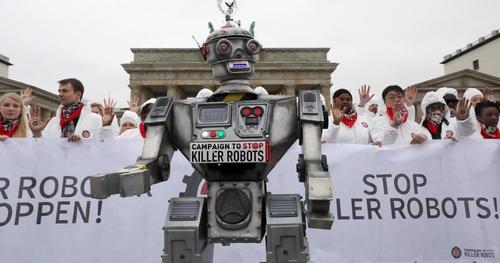
Protest against 'killer robots' as the UN took up the discussion, via AFP
The problem is not just that when AI systems err, they err in bulk. It is that when they err, their makers often don't know why they did and, therefore, how to correct them. The black box problem of AI makes it almost impossible to imagine morally responsible development of autonomous weapons systems.
The proliferation problems
The next two dangers are the problems of low-end and high-end proliferation. Let's start with the low end. The militaries developing autonomous weapons now are proceeding on the assumption that they will be able to contain and control the use of autonomous weapons. But if the history of weapons technology has taught the world anything, it's this: Weapons spread.
Market pressures could result in the creation and widespread sale of what can be thought of as the autonomous weapon equivalent of the Kalashnikov assault rifle: killer robots that are cheap, effective and almost impossible to contain as they circulate around the globe. "Kalashnikov" autonomous weapons could get into the hands of people outside of government control, including international and domestic terrorists.
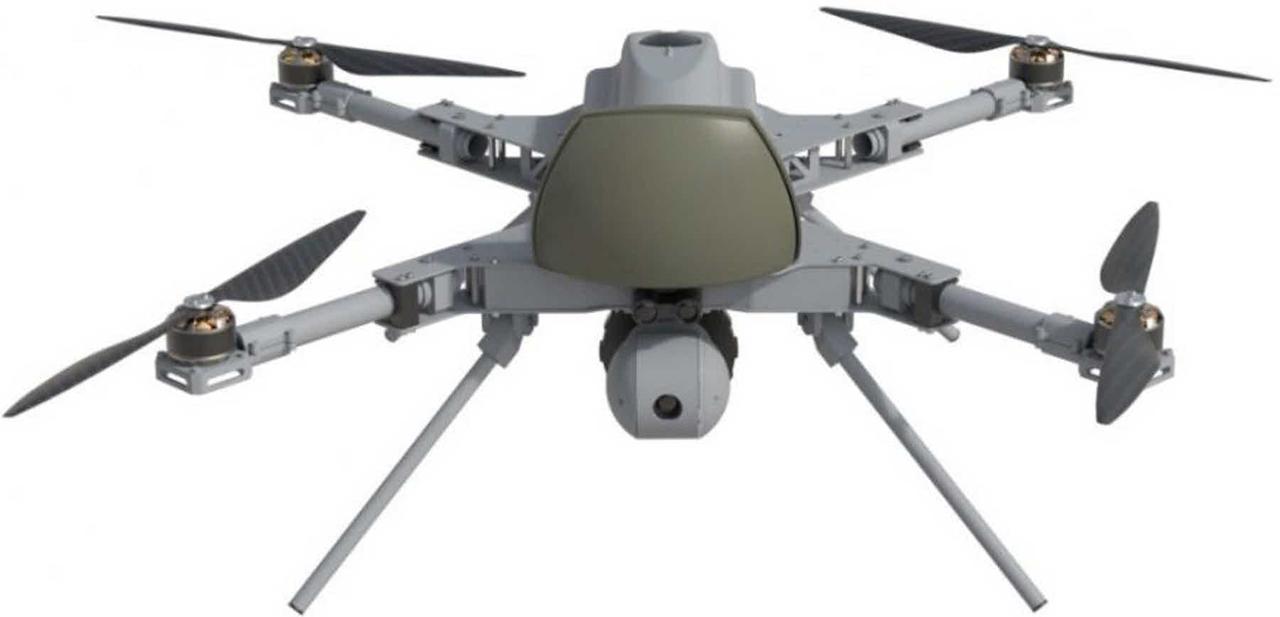
The Kargu-2, made by a Turkish defense contractor, is a cross between a quadcopter drone and a bomb. It has artificial intelligence for finding and tracking targets, and might have been used autonomously in the Libyan civil war to attack people.
High-end proliferation is just as bad, however. Nations could compete to develop increasingly devastating versions of autonomous weapons, including ones capable of mounting chemical, biological, radiological and nuclear arms. The moral dangers of escalating weapon lethality would be amplified by escalating weapon use.
High-end autonomous weapons are likely to lead to more frequent wars because they will decrease two of the primary forces that have historically prevented and shortened wars: concern for civilians abroad and concern for one's own soldiers. The weapons are likely to be equipped with expensive ethical governors designed to minimize collateral damage, using what U.N. Special Rapporteur Agnes Callamard has called the "myth of a surgical strike" to quell moral protests. Autonomous weapons will also reduce both the need for and risk to one's own soldiers, dramatically altering the cost-benefit analysis that nations undergo while launching and maintaining wars.
Asymmetric wars—that is, wars waged on the soil of nations that lack competing technology—are likely to become more common. Think about the global instability caused by Soviet and U.S. military interventions during the Cold War, from the first proxy war to the blowback experienced around the world today. Multiply that by every country currently aiming for high-end autonomous weapons.
Undermining the laws of war
Finally, autonomous weapons will undermine humanity's final stopgap against war crimes and atrocities: the international laws of war. These laws, codified in treaties reaching as far back as the 1864 Geneva Convention, are the international thin blue line separating war with honor from massacre. They are premised on the idea that people can be held accountable for their actions even during wartime, that the right to kill other soldiers during combat does not give the right to murder civilians. A prominent example of someone held to account is Slobodan Milosevic, former president of the Federal Republic of Yugoslavia, who was indicted on charges of crimes against humanity and war crimes by the U.N.'s International Criminal Tribunal for the Former Yugoslavia.
But how can autonomous weapons be held accountable? Who is to blame for a robot that commits war crimes? Who would be put on trial? The weapon? The soldier? The soldier's commanders? The corporation that made the weapon? Nongovernmental organizations and experts in international law worry that autonomous weapons will lead to a serious accountability gap.

To hold a soldier criminally responsible for deploying an autonomous weapon that commits war crimes, prosecutors would need to prove both actus reus and mens rea, Latin terms describing a guilty act and a guilty mind. This would be difficult as a matter of law, and possibly unjust as a matter of morality, given that autonomous weapons are inherently unpredictable. I believe the distance separating the soldier from the independent decisions made by autonomous weapons in rapidly evolving environments is simply too great.
The legal and moral challenge is not made easier by shifting the blame up the chain of command or back to the site of production. In a world without regulations that mandate meaningful human control of autonomous weapons, there will be war crimes with no war criminals to hold accountable. The structure of the laws of war, along with their deterrent value, will be significantly weakened.
A new global arms race
Imagine a world in which militaries, insurgent groups and international and domestic terrorists can deploy theoretically unlimited lethal force at theoretically zero risk at times and places of their choosing, with no resulting legal accountability. It is a world where the sort of unavoidable algorithmic errors that plague even tech giants like Amazon and Google can now lead to the elimination of whole cities.
In my view, the world should not repeat the catastrophic mistakes of the nuclear arms race. It should not sleepwalk into dystopia.