Closing Stock Market SummaryThe S&P 500 rose 1.1% on Wednesday in a relatively broad-based advance led by the growth stocks. The Dow Jones Industrial Average (+1.0%) rose comparably, while the Nasdaq Composite (+2.0%) and Russell 2000 (+1.9%) outperformed with roughly 2% gains.
Investors assumed a dip-buying mindset, undeterred by a larger than expected 1.4% m/m increase in the Producer Price Index (PPI) for March (consensus 1.2%) and an earnings miss from JPMorgan Chase (JPM 127.30, -4.24, -3.2%).
The S&P 500 reclaimed its 50-day moving average (4422) on a closing basis amid gains in nine of its 11 sectors. Six sectors advanced at least 1.0%, including a 2.5% gain for the consumer discretionary sector (+2.5%).
Airline stocks were particularly strong after Delta Air Lines (DAL 41.02, +2.40, +6.2%) beat top and bottom-line estimates and Delta's CEO provided upbeat bookings commentary. The U.S. Global Jets ETF (JETS 21.65, +1.09) rose 5.3%.
Conversely, the financials (-0.1%) and utilities (-0.2%) sectors closed lower, with the former pressured by JPM's disappointing earnings results and a second-straight decline in Treasury yields.
The 2-yr yield decreased five basis points to 2.34%, and the 10-yr yield decreased four basis points to 2.69%. The U.S. Dollar Index fell 0.4% to 99.88.
The decline in rates helped alleviate some of the valuation concerns in the growth stocks, including the mega-caps. The Vanguard Mega Cap Growth ETF (MGK 225.04, +4.02) rose 1.8%, versus a 1.1% gain for the Invesco S&P 500 Equal Weight ETF (RSP 156.60, +1.75).
Demand for Treasuries was presumably influenced by the peak inflation narrative and cautious-sounding commentary from JPM CEO Jamie Dimon about the economic challenges ahead. The PPI report wasn't that surprising, either, after the hot CPI report yesterday, suggesting the report was already priced in.
WTI crude futures, meanwhile, flirted with $105 per barrel ($104.25, +3.56, +3.5%) despite bearish inventory data from the EIA and a downwardly revised 2022 global demand growth forecast from the IEA.
Reviewing Wednesday's economic data:
- The Producer Price Index for final demand jumped 1.4% month-over-month in March ( consensus 1.2%) following an upwardly revised 0.9% increase (from 0.8%) in February. The index for final demand, less foods and energy, rose 1.0% month-over-month ( consensus 0.5%) following an upwardly revised 0.4% increase (from 0.2%) in February. On a year-over-year basis, the index for final demand was up 11.2% while the index for final demand, less foods and energy, was up 9.2%. The accompanying tables for the report show a lengthy list of double-digit percentage increases on a year-over-year basis for many categories.
- The key takeaway from the report is that it is a signpost of potential profit margin pressures that are going to intensify if consumers start showing more resistance to price increases. Beyond that, it's another reminder that the Fed needs to get aggressive with its policy to get these rampant inflation pressures in check.
- The weekly MBA Mortgage Applications Index decreased 1.3% following a 6.3% decline in the prior week.
- Weekly crude oil inventories increased by 9.38 mln barrels after increasing by 2.42 mln barrels during the previous week.
Looking ahead to Thursday, investors will receive Retail Sales for March, weekly Initial and Continuing Claims, the preliminary University of Michigan Index of Consumer Sentiment for April, Import and Export Prices for March, and Business Inventories for February.
- Dow Jones Industrial Average -4.9% YTD
- S&P 500 -6.7% YTD
- Russell 2000 -9.8% YTD
- Nasdaq Composite -12.8% YTD
Yellen Warns Nations Staying Neutral in Russia’s War With Ukraine
The U.S. has cautioned China, India and others not to aid Moscow or undercut sanctions
WASHINGTON—Treasury Secretary Janet Yellen said countries that maintain their ties to Russia after its invasion of Ukraine risk facing isolation from the global economy, sending a warning shot to nations that have so far remained neutral in the conflict.
As it has crafted with its allies a wide-ranging package of sanctions on Russia, the U.S. has urged China, a close partner of Russia, to not provide substantive aid to Russia or take steps to undercut the sanctions. It has also sought to push countries that haven’t put penalties on the Russian economy, notably India, to take a tougher stance against Moscow.
In her speech, made a week before finance officials from around the world will descend on Washington for the spring meetings of the International Monetary Fund and World Bank, Ms. Yellen said indecision about how to respond to the war in Ukraine weakens the international financial system.
“Let me now say a few words to those countries that are currently sitting on the fence, perhaps seeing an opportunity to gain by preserving their relationship with Russia and backfilling the void left by others. Such motivations are shortsighted,” she said at the Atlantic Council. “And let’s be clear, the unified coalition of sanctioning countries will not be indifferent to actions that undermine the sanctions we’ve put in place.”
Ms. Yellen singled out China, saying that it could become more difficult for the U.S. and its allies to separate their economic interests in the country from national security concerns if Beijing supports Russia’s invasion. China has maintained normal trade relations with Russia despite the conflict, and so far major Chinese companies and banks haven’t helped Russia evade sanctions.
“The world’s attitude towards China and its willingness to embrace further economic integration may well be affected by China’s reaction to our call for resolute action on Russia,” she said.
While Ms. Yellen didn’t call out any other countries by name, the Biden administration has stepped up its engagement in recent weeks with India, a key U.S. partner that has maintained a neutral stance amid the war in Ukraine.
During a virtual meeting Monday, President Biden urged Indian Prime Minister Narendra Modi on Monday not to accelerate or increase India’s purchase of Russian oil, according to the White House, and both the U.S. and Russia have recently dispatched officials to India. India has longstanding defense ties to Russia and hasn’t denounced the invasion of Ukraine.
“I think that, to date, there are certainly areas where we have been disappointed by both China and India’s decisions in the context of the invasion in terms of their reaction overall,” Brian Deese, the director of the White House National Economic Council, said last week. “Our message to the Indian government is that the costs and consequences for them of moving into a more explicit strategic alignment with Russia will be significant and long-term.”
The Indian embassy in Washington didn’t immediately respond to a request for comment.
A group of House lawmakers also recently pushed for the Biden administration to follow a more confrontational approach with Saudi Arabia after it has refused to cooperate with Washington over Russia’s invasion of Ukraine.
Ms. Yellen said the war in Ukraine will require an overhaul of international financial agreements and institutions, with an eye toward diversifying supply chains and commodity sources. Europe’s dependence on Russian oil and gas has presented an obstacle to efforts to weaken the Russian economy while still sparing Western economies from harm.
“We cannot allow countries to use their market position in key raw materials, technologies or products to have the power to disrupt our economy or exercise unwanted geopolitical leverage,” she said. She added that countries should try to arrange new trade agreements that reduce the influence of non-friendly partners in a move she called “friend-shoring” to allied nations.
A central concern at next week’s spring meetings will be food shortages and price increases brought on by the war between Russia and Ukraine, which are major suppliers of wheat and fertilizer. Ms. Yellen said she would convene a meeting on the issue.
The IMF, World Bank and international development banks are all in need of strengthening, Ms. Yellen said, pointing to the divergent ability of poor and rich nations to respond to the Covid-19 pandemic and the need to better marshal private capital to developing economies.
“Some may say that now is not the right time to think big. Indeed, we are in the middle of Russia’s war in Ukraine, alongside the lingering fight against a global pandemic and a long list of other initiatives under way,” Ms. Yellen said. “Yet, I see this as the right time to work to address the gaps in our international financial system that we are witnessing in real time.”
Texts reveal UK traders exulting over negative oil price in 2020
‘Please don’t tell anyone what happened today lads,’ message from court papers said, as WTI hit minus $37
A US judge has allowed a case to proceed against UK traders accused of causing an unprecedented crash in oil futures markets after ruling that text messages between the group were sufficient to point towards a potential conspiracy.
The proposed class-action lawsuit centres around trading on April 20 2020, when the price of benchmark West Texas Intermediate crude oil plunged below zero for the first time on record. Self-employed traders linked to Vega Capital London, a little-known commodities brokerage based in the Essex town of Benfleet, stand accused of making more than $700mn by flooding futures markets to drive the price lower.
Mish International Monetary, a California rare coin dealer that says it lost money that day, alleges market manipulation and violations of antitrust laws. Its civil suit accuses the defendants of buying special “trading at settlement” (TAS) contracts, whose price would be fixed by that day’s settlement value, then conspiring to dump huge volumes of ordinary WTI contracts ahead of the expiry.
Court documents released on Tuesday and first reported by Bloomberg show how the group — dubbed the Essex Boys — discussed trading strategies that day over WhatsApp.
“I’m doing a fortune on TAS haha,” one of the traders is quoted as saying.
“We pushed each other so hard for years for this one moment . . . And we f****** blitzed it boys,” said another. A third added: “Please don’t tell anyone what happened today lads.”
US District Judge Gary Feinerman of Chicago gave the go-ahead for the case to progress, ruling that the allegations against eight of the 12 traders accused were plausible based on the communications, as well as on a “high degree of correlative trading”.
The defendants, whose identities are protected by court order, deny the allegations and contend they are independent traders who were following market signals during a period of turmoil. Vega Capital could not be reached for comment.
WTI futures on CME Group’s New York Mercantile Exchange had crashed by $56 a barrel to close at negative $37.63 as a shortage of physical storage space led investors to dump futures contracts rather than take delivery. The price recovered to around $10 the next day, allegedly giving the group its windfall.
In the period immediately before WTI futures expired, the collective was dumping 153.5 contracts a minute and accounting for more than 30 per cent of total global market volume, the Mish lawsuit alleges. It notes an “extremely strong tendency” of between 96.2 per cent and 99.7 per cent for its trades to “move in the same direction at the very same time”.
The Commodity Futures Trading Commission, the US regulator, analysed the WTI price plunge on April 20, 2020, but it did not draw conclusions as to the cause.
Feinerman dismissed the case against Vega Capital and its owner, ruling that they were not party to the alleged conspiracy. Mish has until April 28 to challenge the judge’s decisions by amending its complaint.
Freight Recession Confirmed? Crashing Truck Sales Show US Growth In Jeoaprdy
The recent Op-Ed by FreightWaves CEO Craig Fuller warning about an imminent freight recession sparked a tidal wave of selling, but in retrospect, Fuller was spot on. As Bloomberg's Simon White writes, real economic activity in the U.S. is slowing sharply, and "this is showing up in lower demand for new trucks and autos, and a tailing off in freight volumes, leaving transport stocks facing more downside."
As White picks up where Fuller left off, heavy truck sales in the U.S. are a "very good leading indicator of economic activity, with 65% of the dollar value of North American freight moved by trucks. But new truck sales have been falling sharply, now at -23% on an annual basis. New auto sales are falling at a similar rate. Truck and auto sales combined are falling at a rate previously only associated with recessions.
As White picks up where Fuller left off, heavy truck sales in the U.S. are a "very good leading indicator of economic activity, with 65% of the dollar value of North American freight moved by trucks. But new truck sales have been falling sharply, now at -23% on an annual basis. New auto sales are falling at a similar rate. Truck and auto sales combined are falling at a rate previously only associated with recessions.
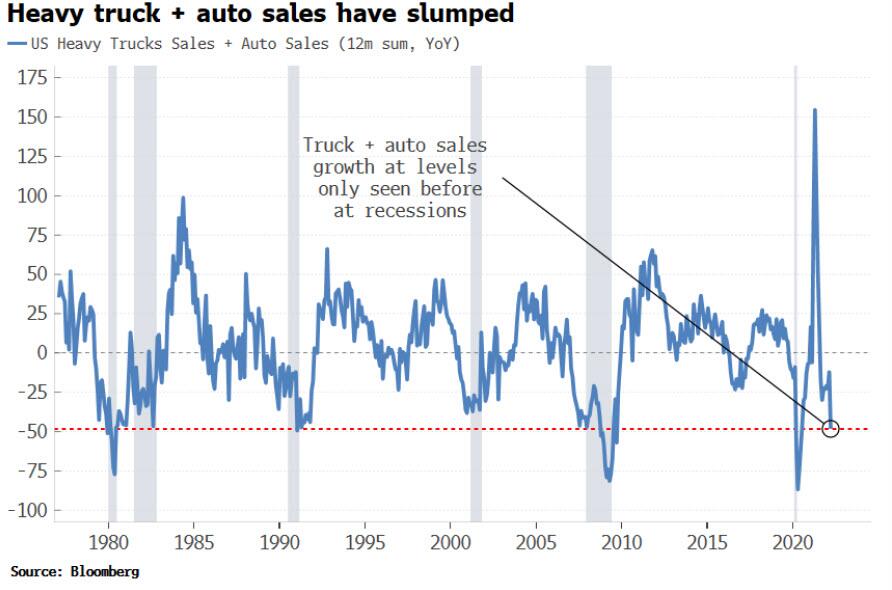
That said, White cautions readers that "before you enter your equity sell orders, this is not a recession prediction. Recessions are signaled by a rapid regime shift across many areas of the economy and markets, and there is no sign we are in the process of this happening." Nonetheless, this sharp decline in vehicle sales shows slowing growth is in the mail.
There's more: freight volume growth has also been slowing. Annual growth in containers loaded at the Port of Los Angeles is steadily heading down to 0% after hitting 20% last year. Lockdowns in China are clearly having an impact here. Cities and regions accounting for over 40% of China’s 2020 GDP are in full or partial lockdown. The Shanghai freight index is 13% lower than it was six weeks ago, the sharpest decline seen in the ten-year history of the index.
As we noted over the weekend, and as White picks up in his note, "shipping rates have been falling, but this is academic as it is virtually impossible -- while such a draconian lockdown is in place -- for exporters to load boxes in their warehouse and move the goods on to the ships."
To be sure, while lockdowns in China may be a proximate cause of falling shipping rates, "the remote cause is the fall in global liquidity as central banks step back from historically loose monetary policies to try to stem inflation." As White shows in the next chart, global liquidity has collapsed and points to continued depressed shipping rates in the coming months.
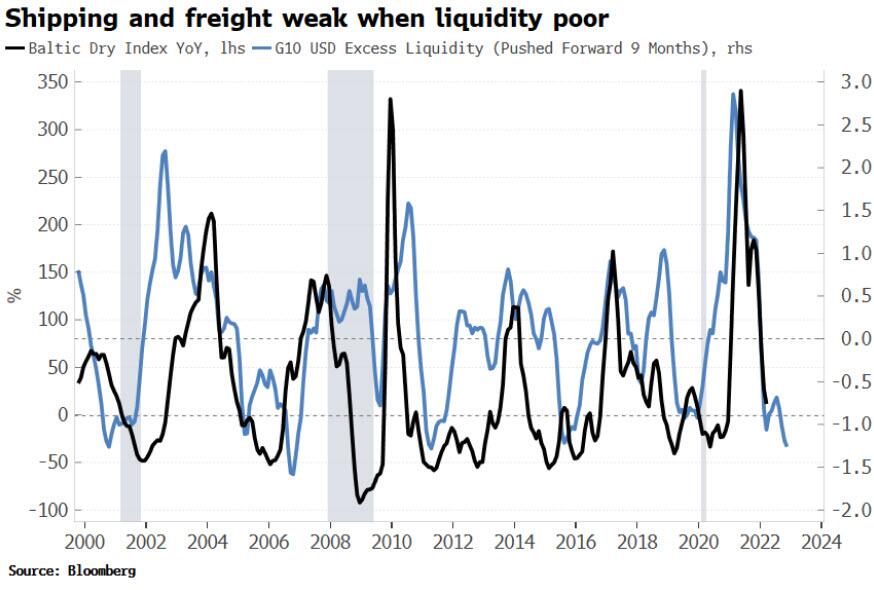
That commodities, their movement around the world, and liquidity are intrinsically linked has become starkly clear in this cycle. As a commodity producer, if you don’t have the liquidity to cover the margin on your short futures positions, bankruptcy means you can’t ship and deliver your commodities, exacerbating the rise in prices and triggering more margin calls.
This liquidity and economic-demand driven decline in shipping and truck usage points to underperformance of transport stocks. The S&P transport index is down 11% from its high made last month. Transports and autos are roughly flat to the S&P year-to-date, so should begin to lag. Furthermore, being underweight medium-to-high duration sectors is a good idea when in an inflationary regime.
This liquidity and economic-demand driven decline in shipping and truck usage points to underperformance of transport stocks. The S&P transport index is down 11% from its high made last month. Transports and autos are roughly flat to the S&P year-to-date, so should begin to lag. Furthermore, being underweight medium-to-high duration sectors is a good idea when in an inflationary regime.
Jersey freezes $7bn worth of assets linked to Roman Abramovich
Channel Island’s order is another major blow to sanctions-hit Russian oligarch
A court in the Channel Island of Jersey has imposed an order freezing more than $7bn in assets linked to Roman Abramovich in a significant blow to the Russian oligarch’s fortune.
The order comes after the island’s police searched premises “suspected to be connected to the business activities of Roman Abramovich”.
“The Royal Court also imposed a formal freezing order on 12 April . . . over assets understood to be valued in excess of $7bn, which are suspected to be connected to Mr Abramovich,” the government said.
The assets were either located in Jersey or owned by entities incorporated on the island, the statement said.
The sheer scale of assets subject to the freezing order hints at the amount of wealth Abramovich appears to have sheltered in offshore tax havens, where opaque corporate structures can shield investments from public view. Forbes estimates the oligarch’s net worth at $8.2bn, while the Bloomberg Billionaires Index pegs it higher at $13.9bn.
The $7bn asset freeze against Abramovich in Jersey is just shy of the $8bn total that Switzerland has seized from all 900 Russians on the EU and US sanctions lists.
It is another blow to Abramovich, who has been hit with sanctions since Russia invaded Ukraine. UK authorities have forced him to sell Chelsea Football Club and his yachts were made to leave harbours to avoid being seized. Trading in shares in Evraz, the steelmaker in which he was a significant shareholder, remains suspended.
Jersey has previously said it was implementing all the sanctions introduced by the UK government following the invasion of Ukraine on February 24.
“In enforcing sanctions, the UK can leverage this unbelievable source of financial intelligence it has via the Crown Dependencies and British Overseas Territories,” said Tom Keatinge, director of the Centre for Financial Crime and Security Studies at the Royal United Services Institute think-tank.
“Where Jersey leads, will we see the BVI and others follow?”
Ian Gorst, Jersey’s minister for external relations and financial services, said he could not comment on matters under “active consideration” by the dependency’s Law Officers’ Department.
“The government of Jersey continues to stand alongside the UK and international partners and has implemented all UK and UN sanctions deployed in response to Russia’s actions against Ukraine,” Gorst said. “Our legislation to give force to these measures has severe criminal consequences, and any links to sanctioned entities or suspected breaches must be reported to the appropriate authorities.”
The move against Abramovich is the clearest step yet by the Channel Island’s government to seize some of the billions of dollars worth of wealthy Russians’ assets widely thought to be invested in the offshore centre.
While it was not clear on Wednesday which assets the freeze order affected, Abramovich has moved a number of his investments to Jersey in recent years from the British Virgin Islands, another offshore haven.
Recommended
The Big Read
Poison, planes and Putin: Abramovich’s race to save a fortune and stop the war
The most recent accounts of Fordstam, the vehicle that controls Chelsea Football Club, show a £1.5bn outstanding loan to the company from Camberley International Investments. Camberley transferred its registration in 2020 from the BVI to Jersey.
Multiple helicopters linked to Abramovich are owned through Jersey-registered entities, as is Sussurro, the first superyacht the oligarch bought in 1998. The Guardian reported last week that Abramovich transferred a Jersey vehicle that owned another yacht — the 50-metre Aquamarine — to his associate David Davidovich on the day Russia invaded Ukraine.
These companies are all registered at the Jersey offices of Zedra, a corporate services provider that acts for a number of Abramovich-linked entities. Zedra declined to comment.
The Jersey Evening Post reported in 2018 that the Russian oligarch had been granted residency rights on the island, under a scheme for “high value residents”, but Abramovich had difficulty renewing his UK visa shortly afterwards.
Eugene Tenenbaum, an associate of Abramovich who has served as a director of Chelsea since the oligarch took it over in 2003, is a Jersey resident, according to British corporate records.
There was no immediate response from a spokesman for Abramovich to a request for comment.
Larry Tanenbaum joins Stephen Pagliuca group vying for Chelsea
NBA chair among heavyweight backers of consortium readying bid for Premiership club
Private equity billionaire and co-owner of Boston Celtics basketball team Stephen Pagliuca has revealed that Larry Tanenbaum, chair of the National Basketball Association, is among the list of heavyweight backers of his bid to buy Chelsea.
The consortium led by the co-chair of Bain Capital, a US private equity firm with $160bn of assets under management, is one of four investment groups vying to buy the Premier League side from sanctioned Russian billionaire Roman Abramovich, who is selling up in the wake of Vladimir Putin’s invasion of Ukraine.
Pagliuca said on Wednesday that he is co-managing the bid alongside Tanenbaum.
They are up against a group backed by the US-based Ricketts family, which owns the Chicago Cubs baseball team, and hedge fund billionaire Ken Griffin; private equity billionaires Josh Harris and David Blitzer; and a group led by Todd Boehly, co-owner of baseball’s Los Angeles Dodgers.
Bidders are not only competing on price but also their ability to redevelop Chelsea’s Stamford Bridge stadium, which is smaller than the home grounds of major rivals such as Manchester United.
Tanenbaum’s involvement in the consortium was revealed a day before Thursday’s deadline for final bids, as merchant bankers at Raine Group press on with the sale of the club, which has been accelerated by the geopolitical situation around the invasion of Ukraine.
Former Disney chief executive Bob Iger and his journalist wife Willow Bay, Facebook co-founder Eduardo Saverin and his wife Elaine Saverin are also backing Pagliuca’s bid.
Hollywood producer Peter Guber, co-owner of the Golden State Warriors NBA team and another investor in the Dodgers, is another member of the consortium with strong ties to the sports industry.
In February, Pagliuca led the acquisition of a majority stake in Italian football team Atalanta. Tanenbaum chairs Maple Leaf Sports and Entertainment, the owner of the Toronto Maple Leafs ice hockey team and the Toronto Raptors basketball outfit. He also helped lead Toronto’s bid to host Fifa 2026 World Cup matches.
Abramovich acquired Chelsea in 2003 and used his fortune to build the team into a trophy-winning outfit with a global brand.
The club has won the Premier League title five times during his ownership, and is among the elite group of English clubs known as the Big Six, which also includes Arsenal, Liverpool, Manchester City, Manchester United and Tottenham Hotspur.
The profile of the bidders for Chelsea suggests that American investors will soon own four of the Big Six. The US Glazer family acquired United in 2005, sports mogul Stan Kroenke owns Arsenal, and John Henry’s Fenway Sports Group controls Liverpool.
Chelsea won last season’s Uefa Champions League, Europe’s most prestigious club tournament, but was knocked out of this year’s competition by Spain’s Real Madrid this week.
Abramovich has pledged to donate the net proceeds off the sale to charity and write off £1.5bn of debt owed to him by the club.
The transaction requires special approval from the UK government, which has allowed Chelsea to continue playing matches despite sanctioning Abramovich, as well as the Premier League.
A Jersey court on Wednesday froze more than $7bn in assets linked to Abramovich, whose assets are under close scrutiny because of his ties to Putin.
Music Streaming Service Deezer Nears SPAC Deal
French business, a competitor to Spotify and Apple Music, to merge with blank-check company backed by family behind Gucci-owner Kering
French music streaming service Deezer is nearing a deal to go public by merging with a special purpose acquisition company backed by the family behind luxury titan Kering SA, KER -1.73% according to people familiar with the matter, as consumer demand for music continues to grow.
The Paris-based competitor to Spotify SPOT +2.52% Technology SA and other music streamers has 16 million active users and is available in more than 180 countries, according to its website. Deezer offers listeners a catalog of more than 90 million songs, as well as podcasts, audio books and radio channels.
Deezer is in talks to merge with Paris-listed I2PO SA, I2PO 1.55% the people said. The blank-check company is backed by France’s Pinault family, controlling shareholder of Gucci-owner Kering, and Centerview Partners banker Matthieu Pigasse. The vehicle is headed by former WarnerMedia WBD +8.75% executive Iris Knobloch.
The deal, if finalized, could be announced in coming days, the people said. The valuation of the deal couldn’t be learned.