Early premarket gappers
- Gapping up:
- KSS +28.3%, HOLI +10%, VOD +6.9%, UL +6.6%, SABS +4.6%, ATGE +3.9%, PTON +1.4%, OPT +0.7%
- Gapping down:
- OPK -12%, PHG -4%, DQ -3.8%, PFE -3.7%, NMG -3.4%, ACHR -3.3%, SBSW -3.3%, MRNA -2.8%, BNTX -2.5%
Reddit’s WallStreetBets Was the GameStop Kingmaker, but Longtime Users Say the Thrill Is Gone
The group was once the engine that powered rookie traders, but now veteran members say only tired-out ideas remain
Reddit’s WallStreetBets was the place to be last year for meme-stock mania. These days, some one-time fans say it is hardly worth clicking on.
Those who once scoured the online message forum for brazen and unexpected trading ideas say they are mostly finding members still chatting about stocks such as GameStop Corp. GME 3.59% and AMC Entertainment Holdings Inc. AMC -0.55% Constructive feedback on trades, some users complain, has largely been replaced by cheerleading. Devotees who were once glued to the forum—watching power users like Keith Gill, or “DeepF—ingValue,” post bold bets on GameStop—say they have largely abandoned the page in favor of other trading communities.
Of course, the market has changed, too. Last year, the S&P 500 hit dozens of records, making it easy for professional and amateur investors alike to look smart. This year, stocks are off to a rocky start, in particular the sorts of tech companies and flashy firms favored by the day-trader crowd.
A year ago, though, WallStreetBets was the engine that powered the rookie trader. Tips posted there were quickly amplified over TikTok, Twitter and messaging platform Discord, allowing hordes of individual traders around the world to act in concert and even drive markets. WallStreetBets members ballooned from fewer than two million at the start of January 2021, just before GameStop shares went flying, to more than 11 million today.
If the meme revolution made trading cool, it also made it harder to separate the next big stock sensation from the next big money loser. Investments that were applauded on forums like WallStreetBets went up because day traders declared they would, with little regard for a trade’s underlying value.
So far this year, the tech-heavy Nasdaq Composite Index is down 12% and has entered correction territory. The VanEck Social Sentiment ETF, which is known by the ticker BUZZ and tracks stocks that are popular on social media, is off 18%. GameStop and AMC have fallen even further, with both down 28% or more in the year to date.
Amid such broad declines, it might get harder for small traders to gang up and boost a stock, unless there is actual good news about a company.
WallStreetBets, or WSB as it is known to users, was created in 2012 by an IT consultant bored with traditional financial advice. It has never been a sober corner of the internet. Users post under pseudonyms like pim9daddy214 and Boogyman422 and exchange unpublishable profanities. Markets are regarded as a giant casino, but one where both big wins and big losses are celebrated. After all, as many members would say, “YOLO”—“you only live once.”
Sol Hu came across WSB roughly four years ago. New to trading, Mr. Hu was immediately hooked. By 2019, he was trading full time after quitting his job as a research technician. Back then, he said, he checked WallStreetBets first thing each morning and would scroll and comment for hours throughout the day.
Mr. Hu enjoyed chatting with others when he wanted advice on a particular trade and appreciated the honest—albeit sometimes brutal—feedback. “Now it’s all ‘yes men’ comments,” said Mr. Hu, who is 31 years old and lives in New Jersey.
He still briefly checks in on the site many days but spends most of his time scouring Twitter for fresh trading ideas and talking strategy with his cousin.
WSB remains one of the most popular Reddit groups. But veterans like Mr. Hu say the newbies are taking more than they are giving. The number of text posts, as well as the number of total comments across WSB’s main page, has been falling. On an average day last November, there were about 27,000 comments on the forum’s main page, which features “hot” content, down from about 47,000 a year before, according to a Wall Street Journal analysis of data from TopStonks, which tracks stocks mentioned on Reddit and other sites.
Many new users continue to be drawn to the original meme stocks. GameStop shares were still the second-most-mentioned stock on WSB in January, according to TopStonks data as of last week. AMC ranked sixth.
Mark Villanueva came across the site last year and was intrigued by the users who said they were making big bucks.
In February, Mr. Villanueva noticed that WSB was buzzing about a special-purpose acquisition company called Churchill Capital Corp IV, or CCIV. SPAC discussions were forbidden on WSB at the time, according to the forum’s own content guidelines, though Mr. Villanueva didn’t know that.
Mr. Villanueva bought about $3,000 worth of shares. Their value plunged within days and he sold everything, losing roughly $1,150. CCIV later merged with the electric-vehicle company Lucid Group Inc. to take it public.
“I thought these guys really knew what they were talking about,” said Mr. Villanueva, who is 32 and lives in the Chicago suburbs. He now prefers another Reddit forum called Superstonk, which focuses on GameStop.
Like other Reddit forums, WSB largely relies on its own members, instead of armies of tech employees, to police its content. Volunteer moderators use bots designed to scour and delete anything that violates forum rules, and moderators can manually delete posts, too. Users aren’t supposed to post about cryptocurrencies, companies with a market capitalization of less than $1.5 billion or so-called over-the-counter stocks that aren’t listed on exchanges, among other rules.
But posts that break the rules can slip through. Some users said they have grown more suspicious about users looking to drive up share prices of lesser-known companies in an attempt to unload them to novice investors.
A moderator for WSB acknowledged that the site’s explosion into the mainstream had resulted in “people trying to influence prices” but said that moderators “work pretty hard to keep that at bay.” He said the team has come up with “automated solutions” to help prevent spam.
The moderator noted WallStreetBets has recently made changes to help keep members engaged, including launching a live call on weekdays before the market opens for members to discuss their trading ideas—and anything else. The moderator, and some other users, said it was natural for WSB to go through phases.
Last year, Grigory Lukin holed up in his Toronto apartment for an entire weekend to read popular posts by Keith Gill and others on GameStop that he found on WSB.
In January 2021, he poured about $44,000 of savings into GameStop and made about $115,000 in profit within days. He has since quit his job as a financial analyst at Amazon.com Inc. to retire early and trades as a hobby.
Mr. Lukin, 35, said he typically spends “a few minutes here and there” on WSB after he gets bored scrolling Twitter and other Reddit groups, including one called “WallStreetBetsHUZZAH” that cropped up last year. He has still been able to find some other winning trades on WSB, like an options trade on the food company Dole PLC that earned him a roughly 60% profit within a day. He still occasionally trades GameStop shares and options.
“There’s some good stuff out there,” Mr. Lukin said, referring to WSB. There is also “some absolutely atrocious advice.”
Sony’s Videogame Strategy Challenged by Microsoft’s Deal for Activision
Japanese company seeks to leverage strength in hardware as battle shifts to cloud services and exclusive software
TOKYO— Sony Group Corp. SONY -1.76% finds itself in a position many gamers could appreciate, having climbed to the highest level only to discover that an old foe is still lurking around—and getting stronger.
Microsoft Corp.’s MSFT -1.85% proposed $75 billion acquisition of videogame publisher Activision Blizzard Inc. ATVI -0.50% would give it control over some of the world’s most popular games. Sony faces decisions on how to beef up its own software lineup, whether to continue stressing hardware and what to do about the metaverse, which is made of three-dimensional virtual worlds that draw inspiration from realistic videogames.
Microsoft sees Activision game franchises like Call of Duty and World of Warcraft as the future core of its service known as Game Pass, which offers an all-you-can-play menu of games for $10 a month. Game Pass challenges Sony’s PlayStation Plus service, and Microsoft’s emphasis on software heightens the contrast with Sony, which still prides itself on packing the latest hyper-realistic graphics power into a proprietary box like the PlayStation 5.
Sony’s stock price has risen eightfold in the past eight years, making it one of the most successful periods in the company’s 76-year history. The Microsoft news sparked a rare selloff as Sony shares fell nearly 13% on Wednesday before recovering 5.8% the next day. Staying at the top requires adapting to a tech ecosystem in which more companies are building a direct relationship with consumers through subscriptions such as Netflix, Apple Music and Amazon Prime.
Its video content business, Sony Pictures Entertainment, has taken an arms-dealer approach of selling to all sides, including selling streaming rights to the decades-old sitcom “Seinfeld” to Netflix Inc.’s platform. Sony Music artists like Adele are most easily heard on non-Sony platforms such as Spotify.
In videogames, Sony is closer to the Netflix model, thanks to PlayStation Plus, which is sold directly to gamers. Investors have cited that business as a big reason the stock is doing well.
As recently as a decade ago, videogames made up an eighth of revenue at a company that still relied on television sets and portable music players. Today, games and network services are Sony’s largest segment, accounting for close to a third of revenue and operating profit.
Sony Chief Executive Kenichiro Yoshida spoke at the CES technology show in January about building more “social entertainment spaces” that blend Sony’s strengths—such as virtual viewing of a soccer game or electric vehicles where passengers could play full-scale videogames. A spokesman declined to comment on Sony’s strategy in the wake of the Microsoft deal.
Sony’s PlayStation 5 went on sale in November 2020 around the same time as Microsoft’s latest Xbox, which has been a rival for two decades. As of last September, Sony had sold 13.4 million units of the PlayStation 5, and that number could have been higher if semiconductor shortages hadn’t been an issue.
But when it comes to profit, content is king—especially if it is exclusive—and that is where the Sony-Microsoft clash looks likely to heat up. Multiple titles in Activision’s Call of Duty franchise, which has sold 400 million games since 2003, rank among the top 10 bestsellers for PlayStation. That popularity has sparked concern from gamers and investors that Microsoft could withdraw access to the Activision games if its deal goes through.
On Thursday, Sony said it expected Microsoft to ensure that Activision games would be available on non-Microsoft platforms. Hours later, Microsoft’s videogame head, Phil Spencer, tweeted that he had expressed to Sony leaders “our desire to keep Call of Duty on PlayStation.”
Analysts said Microsoft might let PlayStation owners buy Activision games while limiting other distribution.
“I can see a scenario where titles like Call of Duty are released cross-platform but are only made available to Microsoft’s cloud and subscription services,” said Michael Inouye of ABI Research.
Microsoft said it has 25 million subscribers to Game Pass, up from 18 million a year earlier, while Sony’s PlayStation Plus had more than 47 million as of last September.
Analysts have speculated that Sony, which has made smaller acquisitions and investments in software companies in recent years, might go after a big game publisher to counteract Microsoft’s move.
One weapon for Microsoft is its Azure cloud-computing service. When multiple players cross virtual swords online, powerful computers process the data behind the scenes. Azure means Microsoft can tailor-make the cloud to suit its own videogames.
Sony has expressed interest in using Azure, and the two companies announced talks in May 2019, but they haven’t reported any progress. Sony said the talks continued, and Microsoft declined to comment. Sony game employees have said they rely on Amazon.com Inc.’s Amazon Web Services.
In China, Sony and Microsoft trail Tencent Holdings Ltd. , which is both a cloud operator and the world’s largest gaming company by revenue. Tencent runs the cloud computing behind games like its own hit “Honor of Kings,” which people generally play on smartphones rather than dedicated game devices.
For Sony, the cloud isn’t as central yet. Around 60% of subscribers to Sony’s game service still download game software onto their consoles rather than streaming it via the cloud, said market researcher Lisa Cosmas Hanson of Niko Partners.
At the same time, Sony leads Microsoft and others in a piece of hardware that may be critical to next-generation videogames—virtual-reality headsets. The headsets are also central to the metaverse concept promoted by Meta Platforms Inc.’s Facebook, an area where Sony’s technology could give it an edge although it hasn’t outlined a strategy yet.
Sony has sold six million units of its PlayStation VR headset since introducing it in 2016, according to analysts, and it plans an updated version soon. Microsoft has opted to sell devices from other companies like HP Inc.
“We are going to lead the way with exploring new technology that unlocks new entertainment experiences. Virtual reality is central to that philosophy,” said PlayStation business chief Jim Ryan in Las Vegas this month.
Chopard Reveals 6,225-Carat Raw Emerald Called ‘Insofu’
This is the second-largest emerald discovered at Kagem and will be the highlight of the “Exceptional Gemstones” showcase during Paris Couture Week.

The Chopard Insofu emerald. COURTESY OF CHOPARD/ERIC SAUVAGE
PARIS— Continuing on its mission of sourcing exceptional stones in a responsible and sustainable way, Chopard will unveil a 6,225-carat raw emerald during the high jewelry presentations coinciding with Haute Couture Week here.
The emerald, named Chopard Insofu, weighs 1.22 kilograms — roughly the same as a Champagne bottle — and was found in the open-air Kagem mine in Zambia by Gemfields, a leading supplier of responsibly sourced colored gemstones.
It was given its name after the word “elephant” in the Bemba language spoken in the region around the mine, for its size and its shape evoking the animal’s trunk. The Chopard Insofu is among the largest emeralds ever found in the world, and the second-largest emerald ever found in Kagem, placing between the 5,655-carat Inkalamu (or “lion”) and the recently unearthed 7,525-carat Chipembele (or “rhinoceros”).
Still in its raw state, the sizable emerald has not yet revealed its secret, but it has already been described as “extraordinarily alive,” with experts lauding its purity and size.
“The size and quality of the crystal make it a rare find indeed,” stated Sean Gilbertson, director of Gemfields, noting that it was also “setting a historic milestone for traceability back to the mine-of-origin, a holy grail for consumers” seeking reassurances on the credentials of their stones as it is the first emerald of this size and purity to meet traceability requirements.
“By purchasing a raw stone, we are able to follow its entire journey through to final creation. Chopard will cut the raw emerald and collect all the cut gems emerging from it….We ensure a complete chain of traceability, which is rare for [such] stones,” said Chopard’s copresident and artistic director Caroline Scheufele who noted that a “fully integrated supply chain” was what made “these treasures of nature so valuable to our clientele,” who despite the COVID-19 pandemic had shown “strong resilience and loyalty” to the house.
She recalled her feeling at the discovery of the Insofu emerald as “surpassing any emotion [she] had ever known.”

The Rose of Caroline ring COURTESY OF CHOPARD
Despite her excitement at this project, which “a passionate gem-lover like her dreams of,” she expressed caution, noting that while “plans are underway to make a collection [out of the stone], a rough emerald holds many mysteries” and that the process was just beginning.
“With a one-of-a-kind stone like this one, we have to find a way to make it the star of the show. In this case, we will start with what results of the cut…and build the surrounding design that best complements [them],” she said in an email interview.
In 2017, the house had unveiled the “Garden of Kalahari” set, designed from a single 342-carat raw diamond of exceptional purity.
Emeralds are a particular point of focus for the brand, which gives them pride of place in its high jewelry designs. “Whenever we have a larger emerald, my priority is to cut the stone in a way that takes advantage of its size. Each [one] possesses an individual internal structure [called] a garden…a fingerprint of textures and inclusions that make [them] unique,” she continued.
In the 2021 Red Carpet Collection unveiled at the Cannes Film Festival under the “Paradise” theme, impressive specimens included a 43.21-carat cabochon on a brooch and a 61.79-carat round shape on a necklace.
The Chopard Insofu emerald will be the highlight of the “Exceptional Gemstones” presentation at its Paris flagship store, where the jeweler will showcase an assortment of 20 exceptionally pure gemstones, in designs or still loose — a first for the house.
Among these will be some emeralds, of course, but also an unheated sapphire of 21.04 carats; an also-unheated pigeon blood ruby cut in a pear shape, found in Mozambique, and a 31.3-carat fancy dark gray-greenish yellow “chameleon” diamond, which has the unusual ability to change color depending on light and heat exposure.

Dark gray-green yellow diamond. COURTESY OF CHOPARD
Completed designs will showcase the house ethos of “revealing the natural radiance of gems, without superfluous ornament or embellishments,” according to Scheufele.
Other rarities are a black Australian opal with striking blue and green streaks, and a vibrant turquoise Paraïba tourmaline.
This exhibition will be the first of several highlights for Chopard this year.
Coming up next is a celebration of its 25th anniversary as Cannes’ official partner, where Scheufele aims to satisfy the house clientele’s appetite for “something that hasn’t been done before, something surprising” to top last year’s “escape into a beautiful imaginary world” that was a response to clients’ crisis-driven desire for the rare and exceptional.
Also slated for 2022 is the move of Chopard’s New York flagship store, which will be paired with the reveal of a new high jewelry collaboration.
The house will leave the 709 Madison Avenue address it has occupied for 15 years and move into a new 2,400-square-foot home in the Crown Building at the corner of 57th Street and Fifth Avenue.
Caroline Spiegel’s Porn Revolution
Can the 24-year-old sister of Snapchat CEO Evan Spiegel create the Peloton of audio porn? First, she has to turn listeners on to the joys of aural sex.
Birds chirp and wind rustles through leaves—the sounds of early fall.
“Man, it’s beautiful out here,” remarks a deep, crackly male voice. “All the trees, the green. The leaves are just starting to turn colors.
“What are you looking at me like that for?” he continues, chuckling. “No, I know that look. You are up to something naughty.
“Whoa, whoa, hang on,” he says with mock resignation. “There are people over by the edge of the lake. You don’t think they’re going to see us?”
The birds continue to sing. Leaves crinkle.
“Wow, OK.” The voice deepens. “If you want to.”
I hit pause on this audio narration and take a deep breath, glancing over at my officemates in The Information’s New York newsroom. I hope nobody can see me blushing, as I stream the audio clip “On the Lake” on Quinn, the three-year-old audio erotica app founded by Caroline Spiegel, a 24-year-old Stanford University dropout and the younger sister of Snapchat founder Evan Spiegel.
The mystery man I’m listening to goes by the name of Bad Influence, and he is one of Quinn’s most popular creators. In real life, B.I., as I’ll call him, lives in Brooklyn, working behind the camera in the (traditional) film industry. He stumbled across the world of audio porn through an open casting call, and is now one of Quinn’s most popular creators. His top episode, a 10-minute steamy reunion called “Rough Return,” has been played over 33,000 times.
While some of B.I.’s relatives and close friends know about his career as an audio porn performer, he prefers to keep an air of mystery around his actual identity. “I think that sometimes it’s better for my listeners to imagine me exactly how they’d like,” he says.
And imagining B.I. is what I’m trying to do as I timidly hit play again. Checking over my shoulder roughly every two seconds, I listen as B.I.’s 11-minute audio quickly escalates from a tame day in the park into a crescendo of moans, growls and assorted sucking and slapping noises. On the Quinn app, the clip’s description reads, simply, “I’m gonna make you shake until we capsize.”
I turn off the audio somewhere around “I want to taste you,” feeling deeply awkward about my setting, though fairly impressed by the production quality of the clip itself. I appreciate the story’s narrative arc and how transporting the audio format is. I am there—in the boat, on the lake, with the birds chirping away, just me and B.I. (who in my head resembles a young Hugh Grant), reassuring me that no one is watching.

New York’s Crosby Street Hotel is known for its afternoon tea, the servers pouring loose-leaf blends out of silver teapots into delicate, flower-adorned white china. On a pre-Omicron afternoon in November, patrons sit at marble tables, munching on tiny sandwiches and warm scones. It’s here that I meet Quinn’s founder, Spiegel—blond, chic and affable—who after ordering tea and showing me photos of her Bernedoodle, turns to the subject of porn.
Spiegel started Quinn in 2019 as an alternative to the dominant forms of pornography familiar to anyone with an internet connection. To Spiegel, standard-issue porn was inhospitable to a female audience, not to mention responsible for a long history of trauma and abuse for performers. Her platform is built around a simple if counterintuitive notion: that pornography need not feature explicit visuals to be arousing. “I think audio porn is actually more visual than visual porn,” she has said.
Spiegel phrased it succinctly on Quinn’s TikTok account: “What is Quinn? Quinn is audio porn for women. I like to think it’s the easiest way to get off. 10 minute audios designed to make you orgasm, and they’re not like audio book stories. They’re…like the kind of good sex people want.”
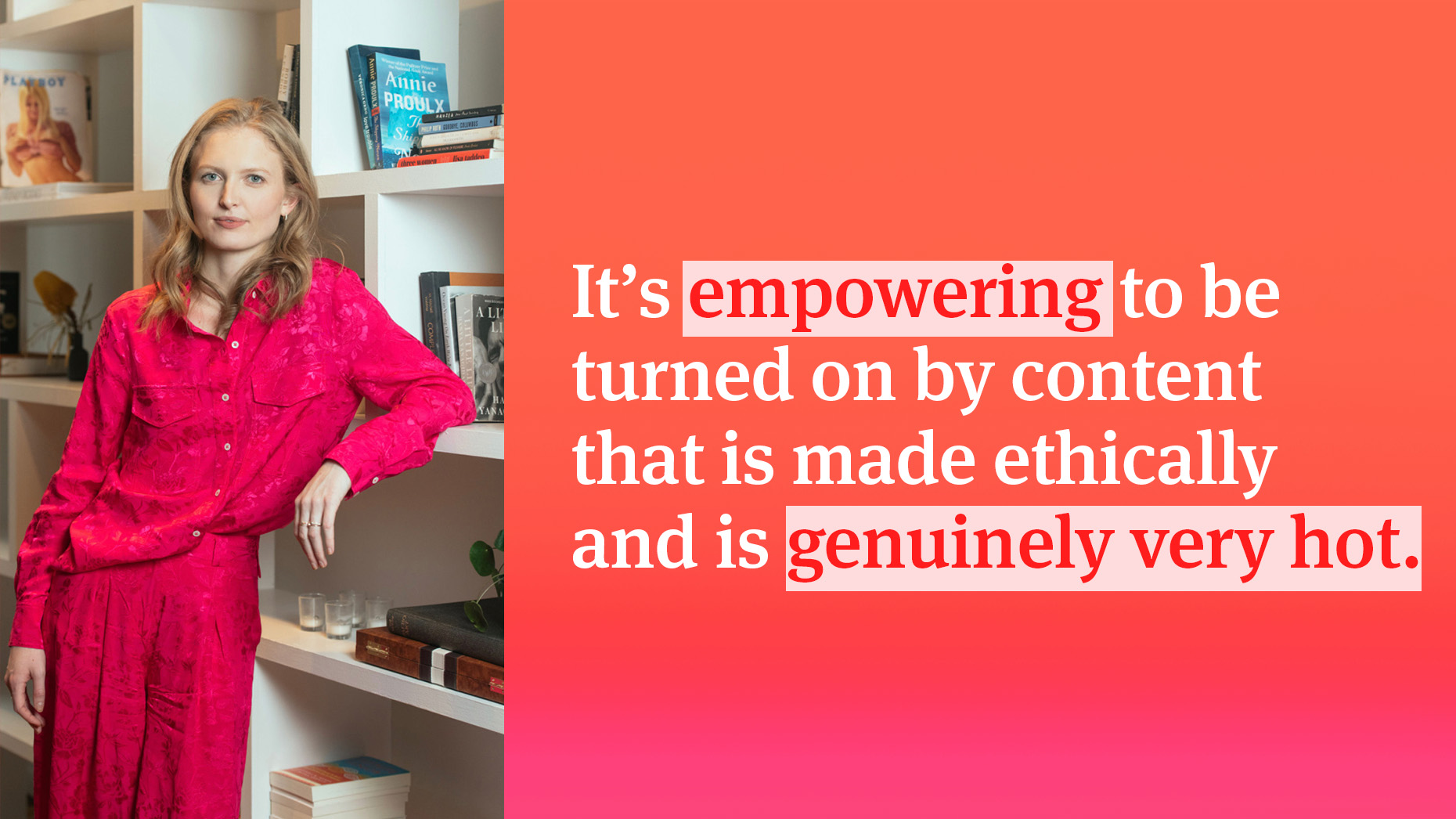
Quinn charges subscribers $4.99 per month, and they are logging in excess of 300,000 monthly sessions on the service. Quinn also has over 100,000 TikTok followers and a branded podcast called The Quinn Show, which covers issues like body image, dating and women’s rights from a feminist point of view. “The reason why I feel Quinn is empowering—it’s not because of ‘p*ssy power’ or like, ‘You should love your v*gina,’” Spiegel tells me. “It’s more about how I think it’s empowering to be turned on by content that is made ethically and is genuinely very hot. It’s not watered down. It’s not what people think women want. It’s made directly in response to what women want—and that is something new.”
Art by Haejin Park.
Spiegel discovered audio porn while she was an undergrad at Stanford University, where she studied computer science and joined the Kappa Alpha Theta sorority. She was recovering from an eating disorder, which led to sexual disfunction, and felt frustrated by her inability to get aroused or orgasm easily. At the beginning of her senior year, she stumbled upon audio erotica on Reddit and Tumblr and something clicked. She then made a (now defunct) blog of her favorite audios from across the internet, and shared it with her friends and sorority sisters, who responded enthusiastically. The blog would morph into an early iteration of Quinn (she borrowed the name from a male friend, who had just met his dream girl—a woman named Quinn).
“I was like, ‘I just don’t think the current erotic content is working and I think this is an opportunity,’” she says. “And obviously, at Stanford, there’s this idea that you are able to change a broken, old industry.”
Eventually Spiegel began spending more time on Quinn than on her classes and made the decision, like her brother Evan before her, to drop out of college. She spent the first year and a half after the company’s founding testing different user interfaces and business models. Would there be a monthly subscription fee or ads? Would content be produced by Quinn or generated by users? Would Quinn have editorial oversight over the audios or would it be, like Pornhub, essentially unmoderated? And how was it going to grow?
She also found a mentor in Erika Nardini, CEO of digital media company Barstool Sports, which had already developed its own hit female-hosted sex-positive podcast, Alexandra Cooper’s “Call Her Daddy.” When Nardini met Spiegel, she initially wanted to bring Quinn under the “Call Her Daddy” umbrella, but when the podcast left Barstool (moving to Spotify for a reported $60 million), the plan dissolved. Still, Nardini remained one of Spiegel’s advisers.
When asked for her top reasons for championing Quinn, Nardini lists three: “One, erotica has not been reimagined for women at all. Two, erotica and porn is really, by definition, from a masculine gaze. And three, how interesting to have this woman who’s willing to put herself out there in advocacy of a product that she thinks can help other women achieve pleasure and happiness.”
Quinn ran through a series of beta models that Spiegel coded herself. But in June, the now-expanded Quinn team (four plus the founder) landed on its current product, one that Spiegel says is “built to last.” It’s a website and app with a subscription model and a vibrant look reminiscent of Instagrammable book covers. As the company nears a Series A financing round, which Spiegel expects to close next month, Quinn is trying to thread the needle between two standard models of porn production. It’s neither the lawless frontier of homemade filth nor the uncanny valley of studio produced erotica, but a new invention somewhere in between.
Two corporations are now synonymous with modern-day erotic content: MindGeek, the parent company of the world’s most popular video-sharing services, including Pornhub and YouPorn, and OnlyFans. The former is marred by its appalling track record of allowing users to upload revenge porn and scenes of rape, child pornography and sex trafficking. The latter, while far more creator friendly and not always explicit, is also entirely dependent upon content made by users.
Quinn first had success with user-generated audio during the early months of the pandemic (partially because everyone was quarantining…often alone). But Spiegel quickly realized that the lack of control over Quinn’s recordings was making it more of an audio porn Tumblr and less of what she believed women really wanted: a curated collection of fantasies.
“When anyone can upload, it might as well be Reddit,” she says. “You don’t know what you’re going to get, which is the peril of user-generated content in general. So that’s when we were like, let’s do something different—let’s make this more like Headspace, Peloton vibes.”
So Spiegel came up with a compromise: Quinn approves every audio creator on the site, sometimes giving them creative ideas and production oversight, but the creators (referred to as Voices) make content on their own and maintain autonomy over the final product. The company makes sure the recording itself is high quality and does not feature anything off-limits (no nonconsensual sex or rape; no incest, minors or zoophilia). Spiegel also wanted creators to have distinct landing pages (à la Spotify’s artist pages) to encourage Voice loyalty. “Girls are fans of Quinn but they’re not really fans of Quinn,” she says. “They’re fans of the creators that they love.”
The app’s Spotify-like setup allows users to sort through audio porn tracks like they’re Top 40 songs—filtered by Voice, category or playlist. But instead of musical genres, audio porn categories range from mild (romance, storytelling) to spicier fare (“butt stuff.”) Collections of audio tracks are displayed as playlists with punchy titles like “Happy Ho-lidays” and “Daddy? Sorry…Daddy?”

The Quinn app offers a Spotify-like audio experience, but for porn.
Art by Haejin Park.
Spiegel and her team recruit new voices from all corners of the internet, scouring Reddit, TikTok, voice actor databases and Patreon for talent. The ratio of Quinn’s creators is roughly five male to one female—Spiegel found that her predominantly female audience generally prefers male-voiced audios—and most use audio porn as supplemental income. It’s just one more facet of the sex-work gig economy, Spiegel explained, absent the stigma that comes with appearing in visual porn. Some of the site’s part-time audio creators are making up to $5,000 per week, she claims.
A Quinn producer approached Danny Diamond (aka Danny) three months ago to record stories. He was already creating erotic audio for his OnlyFans subscribers, but says Quinn allowed him to upgrade the quality of his content. Neither Diamond nor Bad Influence writes detailed scripts—rather, they outline and improvise. “I don’t write stories, per se, but they do all come from me,” Diamond says. “I come up with a scenario”—for instance, sex in a movie theater, in a mall, at the gym—“flesh out the details in my mind and record the audio as if I were there. The dialogue typically isn’t an issue.”
Diamond notes, however, that Quinn audios have a recommended structure. “Quinn does like a certain ratio of ‘setup’ to ‘sex,’” he says. “I’d say 30% setting up the scene, the rest primal.”
“I’ve had real-life encounters that mirror some of the public and some of the rough-play scenarios in my work,” says B.I., who wants his “dom S&M-based audios” to be authentically intense. “In real life, whenever it gets rough, and we both reach that level of ‘literally nothing in the world exists except you and how much I need to f*ck you senseless’—that kind of neighbor-waking, hypnotic state—it’s intoxicating. And I really love exploring that feeling when I make those audios.”
As Spiegel sits in her yellow flannel button-down, sipping peppermint tea, she does not seem like a stereotypical porn executive. So how does she keep it all above board? How does she make sure that, in a field defined by the male gaze, Quinn’s version of pornography offers something better?
“This question of empowering versus exploitative—I fall asleep every night thinking about it,” she says. “And I think it’s really one of the central questions of the young female experience right now.” She cites a passage from feminist activist Andrea Dworkin’s 1987 paper “The Woman-Hating Left and Right,” which describes the ways in which liberals and conservatives misunderstand sex. “[Dworkin] says conservatives get it wrong because they say no one should have sex—no one should use prostitutes, no one should do sex work, no, no, no,” Spiegel said. “And liberals get it wrong because they say everything’s fine. As long as it’s not hurting anyone, everything is fine. And they don’t really critically define what hurting someone means or what consenting means. And there are very real questions of what is consent in a society in which one group of people, women, have not had the same rights as the other.”
Spiegel continues, “Even if [porn features] super–sex-positive sex workers and they consented to it and everything is by the book, I think it still leaves some haunting questions: Should someone be able to consent to this? Can you consent to abuse? Does that make the abuse not real? You know, those are some of the biggest philosophical questions of our time.”
With its contracted, solo-operating performers and allowance of anonymity, audio porn seems to be at least a partial workaround to these complicated questions. And audio porn, more than any other medium, prominently features discussions about sex, a logical bridge to conversations about consent. “I think that a lot of what goes wrong in sexual encounters, whether they be a one-off thing or something with one’s partner, is that there isn’t a lot of talking, both about sex and during sex,” says Professor Nancy Bauer, dean of academic affairs for arts and sciences at Tufts University and author of the book “How to Do Things With Pornography.”
Bauer favors the idea of audio pornography as a counter to the flagrant misogyny of traditional porn. “I think that what [audio] pornographers can do is promote egalitarianism in porn. They can show that saying to somebody, ‘May I touch you here?’ is sexy,” she says. “And it’s also respectful of another human being.”

Art by Haejin Park.
Quinn is still a relatively new, small startup, and how Spiegel will tackle these issues on a larger scale is still to be determined. However, Nardini believes there is a solid path to growth. “Caroline needs to grow her audience. She needs to secure talent. She needs to keep refining the product. So she needs a combination of technology and audience at this point,” Nardini says, emphasizing that the caliber of talent will make or break the business. “That’s why I felt ‘Call Her Daddy’ was so interesting, because we did a good job of building characters. So it’s like, all right, how do we make ‘Sexy Voice Guy’ the guy, you know?”
Spiegel also happens to have an expert in social content a phone call away. Her brother, Evan, is one of the most successful entrepreneurs of his generation, but Caroline is quick to note that his involvement in Quinn is negligible. “He’s more of a friend and a brother and a family member than he is a business partner,” she says. “He’s definitely a mentor in my life, but he didn’t invest in Quinn. He’s very supportive and often gives me advice, but I don’t think he’s particularly involved more than any other member of my family.”
Evan expressed a similar sentiment. “Caroline embodies an entrepreneurial spirit and I’m really proud of her," he wrote in a brief statement.
This hasn’t stopped some people from approaching Caroline with the conspiracy theory that Evan is actually the brains behind the operation. When I express shock at this notion, she responds, “You’d be surprised.” Her response to the doubters: “I’m leading the ship. He’s not,” she says, with finality.
Funded through an initial seed round with investments from Babel Ventures, Adrien Grenier’s DuContra Ventures, and Scooter Braun’s TQ Ventures according to Pitchbook data, Quinn faces a competitive environment as it approaches its Series A. And not just from audio-porn repositories like Reddit and Tumblr, but also from another audio erotica startup that’s perhaps a few steps ahead of Quinn. Dipsea, founded in late 2018, defines itself as “an ever-growing collection of sexy audio stories, wellness sessions, and dreamy sleep scenes.”
Like Spiegel did with Quinn, Gina Gutierrez and Faye Keegan started Dipsea to meet a need they saw among their female friends—the desire for high-quality, compelling, woman-centered erotic content. The Dipsea app has had over 2 million downloads, and the company raised $13.2 million in its seed and Series A funding rounds. It now has 24 employees.
Though Dipsea is also a subscription-based platform, charging users $59.99 annually, the process behind creating the content itself differs from Quinn’s. Dipsea envisions “an HBO model” for its audio programs, says Gutierrez, employing writers, editors, audio producers and directors as part of its in-house “story studio.” Instead of relying on individual personalities, Dipsea works with a paid network of professional freelance voice actors. Gutierrez also emphasizes that over 50 percent of its characters are voiced by people of color. “We want to create really premium content,” she says. “We believe we are the best central team of makers” in the audio porn space.
If Dipsea is HBO, with its high-production, professionally shepherded content, then Quinn’s likely path is to become a porn Spotify, with individual creators whose work is filtered by taste, curated into playlists and shareable across the platform. “We think that the more options for people who haven’t had options, the better,” says Gutierrez. “There is space in the universe for both an HBO and a YouTube. And so there’s certainly space for that in the erotic context, too.”
Barstool’s Nardini believes the best model for the audio porn market can be found not in entertainment, but in fitness. “I think whoever creates the Peloton of porn is going to have a really great business,” she says. “I don’t know if that’s going to be Quinn’s business, but I think that’s an interesting business personally.”
As Spiegel works to scale Quinn, she’s thinking broadly. She’s about to start season two of her podcast, “The Quinn Show,” where she discusses sex with the likes of TikTok influencer Christina “Tinx” Najjar and therapist Dr. Emily Morse. And she continues to make content for the app’s TikTok account.
“I think that Quinn is a media company. It’s a tech company. It’s a content company,” she says. “I’m always looking for new opportunities to find our user through content she’ll enjoy.”
And it does seem like her users are enjoying the content. Perhaps the only thing more passionate than the audios themselves are the app’s comments.
“Your voice is like melody to my ears…listening to you my legs were shaking,” writes one user in response to an audio called “Switching Up Your Roommate Fantasy.”
“Well, this unlocked like, 6 new kinks I wasn’t aware I had,” said another.
And, finally, succinctly, “Leaving instructions for this to be played at my funeral.”
Hello,
Please find attached weekly chart book + trade ideas.
Please let us know if there is anything else we can assist, Have a great week - Thank you.
Research Disclaimer
This publication has been prepared by Makor Capital Limited (“Makor Capital”) and is intended for professional or qualified investors only. Makor Securities London Ltd (“Makor Securities”)is distributing this material to its clients who are Eligible Counterparties or Professional Clients under FCA Rules. It may also be disseminated to persons who are Investment Professionals within the meaning of the Financial Services and Markets Act 2000 (Financial Promotion Order 2005). In the United States Makor Capital only distributes this material to major US institutional investors (as that term is defined in Rule 15 a-6 of the Securities and Exchange Act of 1934) and to SEC registered broker-dealers or banks acting in a broker –dealer capacity” If you do not fall into any of these categories you should disregard it.
This research material is a marketing communication. It is not investment research and has not been prepared in accordance with legal requirements designed to promote the independence of investment research. It is not subject to any prohibition on dealing ahead of the dissemination of investment research. It has not been produced by Makor Securities.
This material does not take into account the particular investment objectives, financial situation or needs of individual clients or other recipients. Before acting on this material, clients and other recipients should consider whether it is suitable for their particular circumstances and, if necessary, seek professional advice.
This material should not be construed in any circumstances as an offer to sell or solicitation of any offer to buy any security or other financial instrument, nor shall it, or the fact of its distribution, form the basis of, or be relied upon in connection with, any contract relating to such action.
This material is produced by research providers which Makor Securities believes to be reliable, but Makor Securities does not warrant or represent (expressly or impliedly) that it is accurate, complete, not misleading or as to its fitness for the purpose intended and it should not be relied upon as such.
Opinions expressed will be the current opinions of those producing the research as of the date appearing on this material only. We expect those producing the material in this report to update it on a timely basis but can give no undertaking that they will do so and regulatory compliance or other reasons may prevent them from doing so (or us from disseminating updated material).
Members and employees of Makor Securities London Ltd, employees of Makor Capital, Makor Capital Markets may from time to time have long or short positions in securities, warrants, futures, options, derivatives or other financial instruments referred to in this material. For Makor Securities, this information is set out in our Conflicts of Interest Policy which is available on request. Policies for the production of research from other research providers are available on request.Unless otherwise stated, share prices provided within this material are as at the close of business on the day prior to the date of the material.
Neither the whole nor any part of this material may be duplicated in any form or by any means. Neither should any of this material be redistributed or disclosed to anyone without prior consent. This material is issued for general information and discussion purposes only. None of Makor Securities, Makor Capital, Makor Capital Markets accepts liability whatsoever for any direct, indirect or consequential loss or damage of any kind arising out of the use of all or any of this material.
The services, securities and investments discussed in this material may not be available to, nor are suitable for all investors. Investors should make their own investment decisions based upon their own financial objectives and financial resources and it should be noted that investment involves risk, including the risk of capital loss. Past performance is no guide to future performance. In relation to securities denominated in foreign currency, movements in exchange rates will have an effect on the value, either favourable or unfavourable
all investors. Investors should make their own investment decisions based upon their own financial objectives and financial resources and it should be noted that investment involves risk, including the risk of capital loss. Past performance is no guide to future performance. In relation to securities denominated in foreign currency, movements in exchange rates will have an effect on the value, either favourable or unfavourable.
Entities
Makor Securities London Ltd is authorised and regulated by the Financial Conduct Authority (FCA registration number 625054) of Gossard House, 7/8 Savile Row, London W1S 3PE.
Makor Capital, company number 514456466, is incorporated in Israel and is a 100% held subsidiary of Makor Holdings Pte Ltd incorporated in Singapore.
Makor Capital Markets SA, company number CH-660.2.999.011-0 is incorporated in Switzerland and is also a 100% held subsidiary of Makor Holdings Pte Ltd.