(ZH) Thousands Of Flights Canceled As 'Bomb Cyclone' Batters Northeast

Thousands Of Flights Canceled As 'Bomb Cyclone' Batters Northeast

Thousands of flights within, into, or out of the US have been canceled across the Mid-Atlantic and Northeast states due to a major "bomb cyclone" producing blizzards.
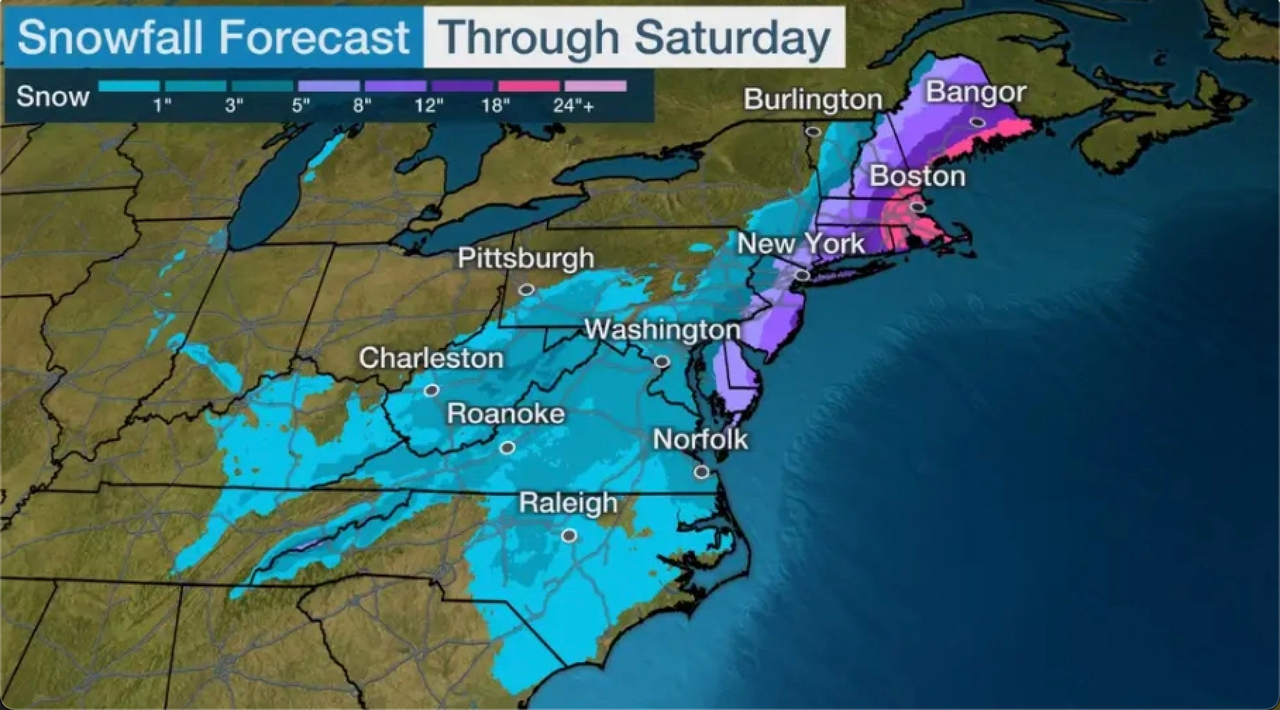
Winter storm warnings cover millions of people across ten states, including Ocean City, Maryland; Atlantic City, New Jersey; New York's Long Island; Boston and Cape Cod, Massachusetts; and Portland, Maine.
Flight tracking website FlightAware reports 3,500 flight cancellations within, into, or out of the US (as of 0720 ET). Flight delays within, into, or out of the US are 220.
A bulk of the delays are centered in the Northeast. John F. Kennedy International Airport in New York City has canceled 457, Newark Liberty International Airport in New Jersey canceled 322 flights, and Boston Logan International Airport canceled 309 flights.
"The heaviest snowfall is likely to fall across a swath extending from the Eastern Shore of Maryland up through most of Maine where 6-12 inches are likely. Parts of coastal New England, where blizzard conditions are forecast, may see between 1-2 feet of snow with locally higher amounts possible, specifically over coastal Massachusetts," the National Weather Service said.
Early snowfall totals show accumulating snow:
  • 12.5" in Forked River, New Jersey
  • 11.4" in Port Republic, New Jersey
  • 10" in Cape May, New Jersey
  • 9.3" in Eldora, New Jersey
  • 7.0" Babylon, New York
The winter storm is expected to dissipate by Sunday. In some areas in the coastal regions of the Northeast, more than two feet could fall and produce 'historic' blizzards.

FT : Wall Street split on ‘buying the dip’ in whipsawing US stock market

Wall Street split on ‘buying the dip’ in whipsawing US stock market
The ‘reflex should be resisted’, T Rowe Price boss says in weak January for indices

Wall Street is starkly divided over buying the dip as the US stock market is on track for its worst January since 2009.

Buying the dip, or adding shares during downturns, has proven a lucrative strategy since the start of the pandemic. Markets have rebounded higher and faster as monetary and fiscal policy kept borrowing rates near zero and flooded the economy with money.

But as the Federal Reserve moves to clamp down on high inflation, investors sharply disagree over how well markets will bounce back this time.

“The buy-the-dip reflex should be resisted in the environment we are likely to continue to face in 2022,” said Rob Sharps, the new chief executive of T Rowe Price, the fund manager which oversees $1.7tn in assets.

Bill Gross, the founder and former chief investment officer of $2.2tn fund manager Pimco, told the Financial Times: “The buy the dip mentality has been obliterated in the market.”

Markets have had a rough start to 2022 as highly-valued tech stocks and lossmaking but buzzy names are pulled back to earth. The tech-heavy Nasdaq Composite index is down nearly 13 per cent since the start of the year, while the S&P 500 index of US blue-chip stocks has dropped 7.6 per cent, even after a rally late on Friday.

Shares have moved violently as investors grapple with the path of US interest rates. The Federal Reserve this week signalled it would begin to raise rates in March, and Jay Powell, chair, left open the prospect of an aggressive sequence of rate rises during the year.

Wall Street analysts took notice: HSBC warned investors that there was little indication that Powell would step in to prop up a falling market, while Jefferies said that the more the Fed tightens, the more optimism in the markets will come into doubt.

“Any environment where there is a reversal of accommodating monetary policy makes it more difficult to expect that returns will be robust, and that it is necessarily the right thing to do to buy each pullback,” Sharps said in an interview with the FT.

Yet others are pouncing on pullbacks. The billionaire Bill Ackman, the head of the hedge fund Pershing Square, this week said his group bought more than 3.1m shares of Netflix after the video streaming company’s price had slumped.

“Many of our best investments have emerged when other investors whose time horizons are short term, discard great companies at prices that look extraordinarily attractive when one has a long-term horizon,” Ackman said in a letter released on Wednesday.

Jonathan Gray, president of Blackstone, said earlier this week that “the market trading off and the average Nasdaq stock being down over 40 per cent [from last year’s all-time high] could create opportunities” for the private equity and alternatives manager with $881bn in assets.

And Cathie Wood of Ark Invest, whose once high-flying flagship portfolio of tech stocks is down 27 per cent since the start of 2022, this week argued that “innovation is on sale” after asset prices dropped.

Analysts note that this month’s sell-offs have been not simply driven by concerns over interest rates but fundamentals, as companies trading at high valuation multiples begin to look more precarious.

Gross said that as Fed policy tightens, investors, especially new ones who have only experienced a bull market, will shy away from buying shares on the way down “in what we’re beginning to see as a bear market”.

Le Figaro: Nucléaire, éolien, Pécresse dévoile son plan «énergies»

Nucléaire, éolien, «Livret Vert»... Valérie Pécresse dévoile son plan «énergies»

INFO LE FIGARO - Après avoir visité le site industriel d'EDF de l'Ain, la candidate a présenté un projet qui prévoit notamment une nouvelle loi de programmation qui stoppera le plan de fermeture des réacteurs.

«Je m'oppose à la fermeture de la centrale nucléaire du Bugey parce que c'est une folie». Valérie Pécresse a lancé ce message samedi après avoir visité le site industriel d'EDF de l'Ain, dont la fermeture est inscrite sur la liste des 14 réacteurs français dont le président de la République a souhaité la fermeture d'ici 2035.

Après la mise à l'arrêt de la centrale nucléaire de Fessenheim (Haut-Rhin) en juin 2020, la candidate a choisi la deuxième centrale menacée de fermeture pour dénoncer les décisions présidentielles. Ce déplacement a été programmé au cœur de sa campagne alors que la hausse de la facture énergétique des Français suscite un vif débat en France, à un peu plus de deux mois du premier tour de la présidentielle.

«Cramer la caisse»

«Emmanuel Macron est en train de cramer la caisse d'EDF pour que la facture d'énergie n'augmente pas d'ici les élections. C'est un bouclier tarifaire totalement illusoire et électoraliste mais l'addition viendra après et il faut sauver EDF car cette politique, incohérente et irresponsable, nous mène droit à la catastrophe », accuse Valérie Pécresse en estimant que ces fermetures «mettent totalement à bas notre souveraineté énergétique» et fait «flamber» les prix de l'énergie. «Les Français doivent savoir que le président de la République tente de masquer une hausse inéluctable des prix de l'électricité», poursuit-elle.

Les choix énergétiques de la France seront au cœur des prochains débats de la présidentielle, mais pour Pécresse cette question du nucléaire fait partie des «sept péchés capitaux» d'Emmanuel Macron, qu'elle accuse de déstabiliser toute une filière en envoyant de mauvais signaux. Elle renvoie aussi sur les épaules du chef de l'État la responsabilité de la hausse des taxes sur l'électricité tout en estimant que le développement du renouvelable, et notamment de l'éolien, se heurte à un seuil de tolérance déjà atteint dans certains territoires. «Quand j'accéderai à la présidence, je mettrai tout à plat sur l'éolien car je veux que toute implantation passe par l'adhésion des populations», confie Valérie Pécresse.

Stopper les fermetures de réacteurs

Au-delà du message politique envoyé samedi, la candidate a levé le voile sur son plan «énergies». Elle appuie son projet sur trois objectifs : décarboner en visant le zéro carbone en 2050, conserver la capacité du pays à produire sa propre électricité et préserver le pouvoir d'achat des Français. Pour répondre à ces «impératifs», elle prévoit une nouvelle loi de programmation qui stoppera le plan de fermeture des réacteurs. Valérie Pécresse s'engage également à supprimer le plafond 50% de production d'électricité d'origine nucléaire inscrit dans la loi car selon elle, cette limite ne permettra pas de tenir l'objectif de décarbonation en 2050. « Il ne faut pas se tromper d'objectif : le seul qui doit nous guider c'est l'objectif écologique du zéro carbone », insiste-t-elle, en envisageant de peser parallèlement sur l'Union européenne.

Dans son projet, Valérie Pécresse prévoit aussi la remotivation de la filière nucléaire. Elle parle de «relance gaullienne» en programmant la construction d'une première tranche de six EPR (réacteurs nucléaires à eau pressurisée de 3e génération), dont quatre à démarrer dès 2035. Sans compter une réflexion sur les prochaines constructions et sur le renouvellement des centrales existantes. Elle veut préparer l'approbation par le Parlement de la gestion des déchets nucléaires (CIGEO) et l'enfouissement de manière réversible. Sur ce point, elle estime que la France a pris dix ans de retard, même si une loi existe depuis 2006.

Livret Vert

Parallèlement au «sursaut» attendu, Valérie Pécresse veut poursuivre le développement du renouvelable dans tous les domaines (hydraulique, biocarburant, biomasse, biogaz, filière bois, géothermie, méthanisation des déchets, réseaux de chaleur…). Elle souhaite porter le «fonds chaleur» à 500 millions d'euros par an. Sur l'éolien, elle envisage d'imposer des territoires zéro éoliennes dans les documents d'urbanisme des collectivités locales, voire de fixer des moratoires ou des normes de protection contre les nuisances. «Mais le principe fondamental pour moi, c'est l'approbation indispensable des populations locales», précise-t-elle.

Enfin, la candidate veut lancer une chasse au gaspi en misant sur des investissements «massifs» (fuites de méthane, éclairages publics, incitation aux économies d'énergie, rénovations des bâtiments publics…). Concernant la rénovation des logements, Valérie Pécresse propose la fusion des livrets A et Développement durable en «Livret Vert», pour permettre à la Caisse des dépôts et consignations de financer davantage de projets. Par ailleurs, la candidate croit à l'élaboration de contrats incitatifs et de tarification écoresponsable qui permettraient aux Français de réduire leur facture d'électricité s'ils parviennent à réduire leur consommation en période de pics. «Ce sera une manière intelligente d'encourager la consommation écologique», soutient-elle.

Suppression de la TVA sur les taxes

Dans le prolongement de ses annonces récentes sur le pouvoir d'achat, Valérie Pécresse s'engage également à supprimer la TVA sur les taxes pesant sur l'électricité (ce qui représente 800 millions d'euros). Sur ce point, elle veut se démarquer des propositions de la présidente du Rassemblement national. «Marine Le Pen veut supprimer la TVA sur l'ensemble de la facture mais cela coûterait 12 milliards d'euros et elle n'a pas le premier kopeck pour le faire !», avance-t-elle. Enfin, la candidate critique aussi les indemnités de frais kilométriques annoncées par Emmanuel Macron : «C'est un fusil à un coup ! Il faudrait plutôt envisager une mesure structurelle comme l'indexation automatique chaque année du barème kilométrique sur les prix des carburants.»

Si l'Allemagne et l'ex-chancelière Angela Merkel ont fait un tout autre choix en s'engageant sur la fin du nucléaire, Valérie Pécresse se pose en ambassadrice de la souveraineté énergétique de la France. «Aujourd'hui en Europe, les Allemands font la loi mais à un moment donné, prévient la candidate à la présidentielle, la France doit pouvoir réaffirmer ses positions. Et nous avons tous les arguments pour dire que l'Allemagne s'appuie sur l'énergie fossile quand nous sommes capables de produire de l'électricité zéro carbone.»

TechCrunch : Whistleblowers can protect crypto and DeFi

Whistleblowers can protect crypto and DeFi

Regulation-free crypto is history. In response to rampant crypto fraud and the incredible growth of regulation-skirting decentralized finance (DeFi), U.S. regulators are set to take unprecedented action against the cryptocurrency industry.

This regulatory shift tracks the United States’ historical pattern for regulating finance — oscillating between greater and lesser regulation depending on whether the desire for more freedom is stronger than the fear of financial instability or vice versa.

While free-market crypto-enthusiasts may despair, there may be significant benefits for those willing to cooperate. If insiders speak up about the illegal activity and abuses they see, they can ensure that their companies succeed while regulators target other bad actors.

If the insider’s company refuses to reform and regulators are forced to take action, the insider could also be eligible to earn hefty awards for blowing the whistle. By blowing the whistle, the insider also may gain protection from retaliation.

History repeats itself
There is a familiar pattern with financial regulation in the U.S. — a period relatively free from financial regulation followed by a period of greater regulation to correct financial instability.

From the beginning, our founders fiercely contested the need for federal regulation of the financial system, a debate that centered around the chartering of a national bank. Andrew Jackson ultimately abolished the national bank in favor of a decentralized banking system, which then led to what has become known as the Free Banking Era, “wildcat” banks and decades of financial instability, which ended with Abraham Lincoln’s crypto fraud

More recently, starting around 1980, a wave of deregulation led to financial innovation and consolidation but also created financial instability in the form of the slow-burning Savings and Loan Crisis of the late 1980s and early 1990s. With this trend of deregulation culminating in the Great Recession of 2007-2008, the pendulum swung back to greater regulation with the passage of the Dodd-Frank Wall Street Reform and Consumer Protection Act.

This same regulatory pattern is playing out within the cryptocurrency industry, which until recently faced little regulation. Lawmakers – concerned about chronic anti-money laundering and “know your customer” (AML/KYC) failures that had given the crypto industry a reputation as a haven for drug dealers, tax-dodgers and terrorist financiers – amended the Bank Secrecy Act to explicitly cover cryptocurrencies.

U.S. Securities and Exchange Commission Chairman Gary Gensler recently compared the crypto revolution to a new era of wildcat banking, and the SEC has taken the position that many cryptocurrencies or cryptocurrency-adjacent products are securities, most famously in its lawsuit against Ripple. Former Commodities Futures Trading Commission Commissioner Dan Berkowitz – now general counsel of the SEC – believes DeFi may be entirely illegal, and the Department of Treasury recommended that Congress prohibit non-banks from issuing stablecoins, a class of cryptocurrency that is backed by a reserve asset in an effort to offer price stability.

Even the states are participating, with state attorneys general taking action against companies like NEXO, Celsius and BlockFi for failing to register in the state before offering or selling securities or commodities. Clearly, cryptocurrency’s time free from regulatory oversight has ended.

Whistleblowers can guide regulation and compliance
While the industry frets over this counterrevolution of sorts, crypto insiders who report fraud and illegal activity to the government could see significant upside. Regulators, such as the SEC, the CFTC, the Financial Crimes Enforcement Network, and the Internal Revenue Service, need whistleblowers who can provide an inside look at the operations of a company or industry segment, helping regulators identify fraud and illegal activities well before wrongdoers irreparably injure investors, customers and the public.

Information from insiders can also help regulators target their enforcement actions and rulemaking to address the worst actors in the space, which can help prevent regulators from unnecessarily quashing innovative and valuable aspects of the cryptocurrency industry.

In exchange for this information, whistleblowers can earn awards under various federal whistleblower rewards programs, provided the whistleblower properly filed a tip that contributed to a qualifying enforcement action.

In the case of the SEC and CFTC programs, and now the newly enhanced AML whistleblower program, a whistleblower can receive an award of up to 30% of an enforcement action of more than $1 million. These programs also allow whistleblowers to shield their identity by filing tips anonymously through an attorney.

For the IRS whistleblower program, a whistleblower can receive as much as 30% of a government recovery of at least $2 million. Whistleblowers have received over $1 billion through the SEC and CFTC programs, including eye-popping awards of over $100 million, and the IRS whistleblower program alone has awarded more than $1 billion to whistleblowers since 2007.

But whistleblowers do not only aid the government. Whistleblowers can help companies stay out of regulatory crosshairs by anticipating regulatory trends and future enforcement actions. Many employees are well-positioned to sound the alarm and let decision-makers know that changes need to be made. A whistleblower can head off potential issues, pointing out that the company should ask regulators for No Action Letters – effectively asking a regulator to bless a particular product or course of action – or suggesting restructuring a transaction or product in such a way that it is less likely to implicate regulations.

Even for companies already engaged in potentially illegal activity, a whistleblower may have the best sense of how to correct course or how to approach regulators about remediating the company’s actions.

Whistleblower protections
Being a whistleblower can be a terrifying prospect given the prevalence of retaliation. Retaliation can take many forms, ranging from a hostile work environment to termination.

Federal and state laws, including the Sarbanes-Oxley Act, the Dodd-Frank Act and the Anti-Money Laundering Act of 2020, can protect whistleblowers against retaliation. While the remedies under the various whistleblower statutes vary, they are designed to put the retaliated-against employee in the same position as if the retaliation had not occurred.

To be afforded these protections, however, an employee must blow the whistle in a way that is protected. A whistleblower need not prove an actual violation of law or even have been correct that fraud or illegal activity happened at all. Rather, in order to encourage employees to come forward with concerns, these laws generally protect whistleblowers from retaliation if they hold a “reasonable belief,” that is, that they can show “that a reasonable person in the same factual circumstances with the same training and experience would believe that the employer violated” the law.

As the many large corporate whistleblower jury verdicts have demonstrated over the last decade, a retaliating employer can find itself liable for substantial sums of money. Given the complexity of whistleblower retaliation law, however, an employee thinking of blowing the whistle should seek legal advice.

Whistleblowers to the rescue
The cryptocurrency industry has a steep learning curve ahead of it. Traditional financial institutions have spent decades accommodating and complying with regulation, while crypto has thus far operated with little regard for compliance.

Crypto whistleblowers can help their industry level the playing field by raising the alarm early. By taking the concerns of their whistleblowers seriously, companies in the crypto industry can head off the inevitable barrage of enforcement actions they are soon to face and save themselves time, money and heartache.

WSJ : How the FTC Is Reshaping the Antitrust Argument Against Tech Giants

How the FTC Is Reshaping the Antitrust Argument Against Tech Giants
Federal Trade Commission chief Lina Khan has developed an innovative way to frame the issue. Whether she has the tools to see it through remains to be seen.

For years, activists, lawmakers, lobbying groups, think tanks and most Americans have agreed something should be done about giant tech companies’ power. With minor exceptions, no one has figured out how to do it.

Now, U.S. competition regulators at the Federal Trade Commission are getting creative. They’re zeroing in on an issue that has been less prominent in the past: how Big Tech dominance harms not consumers, but the businesses that sell goods and services on those tech platforms.

Since mid-1980s Reagan-era reforms of antitrust law, the test for whether a company is a monopolist has been whether its dominance harms consumers—usually through higher prices or shoddy goods. It has been hard to make that charge stick against companies that offer many of their services free, like Google and Meta Platforms (née Facebook), or at (usually) competitive prices, like Amazon ; or that take a cut of what seems to be a big, competitive market, like Apple does with apps.

The FTC, under its Biden-appointed chairwoman, Lina Khan, has been shifting the terms of the argument, focusing less on harm to consumers or even rivals, and more on how the bigness of Big Tech harms companies that are, in essence, its partners.

To understand, we have to look at an unusual word the FTC has used of late: “monopsony.” If a monopoly is a market with one dominant seller, a monopsony is its inverse, a market where one buyer is pre-eminent. Monopolists can gouge consumers. A monopsonist has the same power over sellers.

Big tech’s platforms—the things that have made them so much money—effectively make them market-controlling middlemen, and the FTC is saying that the tech giants are abusing their positions as, in effect, the ultimate proxy buyers for all users of their platforms.

By this logic, Apple’s App Store is the dominant place that app sellers must go to sell their software and services, because globally, it rakes in twice the revenue of its next-biggest competitor, Google’s Play store. Amazon wields its power over companies that want to sell goods online. Google and Facebook lord theirs over the publishers selling ad space.

For those suspicious of Big Tech’s power, it might seem like the FTC’s small band of legal X-wings have found the thermal exhaust port in Big Tech’s collective Death Star. The companies, of course, frame the situation differently, and see the FTC as the tyrannical Empire imposing its will over a world where they have provided unprecedented opportunities for app developers and other whole new categories of business.

Monopsony versus monopoly
The FTC isn’t the only antitrust regulator—the Justice Department also has jurisdiction—and Ms. Khan is hardly the only one pushing for this change. But she’s its most visible advocate. Both Meta and Amazon have tried to have her recused from potential cases involving them, because of her history of writing about why she believes they are monopolists.

Ms. Khan and the FTC, which declined to comment for this column, have laid out their position at length. In papers published before she was chief of the FTC, Ms. Khan argued that for most of the 20th century, harm to competition was justification enough to go after companies that used their size and market power to squash competitors. In subsequent releases by the FTC, she cites her own work to argue that existing legal precedent gives the FTC all the license it needs to protect competition in any market, but especially in those in which Big Tech operates.

Furthermore, the FTC has argued in its public statements, the need to preserve competition trumps any considerations about whether mergers will make the overall operation of markets more efficient, or save companies money by eliminating duplicated effort.

But the FTC has faced a puzzle. The ills typically associated with weak competition—such as higher consumer prices and inferior consumer choices—are difficult to prove in today’s tech sector. Regulators might argue that such harms are inevitable with companies accumulating so much market power, but how can they demonstrate that the damage from not intervening now is more than hypothetical?

That’s where monopsony enters the discussion. This focus is one of the newest ways the FTC is attempting to establish harms to competition from big tech companies, says Krista Brown, a senior analyst at the American Economic Liberties Project, a liberal think tank with which Ms. Khan has collaborated in the past. Marketplaces where companies are both a referee and a player, setting the terms of how the market works and also participating directly by selling their own goods and services, are of special concern, she adds.

Take, for example, Amazon’s e-commerce marketplace. Its share of all online retail in the U.S. grew to more than 40% in 2021, more than five times that of its closest competitor, Walmart.

Its clout is even larger among the third-party sellers that depend on its platform to reach customers. For them, Amazon is in effect the dominant “buyer” of their goods, even if it isn’t the end consumer. It controls the fees they must pay to list their goods on this vital platform, the rates they pay for advertising and, for many, shipping and fulfillment costs—not to mention where their goods appear on its site.

Here, the definition of monopsony has to be updated to reflect modern digital platforms, which are often two-sided marketplaces, with consumers on one side and sellers on the other. Amazon’s marketplace may not be a middleman of the type typical in traditional retail operations, but with its many fees and control over its platform, it is arguably no less a gatekeeper than a retail buyer who decides what to stock at a traditional store.

Amazon has said previously that regulators’ focus on its alleged anticompetitive behavior, and proposed remedies, could amount to “misguided interventions in the free market [which] would kill off independent retailers and punish consumers by forcing small businesses out of popular online stores, raising prices, and reducing consumer choice and convenience.”

Meta and Google, which together account for more than half of the U.S. digital advertising market, are arguably in a similar role, but with advertising and consumer data in place of digital and physical goods.

An ongoing lawsuit brought by a group of state attorneys general accuses Google of using its position in the middle of auctions for online advertising to unfair advantage. Google, a unit of Alphabet, has said the lawsuit lacks merit, that its advertising technologies support a huge variety of sites, that it helps websites and apps reach customers around the world, and that there is vigorous competition in online advertising.

The FTC is suing Facebook, claiming it’s a monopolist in the market for social networks. The suit claims that based on years of legal precedent, the company’s acquisitions of rivals like Instagram and WhatsApp have been anticompetitive.

Facebook has previously said that it must continually battle world-class competitors in every aspect of its business, and that its customers easily can, and sometimes do, choose to move to another product or service.

FTC versus the courts
Some recent legal precedents that relate to tech companies, and others, aren’t on the FTC’s side.

In June 2021, a federal judge granted Facebook’s request to throw out the FTC’s antitrust lawsuit against the company before it even got started. This month, the judge allowed a revised version of the suit to proceed in his Washington, D.C., district court, but predicted that winning it would be a “tall task” for the agency.

The question of whether Apple, through its App Store, was a monopolist in the market for mobile gaming was addressed in the case of Epic Games v. Apple. In that case, a federal court found that the answer was a definite “no.” The U.S. District Court for Northern California court did find that Apple would have to stop preventing companies like Epic from telling users they could pay for games in places other than Apple’s App store, however. Not content with its partial victory, Apple is appealing this decision.

In a June 2018 decision, the U.S. Supreme Court specifically addressed two-sided marketplaces like those run by big tech companies, although the decision was about credit card networks. In that case, the two sides of the marketplace were consumers and stores that accept credit cards. In that decision, the court ruled that any action against credit-card companies would have to come in response not only to harm to merchants but also to harm to consumers.

Ms. Khan, then a legal scholar, weighed in on the decision at the time, writing that it showed “stunning disregard for traditional antitrust principles.”

Some legal scholars are very skeptical of the FTC’s new tactics. “The fact that the agencies are revising the guidelines based on an order from the White House makes this all seem political,” says Daniel Crane, an antitrust expert and law professor at the University of Michigan, referring to a July 2021 executive order on competition. “That increases the likelihood for skepticism in the courts.”

Blocking mergers versus market power
The FTC clearly wants to go beyond the previous attempts to curtail Big Tech’s power, which have mostly been limited to occasional fines representing small fractions of these companies’ annual revenues or skirmishes with states over minor fiefs of their empires.

Here’s the agency’s challenge: While it may have identified a primary harm of these companies, the two credible remedies it has identified—withholding approval for future acquisitions by Big Tech, and forcing the giants to divest previous acquisitions—may not be sufficient to rein in the power it says these companies already hold.

Laws that might give the FTC other powers are being drafted in Congress, but it isn’t clear if, or when, they will come to a vote by the entire chamber, much less be passed by a Congress riven by partisanship.

In September 2021, the FTC released findings from a study showing that from 2010 to 2019, Apple, Alphabet, Microsoft, Amazon and Meta collectively acquired 616 companies worth at least $1 million, but did not alert the agency since the transactions were usually less than around $92 million each, highlighting their tendency to buy smaller companies for their talent and nascent technologies. Below $92 million, companies don’t need to disclose their acquisitions, which, the FTC highlighted, is one reason many of these acquisitions escape notice by regulators, Congress and the public. Then, in 2021, Amazon, Alphabet and Microsoft announced more mergers and acquisitions than any other year in the previous decade.

Even if the FTC continues to make new regulations, the agency has one problem that it can’t solve without help from Congress: It doesn’t have enough people to do all the things it aspires to.

“The agency is strapped, and it’s very resource-intensive to bring suits,” says Ms. Brown of AELP. “I think they’re just getting their ducks in a row before bringing out a broader plan that will go after larger anticompetitive practices across the tech industry.”

FT : Octopus Energy warns of £100m hit from record power prices

Octopus Energy warns of £100m hit from record power prices
UK supplier incurring losses on difference between consumer price cap and wholesale costs

UK power supplier Octopus Energy has warned it will take a £100m hit this financial year from record wholesale energy prices.

The private company, which is Britain’s fifth biggest electricity and gas supplier, has warned it is incurring losses because there is currently a £600-£700 difference between how much suppliers can charge customers under the energy price cap and wholesale market prices.

In the past six months, 27 UK energy suppliers have gone bust as wholesale prices have soared. Initially, the crisis largely affected poorly run companies that did not have the balance sheet strength to withstand price rises or had not adequately hedged their energy requirements, but the warning from Octopus, whose shareholders include Al Gore’s sustainable investment fund, shows better managed companies are also feeling the effects.

Greg Jackson, chief executive, said the company was having to absorb higher costs because more households than expected were moving from fixed-price deals when their contract expired to cheaper tariffs protected by the price cap, which was introduced in 2019.

In a normal market, most of those customers would have agreed a new fixed-price deal: these longer-term contracts used to be cheaper than the price cap but are now hundreds of pounds more expensive. Alternatively, they would have switched supplier.

Jackson insisted the £100m hit was not “cataclysmic” but he and others in the industry have been pushing the UK government for ways to help them smooth out price volatility for households over a period of several years but without risking their own balance sheets.

He said the industry was already “full of mechanisms” that allow certain costs to be recouped over a long period of time — for example contracts that incentivise new low carbon power generation.

“In the same way, you could inject money into reducing bills for customers and then recoup it over a period of time,” Jackson said. “We will keep looking at solutions like that.”

Octopus warned of the £100m hit as it published its results for the last financial year ending April 30 2021.

Its UK energy retail business made an operating loss of £84.7m during the year, compared with a £47.9m loss in the previous 12-month period, although it blamed this on “continued reinvestment in rapid growth” and insisted that if exceptional items and the costs of acquiring new customers were stripped out, operating losses would have narrowed to £1m. Revenue increased 57 per cent during the year to £1.89bn.

Despite the crisis, Octopus Energy Group, the parent company that also owns renewable energy generation assets and technology platforms, has continued to attract external investment, including from Canadian pension fund CPP Investments, pushing its valuation close to $5bn.

FT : Turkish president sacks statistics chief as inflation tension escalates

Turkish president sacks statistics chief as inflation tension escalates
Sait Erdal Dincer lasts just 10 months in the role amid reports of friction over rate-setting policy

Turkey’s president Recep Tayyip Erdogan has sacked the head of the national statistical institute after reports of tension between them over the country’s inflation data.

A decree published in the country’s official gazette early on Saturday morning announced the removal of Sait Erdal Dincer, after the official rate of inflation reached a 19-year high of 36 per cent in December. He had served just 10 months in the role.

He was replaced by Erhan Cetinkaya, who was previously a vice-chair of the country’s banking regulator.

Erdogan, a life-long opponent of high interest rates, rejects the economic orthodoxy that raising interest rates helps to curb inflation, arguing that low rates will usher in price stability.

He ordered the central bank to cut interest rates four times in the final months of last year and the Turkish lira plummeted in value.

The removal of Dincer comes after weeks of speculation in the Turkish media about friction between him and Erdogan over the rising official inflation rate.

At the same time, TurkStat has come under heavy pressure from opposition parties, who have accused it of manipulating the data to show inflation at an artificially low rate.

Dincer rejected that claim earlier this month. “With the inflation data, I have a responsibility to 84m people,” he told the Turkish business newspaper Dunya. “If I sign off on an error, I will do an injustice to 84m people. As you know, millions of workers get a pay rise on the basis of the inflation that we announce. To tamper with those people’s incomes, to deprive them of their rights . . . I would not do that.” 

The agency is due to announce January’s inflation rate on February 3.

Nureddin Nebati, the country’s finance minister, reportedly told a meeting of economists in Istanbul last weekend that he expected inflation to peak at 40 per cent in the months ahead.

Goldman Sachs, the US investment bank, forecasts annual consumer price inflation will have reached 48 per cent in January.

Erdogan also accepted the resignation of his justice minister, Abdulhamit Gul, according to the official gazette. He replaced him with Bekir Bozdag, who has served two previous stints in the role.