FT : Nelson Peltz: the activist investor with a ‘piratical charm’

Nelson Peltz: the activist investor with a ‘piratical charm’

The activist investor hot on Unilever’s heels
In late September last year Nelson Peltz met the chief executive of Unilever, Alan Jope, for breakfast in a private room at Claridge’s in London. Peltz had organised the meeting to lobby against the recent announcement that Unilever’s Ben & Jerry’s brand would stop selling ice cream in the occupied Palestinian territories — an apparent protest against Israeli settlements.

Peltz told Jope his opinion: no company has any place making these kinds of political statements. This remains the only conversation the two men have had — so far.

Just over a week ago it emerged that Trian Partners, the $8.5bn activist fund that Peltz co-founded in 2005, had quietly built up a stake in Unilever, the consumer goods company best known for products such as Dove soap and Hellmann’s mayonnaise.

Until then the only Peltz in the UK headlines this year was Nicola Peltz — one of Nelson’s 10 children — who is marrying Brooklyn Beckham this spring. But news of Trian’s stake changed all that, sending Unilever’s share price soaring more than 7 per cent, leaving the company rushing out their plans to axe 1,500 management roles, and propelling the 79-year-old billionaire into the spotlight.

In this profile of Peltz, James Fontanella-Khan and I speak to those who have worked with and against Peltz to get a sign of what might be in store for Unilever. Roger Carr, who was chair of Cadbury when the activist successfully campaigned to split its drinks business from confectionery, recalls:

“Peltz has a piratical charm and a velvet glove. But don’t mistake the iron fist. He is relentless in pursuit of his own objective, which is value creation.”

Meanwhile Jope may be living many CEOs’ nightmare after being targeted by Peltz. But Brooke Masters, our new US investment editor, argues that activist investors provide an important market function that is needed now more than ever.

And Unilever’s former CEO Paul Polman has waded into the profits versus purpose debate. He argues that critics of ‘woke’ capitalism are wrong. Terry Smith, I hope you’re listening . . . 

This object in space flashed brilliantly for 3 months, then disappeared. Astrono

This object in space flashed brilliantly for 3 months, then disappeared. Astronomers are intrigued
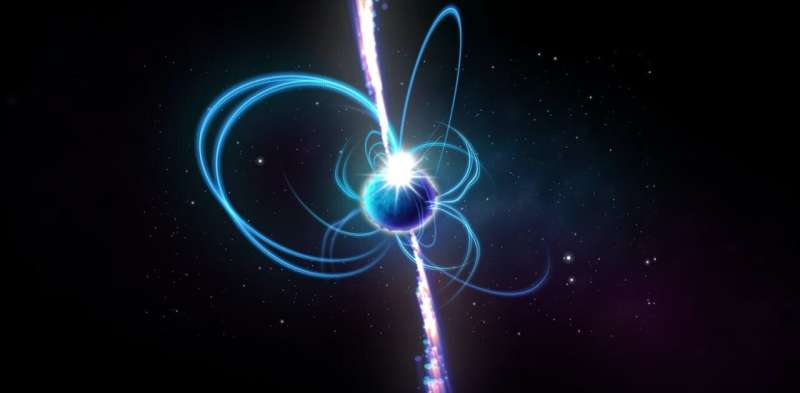
Artist visualisation. Author provided
"Holy sharks, Batman, it's periodic!" I exclaimed on Slack.
It was the first lockdown of 2021 in Perth, and we were all working from home. And when astronomers look for something to distract themselves from looming existential dread, there's nothing better than a new cosmic mystery.
In 2020 I gave an undergraduate student, Tyrone O'Doherty, a fun project: look for radio sources that are changing in a large radio survey I'm leading.
By the end of the year he'd found a particularly unusual source that was visible in data from early 2018, but had disappeared within a few months. The source was named GLEAM-X J162759.5-523504, after the survey it was found in and its position.
Sources that appear and disappear are called "radio transients" and are usually a sign of extreme physics at play.
The mystery begins
Earlier this year I started investigating the source, expecting it to be something we knew about—something that would change slowly over months and perhaps point to an exploded star, or a big collision in space.
To understand the physics, I wanted to measure how the source's brightness relates to its frequency (in the electromagnetic spectrum). So I looked at observations of the same location, taken at different frequencies, before and after the detection, and it wasn't there.
I was disappointed, as spurious signals do crop up occasionally due to telescope calibration errors, Earth's ionosphere reflecting TV signals, or aircraft and satellites streaking overhead.
So I looked at more data. And in an observation taken 18 minutes later, there the source was again, in exactly the same place and at exactly the same frequency—like nothing astronomers had ever seen before.
At this point I broke out in a cold sweat. There is a worldwide research effort searching for repeating cosmic radio signals transmitted at a single frequency. It's called the Search for Extra-Terrestrial Intelligence. Was this the moment we finally found that the truth is … out there?

The plot thickens
I rapidly downloaded more data and posted updates on Slack. This source was incredibly bright. It was outshining everything else in the observation, which is nothing to sniff at.
The brightest radio sources are supermassive black holes flaring huge jets of matter into space at nearly the speed of light. What had we found that could possibly be brighter than that?
000:00
00:07
1


Interstellar space slows down long wavelength radio waves more than short. Credit: ICRAR
Colleagues were beginning to take notice, posting: "It's repeating too slowly to be a pulsar. But it's too bright for a flare star. What is this? (alien emoji icon)??? "
Within a few hours, I breathed a sigh of relief: I had detected the source across a wide range of frequencies, so the power it would take to generate it could only come from a natural source; not artificial (and not aliens)!
Just like pulsars—highly magnetized rotating neutron stars that beam out radio waves from their poles—the radio waves repeated like clockwork about three times per hour. In fact, I could predict when they would appear to an accuracy of one ten-thousandth of a second.
So I turned to our enormous data archive: 40 petabytes of radio astronomy data recorded by the Murchison Widefield Array in Western Australia, during its eight years of operation. Using powerful supercomputers, I searched hundreds of observations and picked up 70 more detections spanning three months in 2018, but none before or after.
The amazing thing about radio transients is that if you have enough frequency coverage, you can work out how far away they are. This is because lower radio frequencies arrive slightly later than higher ones depending on how much space they've traveled through.
Our new discovery lies about 4,000 light years away—very distant, but still in our galactic backyard.
We also found the radio pulses were almost completely polarized. In astrophysics this usually means their source is a strong magnetic field. The pulses were also changing shape in just half a second, so the source has to be less than half a light second across, much smaller than our Sun.
Sharing the result with colleagues across the world, everyone was excited, but no one knew for sure what it was.
The jury is still out
There were two leading explanations for this compact, rotating, and highly magnetic astrophysical object: a white dwarf, or a neutron star. These remain after stars run out of fuel and collapse, generating magnetic fields billions to quintillions times stronger than our Sun's.
And while we've never found a neutron star that behaves quite this way, theorists have predicted such objects, called an "ultra-long period magnetars," could exist. Even so, no one expected one could be so bright.
This is the first time we've ever seen a radio source that repeats every 20 minutes. But maybe the reason we never saw one before is that we weren't looking.
When I first started trying to understand this source, I was biased by my expectations: transient radio sources either change quickly like pulsars, or slowly like the fading remnants of a supernova.
I wasn't looking for sources repeating at 18-minute intervals—an unusual period for any known class of object. Nor was I searching for something that would appear for a few months and then disappear forever. No one was.
As astronomers build new telescopes that will collect vast quantities of data, it's vital we keep our minds, and our search techniques, open to unexpected possibilities. The universe is full of wonders, should we only choose to look.

>>> Quantum computers are a million times too small to hack bitcoin

Quantum computers are a million times too small to hack bitcoin
Bitcoin is theoretically vulnerable to being cracked by quantum computers, but calculations show they would need to be a million times larger than those that exist today

Quantum computers would need to become about a million times larger than they are today in order to break the algorithm that secures bitcoin, which would put the cryptocurrency at risk from hackers.

The bitcoin network is kept secure by computers known as miners that use a cryptographic algorithm called SHA-256, which was created by the US National Security Agency. Breaking this code is essentially impossible for ordinary computers, but quantum computers, which can exploit the properties of quantum physics to speed up some calculations, could theoretically crack it open.

Now Mark Webber at the University of Sussex, UK, and his colleagues have investigated how large a quantum computer you would need to break bitcoin, in terms of the number of qubits, or quantum bits, the equivalent of ordinary computing bits.

Every bitcoin transaction must be “confirmed” by the network of miners before it is added to the blockchain, the immutable ledger of who owns what. Each transaction is assigned a cryptographic key during this confirmation process, and cracking the key would allow you to take ownership of those bitcoins.

“The transactions get announced and there’s a key associated with that transaction,” says Webber. “And there’s a finite window of time that that key is vulnerable and that varies, but it’s usually around 10 minutes to an hour, maybe a day.”

Webber’s team calculated that breaking bitcoin’s encryption in a 10-minute window would require a quantum computer with 1.9 billion qubits, while cracking it in an hour would require a machine with 317 million qubits. Even allowing for a whole day, this figure only drops to 13 million qubits.

This is reassuring news for bitcoin owners because current machines have only a tiny fraction of this – IBM’s record-breaking superconducting quantum computer has only 127 qubits, so devices would need to become a million times larger to threaten the cryptocurrency, something Webber says is unlikely to happen for a decade.

Although bitcoin is secure for the foreseeable future, there are concerns about other encrypted data with a much wider window of vulnerability. An encrypted email sent today can be harvested, stored and decrypted in the future once a quantum computer is available – a so-called “harvest now, decrypt later” attack, which some security experts believe is already happening.

“People are already worried because you can save encrypted messages right now and decrypt them in the future,” says Webber. “So there’s a big concern we need to urgently change our encryption techniques, because in the future, they’re not secure.”

>>> Barron’s Weekend Summary

Barron’s Weekend Summary:For many investors, the selloff feels unfamiliar—there hasn’t been a 10% correction in the S&P 500 since March 2020. But 2022 could actually be closer to normal

Cover Story:
-For many investors, the selloff feels unfamiliar—there hasn’t been a 10% correction in the S&P 500 since March 2020, and the index had just one 5% pullback in all of 2021. But 2022 could actually be closer to normal, with the recent low-volatility conditions more the exception. Since the S&P 500 was created in 1957, the index has averaged about one 10% decline and more than three 5% declines every year, according to Dow Jones Market Data.

Tech Trader:
Tech stocks finally showed a little fight last week, aided by an impressive batch of earnings reports. But the sector remains battered. The Nasdaq Composite is down 16% over the past two months—and beneath the surface, the damage is considerably worse. Among Nasdaq stocks with market caps over $1 billion, one-quarter are down 30% or more since mid-November. More than 60 Nasdaq stocks are down 50%-plus, including familiar names like Overstock, Affirm, Robinhood, DocuSign, and Etsy.

The Trader:
-The Dow Jones Industrial Average rose 1.3% for the week, and the Nasdaq Composite was flat. The Federal Reserve got much of the blame, but earnings didn’t help. This past Tuesday, General Electric (ticker: GE) reported better-than-expected fourth-quarter numbers .
-Tesla stock got hammered this past week after the company reported better-than-expected fourth-quarter earnings Wednesday evening. The reaction to record profits and an earnings beat left investors as well as analysts dazed and confused. More production means more sales, but there could also be some concern that Tesla can’t just sell Model 3 and Model Y vehicles forever with more EV competition coming.

Features:
-A “bomb cyclone” walloped the northeastern U.S. on Saturday, disrupting travel and forcing hundreds of flight cancellations to and from airports in the storm’s path. More than 4,600 flights scheduled for Saturday were canceled by the late morning, with a similar number of delays.
-If you’re like almost everyone else, your first guess is the summer of 1929, just prior to that year’s stock market crash. Close runners up include early 2000, just prior to the bursting of the Internet bubble, 1987 prior to that year’s stock market crash, or October 2007 before the Great Financial Crisis.
-Wesco distributes electrical and communications products. It has 800 locations, 18,000 employees, 30,000 suppliers, 125,000 customers, and 1.5 million products. The Pittsburgh-based company is estimated to have generated about $18 billion in sales in 2021 and is expected to have about $18.9 billion in 2022. It has a roughly 15% share of the U.S. electrical-distribution market. The relatively fragmented nature of such markets gives larger, well-capitalized companies, such as Wesco, a chance to grow by gobbling up smaller, regional players—or by taking market share from them.

European Trader:
For investors navigating an airline sector looking to recover from the pandemic, the flight path of International Consolidated Airlines Group has been particularly tumultuous in recent months, but it suggests the stock has room to grow.
Shares in the British Airways owner surged 25% in the space of 10 days in September after the White House confirmed it would lift travel restrictions on the United Kingdom and continental Europe, signaling the return of trans-Atlantic travel from November. But the recovery failed to take hold as the Omicron variant entered the fray. IAG remains 21% below its high of early October.

Emerging Markets:
The Emerging Markets Internet and Ecommerce exchange-traded fund is down more than half from a peak last February. There should be some bargains in that wreckage. Two non-Chinese internet superstocks, MercadoLibre (MELI) in Latin America and Sea (SE) in Southeast Asia, stayed aloft longer, then crashed more abruptly. MercadoLibre , which is down by half from a September peak, looks like the better rebound prospect.
Baidu, the Chinese search engine looking for a second act in artificial intelligence and autonomous driving.

Commodities:
BCA Research expects Brent oil to average $80 this year and $81 in 2023, but “demand destruction,” either from high prices or widespread Omicron-induced lockdowns, is the biggest risk to that forecast, Ryan says. OPEC+, which refers to the Organization of the Petroleum Exporting Countries and its allies, would need to increase production, and U.S. shale-oil output would have to climb to keep prices from finding a new “equilibrium” above $90.

Streetwise:
Jack Hough makes “some herd-defying recommendations on assets that have suffered much bigger spills.” He spoke with one analyst who downgraded Netflix to the equivalent of Sell, even though its shares have already been Peloton-ed, and another who decided that it’s time to buy, well, Peloton Interactive (—just the thought of which gives me a saddle ache.

>>> Weekend Papers Summary

Weekend Papers Summary


NEW YORK TIMES
-Ukraine’s president complained about “acute and burning” warnings from the Biden administration, saying it was needlessly spreading alarm.
The tensions came even as a new Pentagon assessment said Russia was now positioned to go beyond a limited incursion and invade all of Ukraine.
-The French President Emmanuel Macron is determined to engage with Russia, wants to shape a new European security order from crisis — and win the April election.
-Russian troops mass in Belarus, where the Ukraine Border is largely undefended. From the border, it’s a fast 140 miles down a newly paved highway to Kyiv, the Ukrainian capital, but only a few troops stand guard.
-Getting more young, school-age children vaccinated is crucial for ending the pandemic, public health officials say. Many are focusing on that group.
-The battles of the recent past will no doubt extend into the battle over President Biden’s choice to replace Justice Stephen Breyer.
-President Biden believed pressuring the court’s oldest justice to retire might backfire. A chorus of liberals took a different approach.
-The beliefs underpinning last year’s meme stock phenomenon have given rise to a movement of investors who believe they can use the markets to fight for financial change.
-The Islamic State may no longer be able to control territory, but it has shown in Syria and Iraq that it can still pull off opportunistic military operations.
-The Jan. 6 Committee has subpoenaed fake Trump electors.
The panel demanded information from 14 people who were part of bogus slates of electors for President Donald J. Trump, digging deeper into an aspect of his efforts to overturn the 2020 election.

THE FINANCIAL TIMES
-Ukraine has played down Pentagon warnings that Russia has amassed sufficient military assets along the Ukrainian border to launch an invasion, with the deputy defense minister branding reports that blood supplies had been moved close to the border “psychological warfare.”
-Kyiv, jokes one of its residents, is the eye of the hurricane, the calm spot at the center of the storm. Life in Ukraine’s capital carries on as normal. But fears of impending chaos and destruction are closing in.
-Italian lawmakers appear poised to re-elect the incumbent president Sergio Mattarella as head of state, ending a week-long stalemate over the selection and ensuring the survival of Mario Draghi’s government.
The push to reinstall Mattarella for a second-seven-year term comes as Draghi’s fragile national unity government is in growing danger of collapsing, amid escalating tension over the presidential election process.
-Turkey’s president Recep Tayyip Erdogan has sacked the head of the national statistical institute after reports of tension between them over the country’s inflation data.
-Oaktree Capital has seized one of Evergrande’s most-prized assets in mainland China, a rare intrusion by a global investor in a domestic crisis caused by the biggest ever collapse of a property developer.
-After the World Health Organization’s regional chief for Europe expressed hope last weekend that the continent could be moving to a “pandemic endgame”, his WHO superiors moved quickly to play down such optimism.
Director-general Tedros Adhanom Ghebreyesus clarified Hans Kluge’s remarks the following day by insisting it was “dangerous to assume?.?.?. we’re in the endgame” of coronavirus while WHO Europe stressed that the “pandemic is not over yet”.
-Prices of meme stocks, cryptocurrencies, cannabis companies and blank-cheque vehicles known as Spacs have all tumbled as the air hisses out of the assets that encapsulated that furious rally, leaving no doubt that the game in markets has changed.
-Joni Mitchell said she would remove her music from Spotify, supporting Neil Young’s revolt against the company over podcaster Joe Rogan, who they accuse of spreading “lies” about Covid vaccines.
-The Chinese ambassador to Washington has warned that the US and China could end up at war over Taiwan, in stark comments illustrating the rising tensions between the powers over the fate of the island.
-Argentina has secured an outline deal with the IMF tamzno restructure $44.5bn of debt from a record 2018 bailout, President Alberto Fernandez said on Friday, removing the threat of an imminent clash with the lender as Buenos Aires tries to bolster its floundering economy.
-Container shipping lines are set for another bumper year of earnings as supply chain snarls show little sign of subsiding, to the misery of just about everyone else. Operationally the shipping crisis has been a disaster for the box carriers that underpin global trade: schedule reliability hit a record low of 32% in December, with vessels arriving over a week later than planned on average, according to Sea-Intelligence, a consultancy.
-Now, with Russian troops massing on the Ukrainian border, SocGen was one of the banks put on notice earlier this month by the European Central Bank. The Financial Times revealed this week that the ECB had warned lenders with Russian exposure to prepare themselves for the imposition of international sanctions against the country in the event Ukraine is invaded. Along with SocGen, Austria’s Raiffeisen Bank and UniCredit of Italy are among the European banks with the most substantial operations. The trio together account for 3.7% of assets in the Russian banking system, according to JPMorgan.
-Ketanji Brown Jackson is among the frontrunners to become the newest justice on America’s highest court, after the retirement of Stephen Breyer later this year. If nominated and confirmed, Jackson, a federal appeals court judge in the District of Columbia, would be the first black woman to sit on the most powerful bench in the country, after President Joe Biden vowed to make such an appointment.

THE NEW YORK POST
-Table bookings in Manhattan restaurants are down 64% in January 2022 compared to pre-pandemic January 2020 – only San Francisco (-66%) and Cambridge, Mass. (-75%) have fared worse, according to new data released by OpenTable and crunched by celebrity statistician Nate Silver of FiveThirtyEight.com.
-Goldman Sachs Chief Executive Officer David Solomon will get a 27% raise in annual pay, bringing his total compensation for 2021 to $35 million, the bank said on Friday. The news on the Goldman chief’s pay comes after competitor James Gorman, CEO at Morgan Stanley, also raked in the same amount — $35 million — for 2021, Morgan Stanley reported late last week.
-The manager of New York’s $270 billion pension fund is warning Amazon not to interfere in an upcoming union election at an Alabama facility, The Post has learned.
New York State Comptroller Thomas DiNapoli, who manages the state’s pension fund — which holds more than $3 billion in Amazon shares— fired off a letter to the company this week amid reports that the online seller had been interfering with labor-organizing activities.
NPR : China's ambassador to the U.S. warns of 'military conflict' over Taiwan

China's ambassador to the U.S. warns of 'military conflict' over Taiwan - Link to Article : https://n.pr/34kN56t

China's ambassador to the United States issued a warning Thursday: The U.S. could face "military conflict" with China over the future status of Taiwan.

In his first one-on-one interview since assuming his post in Washington, D.C., last July, Qin Gang accused Taiwan of "walking down the road toward independence," and added, "If the Taiwanese authorities, emboldened by the United States, keep going down the road for independence, it most likely will involve China and the United States, the two big countries, in a military conflict."

It was an unusually direct statement about the U.S. and Taiwan. Observers say China usually speaks in more general terms, such as saying that the U.S. is "playing with fire."

With U.S. focused on defense, China's trade and infrastructure sweep Southeast Asia
Though American eyes may be focused thousands of miles away toward a threatened war in Ukraine, U.S. officials and analysts have voiced increasing concern about Taiwan's ability to defend itself. This week, 39 Chinese military aircraft flew near Taiwan, the latest of several such demonstrations. It's widely believed that the U.S. would defend Taiwan in the event of war, though no formal treaty requires it to do so.

Ambassador Qin spoke of Taiwan at his official residence Thursday, where he welcomed NPR's team to discuss U.S. relations with China and the upcoming Winter Olympics in Beijing. He is a veteran diplomat who previously served as the chief of foreign affairs protocol for China's President Xi Jinping.

Qin arrived in Washington last year at a time of bipartisan disappointment with China. It's widely conceded in Washington that a decades-long policy of engagement with China produced great wealth for many companies but failed to spark democratic reform. Qin told us that any ideas of "changing China" were always "an illusion."

He spoke of the upcoming Olympics with pride: "Beijing is ready." These are the second Olympic Games hosted by Beijing, with athletes and others largely living inside a secure "bubble" to protect against coronavirus infection.

A "diplomatic boycott" of the Games by U.S. officials has added tension, though only a few U.S. allies have followed suit, and U.S. athletes will compete. The U.S. announced the boycott in protest of what it terms the "ongoing genocide" of Uyghurs, a mostly Muslim minority in western China. Qin rejected such accusations as "fabrications, lies and disinformation."

He nonetheless asserted that some Uyghurs were terrorists.

"The destination for them is prisons," he said, while asserting that others had inappropriate thoughts that they were being taught to change in "vocational schools."

NPR correspondents have documented widespread imprisonment of Uyghurs, as well as efforts to turn them away from their language and culture. NPR has also reported a security architecture in the western province of Xinjiang that is even more intense than in other regions of China, with cameras and police stations that are nearly ubiquitous.

The U.S. has become more vocal in defense of Uyghurs as overall relations have soured. If either side hoped for a reset in relations after the departure of President Donald Trump, it hasn't quite happened. President Biden has yet to remove Trump's tariffs on Chinese goods, and U.S. diplomats have traded contentious statements with their Chinese counterparts.

Of the many irritants in the relationship, the ambassador described Taiwan as "the biggest tinderbox." The region has governed itself separately for generations. Unlike the rest of China, Taiwan was not conquered by Communist forces in the civil war that led to the declaration of the People's Republic of China in 1949. The former government took refuge there and, with U.S. support, eventually developed a democratic system.

Beijing has long sought unification with Taiwan and has not renounced the use of force to meet that goal. The U.S. has said it expects the matter to be settled peacefully.

"People on both sides of the Taiwan Straits are Chinese," Qin said, arguing that his government has no desire for war. However, in a sharp rebuff of any effort by Taiwan's government to formally declare independence, he said, "China will not commit to giving up the un-peaceful means for reunification because this is a deterrent."

Even so, Qin said China's "most important relationship" is with the United States, and he gave a straightforward description of his mission in Washington: "Don't mess it up."