SoftBank’s $66bn sale of chip group Arm to Nvidia collapses
Transaction had faced scrutiny from regulators and was opposed by rivals
SoftBank’s $66bn sale of UK-based chip business Arm to Nvidia collapsed on Monday after regulators in the US, UK and EU raised serious concerns about its effects on competition in the global semiconductor industry, according to three people with direct knowledge of the transaction.
The deal, the largest ever in the chip sector, would have given California-based Nvidia control of a company that makes technology at the heart of most of the world’s mobile devices. A handful of big tech companies that rely on Arm’s chip designs, including Qualcomm and Microsoft, had objected to the purchase.
SoftBank will receive a break-up fee of up to $1.25bn and is seeking to unload Arm through an initial public offering before the end of the year, according to one of the people.
The failure is set to result in a management upheaval at Arm, with chief executive Simon Segars being replaced by Rene Haas, head of the company’s intellectual property unit, the person added.
The collapse of the deal robs SoftBank of a big windfall it would have earned thanks to a boom in Nvidia’s stock price.
The cash-and-stock transaction was worth up to $38.5bn when it was announced in September 2020. But the value soared as Nvidia’s shares took off, reaching a peak value of $87bn last November before the tech stock reversal.
Bank Of America Forecasts 7 Rate Hikes In 2022 And Then... Pain

Last week, gasps of shock were heard around Wall Street trading desks when Bank of America decided to outdo every other economist with its either idiotic or brilliant forecast for seven 25bp rate hikes this year. All else equal, we would say "idiotic" as 7 rates hikes would almost certainly send the market crashing as real yields explode, long before the 7th hike is implemented, and to our surprise, BofA does not completely disagree. Yet as the bank correctly notes, the Fed is caught in a trap, and while markets will certainly crack long before the tightening process is completed, the economy is in desperate need to cooling off after Biden's ridiculous trillions in stimmies have unleashed a historic inflationary tsunami.
Admitting the forecasts from her own bank's economists "may sound extreme"...
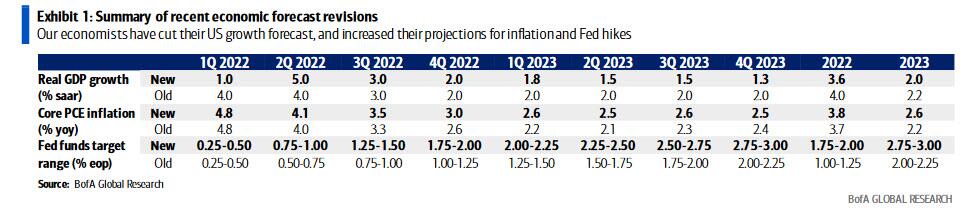
... BofA chief equity strategist Savita Subramanian - who maintains her 4,600 year-end S&P price target for reasons she explains below - writes that "the pivot from super dovish to more hawkish policy underscores that we are at the point of peak liquidity" as the Fed is now more focused on containing the inflationary conflagration that has been sparked by Biden's out of control spending.
What is remarkable, and summarizing the findings from Matt King's seminal note from last month, Savita notes that seven hikes doesn’t even get us to a “neutral” rate, "which is why a move to 1.75% on the Fed Funds rate this year is, in our economists’ view, entirely warranted." She is, of course, right when discussing the economy. The far bigger question is how many hikes can the market sustain without breaking. That is the $64 trillion question.
But beyond mere balance sheet reduction, Subramanian notes that other factors are more concerning: according to BofA, the key risk to stocks from a Fed hiking cycle remains that the Fed is embarking on a hiking cycle into an overvalued market, in fact as Michael Hartnett showed last Friday, the only time stocks were more overvalued entering a rate hike cycle was 1999.
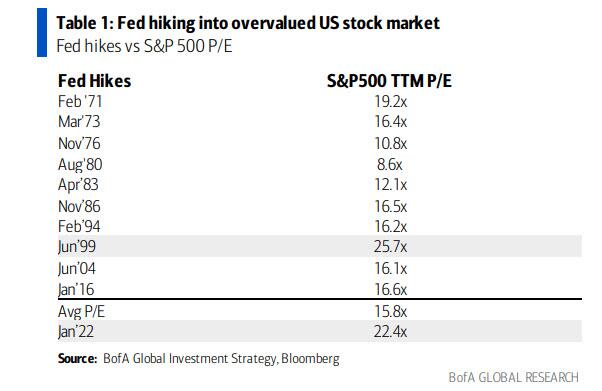
As BofA reminds us - tongue in cheek - "this ended poorly last time (1999)."
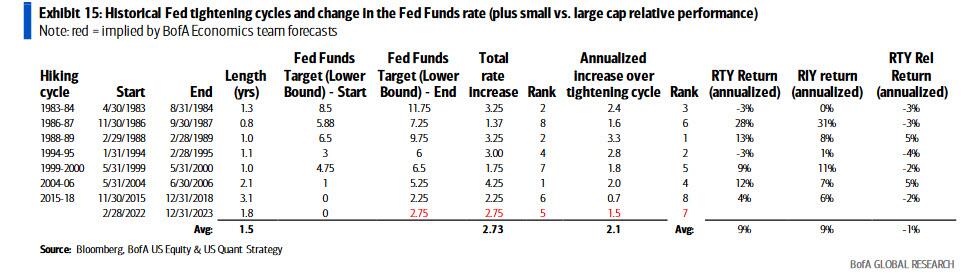
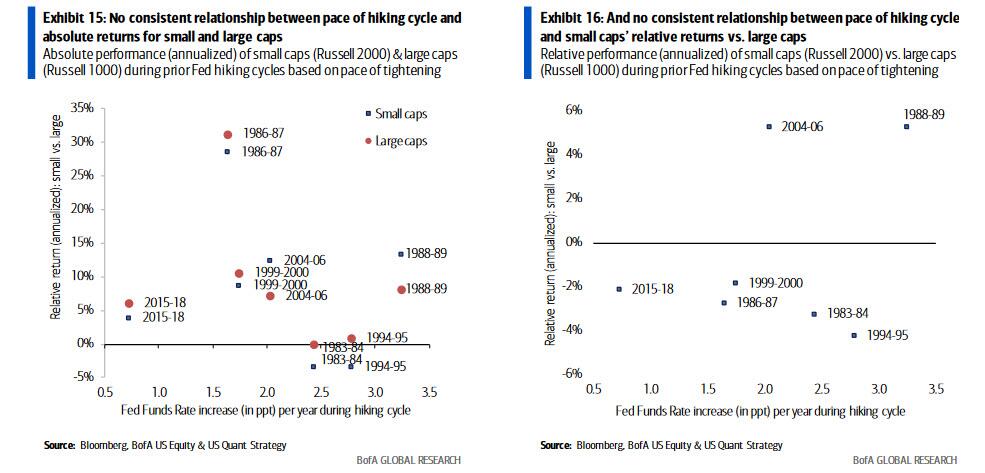
Of course, it's not just risk that overly aggressive rate hikes send stocks tumbling: QT itself will have a far bigger impact on risk assets than mere rate hikes; as Savita explains, Fed Fund rates alone have no significant relationship to US equity returns (we disagree but here is her evidence)...
Despite our economists forecasting a faster pace of hiking than the market is pricing in (with their call for seven hikes this year and four next year), this would still be one of the slowest tightening cycles in history (implying a 1.5ppt annualized rise in the Fed Funds rate vs. a 2.1ppt average annualized rise in prior tightening cycles), with the total increase in the Fed Funds rate in-line with the average for prior tightening cycles.We find no consistent relationship between the pace of hiking and the absolute or relative performance of large and small caps (charts below)
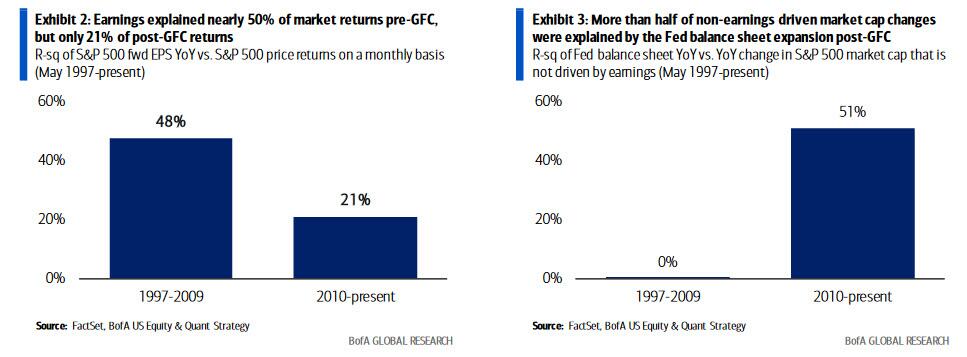
... and "what matters more is quantitative tightening, its effect on 10-yr yields and, of course, earnings." But QT is likely to take center stage in 2022 given that as BofA shows below, Fed balance sheet increases have explained more of S&P 500 returns than earnings post-GFC.
So in light of all this why isn't Savita predicting a far lower year-end price target for the S&P? After all, her BofA colleague Michael Hartnett will not rest until the S&P tumbled well below 4,000 (which he believes is the strike price on the Fed put).
The reason, according to the BofA strategist, is that she views her 4,600 price target as conservative - at least in the context of far more bullish Wall Street peers - and notes that her liquidity framework "suggests muted returns from here – 4600 on the S&P 500 by year end, and just +1.5%/yr over the next three years based on YoY Fed balance sheet change and +2.8%/yr based on rate of change."

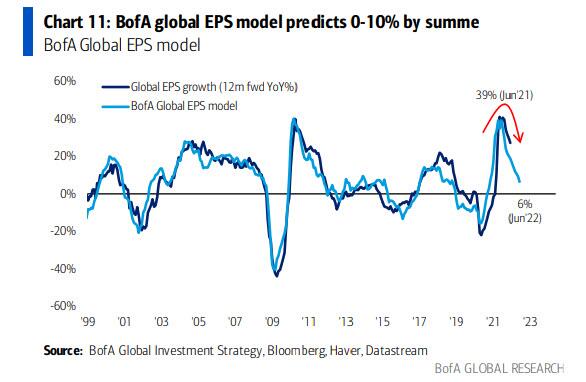
Additionally, she expects EPS growth to slow to 6.5% this year from 48% in 2021; as a reminder, Hartnett is far more bearish, and in his latest Flow Show noted that the probability of global EPS turning negative in H2 is 40% and rising.
Addressing this question directly, Savita writes that she maintains her "year-end target of 4600 based on our five-factor target outlook incorporating valuation, sentiment, fundamentals and technical factors, and we believe that risks to equities would be greater if the Fed did nothing."
Still, since her job in this particular case is to explain to the bank's client why 7 rate hikes does not translate to a market crash, one specific reason why the BofA strategist remains relatively bullish (if only because she was told to be), is that according to her, the public to private sector liquidity hand-off pushed combined consumer/corporate cash to >$19T+, which would shift from generating no return to a healthier ~2ppt returns. She explains:
Following a ~$11T increase in the Fed balance sheet and money supply (M2), the Fed and US government successfully injected much needed liquidity into the system and saved the world. Now, the consumer and corporates are sitting with a record $19T in cash, a 35% increase from 2019.

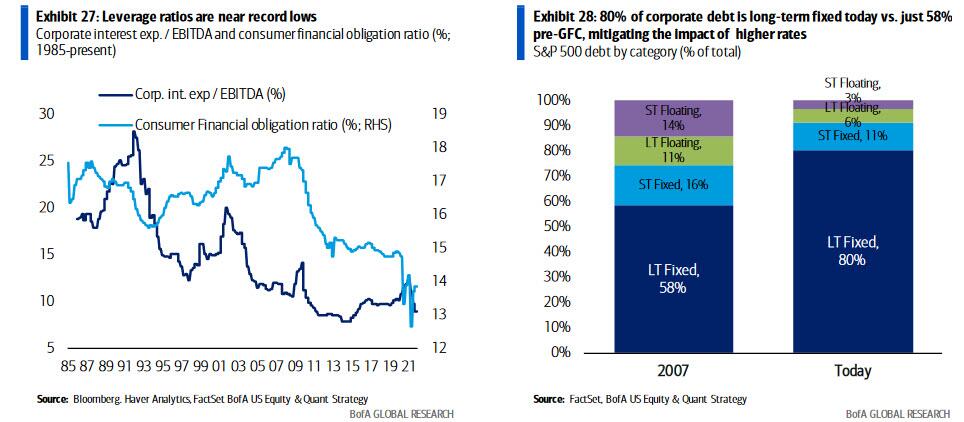
Naturally more cash is better than less cash, and as Savita extrapolates, "balance sheet strength is bullish for the real economy. The financial crisis taught corporates and consumers about the risks of leverage and the unsustainable leverage that we saw during the financial crisis is nonexistent today and bloated leverage ratios post-recessions are non-existent today." While we disagree here because the big variable is the trillions in excess reserves that have been injected into banks and thus any sharp decline in reserves will act to dramatically destabilize banks (as we saw in Sept 2019), BofA claims that banks, as a proxy, "are better capitalized than ever, and are expecting to see loan growth in 2022." Meanwhile, corporates locked in long-dated debt obligations at low fixed rates, with the mix of long-term fixed debt now 80% vs. 58% pre-GFC. The upshot from all this - and we agree with this - rising rates may not hurt for a while.
What will companies do with the excess cash? BofA expects more capex, R&D spend and dividend raises than buybacks, while consumers are likely to ramp up spending in services in 2022 given that durable goods spending accelerated post-COVID leaving more pent-up demand for services.
Clearly showing just how much she stretched the goalseek function in excel to come up with some more favorable "benefits" from higher rates, Savita goes so far as to praise the generous benefits that higher rates will confer on - wait for it - interest income!
A higher cash yield translates in additional interest income, and we estimate a 0.8% tailwind to S&P 500 EPS from a 90bp YoY increase in the Fed funds rate (house forecast for average 2022), all else equal. And we see a smaller headwind from higher interest expense, as 80% of corporate debt has long-term fixed rates today, compared to just over 50% prior to the GFC.

Right... just ignore interest expense.
There is one more argument brought up by Savita as to why higher rates will boost risk assets, and it has to do with the strong, significant relationship between S&P 500 Price to Earnings ratios and CPI, where higher inflation usually translates into lower multiples...
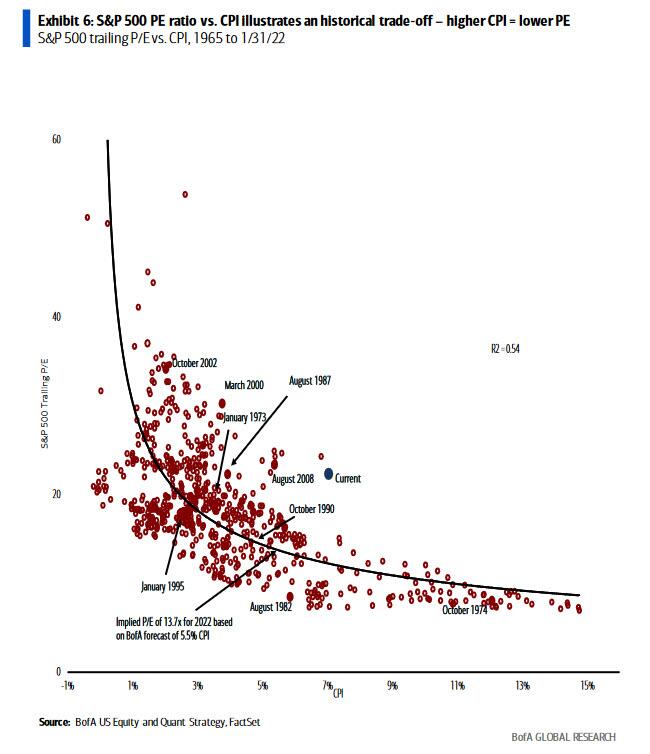
... which is hardly a surprise, but what is amazing is how the BofA chief equity strategist actually manages to spin this as a positive.
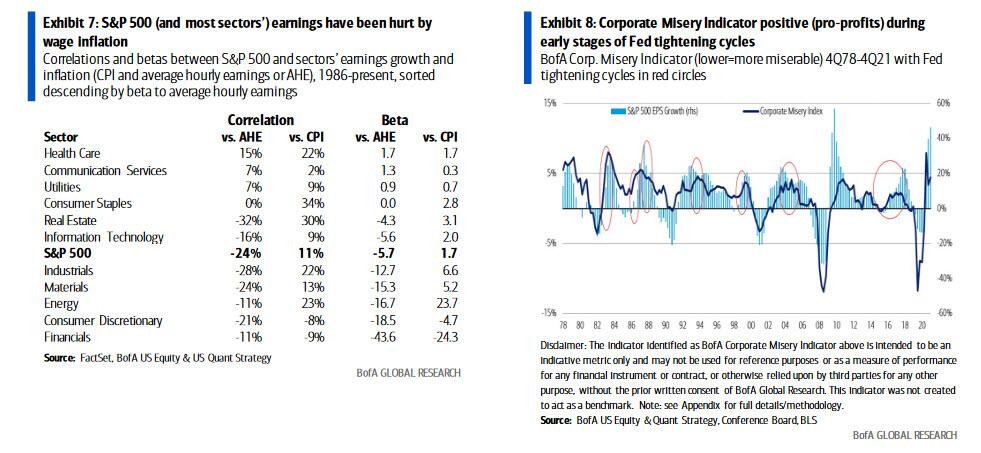
As she says, one reason is that S&P 500 earnings are positively correlated with CPI. But S&P 500 EPS are negatively correlated with wage inflation (Exhibit 7). Moreover, the bank's Corporate Misery Indicator, a macro model that has led the profits cycle, remained positive during the early and mid-stages of Fed tightening cycles indicating that the Fed’s attempt to control inflationary pressures was either (a) positive for margins, (b) not enough to derail demand, or (c) some combination of the two (Exhibit 8)
In other words, and this is some truly remarkable logical gymnastics, she concludes that "if the Fed is hiking rates to control inflation, that’s positive for equities" as runaway inflation would likely compress S&P 500 multiples and cut into earnings; and if inflation moderates significantly, the Fed has signaled it will adapt its policy on a real-time basis.
And that's how you just take your first step toward "validating" Erdoganomics, or in this case that rate hikes are actually positive for stocks.
Yet while we commiserate with Savita for having been told to somehow spin the bank's forecast of 7 rate hikes into a non-apocalyptic outcome, not even she can avoid the reality that what comes next will be painful, and while one can ignore rate hikes (we wouldn't), just focusing on the bank's "QT model" suggests far more muted returns from here, which according to Savita translates to 4600 on the S&P 500 by year end (a far more bearish Morgan Stanley is at 4,400 just so readers get a sense of what Wall Street's bears have to work with; the bulls are all 5,000 and higher), and low single digit returns over the next two years.
That said, even Savita admits that if inflation continues to surprise to the upside, "the strong negative relationship to PE multiples is worrisome. Moreover, EPS growth for the S&P 500 and most sectors has been inversely correlated with changes in wage inflation." Finally, the bank forecasts a demonstrable slowdown in EPS growth from 48% in 2021 to 6.5% in 2022, a number which Subramanian's colleague Michael Hartnett believes will turn negative in the second half.
And while other notable Wall Street voices, including Morgan Stanley’s Michael Wilson, (see "Wall Street's Most Bearish Analyst Warns Of "Calamitous" Collapse In First-Half Earnings") share BofA's modest pessimism, the assessment is by no means the consensus view. JPMorgan Chase & Co.’s team reiterated on Monday that growth will remain solid this year and with still more upside for equities, following the ferocious rally of 2021. Then again, since it is JPM's mandate to remain the fluffer of the Biden/Powell regime until the bitter end, we would urge all to discount what Jamie "Bitcoin is a worthless fraud" Dimon's bank has to say about the future.
Lagarde signals ‘gradual’ shift in ECB policy to tackle record inflation
ECB president says ‘real chance’ rate will stabilise at 2 per cent target
Christine Lagarde, the European Central Bank president, has played down the chances of a “measurable tightening” of monetary policy to tackle this year’s record eurozone inflation, saying any shift would be gradual.
With financial markets pricing in an interest rate rise in June, Lagarde told the European Parliament on Monday that the ECB saw “no need to rush to any premature conclusion at this point in time — the outlook is way too uncertain”.
Her comments were more cautious than last week when she sparked a sell-off in eurozone bond markets by refusing to rule out a potential rate rise this year and saying there was “unanimous concern” about inflation on the ECB governing council.
However on Monday Lagarde also said she no longer expected inflation to fall below its 2 per cent target by the end of this year.
Eurozone inflation defied expectations for a decline at the start of this year by rising to a record of 5.1 per cent in January. Lagarde said it would “continue to be high in the near term” before declining over the course of the year.
Lagarde said there was “a real chance inflation will stabilise” at the 2 per cent target, which she said would lead to a “normalisation of our monetary policy”.
The ECB’s governing council next meets in March. If it was confident then that inflation would remain at the target over the next two years, Lagarde said, it would “take the necessary decision”. That would include “gradually reducing” its asset purchases, which it has used to deliver added stimulus to the eurozone economy, and then “hiking interest rates”.
Carsten Brzeski, head of macro research at ING, said Lagarde had “tried to put the hawkish genie back into the bottle after an aggressive repricing in markets following Thursday’s ECB meeting”.
Eurozone government bond prices continued to fall on Monday, pushing up the borrowing costs of some southern European countries, such as Greece, back to pre-pandemic levels. Bond prices fall as yields rise.
The spread between Italian 10-year borrowing costs and those of Germany — a key measure of stress in eurozone bond markets — rose to 1.63 percentage points, its highest level since July 2020.
Frederik Ducrozet, a strategist at Pictet Wealth Management, said: “The lack of change in tone in the face of a significant re-pricing in rates markets is in itself an important signal.”
He predicted the ECB was likely to raise rates for the first time in September or December, after having ended its net asset purchases in the third quarter. The bank last raised rates in 2011.
Lagarde was asked repeatedly by MEPs whether the ECB would intervene to curb the rise in borrowing costs for peripheral eurozone countries.
She said: “We will use any tools, any instruments that are needed in order to make sure that our monetary policy is properly transmitted throughout the whole euro area, to all member states.”
The ECB president also emphasised that the eurozone economy had no “labour market overheat” — unlike the US or UK. She said it was in a “completely different” situation in terms of the size of its fiscal stimulus, the strength of demand and the level of core inflation, which excludes energy and food prices.
Eugen Jurzyca, a Slovakian MEP, said: “People are genuinely worried about what will happen in the upcoming months as inflation has been much higher than predicted and governments face tough questions of whether they should respond with compensation measures.”
Peter Thiel plans to leave board of Facebook owner Meta
Billionaire tech investor will focus on ‘political endeavours’ as he promotes Trump-aligned candidates
Peter Thiel will not seek re-election to the board of Facebook’s owner Meta later this year, the social media group said on Monday.
Thiel, a billionaire tech investor and Silicon Valley’s most prominent supporter of the former president Donald Trump, took the decision in order to focus on “political endeavours” and “avoid that being a distraction for Facebook”, said a person familiar with his thinking.
Thiel intends to focus his support on Republicans aligned with Trump’s agenda, such as Blake Masters and JD Vance, who are seeking election to the Senate in the 2022 midterm elections, the person said.
“It has been a privilege to work with one of the great entrepreneurs of our time. Mark Zuckerberg’s intelligence, energy, and conscientiousness are tremendous,” Thiel said in a blog post from the company. “His talents will serve Meta well as he leads the company into a new era.”
Thiel, a close confidante of chief executive Zuckerberg, was the first outside investor in Facebook, and has sat on the board since 2005. He has made more than $1bn from selling its shares.
But Thiel’s presence on Facebook’s board has long been considered controversial by some because of his political affiliations — especially as the social media company has been criticised over how it handles political speech and misinformation. Republicans have accused it of censoring conservative voices, while Democrats argue it does not adequately police content.
According to a report from the Wall Street Journal, Thiel helped foment divisions on Facebook’s board after lobbying Zuckerberg to continue to run political advertising, and not fact check those adverts, ahead of the 2020 election. Zuckerberg resisted public pressure to fact-check political ads but eventually placed a temporary ban on political advertising around the election to curb the spread of misinformation.
Facebook also banned Trump from the platform last year for repeatedly breaching its rules over violent speech and misinformation, in the wake of the January 6 assault on the Capitol.
“Peter has been a valuable member of our board and I’m deeply grateful for everything he has done for our company,” Zuckerberg said in the statement. “Peter is truly an original thinker who you can bring your hardest problems and get unique suggestions.”
The news comes just a week after the company lost more than $200bn in market value after reporting falling profits and user numbers in its latest earnings report.
Thiel, 54, in 2016 gave more than $1mn to pro-Trump groups and has been supporting the Republican Party throughout 2021, donating about $86,000 to the National Republican Congressional Committee and Republican leadership committees.
He has also recently become a major donor to a new, younger crop of rightwing populists, some of whom are part of his venture capital network.
These include Masters, who also runs Thiel’s multibillion-dollar tech investment firm, Thiel Capital, as well as his non-profit Thiel Foundation, and is now running for a US Senate seat representing Arizona. Last year Thiel gave $10mn to a political action committee supporting Masters, plus $5,800 directly to his campaign.
Thiel also donated $10mn to a committee supporting Vance, an author and venture capitalist, for his Senate race in Ohio, and $3,000 directly to Vance’s campaign. Vance used to work as a principal for Mithril Capital, another venture capital group that Thiel co-founded.
The Thiel-funded committees have not been afraid of aggressive campaign tactics. Last September the Saving Arizona committee launched its first television advertisement, excoriating Mark Brnovich, the Republican attorney-general, for certifying Joe Biden’s electoral victory in the state in 2020.
Masters and Vance have been critical of Big Tech, and have singled out Facebook for “election meddling”.
Separately, Thiel faced scrutiny last month following a report that Founders Fund, another venture capital group he co-founded, had invested in a company claiming to have developed a way to hack Meta-owned encrypted messaging app WhatsApp.
After Hours Summary: CHGG +9.2%, TDC +7.1% higher on earnings; VLDR +70.3% jumps as it issues warrants to AMZN; SLQT -35.7%, SPG -2.6%, TTWO -2.3% fall on earningsAfter Hours Gainers:
Companies trading higher in after hours in reaction to earnings/guidance: CHGG +9.2%, TDC +7.1%, ACLS +2.2%, ACM +0.9%, LEG +0.4%, DHT +0.2%, PDM +0.2%, DAC +0.2% (also increases quarterly dividend 50% to $0.75/sh), SSD +0.1%, VRNS +0.1%, TFII +0.1%
Companies trading higher in after hours in reaction to news: VLDR +70.3% (issues warrants to AMZN, allwoing AMZN to acquire up to 39.6 mln shares), BOWL +4.7% (approves $200 mln share and warrant repurchase program), AXSM +3.2% (provides update regarding AXS-07 program), ALGN +1% (settles patent litigation with 3Shape A/S), NRP +0.9% (DEN and NRP enter into CO2 sequestration agreement), GD +0.7% (awarded $229 mln US Army contract), BIIB +0.2% (announces commercialization and license agreement with Xbrane Biopharma for biosimilar referencing CIMZIA), NETI +0.1% (signs new contract award for Seajacks), GKOS +0.1% (names new COO), AAPL +0.1% (acquires startup AI Music, according to Bloomberg)
After Hours Losers:
Companies trading lower in after hours in reaction to earnings/guidance: SLQT -35.7% (faced a series of unexpected challenges in its core Senior segment), SPG -2.6%, TTWO -2.3%, ASTE -1.1%, AMGN -0.9%, AOSL -0.6%, KMT -0.1%, NUAN -0.1%
Companies trading lower in after hours in reaction to news: EHTH -9.3% (in sympathy with SLQT earnings miss), EDIT -6.8% (terminates CMO), RTX -2.1% (three senior execs in missiles division have departed, according to Bloomberg), FB -0.3% (Peter Thiel to step down from board at next shareholder meeting), TGI -0.3% (awarded new contract with Airbus for primary thermal acoustic system on A220 aircraft), AIR -0.2% (announces 10-yr extension of component MRO agreement with Intl Aerospace Mgmt), NVST -0.1% (renews commercial partnership with Vitaldent Group), HOMB -0.1% (purchases marine loan portfolio for approx. $238 mln)
Closing Stock Market SummaryThe S&P 500 declined 0.4% on Monday amid some slippage in the last 45 minutes of action, which erased a 0.5% gain for the benchmark index. The Nasdaq Composite fell 0.6% after being up 1.0% intraday. The Dow Jones Industrial Average (unch) closed flat, while the Russell 2000 outperformed with a 0.5% gain.
For most of the day, there wasn't a lot of trading conviction as the major indices, and most S&P 500 sectors, wavered between gains and losses. Investors continued to contemplate whether the market bottomed on Jan. 24 in the face of rising rates and the Fed's tightening plans.
Trading conviction was reserved for the energy (+1.3%) and communication services (-2.3%) sectors, which diverged in opposite directions, as well as individual story stocks.
Energy stocks outperformed as oil prices stayed above $90 per barrel ($91.27, -1.03, -1.1%), although WTI crude futures did settle on a lower note today. The communication services sector was dragged lower by weakness in Alphabet (GOOG 2778.76, -81.56, -2.9%) and Meta Platforms (FB 224.91, -12.18, -5.1%).
Generally, there was a preference for value/cyclical stocks over the growth stocks. The Invesco S&P 500 Equal Weight ETF (RSP 155.83, +0.10) increased 0.1% -- as did the Russell 3000 Value Index (+0.1%) -- while the Vanguard Mega Cap Growth ETF (MGK 233.18, -2.08) fell 0.9%.
One of today's bigger stories was the airline merger between Spirit (SAVE 25.46, +3.73, +17.2%) and Frontier (ULCC 12.82, +0.43, +3.5%), valued at $6.6 billion in cash and stock, including net debt and operating leases. On a related note, both companies reported better-than-expected EPS results.
On Semiconductor (ON 62.26, +4.84, +8.4%) and Tyson Foods (TSN 99.09, +10.80, +12.2%) also exceeded earnings expectations while Peloton (PTON 29.75, +5.15, +20.9%) jumped 21% on reports indicating that Amazon.com (AMZN 3158.71, +5.92, +0.2%) and Nike (NKE 145.14, -0.25, -0.2%) are interested in acquiring the company.
U.S. Treasury yields settled slightly lower amid a warning from National Security Adviser Jake Sullivan that Russia could invade Ukraine "any day now." The 2-yr yield declined three basis points to 1.29%, and the 10-yr yield declined one basis point to 1.92%. The U.S. Dollar Index declined 0.1% to 95.42.
Reviewing Monday's economic data:
- Consumer credit increased by $18.9 billion in December ( consensus $25.0 billion). The prior month saw a downward revision to $38.9 bln from $39.9 bln.
- The key takeaway from the report is that the increase in consumer credit in December was driven mostly by an expansion in nonrevolving credit.
Looking ahead, investors will receive the Trade Balance report for December on Tuesday.
- Dow Jones Industrial Average -3.4% YTD
- S&P 500 -5.9% YTD
- Nasdaq Composite -10.4% YTD
- Russell 2000 -10.4% YTD