FT : Deglobalisation is boosting foreign exchange volatility

Deglobalisation is boosting foreign exchange volatility
Currency swings will continue until globalising forces, such as resilient supply chains, resume

Foreign exchange markets have this year been jolted by a sudden increase in volatility. There are many reasons for this, but at the heart of the shift is deglobalisation.

To understand why, consider first the opposite. In a hypothetical, perfectly globalised world, there would be no barriers to international trade, meaning goods could be produced in one country and transported to the other without cost or friction.

Let us focus on Japan and the US in our hypothetical world, and suppose that each country produces goods called widgets of identical quality. In such a world the real foreign exchange rate cannot deviate from 1.0. That is because if the cost of a Japanese widget expressed in dollars were cheaper than a US-produced version, traders in international goods markets would buy more Japanese widgets, put them on ships and sell them in the US. The traders would continue until the arbitrage opportunity is competed away, forcing the real foreign exchange rate back to 1.0. Therefore there is little, if any, volatility in the real exchange rate.

Since the coronavirus pandemic hit in 2020, the world we have been moving towards resembles our hypothetical world much less. The Global Supply Chain Pressure index produced by the Federal Reserve Bank of New York measures global transportation costs and other supply chain pressures. It has moved to the highest levels that we have seen.

This is just one component of what is broadly being labelled “supply constraints”. Correspondingly, we are seeing somewhat dramatic variations in the real exchange rate.


The yen may weaken and Japan may continue to run with lower inflation than the US. But with transportation costs so high, and with Covid-19 and other supply chain disruptions, it becomes more difficult for traders and business to take advantage of a cheap yen exchange rate. With such reduced demand, the yen is more vulnerable. The trade-weighted level of the yen has weakened by about 10 per cent in 2022 in real terms (after accounting for inflation), and by 20 per cent since the start of 2020. Our hypothetical world would not have seen such volatility.

A second source of the high currency volatility we are experiencing comes from divergence in central bank policy rates, which are in turn driven by divergent international economies.

The pandemic-driven economic collapse in 2020 and vaccine-driven recovery in 2021 were internationally shared experiences. During this period, there was broadly no reason for central banks across developed market economies to take different policy paths. But, this year, a divergence has begun.

This is normal after a crisis: economies should be expected to react and cope with their respective debt burdens in different ways. However, the energy price shock — spurred on by the war in Ukraine — has created further divergences, with energy importers such as Europe, Britain and Japan suffering a negative impact, while energy-neutral countries such as the US have fared better.


Markets are pricing in a total of 250 basis points of rate rises by the US Federal Reserve in 2022, compared with 100 basis points from the European Central Bank, 180 basis points from the Bank of England and potentially none at all from the Bank of Japan.

Even in our hypothetical world, in which real foreign exchange rates are fixed, such divergence would cause volatility in nominal spot rates. The reason is that more interest rate rises bring down inflation expectations, thereby lifting the future purchasing power of the currency. With the Federal Reserve leading the way, it is no surprise that contracts to exchange the euro, sterling and yen at a future date have all moved substantially in favour of the dollar. And spot rates are trading at even higher premiums than usual to these forward rates because of higher US interest rates.

This has been the lesson from history. Foreign exchange volatility remained broadly contained relative to what was seen in equity, interest rate and credit markets during the 2008-10 financial crisis. Yet between 2011 and 2017, we saw numerous idiosyncracies, such as the European sovereign debt crisis, Abenomics and the Brexit referendum.

In 2017, currency fluctuations eased. But we are once again in a period of macro divergences. Until globalising forces re-emerge, the post-pandemic world will remain one of high foreign exchange volatility.

FT : Is America heading for civil war?

Is America heading for civil war?
A clutch of books makes an alarmingly persuasive case that the warning lights are flashing redder than at any point since 1861

In the summer of 2015, America caught a glimpse of how its future could unfold. The US military conducted a routine exercise in the south that triggered a cascade of conspiracy theories, particularly in Texas. Some believed the manoeuvre was the precursor to a Chinese invasion; others thought it would coincide with a massive asteroid strike. The exercise, called Jade Helm 15, stood for “homeland eradication of local militants”, according to one of the right’s dark fantasy sites. Greg Abbot, Texas’s Republican governor, took these ravings seriously. He ensured that the 1,200 federal troops were closely monitored by the armed Texas National Guard. In that bizarre episode, which took place a year before Donald Trump became the Republican nominee for president, we see the germs of an American break-up.

As with any warning of impending civil war, the very mention of another American one sounds impossibly alarmist — like persistent warnings from chief Vitalstatistix in the Asterix comic series that the sky was about to fall on Gaulish heads. America’s dissolution has often been mispredicted.

Yet a clutch of recent books make an alarmingly persuasive case that the warning lights are flashing redder than at any point since 1861. The French philosopher Voltaire once said: “Those who can make you believe absurdities can make you commit atrocities.” As the University of California’s Barbara Walter shows in her bracing manual, How Civil Wars Start, US democracy today is checking all the wrong boxes.

Even before Trump triumphed in the 2016 presidential election, political analysts were warning about the erosion of democracy and drift towards autocracy. The paralysing divisions caused by Trump’s failed putsch of January 6, 2020, has sent it into dangerous new territory. Polls show that most Republicans believe, without evidence, that the election was stolen by Democrats backed by the so-called “deep state”, the Chinese government, rigged Venezuelan voting machines, or a feverish combination thereof.

In This Will Not Pass, a book by New York Times reporters Jonathan Martin and Alexander Burns, Joe Biden is quoted telling a senior Democrat: “I certainly hope [my presidency] works out. If it doesn’t I’m not sure we’re going to have a country.” That a US president could utter something so apocalyptic without raising too many eyebrows shows how routine such dread has become.

In 1990, the CIA correctly forecast that Yugoslavia would break up within two years because its politics was hardening into ethnic factions. In 2022, America’s two parties are increasingly sorted along racial and identity lines. Republicans are white, small town and rural — the party now holds just one truly urban congressional district in New York’s Staten Island. Democrats are now almost entirely urban and multi-ethnic. The habits of a normal democracy in which the losing party forms a loyal opposition are vanishing.

More than a third of Republicans and Democrats today believe violence is justified to achieve their political ends, compared with less than a tenth apiece in 2017, the year Trump took office. His rhetoric opened the floodgates to separatist feelings. When one party loses, its voters feel as though their America is being occupied by a foreign power. America, Walter points out, has become “a factionalised anocracy” — the halfway state between autocracy and democracy — that is “quickly approaching the open insurgency stage”. Violence stalks America’s political language. As Stephen Marche, a Canadian novelist, writes in The Next Civil War, a richly imagined jeremiad about America’s coming disunion, the country “is one spectacular act of violence away from a national crisis”.

How did America reach this pass? Take your pick of grim milestones — Newt Gingrich’s scorched earth approach to his term as polarising speaker of the House of Representatives in the 1990s, the Supreme Court’s 5-4 ruling that handed the 2000 election to George W Bush, America’s unhinged response to the 9/11 terrorist attacks, the FBI’s fateful probe into Hillary Clinton’s almost comically trivial emails, Democrats attributing Trump’s win to Vladimir Putin, Trump’s attempt to uproot every guardrail within reach, or Congress’s failure to unite on the need to punish a violent assault on itself. America’s democratic backsliding is like Ernest Hemingway’s famous observation on going bankrupt: “Gradually then suddenly.”

Burns and Martin provide a diligently researched and often illuminating chronicle of America’s recent political degeneration. Much of it boils down to the absence of character. As the dust settled on last year’s Capitol Hill assault — composed of an almost entirely white rabble of retired policemen, nurses, property developers, doctors, lawyers and small-business owners carrying confederate flags, nooses, Smith & Wesson handguns, stun devices, firecrackers, handcuffs, chemicals and knives — Republican leaders breathed a sigh of relief. The Capitol may have been littered with glass; its corridors smeared with fecal matter. But the Trumpian spell had been broken. This “despicable human being” had “finally discredited himself”, said Mitch McConnell, the Republican Senate leader. Kevin McCarthy, his counterpart in the House, said Trump’s actions were “atrocious and totally wrong”.

Three weeks later, McConnell voted to acquit Trump for what he had called a “failed insurrection”. McCarthy backtracked even more, heading to Mar-a-Lago, Trump’s Florida retreat, to renew his fealty. In the intervening weeks, he had concluded that his only pathway to becoming Speaker was with the blessings of the disgraced ex-president. “Trump was on life support,” said Adam Kinzinger, one of just 10 Republicans who voted to impeach him. “He [McCarthy] resuscitated him.” The authors brand McCarthy as “perhaps the most ingratiating figure” in the Republican party. There is fierce competition for that honour; South Carolina’s Lindsey Graham, among others, is hard on McCarthy’s heels.

It was not absurd to hope that Biden’s folksy touch would lower America’s fever. It was nevertheless forlorn. America is even more bitterly separated into imagined rival nations that it was under Trump. Biden did not help matters by promising to restore bipartisan normalcy — a pious hope shredded under Barack Obama — while also vowing to be a transformative Franklin Roosevelt-style president. With a 50:50 Senate, this was never realistic. Joe Manchin, the obstinate West Virginia Democrat, who has blocked Biden’s big reform bills, did not hold the balance of power in FDR’s Washington.

Democrats thus retreated into their by-now routine ethnic division of spoils. Biden treated his cabinet selection as an “identity politics Rubik’s Cube”, write Burns and Martin. Far from dangling the hope of a new generation, his vice-president, Kamala Harris, has been “fixated on real and perceived snubs in ways the West Wing found tedious,” they write. Their party faces likely decimation in this year’s midterm elections in November, which will set up a crushingly depressing 2024 rematch between Biden and Trump. A popular Trumpian T-shirt says: “I’d rather be a Russian than a Democrat”.

More seriously, the number of rightwing militias in the US has exploded in recent years. White supremacist sentiment has also penetrated US law enforcement agencies, says Walter. The numbers of armed potential insurgents is a multiple of the left insurgent groups, such as the Black Panthers, and Symbionese Liberation Army, that caused such panic in the early 1970s.

How would a 21st century US civil war actually happen? Nothing like the first time. Unlike the 1860s, when America was neatly split between the slave-owning confederates and the north, today’s separatist geography is marbled. Unlike then, America’s armed forces today cannot be outgunned. Even in a country that, uniquely, has more privately owned guns than people (at more than 400mn), many of which are military-grade, it would be no contest. Yet America, of all countries, knows that asymmetric warfare is unwinnable. Think of Vietnam, Iraq and Afghanistan.

Think, also, of how America was born — its revolutionary army lost almost every encounter with Britain’s vastly better equipped redcoats. Yet, with the help of the French, America’s guerrilla forces prevailed. Now substitute today’s federal army for the redcoats. Armies have a terrible record of pacifying restive populations. Every casualty breeds 10 more rebels.

“They will slip in and out of the shadows, communicating on message boards and encrypted networks,” writes Walter. “They will meet in small groups in vacuum-repair shops along retail strips. In desert clearings along Arizona’s border, in public parks in southern California, or in the snowy woods of Michigan, where they will train to fight.”

Walters’ book lays out America’s possible roads to dystopia with impressive concision. Her synthesis of the various barometers of a country heading to civil war is hard to refute when applied to the US. But she mars her case with a number of basic errors. Nowhere near 60 per cent of the world’s countries are “full” democracies, as she claims. Nor is India a “strictly secular democracy”. Its constitution celebrates rather than shuns all religions. Her book is nevertheless indispensable.

None of the writers offer a simple antidote for America’s continued democratic slide. Their remedies — find ways of making multi-ethnic democracy work, get money out of politics, teach civics to American children — have the air of wishful afterthoughts, rather than serious game plans.

Though Canadian, Marche is poignantly aware of the degree to which global liberty rides on what happens to America. In spite of its inaugural hypocrisies, no other nation was founded on the creed that it could live with — and indeed thrive on — fundamental differences between strangers. Marche concludes with these stirring words: “It would be a lie, an evil lie, to say that the American experiment did not give the world a glorious and transcendent vision of human beings: worth affirming in their differences, vital in their contradiction. That is still a vision of human existence worth fighting for.”

Yet the warning signs have become impossible to ignore. At the end of their book, Burns and Martin quote Malcolm Turnbull, Australia’s former prime minister, on America’s tendency to self-sooth with familiar homilies. They are no longer helpful. “You know that great line that you hear all the time: ‘This is not us. This is not America?’” Turnbull asks. “You know what? It is actually.”
WSJ : Germany’s New Defense Deal

Germany’s New Defense Deal
Berlin reaches consensus on more military spending—for now.

One big question facing the North Atlantic alliance after Russia’s invasion of Ukraine is whether Germany is serious about Chancellor Olaf Scholz’s pledge to rearm Europe’s largest country. An answer of sorts emerged Sunday evening, and allies will be somewhat reassured.

Mr. Scholz in late February promised rearmament after 30 years of underinvestment in the German military. The centerpiece of his “turning point” in foreign policy was a twin commitment to create a €100 billion ($108 billion) special fund for defense procurement and to spend 2% of gross domestic product on defense in line with the North Atlantic Treaty Organization goal.

It was an ambiguous promise. Mr. Scholz didn’t clarify whether he intended to create the special procurement fund in addition to reaching the 2% goal, or whether money from the special fund would be used to top up the annual budget to hit 2%. He also hedged on how the procurement fund might be spent. Berlin has committed to buy 35 American-made F-35 fighter jets to bolster Germany’s contribution to NATO’s nuclear deterrence, but calls have been growing to divert some of the money to boondoggles such as foreign aid.

Now Germany’s four main political parties have decided what Mr. Scholz meant. A deal reached Sunday among the three ruling parties (Mr. Scholz’s Social Democrats, the Greens, and the Free Democrats) as well as the opposition Christian Democrats paves the way for a constitutional amendment creating the special procurement fund.

Allies will be relieved that Berlin’s hawks have ring-fenced the special fund for genuine military procurement. Partly they’ve done this by setting aside even more money for worthy defense purposes. Foreign Minister Annalena Baerbock of the Greens had argued for using some of the special fund for cyber defense. The four-party deal rebuffed that in favor of limiting the special fund to military hardware, but the deal promises additional spending from the regular budget for cybersecurity.

Yet this appears to have come at a political price related to the 2% goal. The agreement says this will be treated as a multiyear average target, meaning defense spending below 2% in some years can be offset by spending above 2% in others. In practice this will let Berlin count procurement financed by the €100 billion special fund toward the 2% goal.

This avoids the danger that using the special fund as a top-up would have exhausted that money in only four years. But it leaves open the question of Berlin’s commitment to hitting 2%, on average or otherwise, whenever the special fund runs out.

Allies can still count Berlin’s political agreement as a step forward. It demonstrates a broad consensus in favor of rearmament, and Germany’s noisy pacifist movement for once failed to water down defense commitments. But the transformation Mr. Scholz promised requires a sustained attitude change in Berlin.

Having shown Germany can take the first budgetary step, now Berlin will need to take the next, and the step after that. The threat from Russia, and elsewhere, won’t end once the war in Ukraine does.

FT : Small businesses struggle to absorb soaring costs

Small businesses struggle to absorb soaring costs
Companies in Bristol are being forced to raise prices for customers

Stuart Hignell, who runs Bristol Gas Supplies, has known many of his customers in the English city of Bristol for years — he has a Polaroid photo of one of his elderly clients on the corkboard behind his desk — and is conscious that many are on fixed incomes.

But as petrol prices rise and the costs of delivering gas canisters around the city grow, Hignell is being forced to make a difficult choice: put up the prices for his customers or protect them by absorbing ever increasing costs.

“How can I turn around to these people and tell them their prices are going up?” he asked. “But something’s got to give — you can’t just keep sucking it in and sucking it in”.

Many small business owners are, like Hignell, struggling to absorb the impact of spiralling prices as UK inflation hits a 40 year high. Rising costs for energy and goods and services have become the top two concerns of businesses throughout the UK.

In June last year, only 30 per cent of UK businesses with 10-49 employees reported above normal input prices to the Office for National Statistics. By March of this year, the proportion had jumped to 57 per cent.


Many can no longer hold off passing these increases on to customers. Aleksis Gailans, who runs a costume hire company on the outskirts of Bristol, struggled to think of any product or service that his business uses which hasn’t gone up in price. While his company has “tried to hold off for as long as we can”, he said, it has had to begin passing on costs.

Gailans is not alone: around 41 per cent of UK businesses with between 10 and 50 employees indicated in late April that they have already begun increasing prices.

Matt Griffith, director of policy at Business West, the chamber of commerce for England’s western region, is in close contact with many enterprises in the area and is clear that they need to start recouping costs. Increasing prices is “the only route left” for many, he said. “Financially they have nowhere else to go.”

Vicky Lee, who heads the Bristol City Centre Business Improvement District, agreed. Many of the companies that she works with in the city centre cannot keep their costs down. They don’t have “the buying power, the strength to reduce cost per unit by purchasing on a larger scale”, she said.


She added that the shadow of the pandemic continues to affect many small businesses in the area. While they have managed to “bounce back quickly”, they had to borrow to keep going during the crisis. Debt repayments on these loans have further tightened margins and pushed businesses to raise prices.

Passing the increased costs on to customers has not been an easy decision for many small business owners, despite the challenges of the current environment, said Chris Jenkins, who has worked in Bristol’s wholesale fruit market for most of his life. In the face of steep transport costs, his company tried to become more efficient.

“We’ve got no excess staff whatsoever. All of us are working flat out all the time. And, we’ve just got no fat. It’s just been cut, cut, cut everywhere we can go to try and minimise costs”, he said, adding that there was “nothing else they can do” to keep prices down.

The knock-on effect of rising prices on consumer spending is another worry. Jeremy Kynaston managing director of No1 Harbourside, a bar, restaurant and live music venue situated on Bristol’s historic harbour, and two other venues in the city, acknowledged that people are just beginning to feel the increase in prices, but is hoping that they will continue to eat out.

“When people go out, they know it’s going to cost a little bit more, and it’s up to us to make sure we’re clever about our quality and standards”, he said.

However, Kynaston is worried about the impact the increase in the energy price cap in the autumn will have on his business. Ofgem predicts that household energy prices will increase by around 42 per cent in October, after a 54 per cent rise in April.

“It’s daunting — the October price rises. But we do have a plan at least. It’s better than having no plan at all,” said Kynaston.

To address the impact of spiralling energy prices on the cost of living, UK chancellor Rishi Sunak last week introduced a £15bn package of support. It included a one-off payment of £650 to around 8mn households in receipt of welfare payments.

But those further up the supply chain, such as Jenkins, are nervous that even with the extra government support, increasing energy prices will suck demand out of the local economy.

“Come November, December, they’re [households] really going to feel it,” he said. He added that the pressure on household budgets in the coming months may see the fruit he sells to retailers become “more of a luxury”. 

Most economists acknowledge that price pressures may get worse before they get better, but predict that the energy shock, pandemic supply chain impacts and higher interest rates will taper off quite rapidly from the start of next year onwards.

However, for Jenkins hope that a brighter period may lie ahead is hard to find.

“I’ve been in the job for all my life. I was born into it,” he said. “In all that time, you’ve always been able to see the light at the end of the tunnel. You can’t seem to see it now.”

(ZH) New IRS Data Reveals Florida Biggest Winner, New York Biggest Loser In Comp

New IRS Data Reveals Florida Biggest Winner, New York Biggest Loser In Competition For People & Their Wealth

Every year, states across the country compete with each other for people and their wealth as millions of Americans move between states. The stakes are large. A growing population for the winners means an increasing tax base, economic growth and investment. For the biggest losers, it means more difficulties in paying down debts, higher taxes and fewer investments for the future.
The nation’s most-recent winners of migration from other states are Florida and Idaho according to the latest migration data released by the IRS. Florida, the nation’s perennial winner, gained the most people and income overall in 2020, while Idaho gained the most of both on a percentage basis.
On the other end of the competition are states that have become perennial losers. States like California, New York, Illinois and New Jersey once again experienced some of the nation’s biggest losses of both residents and their money.

Those findings are based on a Wirepoints’ analysis of the latest 2020 domestic migration data provided by the Internal Revenue Service. The IRS reviews tax returns annually to track when and where people move. It also aggregates the ages, income brackets and adjusted gross incomes of filers.
Winners and losers
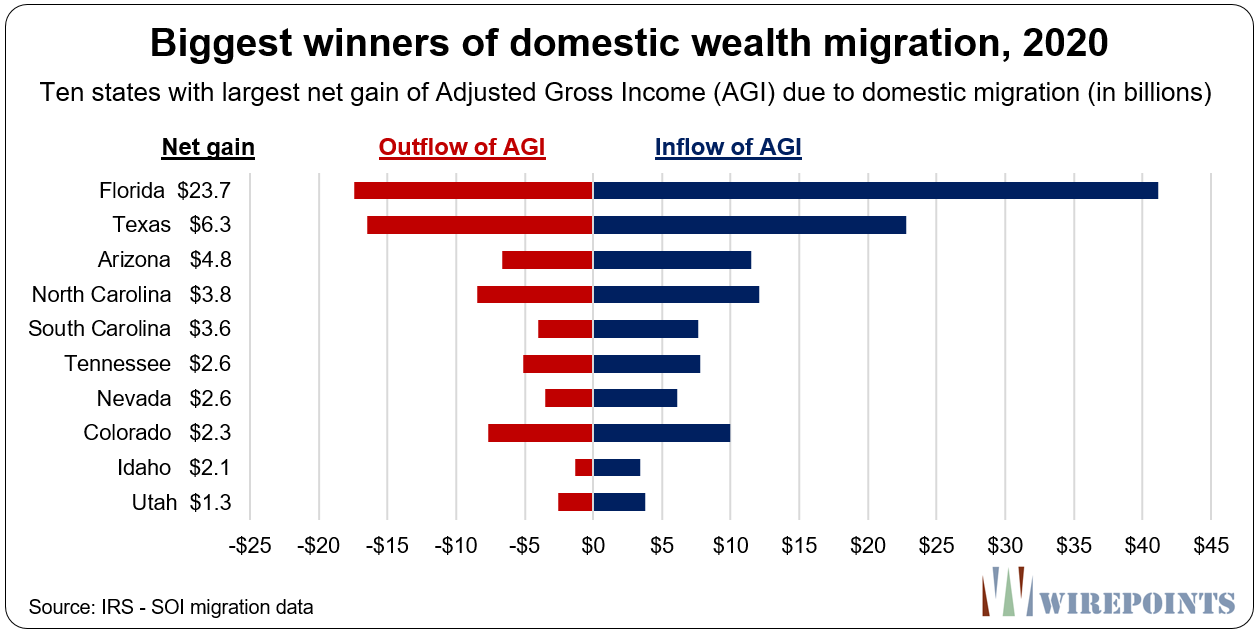
The Sunshine State attracted over $41.1 billion in Adjusted Gross Income (AGI) from 624,000 new residents (tax filers and their dependents) that moved into Florida in 2020. On the flip side, Florida lost $17.4 billion in AGI from 457,000 people who left. Overall, Florida came out ahead with 167,000 net new people and $23.7 billion in net new taxable income.
That’s a total gain of about 3.3 percent of the state’s total 2019 AGI ($711 billion).
Texas was the runner up with a net income gain of $6.3 billion, followed by Arizona with $4.8 billion. North and South Carolina rounded out the top five with net gains of $3.8 billion and $3.6 billion, respectively.
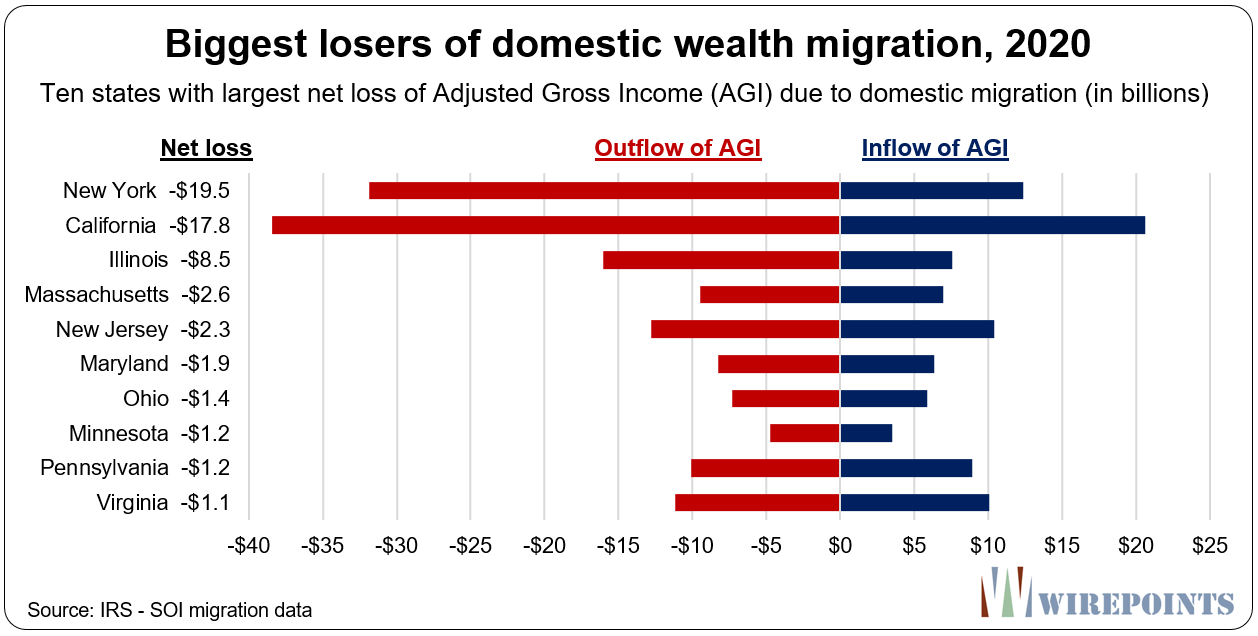
On the losing side, New York suffered the worst outflow of money of any state in 2020. The Empire State lost a net $19.5 billion in income, or 2.5 percent of its 2019 AGI, while a net of nearly 250,000 residents moved out.
California was next, losing a net $17.8 billion and 263,000 people. Illinois was third with a net loss of $8.5 billion and 101,000 people. Massachusetts and New Jersey were in 4th and 5th place, with $2.6 and $2.3 billion in income losses, respectively.
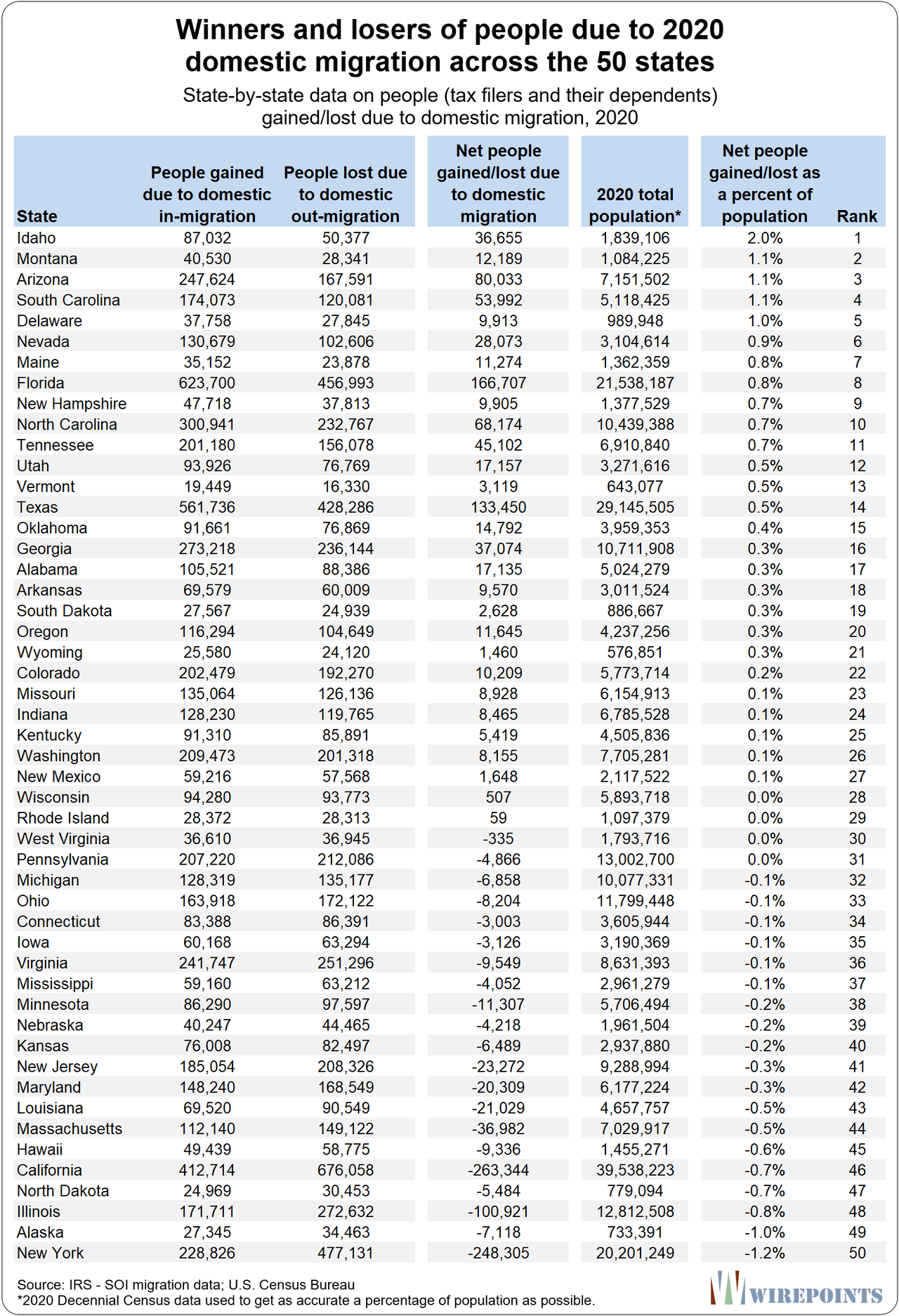
Tables with each state’s ranking in migration gains/losses are provided below.
The cumulative impact of income losses and gains
The problem with chronic outflows, like in the case of New York, is that one year’s losses don’t only affect the tax base the year they leave, but they also hurt all subsequent years. The losses pile up on top of each other, year after year. And when a state loses income to other states for 21 straight years, the numbers add up.
In 2020 alone, New York would have had nearly $123 billion more in AGI to tax had it not been for the state’s string of yearly migration losses. And when the state’s AGI losses are accumulated from 2000 to 2020, it totals $1.0 trillion in cumulative lost income that could have been taxed over the entire period.
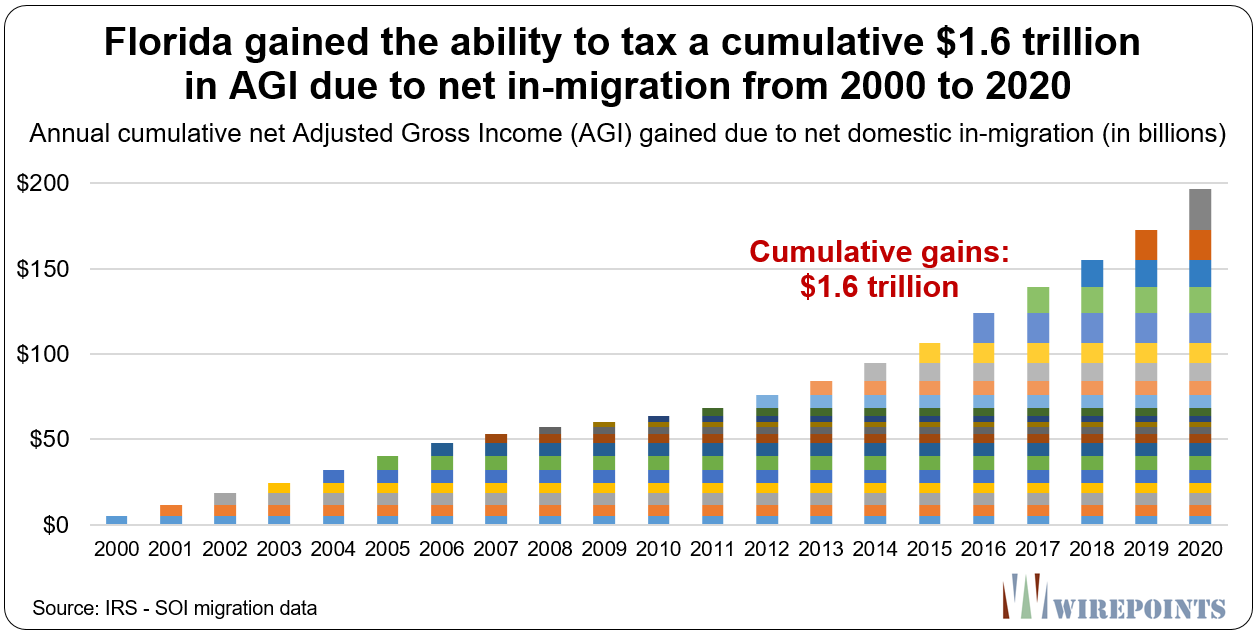
The opposite is true for migration winners like Florida. Gains in people and income pile on top of each other each year, building an ever-growing tax base. In 2020 alone, the state’s tax base was some $197 billion higher due to the 20-year string of positive income gains from net in-migration.
Even though Florida doesn’t tax incomes, Wirepoints also added up Florida’s cumulative AGI to make an apples-to-apples comparison with New York. When the Sunshine State’s AGI gains are accumulated from 2000 to 2020, it totals $1.6 trillion in income that could have been taxed over the entire period.
The competition for people matters
Illinois, one of the nation's other big losers, shows just how damaging being an “exit” state can be – especially when a state starts to lose its wealthier residents and and they are only partially replaced by people who make less. The Illinoisans who fled in 2020 earned, on average, $30,600 more than the residents Illinois gained from other states. That’s the biggest gap since at least 2000, based on Wirepoints’ analysis of the IRS data.
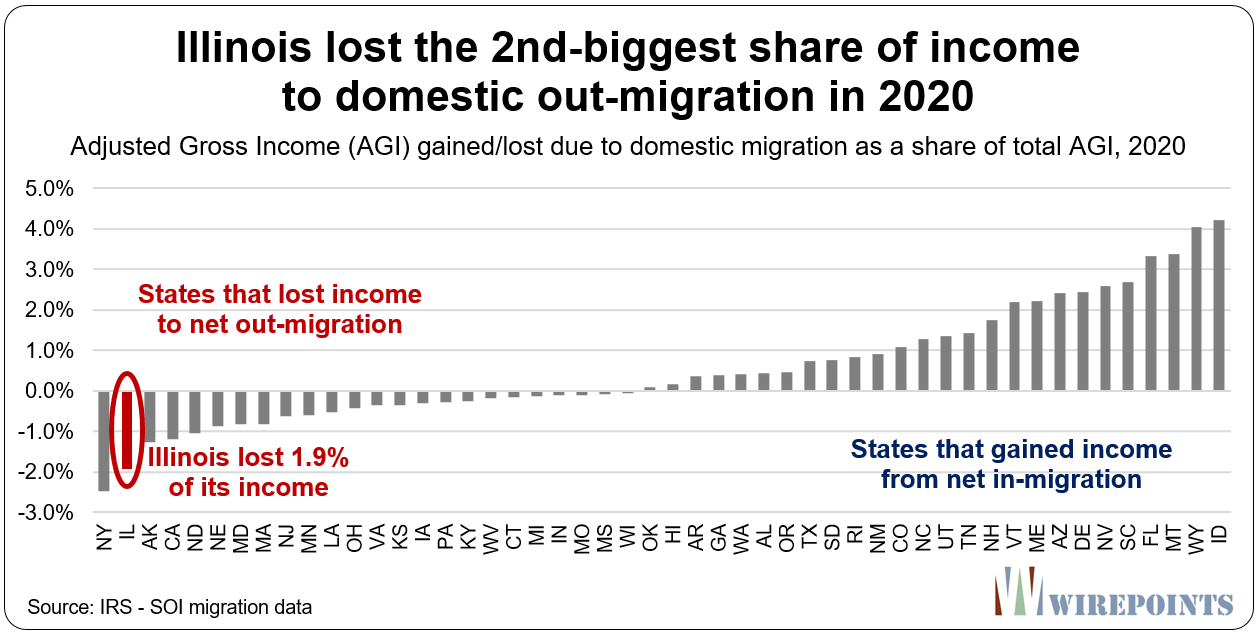
Based on a percentage of total income, Illinois ranked 2nd-worst nationally for income losses in 2020. Illinois lost 1.9 percent of its 2019 AGI. New York and Alaska ranked 1st and 3rd, with losses of 2.5 percent and 1.3 percent of their 2019 total incomes, respectively.
In contrast, Idaho was the nation’s big winner on a percentage basis in 2020, gaining 4.2 percent of its 2019 AGI base. The nation’s top five were rounded out by Wyoming, Montana, Florida and South Carolina.
* * *
Florida’s gains and Illinois’ losses are a clear reminder that states are constantly competing for people, businesses and a growing tax base.
The prize for winning is big, but the price for losing may be even bigger.
Read more from Wirepoints:
Appendix

(ZH) Mastercard CEO: SWIFT Payment System May Be Replaced By CBDCs In Five Years

Mastercard CEO: SWIFT Payment System May Be Replaced By CBDCs In Five Years

There has been a long list of revelations coming out of the recent World Economic Forum meeting in Davos, but one issue that might have gone under the media radar involves comments by Mastercard CEO Michael Miebach during a discussion on the future of cross-border payments between nations.
Miebach, participating in a panel on Central Bank Digital Currencies at the WEF and hosted by the Global Blockchain Business Council, was one of the few participants that was willing to suggest that the SWIFT system, long dominated by western interests, might be made obsolete along with the proliferation of digital currencies among central banks.
Initially dismissed as “conspiracy theory” only a few years ago by the media, whispers of CBDCs have suddenly gone mainstream and blockchain technologies took center stage at Davos in 2022. The Federal Reserve has even started active public discussions assessing the case for retail digital currency products.
Few at Davos were willing to admit to the outcome that Mastercard's CEO suggested, arguing that SWIFT would continue its prevalence for decades. Yet, almost every major central bank in the world is now pursuing a digital currency program, and the IMF has been exceedingly vocal about the need for a global digital currency system in the near future to provide “stability” in the face of national inflationary crisis events.
In the last year alone we have seen a developing trend among Eastern trade partners circumventing NATO sanctions in the wake of the war in Ukraine. After being blocked from accessing the SWIFT transfer network, which allows governments and central banks to quickly and accurately exchange data and transfer vast sums of capital, Russia and its allies are seeking alternative options. The Kremlin has talked often about using crypto and digital currencies to bypass restrictions, and China is currently establishing digital products to work around SWIFT and the CHIPS settlement system (Clearing House Interbank Payment System).
It would seem that western sanctions are only accelerating a global move away from dollar denominated structures, but of course, this may be exactly what global institutions like the WEF and IMF want. With a host of new CBDCs in play, price fluctuations may be just as erratic as they have been with Bitcoin and other cryptocurrencies. Meaning, buying power would be far too unpredictable for the average consumer. This sets the stage for groups like the IMF and WEF to “save the day” by instituting a global basket system, likely under the SDR (Special Drawing Rights) basket, in the name of homogenizing and stabilizing various CBDC markets into a single centralized entity.
In the meantime, only a select few among the globalists at Davos are willing to publicly address the real implications of CBDCs. The goal of global economic centralization is touched upon, but only as a consequence of the far distant future. Mastercard's CEO may have let slip the truth – That the plan is for CBDCs to take over global trade far faster than most people expect.

FT : EDF rules out extension of nuclear plant to secure UK winter supplies

EDF rules out extension of nuclear plant to secure UK winter supplies
Britain’s plea to delay closure comes too late as ministers consider emergency measures to prevent blackouts due to Ukraine war

EDF Energy has ruled out keeping one of Britain’s six remaining nuclear power plants open beyond the middle of the year in a blow to government efforts to bolster domestic energy supplies this winter and avoid the possibility of blackouts if Russia cuts off gas to Europe.

The French-owned energy group told staff in a memo on Monday that it would not delay the shutdown of Hinkley Point B in Somerset beyond its scheduled closure date of the end of July.

Extending the life of the plant was one option ministers were exploring as part of contingency planning for potential energy shortages later this year. Whitehall’s worst-case scenario would leave 6mn homes facing partial blackouts if Moscow stops sending gas to western Europe in the colder months.

Kwasi Kwarteng, business secretary, wrote to National Grid last week urging the FTSE 100 company to “significantly” increase the amount of electricity-generating capacity available over the winter, with a particular focus on non-gas fired stations.

“I think he’s considering whether Hinkley B, the large nuclear power station, might continue beyond its planned end of life as well,” Chris Philp, technology minister, told Times Radio on Monday following the report about possible power cuts by the Times.

He added that Kwarteng had also asked the operators of three coal-fired power stations, including EDF, to delay their closure. All but one of those was due to be mothballed by the end of September as part of the UK’s plan to reduce carbon emissions.

“That’s a sensible precautionary measure, given that gas supply coming out of Russia, and Ukraine is for obvious reasons, so heavily disrupted and we do, of course, use quite a lot of gas to generate electricity,” Philp said. Gas-fired plants are still the single biggest source of electricity generation in Britain, accounting for about 40 per cent of the total mix.

But in a partial blow to the government, EDF warned in the memo, seen by the Financial Times, that the request had come too late. “Although it is technically feasible to extend operations [at Hinkley Point B] for up to six months, the time required to do this and to be confident we would be ready for winter operating has now run out.”

An extension would involve compiling a detailed safety case that would have to be approved by the UK’s nuclear regulator and inspections of the graphite cores of Hinkley’s reactors, the memo added.

The retirement of the 46-year-old plant will cut the UK’s nuclear generating capacity by 1 gigawatt to 5.9GW of nuclear capacity. Nuclear output will fall to just 3.65GW by March 2024 under plans to shut down two more ageing plants at Hartlepool and Heysham, with unions and backbench MPs urging the government to consider keeping them open longer in the event of a protracted war in Ukraine.

Although the UK is directly dependent on Russia for less than 4 per cent of its gas supply, it is heavily reliant during the winter on supplies from Norway as well as imports via pipelines from the Netherlands and Belgium.

Government officials fear these imports could drop dramatically or dry up completely in the event that Moscow ceases exports to the rest of Europe, which relies on Russia for 40 per cent of its gas.

Ministers have launched an exercise — dubbed “Project Yarrow” — to stress test an existing electricity and gas “national emergency plan”, first drawn up in November 2019. That document sets out the process for ensuring “fair rationing” of electricity during a “supply emergency”.

The government has insisted that rationing would only occur in a “worst-case scenario”. One official said: “As a responsible government it is right that we plan for every single extreme scenario, however unlikely.”

But energy bosses are concerned that the government has left it too late to keep open some of the last remaining coal-fired power plants this winter that rely on Russian coal imports, which will be banned by the end of the year.

Ministers have also been in discussions with Centrica to resurrect Rough, Britain’s biggest gas storage site, which was effectively closed in 2017. The company said on Monday it could potentially reopen for storage but would need to apply for a new licence.

FT : Biden rules out sending weapons to Ukraine that can strike inside Russia

Biden rules out sending weapons to Ukraine that can strike inside Russia
US president says Washington will not send long-range rocket systems asked for by Kyiv

Joe Biden on Monday said the US would not send Ukraine long-range rocket systems that could be used to attack Russian territory, dealing a blow to Kyiv, which has repeatedly asked for such weapons.

“We are not going to send to Ukraine rocket systems that can strike into Russia,” the US president said in response to a question on whether Washington would consider sending long-range systems to the country.

US media reported last week that the administration was preparing to dispatch long-range rocket systems to Ukraine, including the Multiple Launch Rocket System, a US weapon capable of firing long-range rockets.

On Monday, a senior US administration official said that “nothing is on the table with long-range strike capabilities” but that providing an MLRS system — which could also be used for short-range munitions — was still “under consideration”.

US officials have previously said Washington does not want to see American military aid used to help Ukraine strike inside Russia.

Oleksiy Arestovych, an adviser in Ukrainian president Volodymyr Zelensky’s office, said Biden’s comments probably meant the US was trying to decide what type of MLRS to provide to Kyiv.

“MLRS has missiles of very different types and ranges . . . Let’s see what decision will be made in the US in the near future,” Arestovych said.

On Friday, Pentagon spokesperson John Kirby acknowledged that Ukraine had asked for an MLRS system but said a decision on whether to provide one had not yet been taken.

“Certainly we’re mindful and aware of Ukrainian asks, privately and publicly, for what is known as a Multiple Launch Rocket System. And I won’t get ahead of decisions that haven’t been made yet,” he said.

Senior Ukrainian officials, including President Volodymyr Zelensky, have ratcheted up pressure on the US and allies to provide longer-range weapons, including the MLRS and a separate long-range rocket system known as himars.

Ukrainian forces view longer-range fire as critical in the fight for the Donbas, which is becoming a war of attrition, where both sides are shelling each other with heavy artillery and sustaining big losses.

Dmitry Medvedev, a former prime minister of Russia who is now deputy chair of the country’s security council, on Monday welcomed Biden’s comments, describing them as “rational”, according to Reuters.

On Friday, following the US media reports that Washington was weighing sending long-range rocket systems, a Russian television host on a state-owned channel warned sending Ukraine an MLRS system would “cross a red line”.

The US has already pledged dozens of American-made 155mm howitzers, which have a longer range and are more accurate than standard Russian cannons. The majority have arrived in Ukraine and are beginning to be used on the battlefield, US defence officials have said.

The weapons are part of an overall package of lethal assistance to Ukraine worth billions of dollars, including the artillery and anti-tank systems that played a critical role in fending off Russian efforts to take Kyiv and other parts of the country.

This month, the US Senate approved a further $40bn in military, economic and humanitarian assistance.

Later on Monday, Biden used his annual Memorial Day address at Arlington Cemetery, Virginia, to accuse Russia of trying to “snuff out the freedom, the democracy -- the very culture and identity -- of neighboring Ukraine”.

He added: “Ukraine is a people on the frontlines fighting to save their nation,” said Biden. “Their fight is part of a larger fight that unites all people, is a fight that so many of the patriots whose eternal rest is here in these hallowed grounds are part of -- a battle between democracy and autocracy, liberty and repression.”

WSJ : China and the U.S. Are Arranging an In-Person Meeting Between Heads of Def

China and the U.S. Are Arranging an In-Person Meeting Between Heads of Defense
Chinese Defense Minister Wei Fenghe is expected to meet U.S. Defense Secretary Lloyd Austin at Singapore conference amid tensions over Taiwan

China and the U.S. are working to finalize what would be the first face-to-face meeting between their top defense officials on the sidelines of a conference in Singapore in June amid rising tensions over Taiwan, according to people familiar with the situation.

U.S. Defense Secretary Lloyd Austin has said he will travel to the Shangri-La Dialogue, an annual defense conference to be held this year June 10-12. The attendance of Chinese Defense Minister Wei Fenghe hasn’t been announced, but he intends to participate in person, according to the people.

Defense ministers and other officials typically meet in private before and during the conference. A meeting between Mr. Austin and Gen. Wei would take on extra significance because of increased tension between the U.S. and China over Taiwan.

Beijing reacted angrily after President Biden said during a recent visit to Tokyo that the U.S. would get involved militarily in response to any Chinese invasion of Taiwan, a self-ruled island that China says should be governed by Beijing.

Gen. Wei, who was the commander of China’s strategic missile force and was appointed defense minister in 2018, held talks with then acting Defense Secretary Patrick Shanahan during the Shangri-La Dialogue in 2019. The event, organized by the International Institute for Strategic Studies, a London-based think tank, didn’t take place in 2020 and 2021 because of the pandemic.

The people cautioned that a meeting between Gen. Wei and Mr. Austin had not been fixed and plans could still change. China’s Ministry of Defense didn’t immediately respond to a request for comment, and a Pentagon press officer said there was no information immediately available about a meeting.

Mr. Austin and Gen. Wei spoke for the first time by phone in April. The two discussed defense relations, regional security issues and Russia’s invasion of Ukraine, according to the Pentagon’s account of the call.

In the China Defense Ministry’s slightly different summary of that conversation, Gen. Wei said it would have a “disruptive impact” on China-U.S. relations if the Taiwan question isn’t handled well, and that China’s military would defend national sovereignty, security and territorial integrity.

There are no clear signs China intends to attempt to seize Taiwan by force, but it hasn’t ruled out the use of its military to try to bring the island under its control.

U.S. administrations have long maintained a policy of not clarifying whether the U.S. military would intervene if China invaded Taiwan, an approach intended to deter a conflict. Following his comments in Tokyo, Mr. Biden said U.S. policy toward Taiwan hasn’t changed.

The Chinese defense minister’s last face-to-face encounter with his American counterpart came in Bangkok in November 2019, when he met with then Defense Secretary Mark Esper.

Mr. Austin told the Senate Appropriations Committee earlier this month that he expected to meet with Gen. Wei in Singapore and hoped a face-to-face encounter would “promote security and stability in the region.”

“We both recognize the importance of a dialogue and maintaining open channels,” said Mr. Austin. “I look forward to again engaging him in the future—in the not-too-distant future.”

The Asian security summit has been used as a venue for Chinese and American military officials to lower the temperature on the array of hostilities between Washington and Beijing. In 2018, Gen. Wei met with his American counterpart, Jim Mattis, and invited the latter for a visit to Beijing.

Mr. Mattis traveled to Beijing a few weeks later for meetings with Gen. Wei and President Xi Jinping. The Chinese defense ministry said the visit “yielded positive, constructive results.”

Preparations are also being made for Japanese Prime Minister Fumio Kishida to make the keynote speech at the start of this year’s conference, according to people familiar with the planning. An appearance by Mr. Kishida as keynote speaker would be the first by a Japanese prime minister since Shinzo Abe gave a speech to open the 2014 conference.

Mr. Kishida has said Japan plans to significantly increase defense spending because of increasing threats in the region, and has said Tokyo should consider developing its own ability to hit enemy military bases that threaten Japan.

A Japanese foreign ministry spokesman said it wasn’t yet decided whether Mr. Kishida would speak at the Singapore conference.

Japan is concerned about a possible conflict over Taiwan because of the close proximity of its southern island chain, including the island of Okinawa, which hosts major U.S. military bases.

Gen. Wei is unusually blunt for a Chinese leader. During the 2019 gathering in Singapore, he caused a stir by commenting openly on the Chinese military’s bloody suppression of the Tiananmen Square pro-democracy protests in 1989. He said military action was the best choice available at the time, and credited it with opening a path to China’s peaceful development in the following decades.