- Coloplast (CBHD TH) +4.5%
- Siemens (SIE TH) +4.4%
- Nibe (NJB TH) +4.3%
- EQT (6EQ TH) +3.6%
- Salmar (JEP TH) +3.5%
- Vestas (VWSB TH) +3.1%
- Norsk Hydro (NOH1 TH) +2.5%
- Rheinmetall (RHM TH) +2.4%
- Danske Bank (DSN TH) +2.3%
- Anglo American (NGLB TH) +2.3%
- OMV (OMV TH) -0.6%
- Siemens Gamesa (GTQ1 TH) -0.9%
- K+S (SDF TH) -0.9%
- Boliden (BWJ1 TH) -1.3%
- Swedish Match (SWMC TH) -1.8%
- Just Eat Takeaway (T5W TH) -2.9%
- Just Eat’s Grubhub Sale Could Lead to Multibillion-Pound Writedown, Sunday Times Reports
Stocks in Asia and US futures advanced Monday after China eased some virus curbs and Wall Street had its best week since November 2020. Japanese and Hong Kong equities led gains, while S&P 500 and Nasdaq 100 contracts climbed in a sign the bounce may have further to run. The S&P 500wiped out its May losses and snapped a string of seven weekly declines as institutional investors rebalanced portfolios into the end of the month. China’s yuan outperformed after the nation reportedfewer Covid-19 cases in Beijing and Shanghai. That spurred the government to ease some of the strict virus controls to stimulate sagging growth. Chinese stocks had more modest gains. The dollar slipped for a third day versus major peers as havens lost their appeal amid the improved mood. Oil traded near $116 a barrel as the European Union failed to agree on a revised package of Russian sanctions. Cash Treasuries won’t trade in Asia because of the US Memorial Day holiday. Trader are pondering whether the bottom of the selloff is near as investors have been buying the dip after one of the worst starts to the year for equities. However, a wall of worries remains from hawkish central banks underscoring fears of a recession, escalating food inflation from the war in Ukraine and China’s lockdowns stunting economic activity. Traders will be looking to the US payroll numberslater this week to gauge the Federal Reserve’s tightening path as it strives to rein in inflation. Meanwhile, the Fed is set to start shrinking its $8.9 trillion balance sheet starting Wednesday. Asia’s coal benchmark rallied to the highest on record as India moved to secure shipments, tightening supplies in the region.
Nikkei +2.26% Hang Seng +1.87% CSI +0.65% Shanghai +0.49% Shenzen +0.89%
Eur$ 1.0757 CNH 6.6154 CNY 6.6482 JPY 126.98 GBP 1.2647 RUB 66.3671 CHF 0.9564 TRY 16.33 WTI$ 116.04 +0.84% Gold 1,861.51 +0.42% BTC 30,290 +3.87% ETH 1;871.62 +4.26%
S&P +0.81% Nasdaq +1.46% EuroStoxx +0.81% FTSE Closed Dax +0.67% SMI +0.75%
Macro :
- European Luxury Stocks May Be Active as China Eases Virus Curbs
- Watch Europe Oil Stocks as Crude Rises, Brent Tops $120
- BofA Quant Sees More US Tech Losses Amid High Rates, Crowding
- German Machine Makers Lobby to Cut Output Forecast, Welt Says
- Germany Won’t Spend 2% of GDP on Defense Every Year, FAS Reports
Keep an eye on :
- ARYN SW : Aryzta 3Q Revenue EU433.9M, Up 22.6% Organically
- EURN BB : Frontline Buys 2.95% of Euronav Issuing 8.34 Million New Shares
- EAPI FP : EuroAPI Expands Sanofi Collaboration on mRNA Vaccines
- FOXT LN : Foxtons to Name Guy Gittins as CEO, Replacing Nic Budden: Sky
- GLEN LN : Glencore Bribery Cases Draw in Billionaire Former Executives
- SDF GY : K+S Drops Amid Weaker Potash Prices, Russia Sanctions Concerns
- PST IM : Poste Italiane Starts Share Buyback Programme
- RHM GY : Germany Won’t Spend 2% of GDP on Defense Every Year, FAS Reports
- RWE GY : German Judges Seek Evidence in Peru on RWE Climate Change Case
- SAN FP : EuroAPI Expands Sanofi Collaboration on mRNA Vaccines
- SPM IM : Saipem Appoints Calcagnini Chief Financial Officer
- SPM IM : Saipem, Havfram to Evaluate Cooperation in Offshore Wind
- SEM PL : Semapa 1Q Net Income EU42M Vs. EU25.4M Y/y
- SPI AV : S Immo 1Q Net Income EU24.1M
- SKAB SS : Skanska Redevelops Army Storage Facility in UK for SEK3.2b
- TIT IM : Telecom Italia, Italy’s CDP Sign Preliminary Single Grid Pact
- TED LN : Authentic Brands in Talks to Buy Ted Baker for £300 Million: Sky
- TSLA US : Musk Says Gates Has ‘Multi-Billion Dollar’ Tesla Short Position
- UMI BB : Goldman Says Bull Market in Battery Metals Is Finished for Now
- XIOR BB : Xior Buys EU939M Student Accommodation Portfolio from Basecamp
- ZEAL DC : Zealand Pharma CEO Targets Partners in Obesity Market: Borsen
>>> Up
* HeidelbergCement Raised to Neutral at On Field; PT 57 euros
* Nordea Bank Raised to Buy at SocGen; PT 112.79 kronor
* Voestalpine Raised to Equal-Weight at Morgan Stanley
* Zoom Video Raised to Outperform at Daiwa; PT $121
>>> Down
* Canopy Growth Cut to Sell at Benchmark; PT C$5off
* DCC Cut to Sector Perform at RBC; PT 5,800 pence
* Intesa Sanpaolo Cut to Market Perform at KBW; PT 2.70 euros
* Traton Cut to Underperform at Exane; PT 15 euros
>>> Initiation
* ABN AMRO GDRs Reinstated Neutral at Goldman; PT 13.25 euros
* Credit Agricole Reinstated Neutral at Goldman; PT 13.60 euros
* ING Reinstated Buy at Goldman; PT 16.25 euros
* Intesa Sanpaolo Reinstated Buy at Goldman; PT 3.25 euros
* KBC Group Reinstated Neutral at Goldman; PT 77 euros
* RWS Holdings Resumed Buy at Berenberg; PT 650 pence
* SocGen Reinstated Neutral at Goldman; PT 35 euros
* UniCredit Reinstated Buy at Goldman; PT 18.50 euros
>>> Call
* DCC Downgraded at RBC on Exposure to Squeezed Consumer
* Steel Stocks Offer Good Risk-Reward, MS Upgrades Voestalpine
The new Schleswig-Holstein question is about hydrogen
How should Germany transport renewable energy from places where it is plentiful to where it is needed?
The Schleswig-Holstein question was a 19th-century diplomatic puzzle supposedly understood by only three people. They variously died, went mad or forgot the details, said the British statesman Lord Palmerston. Now the north German state is at the heart of a thoroughly modern conundrum.
How should Germany transport renewable energy from places where it is plentiful, including windswept Schleswig-Holstein, to places it is needed but the grid cannot serve? To some investors and policymakers the answer is simple: hydrogen.
That certainly makes sense to HH2E, a renewable energy project developer. It hopes to dot northern Germany with electrolysis plants turning electricity from wind farms into the gas, hoping to earn internal rates of return “in the low to mid-teens”.
HH2E just raised €12mn in equity from investors including HydrogenOne, a business backed by British chemicals tycoon Jim Ratcliffe. The partners have conditionally agreed to contribute to hydrogen projects costing more than €500mn across Germany.
HH2E initially plans to produce green hydrogen at times of the day when renewable electricity is cheap to fuel vehicles and chemical plants. Hydrogen evokes particular enthusiasm in Germany as a low-carbon fuel for industry. Germany is an environmentally conscious nation whose three-party coalition government includes the Greens. It is also Europe’s industrial powerhouse and its largest emitter of carbon dioxide.
Coal-fired power stations are largely to blame, a problem the push to reduce Russian hydrocarbons imports is doing nothing to alleviate. The steel industry is another culprit. The bulk of Germany’s 40mn tonnes of annual steel output last year was made using coking coal, generating around a tenth of all carbon emissions.
Earlier this year, steelmaker Salzgitter pledged to switch over to smelters powered by hydrogen and electricity by 2033. Larger rival ThyssenKrupp has promised to cut steelmaking emissions by a third by 2030. It is, meanwhile, planning to list Nucera, a subsidiary that makes hydrogen equipment for refining, which has a mooted valuation of up to €6bn.
Politicians are enthusiastic proponents of hydrogen too. A couple of weeks ago, the European Commission set a target for the EU to produce 10mn tonnes of domestic green hydrogen a year by 2030, importing the same amount. German legislators aspire to install hydrogen plants requiring 10 gigawatts of renewable electricity capacity by the same deadline.
We should be happy for hydrogen, an industrial gas which, it if were the author of confessional literature, would admit to having “been in a dark place”. In the 1930s, a promising role in the airship business ended explosively. And until a few years ago, anyone who suggested hydrogen might be useful in the circular economy risked being pigeonholed as a crank.
A lot is now being expected of hydrogen — and of the private sector investors who would be needed to fund new manufacturing capacity. Switching the German steel industry from coking coal to hydrogen would be a huge endeavour, for example. Some back-of-an-envelope figures underline this.
German steelmakers require about 180 terawatt hours of energy a year, I calculate, equivalent to 5.4mn tonnes of hydrogen. But converting electricity into the gas is inefficient. So electrolysis plants would suck up some 270 terawatt hours of juice. That would be just under half Germany’s projected production of renewable energy.
The cost would be steep. Hydrogen prices are hard to forecast in the current nascent market. Rafi Ghazi, head of corporate finance at HH2E, says motorists currently pay around €9 per kg. Wholesale prices are expected to settle at a lower level as production increases, at €3-€4 per kg. Coking coal yields the same energy at far lower financial expense but at a much heftier price in carbon emissions.
You could quickly drive yourself as mad as an expert in the Schleswig-Holstein question by flexing statistical assumptions. The bottom line is that weaning German furnaces off coking coal will be expensive.
To lure the tens of billions of euros in investment for hydrogen production, the German government must do two things. First, write a detailed transition plan, so investors know what to expect. Second, cover the price gap with fuels like coking coal. The cost would be borne, one way or another, by taxpayers.
Hardly a popular message when living costs are soaring. But is there ever a good time to tell someone bad news?
When Will Powell Trigger The "Fed Put": Here Are The Four Things To Watch, As Well As The Most Important One
Despite the market's long-overdue rebound after a near-record 7 consecutive down weeks for the S&P (a 20yr record), the Fed has so far offered no help to risk assets and appears far from stepping in or triggering the elusive "Fed Put". This is despite, as BofA's Gonzalo Aziz warns in the bank's latest Global Equity Volatility Insights note (available to pro subs), risks building in financial markets to an extent that central banks wouldn’t have allowed in years past.
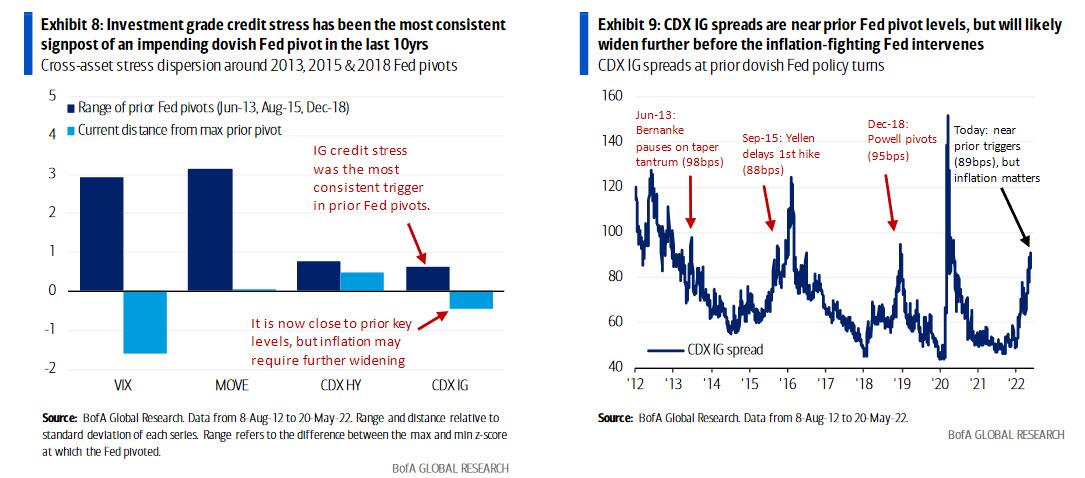
Indeed, as we observed recently (see "When Will The Fed Capitulate And Stop Hiking: Finally Some Good News For The Bulls"), credit spreads, historically the most reliable predictor of Fed interventions, have reached levels of prior Fed rescues. Furthermore, over 85% of dovish Fed turns in the last 50yrs were preceded by less volatile equity selloffs than today’s. And as we highlight virtually every day, S&P futures liquidity has only been worse in the depths of the GFC and the Covid shock, adding to fragility risk and the potential the Fed put is tested in a dysfunctional market.
And yet, despite all these growing risk-factors, so far Powell has ignored all appeals for help from the market. Of course, no matter how hard the US central bank may try to signal otherwise, the Fed put isn’t fully gone, and it will likely be tested, as it has repeatedly since Greenspan gave birth to it in 1987.
So what signposts should investors watch to know when the Fed put’s strike is near? According to Bank of America there are key indicators to keep an eye on:
1. Credit stress: We have discussed before that credit stress has been the most consistent predictor of dovish Fed pivots in the last 10yrs, particularly stress in Investment Grade bonds (which have historically used by companies to fund buybacks, if not so much capex). This is notable because CDX IG spreads are near those key levels now, but the Fed’s focus on inflation means spreads are likely to widen further before triggering a policy response.
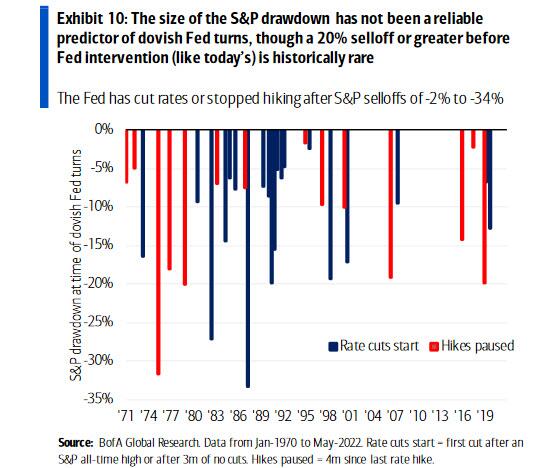
2. S&P drawdown: Perhaps just as important as nascent credit stress, the size of the equity drawdown from all-time highs has according to BofA become an important signal for investors looking to buy the dip in recent years. However, while this may have worked relatively well in the era of high Fed sensitivity to markets, it has been a much less reliable predictor of dovish Fed turns over a longer history. As chart 10 shows, the Fed has either stopped hiking or begun cutting rates during S&P drawdowns of very different magnitudes – from as low as 2-3% in the mid-1990s to over 30% in ‘75 and ‘87.
3. Economic data: Economic data is of course critical to the Fed’s reaction function, and a sustained cooling of inflationary pressures is arguably the data point most likely to slow their tightening plans (something we expect is gradually taking place now and will become manifest at the Jackson Hole PivotTM). Indeed, BofA's rates team’s 20-May Global Rates Weekly argues that a Fed pivot requires a meaningful slowdown in job market data. However, that type of data is much slower-moving, and it would take several months or quarters to convince the Fed that a dangerous inflationary spiral has been averted. On the other hand, as PIper Sandler quantified recent layoff announcements, it is clear that mass layoffs have begun, and the bank expects "a million layoffs or more" which will be more than sufficient to force the Fed to pivot.

4. Market dysfunction: While all of the above are certainly important catalysts for the Fed to "panic" and go into full-blown Fed Put mode, BofA's derivatives traders believe that an episode of market dysfunction is the most likely trigger for central banks, or as they quote us (quoting BofA's Michael Hartnett), “markets stop panicking when central banks start panicking”, but today it will take more market panic for the Fed to start panicking.
So are we there yet? Not quite, but getting closer. The near-record low liquidity in equity futures (a key feature of fragility shocks) which we highlight virtually every day...

... indicates that such risk may be closer than the relatively orderly pace of the YTD selloff may suggest.

And in fact 85% of the Fed’s dovish turns in the last 50yrs were preceded by less volatile equity selloffs than today’s.
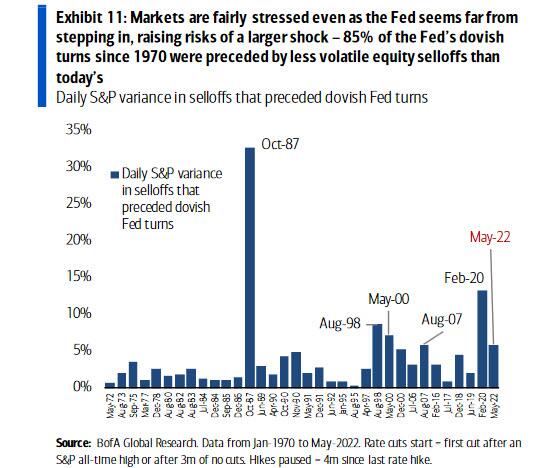
In other words, while the Fed may need a lower inflation and higher unemployment print to greenlight a dovish pivot, one which will send high beta growth names and cryptos limit up in milliseconds, the actual catalyst that prompts the Fed's capitulation may simply be a market crash which the illiquidty in the market accelerates to the point where not even the Fed will be able to ignore what is going on.
One final, important point, according to the BofA strategists: the Fed pivoting to rescue markets may not crush volatility or create a sustained rebound back to new highs, as the 2013, 2015, and 2018 pivots did. If inflation remains a pressing concern, a Fed intervention may only bring temporary relief to risk assets.
Despite the lack of a Fed capitulation so far, BofA believes markets will continue to test the Fed put, but they caution that it will take more market panic for the Fed to start panicking. To hedge this event, BofA's derivatives traders like owning local SPX skew near 10yr lows through Dec put ratios. The trade is designed for a tail event in which markets test the Fed put and find that it’s heavily compromised in the face of inflation. As one example, consider selling 1x SPX Dec 4050 put to buy 2.5x of the Dec 3500 put for an upfront debit of ~1% (ref. 3973.75). More details on this highly convex trade in the full BofA note available to pro subscribers.
Private equity cannot avoid the reckoning in markets
Both the real economy and the financial system are in a destabilising phase for both public and private investors
At a conference of investment professionals I recently attended, several private equity funds argued with considerable vigour that this year’s large losses in public markets would drive even more investors their way.
They were confident that their asset class would avoid the reckoning that stocks and bonds have been exposed to this year because they were structurally immunised against disruptive changes in the investment landscape.
I fear that this may prove to be too much bravado and misplaced self-confidence. Both the real economy and the financial system have entered a phase that is uncertain and destabilising for private as well as public market investors.
As noted recently in the Financial Times by Katie Martin, “adherents to the classic portfolio split — 60 per cent stocks and 40 per cent bonds — have not had it so bad in half a century”. Both equities, usually dubbed as risk assets, and the “risk free” alternatives of government bonds have experienced large losses this year.
In the traditional correlation between such assets, if stocks sold off, government bonds rose. That correlation has broken down as all these assets (understandably) suffered from worries about higher interest rates and tightening financial conditions.
While the last couple of weeks have seen some reversion to the more traditional correlation, that is not without its own problems. The reason is growing worries about global growth and corporate earnings. They point to further volatility for equities which constitute the largest part of most public market portfolios.
In contrast to this year’s brutal sell-off in stocks and bonds, private equity valuations have remained robust. As often pointed out by their marketers, the conventionally longer holding period reduces the disruptive influence of speculative money looking to get out quickly. As does the fact that private equity investments are usually focused on single assets as opposed to indices, limiting the scope for contagion.
Such factors fuel expectations of an acceleration of what already has been a considerable multiyear increase in the strategic allocation of investment flows, and not just from public pension funds, foundations, endowments and sovereign wealth institutions. Private equity fans also expect the asset class to get a boost from ongoing efforts to make private equity more accessible for retail money.
Such optimism about the robustness of the asset class may, however, be excessive. Private equity valuations are updated much less regularly than for public investments. Indeed, historically, revaluations have tended to lag behind public markets by a minimum of six to nine months. Moreover, several of the factors that have recently undermined the public markets are also worrisome for private equity.
Higher interest rates and tightening financial conditions will complicate the refinancing of leveraged take-private transactions. They make the paths back into the public markets less secure and the exit valuation less certain. They also curtail new investors’ enthusiasm for buying private equity stakes in the secondary market, putting pressure both on prices and volumes.
The worsening global economic outlook is also a problem. Downturns rob companies of actual and prospective revenues, leading to faster burning of cash reserves, increased debt burdens relative to equity and capital erosion.
There are two additional risks that are specific to private equity in the period ahead. First, that one of its often-cited structural strengths — that of illiquidity that damps unfavourable price volatility — turns into a weakness; and second, that financial regulators and supervisors pay a lot more attention to conduct in private markets.
Private equity is just as likely to experience a shift in operating paradigm this year as the public markets have been undergoing — from a seller’s to a buyer’s market. Indeed, both are in the process of exiting from a world of massive and predictable central bank liquidity injections that over-facilitated a seemingly endless flow of money into a smaller set of investment opportunities. What lies ahead is a world in which the cost of money will be higher and financial flows more selective as they become less ample.
With time, genuinely attractive value will be restored to private and public markets. The process of doing so, however, is likely to be as bumpy.
Fund industry heavyweights muscle in on ETF market
Morgan Stanley, Neuberger Berman, SEI and Matthews Asia have recently launched or are set to debut ETF
A new clutch of the world’s largest asset managers are joining the exchange traded fund industry for the first time, transforming options for investors as industry heavyweights belatedly seek a foothold in the fast-growing sector.
Morgan Stanley, Neuberger Berman, SEI and Matthews Asia, which manage a combined $3tn, have recently launched or indicated their intention to launch their debut ETFs. AllianceBernstein (AB), which has a solitary ETF offering in Australia, is on track to join the US party later this year.
These companies join other recent heavyweight converts, such as T Rowe Price, Dimensional Fund Advisors, Federated Hermes and Capital Group, as ETFs rapidly gain market share at the expense of mutual funds.
In the US, ETF assets jumped 185 per cent to $7.2tn in the five years to 2021, according to the Investment Company Institute, while those of mutual funds rose just 65 per cent to $27tn over the same period. Globally, ETF assets have more than tripled to $10.1tn since 2015, according to consultancy ETFGI.
ETFs benefit from being cheaper to run than old-school mutual funds, with these savings typically passed on to investors, as well as intraday liquidity and — in the US at least — greater tax efficiency.
“If you talk about meeting clients where they are, the ETF tool is one that we want to offer alongside our other offerings,” said Noel Archard, global head of ETF and portfolio solutions at AB.
Morgan Stanley, which has $1.4tn in assets under management and was ranked 15th-largest by Willis Towers Watson in its latest report, is the largest fund provider not to offer ETFs.
However, an internal memo written by Dan Simkowitz, head of investment management at Morgan Stanley, said it had made a “strategic decision” to launch a multi-asset ETF platform offering active and systematic strategies this year.
Morgan Stanley shared the memo, which was circulated in March, but declined to comment for this story.
For AB, the imminent arrival of its first US ETFs will be the culmination of a 12-year journey.
It filed to launch equity ETFs in 2010 and was later granted approval by the Securities and Exchange Commission, but the funds never saw the light of day. While AB was prevaricating, Cathie Wood took the decision to leave in 2014 and set up Ark Invest, which has since launched a suite of ETFs.
AB appears to have rekindled its earlier enthusiasm for the idea of launching ETFs, however, and filed earlier this month to roll out actively managed Ultra Short Income and Tax-Aware Short Duration ETFs.
Archard, who was recruited from State Street Global Advisors in February to head up the push, said a “significant event” in AB’s ultimate conversion to ETFs was a SEC ruling in 2019 that simplified and accelerated the approval process for ETFs, including actively managed ones.
“It lowered one of the barriers to entry for many firms that had been thinking about getting into ETFs,” said Archard. “We have a predominantly active footprint. That change in rule prompted another look into whether we should we introduce [active ETFs].”
Archard said AB’s two initial fixed-income ETFs should list in “late Q3 or early Q4” and it was planning “several equity products”.
While the rollout is starting in the US, Archard said AB was “not constraining” itself to any region. Its initial ETFs will have a fully transparent structure, which is essential in markets such as Europe where the portfolio-shielding, semi and non-transparent structures commonplace in the US have yet to be approved.
Kevin Barr, head of the investment management unit at SEI, said the company was “looking for something that is differentiated”. “There really is not much need for more passive ETFs,” he added.
The first fruits of these endeavours are four actively managed factor-based large-cap US equity funds that launched on May 18. SEI has been running these strategies since 2013 in separately managed accounts, which are only available to institutions and wealthy individuals. Pricing is comparable at 15 basis points.
Although SEI is initially focusing on the US market, Barr said it was “actively looking” at the possibility of launching active ETFs in Europe, with the need for full transparency again not a barrier. “We’re comfortable with transparency. It’s not a passive approach where someone is going to be able to arbitrage it away,” he added.
Neuberger Berman debuted its first three ETFs in April this year. The actively managed thematic equity strategies cover the Connected Consumer, Carbon Transition and Infrastructure, and Disrupters ETFs, each at 55bp.
The New York-based group already manages $18bn — out of $460bn in total — in thematic funds and Hari Ramanan, its CIO of global research strategies, cited the “potential for tax efficiency” in expanding this range into ETFs.
Matthews Asia is also going down the transparent active equity route, filing in April for three ETFs focused on emerging markets, Asian innovators and China, which build on its existing mutual funds in these areas.
“While we believe mutual funds will continue to provide benefits to many investors, we have seen a growing interest from financial intermediaries and end-investors who want to take advantage of the benefits active ETFs offer,” said Jonathan Schuman, Matthews Asia’s global head of distribution.
Matthews Asia may have spotted a potential gap in the market, given the relative lack of actively managed Asia or China-focused ETFs at present.
But all the latecomers may have to find their own niches in order to gain a toehold in an ETF industry dominated by BlackRock, Vanguard and State Street, which account for 77 per cent of the US market.
When asked how SEI’s offerings could challenge the three market leaders, Barr replied: “[W]e don’t see people offering these products. These are differentiated products. This is not a ‘me too’ strategy.”
Once Upon a Time in Londongrad investigates Russia-linked deaths on British soil
This timely Sky documentary series examines the long reach of the Kremlin through 14 mysterious cases
What links a fall from a fourth floor window, a helicopter crash, a hanging, radioactive poisoning and suffocation in a gym bag? Nothing . . . officially.
A timely six-part Sky original documentary series, Once Upon a Time in Londongrad, centres on a spate of unusual deaths that occurred on British soil between 2003 and 2016 involving 14 individuals — oligarchs, financiers, lawyers, spies, whistleblowers and even a scientist — all of whom (either directly or tangentially) could be seen to have posed some kind of threat to the Russian state.
While UK police authorities claimed there was insufficient evidence to confirm Russian foul play in almost all the cases, a team of journalists at BuzzFeed News — whose diligent work and insights drives the documentary — have developed a compelling evidence-based theory that the deceased were victims of assassinations ordered by Russia. The Kremlin has always denied any such accusations.
We start with the death which served as the fountainhead for BuzzFeed’s exhaustive, two-year-long investigation. In 2014 Scot Young, a property mogul, investor and “fixer” for some notorious figures, fell to his death from a window in his Marylebone flat. A coroner ruled that suicide couldn’t be confirmed, while the Met Police dismissed murder as a possibility.
So far, so conventional true-crime thriller. But the scope of the documentary changes once it shifts its attention to one of Young’s business associates, the oligarch Boris Berezovsky — brilliantly described here by one of his own friends as “absolutely honest and dishonest . . . kind and evil”. His exact connection to Young becomes apparent with time, but the story of his transition from the architect of post-Soviet crony capitalism under Yeltsin to the scourge of the Kremlin is fascinating in itself.
In exile in London, Berezovsky invested millions into financing organisations and actions against Putin’s government, including, allegedly, the removal of a pro-Russian presidential candidate in Ukraine. He also helped the FSB officer-turned-dissident Alexander Litvinenko flee to the UK. The latter was poisoned in 2006, and a number of other close associates also died suddenly. Berezovsky himself was found dead in his bathroom in 2013.
Further deaths — each more macabre than the last — follow, but the documentary carefully avoids veering into sensationalism. It may be unable to provide any concrete answers but it asks urgent questions about the kind of influence that Russia has over London: from the City to Scotland Yard to Downing Street and beyond. A montage towards the end of a host of western leaders chummily talking to Putin gives way to shots of the war in Ukraine. The repercussions of not asking questions are all too chillingly clear.