Mia Khalifa would be an obvious choice for a Playboy Playmate of the Month, if such a thing still existed. Instead, one of the biggest names in adult entertainment just signed up for its digital equivalent.
Khalifa, a social media influencer and former porn star with 27 million Instagram followers, is set to join Playboy’s new subscription content service,
Centerfold, later this month. The platform launched in December with the vision to become, according to Playboy Enterprises CEO Ben Kohn, “the uncensored Instagram.” Two months in, the site looks less like a rehash of the old, Hugh Hefner velvet-and-lace aesthetic than a modern mashup of OnlyFans and Patreon. Its home page displays suggestive photographs of adult entertainers both female and male, plus the occasional YouTuber and makeup artist. It features an Instagram-style “following” feed showcasing its current roster, and a tab for messaging creators (for a fee, of course). Its founding creative director, with input on editorial decisions and creator recruiting, is rapper Cardi B.
Since Centerfold’s launch, Playboy has brought on a number of highly followed figures, from YouTuber
Amanda Cerny to former adult film star
Lana Rhoades to current porn actress
Mia Malkova, who collectively boast more than 50 million followers on Instagram. But Khalifa is perhaps the site’s buzziest addition. “I was very excited and very honored,” Khalifa says. “I mean, it’s Playboy.”
The partnership is a change of course for Khalifa, who, despite only working in the porn industry for three months in 2014, has amassed over 1 billion video views on PornHub. When she popped up on a Zoom last week, wearing a purple tie-dyed sweatshirt and little makeup, and contending with a poor internet connection, she seemed more like a remote-working 20-something than a global sensation. But she had strong things to say about her other home on the Internet, OnlyFans, where she charges subscribers $12 per month for content she describes as “Safe for work, but spicy.”
“I feel like where OnlyFans is headed is no longer in support of sex workers. I disagree with a lot of their changes and a lot of their tactics,” she says, referencing the site’s short-lived ban on
sexually explicit content and changes to creator
payouts. “I would like to be on a platform that can be a place with a fresh start.”
Centerfold is just one piece of an extensive digital portfolio Playboy is in the process of developing. In an effort to revitalize what was a faltering and scandal-shadowed brand, the company is pivoting away from the ubiquitous magazines of yore and going all in on today’s buzziest tech phenomena: subscription platforms and Web3.
Indeed, the trope of “reading Playboy for the articles” no longer applies—the company halted the print publication in March 2020, and
laid off 25 remaining web editors and writers two months later. But solving one problem only created another: Playboy’s competition is no longer raunchy reads like Penthouse and Hustler, but tech juggernauts like Meta Platforms and OnlyFans. So the central question remains—will a tech overhaul be enough to keep The Bunny afloat?
The executive behind Playboy’s digital pivot is not the expletive-slinging, cigar-smoking, robe-wearing lothario you might expect. Instead, she’s a former National Geographic vice president who began her career at Rupert Murdoch’s News Corp. Rachel Webber, president of corporate development and chief marketing officer at Playboy Enterprises, joined the company three years ago to help transform what she calls “the original lifestyle brand” into a digital-first business.
Speaking to me on Zoom from their respective homes in Los Angeles, Webber and Anna Ondaatje, vice president of global brand and franchise strategy, reiterated two phrases consistently. First, Playboy is still a “platform that sits at the intersection of culture and sex,” Webber said. And second, its mission is to be a space “where all people can pursue pleasure.” In other words, it’s no longer just “Entertainment for Men,” as the old company tagline went. Aside from the reach toward gender parity, these goals sound fairly consistent with the aims that Hugh Hefner set out at the company’s founding in 1953. But that’s where the comparisons end. The digital offerings, Webber hopes, will set a new course for Playboy that is both more ethical and more profitable than previous iterations.
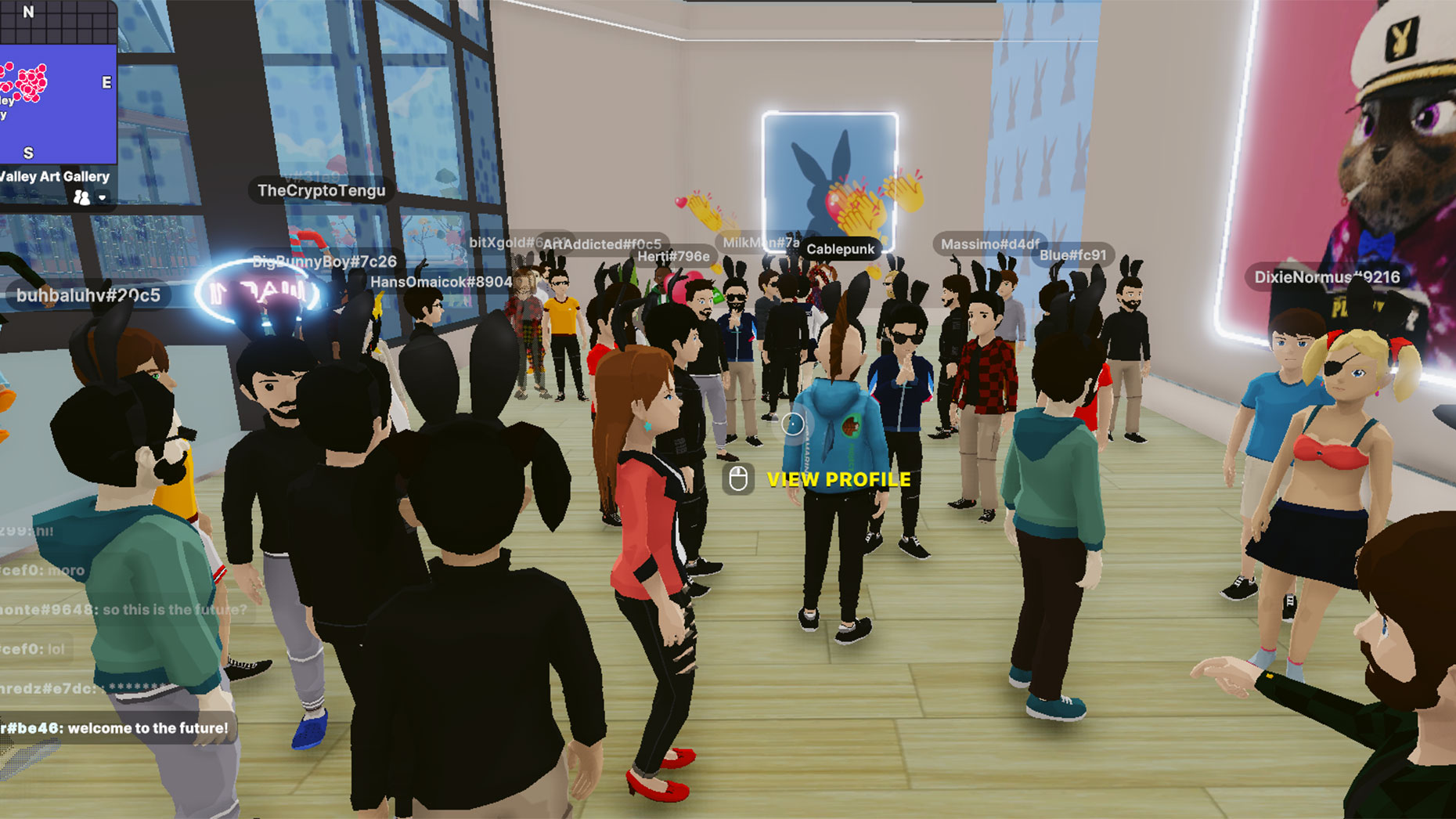
A Playboy party in the metaverse.
Image courtesy Playboy.
No longer towing around Hefner’s substantial baggage, Playboy is far from the debaucherous bacchanal of years past. Hefner led the company for 35 years, becoming famous for his wild mansion parties and an office environment as leering as the magazine’s content. Following a 1985 stroke, Hefner handed over the titles of chair of the board and CEO to his daughter Christie in 1988. In 2009, Christie retired, and
Scott Flanders, a longtime media executive, became the first non-Hefner Playboy chief executive. Hugh Hefner and Flanders took the company
private in 2011 in a $207 million transaction.
During his tenure, Flanders focused on Playboy’s licensing business and steered it away from pornography, while Hefner kept his editor in chief title and lived in the Playboy mansion until his death in 2017. More recently, a slew of
allegations of sexual misconduct and rampant drug use during Hefner’s tenure has come to light in a 10-part A&E network docuseries, “Secrets of Playboy,” that debuted last month. (“We strongly support the individuals who have come forward to share their experiences,” wrote the current Playboy leadership team in
response). After Hefner’s death, Ben Kohn, a financier who helped take the company private, took over as CEO of Playboy’s parent company, Playboy Enterprises Inc., in 2018. The company later rejoined public markets in February 2021
via a SPAC.
In a striking contrast to Hefner’s Playboy, the company now reports that its workforce is 84% women. The audience that comes to Playboy.com, according to the company, is 50% women, with 85% of them under age 44. No longer publishing headline–making interviews with Miles Davis and Steve Jobs, or narrative nonfiction from Norman Mailer and Hunter S. Thompson, Playboy.com is now dominated by e-commerce, advertising lingerie, smoking accessories and printed pants worn by the likes of
Bella Hadid. It’s fair to say we aren’t at the mansion anymore.
The new Playboy’s business model is three-pronged: there is the direct-to-consumer business; a licensing operation offering the signature bunny logo to other companies, especially international clients in China and India, as well as businesses in the gaming market; and the aforementioned digital initiatives. According to Kohn, the direct-to-consumer and licensing businesses are driving billions of dollars of consumer spend each year. The hard shift to digital also trades Playboy’s traditional (and expensive) editorial pursuits—gauzy, heavily airbrushed, meticulously art-directed photo and video shoots—for rougher-around-the-edges creator-generated content on Centerfold, plus original non-fungible token collaborations with fine artists. The digital wing is Webber’s domain, and it’s what she hopes will sustain the company for years to come.
“This is not about slapping our brand on a digital asset and having a stunt around that,” she says. “We genuinely believe this is a brand that can be a driving force in moving culture forward.” The digital products emphasize the principles that, in Webber’s mind, make up Playboy’s original DNA, “from owning your own identity to trustless systems to anti-censorship to free expression to supporting creators." (Whether Hefner’s empire was ever “trustless” is a topic for another day.)
The new Playboy audience, in Webber’s mind, is not the old Playboy audience. It skews younger, queerer, and more female. Internally, the changes are even more dramatic: women are now calling most of the shots at the company. The glossy magazine has been replaced by a “platform for creative freedom, artistic expression, and sex positivity.” And NFTs and Web3—well, they’re the new Playboy Club.
Gigi Goode saw her first print Playboy at age 13, in the lower level of a Woodstock, Ill., antique mall. She was struck by the photo shoots in the issue, which she remembered feeling “less like porn and more like art.” After ogling the magazine, she had to leave it behind at the store. “If I had been caught with a Playboy magazine in my house, my mom would have lost her mind,” she says.
Now Goode is one of the
founding creators on the Centerfold platform (and her mom is her “biggest supporter”). The 24-year-old gained recognition on “RuPaul’s Drag Race” as a runner-up on the show’s 12th season. She’s now a model and influencer, with 1.3 million
Instagram followers. After working with Playboy on a few projects, Goode was asked by the company to produce content for the new platform.
Unlike some of the other Centerfold creators, Goode is not on OnlyFans or any other subscription app. Though she does not have an exclusive agreement with Playboy (“I’m not exclusive to anybody,” she winks), her hair and makeup tutorials are currently only available on Centerfold. Prior to the platform’s launch, Goode noted that she’d been looking for a site “like Patreon, but more sex positive and more for the queers and for just about anybody and everybody on this planet.”
A Playboy that’s “more for the queers” perhaps sounds discordant with the brand’s history. But Webber points out that Playboy magazine published stories advocating for gay rights as early as the 1950s. “The biggest changes we’ve made over the past several years,” she said, “are all centered around being more inclusive.”
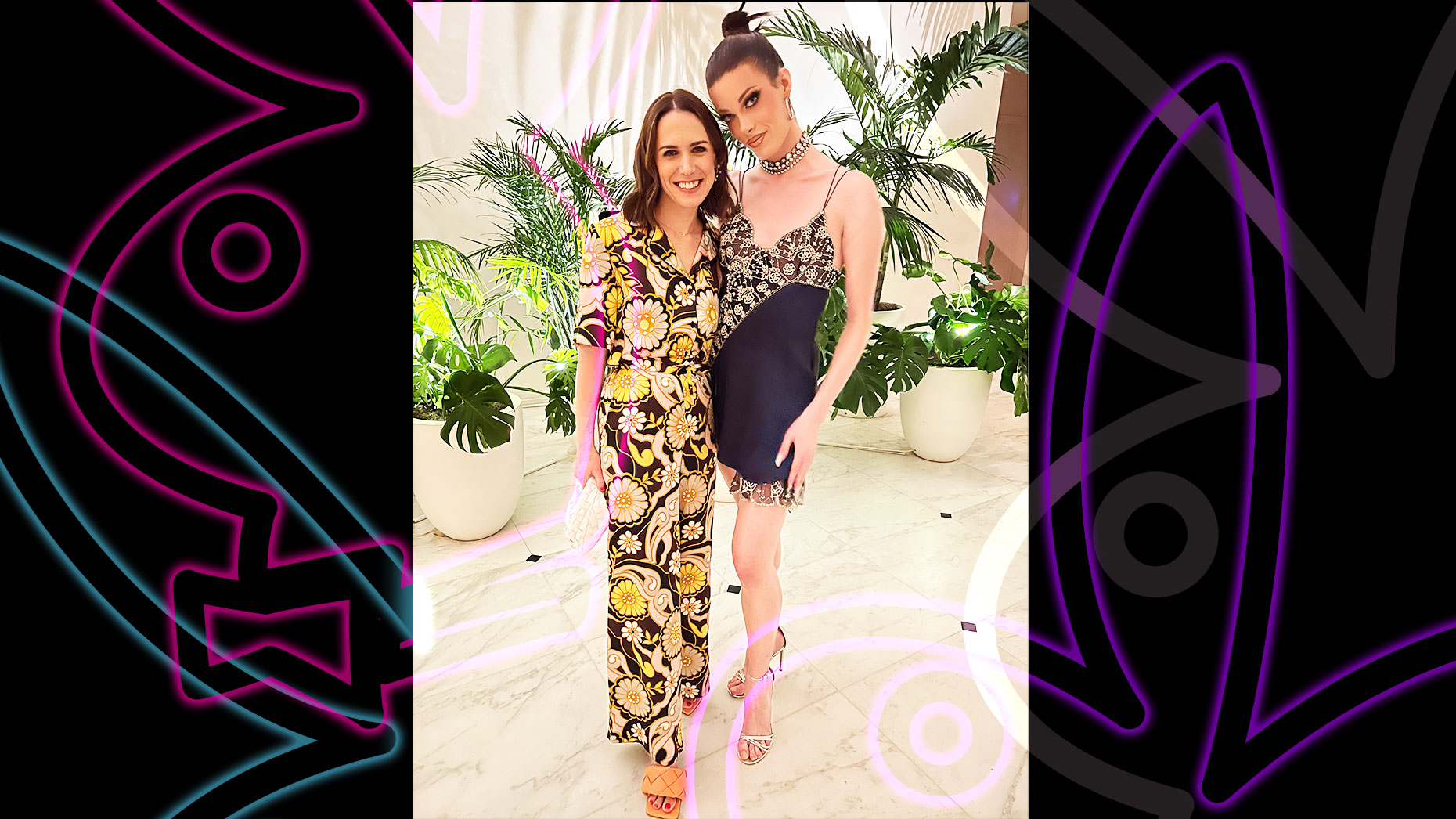
Playboy president of corporate development and chief marketing officer Rachel Webber and founding Centerfold creator Gigi Goode.
Photo courtesy Playboy. Art by Mike Sullivan.
On Centerfold as on OnlyFans, creators can choose their own subscription rates, with some selecting monthly fees (Goode’s is $15 per month) and others opting for a pay-per-photo model (Cerny charges $5 to $30 to unlock one post). Also like OnlyFans, the platform takes a 20% cut of creator payments. Though Goode wouldn’t share how much she’s netted on Centerfold over its first few months, she says the platform has been “lucrative so far.” (The company and the creators declined to divulge whether Playboy paid them to appear on the platform in the first place.)
In attracting creators to Centerfold, Webber believes Playboy is responding to a gap in the market left by Instagram’s
anti-nudity clauses, as well as OnlyFans’ short-lived decision to
ban adult content. Centerfold, though lacking the scale and recognition of its competition, is establishing itself from the get-go as a sex-positive platform, one that will not pull the rug out from under creators unexpectedly. But there are limits—Centerfold’s
terms for creators stipulate that all “content with multiple people must be entirely safe-for-work,” whereas OnlyFans’
terms do not include such language.
In many ways, Webber says, Centerfold is the brand’s new version of editorial. “Centerfold is essentially taking a magazine and turning it from the inside out,” she says. Now, it’s the people in front of the camera who have the creative power, rather than the executives and editors.
Though Playboy hopes creators will want to work with Centerfold exclusively, staying on other subscription services is allowed. Khalifa, for one, has her qualms regarding OnlyFans, but she says she will keep posting content there. “I think it’s going to be more of a gradual transition [away from the platform],” she says. But Khalifa wants her Centerfold account to look different from her OnlyFans content. “It’s going to be a little bit more stylized,” she says. “My OnlyFans is strictly me and my iPhone, and I would really love to throw in more professional photo shoots onto my Centerfold because you’ve gotta step it up—it’s Playboy.”
In January 2021, while many people were still wrapping their minds around the concept of NFTs, Webber already had a plan to market them. Ondaatje remembers Webber kicking an NFT project into gear that month, telling skeptical team members that NFTs were soon going to be the biggest story in tech. “Rachel could see where this was going in a way that a lot of us couldn’t,” Ondaatje says.
Playboy is one of countless brands, from
Louis Vuitton to the
NBA, that are jumping on the NFT bandwagon. But the company has something most others don’t: exclusive access to a vast library of archival images just waiting to be mined into tokens. Crucially, there’s also the internationally famous bunny logo, which can be repurposed into an infinite variety of digitized artworks.
Playboy’s first foray into the NFT world was a May collaboration with blockchain-powered auction service
Nifty Gateway, entitled
Liquid Summer. The collection consisted of collages by artist Slimesunday, launched with a party (where else?) in the Crypto Valley of the Decentraland metaverse. Playboy’s
stock jumped 83% in April after announcing the project (it has since plummeted back to pre-April levels), and when the collection launched on May 4, it
sold out in under three minutes.
Next, Liz Suman, Playboy’s vice president of art curation and editorial, reached out to artist
Shantell Martin, who has collaborated with everyone from Adidas to Kendrick Lamar, about creating
an NFT collection with imagery from Playboy’s 1976 David Bowie interview. Martin found the process “very collaborative” and eventually landed on three images with corresponding Bowie quotes, each relating to sex, drugs or rock-and-roll.
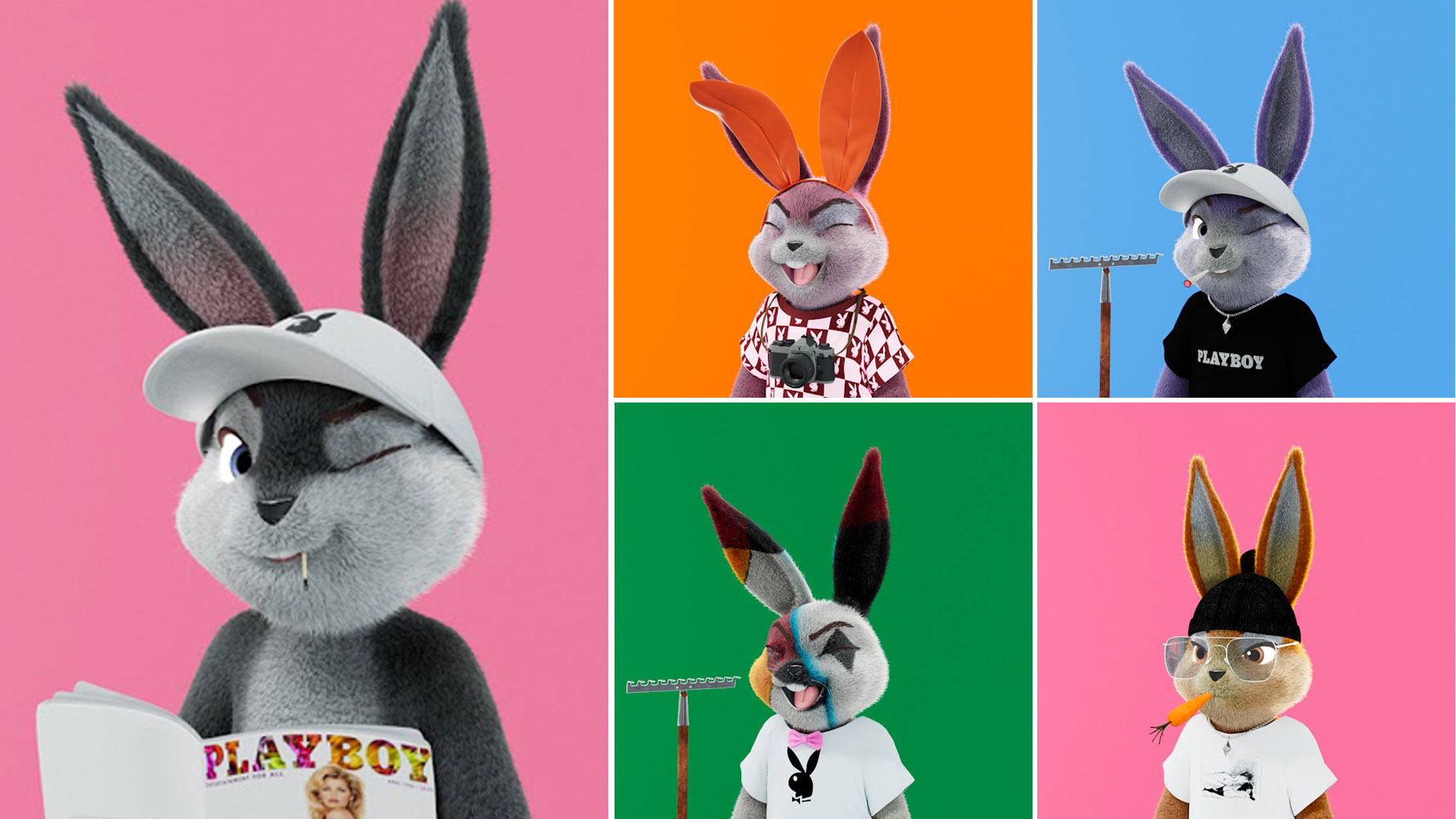
In October, Playboy launched a different sort of NFT project—the Rabbitars—and instantly knew it had a hit on its hands. The company has since sold 11,953 of the cartoon rabbit tokens, costing $900 at minting, with one Rabbitar,
Midsummer Night Queen, selling for a record of roughly $47,000 in November. The Rabbitars have different furs, accessories and clothing and each grants its owner access to events and perks. Webber calls the Rabbitars the “new keys to what the Playboy Club of the 21st century can be.”
A selection of Playboy’s Rabbitar NFTs.
Images courtesy Playboy. Art by Mike Sullivan.
So far, the community of Rabbitar owners is highly engaged. Case in point: Moe Faux, the pseudonymous owner of eight cartoon rabbits. A longtime collector of vintage Playboy magazines, Faux was initially drawn to the “freaking adorable” look of the Rabbitars. (“Bored Apes aren’t cute,” she said. “They’re kind of yucky looking.”) She purchased her first two, sight unseen, in October, and her collection has only grown since. Her most expensive one cost $1,400.
“It was a big purchase for me. I don’t have a lot of money to throw around,” says Faux, who makes a living walking dogs and bartending in Los Angeles. “I thought, this is an investment into something I’m going to enjoy that will most likely retain its value or even increase.” Soon Faux also became invested in the Rabbitar community itself, making friends in Playboy’s 84,000-member Discord channel.
Another Rabbitar owner, who goes by the name Fat Doinks (the moniker stems from his penchant for rolling “big blunts”), also purchased his Rabbitar after moving from New York to Miami. He now owns two Rabbitars, each of which he bought for around $800. “My fiancée has a lot of family and friends [in Miami], but I don’t really have anyone. So I wanted to go and find a community, find some like-minded people,” he says. “I’m engaged, but I love sex. I believe sex sells and I believe Playboy just has an illustrious name.”
Doinks became an active member of the Discord channel and eventually was approached by Playboy to become a paid “community moderator,” orienting new members and answering NFT questions. As a Rabbitar owner, Doinks also gets access to events, both in person (attending Playboy’s Miami Art Basel parties) and in the metaverse (where Playboy hosted a Rabbitar Christmas soirée). He was also offered an invitation to Centerfold’s Miami launch party, which he called “bananas”—guests included singer Charli XCX and actress (and
Kanye West ex) Julia Fox.
Rich Greenfield, a general partner at LightShed Ventures who has
invested in digital-media companies like Cameo and Wondery, noted that in a crowded NFT marketplace, an authentic and engaged community is essential for success. “What the internet is powerful about is it can connect fans around content,” Greenfield says. “And the ability for NFTs to be a way of gating that and making it so that you can really create a community among your most passionate fans—that’s really interesting.”
In Webber’s light-filled office inside Playboy’s Los Angeles headquarters, a stack of Playboy magazines sits on a stool behind her desk. After I ask about them, Webber picks up the December 2019 issue from the top of the pile. One of the magazine’s final print issues, the cover features a vintage-style topless photo of a woman with blond hair, artfully holding playing cards to cover herself. “There’s an article in this one that [Communications Director Megan Jordan] and I were looking at last night. It was by Jamilah Lemieux and it was on
the role of the Playmate,” she says. The piece is exemplary of the conversations Webber wants the new Playboy to spark, asking consumers to think about issues of consent and to question established gender roles.
Indeed, much of working on the post-print Playboy involves contending with the brand’s original slogan, “Entertainment for Men.” In other words, it’s cleaning up the mess left by Hefner, unraveling a value system that often objectified rather than empowered its subjects, while maintaining the type of critical thinking that encouraged writers like Margaret Atwood and Gabriel García Márquez to publish their work in the magazine. Playboy’s history is predatory and abusive at its worst, but liberating and brilliant at its best—the challenge for Webber is to discard the bad parts while holding onto the good.
Maybe this new Playboy ends up looking like a cartoony, digital world, populated by animated rabbits. Or maybe it looks like Playboy’s Cardi B–hosted Art Basel party, where “cake and strawberries could be eaten off the nearly naked models in a downstairs dining room,” according to
The New York Times, and where “Jaret Leto could be overheard in the garden talking about NFTs with friends.”
But this sharp turn into the metaverse will not come without its challenges. “Legacy media companies generally don’t lead, they follow,” says LightShed’s Greenfield. “They usually wait to see what works and then try to jump on whatever that quote unquote bandwagon is. They generally are not first movers.”
For Centerfold especially, Playboy is exceptionally late to the game. OnlyFans launched in 2016 and Instagram has been churning out “thirst traps” for a decade. Of course, the appeal of a brand that emphasizes sex positivity is not to be undersold, especially when many creators on the platform are themselves sex workers. But scaling this vision will be an uphill battle. “It’s very, very difficult to compete with massive established platforms, whether that’s Instagram, whether that’s TikTok,” Greenfield says. “Launching a consumer app in 2021, you’re fighting just massively scaled companies, and so it’s just very hard and it takes a tremendous amount of capital to be successful.”
Playboy’s CEO, however, seems undeterred. “When you think about this brand and how wide it can go,” Kohn says, referencing Playboy’s offerings from a $900 tequila to gambling properties in India, “I don’t know of another brand that can do that outside of, I would say Disney, that can couple products and experiences together. I can’t think of another one.”
The comparison may be less absurd than it seems. Playboy, like Disney before it, is attempting to jump-start a legacy media brand by combing through valuable intellectual property, updating it for a new audience, and distributing it through new digital channels. Per Kohn, the possible next steps include integrating merchandise into Centerfold, building a Playboy mansion in the metaverse, and expanding blockchain technology “into everything we do.”
After all, on top of the buzzy technology plays and “freaking adorable” rabbit art, there is just something about the pure, unadulterated swagger that the Playboy brand still evokes. Webber sensed it when she donned a Playboy sweatshirt in the office for the first time. “I thought, ‘Why do I feel so badass in this?’” she remembers. “And then I was like, ‘This is it. It works.’”