WSJ : Volkswagen in Advanced Talks Over Porsche IPO

Volkswagen in Advanced Talks Over Porsche IPO
Move could help the car maker raise the cash needed for investment in electric vehicles

BERLIN— Volkswagen AG VOW +4.63% and the heirs of Beetle designer Ferdinand Porsche, the company’s largest shareholder, said on Tuesday they are in advanced talks that could lead to the initial public offering of the iconic Porsche AG sports-car maker.

The German auto maker said it had worked out a framework agreement with Porsche SE that still requires formal approval of both companies and their supervisory boards. VW shares jumped nearly 9% on the news as trading opened on the Frankfurt stock exchange, and were trading at around €188.14 by midmorning, equivalent to $212.81.

A listing would provide VW with fresh cash to fund its aggressive push into electric vehicles, the development of new technology such as self-driving cars and the creation of a new business building batteries for its EVs. The discussions highlight how auto makers are scrambling to secure the capital to finance the auto industry’s most far-reaching transformation in a century.

The announcement comes after more than a year of speculation and intense discussion among VW core shareholders that include Porsche Automobil Holding SE, the fund owned by the Porsche and Piech families, the state of Lower Saxony, which controls around 20% of VW and has special rights under Germany’s “VW Law,” and the influential IG Metall labor union which holds half the seats on VW’s board of directors.

Porsche SE confirmed the talks and said it could purchase Porsche AG shares in the event of an IPO. People close to the family have said as recently as December that it was considering selling some of its 53% stake in VW to take a large share of Porsche, which the family ceded to VW after Porsche’s failed attempt to take over VW in 2008.

Volkswagen is investing in electric vehicles more than other legacy car makers in the U.S. WSJ goes inside an engine factory that is being transformed into a battery plant as the German giant looks to change its image and become a rival to Tesla. Photo illustration: George Downs
Porsche is a major driver of VW profits and one of its most recognized brands. The maker of the 911 sports car and the Taycan all-electric sports sedan contributes a large share of its profit to the VW group, which also includes the namesake VW brand, Audi, Bentley, Lamborghini and others.

Although its sales of 301,915 vehicles last year are dwarfed by VW’s mainstream mass-market brands, analysts estimate that Porsche’s electric car business alone could be worth nearly half of the value of the entire VW group, which has a market capitalization of €108.61 billion.

TechCrunch : Automata expands its lab automation ambitions with $50M B round

Automata expands its lab automation ambitions with $50M B round
Image Credits: Automata
The world’s labs are under pressure to do more tests and process more materials, not just due to COVID but from the growing biotech and drug development sectors — and automation is the sure path forwards. Automata, which got its start making a robotic arm for handling individual tasks, has now raised $50M to automate entire lab processes from start to finish.
When we last talked with Automata in 2019, the company had just raised a $7.4M A round and was focusing on developing and deploying its Eva robotic arm, which could be used for a variety of common tasks: moving glass around, performing simple samples, that sort of thing. But they soon found that life as a robot provider for small, highly individual projects and labs wasn’t a viable business model.
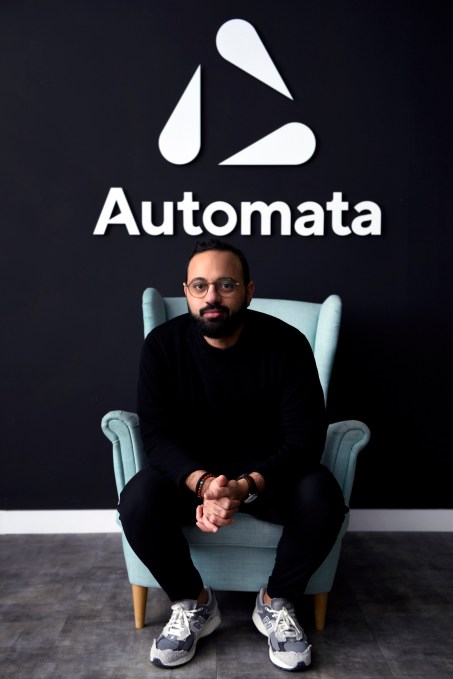
“It’s not enough to engage with your customer at one stage — like, ‘here’s the most affordable robot arm on the market, good luck!’ If companies buy one or two robots, it optimizes a few processes but it doesn’t revolutionize how that company works. So over the last few years we’ve started looking at how we can drive adoption of our tech at a scale that matters,” said co-founder and CEO Mostafa ElSayed.

They identified three large markets that they felt were on the cusp of an automation boom: diagnostics, drug discovery, and synthetic biology (i.e. the discovery and cultivation of purpose-built microbes).
What the company found as it installed the first few hundred of its Eva arms was that companies in these sectors had a lot of “partial automation.” ElSayed compared this to having a dishwasher in your kitchen: you don’t have to wash plates by hand any more, but you still have to load and unload it, add soap, select the settings, etc. Useful but it still relies entirely on human labor.
The limits of partial automation were highlighted during the pandemic, when labs performing PCR tests especially were operating at maximum capacity and still nowhere near meeting demand. Similarly in drug development and synthetic bio, timelines stretch into the 5-7 year range for certain processes because there’s a hard limit on how frequently a given process can be run. By moving from partial to full automation, huge time savings and throughput increases can be realized. But it couldn’t be done with a handful of robotic arms.

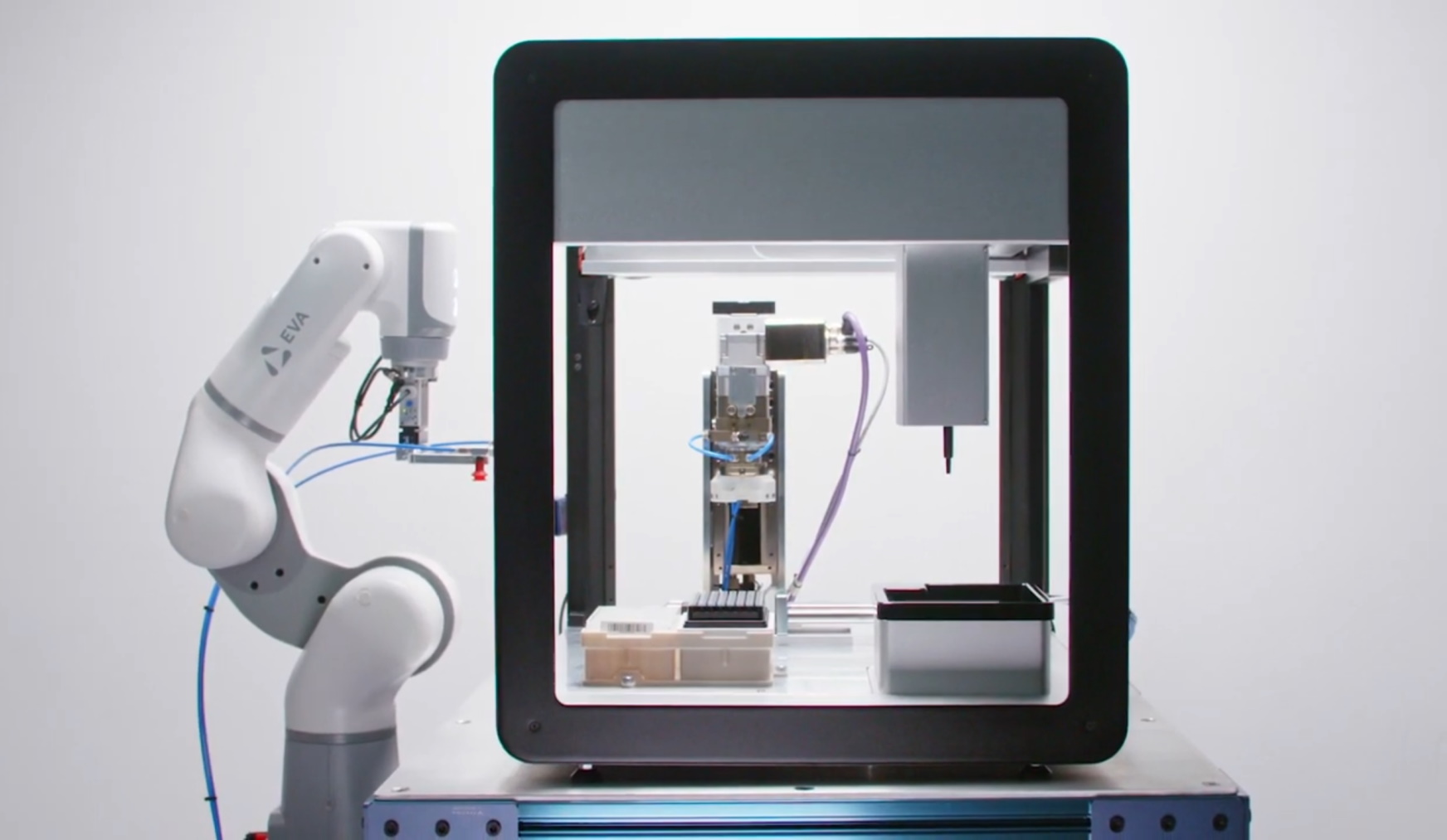
The Automata Labs enclosure with Eva robotic arm next to it.


“We’ve had to build an entirely new hardware stack that allows for this kind of automation,” ElSayed said. Late last year they announced their new hardware platform, Automata Labs, a sort of modular container built for continuous operation of machinery inside and the ability to pass the results to the next step. “The benchtop is really the standard unit of all laboratories, so it’s basically a whole lab bench that’s amenable to automation.”
The company’s most visible success is an NHS testing facility that has been as automated as is currently possible (that is, humans are still in there but a huge amount of the work is done robotically), and has now processed over a million samples. ElSayed pointed out that the number is large, but the more important one was that the automation reduced turnaround times for results by half, which as you might imagine is crucial for time-sensitive tests. It’s largely because the automation level lets the clinicians set the robots to work overnight, and they can have results ready in the morning.
In experimental settings, timelines can be reduced by 25-40 percent, which is significant but may sound modest to anyone who has read of orders of magnitude productivity increases in sectors like manufacturing. ElSayed said there are other paths to go down to further improve that specific number, like the “lights out laboratories” that enabled the NHS rapid labs.

CEO Mostafa ElSayed.

But he noted that for many researchers there’s also a serious need for accuracy and repeatability.
“There was a clear, describable need for those user bases,” he said. “There’s the basic one of increasing throughput while reducing menial tasks in a lab… but there was also, and we didn’t know this going in, a repeatability problem in labs. Teams would publish their own research papers, then try to replicate the results and fail, because the processes in the lab were highly manual and variable.”
So a large part of the draw in automation is systematic tracking and performance, and fewer errors. To that end Automata has been investing in the software to manage and administer its labware and robots.
“The scientists in these organizations — especially their automation scientists, this up and coming role — what they really want is the ability to program these systems themselves, and design these screenings themselves, rather than call us in,” said ElSayed. As anyone who’s negotiated with scientists before probably knows, many would rather keep doing things the old way rather than cede control to an outside agency. So building a system that’s designed to be deployed and adjusted by the on-site crew has been a major focus.
“More and more of the labs adopting our hardware are coming to us for these digital solutions to configure or deploy them, or connect the ecosystem to their data system,” he continued.
A new generation of hardware, in limited testing with partners, is set to be revealed later this year, and Automata is also getting ready to make the leap into the U.S. and wider European markets. The huge amount of hiring, manufacturing, sales, support and so on that this expansion necessitates are the reason the company has raised this $50M B round. The round was led by Octopus Ventures, with participation from Hummingbird, Latitude Ventures, ABB Technology Ventures, Isomer Capital, In-Q-Tel and others.

LE Figaro : Ubisoft devient une cible alléchante pour un rachat

Ubisoft devient une cible alléchante pour un rachat

Assassin’s Creed Valhalla. Ubisoft
Le groupe fondé par les frères Guillemot ne manque pas d’atouts et traverse une période compliquée en bourse. De quoi attirer les convoitises de plus grands acteurs du secteur.

Qui sera le prochain gros acteur du jeu vidéo à se faire racheter par Microsoft, Sony ou bien un des Gafa? Au jeu des devinettes, le nom d’Ubisoft revient souvent dans la bouche des analystes financiers.

L’éditeur français, créé en 1986 par les frères Guillemot, a de beaux atouts à faire valoir. Il est propriétaire de licences puissantes et touchant des publics variés, comme Assassin’s Creed, Les Lapins crétins, Far Cry, Just Dance… Il détient une force de production impressionnante, avec plus de 17.000 développeurs répartis entre l’Amérique du Nord et l’Europe - soit plus qu’Activision, EA et Take-Two réunis. Il travaille avec tous les acteurs de l’industrie, de Nintendo à Google Stadia, et développe pour le compte de Disney des jeux Star Wars et Avatar. Son expertise sur la création de mondes ouverts en 3D, recherchée pour le développement des futurs métavers, est reconnue. Et, surtout, Ubisoft est bien plus accessible que les autres grands éditeurs indépendants du marché. Sa valorisation boursière n’est que de 5,6 milliards d’euros (45 euros l’action), contre 18 milliards de dollars pour Take-Two et 36 milliards pour EA.

À LIRE AUSSIAvec Quartz, Ubisoft est le premier acteur majeur du jeu vidéo à se lancer dans les NFT

Cette faiblesse boursière s’explique par plusieurs facteurs. «La monétisation des jeux Ubisoft est moins bonne que ce que l’on peut voir chez les éditeurs américains», qui ont resserré leur production sur une poignée de licences et sont devenus experts des microtransactions, note Charles-Louis Scotti, analyste chez Kepler Cheuvreux.

Surtout, Ubisoft traverse depuis deux ans une passe difficile. Son planning de sorties a été bouleversé par le Covid et seul Assassin’s Creed Valhalla (novembre 2020) a connu un véritable succès. Sa réponse à Fortnite, le jeu Hyper Scape, a été un échec cuisant. Son incursion dans la blockchain et les NFT est décriée par les joueurs mais aussi ses propres salariés. Le groupe a également été secoué à l’été 2020 par des affaires de harcèlement moral et sexuel qui a conduit au départ de membres clés du top management mais aussi de nombreux développeurs. Au Canada, où la concurrence avec les autres studios est acharnée, Ubisoft a dû augmenter les salaires et offrir plus de congés payés pour tenter d’endiguer la fuite de salariés.

L’action, qui valait 85 euros en janvier 2021, est aujourd’hui sous pression. «Même les actionnaires qui croient en Ubisoft ne peuvent s’empêcher de penser que le moment est peut-être venu de maximiser la valeur de l’entreprise, alors que des énormes sociétés bataillent pour avoir du contenu. Dans un an, il sera peut-être trop tard», note Ken Rumph, analyste chez Jefferies. «Il est certain que les Guillemot ont bien moins le soutien des actionnaires qu’à l’époque Vivendi», souligne un fin connaisseur de l’entreprise.

L’inconnue Guillemot
De 2016 à 2018, Vincent Bolloré a tenté de s’emparer d’Ubisoft mais s’est heurté à une forte résistance de la famille Guillemot. «La situation était différente. Il s’agissait d’une prise de participation rampante, sans OPA ni prime pour les actionnaires», rappelle Charles-Louis Scotti. Vivendi avait fini par se retirer du capital en empochant 1,2 milliard d’euros de plus-value, tandis qu’Ubisoft avait fait entrer de nouveaux actionnaires, dont le chinois Tencent.

À LIRE AUSSIBaskets, vêtements de luxe, foncier… Le business déjà bien réel des univers virtuels

Lors de cette bataille, la famille Guillemot avait clamé haut et fort qu’elle ne renoncerait pas à son indépendance. «Bungie et Activision disaient aussi la même chose, et au final ils ont été rachetés par Sony et Microsoft pour des dizaines de milliards de dollars. L’indépendance n’a qu’un prix!» affirme l’analyste de TP Icap Charles-Louis Planade. De l’avis des analystes interrogés par Le Figaro, aucune opération ne pourra se faire sans l’assentiment des frères Guillemot, qui détiennent 20 % des droits de vote. Mais sont-ils vendeurs? «C’est la grande inconnue», déclare Ken Rumph. Interrogé à ce sujet jeudi lors de la présentation des résultats trimestriels du groupe, Yves Guillemot a indiqué: «Ubisoft peut rester indépendant. Nous avons les talents, un portefeuille de licences fortes et une taille critique. Mais si nous recevions une offre, nous l’étudierons.»

Une belle porte de sortie
«Les frères Guillemot ont désormais 60 ans et personne ne semble prendre la suite dans la famille. Une belle porte de sortie serait un rachat par un gros acteur de la tech. Ils refuseront de se vendre à un concurrent direct» comme EA, estime le bon connaisseur du groupe. La liste des repreneurs potentiels se compose de Microsoft, Sony, Amazon, Google, Meta, voire Disney ou même Tencent, mais un rachat d’un fleuron européen par un acteur chinois risque de susciter une levée de boucliers. Surtout, les observateurs ne voient pas Ubisoft se revendre à n’importe quel prix: «les Guillemot savent la valeur de leur groupe. Ils ne céderont pas en dessous de 80 euros l’action.» Reste désormais à voir si, au-delà des spéculations, Ubisoft recevra ou non des marques d’intérêt.

FT : Bitcoin money laundering: bug or feature?

Bitcoin money laundering: bug or feature?

Bitcoin has a problem. It is not terribly useful for things like generating yield. It’s also a bad payment method, assuming your goal is to make fast payments with low fees and low price risk. Newer bitcoiners mostly mutter something about “digital gold” and move on.

But bitcoin is half-decent at one thing: money transfers that don’t need official approval. This is not necessarily bad. During the worst of this year’s lira volatility, some Turks turned to crypto, which they saw as no less volatile than the official currency.

The issue, from a bitcoiner’s perspective, is that it isn’t the only game in town. Something similar happened in Myanmar in December, where anti-junta rebels used the stablecoin tether to transact. And then there are the privacy coins, as the FT’s Gary Silverman laid out in a recent column:

[Some in crypto are] working today to thwart the enforcement of anti-money-laundering laws through the creation of so-called privacy coins — cryptocurrencies designed to be difficult to track or trace.

The threat posed by privacy coins can be gleaned from the fine print of a federal criminal complaint filed this month, which accuses a New York couple of laundering proceeds from the August 2016 hack of the Bitfinex exchange that netted bitcoin worth $4.5bn at the time the government acted. Among the techniques they allegedly used was converting some of the bitcoin into “anonymity-enhanced virtual currency”, the filing says, the most notable example being a privacy coin called Monero.

Privacy coins such as Monero and Zcash use complex cryptography to obscure the identities of people trading them. In contrast, bitcoin traders are identified by public addresses, which are theoretically anonymous but often can be traced in practice. That is exactly what happened in the federal probe Silverman mentions.

So bitcoin is pinched. It’s not a great option for privacy hawks (to describe them generously), nor is it all that intrinsically useful. Its clout comes from a first-mover advantage and a loyal fan base, not any purported features of digital gold. But what moats will stave off the crypto competition in the long run?

Some bitcoin diehards want the cryptocurrency to pivot to privacy. Here’s Human Rights Foundation exec Alex Gladstein speaking to Bloomberg’s Joe Weisenthal last week:

Gladstein thinks it’s a mistake for bitcoiners to accept the premise that it’s not good for money laundering. As he puts it, “It has to be good for money laundering if it’s going to be freedom money.”

As he put it, there was an understanding from the very beginning that bitcoin didn’t have great privacy, and that it was a purposeful trade-off at the start ...

According to Gladstein, privacy tech is advancing all the time within the bitcoin ecosystem. There are things like Coinjoin, where people can combine their bitcoins, such that it’s difficult to see who has control of what.

Gladstein’s vision is of a bitcoin that looks more like Monero than ethereum, where its purpose is challenging state control. But as crypto has expanded beyond bitcoin, this “freedom money” view has lost ground to one that wants widespread adoption. Regulated, centralised exchanges such as Coinbase and FTX, for instance, want trading volume and a regulatory truce.

Izabella Kaminska, who has just left the FT for her brand-new The Blind Spot, thinks a little monetary competition isn’t so bad:

Crypto is a terrible system. And I would seriously rather not operate via its channels. But with great centralisation comes great authority, and having a pesky challenger in the mix is probably a good thing. It keeps the core system honest. It’s the reason we have a shadow government in politics too. A challenger system keeps things in balance, and prevents the forces of corruption taking root in the core system. The best scenario is one where bitcoin is there as an option but very rarely used.

Kaminska elaborates in a separate blog post that many democracies’ core systems are not so honest, too often passing clunky anti-money laundering laws that don’t stop corruption and that can be used against domestic political opposition.

This is a strong argument in a debate I won’t resolve. What we are talking about is knowingly creating a gift for organised crime so that dissidents across the world can better resist state power. Maybe, on balance, that’s a good thing for humanity. But if I were an institutional money manager with a bitcoin allocation, I might just be a tad alarmed that the leading theory for its long-term moat is embracing the shadows.

FT : The value rotation is on pause in the US, but not in Europe

The value rotation is on pause in the US, but not in Europe

It feels distant now, but just last month the high market drama was the rotation to value. One exaggerated headline in a major publication hailed it as the biggest since 1995. Since then, though, markets have had bigger problems. An indeterminately hawkish Federal Reserve and Russia-Ukraine tensions are keeping everyone on edge.

It’s not so surprising, then, that the US value rotation has taken a breather. Assets held in large-cap value ETFs have grown a brisk 4.3 per cent year-to-date, but that has recently slowed to a trickle, according to Jefferies data. Since late January, the Russell 1000 growth and value indices have traded close together:


The most immediate backdrop is the growing appetite for safety. Gold is beating just about everything else. The latest Bank of America fund manager survey found the highest share of cash holdings since May 2020. Perhaps investor anxiety has put the value rotation on ice?

That story is harder to see in European equities, where the pivot to value is chugging along. Despite some wobbles in the last few days, European value continues to outperform growth:


When we last discussed it in January, US value was still outperforming growth, just at a slower clip than Eurovalue. At the time, Schroders research head Duncan Lamont gave us two possible explanations:

  • The European value index depends more on financials and energy

  • European growth’s valuation gap over European value has gotten extreme

A month later, the first point looks bang on. In absolute terms, energy stocks in the S&P 500 value index beat their counterparts in the MSCI Europe value index this year. But in weighted terms, European energy’s contribution margin to the Europe value index was 47 basis points higher than the US energy equivalent. The story is broadly similar for financials.

The second point is harder to judge, as valuation data is published less frequently. Bloomberg estimates show Europe’s valuation gap — the difference in forward P/E ratios between growth and value indices — shrinking since late 2021, though this is subject to sharp quarterly revisions.

It’s early, but the value rotation in Europe looks firmer than in America. Which is not to say that the US rotation is doomed, but that more needs to go right. In Europe strong bank and energy stocks, set to gain from rising rates and oil, can do the heavy lifting, whereas other US sectors will need to pitch in. We’ll keep an eye on this.

FT : IHG says hotel demand ‘getting closer’ to pre-pandemic levels

IHG says hotel demand ‘getting closer’ to pre-pandemic levels
Holiday Inn and Crowne Plaza owner reinstates dividend

InterContinental Hotel Group, the owner of Holiday Inn and Crowne Plaza chains, said that business was “getting closer to pre-pandemic levels” in 2021, as rising vaccination rates and easing of travel restrictions boosted demand for its hotel rooms.

The sector was affected by the spread of coronavirus and lockdowns that prevented travellers from visiting its hotels, but it has begun to rebound. IHG said its revenue per available room, the industry’s preferred metric, has returned to 70 per cent of 2019 levels.

Keith Barr, chief executive, said on Tuesday: “As vaccination rates rise and restrictions are lifted around the world, we are seeing the demand for travel increase. While there may be unexpected challenges ahead, we are confident in our ability to respond and adapt to what consumers and owners need.”

Operating profit from reportable segments doubled from 2020 to 2021 to $534mn, slightly ahead of analysts’ estimates. Group operating profit was $494mn, bouncing back from a loss of $153mn in 2020.

Revenue per available room recovered strongly in the US, to 20 per cent below 2019 levels, while the company’s operations in Greater China and the Europe, the Middle East and Africa regions were down 29 per cent and 52 per cent on 2019 levels respectively.

Given the profit growth and a reduction in debt, Barr said the company would reinstate its dividend, suspended since 2019, with a payout of 85.9 cents per share.

>>> Europe : Brokers Upgrades & Downgrades - 22nd of February 2022 V2(+)

>>> Up
* AMD Raised to Outperform at Bernstein; PT $150
* Belimo Raised to Add at Baader Helvea; PT 510 Swiss francs (+)
* BP Raised to Reduce at AlphaValue/Baader
* Nibe Raised to Equal-Weight at Morgan Stanley; PT 70 kronor
* Orsted Raised to Overweight at Barclays; PT 900 kroner
* Paragon Raised to Buy at Investec; PT 610 pence (+)
* Poste Italiane PT Raised to 15.50 euros at Barclays
* S4 Capital Raised to Buy at Numis; PT 599 pence (+)
* Spectris Raised to Buy at Peel Hunt; PT 3,470 pence
* Tenaris Raised to Add at AlphaValue/Baader
* Valiant Raised to Add at Baader Helvea; PT 110 Swiss francs
* Voestalpine Raised to Outperform at Credit Suisse; PT 43 euros

>>> Down
* Goodyear Cut to Hold at Jefferies; PT $17
* Kahoot Cut to Neutral at SpareBank; PT 30 kroner
* Lehto Group Cut to Sell at SEB Equities; PT 30 euro cents
* Pennon Cut to Underperform at Jefferies; PT 900 pence
* Severn Trent Cut to Underperform at Jefferies; PT 2,480 pence
* SSAB Cut to Neutral at Credit Suisse; PT 57 kronor
* United Utilities Cut to Hold at Jefferies; PT 1,000 pence

>>> Initiation
* Faurecia SE Reinstated Hold at Jefferies; PT 38 euros
* Nexi Rated New Equal-Weight at Morgan Stanley; PT 13 euros
* Prudential Rated New Outperform at CICC; PT 1,656.81 pence
* Seeing Machines Rated New Buy at Berenberg; PT 12 pence
* Tracsis Rated New Buy at Liberum; PT 1,335 pence (+)

>>> Call
* Citi Strategists See Investor Positioning Turning More Bearish (+)
* Beiersdorf’s Eucerin Brand is ‘Losing its Mojo,’ RBC Trims PT
* Casino Seeks Cash Lever With Mercialys Stake Sale: Bryan Garnier (+)
* Eurofins Scientific Raised Guidance Should Be Taken Well: Citi (+)
* Insatiable U.K. Housing Demand, Lack of Stock Spur Buyer Rivalry
* Nibe Risks Now Reflected in Stock, Morgan Stanley Upgrades
* SoftBank Needs to Sell More Alibaba Shares This Year: Jefferies
* Ubisoft Becoming More Reliable and Price Is ‘Reasonable:’ Citi (+)
* U.K. Water Cos. Cut at Jefferies on Regulatory and Opex Risks