SOFR Leads Race to Replace Libor as Interest-Rate Benchmark
Sales of corporate loans and derivatives tied to rate have picked up, with Crocs among recent issuers
U.S. companies and financial institutions are starting to settle on a new interest-rate benchmark to replace the troubled London interbank offered rate, which underpins trillions of dollars of financial contracts.
Sales of corporate loans and derivatives tied to the Secured Overnight Financing Rate, or SOFR, have soared in 2022, with borrowers including Crocs Inc. and NortonLifeLock Inc. accelerating the shift away from issuing new debt tied to Libor.
Large U.S. financial institutions, meanwhile, have largely replaced Libor with SOFR—regulators’ preferred choice—for matters such as low-rated corporate loans and derivatives on future debt sales, analysts said.
Financial authorities started phasing out Libor in 2017 after the discovery that traders at large banks manipulated the rate, which helps set borrowing costs on financial contracts such as mortgages and corporate loans. Starting this year, U.S. banks can’t issue any new debt linked to Libor, while around $200 trillion of existing interest-rate derivatives and business loans tied to the benchmark are set to expire by June 2023.
Regulators have worked with banks to promote broader adoption of SOFR. But the changeover has been slower than some expected, raising concern that an unruly transition would spark legal conflicts and spawn a complex mix of competing benchmarks.
Companies, banks and traders said they picked SOFR—which is based on the cost of transactions in the market for overnight Treasury repurchase agreements—in part because its stability during the Covid-19 pandemic’s market swings demonstrated it is robust enough to support large numbers of financial arrangements.
“There seems to be a clear No. 1 candidate for most deals,” said Amol Dhargalkar, managing partner and global head of corporates at Chatham Financial, a financial-risk adviser.
SOFR has gained traction since a Dec. 31 deadline that prohibited U.S. banks from issuing new debt tied to Libor. U.S. companies in January sold 61 leveraged loans tied to SOFR totaling over $66 billion, according to Leveraged Commentary & Data, a unit of S&P Global Inc. That is up from around $3.9 billion raised across four deals in December.
Shoe maker Crocs said last month it sold a $2 billion SOFR-based leveraged loan to acquire Hey Dude, a casual-footwear brand, for $2.5 billion in a deal that closed last week. Crocs decided to switch to SOFR because “it’s what has been dictated by the market,” said Chief Financial Officer Anne Mehlman.
NortonLifeLock, a Tempe, Ariz.-based cybersecurity software provider, sold in January a $3.69 billion loan to fund its merger with Avast PLC, which is expected to close in April. NortonLifeLock CFO Natalie Derse said primary lender Bank of America Corp. advised the company to switch to SOFR, citing its traction in the market.
NortonLifeLock plans to switch over its remaining $2 billion in Libor-linked debt when it refinances, or pays it off and needs new loans, said Ms. Derse.
“We were OK with Libor,” she said. “If we were in complete control, I don’t know that we would have pushed for a change from Libor.”
The weekly count of derivatives trades tied to SOFR surpassed that of Libor for the first time in the week ended Jan. 21, when the former totaled 8,200 compared with the latter’s 6,815, according to a Chatham Financial review of market data.
Average daily trading of SOFR-based derivatives has grown as well. Over $1.4 trillion of futures and options contracts tied to SOFR changed hands daily during the month through Feb. 15, according to exchange operator CME Group Inc., compared with $237.6 billion in February 2021.
Some small or midmarket businesses are considering other benchmarks, such as the Bloomberg Short Term Bank Yield Index, known as BSBY, and American Financial Exchange’s Ameribor, which they say better reflect lenders’ funding costs and account for the risks from short-term lending.
BSBY derivatives trades totaled 21 in the week that SOFR first topped Libor. A spokeswoman for American Financial Exchange said the electronic marketplace didn’t have a tally of the loans tied to the rate, but said Ameribor is a “true plug-and-play” replacement to Libor.
Some borrowers have held on to Libor, despite the Dec. 31 deadline. Last month U.S. companies launched 10 leveraged loans tied to Libor, seeking to raise $2.9 billion, on top of $9.9 billion from the previous month.
Most of the Libor-linked leveraged-loan transactions this year were so-called add-on loans, in which companies raise additional funds as part of an existing borrowing contract. Companies can also issue Libor-linked debt established before 2022 but set to close this year.
Companies with loans that expire before the June 2023 deadline—when products both existing and new must cease referencing Libor—will likely look into refinancing debt at a SOFR rate, said Jamie Spaman, managing director at the advisory firm and investment bank Stout Risius Ross LLC. Those whose loans don’t expire before then might still wait to evaluate their options.
“It’s still a little bit of wait and see,” he said.
According To The 'Big Mac Index', China's Yuan Is 34% Under-Valued
The Big Mac was created in 1967 by Jim Delligati, a McDonald’s franchise owner in Pennsylvania. It was launched throughout the U.S. the following year, and today you can buy one in more than 70 countries. However, as Visual Capitalist's Jenna Ross details below, the price you pay will vary based on where you are, as evidenced by the Big Mac Index.
Spanning from 2004-2022, this animation from James Eagle shows the U.S. dollar price of a Big Mac in select countries around the world.
What Does the Big Mac Index Show?
The Big Mac Index was invented by The Economist in 1986. It is intended to be a lighthearted way to demonstrate the concept of purchasing power parity. In other words, it helps illustrate the idea that market exchange rates between countries may be “out of whack” when compared to the cost of buying the same basket of goods and services in those places.
Given that McDonald’s is one of the biggest companies in the world and the Big Mac is widely available globally, it means that the famous burger can be used as a basic goods comparison between most countries. It also has the advantage of having the same inputs and distribution system, with a few minor modifications (like chicken patties in India instead of beef).
Using the price of a Big Mac in two countries, the index can give an indication as to whether a currency may be over or undervalued. For example, a Big Mac costs ¥24.40 in China and $5.81 in the United States. By comparing the implied exchange rate to the actual exchange rate, we can see whether the Yuan is over or undervalued.
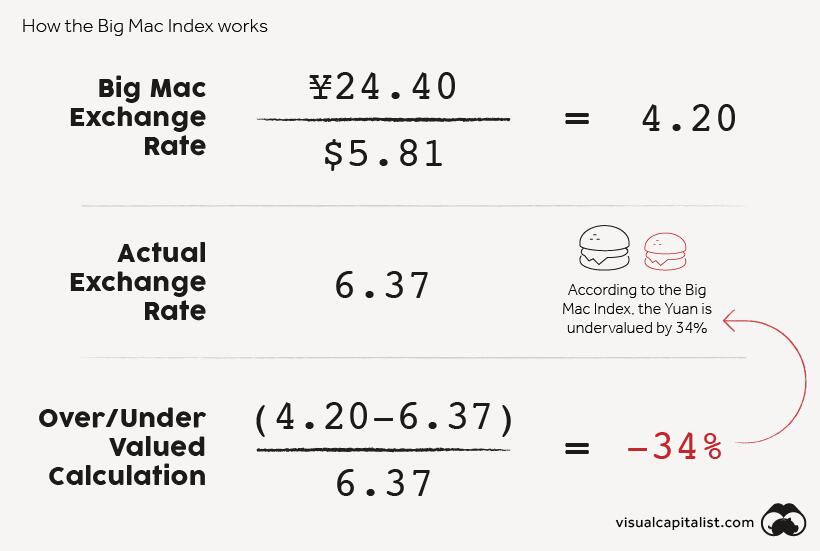
According to the Big Mac Index, the Yuan is undervalued by 34%.
Beyond currency misalignment, the index has other uses. For instance, it shows inflation in burger prices over time. If we compare the price of a Big Mac across countries in the same currency—such as the U.S. dollar—we are also able to see where burgers are cheaper or relatively more expensive.
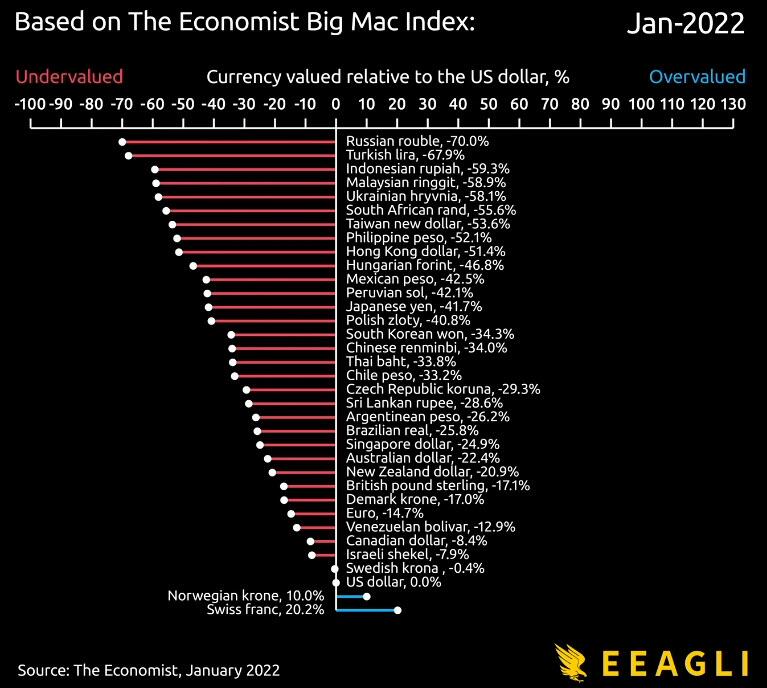
Burger Costs Around the World
In the animation, all Big Mac prices have been converted from local currency to U.S. dollars based on the actual exchange rate in effect at the time.
Switzerland takes the cake for the priciest Big Mac, followed closely behind by Norway.
Both countries have relatively high price levels but also enjoy higher wages when compared to other OECD countries.
Venezuela has seen the largest jump in burger prices, with the cost of a Big Mac climbing nearly 250% since 2004. The country has been plagued by hyperinflation for years, so it’s no surprise to see large price swings in the country’s data.
While it appears that the price of a Big Mac has decreased in Turkey, this is because the prices are shown in U.S. dollars. The new Turkish lira has depreciated against the U.S. dollar more than 90% since it was introduced in 2005.

Finally, it’s worth noting that Russia has the cheapest Big Mac, reflecting the country’s lower price levels. Labor costs in Russia are roughly a third of those in Switzerland.
The Limitations of Burgernomics
The Big Mac Index is useful for a number of reasons. Investors can use it to measure inflation over time, and compare this to official records. This can help them value bonds and other securities that are sensitive to inflation. The Big Mac Index also indicates whether a currency may be over or undervalued, and investors can place foreign exchange trades accordingly.
Of course, the index does have shortcomings. Here are some that economists have noted.
- Non-traded services can have different prices across countries. The price of a Big Mac will be influenced by the costs of things like labor, but this is not a reflection of relative currency values. The Economist now releases a GDP-adjusted version of the Big Mac Index to help address this criticism.
- McDonald’s is not in every country in the world. This means the geographic reach of the Big Mac Index has some limitations, particularly in Africa.
- The index lacks diversity. The index is made up of one item: the Big Mac. Because of this, it lacks the diversity of other economic metrics such as the Consumer Price Index.
Despite all of these limitations, the Big Mac Index does act as a good starting place for understanding purchasing power parity. Through the simplicity of burgers, complex economic theory is easier to digest
Exodus From Bond Funds Is Mitigating the Stock Market’s Swoon
Bond investors heading for the exits amid interest-rate concerns find few other alternatives to stocks
The bad news in the bond market has been a rare boon for stocks.
Investors pulled nearly $160 billion from money-market funds and $17.5 billion from bond mutual funds and exchange-traded funds in the first seven weeks of the year, according to Refinitiv Lipper. The exodus is already on pace to be the biggest in at least seven years.
About $50 billion was funneled into stock funds over that period, including nearly $21 billion so far this month.
The massive reshuffling of assets comes in the midst of a changing economic and monetary landscape. Worries about surging inflation and the Federal Reserve’s plan to begin raising interest rates as soon as next month have put the bond and stock markets under pressure to start the year.
The yield on the 10-year Treasury note eclipsed 2% earlier this month for the first time since mid-2019, and the S&P 500 is down 8.8% in 2022, including last week’s 1.6% drop.
Investors typically use money-market funds as a relatively safe place to park cash. Now that inflation has returned, their purchasing power is sapped.
“There’s not a whole lot of options for people,” said Jonathan Waite, a senior investment analyst at Frost Investment Advisors. He said he summed up the situation at a recent team meeting on the macroeconomic backdrop with a well-worn four-letter acronym: “TINA. There is no alternative” to stocks.
In other words, even as the stock market struggles to gain momentum, investors have few other attractive choices to put their cash to work, he and other analysts said.
This week, investors will look at a fresh batch of economic data, including measures of consumer confidence, new home sales and personal-consumption expenditures, to assess the market’s trajectory. Markets are closed Monday for Presidents Day.
To be sure, investor sentiment has deteriorated in recent weeks. The share of individuals who say they expect U.S. stocks to rise over the next six months fell to about 19%, its lowest level since 2016, according to the latest survey by the American Association of Individual Investors.
Analysts warn that the tumult will continue as long as investors feel uncertain about the course of geopolitical events in Ukraine and the outlook for monetary policy. That is partly why Goldman Sachs last week trimmed its outlook for the S&P 500, cutting its year-end forecast to 4900 from 5100. The new target represents a 12% gain from current levels.
So far, some investors have shown a willingness to buy the dip in the stock market, softening the pullback. Some $18 billion has flowed into the Vanguard S&P 500 ETF so far this year, along with about $11 billion into a similar fund run by BlackRock’s iShares unit, according to data from FactSet.
Beyond that, investors appear to be more discerning. They are favoring relatively inexpensive value stocks and those that pay dividends, over pricier shares of fast-growing companies. Value stocks are those that trade at low multiples of their book value, or net worth, whereas growth stocks tend to command heftier multiples based on the prospects of big profits in the future.
Large-cap value funds have pulled in $5.2 billion over the past seven weeks, already more than half of the amount they raised last year, while those focused on dividend strategies have added $13.2 billion, according to Refinitiv Lipper. Meanwhile, large-cap growth funds have lost $18 billion.
David Groman, a global equity strategist at Citi, says he predicts investors will continue to favor stocks, especially those that fit the traditional definition of value, as long as the valuation gap between growth and value remains as vast as it is. His latest analysis showed value stocks’ forward-looking price-to-earnings ratios trailing growth by as much as 40%.
“The gap is so, so wide,” Mr. Groman said. “We could be just scratching the surface of a rotation into value.”
Calls for a resurgence in value investing are hardly new following more than a decade of dominance by growth stocks. Any outperformance of traditional value sectors like banks, energy firms and manufacturers has tended to be short-lived.
Julian Koski, chief investment officer of asset-management firm New Age Alpha, believes value’s latest comeback is set for a similar fate.
He said he is bearish on value stocks because the valuations of banks and other relatively cheap stocks have already crept up and solid earnings growth will be required to justify higher multiples. At the same time, valuations of growth stocks continue to fall and will eventually be hard to pass up, especially if the economy ends up weakening under the weight of higher rates and inflation, he added.
Indeed, the forward-looking P/E ratio of banks in the S&P 500 has risen this year to nearly 14, above the sector’s five-year average of 13.3, according to FactSet. Communication-services stocks in the benchmark stand at 18.8 times, roughly the same level those companies traded at in late 2019. The latter sector is home to the parent companies of Facebook and Google, among other firms like Walt Disney Co. and AT&T Inc.
“When earnings season comes around and value stocks miss their numbers, they are going to get hit hard,” Mr. Koski said, adding that the pullback in growth stocks will “make it easier for companies to deliver the growth implied in their prices.”
Earnings forecasts support that possibility. Financial companies in the S&P 500 are expected to see earnings shrink 11% in 2022, whereas profits among communication-services companies are predicted to grow 2.6%.
Regardless of how investors divvy up their dollars among stocks, several analysts said the bonds market is in for a rough ride that could put its multidecade bull run on hold. The recent outflows mark a stark reversal from recent years. In each of the past three years, investors added hundreds of billions of dollars to bond funds, with flows peaking at $457.6 billion in 2021.
Now, Deutsche Bank analysts compare the environment with 2013, when a large increase in rates around the taper tantrum led to more than $300 billion flowing into stock funds in the following 12 months and bond funds suffered outflows.
“Far from being an anomaly, this rotation is very much in line with the historical pattern,” Deutsche Bank’s analysts said.
Tesla Planned to Open Its First European Gigafactory Last Summer. It’s Still Waiting.
Late filing and environmental challenges keep Tesla waiting for green light to open plant near Berlin
BERLIN—When Rocco Pigola, a 59-year-old refinery worker from Bavaria who has owned six Tesla TSLA -2.21% vehicles, heard about the electric-car maker’s new plant near Berlin, he jumped at the opportunity to order a Model Y Performance.
“I want to be the first person to drive a Tesla ‘Made in Germany,’” he said.
For now, though, he and other German fans have to wait. Tesla Inc. officials say the plant’s machines are installed and have been producing preproduction test vehicles since late last year, but without the permit to operate commercially, the plant can’t increase and sell its vehicles.
The factory’s opening, initially set for last summer, has been pushed back several times and there is still no official launch date.
The main reason for the postponements was a decision Tesla made, compounded by Germany’s planning procedures, according to analysts and local authorities. Tesla didn’t respond to requests for comment on the delays.
The plant in Grünheide, a hamlet surrounded by lakes and forest, is key for Tesla’s growth and profitability, analysts said. According to Tesla’s planning application and statements from management over the past two years, Tesla will first build the Model Y at the plant, which will have capacity for around 500,000 vehicles a year.
Tesla reported global sales of 936,222 vehicles in 2021, an 87% increase from the year before. Analysts forecast the company could sell up to 1.5 million cars world-wide this year. The German plant will allow it to serve European auto markets without relying on expensive imports from its Chinese and U.S. factories.
The latest forecast opening date to come and go was last fall. Tesla Chief Executive Elon Musk said on several occasions the plant would begin building a small number of cars by the end of 2021, and likely begin deliveries in early 2022, but that ramping up to full production would take time.
“It will take a longer time to reach high-volume production than it took to build the factory. It’s really difficult,” he said at the Grünheide plant in October.
In a way, Tesla has delivered: The plant is ready to produce cars. The regional economics ministry confirmed in January that Tesla had purchased a section of railroad track to run a shuttle between nearby Erkner and the plant to ease workers’ commute. Germany’s powerful industrial labor union, IG Metall, said it has opened an office outside the plant to organize the workforce. Customers are putting in orders for cars to be built there.
What is missing to kick off commercial production is the final planning approval.
Environmental opposition to the plant explains some of the delays, but the biggest delay, regional officials and analysts said, was caused by Tesla’s late application to build a battery plant that wasn’t included in the original permit application.
“That cost them an additional six months,” said Stefan Bratzel, director of the Center of Automotive Management, a research institute in Germany. Even so, he said, “the plant is going up in record time.”
The Brandenburg state government said it used fast-track laws created in the wake of German reunification to accelerate the approval process. The state has issued preliminary approval for the plant in stages, allowing Tesla to construct the plant and build a few vehicles to test systems, but preventing commercial production until final approval.
Under German law, Tesla had to submit an environmental impact study that was open to public comment. During this process, citizens and environmental groups raised concerns about the plant’s impact on the local environment. The state collected more than 800 individual complaints during public hearings in 2020 and 2021.
State officials have said they need to study each objection and make any required changes to the plant to ensure that the final permit can withstand any legal challenges after the plant has officially opened.
A spokeswoman for the Brandenburg environment ministry said that the approval process was in the final phase, but that she couldn’t name a date for approval.
If approved, the plant could still face roadblocks. A concern expressed by local citizens and by environmental groups is that the plant and service providers who may subsequently locate in the area could use too much water, threatening residents’ supply. Most of these lawsuits were dismissed by the courts.
Environmental activists have sued to block a utility provider from increasing the water it draws from the ground to serve the Tesla plant via a second utility. If the court sides with the plaintiffs, the water company says it would have a shortfall so large that the entire community would be affected.
“In a nutshell: No water—no Tesla,” the Wasserverband Strausberg-Erkner company said.
Analysts say it is unlikely that approval will be withheld for the factory dubbed Giga Berlin. Such a decision, which could require Tesla to pack up the plant and return the land to its original state, would likely scare investors away from Germany for years, they said.
Back in Bavaria, Mr. Pigola said he placed his order for a Model Y Performance car in September and was given a preliminary delivery date in January. He says he got a call in November telling him that the vehicle probably won’t be ready until March, and that his choice of a white model would take even longer.
“I changed to black,” he said. “I still don’t have a firm delivery date.”
The hydrogen market’s growing credibility
Plus, inside the sustainability schism and a look at pandemic-era philanthropy
When journalists write about other journalists, it often smacks of navel gazing — and is thus best avoided. However, this week I am breaking this rule since I have been struck by the intensifying debate inside the media about how to cover the climate crisis.
To cite one example: on Tuesday the World Editors Forum is holding its first virtual global climate conference to discuss “the gaps between what audiences need and want on climate change and what newsrooms are delivering right now.” This will discuss issues such as the role of storytelling and how to communicate technical data. Another debating point will be the decision by Canada’s Globe and Mail to release more than 180 files of its raw sources from an investigation into last summer’s extreme heat, reflecting a wider #ReadTheSources campaign from Unesco and the French group Outlet to make climate reporting more credible.
Can tactics such as these offset the crumbling levels of public trust in the media? What else can journalists (like us) do to communicate climate issues effectively? We would love to hear your views, given that Moral Money was established three years ago to illuminate green finance issues and ESG.
Meanwhile in today’s newsletter, we cover a striking data initiative in the fast-expanding world of hydrogen, a pandemic-era twist in philanthropy at Fidelity, new data about impact investing and alarming news about how rising sea levels threaten the US east coast. And if you want another sign of how sustainability issues are getting more media focus, check out the breaking story about how Carl Icahn, the corporate raider, has teamed up with animal welfare activists (which we will return to later this week.) Read on. Gillian Tett
Hydrogen is hot
The hydrogen market is red hot today, or so many opportunistic investors would say. However, like many nascent areas of finance, it has hitherto operated with considerable opacity. Last autumn, one of the first efforts to create more price transparency and consistency emerged: Deutsche Börse’s power and gas exchange EEX announced plans to launch a new price index in 2022.
Now another initiative is under way to help the market become more credible: S&P Global Platts, a provider for benchmark prices in the commodities and energy markets, is joining forces with other industry players to create a so-called Open Hydrogen Initiative (OHI) — a platform to let investors and companies track carbon emissions from hydrogen.
It is easy to see why this is needed. Hydrogen has recently sparked great excitement in the renewable energy world since the fuel is light, storable, energy-dense, and appears to produce no direct emissions of pollutants or greenhouse gases, a key attracter for green investors, as a recent report from the International Energy Agency explains.
As a result, the sector is growing fast: in 2020, the space was estimated to be worth more than $187bn, but it is projected to reach $286bn by 2027, according to MarketWatch. Meanwhile, annual government funding for hydrogen has reached $16bn a year globally, up 40 per cent from July 2021, according to research group Bloomberg NEF.
However, thus far there have been relatively few ways for investors, companies or governments to track indirect emissions from the fuel in a consistent way. This matters given the pressure on companies (and asset managers) to measure all aspects of emissions emanating from corporate supply chains, under scope one, two and three reporting systems.
To tackle this, S&P Platts is working with GTI (the research education group) and the National Energy Technology Laboratory to build tools to track hydrogen greenhouse gas emissions at the production facility level. These will be free for investors and companies to use, and aim to establish benchmarks for the market. “What we know is that we need hydrogen. It is very versatile. But what we have not yet had is precise and consistent technical tools for measuring hydrogen’s carbon intensity,” said Paula Gant, senior vice-president of strategy and innovation at GTI. “And, we’re at a place where the market needs that to enable hydrogen’s rollout.”
The group hopes this will promote wider adoption of hydrogen. “We see hydrogen being a key part of the future of the energy market in the decades to come” Jonty Rushforth, S&P Global Platts senior director, told Moral Money.
However, technical challenges remain. Previous research from S&P Global Platts suggests the cost of producing hydrogen from renewables will need to fall by more than 50 per cent to be a viable alternative to traditional energy. Hydrogen faces big production challenges and is difficult to store and transport. (The Saudis, however, seem to have set their bet on the growing market.)
Establishing price and emissions indices could spark more research and development to tackle these issues; or so the group hopes. And the initiative incorporates another interesting twist that investors should watch: the group intends to include metrics that indicate how much confidence investors should have in the emissions data.
This reflects a growing recognition that “green” measurements can sometimes be more art than science. This should not stop investors or companies from trying to measure emissions; but a more realistic debate is needed about the limits of current tools. Call this, if you like, another sign that the green market is growing up.
John Menzies accepts sweetened takeover offer
Proposal from Kuwaiti suitor values airport services group at £560mn
Edinburgh-based John Menzies has accepted a sweetened takeover proposal from its Kuwaiti suitor that values the airport services company at about £560mn.
The FTSE 250 group’s board indicated on Monday it would unanimously recommend a final offer of 608p a share from National Aviation Services, a reversal of the board’s previously hostile position towards approaches.
The bid, which is yet to be formalised, would be a significant premium over NAS’s previous offers of 460p and 510p per share.
John Menzies shares were flat at 584p after surging 25 per cent last Thursday when NAS began to build a 19 per cent stake in the company, paying 605p a share, making it the largest shareholder and prompting investors to bet on a new bid.
NAS has argued a tie-up makes sense, given the limited geographical overlap of the businesses and the fragmented global market for aviation services.
John Menzies’ board earlier this month described NAS’s unsolicited bid of 510p a share, a 52 per cent premium to its share price at the time, as “highly opportunistic”.
The two sides have publicly disputed valuations of the business, with John Menzies arguing previous offers did not reflect its “true intrinsic worth” or its prospects as the aviation industry recovered from the pandemic.
John Menzies, which traces its history back to a bookshop and publishing business set up in 1833, has become the latest UK business to attract the attention of an overseas bidder following the interest from NAS, a subsidiary of Kuwaiti logistics group Agility Public Warehousing.
Travel restrictions during the pandemic hit John Menzies cargo handling and aircraft maintenance operation, sending its share price spiralling to a near record low in 2020.
Agility is a Kuwaiti supply-chain and logistics conglomerate with 16,000 employees and operations and investments in more than 40 countries.
The US Department of Justice in 2017 said Agility agreed to pay $95mn to resolve civil fraud claims over its work in Iraq, which arose from allegations that Agility overcharged the US government when performing contracts to supply food for US troops between 2003 and 2010.
The agreement lifted a seven-year suspension on US government contracts, and Agility has since won new contracts with the Department of Defense, which are ongoing.
Agility at the time said it acted “transparently and responsibly” during an “extraordinarily complex mission”.
John Menzies continued to push back against the approach from NAS at the end of last week, adding it was “confident in the execution of Menzies’ strategy and the significant potential value creation that this strategy will deliver”.
But the board said on Monday it had indicated to NAS that it would be willing to recommend the final offer, which will not be increased unless John Menzies receives a rival takeover bid.