FT : Holland & Barrett payment held up by HSBC over sanction concerns

Holland & Barrett payment held up by HSBC over sanction concerns
Russian-backed owners of UK healthcare group paid interest on €415mn loan last week but creditors still waiting

Holland & Barrett has been left in limbo over a crucial debt payment held up by HSBC given the bank’s concerns about links between the UK healthcare retailer and sanctioned Russian oligarchs.

The problem of covering even a straightforward interest payment shows the complexity of doing business with groups linked to sanctioned individuals across borders, as banks struggle to work out which transactions regulators will allow them to make.

There are different sets of sanctions in the EU and UK, and these can be interpreted differently in each EU country, while financial institutions are seeking legal advice that can often differ.

The interest on the €415mn loan was paid last week by LetterOne, the Russian-backed but London-based investment group that owns Holland & Barrett. The British retailer employs about 5,000 people across hundreds of stores in the UK.

But payment had still not reached creditors at the end of a grace period on Wednesday, according to people close to the situation, sparking uncertainty about what happens next for the money owed to its debt holders.

The interest has been held up in the EU banking system after HSBC, one of the banks involved in the payment, sought additional reassurance over LetterOne’s status from EU regulatory authorities, according to people familiar with the matter. The bank declined to comment.

LetterOne’s Russian owners such as Mikhail Fridman have been hit with asset freezes and travel bans as part of sanctions imposed by the UK and EU on Russian oligarchs.

However, LetterOne, which is based in the UK and domiciled in Luxembourg, said that it has received confirmation from authorities in both jurisdictions that it does not fall under the sanctions. It has frozen the shares held by its sanctioned owners, and ejected them from its offices.

The retailer’s loans have plummeted in value since the issue around the interest payment became public, with traders quoting the €415mn loan at around 66 cents on the euro, having been at 83 cents previously.

The Holland & Barrett payment had already passed through Luxembourg and Germany without issue, according to a person close to the situation, and had been accepted by Barclays, which was also involved in the transaction.

An interest payment on another £450mn loan at Holland & Barrett in the UK has also flowed through to lenders successfully.

Russian steelmaker Severstal last week faced similar issues paying a coupon to bondholders, after Citigroup blocked the payment, even though the company is not under sanctions.

The delayed payment should not automatically trigger a Holland & Barrett default, according to two people briefed on the arrangements, because the retailer’s owners have already released the funds even though they have not found their way to the creditors.

Distressed debt investors have begun buying the loans in the secondary market, however, and could still try to seize on the opportunity to gain control of the company.

Some of the banks that lent to LetterOne — which include HSBC, Barclays, Citigroup, UBS and Société Générale — have been reviewing their relationships with the company given concern among the financial industry of doing business with entities linked to sanctioned Russian oligarchs.

LetterOne has confirmed to the Financial Times that “one of the paying agents is having difficulties processing euro payments”. It added that LetterOne was not sanctioned “and has had confirmation of this from authorities in the UK and Luxembourg”.

FT : Adecco: a barometer ticking lower on gloomy job prospects

Adecco: a barometer ticking lower on gloomy job prospects
Recruitment agency at risk of being buffeted by storms ahead in employment trends

Switzerland’s Adecco is a handy barometer of global economic prospects. Recruiters make bumper profits when economies are booming and clients are hiring. They languish pro-cyclically when work is scarce.

Labour markets are tight at present but Adecco shares are warning of storms ahead. The stock has fallen by a third over a year. This week, the group said it remained “on track” to deliver on its first-quarter outlook, outlined in late February when Russia’s invasion of Ukraine was just starting.

Back then, Adecco expected “robust economic growth” to power solid top-line growth, while investments would buoy profits. Yet a month down the line, the macroeconomic effects of the war appear largely negative. Surging commodity prices threaten to blow Adecco’s growth plans off course. Any subsequent drop in employment would seriously dent them.

Adecco is helped by its broad geographic footprint. This encompasses the US but not Russia or Ukraine. Economic disruption could bring benefits if companies seek to retrain workforces or exploit growth opportunities. Market shares gains from weaker rivals may partially help offset a gloomier world outlook. So too could a drive to reduce costs.

But Adecco’s share price decline suggests any optimism would be misplaced. There are early signs of wilting in a eurozone economy pummelled by inflation and escalating energy prices. Lay-offs in big industry look inevitable.

Investors clearly align with pessimistic pundits. Adecco’s shares have sharply underperformed peers. Three years ago they traded on similar multiples to rivals. Now, at 10 times earnings, they are priced at a 20 per cent discount to Randstad and Manpower.

Adecco did not offer any income guidance beyond the first quarter. That was sensible given the shifting political ground underfoot. Investors, making their own calculations of how things will pan out, see more squalls than sunshine. Adecco will make the defensive argument that it has superior operational skills to rivals, but competitors will make the same claim. The pro-cyclical gearing of recruiter shares is simply a fact of life for traders to exploit and chief executives to live with.

WSJ : Ackman Says He Is Done With Activist Short Selling

Ackman Says He Is Done With Activist Short Selling
‘We have permanently retired from this line of work,’ he says in Pershing Square’s annual report, noting it makes jobs easier, more fun and improves quality of life

William Ackman said he is saying goodbye to the activist short-selling game.

Mr. Ackman, the founder and chief executive of Pershing Square Capital Management, which previously engaged in a yearslong battle against Herbalife Nutrition Ltd., said his fund will be less vocal about its positions and more cordial with the companies he invests in.

“Despite our limited participation in this investment strategy, it has generated enormous media attention for Pershing Square,” Mr. Ackman said in his firm’s annual report. “In addition to massive amounts of media hits, our two short activist investments managed to inspire a book and a movie.”

“Fortunately for all of us, and as importantly for our reputation as a supportive constructive owner, we have permanently retired from this line of work,” Mr. Ackman said.

Mr. Ackman made his name as a corporate rabble-rouser. Pershing Square at one point was one of the biggest activist funds in the world before suffering four straight years of losses amid poor wagers on drugmaker Valeant and supplement marketer Herbalife.

Pershing Square is now back near its peak size again. Its publicly traded fund—a decent proxy for the hedge fund that manages the money of Mr. Ackman, his employees and institutional investors—gained 70% in 2020 and 27% last year.

Mr. Ackman said his firm’s interactions with companies over the past five years have been “cordial, constructive, and productive,” a stance that he said he intends to maintain.

“It makes our job easier and more fun, and our quality of life better,” Mr. Ackman said. “So, if it is helpful to call this quieter approach Pershing Square 3.0, let it hereby be so anointed.”

The comments in Pershing Square’s annual letter come after Mr. Ackman previously signaled he would be taking a quieter approach to investing. In 2019, Mr. Ackman told investors he was staying away from companies that were hard to understand. He also said he was returning to the basics of investment analysis and would attempt to stay out of the media spotlight.

It is a contrast from the five-year, $1 billion short bet he spearheaded years ago against Herbalife, one that pegged him against activist investor Carl Icahn who had built a stake in the nutritional products company. At one point they got into a 30-minute argument on live television, in which Mr. Ackman questioned Mr. Icahn’s memory and Mr. Icahn called him a loser.

Short sellers borrow shares and sell them, with a plan to repurchase them at lower prices and pocket the difference.

Mr. Ackman largely exited his Herbalife position in 2018, and likely lost hundreds of millions of dollars. He also suffered a roughly $4 billion loss in his highly publicized investment in drug company Valeant.

“We exited because we believed that the capital could better be deployed in other opportunities, particularly when one considered the opportunity cost of our time,” Mr. Ackman said in the letter. “The aphorism that you ‘don’t need to make it back the way you lost it’ has always resonated with us.”

Mr. Ackman’s move comes as there were 126 activist short-seller campaigns last year, according to research firm Insightia, the fewest since the firm began tracking the data in 2013, and down from 156 in 2020 and 170 in the year prior to that.

Pershing Square has recently taken positions in companies such as Netflix Inc. and Canadian Pacific Railway. In its annual letter, Pershing said it was confident in the longer-term outlook for Netflix but cautioned it expected near-term variability in the company’s results.

About 30% of Pershing Square’s equity portfolio is invested in music and video streaming, including Universal Music Group NV, the firm said, while 26% is invested in restaurant companies such as Domino’s Pizza Inc. and Chipotle Mexican Grill Inc.

Pershing said 15% of its equity portfolio is invested in home improvement retailer Lowe’s Cos.

“We expect that each of these companies will grow their revenues and profitability over the long term, regardless of recent events and the various other challenges that the world will face over the short, intermediate, and long-term,” Mr. Ackman said.

Mashable : Dyson unveils its latest product, and it's... a headphone purifier?

Dyson unveils its latest product, and it's... a headphone purifier?
So you're saying it's not a vacuum or a $500 hair styling doodad?

I think I'd feel like a robot wearing this thing. Credit: Dyson

Dyson, the company probably most known for its fancy schmancy vacuum cleaners and the very viral Airwrap, has announced a new product: Headphones! That connect to a cyborg-mask-like air purifier!
Let us explain. Dyson today unveiled the Dyson Zone, which is indeed a pair of headphones that attaches to an impressively small air purifier that goes across the nose and mouth area when worn. It's Dyson's first foray into the world of audio tech, and its first wearable air purifier.
It's headphones! No, it's an air purifier! No, it's both headphones AND an air purifier! Credit: Dyson
The Dyson Zone aims to combat both noise and air pollution, and is now debuting after 500 prototypes worth of development. On the audio side, the headphones feature three active noise cancellation modes: isolation, the highest level of noise cancellation; conversation, which activates when you dip the visor to turn off the purification function and amplify conversation; and transparency, which lets in the most noise and helps you remain aware of your surroundings.
On the purification side, the visor — which houses a potassium-enriched carbon filter that uses electrostatic filtration to clean the air — has four air purification modes: low, medium, high, and auto. The different modes are made for different breathing patterns (i.e. breathing harder while working out or climbing stairs), and the auto mode should help the wearer toggle between them as needed. The visor also should not touch the wearer's face at any point, attaching only to the headphones themselves and allowing for two contactless streams of cleaned air flowing directly to the nose and mouth.
"The Dyson Zone purifies the air you breathe on the move," said Jake Dyson, Chief Engineer, in a press release. "And unlike face masks, it delivers a plume of fresh air without touching your face, using high-performance filters and two miniaturized air pumps. After six years in development, we’re excited to deliver pure air and pure audio, anywhere."
To to be clear, while the visor and its filter does clean the wearer's breathing air, the Dyson Zone is not on its own a Covid-specific device — meaning it will not be a tech-based alternative for surgical masks, KN95s, or other facial masks.
The Dyson Zone can also be worn in any of four formats, depending on the user's specific needs. It can be worn in what seems like to-the-max mode, with ANC enacted and visor attached for a combination noise and air pollution solution. It can also be worn as just headphones, with the level of ANC preferred in use. And amidst the ongoing pandemic, Dyson has also built in an option to add on a more classic face mask with a sealed edge, which is an attachment that comes with the Dyson Zone. For those in even higher risk environments, Dyson also has a FFP2 face covering attachment that will meet higher filtration standards.
While the Dyson Zone is the company's first wearable device, this is not Dyson's first rodeo in air purification. Dyson initially set down its air cleaning path with the launch of its Pure Cool fan back in 2015, and has been working on various purifiers since. The Dyson Zone takes all of the company's previous developments and hopes to put it into an on-the-go package — with a side of headphones, for your music and podcast-listening pleasure.
Dyson has not yet announced an official launch date or price, but expects the Dyson Zone to become available online and in-store at Dyson Demo Stores starting in the fall of 2022.

Mashable : The business of being Victoria Paris

The business of being Victoria Paris
After only two years on TikTok, Victoria Paris is on her way to making millions. How did a 22-year-old learn to make that much money?


Paris in a reverie at her dining room table. Credit: Molly Flores

If money could talk, Victoria Paris' would say "f.ck you." The TikTok creator is fuming on a sidewalk in Williamsburg, Brooklyn, outside a shop selling pricey mid-century relics. Fifteen thousand dollars worth of Willy Guhl planters rest in pooling rainwater in the driveway. When we arrived 20 minutes ago, the proprietor observed our little group of twenty-somethings with thinly-veiled disdain. Then Paris purchased one of the shop's more unique pieces: a paper lamp in the shape of a Campbell's soup can. It cost more than my monthly rent.
"That's a 'f.ck you' purchase," Paris says, her arms crossed by the street. "I will love it even more because I know why I bought it, and I know exactly how I felt in that moment when he treated me like I was so tiny… looking at me like I don't belong there." She adjusts the shearling-trimmed Jacquemus bag on her shoulder. "I hate people who are judgmental. You don't know people's shit, you don't know how much money anybody has."
The 22-year-old standing before me in denim shorts, high tops, a green trucker hat, and a tie-dye shirt does not fit the customer profile of a furniture store for Brooklyn's artistically minded elite. But look any further than her green-billed brim and you'll find that Paris is a self-built entrepreneur of the digital era, with a million TikTok followers, six-figure deals with brands like Amazon and Anthropologie, and the financial freedom to buy whatever the f.ck she wants.
Paris Facetimes with best friend and fellow creator Antoni Bumba. Credit: Molly Flores
Paris has always been a hustler. Growing up in New Jersey, then North Carolina, she was a gamer girl who liked Yogscast, attended Minecon, and sat on the floor watching her older brother stream on Twitch. As a child, she sold homemade creations to Chapel Hill's local comic store. In high school, she was arrested for racing her car, and learned the business of thrifting while completing community service behind the counter of a Christian thrift store. In the year she spent at Indiana University, she flipped clothes to pay for alcohol and drugs, then upsold vintage audio equipment on eBay to finance her move to New York and attend the New School.
When she was laid off from her role at a fintech startup in the pandemic panic of early 2020, Paris doubled down on driving traffic to her DePop store to make money. She saw TikTok as an untapped fount of opportunity, and made creating videos for it her full-time job. She posted dozens of times a day, drawing viewers in with her stream-of-consciousness relatability and vlog-like filming style. In six months, she had charmed the TikTok algorithm, gaining more than 1 million followers and an audience of fans called Victorians.
Paris in her kitchen. Credit: Molly Flores
Perched on the orange boucle couch that anchors her airy downtown loft, Paris broke down her success: "It's like an equation, and the variable [is] the video, the product. The constant will always be me. And no matter what I change the variable to… they love the constant. And so that takes a lot of pressure away." Her goal now is "just trying new things and staying true to myself. I don't think I am a creative person. I think I'm a consistent person… I just keep creating stuff."
Paris is not in pursuit of perfection. "Most of my shit's bad," she laughs, "I'm not trying to act like I'm some savant, like this is some f.cking Picasso shit." She points to her friend, prolific YouTuber and filmmaker Casey Neistat. "He's like 'I won't put anything out there they don't think is amazing and I don't give a f.ck how people receive it.' And I was like, 'I don't give a f.ck if it's amazing."
The perceived mediocrity of her content, and its subsequent success despite that, was dubbed the "Victoria Paris Effect" by the Embedded Substack. She's had advantages others don't: her college education, pandemic timing, and the fact that "so many massive creators are thin and white," she says. "That is never something that's not always working in your favor; it's always important to acknowledge that. To act like the elephant isn't there is ridiculous."
Paris at home. Credit: Molly Flores
Still, she feels vindicated by her success. "I was the f.ck up, the one that got kicked out of multiple schools…the one who couldn't keep a job. Nobody expected shit out of me. So for this to happen, it's kind of like f.ck you guys," she says, holding two defiant middle fingers in the air. "Now it's like, reconciling with that [and] being comfortable with myself and my success and with being intelligent."
Not everyone with Paris' follower count is on their way to making millions less than two years after appearing, seemingly out of thin air, on the world's fastest-growing social media platform. But after talking to Paris about her business, I was struck by her strategic approach to nearly every aspect of her career. She says she never planned to become famous, but I feel like it was inevitable.
You can write that I'm power hungry and want this so badly, which is true, but it's also because I'm good at it.
Within the first 10 minutes of meeting, we're digging into the pros and cons of hiring and dividing income between a team: after her manager, agent, lawyer, business manager, and the government take their share, Paris is left with less than 25 percent of what comes in. But, she notes astutely, "What I do right now costs me the WiFi bill and my phone plan. There's no other business that is as lucrative with zero overhead." She adds, for perspective, that "the average kid in New York City who graduates college gets a job that pays 50 to 80 grand on the high end, right?" Paris is doing much better than that. "My business manager told me that I was one of their most successful 22-year-old clients and had saved the most," she says proudly.
Spending money is hard for her. She’s slowly allowed herself to vacation and eat out, but paying for a cab uptown still makes her nervous. "I had $100 in my bank account the first two years living here [in New York City]," she says. She's already eyeing her own version of retirement in five to 10 years. When I ask her how much money that will take, she replies, almost existentially, "How much do you need to retire? It's just like, how do you want to live?" Her plan as of now is to "develop brands and live off passive income and periodic projects and making videos when I want to."
Tacos with a side of side eye and the bird. Credit: Molly Flores
"In the conception of my career, people wanted to make me out to seem like this viral, crazy girl who's like running on a rampage and not an actual businesswoman," she tells me. "You can write that I'm power hungry and want this so badly, which is true, but it's also because I'm good at it."
I ask her about a June 2021 piece in The Cut that reduced her to a "strangely-transfixing-if-also-sometimes-annoying everygirl" whose "antics are a kind of charming farce of youthful relatability." The article wounded Paris' trust in ways she's still recovering from.
"This person was so extremely nice to me, acting like my best friend." She takes a deep breath, the first I've heard her take in hours. "It'll be really hard for me to do [another] piece with a male writer… To put yourself in a vulnerable relationship where someone can interpret you, I find that men constantly misinterpret me… Being comfortable in my own skin always rubs men, no matter their sexuality, their identity, the wrong way… When that piece came out, I was reconciling with newfound 'internet fame' and not sure how I felt about it." Now, "I'm so much more settled down and secure in myself."
Paris at her dining room table. Credit: Molly Flores
As we chat about her PH balance, she fishes her laptop out of a large wicker bowl. She has a consulting call, one of a handful she does for large brands and startups every month. Paris uses her phone for everything, including editing her YouTube vlogs and attending meetings. But she noticed that most people on these calls had home offices and worried that her mobile setup might come off as "disrespectful." So she attempts to fire up the laptop. "I haven't used [this] in weeks, I've got to figure out how to get on."
While on the hour-long call, Paris eats two small packs of dried mango, texts her manager, scrolls through Twitter (I can see her liking tweets in real time), looks up call participants on LinkedIn and Instagram, makes savvy, tongue-in-cheek asides to me about the viability of the proposed product, orders a salad (a HarvestBowl from Sweetgreen), and eats the salad.
Amidst all this activity, she will unmute herself and contribute the most incisive feedback of anyone in the meeting, including participants more than twice her age. The voices coming out of her phone (her laptop dies mid-meeting; her charger is at a date's house) sound audibly impressed by the precision of her insights.
Working. Credit: Molly Flores
Paris has ADHD; multitasking is a way of engaging with the call, her version of actively listening and processing. It's possible that her neurodivergence makes her particularly good at her job. People with ADHD are motivated by pressure, passion, and novelty. "I would not be able to do what I do if I wasn't obsessed with this," Paris explains. "When it comes to something that I'm so overwhelmingly passionate about, it's like…" she makes a noise that sounds like an object breaking the sound barrier. "I can just push through everything."
Paris has wrestled with moderation for much of her life. She has battled anorexia and binging. A self-described "workaholic," she works every moment she's not asleep and even answers emails in the shower, with her phone in one hand and her shampoo in the other. "Creating and producing and always needing to be doing something can be a vice in itself," she notes.
Front: Paris bundles up for a dentist appointment. Back: Beyond the bathroom door sits a neglected chandelier that was described by a follower as being “made of tampons.” Credit: Molly Flores
Her most all-consuming obsession is data and optimization. "My friends think it's f.cking scary; [if] I'm doing something on my phone, I'm either texting or responding to an email or refreshing and watching this," she leans over to show me her TikTok dashboard. "I watch the data all day long… I see every uptick or downtick. I put a video out, I watch how it trends. And then I'll make another video and see if that trends similarly." Then, she privates the videos that don't do well. She estimates she's made more than 20,000 TikToks, only a third of which are still public.
Many creators will say they create to feel a connection with their viewers. It’s not a motivation Paris can relate to. "I have never been the type of person to follow people religiously. I've never experienced a parasocial relationship," she says. The one exception was with the stars of reality show John and Kate Plus 8. She cried when they got divorced. "I love every single one of [the Victorians], and I would be nothing without them," she acknowledges. "But I've never experienced what they experience. I almost envy conviction and connection because I can be a very analytical, clinical person."
Paris, flanked by phone and laptop, in a rare demure moment. Credit: Molly Flores
In person, Paris can be surprisingly drawn inward, almost somber. "I'm neutral off camera," she says. "It takes a lot to get to me now or [get] close [with me]." In a recent YouTube video, she said that being a public figure has "stripped me of my emotions. I am working on getting empathy back, and joy."
Strangers feel entitled to her time, energy, and body; they grab her on the sidewalk, follow her in cars, and take pictures of her at the gym or on the street without her knowledge. "No person should be subjected to so many opinions… you almost have to neutralize [yourself] and just stop caring completely," she says. But, "at the end of the day, [the public] don't get to see me when I wake up in the morning, open my eyes, like a partner would. And those are the only people who can really hurt me."
Paris gazes up at vintage furniture stacked to the ceiling Credit: Molly Flores
To take back control, Paris started moderating her own video comments. "It's been one of the best things I've ever done for myself," she says. "I've created such a positive ecosystem where the comment[s] section is very constructive or happy." She recently decided to let the Botox in her forehead dissolve ("I don't really fear facial expression anymore"), but she hasn't been able to evade the effect of persistent public scrutiny of her appearance. "It's a reality that you're on camera all the time, and you have to take care of yourself." She pulls back her lower lip and points at a tooth. "I got a veneer because people were like you have a yellow tooth… I've only ever taken care of things because of other people."
Audience opinion also dictates much of her content. "Being an engaged producer [is] knowing what people want from you. Recently, somebody told me, 'Stop doing that ass pose.' And then they're like, 'I kind of miss the ass pose.' And they were like, 'Stop screaming.' And so you turn down the audio a little bit." In that way, content creation feels collaborative, like a game she plays with her audience. "I produce with them."
A playful Paris and her phone. Credit: Molly Flores
"When I turn on the camera, I'm very much myself amplified… Filming videos is like acting. Some of the most talented creators are amazing actors [in] their own self-produced reality show… This is a fully operating, functional set," she says, surveying her bright, spacious loft in downtown Manhattan. She moved here in the fall, out of a 10-by-10 foot box of a room in a shared apartment. She could have purchased a house or moved into a doorman building like some "Depop flipper who now lives in a high rise with CB2 couches," she jokes, but "that would have been such a disruption to the ecosystem," she explains, as if describing the fictional universe of a television show. "This is literally my old apartment but larger."
Her vibrant, maximalist style has made the space recognizable to viewers in the same way that Rachel and Monica’s purple door in Friends or Carrie's desk by window in Sex and the City are cultural touchstones. Updates to Paris' kitchen — quirky lime green cabinets and patterned backsplashes and floor tiles — divided her comments section. Now they're part of her brand, one of several rotating backdrops of The Victoria Paris Show. "You will never see that kitchen, even without me standing there, and not think it's me," she says, noting that the videos she makes while traveling perform more poorly than the ones in which the most recognizable pieces of her apartment are on screen.
Paris in her kitchen. Credit: Molly Flores
"My end goal is to be able to operate [my] Instagram without me in it, [to] take a picture of my couch that grosses just as many likes, if not more, and better retention than a picture of me." She recently posted a tongue-in-cheek TikTok bemoaning that an Instagram photo of her lamp had gotten more likes than one of her in a bikini. In reality, she was thrilled. "Over the moon!" she says, "it takes pressure off me as a woman who has gained weight or changed my look or experimented with sexuality that my audience is just as happy with something that's a product of me."
A pile of laundry sits in the palm of a wicker chair, shaped like two cupped hands, that Victorians know well. It was a piece she dreamed of owning in high school but couldn't afford. Last year, she got it as part of a brand deal with Urban Outfitters. I ask why she doesn't just pay to have her laundry picked up and done professionally like other well-off New Yorkers and, of course, Paris has a good reason: Stylized videos of her taking her clothes to a local laundromat perform well. "They're fun to watch because most kids just don't even do laundry, period." By kids, she means 16 to 25 year olds, her largest audience.
Laundry day. Credit: Molly Flores
The Victoria Paris living room. Credit: Molly Flores
"To have ownership of your space as a 22-year-old is a privilege," she acknowledges. "Having a space like this has been crucial to me being happy with myself."
She wants her audience to feel the same way. She hopes to eventually make a line of homeware decor like "peelable decals or wallpaper for your dorm" to empower young people to personalize their space as an amplification of their identity, even if it's temporary or rented. As she talks, the former history major references the parallel mid-century rise of children’s rights and the development of children’s furniture as a consumer category.
Paris thinks that the smartest investment she can make right now is purchasing a house in Connecticut or Long Island. The other investment surprises me: furniture. The couch we're sitting on cost $15,000 by the time it was reupholstered and delivered. She thinks she can eventually sell it for more. "All the time people are like, 'invest in my drink company' and 'let's just set up an NFT project.' I'd rather buy a f.cking couch. Just because you can make money doesn't mean you should make money." She opens her Instagram to DMs from Shein and NastyGal. She hasn't replied.
Paris in paradise, shopping for furniture. Credit: Molly Flores
Our last day together is spent shopping for furniture. She gives me an address in Long Island City, and I assume we'll be traipsing through the aisles of a warehouse, drooling over mid-priced mid-century modern gems. Instead, I open the door into a warm, airy showroom that seems, even at 12:30 in the afternoon, bathed in golden-hour light.
Paris and her interior designer Addison are chatting with a salesman who cranes his neck around Addison's tall frame to appraise me suspiciously. He tells me not to touch or sit on anything. I feel so unwelcome that I am afraid to use the bathroom, with its gallery wall and Aesop soap. I look up the price of a vintage cloud-shaped white boucle loveseat and chair set in the corner then quickly close the tab when I see that the set is $20,700.
When we leave, Paris beams under the brim of her trucker hat. “That was so fire!" she says. I note the irony of not touching furniture ostensibly made to be sat on. "These are for houses that you don't sit in," Addison says, mostly seriously. "When was the last time a 22-year-old even went in there?" Victoria says. As I all but cowered in the corner, Paris was having the time of her life. "It was such a fun experience."
Paris and interior designer Addison, through the looking glass. Credit: Molly Flores
Over the next few hours, it becomes apparent to me just how much of a long game she's playing.
"This kind of content [around investment furniture and design], nobody else is making on this level of social media." She notes that YouTube creator MrBeast consistently invests money back into his content. "These [furniture purchases] are like pieces of content." She's also interested in the relationships she can make as she learns about the industry, curating a network of "people that have good style and are experts at what they [do]. Building an amazing business is employing amazing people," she says with the conviction of someone many times her age. "It's all valuable experience."
By the time we get to the shop where Paris makes her Campbell's soup can "f.ck you" purchase, I'm not surprised to learn she didn't just buy it to send a message. "That's going to appreciate because of the brand name," she explains. Plus, "while y'all were talking to the owner, I looked it up online." It was the only lamp of its kind available, and she thinks it will hold its value for years.
She pauses to post a branded video to her TikTok, essentially paying for the lamp with the tap of a button. Then she looks up at us, over the whole thing. "I'm hungry… You want tacos?"
Paris photographs her pop art purchase. Credit: Molly Flores
Photography by Molly Flores

>>> GAM Holding : Provides update in relation to a fund management services clie

Provides update in relation to a fund management services client; Client to move CHF10.5B from GAM to in house
- Provides an update in relation to a Fund Management Services client, who has given notice that they will be moving a part of their business with GAM Fund Management Services in house, starting in Q2 2023.

- As at 31 December 2021, the relevant assets under management were CHF 11.5 billion with associated revenues of approximately CHF 6 million per annum, representing less than 3% of GAM’s net fee and commission income for the full year 2021. The client will be moving approximately CHF 10.5 billion of funds to their existing management services company from April 2023. Approximately CHF 1 billion of assets under management will remain with GAM Fund Management Services.

- The GAM Fund Management Services business provides fund solutions focused on structuring, legal set-up, fund administration arrangements and management company services. These services allow our clients to focus on asset management and fund distribution for their clients. GAM Fund Management Services has a strong pipeline of future business opportunities.

WSJ : What to Know About the BA.2 Omicron Variant, the New Covid Strain

What to Know About the BA.2 Omicron Variant, the New Covid Strain
At least 40 countries including the U.S., U.K., India and Denmark have detected the version of the virus

As parts of the world see surges of newly reported cases of Covid-19, researchers and public-health officials are keeping a close eye on the Omicron variant known as BA.2. The variant has fueled new surges in parts of Europe including the United Kingdom, and Covid-19 cases also are rising in parts of Asia including Hong Kong and Shanghai. Here’s what scientists and public-health experts know so far about the BA.2 variant:

What is the BA.2 variant of Covid-19?
The BA.2 variant of Covid-19 is a relation of the original Omicron variant known as BA.1, according to Theodora Hatziioannou, an associate professor of virology at Rockefeller University.

The two variants arose around the same time and come from the same ancestor strain. They have many mutations in common, but around 20 mutations differ between the two variants. The differences between this variant and BA.1 can be seen in the spike protein of the virus, Dr. Hatziioannou said.

This was the first time that two competing variants emerged in parallel, according to Mark Zeller, a genomic epidemiologist at the Scripps Research Institute in San Diego, Calif.

Viruses mutate all the time and diversification within a variant is normal. The earlier Delta variant comprised more than 200 sublineages before it was replaced by Omicron, according to Francois Balloux, director of the University College London Genetics Institute.

What are the symptoms for the BA.2 variant? Is it more severe that the initial Omicron variant?
It isn’t yet known whether the BA.2 variant behaves in materially different ways than the BA.1 Omicron variant, which research has shown to be far more infectious than previous Covid-19 strains but also less likely to lead to severe disease in many cases.

In Denmark, one of the countries with high rates of BA.2, an initial analysis by the government-run State Serum Institute showed no differences in hospitalizations for BA.2 compared with BA.1.

A South African analysis found that a group of people with what is likely BA.2 had about the same odds of hospitalization and developing severe disease relative to a group with likely BA.1.

The WHO reported that evidence so far suggests BA.2 could be roughly 30% more infectious than BA.1. When the variant first emerged, research done on hamsters found that BA.2 could invade the animals’ lungs more easily than BA.1.

Though BA.2 continues to spread in different countries, the CDC said the variant was responsible for a very small share of recent Covid-19 infections compared with other viruses circulating in the U.S. and around the world. “Currently there is no evidence that the BA.2 lineage is more severe than the BA.1 lineage,” the agency said, adding that it “continues to monitor variants that are circulating both domestically and internationally.”

How is the BA.2 variant responding to treatment and vaccinations?
Research led by New York University virologist Nathaniel Landau suggests that BA.2 is even better than BA.1 at evading monoclonal-antibody drugs developed to fight Covid-19.

The Food and Drug Administration said in March that healthcare providers should no longer use GlaxoSmithKline PLC’s Covid-19 antibody treatment sotrovimab in Massachusetts, New York and several other states where a large proportion of the cases detected were BA.2, after finding that the drug is likely ineffective against the variant.

Gilead Sciences Inc.’s remdesivir, molnupiravir from Merck & Co. and its partner Ridgeback Biotherapeutics LP, and the main component of Pfizer Inc.’s Paxlovid pill were all effective against the BA.2 variant, according to a study published in March in the New England Journal of Medicine.

Researchers predict that there won’t be a significant difference in how vaccines hold up against BA.2 compared with BA.1. Most of the mutation differences between the two variants occur outside areas of the virus that are important for immune recognition. An analysis by the U.K. Health Security Agency found similar vaccine effectiveness against symptomatic disease from both BA.1 and BA.2. Further studies are under way.

“I can be pretty confident in saying that vaccines will continue to work really well at keeping people away from the hospital if they are boosted,” said Dr. Chin-Hong. When fully vaccinated and boosted, a person’s cells adopt memory and are able to detect similar variants, preventing extreme illness if infected, Dr. Chin-Hong said.

Is the BA.2 variant in the U.S.?
Yes. The BA.2 variant has been detected in the U.S., according to the Centers for Disease Control and Prevention, which provides estimates of the prevalence of various Covid-19 strains. The CDC’s estimates show that Omicron was likely responsible for 99.9% of Covid-19 infections in the week ending Jan. 22. The CDC said the prevalence of some other variants including BA.2 was included in its Omicron tally.

CDC data estimates that BA.2 represented more than 50% of U.S. cases as of the week ending on March 26. In the region that includes New York and New Jersey, BA.2 represents over 70% of cases, according to CDC sequencing estimates.

Where else in the world has the BA.2 variant been detected?
At least 40 countries have detected the BA.2 variant, including the U.K., Denmark, India, Sweden, Singapore and the Philippines. It isn’t possible at this point to determine where the sublineage originated, according to the U.K. Health Security Agency.

The BA.2 variant might be displacing the BA.1 in Denmark, said Dr. Hatziioannou. “They’re identifying more and more cases of BA.2 rather than BA.1,” she said.

Covid-19 caseloads are rising in the U.K. and other parts of Europe. U.S. health experts are monitoring Britain in particular, as trends there have foreshadowed those to come in the U.S.

The spread of BA.2 and relaxed Covid-19 restrictions—two factors also present in the U.S.— might be driving up caseloads in the U.K., public-health experts say. In March, more than four of every five known Covid-19 cases in the U.K. were BA.2, according to estimates from the country’s Health Security Agency.

Is BA.2 a Covid-19 variant of concern?
No. The World Health Organization designated Omicron the fifth “variant of concern” last November based on the risks posed by changes in its makeup and behavior, compared with other versions of the virus, including its increased infectiousness. The organization hasn’t given BA.2 any designation but has urged researchers to track and study the variant.

Earlier variants of concern included Delta, which drove a wave of cases in the U.S. and elsewhere last summer, and the Beta variant that, like Omicron, was first identified in South Africa.

Other variants have remained “variants of interest,” meaning they have genetic changes that affect the way the virus works, according to the WHO. Lambda and Mu are variants of interest that sickened people in some parts of the world, such as South America, but didn’t outcompete variants including Delta in the U.S. and elsewhere.

Why is BA.2 being called ‘stealth Omicron’?
Some PCR tests search for three chunks of the virus’s genetic code to figure out whether the sample contains the virus that causes Covid-19, according to Peter Chin-Hong, an infectious-disease specialist at the University of California, San Francisco. Most variants identified earlier, including Delta, possessed all three snippets of genetic code, but BA.1 only has two of those same sections, providing a less costly and laborious shortcut for identifying it from other variants. Some people have called BA.2 “stealth Omicron” because it has all three of the genetic pieces detected by those PCR tests.

“BA.2 is called ‘stealth’ because people got used to the idea of finding a variant with only two genes and knowing it was Omicron (BA.1),” Dr. Chin-Hong said.

(ZH) The Fed Owned The Bond Market, Now It's Breaking It

The Fed Owned The Bond Market, Now It's Breaking It

By Garfield Reynolds, Bloomberg Markets live Chief Correspondent for Rates
The Federal Reserve and other central banks took ownership of the bond markets during the pandemic with zero-bound rates. Now they are busy breaking them.
The bleak reality for investors is that bonds are at risk of turning into just another speculative asset, and a particularly focused area for speculation -- what the Fed will do next is becoming almost the only question that matters, rather than one of the key questions.
The fallout from all these central bank maneuverings is degrading the haven qualities of fixed-income securities and threatens to turn yield curves into mere noise, rather than reliable signals about real-world economics.
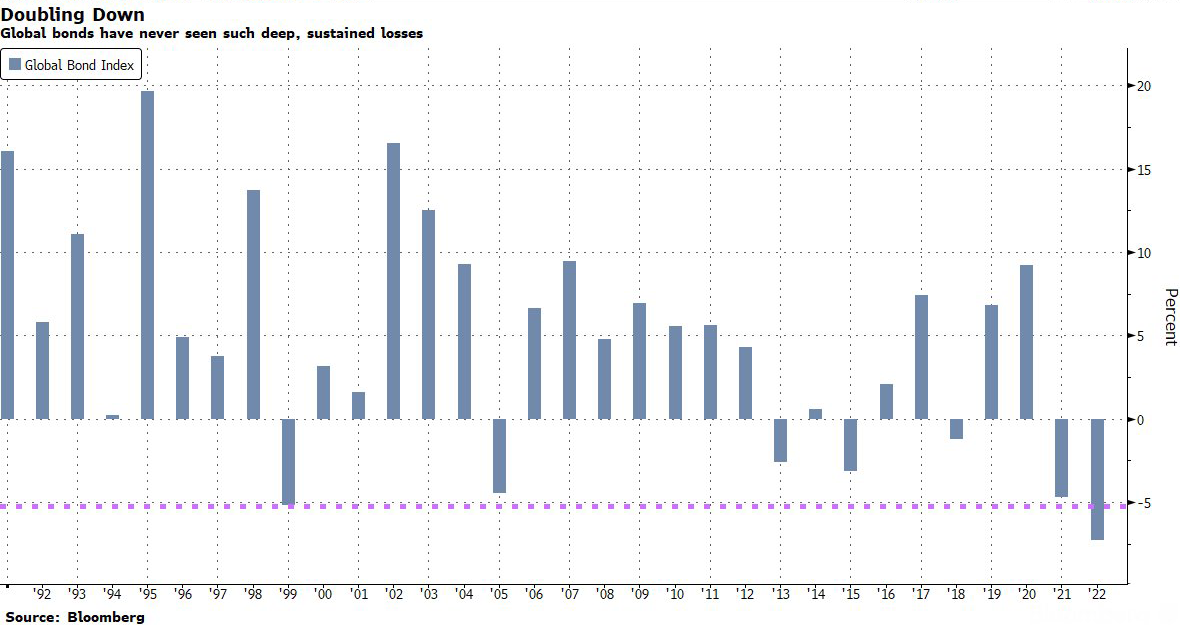
The meltdown across global bonds is truly epic and unprecedented. Whether you look at Bloomberg’s global aggregate bond index, which started in 1990, or at the U.S. gauge that goes back to 1976, the drops of more than 6% seen year-to-date exceed any full-year declines. Each index is well-nigh certain to suffer consecutive yearly losses for the first time on record. The picture is about the same if you just look at government debt securities.


It could be easy to shrug this off as a fairly modest slide -- other asset classes like equities, commodities and junk bonds regularly switch between bull and bear markets. But that’s not the way bonds were supposed to work because as they decline, the increased yields they start offering would normally start to draw money back in to bonds -- especially because their role as benchmarks for risk-free rates means those rising yields start to place an increased burden on other assets.
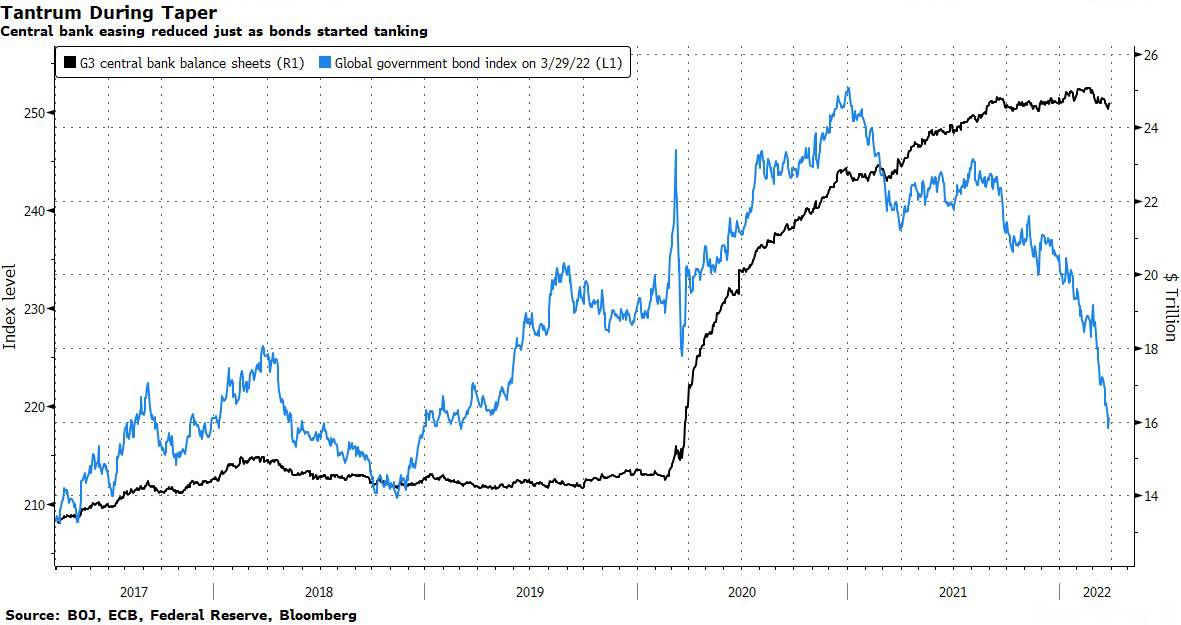
An underappreciated dynamic in this year’s rout is the impact of central banks rushing to end quantitative easing and raise rates all at once as they realized they had stuck with pandemic-era stimulus for far too long. With the war in Ukraine underscoring expectations inflation will be the opposite of transitory, the previous taper playbook has been turned on its head.
Treasuries for example have been hammered as the removal of the steady flow of demand from the Fed enhances the impact of triggers such as convexity, investment-grade corporate sales, and Japanese investors squaring positions into the March 31 end of the fiscal year. (The BOJ is playing its own special role in damaging global markets as it pulls out all the stops to stay easy in a tightening world).
Yields are spiking higher during and after the taper, unlike last decade when yields retreated on expectations that an end to QE would slow the economy.
Matters are only likely to get worse as the Fed pursues quantitative tightening, with more declines and more volatility looming. Heaven help investors and economists trying to read what bond pricing means once QT starts and further distorts already strained curves.
The new normal for bonds is that they become more and more about simply guessing at central bank moves, and less about real-world fundamentals because investors will turn elsewhere to express such views -- precious metals, various equity sectors, commodity baskets and so on.

>>> US Research Calls

Research Calls

  • Upgrades:
    • Beacon Roofing Supply (BECN) upgraded to Neutral from Underweight at JP Morgan; tgt $68
    • Freshpet (FRPT) upgraded to Buy from Neutral at Goldman; tgt raised to $136
    • HF Sinclair (DINO) upgraded to Neutral from Sell at Goldman; tgt raised to $43
    • HealthEquity (HQY) upgraded to Buy from Neutral at BTIG Research; tgt $85
    • Host Hotels (HST) upgraded to Buy from Hold at Jefferies; tgt raised to $25
    • Masco (MAS) upgraded to Neutral from Underweight at JP Morgan; tgt lowered to $62
    • Northern Trust (NTRS) upgraded to Buy from Neutral at Goldman; tgt raised to $141
    • PagSeguro Digital (PAGS) upgraded to Outperform from Market Perform at Itau BBA; tgt $31
    • RH (RH) upgraded to Buy from Hold at Jefferies; tgt lowered to $560
  • Downgrades:
    • Banco Santander Mexico (BSMX) downgraded to Neutral from Overweight at JP Morgan; tgt $6
    • BNY Mellon (BK) downgraded to Neutral from Buy at Goldman; tgt lowered to $60
    • JELD-WEN (JELD) downgraded to Underweight from Neutral at JP Morgan; tgt lowered to $23
    • Kala Pharmaceuticals (KALA) downgraded to Underweight from Neutral at JP Morgan
    • Kimco Realty (KIM) downgraded to Equal-Weight from Overweight at Morgan Stanley; tgt raised to $26.50
    • Mohawk (MHK) downgraded to Underweight from Overweight at JP Morgan; tgt lowered to $140
    • Park Hotels & Resorts (PK) downgraded to Hold from Buy at Jefferies; tgt lowered to $19
    • Procter & Gamble (PG) downgraded to Neutral from Overweight at JP Morgan; tgt lowered to $165
    • Sera Prognostics (SERA) downgraded to Neutral from Buy at Citigroup; tgt lowered to $4
    • SmileDirectClub (SDC) downgraded to Sell from Hold at Loop Capital; tgt $2
    • Wayfair (W) downgraded to Sell from Hold at Loop Capital; tgt lowered to $90
  • Others:
    • ABM Industries (ABM) initiated with a Buy at Deutsche Bank; tgt $62
    • 1Life Healthcare (ONEM) initiated with a Neutral at Guggenheim
    • 2U (TWOU) initiated with a Neutral at Cantor Fitzgerald; tgt $12
    • Advantage Solutions (ADV) initiated with a Hold at Deutsche Bank; tgt $7
    • Agilon Health (AGL) initiated with a Buy at Guggenheim; tgt $32
    • Aramark (ARMK) initiated with a Hold at Deutsche Bank; tgt $38
    • Beyond Meat (BYND) initiated with a Neutral at UBS; tgt $48
    • Block (SQ) initiated with a Buy at Goldman; tgt $173
    • Campbell Soup (CPB) initiated with a Sell at UBS; tgt $42
    • Carnival (CCL) initiated with an Underweight at Wells Fargo; tgt $21
    • Cintas (CTAS) initiated with a Buy at Deutsche Bank; tgt $517
    • Clean Harbors (CLH) initiated with a Buy at DA Davidson; tgt $130
    • Conagra (CAG) initiated with a Neutral at UBS; tgt $34
    • Coursera (COUR) initiated with an Overweight at Cantor Fitzgerald; tgt $30
    • Custom Truck One Source (CTOS) initiated with a Buy at Deutsche Bank; tgt $12
    • Dun & Bradstreet (DNB) initiated with a Hold at Deutsche Bank; tgt $20
    • Equifax (EFX) initiated with a Hold at Deutsche Bank; tgt $265
    • Evolent Health (EVH) initiated with a Buy at Guggenheim; tgt $43
    • FactSet (FDS) initiated with a Hold at Deutsche Bank; tgt $453
    • FirstService (FSV) initiated with a Hold at Deutsche Bank; tgt $143
    • General Mills (GIS) 
    • iHarsco (HSC) initiated with a Buy at DA Davidson; tgt $18nitiated with a Neutral at UBS; tgt $69
    • Hershey Foods (HSY) initiated with a Neutral at UBS; tgt $226
    • Innospec (IOSP) initiated with a Neutral at Seaport Research Partners
    • J.M. Smucker (SJM) initiated with a Sell at UBS; tgt $123
    • Kellogg (K) initiated with a Buy at UBS; tgt $73
    • Kraft Heinz (KHC) initiated with a Neutral at UBS; tgt $40
    • Mondelez Int'l (MDLZ) initiated with a Buy at UBS; tgt $73
    • Moody's (MCO) initiated with a Buy at Deutsche Bank; tgt $408
    • MSCI (MSCI) initiated with a Hold at Deutsche Bank; tgt $533
    • Nomad Foods (NOMD) initiated with a Buy at UBS; tgt $26
    • Nerdy (NRDY) initiated with an Overweight at Cantor Fitzgerald; tgt $7
    • Nordson (NDSN) initiated with a Hold at Loop Capital; tgt $250
    • Norwegian Cruise Line (NCLH) initiated with an Overweight at Wells Fargo; tgt $27
    • Oak Street Health (OSH) initiated with a Neutral at Guggenheim
    • Offerpad Solutions (OPAD) initiated with a Neutral at Goldman; tgt $6
    • Open Lending (LPRO) initiated with a Hold at Deutsche Bank; tgt $25
    • PayPal (PYPL) initiated with a Buy at Goldman; tgt $144
    • PowerSchool (PWSC) initiated with an Overweight at Cantor Fitzgerald; tgt $20
    • Privia Health (PRVA) initiated with a Buy at Guggenheim; tgt $35
    • Redfin (RDFN) initiated with a Neutral at Goldman; tgt $20
    • Robinhood Markets (HOOD) initiated with an Equal-Weight at Morgan Stanley; tgt $15
    • Roblox (RBLX) initiated with a Neutral at MKM Partners; tgt $55
    • Royal Caribbean (RCL) initiated with an Overweight at Wells Fargo; tgt $93
    • S&P Global (SPGI) initiated with a Buy at Deutsche Bank; tgt $515
    • Simply Good Foods (SMPL) initiated with a Buy at UBS; tgt $44
    • Signify Health (SGFY) initiated with a Buy at Guggenheim; tgt $36
    • Southwestern Energy (SWN) initiated with a Buy at Seaport Research Partners; tgt $9
    • Sovos Brands (SOVO) initiated with a Buy at UBS; tgt $16
    • TransUnion (TRU) initiated with a Buy at Deutsche Bank; tgt $124
    • Trinseo (TSE) resumed with a Buy at Deutsche Bank; tgt $60
    • Udemy (UDMY) initiated with an Overweight at Cantor Fitzgerald; tgt $22
    • Verisk Analytics (VRSK) initiated with a Buy at Deutsche Bank; tgt $255
    • Verra Mobility (VRRM) initiated with a Hold at Deutsche Bank; tgt $17
    • WillScot Mobile Mini (WSC) initiated with a Buy at Deutsche Bank; tgt $49
    • Zillow (ZG) initiated with a Neutral at Goldman; tgt $57