MIT News : A new heat engine with no moving parts is as efficient as a steam tur

A new heat engine with no moving parts is as efficient as a steam turbine
The design could someday enable a fully decarbonized power grid, researchers say.

Link : https://bit.ly/3M9TRgd

Caption: A thermophotovoltaic (TPV) cell (size 1 cm x 1 cm) mounted on a heat sink designed to measure the TPV cell efficiency. To measure the efficiency, the cell is exposed to an emitter and simultaneous measurements of electric power and heat flow through the device are taken.


Engineers at MIT and the National Renewable Energy Laboratory (NREL) have designed a heat engine with no moving parts. Their new demonstrations show that it converts heat to electricity with over 40 percent efficiency — a performance better than that of traditional steam turbines.
The heat engine is a thermophotovoltaic (TPV) cell, similar to a solar panel’s photovoltaic cells, that passively captures high-energy photons from a white-hot heat source and converts them into electricity. The team’s design can generate electricity from a heat source of between 1,900 to 2,400 degrees Celsius, or up to about 4,300 degrees Fahrenheit.
The researchers plan to incorporate the TPV cell into a grid-scale thermal battery. The system would absorb excess energy from renewable sources such as the sun and store that energy in heavily insulated banks of hot graphite. When the energy is needed, such as on overcast days, TPV cells would convert the heat into electricity, and dispatch the energy to a power grid.
With the new TPV cell, the team has now successfully demonstrated the main parts of the system in separate, small-scale experiments. They are working to integrate the parts to demonstrate a fully operational system. From there, they hope to scale up the system to replace fossil-fuel-driven power plants and enable a fully decarbonized power grid, supplied entirely by renewable energy.
“Thermophotovoltaic cells were the last key step toward demonstrating that thermal batteries are a viable concept,” says Asegun Henry, the Robert N. Noyce Career Development Professor in MIT’s Department of Mechanical Engineering. “This is an absolutely critical step on the path to proliferate renewable energy and get to a fully decarbonized grid.”
Henry and his collaborators have published their results today in the journal Nature. Co-authors at MIT include Alina LaPotin, Kyle Buznitsky, Colin Kelsall, Andrew Rohskopf, and Evelyn Wang, the Ford Professor of Engineering and head of the Department of Mechanical Engineering, along with Kevin Schulte and collaborators at NREL in Golden, Colorado.
Jumping the gap
More than 90 percent of the world’s electricity comes from sources of heat such as coal, natural gas, nuclear energy, and concentrated solar energy. For a century, steam turbines have been the industrial standard for converting such heat sources into electricity.
On average, steam turbines reliably convert about 35 percent of a heat source into electricity, with about 60 percent representing the highest efficiency of any heat engine to date. But the machinery depends on moving parts that are temperature- limited. Heat sources higher than 2,000 degrees Celsius, such as Henry’s proposed thermal battery system, would be too hot for turbines.
In recent years, scientists have looked into solid-state alternatives — heat engines with no moving parts, that could potentially work efficiently at higher temperatures.
“One of the advantages of solid-state energy converters are that they can operate at higher temperatures with lower maintenance costs because they have no moving parts,” Henry says. “They just sit there and reliably generate electricity.”
Thermophotovoltaic cells offered one exploratory route toward solid-state heat engines. Much like solar cells, TPV cells could be made from semiconducting materials with a particular bandgap — the gap between a material’s valence band and its conduction band. If a photon with a high enough energy is absorbed by the material, it can kick an electron across the bandgap, where the electron can then conduct, and thereby generate electricity — doing so without moving rotors or blades.
To date, most TPV cells have only reached efficiencies of around 20 percent, with the record at 32 percent, as they have been made of relatively low-bandgap materials that convert lower-temperature, low-energy photons, and therefore convert energy less efficiently.
Catching light
In their new TPV design, Henry and his colleagues looked to capture higher-energy photons from a higher-temperature heat source, thereby converting energy more efficiently. The team’s new cell does so with higher-bandgap materials and multiple junctions, or material layers, compared with existing TPV designs.
The cell is fabricated from three main regions: a high-bandgap alloy, which sits over a slightly lower-bandgap alloy, underneath which is a mirror-like layer of gold. The first layer captures a heat source’s highest-energy photons and converts them into electricity, while lower-energy photons that pass through the first layer are captured by the second and converted to add to the generated voltage. Any photons that pass through this second layer are then reflected by the mirror, back to the heat source, rather than being absorbed as wasted heat.
The team tested the cell’s efficiency by placing it over a heat flux sensor — a device that directly measures the heat absorbed from the cell. They exposed the cell to a high-temperature lamp and concentrated the light onto the cell. They then varied the bulb’s intensity, or temperature, and observed how the cell’s power efficiency — the amount of power it produced, compared with the heat it absorbed — changed with temperature. Over a range of 1,900 to 2,400 degrees Celsius, the new TPV cell maintained an efficiency of around 40 percent.
“We can get a high efficiency over a broad range of temperatures relevant for thermal batteries,” Henry says.
The cell in the experiments is about a square centimeter. For a grid-scale thermal battery system, Henry envisions the TPV cells would have to scale up to about 10,000 square feet (about a quarter of a football field), and would operate in climate-controlled warehouses to draw power from huge banks of stored solar energy. He points out that an infrastructure exists for making large-scale photovoltaic cells, which could also be adapted to manufacture TPVs.
“There’s definitely a huge net positive here in terms of sustainability,” Henry says. “The technology is safe, environmentally benign in its life cycle, and can have a tremendous impact on abating carbon dioxide emissions from electricity production.”
This research was supported, in part, by the U.S. Department of Energy.
(ZH) Musk Speaking To Co-Investors As Twitter Board Adopts "Poison Pill" To Thwa

Musk Speaking To Co-Investors As Twitter Board Adopts "Poison Pill" To Thwart Hostile Takeover

(Update: 20:00ET): In an attempt to move along his hostile takeover following Twitter's adoption of a poison pill takeover defense (see below), the NY Post reports that Elon Musk is speaking to potential co-investors who could partner with him on a bid for the social network, and cites sources according to whom a new plan that includes partners could be announced within days.
One possibility is teaming with private-equity firm Silver Lake Partners, which was planning to co-invest with him in 2018 when he was considering taking Tesla private, and whose Co-CEO Egon Durban is already a Twitter board member and led Musk’s deal team during the 2018 failed effort to take Tesla private, sources said. Silver Lake declined to comment.
Whether Musk would present Twitter with an entirely new offer — perhaps raising his current bid — or whether new partners would simply go in on a purchase with him isn’t clear. A Musk spokesperson declined to comment.
As we predicted earlier (see below), one way to circumvent Twitter's Poison Pill is for Musk "to be joined by one or more like-minded, anti-censorship investors such as Peter Thiel who either build up stakes through the poison pill 15% limit in the process making a management and board replacement by proxy vote the simple outcome." And indeed, the Post writes now that the "pill may not stop other entities or people from acquiring their own shares of up to 15% of the company. Those owners could partner with Musk to force a sale, make changes in the executive ranks or push for other overhauls of the company."
“This is not over,” a source close to the situation told the Post.
It sure isn't because separately, Bloomberg, Reuters and the Post all report that besides Musk’s offer, Twitter has been fielding takeover interest from other parties, including technology-focused private equity firm Thoma Bravo, which is considering making a rival offer. The New York Post reported Thoma Bravo’s interest on Thursday.
Additionally, Bloomberg Intelligence analyst Mandeep Singh writes that “Musk could decide to partner with Oracle, whose co-founder Larry Ellison sits on Tesla’s board and has expressed interest in acquiring social media company TikTok’s U.S. assets, and a private equity consortium that includes Thoma Bravo to thwart Twitter’s poison pill, while raising the bid 10-15% to about $50 billion.”
* * *
As was widely expected and reported in the aftermath of Elon Musk going hostile on Friday morning, on Saturday morning Twitter adopted a measure that will shield it from hostile acquisition bids in a desperate step to prevent billionaire Elon Musk’s offer to take the company private and make it a bastion of free speech.
The board set up a shareholder rights plan, also known as a "poison pill" which as we clarified yesterday for the benefit of the company's overly dramatic, overly literal and overly snowflake employees, is not literal...
... and which is exercisable if a party - read Elon Musk - acquires 15% of the stock without prior approval, lasting for one year (if the pill had expired the day after the midterms it may have been a bit too obvious). The plan seeks to ensure that anyone taking control of Twitter through open market accumulation pays all shareholders an appropriate control premium, according to a statement Friday.
For a company that has struggled greatly with value creation - on Friday TWTR stock closed at $45.08, or 18 cents higher than where it closed on its first day as a public company, or $44.90 - a poison pill defense strategy allows existing shareholders the right to purchase additional shares at a discount, effectively diluting the ownership interest of the hostile party. Poison pills are common among companies under fire from activist investors or in hostile takeover situations.
Under Twitter’s plan, each right will entitle its holder to purchase, at the then-current exercise price, additional shares of common stock having a then-current market value of twice the exercise price of the right.
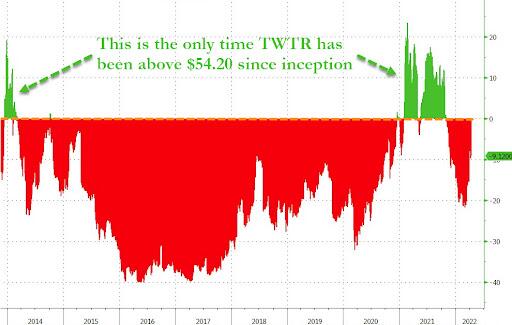
Twitter enacted the plan to buy time, Bloomberg reported citing a person familiar with the matter, although it wasn't clear time for what: at $54.20, Musk's offer represents a premium to the historical TWTR price since IPO on 92% of the time.
And since the Twitter board, whose constituents are listed below...
... is about to get bombarded with a barrage of lawsuits claiming it violated its fiduciary duty, the board also said it wants to be able to analyze and negotiate any deal, and may still accept it (spoiler alert: it won't).
Twitter’s board met Thursday to review Musk’s proposal - which according to the world's richest man was his “best and final” offer and who had already accrued a stake of more than 9% in Twitter since earlier this year - to determine if it was in the best interest of the company and all of its shareholders.
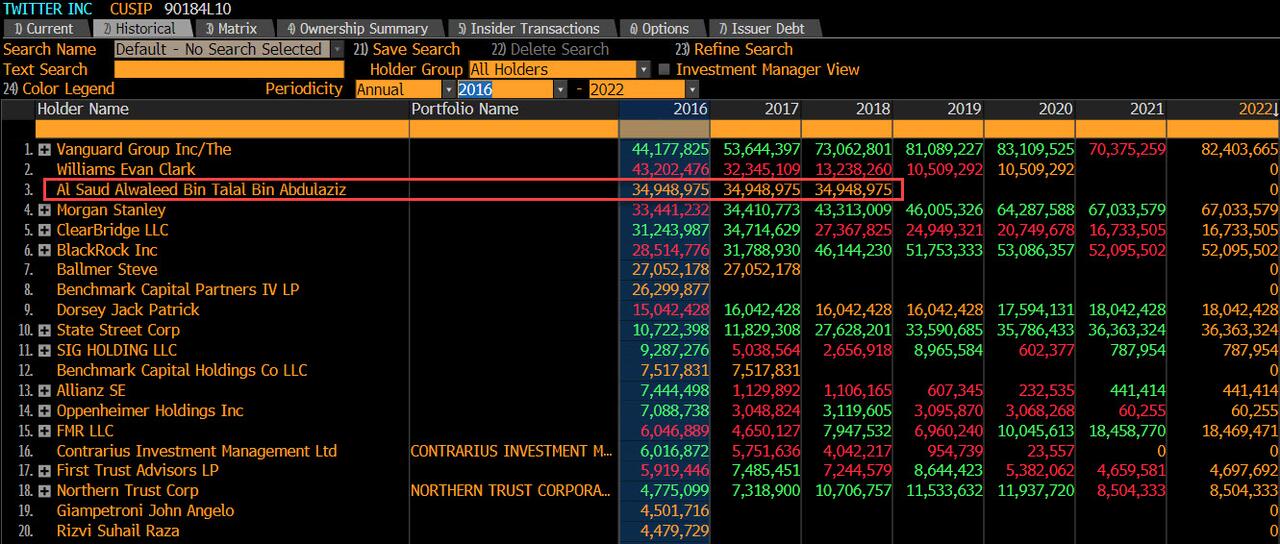
Included in Musk’s securities filing disclosing the bid Thursday morning was a script of text he sent to the company. In it he said, “it’s a high price and your shareholders will love it.” Hilariously, one prominent - and former - investor said the offer was too low and the market reaction appeared to agree. Saudi Arabia’s Prince Alwaleed bin Talal said the deal doesn’t “come close to the intrinsic value” of the popular social media platform. Which is, well, hilarious since as we showed yesterday, it appears the Prince no longer has direct ownership of even one share of Twitter stock.
Speaking later Thursday at a TED conference, Musk said he wasn’t sure he “will actually be able to acquire it.” He added that his intent was to also retain “as many shareholders as is allowed by the law,” rather than keeping sole ownership of the company himself.
After initially surging, Twitter shares dropped 1.7% in New York on Thursday, reflecting the market’s view that the deal is likely to be rejected or to fall through.
Musk first disclosed his Twitter stake on April 4, making him the largest individual investor. At the TED conference, he indicated that he has a Plan B if Twitter’s board rejects his offer. He declined to elaborate. But in his filing earlier in the day, he said he would rethink his investment if the bid failed.
“If the deal doesn’t work, given that I don’t have confidence in management nor do I believe I can drive the necessary change in the public market, I would need to reconsider my position as a shareholder,” said Musk.
* * *
Previewing the poison pilll defense, on Thursday, Cameron Winklevoss, founder of the Gemini cryptocurrency exchange, tweeted (of course) that “Twitter is considering a poison pill to thwart @elonmusk’s offer." In response, Musk said that a “poison pill” move would be a "breach" of the board's fiduciary duty and could expose Twitter’s board to “titanic” legal liability.
Winklevoss alleged in his tweet that, by adopting the poison pill tactic, Twitter was demonstrating its commitment to preserving the status quo even if it has a negative impact on existing shareholders.
“They would rather self-immolate than give up their censorship programs. This shows you how deeply committed they are to Orwellian control of the narratives and global discourse. Scary,” he wrote. Twitter has repeatedly suppressed and "shadowbanned" conservative viewpoints, allegations the company has repeatedly denied.
Adam Candeub, a law professor at Michigan State University, said that Twitter’s board could face legal consequences if they turn down an offer that’s financially lucrative to shareholders.
“Twitter’s owned by shareholders, and the directors have to act in a way that’s in their best interests, not in the way that allows them to keep control of the corporation,” Candeub told The Epoch Times.
“If they turn down a very favorable price, there will be dereliction of their legal duty, and there could be lots of legal consequences.”
* * *
Now that his original plan has been thwarted, Musk has said that he has a "Plan B" in stock for the company although he did not disclose what it is. As Mark Cuban pointed out yesterday...
... one possible response is for Elon to be joined by one or more like-minded, anti-censorship investors such as Peter Thiel who either build up stakes through the poison pill 15% limit in the process making a management and board replacement by proxy vote the simple outcome, or they just raise the takeover price to a level that even the woke Twitter board can not reject.
Or skip the whale investor approach entirely, and open up twitter to a mass investor buyout, in the form of a DAO, where "token holders will get to vote on what's trending and who gets verified."
Alternatively, Musk can take his appeal directly to his 82 million twitter followers (a quarter of Twitter's total 217 million global Daily Active Users) and have them all buy several shares, then pledge them for Elon during the next proxy vote. Because as much as Twitter wants to reject any buyout offer that will prevent it from imposing the censorship its liberal board and employees love so much, there is only so much it can do.
In the end, however, the only question is how dedicated is Musk to control Twitter, because if he really wants it, he will get it.

Barrons : ‘Sell in May and Go Away’ Could Be the Best Strategy This Year

‘Sell in May and Go Away’ Could Be the Best Strategy This Year

This could be the year to follow the adage: Sell in May and go away.

It was a pretty lousy holiday-shortened week. The S&P 500 dropped 2.1%. The Nasdaq Composite fell 2.6%. The Dow Jones Industrial Average was the relative winner, slipping just 0.8%.

The reasons are pretty simple. War, inflation, disease, and the Federal Reserve’s newfound determination to put the brakes on rising prices are all ratcheting up uncertainty and hurting investor sentiment. It’s a lot to digest. Maybe it’s best just to give up—for a while.

“Markets discount three things. Earnings and rates, of course. But the third is conviction about those inputs,” says DataTrek co-founder Nicholas Colas. “It’s a fancy way of saying [the] markets hate uncertainty.”

“We’ve already got a fair amount of uncertainty,” adds Colas. “But can we really know if the 10-year [yield] stops at 3% or goes to 4%? No one knows. Not investors, not the Fed.”

Bond yields are up because the central bank is committed to slaying inflation by raising interest rates.

The Fed makes hawkish statements from time to time, but its tone now is very different than in recent years, says Brian Rauscher, Fundstrat’s head of global portfolio strategy and asset allocation. “I know it’s overly simplistic, but don’t fight the Fed,” Rauscher told clients on a conference call this past week. In other words, if the central bank says it is set on slowing the economy, believe it.

Hawkishness isn’t great news for stocks. “We’re going to have a tough spring and summer,” says Stifel market strategist Barry Bannister. He looks at everything from purchasing manager indexes to real bond yields, retail sales, and more—and they’re “all saying the same thing”: there is trouble ahead.

That trio of market veterans is like a Greek chorus of bad news. But they could well be right. While the Fed tightens, investors should use seasonality to their advantage and be spectators to the drama this summer.

The market, in all likelihood, will be down in the first four months of the year. Since 1980, when the market is down through April, it has fallen from the start of May through September six of 15 times, or 40% of the time. The average move from May through September in those 15 years is minus 1.5%.

When the market rises to begin the year, it drops from May through September 23% of the time. Not as bad. And the average gain over that span is 8%.

That history means investors don’t lose a lot by going conservative in a year like this.

Of course, investors don’t just go to cash and take an extended vacation. Most of the time they make changes in their portfolios at the margins. In practical terms, it means taking exposure down a little or shifting into more-defensive positions.

Bannister and Rauscher both like the healthcare sector as an option for nervous investors. Taking up healthcare and taking down riskier exposure to industrial and commodity stocks looks like a prudent way to survive the turmoil of 2021.

Barrons : Utility Stocks Are Hot Right Now. Here’s Why.

Utility Stocks Are Hot Right Now. Here’s Why.

Higher bond yields are roiling the stock market. Utility shares have benefited—and it doesn’t look like their run-up is over.

The 10-year Treasury yield has surged to 2.83% from 1.51% at the end of 2021, as the Federal Reserve raises borrowing costs to curb inflation. It’s already begun hiking interest rates and is expected to reduce its bond holdings soon—which bodes badly for riskier sectors like industrials, consumer discretionary, and banking, but helps bolster defensive sectors like utilities.

The Fed’s moves have helped send the S&P 500 down 7.8% this year. The Utilities Select Sector SPDR exchange-traded fund (ticker: XLU), meanwhile, is up 6.3%.

Normally, higher yields hurt utility stocks, as they typically accompany strengthening economic demand, prompting investors to favor cyclicals. Utilities don’t see higher earnings growth when the economy strengthens.

Right now, however, higher yields are a result of the Fed trying to slow economic growth, and that’s scaring investors into utilities. Such a slowdown would dent profit gains in cyclical sectors. But utilities' earnings growth should be stable, as they can keep raising prices for residential and commercial customers, which is precisely why strategists at Morgan Stanley recently upgraded the sector.

Analysts expect utilities’ 2023 earnings per share to rise almost as fast as the S&P 500’s 10% rate, which could decline should the economy falter. Utilities’ steady growth—higher than the low single digits in percentage terms in the past few years—is aided by demand for renewable energy.

State regulators only allow utilities to realize a set return on their assets—roughly 10%. When they invest in renewable projects, they boost their total assets. As their assets increase, their earnings grow almost as fast.

“There’s a lot of macro uncertainty, and this group has a lot of appealing characteristics,” says Wells Fargo analyst Neil Kalton. “If there are some pullbacks, we want to step in and add to positions.”

Consider Dominion Energy (D). The company said in its most recent earnings release that it aims to expand its asset base by 9% annually starting this year. That will drive almost 7% EPS growth, to $4.38, for 2023, according to FactSet. Driving Dominion’s asset expansion would be 11% growth in zero-carbon electricity generation, amounting to about $5.4 billion of a total $7.4 billion in annual investments.

Dominion is “levered to decarbonization and renewables,” says Guggenheim analyst Shahriar Pourreza, who rates the stock a Buy. “They’re going to grow [earnings] into perpetuity at 6% to 8%.”

That could take Dominion stock higher, as it isn’t necessarily as expensive as it looks. At $87.40, it trades at 21.2 times forward EPS, above the S&P 500’s 18.9 times. It’s normal for utilities to trade expensively during heightened economic uncertainty. ”If investors are worried about recession, Dominion is going to work for investors,” says Mizuho analyst Anthony Crowdell.

Barrons : Why Twitter Shareholders Should Sell Out to Elon Musk

Why Twitter Shareholders Should Sell Out to Elon Musk

Elon Musk’s embrace of Twitter leaves investors with a riddle wrapped in a mystery.

Much as he has whipsawed the prices of Bitcoin and Dogecoin with his tweets in the past, Musk generated a frenzy of headlines over Twitter (ticker: TWTR) in recent weeks: first, taking a big stake, then joining the board, not joining the board, and finally offering $54.20 a share to take the company private.

Even for a company that has frustrated repeated efforts to wring big profits from its monopoly on real-time news, the takeover bid falls well short of offering a neat solution to Twitter’s woes. Indeed, the stock closed Thursday at $45.08, in apparent disbelief that Twitter will get bought by Musk or anyone else.

That is still 15% above where it traded before Musk disclosed his 9.1% position. On Friday, the company announced it had adopted a “poison pill” to thwart a hostile takeover.

So what should Twitter shareholders do? Sell to Musk or anyone else who will take their money, suggests Michael Nathanson of SVB’s MoffettNathanson and other analysts. Under its present management and business model, Twitter stock is unlikely to revisit last year’s $80 peak.

The upside for the stock is now capped, says an analyst whose hedge fund sold its position at last year’s higher prices. “The situation’s turned 180 degrees in just a week,” he says. “It was amazing when Elon seemed like he would turn the stock into a meme. Then it all fell apart.”

Musk, the chief executive of Tesla (TSLA) and SpaceX, told a TED talk audience this past week that he was not after Twitter for the money, but rather for his love of free speech. Many tweeters on the platform say he would turn Twitter into an unmoderated nightmare, like the town square in a Purge movie or right-wing sites like Parler.com. Those fears aren’t warranted.

Musk calls himself a free speech “absolutist,” but he isn’t. He told the TED audience that a platform’s content needs some moderation to filter calls to violence and conform with local law. Rule breakers deserve timeouts, he said. Musk’s suggestion that Twitter speech controls should be “open source” echoes the aims of the platform’s co-founder and recent chief executive, Jack Dorsey.

Turning Twitter into a haven for hate speech would destroy its business value, notes Eric Goldman, a law professor at Santa Clara University who studies the regulation of social media.

Musk may say he’s primarily interested in Twitter’s civic value, but he does know something about creating valuable businesses. He has suggested that the company try to get more revenue from subscriptions.

Twitter hasn’t gotten far in its pursuit of the direct-response advertising sales enjoyed by Facebook parent Meta Platforms (FB) or Google parent Alphabet (GOOGL). Despite Twitter’s goal of getting half its ad revenue from direct-response clicks, Nathanson notes that brand advertising still brought in 85% of revenue last year. Privacy restrictions by Apple (AAPL) have steepened the grade for anyone trying to climb into performance-advertising.

As a result, Nathanson thinks it’s generous to assume that Twitter can reach 2025 cash earnings of 25% on $10.7 billion in revenue (or double last year’s sales of $5 billion). But he does. Applying a multiple of 13 to that estimate of $2.7 billion in 2025 earnings before interest, taxes, depreciation, and amortization (Ebitda)—which is between the multiples of Meta and Alphabet—the analyst says Twitter would have an enterprise value just shy of $35 billion, in a couple of years’ time. And that’s before discounting to the present. Today, Twitter already trades at that level.

In his letter to the board, Musk called his $54.20 bid a “best and final offer.” In the past, others have looked into acquiring Twitter, including Walt Disney (DIS) and Salesforce (CRM). If Twitter’s board doesn’t see Musk as its white knight, it’s not likely they would find one willing to bid far more than his cannabis-joke price.

Unless you’re like Musk and want to own Twitter for idealistic reasons, you should let him have it. He won’t ruin it, so you can do so with a clear conscience.

Barrons : Is Tesla Stock Vulnerable to the ‘Key-Man’ Risk? The Meaning of Musk i

Is Tesla Stock Vulnerable to the ‘Key-Man’ Risk? The Meaning of Musk in the Long Term.

It’s not easy riding with Elon Musk on one of his adventures. Tesla stock has been jumpy since he took his Twitter stake. On Thursday, after he made his takeover bid, Tesla shares fell 3.7%, shedding $38.6 billion in market value.

Shareholders are nervous. Many investors see the unpredictable Musk as irreplaceable—the so-called key-man risk. “Tesla is Elon Musk,” says Roth Capital analyst Craig Irwin, likening him to Apple ’s Steve Jobs. “He’ll be the most important person at Tesla for the next 20 years.”

Last year, Tesla shares (ticker: TSLA) fell 16% in two days following a Twitter poll Musk ran asking if he should sell 10% of his stake to pay taxes. The Twitterverse voted “yes,” Musk sold $16 billion in shares—and the stock hasn’t closed above $1,200 a share since. It’s now just under $1,000.

Accounting for what Musk already owns, buying Twitter could mean selling some 40 million Tesla shares. Of course, Musk could borrow against his Twitter stake, with a loan secured by his Tesla position, or, says Future Fund Active exchange-traded fund founder Gary Black, “line up a private equity backer or lenders who can provide leverage. He can sell some SpaceX shares. He doesn’t necessarily have to sell more [Tesla] stock.”

Bottom line: Most Tesla shareholders are used to Musk’s non-Tesla activities. In the long run, the stock moves on making and selling electric cars.

Barrons : This Chip Supplier to Tesla and Apple Gets a Boost as Shortages Contin

This Chip Supplier to Tesla and Apple Gets a Boost as Shortages Continue

Dutch-Swiss chip maker STMicroelectronics , along with many of its peers, has seen business boom on the back of rising global demand and supply constraints.

That, in turn, led the Tesla and Apple supplier—which designs, develops, and makes semiconductors—to post fourth-quarter revenue ahead of guidance in January. And it has driven up the Paris-listed stock (ticker: STM.France) about 6% in the past 12 months to 34.75 ($37.84) euros.

While the stock has tumbled about 20% this year, the investment case remains strong. The Geneva-based company, which also has listings in Milan and New York, is set apart from its peers because its broader customer base spans a range of sectors, such as automotive and industrial, which accounted for about 35% of 2021 sales. Many of these sectors are expanding, and this diversity also offers protection.

STM can also provide an element of certainty in terms of 2022 revenue guidance, which is expected to rise 20% to a range between $14.8 billion and $15.3 billion because its order book for the year is full.

While peers slowed down investment in capital expenditures during the pandemic, STM continued to spend, and said in January that it will double investment in chip making facilities to about $3.5 billion in 2022, up from $1.8 billion in 2021. This will include a new factory in Italy.

Johannes Schaller, an analyst at Deutsche Bank Research, wrote in a note: “We retain our bullish stance on the stock…which we see in a unique position being able to deliver highly cost-efficient capacity into a tight market.” He thinks the stock could jump about 45% to €52.

This efficient production keeps costs low at the same time that product prices are climbing because of the supply squeeze, and this combination means the company is able to deliver healthy gross profit margins of 45%.

Aleksander Peterc, an analyst at Société Générale, says these margins should comfortably offset any increased input costs. He lifted STM’s revenue estimates to $15 billion for 2022 and $16.5 billion for 2023, predicting reported net income would increase to $3.22 billion for 2023. And he argued in a note that STM’s valuation is at an “unusually high discount” to both its peers and to historical earnings-based 12 month forward multiples.

STM employs more than 48,000 employees and has a market value of €32.3 billion. It fetches a low 12.2 times this year’s expected earnings, and while it is valued in line with its peers, rival Broadcom (AVG) trades at 16.95 this year’s expected earnings, and Analog Devices (ADI) at 19.12.

For the year ended Dec. 31, 2021, STM posted net sales of $12.7 billion, up from $10.2 billion the previous year. It saw net income almost double to $2 billion in 2021 from $1.1 billion. STM will post first-quarter earnings later this month.

“In 2022 we will accelerate the execution of our strategy, continuing to deliver differentiating products to customers for smart mobility, improved power and energy management, and the IoT and 5G,” CEO Jean-Marc Chery told Barron’s. “We will invest significantly to capture new opportunities and prepare for future growth, keeping our strong focus on sustainability.”

A dynamic market is set to last well into 2023, with favorable inventory levels, continued supply-chain issues, heightened price changes, and high order levels.

A survey of 120 industry respondents issued by Berenberg in March revealed half of respondents believe the supply chain/shortage won’t ease in 2022, and half of them suggested it may get worse before it improves. Customer demand has continued to grow since early 2021, and just a small number of respondents reported a slight drop in order levels recently.

WSJ : Jack Dorsey Tweet NFT Once Sold for $2.9 Million, Now Might Fetch Under $1

Jack Dorsey Tweet NFT Once Sold for $2.9 Million, Now Might Fetch Under $14,000
Modest bids for tweet, converted to a nonfungible token last year, show a maturing NFT market

Twitter Inc. TWTR -1.68% founder Jack Dorsey’s first tweet was converted to a nonfungible token last year and sold for $2.9 million. Now, it may be resold for less than $14,000, a reflection of a maturing NFT market.

Sina Estavi, chief executive of Malaysia-based blockchain company Bridge Oracle, paid $2.9 million last March for the NFT, a digital certificate that says he owns Mr. Dorsey’s tweet, which reads “just setting up my twttr.”

NFTs exist on the blockchain alongside cryptocurrencies and serve as authentication certificates for those who buy original digital goods.

Non-fungible tokens, or NFTs, have gone in the last year from a relatively obscure blockchain technology to a market valued at around $44 billion. WSJ explores how NFTs are transforming the art market and tells the story of who is behind the buzz. Photo illustration: Alexander Hotz/WSJ
At the time of his purchase, Mr. Estavi tweeted: “This is not just a tweet! I think years later people will realize the true value of this tweet, like the Mona Lisa painting.”

About a year later, Mr. Estavi put the NFT up for auction. He didn’t say why.

Mr. Estavi listed it on an NFT marketplace called Opensea last week, expecting it to sell for at least $50 million. He pledged to donate at least 50% of the proceeds to a charity called GiveDirectly, which allows people to send money directly to people with no conditions on how the funds must be spent.

As of 5:45 p.m. ET Friday, however, a day after Tesla Inc. CEO Elon Musk made an offer to buy Twitter for $43 billion, the highest bid was only about $13,940, according to Opensea. Mr. Estavi said he was now rethinking the sale.

The low bids come as the NFT market has slowed in recent months. Global monthly sales of NFTs totaled almost $5 billion last August, according to CryptoSlam Inc., a site that aggregates NFT data. In March, sales were down to $2.4 billion.

“I don’t think it’s surprising that we’re seeing a little cooling off like we’re seeing in other markets as well,” said Jonathan Victor, NFT and gaming lead at Protocol Labs Inc., an open source research and development project. He said 2021 was the breakthrough year for NFTs, which led to high valuations. NFTs initially allowed artists and other creatives another avenue to be compensated for their work.

Now the market is broadening, more traditional companies are getting involved, and the focus is shifting to the utility that NFTs can provide—including to serve as tickets into exclusive spaces—leading to more digital certificates that don’t come with a hefty price tag, Mr. Victor said.

He likened some of the NFTs that have sold for seven-dollar-figures to works that have sold in the high end art market. “There isn’t a clear formula to say ‘this is how much this should cost,’ ” he said.

In the instance of the NFT of Mr. Dorsey’s first tweet, Mr. Victor said it was hard to determine its price.

“You have a price that’s set by one person who thought this was a fair value,” he said. Sometimes, others just don’t agree.

Mr. Estavi, reached by WhatsApp on Wednesday night, is reconsidering whether he wants to sell the NFT given the low bids. He said he might not sell it if he doesn’t get a good enough offer.

“It’s important to me who buys this NFT,” he said, “because I think the value of this NFT is far greater than you can imagine and anyone, whoever wants to buy it, must be worthy.”

Mr. Estavi put the NFT up for sale after spending nine months in prison in Iran for allegedly disrupting the country’s economic system, he said. He reiterated that if he does sell the digital certificate, he would donate the proceeds to charity.

After Mr. Dorsey sold the digital rights to the tweet last year, he posted tweets that showed the proceeds being converted to the cryptocurrency bitcoin and then sent to GiveDirectly’s Africa Response project to provide cash to families in Kenya, Rwanda, Liberia and Malawi.

FT : Inflation surge slashes $11tn from world’s negative-yielding debt

Inflation surge slashes $11tn from world’s negative-yielding debt
Central banks adopt hawkish move to end large-scale asset purchases and raise interest rates

This year’s hawkish change in tack from central banks is close to ending the era of negative-yielding debt, shrinking the global tally of bonds with sub-zero yields by $11tn.

Bond prices have tumbled this year as central banks move to end large-scale asset purchases and raise interest rates in their battle with soaring inflation, pushing yields in many big economies to their highest levels in years.

As a result, bonds worth $2.7tn currently trade at a yield of less than zero, the lowest figure since 2015, and a sharp plunge from more than $14tn in mid-December, according to the Bloomberg global aggregate bond index — a broad gauge of the fixed income market. Wiping out negative yields entirely would mark a return to normality for a broad range of big investors.

“Central banks are belatedly trying to get ahead of this inflation shock, so the bond market has abruptly priced in a big shift in interest rates,” said Mike Riddell, a senior portfolio manager at Allianz Global Investors.

Negative yields were once considered inconceivable, then as a novelty, and later as an established feature of global markets. They mean that prices for debt are so high, and interest payments so low, investors are certain to lose money if they hold their bonds to maturity. They reflect a belief that central banks would keep interest rates at rock bottom and have become entrenched in large quantities of debt in Japan and the eurozone in recent years.

That assessment has shifted dramatically in recent months, particularly in the euro area, where the European Central Bank on Thursday reiterated plans to end its bond-buying programme this year, and traders are betting that interest rates will return to zero for the first time since 2014 by December.


An end to ultra-low or negative yields is a “double-edged sword” for bond investors, according to Riddell. “On the one hand people are nursing losses on the bonds they hold. But the flipside is that positive risk-free rates mean future returns arguably look better.” He added that would be “good news” for investors such as pension funds that need to hold large quantities of safe assets like government bonds but also need to earn sufficient returns to meet future payouts.

The dwindling stock of negative-yielding debt also reflects high levels of inflation, which has driven investors to demand greater compensation for rising prices, according to Salman Ahmed, global head of macro at Fidelity International.

“Yes, nominal yields are moving up but long-term investors should really care about real returns. It’s what’s left after inflation that counts, and inflation is very high right now,” he said.

The eurozone has been the big driver of the reduction in debt trading at sub-zero yields. In December, the currency bloc accounted for more than $7tn of such bonds, including all of Germany’s government bonds. That figure has declined to just $400bn. Japan, where the central bank has so far resisted the global shift towards tighter monetary policy, now accounts for more than 80 per cent of the world’s negative-yielding bonds.

Negative yields are likely to multiply again in the euro area, unless the ECB delivers the interest rate rises already priced in by markets. The central bank will struggle to lift rates much from the current level of minus 0.5 per cent given the threat to the region’s recovery posed by Russia’s invasion of Ukraine and the resulting rise in energy prices, Ahmed said.

“I think the ECB has missed the window to normalise policy because the growth shock from Ukraine will be much more severe in Europe,” he added. “In our view they aren’t getting back to zero this year, and that means negative-yielding bonds are not about to disappear.”

FT : Elon Musk fails to convince the doubters that he will ‘save’ Twitter

Elon Musk fails to convince the doubters that he will ‘save’ Twitter
Billionaire has yet to explain how he will bring free speech and public trust to the social media platform

If Elon Musk thought that casting himself as Twitter’s saviour would win widespread backing for his $43bn hostile takeover bid, he was in for a rude awakening.

The world’s richest man laid out some sweeping claims for this week’s unsolicited approach. Shareholders, he promised, would “love” the rich premium he was offering. He would bring free speech back to one of the most important social media sites. And he would overhaul the management of a company that had lost its way.

With characteristic hype, he even pitched his bid as a benefit to humanity. “Civilisational risk is decreased the more we can increase the trust of Twitter as a public platform,” he said in an interview at a TED conference, hours after his approach had been revealed.

On all counts, the claims have fallen largely on deaf ears. Even before Twitter’s board revealed its opposition early on Friday by adopting a poison pill takeover defence, shareholders had given their own vote of no confidence. Twitter’s shares dropped nearly 2 per cent on news of the bid, in a sign of Wall Street’s low confidence in it succeeding.

“I would be pretty surprised if the Twitter board were willing to give in at $54 given where the stock was just six months ago,” said Rich Greenfield, a partner at consultancy LightShed, voicing a widespread view before news of the poison pill. Musk’s emergence as Twitter’s biggest shareholder (a position he lost to Vanguard this week) sent the shares up 38 per cent earlier this month on hopes he would be a catalyst for change. But his offer is still 26 per cent below the 12-month high.

If Musk’s proposal was intended as a sighting shot, then it left many investors unsure of how serious he was about following through — particularly given his incorrect claim once before to have had “funding secured” to take Tesla private.

Feeding the scepticism, Musk smirked as he took the TED stage shortly after his bid, and then reopened the “funding secured” controversy by insisting he had had the money all along. He only settled a complaint from regulators, he claimed, because they had backed him into a corner where Tesla was facing bankruptcy.

Going public with a hostile approach for Twitter before he had financing in place or discussing it in depth with the board was a “highly unusual” move that had not made it any easier for people to his true intentions, said Ann Lipton, associate professor in business law and entrepreneurship at Tulane University. Twitter’s directors were left in a position of trying to assess not only whether the price he was offering was a fair one, but also whether he is even willing to pay it. Without the financing, “it’s very hard to believe that he is”, she added.

Musk’s attempt to wrap his bid in the banner of free speech, meanwhile, also drew a sceptical response from many experts who have worked on keeping the largest social media platforms free of hate speech and misinformation. He said he wanted to end the secretive system through which Twitter favoured some tweets over others, and make it less likely users are banned. “Time outs are better than permanent bans,” he said.

The declaration drew halfhearted applause on the Republican right, where the permanent ban against Donald Trump has become a symbol of Silicon Valley bias. But some questioned how far Musk would be able to go in challenging the wider practice of content moderation.

“Reinstating Trump would be the ultimate litmus test,” said Jason Miller, a former senior Trump adviser. Without that, “it’s all just window dressing”, he said — though he added that Twitter’s culture and its employees’ left-leaning views would make it hard to completely change the ethos.

Among many experts, Musk’s claim that Twitter was suppressing free speech was dismissed as a naive claim that failed to take into account years of effort to weed out hate speech and misinformation.

Twitter is grappling with a deeper problem caused by its advertising business model, which “rewards extreme speech”, said Roger McNamee, a Silicon Valley investor who has campaigned against Facebook. That has forced it to try to fight back a tide of hatred and misinformation, in turn drawing criticism over alleged censorship, he and others have said.

In another move that he claimed would improve freedom of speech, Musk said he would publish the algorithm that determines what users see on Twitter. “Having a black box algorithm, promoting some things and not other things”, could be “quite dangerous”, he claimed.

However, most digital services keep their ranking algorithms secret, and disclosing Twitter’s could make it possible for people to “game the algorithm and manipulate the content” users see, said Greg Sterling, co-founder of Near Media and an expert on search and social media. That could cause particular problems given Twitter’s role in political debate and its use by some governments to release official information, he added.

The promise of a stronger commitment to free speech on Twitter could also damage the company’s business by making its site less attractive to brand advertisers, according to some advertising experts and financial analysts.

It isn’t “necessarily good for civilisation if inaccuracy is allowed to spread under the guise of free speech”, said Arun Kumar, chief data and technology officer at advertising group IPG. Advertisers “don’t want to be associated with fake news or hate speech”, he added.

Musk himself said this week that he was not investing in Twitter for economic reasons, suggesting that he might not be swayed by such concerns. A week ago, in a tweet that he later deleted, he also claimed that its reliance on an advertising business model had exposed Twitter to the “power of corporations to dictate policy”.

But experts warn that relying on other business models such as subscriptions for its income could reduce the reach of the service. “There would be much less conversation if it was a paid platform,” said Greenfield.

Voicing a widespread view, McNamee said all the doubts surrounding Musk’s bid showed it might be more a pursuit of attention than a concerted effort to take control of Twitter. Yet Musk has never followed the conventional course, and his huge personal wealth and declared aim of taking control of the company have made it hard even for most critics to dismiss his approach out of hand.

With Twitter digging in against his opening shot, Wall Street may soon get to see whether Musk really has the desire — and the patience — for a drawn-out fight.