(ZH) When Will Powell Trigger The "Fed Put": Here Are The Four Things To Watch,

When Will Powell Trigger The "Fed Put": Here Are The Four Things To Watch, As Well As The Most Important One

Despite the market's long-overdue rebound after a near-record 7 consecutive down weeks for the S&P (a 20yr record), the Fed has so far offered no help to risk assets and appears far from stepping in or triggering the elusive "Fed Put". This is despite, as BofA's Gonzalo Aziz warns in the bank's latest Global Equity Volatility Insights note (available to pro subs), risks building in financial markets to an extent that central banks wouldn’t have allowed in years past.
Indeed, as we observed recently (see "When Will The Fed Capitulate And Stop Hiking: Finally Some Good News For The Bulls"), credit spreads, historically the most reliable predictor of Fed interventions, have reached levels of prior Fed rescues. Furthermore, over 85% of dovish Fed turns in the last 50yrs were preceded by less volatile equity selloffs than today’s. And as we highlight virtually every day, S&P futures liquidity has only been worse in the depths of the GFC and the Covid shock, adding to fragility risk and the potential the Fed put is tested in a dysfunctional market.
And yet, despite all these growing risk-factors, so far Powell has ignored all appeals for help from the market. Of course, no matter how hard the US central bank may try to signal otherwise, the Fed put isn’t fully gone, and it will likely be tested, as it has repeatedly since Greenspan gave birth to it in 1987.
So what signposts should investors watch to know when the Fed put’s strike is near? According to Bank of America there are key indicators to keep an eye on:
1. Credit stress: We have discussed before that credit stress has been the most consistent predictor of dovish Fed pivots in the last 10yrs, particularly stress in Investment Grade bonds (which have historically used by companies to fund buybacks, if not so much capex). This is notable because CDX IG spreads are near those key levels now, but the Fed’s focus on inflation means spreads are likely to widen further before triggering a policy response.
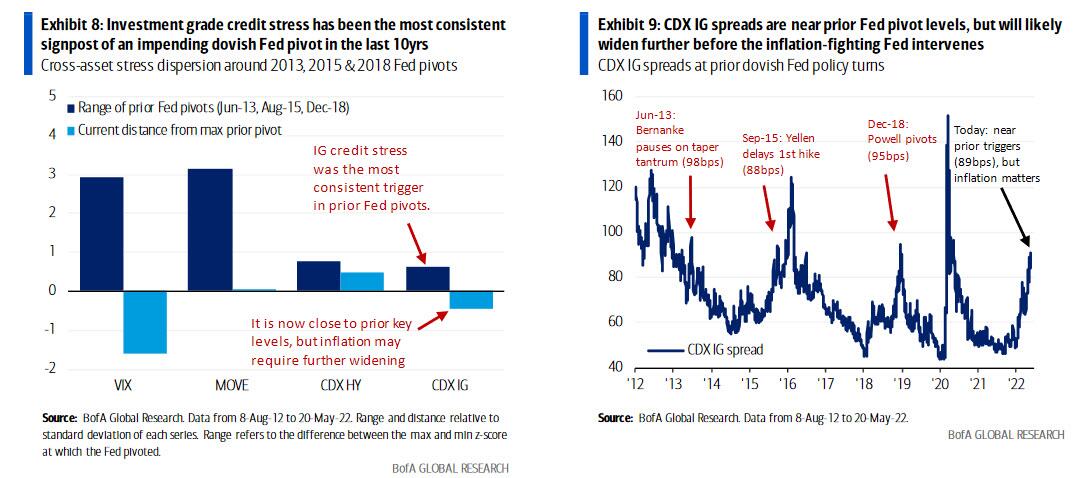
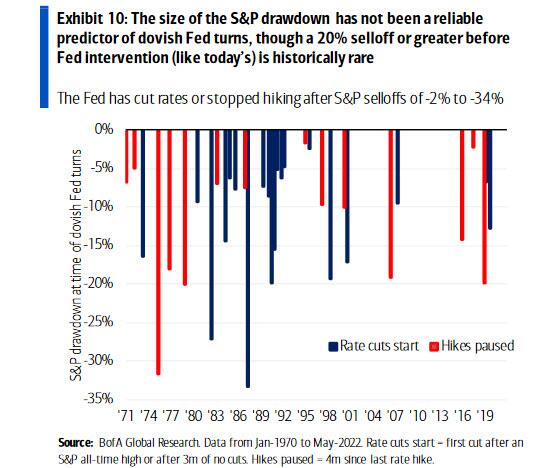
2. S&P drawdown: Perhaps just as important as nascent credit stress, the size of the equity drawdown from all-time highs has according to BofA become an important signal for investors looking to buy the dip in recent years. However, while this may have worked relatively well in the era of high Fed sensitivity to markets, it has been a much less reliable predictor of dovish Fed turns over a longer history. As chart 10 shows, the Fed has either stopped hiking or begun cutting rates during S&P drawdowns of very different magnitudes – from as low as 2-3% in the mid-1990s to over 30% in ‘75 and ‘87.
3. Economic data: Economic data is of course critical to the Fed’s reaction function, and a sustained cooling of inflationary pressures is arguably the data point most likely to slow their tightening plans (something we expect is gradually taking place now and will become manifest at the Jackson Hole PivotTM). Indeed, BofA's rates team’s 20-May Global Rates Weekly argues that a Fed pivot requires a meaningful slowdown in job market data. However, that type of data is much slower-moving, and it would take several months or quarters to convince the Fed that a dangerous inflationary spiral has been averted. On the other hand, as PIper Sandler quantified recent layoff announcements, it is clear that mass layoffs have begun, and the bank expects "a million layoffs or more" which will be more than sufficient to force the Fed to pivot.
4. Market dysfunction: While all of the above are certainly important catalysts for the Fed to "panic" and go into full-blown Fed Put mode, BofA's derivatives traders believe that an episode of market dysfunction is the most likely trigger for central banks, or as they quote us (quoting BofA's Michael Hartnett), “markets stop panicking when central banks start panicking”, but today it will take more market panic for the Fed to start panicking.
So are we there yet? Not quite, but getting closer. The near-record low liquidity in equity futures (a key feature of fragility shocks) which we highlight virtually every day...
... indicates that such risk may be closer than the relatively orderly pace of the YTD selloff may suggest.
And in fact 85% of the Fed’s dovish turns in the last 50yrs were preceded by less volatile equity selloffs than today’s.
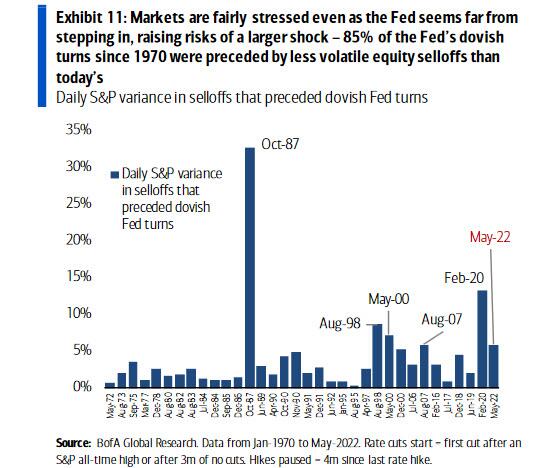
In other words, while the Fed may need a lower inflation and higher unemployment print to greenlight a dovish pivot, one which will send high beta growth names and cryptos limit up in milliseconds, the actual catalyst that prompts the Fed's capitulation may simply be a market crash which the illiquidty in the market accelerates to the point where not even the Fed will be able to ignore what is going on.
One final, important point, according to the BofA strategists: the Fed pivoting to rescue markets may not crush volatility or create a sustained rebound back to new highs, as the 2013, 2015, and 2018 pivots did. If inflation remains a pressing concern, a Fed intervention may only bring temporary relief to risk assets.
Despite the lack of a Fed capitulation so far, BofA believes markets will continue to test the Fed put, but they caution that it will take more market panic for the Fed to start panicking. To hedge this event, BofA's derivatives traders like owning local SPX skew near 10yr lows through Dec put ratios. The trade is designed for a tail event in which markets test the Fed put and find that it’s heavily compromised in the face of inflation. As one example, consider selling 1x SPX Dec 4050 put to buy 2.5x of the Dec 3500 put for an upfront debit of ~1% (ref. 3973.75). More details on this highly convex trade in the full BofA note available to pro subscribers.

FT : Private equity cannot avoid the reckoning in markets

Private equity cannot avoid the reckoning in markets
Both the real economy and the financial system are in a destabilising phase for both public and private investors

At a conference of investment professionals I recently attended, several private equity funds argued with considerable vigour that this year’s large losses in public markets would drive even more investors their way.

They were confident that their asset class would avoid the reckoning that stocks and bonds have been exposed to this year because they were structurally immunised against disruptive changes in the investment landscape.

I fear that this may prove to be too much bravado and misplaced self-confidence. Both the real economy and the financial system have entered a phase that is uncertain and destabilising for private as well as public market investors.

As noted recently in the Financial Times by Katie Martin, “adherents to the classic portfolio split — 60 per cent stocks and 40 per cent bonds — have not had it so bad in half a century”. Both equities, usually dubbed as risk assets, and the “risk free” alternatives of government bonds have experienced large losses this year.

In the traditional correlation between such assets, if stocks sold off, government bonds rose. That correlation has broken down as all these assets (understandably) suffered from worries about higher interest rates and tightening financial conditions.


While the last couple of weeks have seen some reversion to the more traditional correlation, that is not without its own problems. The reason is growing worries about global growth and corporate earnings. They point to further volatility for equities which constitute the largest part of most public market portfolios.

In contrast to this year’s brutal sell-off in stocks and bonds, private equity valuations have remained robust. As often pointed out by their marketers, the conventionally longer holding period reduces the disruptive influence of speculative money looking to get out quickly. As does the fact that private equity investments are usually focused on single assets as opposed to indices, limiting the scope for contagion.

Such factors fuel expectations of an acceleration of what already has been a considerable multiyear increase in the strategic allocation of investment flows, and not just from public pension funds, foundations, endowments and sovereign wealth institutions. Private equity fans also expect the asset class to get a boost from ongoing efforts to make private equity more accessible for retail money.

Such optimism about the robustness of the asset class may, however, be excessive. Private equity valuations are updated much less regularly than for public investments. Indeed, historically, revaluations have tended to lag behind public markets by a minimum of six to nine months. Moreover, several of the factors that have recently undermined the public markets are also worrisome for private equity.

Higher interest rates and tightening financial conditions will complicate the refinancing of leveraged take-private transactions. They make the paths back into the public markets less secure and the exit valuation less certain. They also curtail new investors’ enthusiasm for buying private equity stakes in the secondary market, putting pressure both on prices and volumes.

The worsening global economic outlook is also a problem. Downturns rob companies of actual and prospective revenues, leading to faster burning of cash reserves, increased debt burdens relative to equity and capital erosion.

There are two additional risks that are specific to private equity in the period ahead. First, that one of its often-cited structural strengths — that of illiquidity that damps unfavourable price volatility — turns into a weakness; and second, that financial regulators and supervisors pay a lot more attention to conduct in private markets.

Private equity is just as likely to experience a shift in operating paradigm this year as the public markets have been undergoing — from a seller’s to a buyer’s market. Indeed, both are in the process of exiting from a world of massive and predictable central bank liquidity injections that over-facilitated a seemingly endless flow of money into a smaller set of investment opportunities. What lies ahead is a world in which the cost of money will be higher and financial flows more selective as they become less ample.

With time, genuinely attractive value will be restored to private and public markets. The process of doing so, however, is likely to be as bumpy.

FT : Fund industry heavyweights muscle in on ETF market

Fund industry heavyweights muscle in on ETF market
Morgan Stanley, Neuberger Berman, SEI and Matthews Asia have recently launched or are set to debut ETF

A new clutch of the world’s largest asset managers are joining the exchange traded fund industry for the first time, transforming options for investors as industry heavyweights belatedly seek a foothold in the fast-growing sector.

Morgan Stanley, Neuberger Berman, SEI and Matthews Asia, which manage a combined $3tn, have recently launched or indicated their intention to launch their debut ETFs. AllianceBernstein (AB), which has a solitary ETF offering in Australia, is on track to join the US party later this year.

These companies join other recent heavyweight converts, such as T Rowe Price, Dimensional Fund Advisors, Federated Hermes and Capital Group, as ETFs rapidly gain market share at the expense of mutual funds.

In the US, ETF assets jumped 185 per cent to $7.2tn in the five years to 2021, according to the Investment Company Institute, while those of mutual funds rose just 65 per cent to $27tn over the same period. Globally, ETF assets have more than tripled to $10.1tn since 2015, according to consultancy ETFGI.

ETFs benefit from being cheaper to run than old-school mutual funds, with these savings typically passed on to investors, as well as intraday liquidity and — in the US at least — greater tax efficiency.

“If you talk about meeting clients where they are, the ETF tool is one that we want to offer alongside our other offerings,” said Noel Archard, global head of ETF and portfolio solutions at AB.

Morgan Stanley, which has $1.4tn in assets under management and was ranked 15th-largest by Willis Towers Watson in its latest report, is the largest fund provider not to offer ETFs.

However, an internal memo written by Dan Simkowitz, head of investment management at Morgan Stanley, said it had made a “strategic decision” to launch a multi-asset ETF platform offering active and systematic strategies this year.

Morgan Stanley shared the memo, which was circulated in March, but declined to comment for this story.


For AB, the imminent arrival of its first US ETFs will be the culmination of a 12-year journey.

It filed to launch equity ETFs in 2010 and was later granted approval by the Securities and Exchange Commission, but the funds never saw the light of day. While AB was prevaricating, Cathie Wood took the decision to leave in 2014 and set up Ark Invest, which has since launched a suite of ETFs.

AB appears to have rekindled its earlier enthusiasm for the idea of launching ETFs, however, and filed earlier this month to roll out actively managed Ultra Short Income and Tax-Aware Short Duration ETFs.

Archard, who was recruited from State Street Global Advisors in February to head up the push, said a “significant event” in AB’s ultimate conversion to ETFs was a SEC ruling in 2019 that simplified and accelerated the approval process for ETFs, including actively managed ones.

“It lowered one of the barriers to entry for many firms that had been thinking about getting into ETFs,” said Archard. “We have a predominantly active footprint. That change in rule prompted another look into whether we should we introduce [active ETFs].”

Archard said AB’s two initial fixed-income ETFs should list in “late Q3 or early Q4” and it was planning “several equity products”.

While the rollout is starting in the US, Archard said AB was “not constraining” itself to any region. Its initial ETFs will have a fully transparent structure, which is essential in markets such as Europe where the portfolio-shielding, semi and non-transparent structures commonplace in the US have yet to be approved.

Kevin Barr, head of the investment management unit at SEI, said the company was “looking for something that is differentiated”. “There really is not much need for more passive ETFs,” he added.

The first fruits of these endeavours are four actively managed factor-based large-cap US equity funds that launched on May 18. SEI has been running these strategies since 2013 in separately managed accounts, which are only available to institutions and wealthy individuals. Pricing is comparable at 15 basis points.

Although SEI is initially focusing on the US market, Barr said it was “actively looking” at the possibility of launching active ETFs in Europe, with the need for full transparency again not a barrier. “We’re comfortable with transparency. It’s not a passive approach where someone is going to be able to arbitrage it away,” he added.

Neuberger Berman debuted its first three ETFs in April this year. The actively managed thematic equity strategies cover the Connected Consumer, Carbon Transition and Infrastructure, and Disrupters ETFs, each at 55bp.

The New York-based group already manages $18bn — out of $460bn in total — in thematic funds and Hari Ramanan, its CIO of global research strategies, cited the “potential for tax efficiency” in expanding this range into ETFs.

Matthews Asia is also going down the transparent active equity route, filing in April for three ETFs focused on emerging markets, Asian innovators and China, which build on its existing mutual funds in these areas.

“While we believe mutual funds will continue to provide benefits to many investors, we have seen a growing interest from financial intermediaries and end-investors who want to take advantage of the benefits active ETFs offer,” said Jonathan Schuman, Matthews Asia’s global head of distribution.

Matthews Asia may have spotted a potential gap in the market, given the relative lack of actively managed Asia or China-focused ETFs at present.

But all the latecomers may have to find their own niches in order to gain a toehold in an ETF industry dominated by BlackRock, Vanguard and State Street, which account for 77 per cent of the US market.

When asked how SEI’s offerings could challenge the three market leaders, Barr replied: “[W]e don’t see people offering these products. These are differentiated products. This is not a ‘me too’ strategy.”

FT : Once Upon a Time in Londongrad investigates Russia-linked deaths on British

Once Upon a Time in Londongrad investigates Russia-linked deaths on British soil
This timely Sky documentary series examines the long reach of the Kremlin through 14 mysterious cases

What links a fall from a fourth floor window, a helicopter crash, a hanging, radioactive poisoning and suffocation in a gym bag? Nothing . . . officially.

A timely six-part Sky original documentary series, Once Upon a Time in Londongrad, centres on a spate of unusual deaths that occurred on British soil between 2003 and 2016 involving 14 individuals — oligarchs, financiers, lawyers, spies, whistleblowers and even a scientist — all of whom (either directly or tangentially) could be seen to have posed some kind of threat to the Russian state.

While UK police authorities claimed there was insufficient evidence to confirm Russian foul play in almost all the cases, a team of journalists at BuzzFeed News — whose diligent work and insights drives the documentary — have developed a compelling evidence-based theory that the deceased were victims of assassinations ordered by Russia. The Kremlin has always denied any such accusations.

We start with the death which served as the fountainhead for BuzzFeed’s exhaustive, two-year-long investigation. In 2014 Scot Young, a property mogul, investor and “fixer” for some notorious figures, fell to his death from a window in his Marylebone flat. A coroner ruled that suicide couldn’t be confirmed, while the Met Police dismissed murder as a possibility.

So far, so conventional true-crime thriller. But the scope of the documentary changes once it shifts its attention to one of Young’s business associates, the oligarch Boris Berezovsky — brilliantly described here by one of his own friends as “absolutely honest and dishonest . . . kind and evil”. His exact connection to Young becomes apparent with time, but the story of his transition from the architect of post-Soviet crony capitalism under Yeltsin to the scourge of the Kremlin is fascinating in itself.

In exile in London, Berezovsky invested millions into financing organisations and actions against Putin’s government, including, allegedly, the removal of a pro-Russian presidential candidate in Ukraine. He also helped the FSB officer-turned-dissident Alexander Litvinenko flee to the UK. The latter was poisoned in 2006, and a number of other close associates also died suddenly. Berezovsky himself was found dead in his bathroom in 2013.

Further deaths — each more macabre than the last — follow, but the documentary carefully avoids veering into sensationalism. It may be unable to provide any concrete answers but it asks urgent questions about the kind of influence that Russia has over London: from the City to Scotland Yard to Downing Street and beyond. A montage towards the end of a host of western leaders chummily talking to Putin gives way to shots of the war in Ukraine. The repercussions of not asking questions are all too chillingly clear.

FT : ‘Absolute transparency’ needed on private market fees, BlackRock says

‘Absolute transparency’ needed on private market fees, BlackRock says
Fund manager seeks to improve disclosures to pension clients as UK pushes for shift into unlisted assets

BlackRock is seeking to provide “absolute transparency” on private market fees as the UK government pushes pension plans to plough funds into unlisted assets, an executive at the world’s biggest asset manager said.

The comments come as Britain is seeking to ignite an investment “big bang” by convincing pensions and other large asset allocators like endowments and sovereign wealth funds to invest in unlisted UK assets.

“The sentiment is that we need absolute transparency and we need to work towards that,” said Armit Bhambra, head of corporate pensions UK at BlackRock at last week’s Pensions and Lifetime Savings Association conference in Edinburgh.

In the UK, asset managers, including BlackRock, have in recent years been pushed to adopt standardised fee templates, to help pension fund clients understand what they are paying.

Private markets are “notoriously opaque,” said Richard Butcher, managing director of PTL, a UK firm of independent trustees, at the same event. “How do I know what the true cost of investment is?”

Private equity managers generally charge a two per cent annual management fee and a 20 per cent performance fee if a return goal is met. Investors also pay other fees and expenses — such as legal and monitoring costs — that can erode overall returns.

BlackRock said it used the UK industry-designed fee templates to provide private markets data to clients “who asked”, but told the Financial Times it was “actively pursuing an improved way of disclosing” these fees to UK pension fund investors.

In January 2021, BlackRock appeared on a list of investment companies failing to disclose fees adequately to some pension clients, more than three years after the fund manager worked with the UK regulator to improve transparency for the sector.

ClearGlass, the firm which compiled the list, said BlackRock had since improved on the general disclosure of costs but faced issues with private markets. However, ClearGlass added there was a wider industry problem with providing private market fee data for pension plans that used daily pricing.

Global regulators have in recent months also called for greater transparency on fees private capital managers charge to investors. The US Securities and Exchange Commission in February proposed that private equity funds should provide standardised quarterly data on fees, expenses and performance.

The top US securities regulator had pointed out in a January report that it had found examples of private equity companies providing inaccurate or misleading information about their performance and overcharging fees.

The push for greater fee transparency comes as the global private capital industry is booming. Assets under management across private markets hit an all-time high of $9.8tn as of June 2021, up from $7.4bn a year earlier, according to a report in March by consultancy McKinsey & Co.

Asset allocators are seeking investments that can provide returns well into the future as the powerful rally in equity and debt markets since early 2020 pulls sharply into reverse. At the same time, governments are looking for private investment to fund projects as fiscal finances have become stretched because of stimulus programmes put in place at the height of the coronavirus crisis.

Calpers, the biggest US pension scheme with $450bn under management, plans in July to boost its allocations to private equity, shift into private debt and reduce the share of its portfolio in public stocks.

Meanwhile, AustralianSuper and Canada’s Caisse de dépôt et placement du Québec are planning to inject £32bn combined into private markets in the UK and Europe in coming years.

WSJ : FDA Probing Organic Strawberries Linked to Possible Hepatitis A Outbreak

FDA Probing Organic Strawberries Linked to Possible Hepatitis A Outbreak
The potentially tainted fruit was sold at stores including Aldi, H-E-B, Kroger, Trader Joe’s, Walmart and others

Two brands of organic strawberries sold at major chains such as Trader Joe’s and Walmart may be linked to an outbreak of hepatitis A, the Food and Drug Administration said.

The FDA said in a statement Saturday that it is investigating a multistate outbreak of hepatitis A infections in the U.S. and Canada that appears to be linked to fresh, organic strawberries.

The potentially tainted fruit carried a FreshKampo or H-E-B label, the FDA said. Anyone who purchased those brands of berries between March 5 and April 25 and froze them for later consumption should get rid of them immediately, the agency urged.

The products were sold at stores such as Aldi, H-E-B, Kroger, Safeway and Weis Markets, along with Trader Joe’s and Walmart, the FDA said.

The products were sold at stores such as Aldi, H-E-B, Kroger, Safeway and Weis Markets, along with Trader Joe’s and Walmart, the FDA said.

The FDA, which is conducting its investigation along with the Centers for Disease Control and Prevention, said 17 people have been sickened thus far, with 12 hospitalizations.

“The traceback investigations show that cases in California, Minnesota, and Canada report having purchased fresh organic strawberries branded as FreshKampo or H-E-B prior to becoming ill,” the FDA said.

In a statement on its website, Texas-based H-E-B said its strawberries are safe to consume.

“No illnesses from strawberries related to the FDA investigation have been reported at H-E-B or in Texas,” the company said.

“The FDA is conducting an investigation into organic strawberries sold between March 5 and April 25, 2022. H-E-B has not received or sold organic strawberries from the supplier under investigation since April 16,” H-E-B said.

FreshKampo, based in Fresno, Calif., didn’t immediately respond to a request for comment.

Hepatitis A is a contagious virus that in severe cases can cause liver disease. In most cases, it results in a mild illness that includes nausea, fatigue and abdominal pain.

The virus is most commonly spread through close proximity to an infected person. However, it can be contracted through food or water consumption if an infected food handler hasn’t followed proper hand-washing hygiene.

FT : Europe’s unity ‘crumbling’ on Russia sanctions, Germany warns

Europe’s unity ‘crumbling’ on Russia sanctions, Germany warns
EU struggles to find compromise over plan to impose embargo on buying oil from Moscow

Europe’s unity on sanctions against Russia is “starting to crumble”, Germany’s economy minister has warned as diplomats highlight continued divisions over a package of sanctions set to be discussed by member states on Monday.

Robert Habeck spoke as EU ambassadors meeting in Brussels on Sunday failed to agree on the bloc’s latest package of sanctions against Moscow, including a plan to stop imports of Russian oil which Hungary has been blocking for weeks.

Diplomats had hoped to agree on measures to put to EU leaders who are due to start a two-day summit on Monday.

“After Russia’s attack on Ukraine, we saw what can happen when Europe stands united. With a view to the summit tomorrow, let’s hope it continues like this. But it is already starting to crumble and crumble again,” Habeck, who is also deputy chancellor, told reporters in Germany on Sunday.

His comments underline the EU’s difficulties in finding a way to extend punishments on Moscow for its war on Ukraine while not affecting parts of the European economy that rely heavily on deliveries of Russian oil and gas.

“Europe is still a huge economic area with incredible economic power. And when it stands united, it can use that power,” Habeck said at the opening of a trade fair.

EU diplomats tried on Sunday to unite on a compromise plan to impose an embargo on Russian seaborne oil purchases and to exempt imports via pipeline, according to three EU diplomats. That would cover about two-thirds of Europe’s imports of Russian oil but avoiding hitting oil that flows to Hungary and other countries, including Germany.

The potential solution is seen as a way to solve the concerns over security of oil supplies that have been aired by Hungary, Slovakia and the Czech Republic.

“The issues are the same, but the way we are trying to solve it is different,” said a senior EU diplomat, who added it could take another few weeks until a final agreement is reached.

EU diplomats are scheduled to meet again on Monday morning before a European Council meeting in a last-ditch attempt to avoid an acrimonious disagreement during the summit.

Some officials are concerned that treating Russian crude deliveries differently depending upon how they enter the bloc could introduce distortions to the oil market.

“Many countries have made the point that this is such a complicated economic sector, that we have to be careful we preserve the level playing field,” said an EU diplomat with direct knowledge of the talks. “The legal aspects need fine-tuning, so it may take some more time,” the diplomat said.

Among the issues still to be ironed out are technical adjustments needed for central European refineries so they can handle different supplies, as well as construction and financing of alternative oil pipelines so that all Russian oil can be subjected to an embargo at a later stage.

The sanctions package being discussed is the sixth put forward by Brussels since the invasion began in February. The EU has already implemented sanctions on coal but has made it possible for countries to continue to buy gas from Moscow.

Nature : Monkeypox outbreaks: 4 key questions researchers have

Monkeypox outbreaks: 4 key questions researchers have
Researchers are racing to understand the latest monkeypox outbreaks — from their origins to whether they can be contained.

It’s been three weeks since public-health authorities confirmed a case of monkeypox in the United Kingdom. Since then, more than 400 confirmed or suspected cases have emerged in at least 20 non-African nations, including Canada, Portugal, Spain and the United Kingdom — the largest outbreak ever outside of Africa. The situation has scientists on alert because the monkeypox virus has emerged in separate populations across multiple countries, and there is no obvious link between many of the clusters, raising the possibility of undetected, local transmission of the virus.

“We need to act quickly and decisively, but there is still a lot to be learned,” says Anne Rimoin, an epidemiologist at the University of California, Los Angeles, who has studied monkeypox in the Democratic Republic of the Congo for more than a decade.

Nature outlines some of the key questions about the recent outbreaks that researchers are racing to answer.

How did the current outbreaks start?
Since the latest outbreaks began, researchers have sequenced viral genomes collected from people with monkeypox in countries including Belgium, France, Germany, Portugal and the United States. The most important insight they have gained so far is that each of the sequences closely resembles that of a monkeypox strain found in western Africa. The strain is less-lethal — it has a death rate below 1% in poor, rural populations — than another that has been detected in central Africa and has a death rate up to 10%.

Clues have also emerged as to how the outbreak might have begun. Although researchers need more data to confirm their suspicions, the sequences they have evaluated so far are nearly identical, suggesting that the recent outbreaks outside of Africa might all be linked back to a single case with a thorough epidemiological investigation.

The current sequences are most similar to those from a smattering of monkeypox cases that arose outside of Africa in 2018 and 2019 and that were linked to travel in western Africa. The simplest explanation is that the person who had the first non-African case this year — who has still not been identified — became infected through contact with an animal or human carrying the virus while visiting a similar part of Africa, says Bernie Moss, a virologist at the National Institute of Allergy and Infectious Disease in Bethesda, Maryland.

But other explanations cannot be ruled out, says Gustavo Palacios, a virologist at the Icahn School of Medicine at Mount Sinai in New York City. It’s possible, that the virus was already circulating, undetected, outside of Africa in humans or animals, introduced during earlier outbreaks. This hypothesis, however, is less likely because the monkeypox virus usually causes visible lesions on people’s bodies — which would probably be brought to the attention of a physician.

Can a genetic change in the virus explain the latest outbreaks?
Understanding whether there is a genetic basis for the virus’s unprecedented spread outside Africa will be incredibly difficult, says Elliot Lefkowitz, a computational virologist at the University of Alabama at Birmingham who has studied poxvirus evolution. Researchers are still struggling to characterize precisely which genes are responsible for the higher virulence and transmissibility of the central African strain, compared with the west African one, more than 17 years after they identified a difference between the two.

One reason for this is that poxvirus genomes contain many mysteries, Lefkowitz says. The monkeypox genome is enormous relative to that of many other viruses — it is more than six times as large as the genome for the SARS-CoV-2 coronavirus. That means they’re at least “six times harder to analyse”, says Rachel Roper, a virologist at East Carolina University in Greenville, North Carolina.

Palacios says another reason is that few resources have been dedicated to genomic surveillance efforts in Africa, where monkeypox has been a public-health concern for many years. So virologists are flying somewhat blind right now, because they have few sequences to which they can compare the new monkeypox sequences, he says. Funding agencies have not heeded scientists who have been warning for more than a decade that further monkeypox outbreaks could occur, he adds.

Ifedayo Adetifa, the head of the Nigeria Centre for Disease Control says that African virologists he’s spoken with have expressed irritation that they’ve struggled to garner funding and publish studies about monkeypox for years — but now that it’s spread outside the continent, public-health authorities worldwide suddenly seem more interested.

To understand how the virus evolves, it would also be useful to sequence the virus in animals, Palacios says. The virus is known to infect animals — mainly rodents such as squirrels and rats — but scientists have yet to discover its natural animal reservoir in the impacted areas of Africa.

Can the outbreaks be contained?
Since the current outbreaks began, some nations have been procuring smallpox vaccines, which are thought to be highly effective against monkeypox, because the viruses are related. Unlike the vaccines against COVID-19, which take up to two weeks to offer full protection, smallpox vaccines are thought to protect against monkeypox infection if administered within four days of exposure because of the virus’s long incubation period, according to the US Centers for Disease Control and Prevention (CDC) in Atlanta, Georgia.

If deployed, the vaccines would probably be applied using a ‘ring vaccination’ strategy, which would inoculate close contacts of infected people. Andrea McCollum, an epidemiologist who heads the poxvirus team at the CDC, says the agency is not yet deploying a ring vaccination strategy. But in the meantime, CNN reports that the United States plans to offer smallpox vaccines for some healthcare workers treating infected people. It might also be worth considering vaccinating groups at higher risk of infection in addition to close contacts of infected people, Rimoin says.

Even if public-health officials halt transmission of monkeypox in humans during the current outbreaks, virologists are also concerned that the virus could spill back into animals. Having new reservoirs of virus in animals would increase the probability of it being transmitted to people again and again, including in countries that don’t host any known animal reservoirs of the virus. On 23 May, the European Centre for Disease Prevention and Control highlighted this possibility, but deemed the probability as “very low”. Still, European health officials strongly recommended that pet rodents such as hamsters and guinea pigs belonging to people with confirmed cases of monkeypox be isolated and monitored in government facilities or euthanized to avoid the possibility of spillover.

Although the risk is low, Moss says the main concern is that scientists wouldn’t know if such a spillover event occurred until it was too late, because infected animals don’t typically show the same visible symptoms as humans.

Is the virus spreading differently now compared with previous outbreaks?
Monkeypox virus is known to spread through close contact with the lesions, bodily fluids and respiratory droplets of infected people or animals. But health officials have been examining sexual activity at two raves in Spain and Belgium as drivers of monkeypox transmission, according to the Associated Press, raising speculation that the virus has evolved to become more adept at sexual transmission.

Cases linked to sexual activity don’t mean that the virus is more contagious or is transmitted sexually, however — just that the virus spreads readily through close contact, Rimoin says. Unlike SARS-CoV-2, which isn’t thought to linger on surfaces much, poxviruses can survive for a long time outside the body, making surfaces such as bedsheets and doorknobs a potential vector of transmission, Roper says.

Although health officials have noted that many cases have been among men who have sex with men (MSM), Rimoin emphasizes that the most likely explanation for the virus’s spread among MSM groups is that the virus was coincidentally introduced into the community, and it has continued spreading there.

All of the new attention on monkeypox has laid bare just how much scientists have yet to understand about the virus, McCollum says. “When this has all settled down, I think we’ll have to think long and hard about where the research priorities are,” she says.

(ZH) 11 Statistics That Expose The Reality Facing US Consumers In This Rapidly D

11 Statistics That Expose The Reality Facing US Consumers In This Rapidly Deteriorating Economy

Prices are soaring, there are widespread shortages of certain items such as baby formula all over the nation, and at the same time U.S. economic activity appears to be really slowing down. Considering all of that, it makes perfect sense why the American people are feeling so negative about the economy right now. In fact, a whopping 85 percent of all Americans believe that there will be a recession within the next year. These days, it is virtually impossible to get Americans to overwhelmingly agree about anything, and so the fact that 85 percent of us are anticipating a recession is a really big deal.

Just about everyone realizes that economic conditions are going to get worse, but for those of you that still doubt where we are headed here are 11 statistics that show how U.S. consumers are faring in this rapidly deteriorating economy…
#1 According to a Harvard CAPS/Harris Poll that was recently conducted, 56 percent of Americans say that their financial situations are getting worse, and only 20 percent of Americans say that their financial situations are improving.
#2 Another new survey has just discovered that 66 percent of Americans “have avoided social events because they’ve felt embarrassed or uncomfortable” about their financial situations.
#3 The housing bubble appears to be bursting. At this point, sales of new single family homes are falling at a very frightening pace
Sales of new single-family houses in April plunged by 16.6% from March and by 26.9% from a year ago, to a seasonally adjusted annual rate of 591,000 houses, the lowest since lockdown April 2020, according to the Census Bureau today. Sales of new houses are registered when contracts are signed, not when deals close, and can serve as an early indicator of the overall housing market.
#4 After breaking the all-time national record in March, the average price of a gallon of gasoline in the United States has gone 42 cents above the old record and is now sitting at $4.59.
#5 The average age of a car on U.S. roads has reached an all-time record high of 12.2 years. Many Americans continue to delay replacing their current vehicles because new vehicles have become so unaffordable.
#6 Millions of American families are struggling with rapidly rising food prices…
The index for food away from home increased 7.2% over the last year, the Labor Department reported earlier this month. Food prices were up 9.4% in April from the same time last year — the biggest jump since April 1981, the Bureau of Labor Statistics recently reported. And grocery store prices increased 10.8% for the year ended in April.
#7 U.S. natural gas futures just crossed the nine dollar threshold – the highest level that we have seen since the financial crisis of 2008. That means that much higher energy costs are on the way for U.S. consumers.
#8 Multiple Fed surveys are showing that manufacturing activity in the U.S. is really slowing down…
The slowdown in manufacturing activity on display in reports from the Federal Reserve banks of New York and Philadelphia was confirmed by a survey from the Richmond Fed indicating that factory activity contracted in the mid-Atlantic region in May.
The Fifth District Survey of Manufacturing Activity index dropped 23 points from a positive reading of 14 in April to a minus nine, the lowest reading since May 2020, when much of the economy was still reeling from the onset of the pandemic and lockdowns.
#9 Zero Hedge is reporting extremely depressing news about U.S. macro data: “Other than April 2020 – when the entire economy was closed – May’s serial disappointment in US Macro data is the worst since Lehman”
#10 Thanks to plunging stock prices, approximately 20 trillion dollars in household net worth has been “wiped out” so far this year.
#11 A new CBS News/YouGov survey has found that 74 percent of Americans believe that things are going badly in this country and that 51 percent of Americans actually believe that Joe Biden is “incompetent”.
Right now, conditions are so similar to what we witnessed just before the financial crisis of 2008.
If we had addressed our long-term problems back then, perhaps we would be in a much different place at the moment.
But instead, we appear to be poised to repeat history in a lot of ways.
In fact, many experts believe that the crisis that is staring us in the face will be even worse than what we went through more than a decade ago. For example, just check out what Peter Schiff is saying…
This one is going to be even bigger because the economy has a lot more debt now than it did in 2008. And Americans are less able to pay it when interest rates rise because the balances are much greater. So, we’re in much worse shape as a result of all the bailouts and all the stimulus that papered over the last crisis. So, now the one we’re dealing with is going to be much worse because we kicked the can down the road instead of solving the problem when we had a chance.”
He makes some really great points.
Every time there has been some sort of a crisis in our society, our leaders responded by showering the system with even more money.
In 2008, the U.S. national debt crossed the 10 trillion dollar threshold.
In 2022, the U.S. national debt has crossed the 30 trillion dollar threshold.
Our politicians have been systematically destroying our future, and most Americans didn’t seem to care.
Now a day of reckoning has arrived, and it is going to be immensely painful.
There is no silver bullet that is going to cure inflation.
The Federal Reserve is going to try to tame inflation by hiking interest rates, but that will just destroy the housing bubble and dramatically slow down the economy.
And there is no silver bullet that is going to end the shortages that we are currently facing.
We are now experiencing some of the consequences of decades of mismanagement, and a lot more pain is on the way.