(ZH) New IRS Data Reveals Florida Biggest Winner, New York Biggest Loser In Comp

New IRS Data Reveals Florida Biggest Winner, New York Biggest Loser In Competition For People & Their Wealth

Every year, states across the country compete with each other for people and their wealth as millions of Americans move between states. The stakes are large. A growing population for the winners means an increasing tax base, economic growth and investment. For the biggest losers, it means more difficulties in paying down debts, higher taxes and fewer investments for the future.
The nation’s most-recent winners of migration from other states are Florida and Idaho according to the latest migration data released by the IRS. Florida, the nation’s perennial winner, gained the most people and income overall in 2020, while Idaho gained the most of both on a percentage basis.
On the other end of the competition are states that have become perennial losers. States like California, New York, Illinois and New Jersey once again experienced some of the nation’s biggest losses of both residents and their money.

Those findings are based on a Wirepoints’ analysis of the latest 2020 domestic migration data provided by the Internal Revenue Service. The IRS reviews tax returns annually to track when and where people move. It also aggregates the ages, income brackets and adjusted gross incomes of filers.
Winners and losers
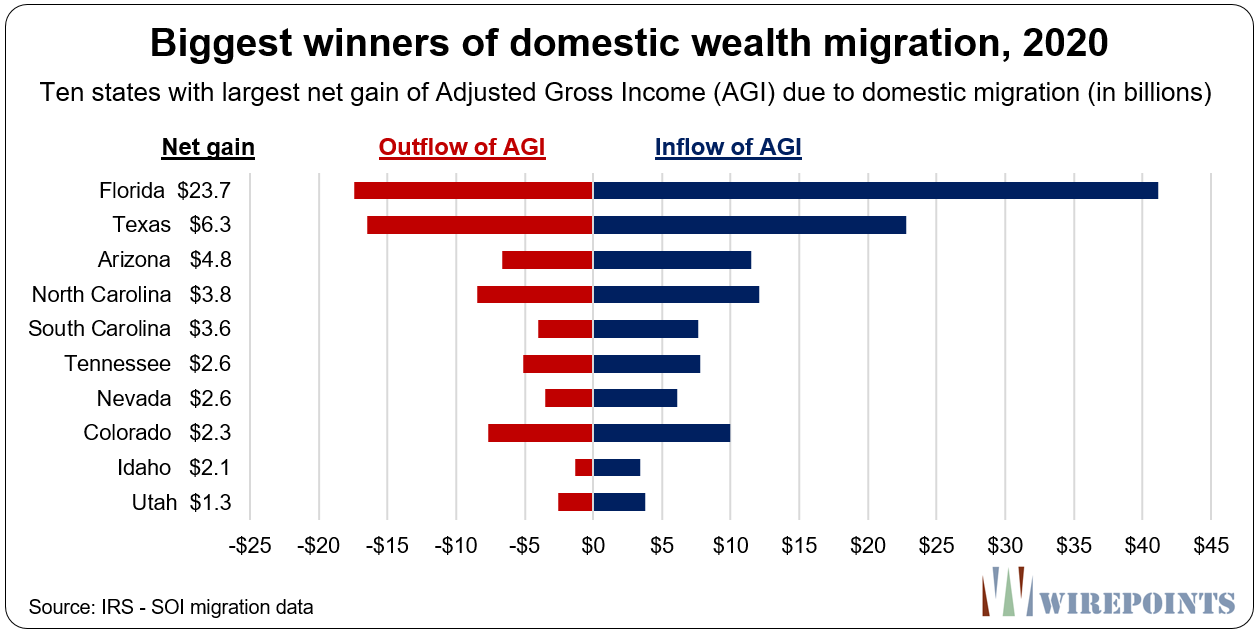
The Sunshine State attracted over $41.1 billion in Adjusted Gross Income (AGI) from 624,000 new residents (tax filers and their dependents) that moved into Florida in 2020. On the flip side, Florida lost $17.4 billion in AGI from 457,000 people who left. Overall, Florida came out ahead with 167,000 net new people and $23.7 billion in net new taxable income.
That’s a total gain of about 3.3 percent of the state’s total 2019 AGI ($711 billion).
Texas was the runner up with a net income gain of $6.3 billion, followed by Arizona with $4.8 billion. North and South Carolina rounded out the top five with net gains of $3.8 billion and $3.6 billion, respectively.
On the losing side, New York suffered the worst outflow of money of any state in 2020. The Empire State lost a net $19.5 billion in income, or 2.5 percent of its 2019 AGI, while a net of nearly 250,000 residents moved out.
California was next, losing a net $17.8 billion and 263,000 people. Illinois was third with a net loss of $8.5 billion and 101,000 people. Massachusetts and New Jersey were in 4th and 5th place, with $2.6 and $2.3 billion in income losses, respectively.
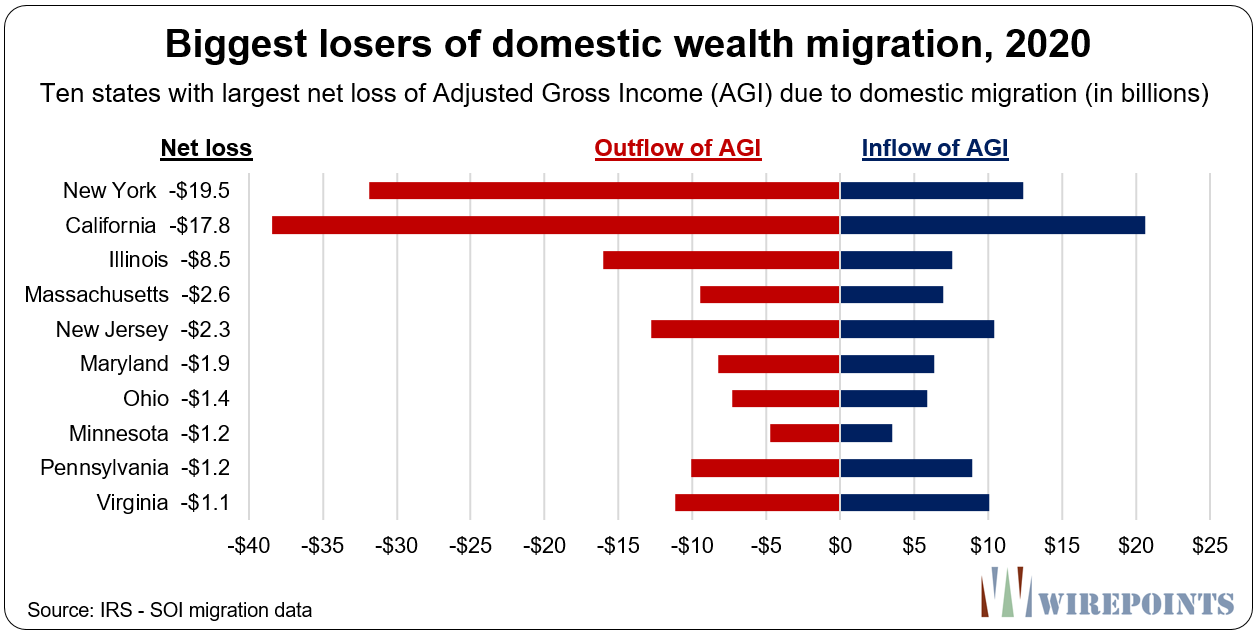
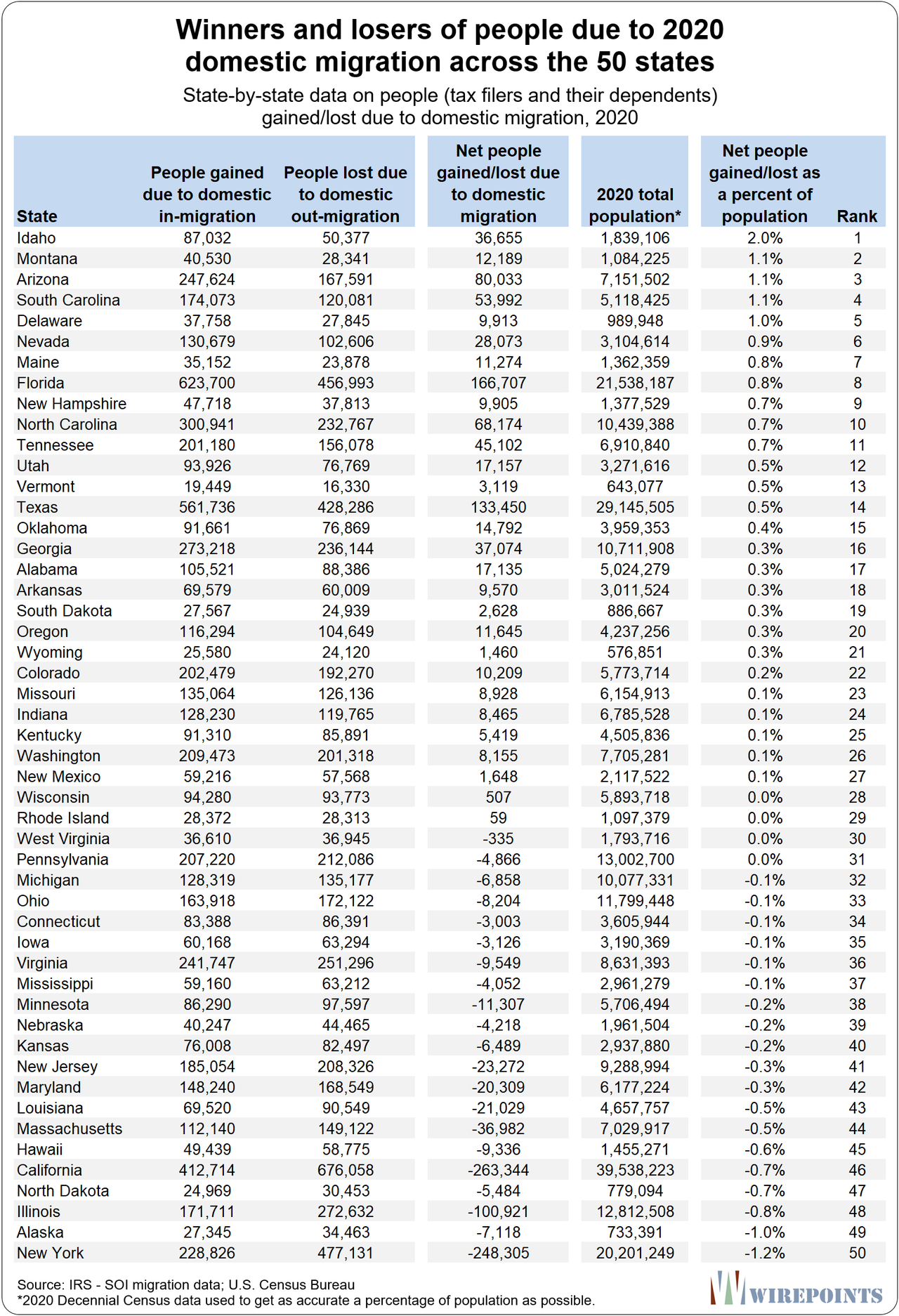
Tables with each state’s ranking in migration gains/losses are provided below.
The cumulative impact of income losses and gains
The problem with chronic outflows, like in the case of New York, is that one year’s losses don’t only affect the tax base the year they leave, but they also hurt all subsequent years. The losses pile up on top of each other, year after year. And when a state loses income to other states for 21 straight years, the numbers add up.
In 2020 alone, New York would have had nearly $123 billion more in AGI to tax had it not been for the state’s string of yearly migration losses. And when the state’s AGI losses are accumulated from 2000 to 2020, it totals $1.0 trillion in cumulative lost income that could have been taxed over the entire period.
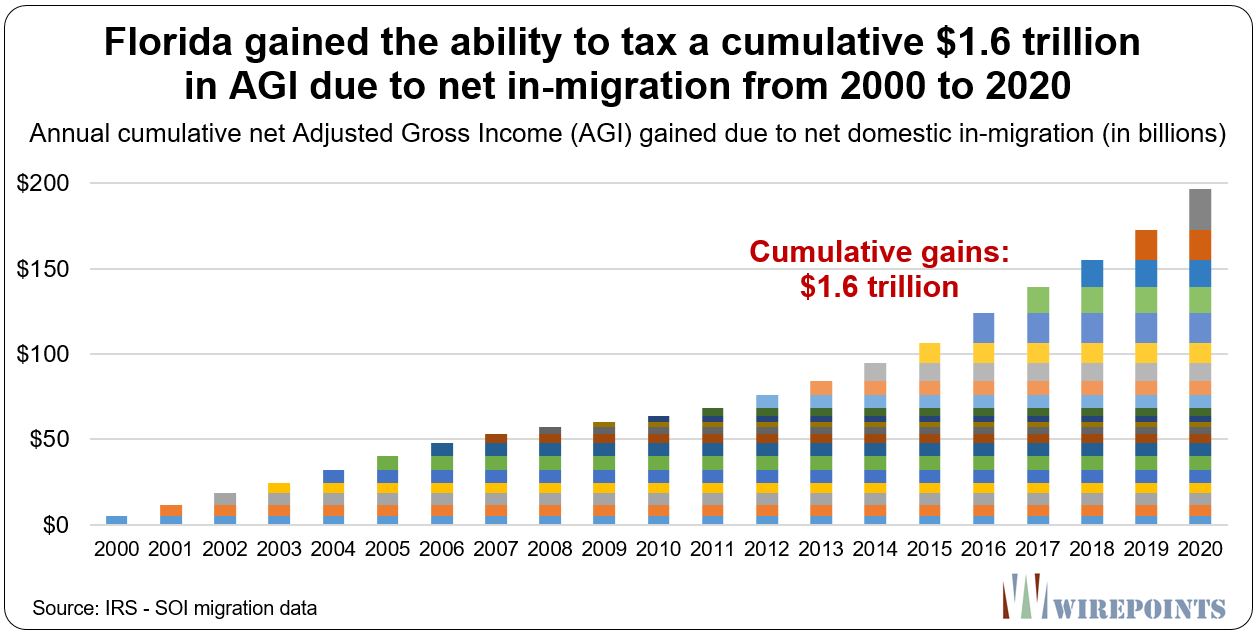
The opposite is true for migration winners like Florida. Gains in people and income pile on top of each other each year, building an ever-growing tax base. In 2020 alone, the state’s tax base was some $197 billion higher due to the 20-year string of positive income gains from net in-migration.
Even though Florida doesn’t tax incomes, Wirepoints also added up Florida’s cumulative AGI to make an apples-to-apples comparison with New York. When the Sunshine State’s AGI gains are accumulated from 2000 to 2020, it totals $1.6 trillion in income that could have been taxed over the entire period.
The competition for people matters
Illinois, one of the nation's other big losers, shows just how damaging being an “exit” state can be – especially when a state starts to lose its wealthier residents and and they are only partially replaced by people who make less. The Illinoisans who fled in 2020 earned, on average, $30,600 more than the residents Illinois gained from other states. That’s the biggest gap since at least 2000, based on Wirepoints’ analysis of the IRS data.

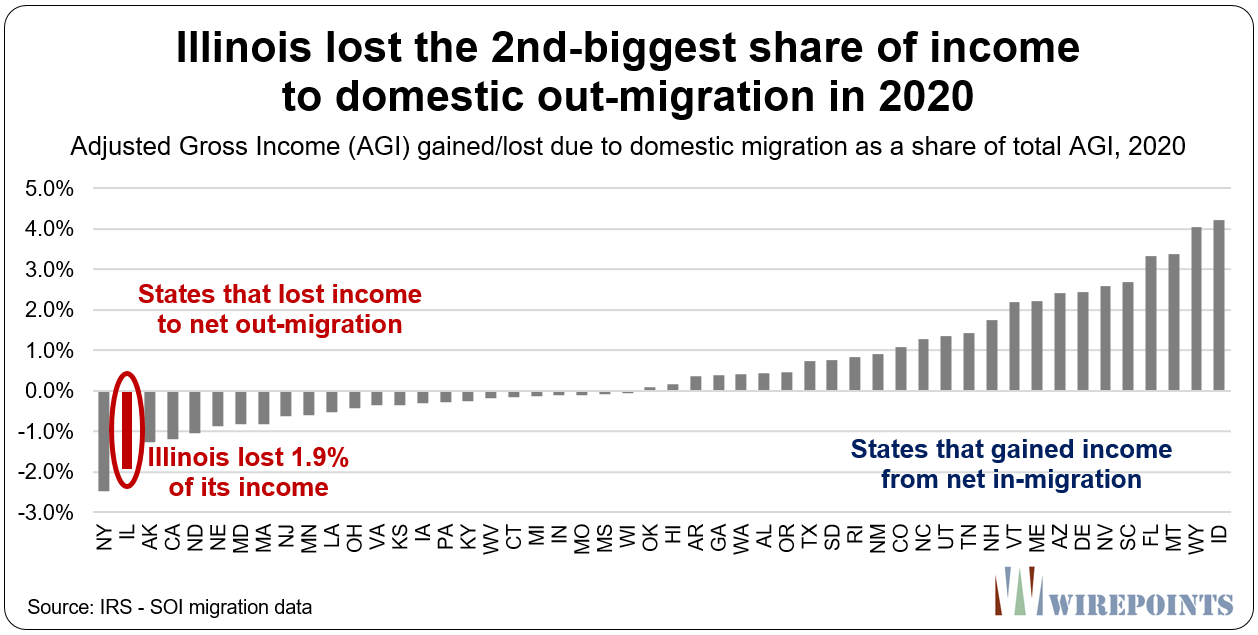
Based on a percentage of total income, Illinois ranked 2nd-worst nationally for income losses in 2020. Illinois lost 1.9 percent of its 2019 AGI. New York and Alaska ranked 1st and 3rd, with losses of 2.5 percent and 1.3 percent of their 2019 total incomes, respectively.
In contrast, Idaho was the nation’s big winner on a percentage basis in 2020, gaining 4.2 percent of its 2019 AGI base. The nation’s top five were rounded out by Wyoming, Montana, Florida and South Carolina.
* * *
Florida’s gains and Illinois’ losses are a clear reminder that states are constantly competing for people, businesses and a growing tax base.
The prize for winning is big, but the price for losing may be even bigger.
Read more from Wirepoints:
Appendix

(ZH) Mastercard CEO: SWIFT Payment System May Be Replaced By CBDCs In Five Years

Mastercard CEO: SWIFT Payment System May Be Replaced By CBDCs In Five Years

There has been a long list of revelations coming out of the recent World Economic Forum meeting in Davos, but one issue that might have gone under the media radar involves comments by Mastercard CEO Michael Miebach during a discussion on the future of cross-border payments between nations.
Miebach, participating in a panel on Central Bank Digital Currencies at the WEF and hosted by the Global Blockchain Business Council, was one of the few participants that was willing to suggest that the SWIFT system, long dominated by western interests, might be made obsolete along with the proliferation of digital currencies among central banks.
Initially dismissed as “conspiracy theory” only a few years ago by the media, whispers of CBDCs have suddenly gone mainstream and blockchain technologies took center stage at Davos in 2022. The Federal Reserve has even started active public discussions assessing the case for retail digital currency products.
Few at Davos were willing to admit to the outcome that Mastercard's CEO suggested, arguing that SWIFT would continue its prevalence for decades. Yet, almost every major central bank in the world is now pursuing a digital currency program, and the IMF has been exceedingly vocal about the need for a global digital currency system in the near future to provide “stability” in the face of national inflationary crisis events.
In the last year alone we have seen a developing trend among Eastern trade partners circumventing NATO sanctions in the wake of the war in Ukraine. After being blocked from accessing the SWIFT transfer network, which allows governments and central banks to quickly and accurately exchange data and transfer vast sums of capital, Russia and its allies are seeking alternative options. The Kremlin has talked often about using crypto and digital currencies to bypass restrictions, and China is currently establishing digital products to work around SWIFT and the CHIPS settlement system (Clearing House Interbank Payment System).
It would seem that western sanctions are only accelerating a global move away from dollar denominated structures, but of course, this may be exactly what global institutions like the WEF and IMF want. With a host of new CBDCs in play, price fluctuations may be just as erratic as they have been with Bitcoin and other cryptocurrencies. Meaning, buying power would be far too unpredictable for the average consumer. This sets the stage for groups like the IMF and WEF to “save the day” by instituting a global basket system, likely under the SDR (Special Drawing Rights) basket, in the name of homogenizing and stabilizing various CBDC markets into a single centralized entity.
In the meantime, only a select few among the globalists at Davos are willing to publicly address the real implications of CBDCs. The goal of global economic centralization is touched upon, but only as a consequence of the far distant future. Mastercard's CEO may have let slip the truth – That the plan is for CBDCs to take over global trade far faster than most people expect.

FT : EDF rules out extension of nuclear plant to secure UK winter supplies

EDF rules out extension of nuclear plant to secure UK winter supplies
Britain’s plea to delay closure comes too late as ministers consider emergency measures to prevent blackouts due to Ukraine war

EDF Energy has ruled out keeping one of Britain’s six remaining nuclear power plants open beyond the middle of the year in a blow to government efforts to bolster domestic energy supplies this winter and avoid the possibility of blackouts if Russia cuts off gas to Europe.

The French-owned energy group told staff in a memo on Monday that it would not delay the shutdown of Hinkley Point B in Somerset beyond its scheduled closure date of the end of July.

Extending the life of the plant was one option ministers were exploring as part of contingency planning for potential energy shortages later this year. Whitehall’s worst-case scenario would leave 6mn homes facing partial blackouts if Moscow stops sending gas to western Europe in the colder months.

Kwasi Kwarteng, business secretary, wrote to National Grid last week urging the FTSE 100 company to “significantly” increase the amount of electricity-generating capacity available over the winter, with a particular focus on non-gas fired stations.

“I think he’s considering whether Hinkley B, the large nuclear power station, might continue beyond its planned end of life as well,” Chris Philp, technology minister, told Times Radio on Monday following the report about possible power cuts by the Times.

He added that Kwarteng had also asked the operators of three coal-fired power stations, including EDF, to delay their closure. All but one of those was due to be mothballed by the end of September as part of the UK’s plan to reduce carbon emissions.

“That’s a sensible precautionary measure, given that gas supply coming out of Russia, and Ukraine is for obvious reasons, so heavily disrupted and we do, of course, use quite a lot of gas to generate electricity,” Philp said. Gas-fired plants are still the single biggest source of electricity generation in Britain, accounting for about 40 per cent of the total mix.

But in a partial blow to the government, EDF warned in the memo, seen by the Financial Times, that the request had come too late. “Although it is technically feasible to extend operations [at Hinkley Point B] for up to six months, the time required to do this and to be confident we would be ready for winter operating has now run out.”

An extension would involve compiling a detailed safety case that would have to be approved by the UK’s nuclear regulator and inspections of the graphite cores of Hinkley’s reactors, the memo added.

The retirement of the 46-year-old plant will cut the UK’s nuclear generating capacity by 1 gigawatt to 5.9GW of nuclear capacity. Nuclear output will fall to just 3.65GW by March 2024 under plans to shut down two more ageing plants at Hartlepool and Heysham, with unions and backbench MPs urging the government to consider keeping them open longer in the event of a protracted war in Ukraine.

Although the UK is directly dependent on Russia for less than 4 per cent of its gas supply, it is heavily reliant during the winter on supplies from Norway as well as imports via pipelines from the Netherlands and Belgium.

Government officials fear these imports could drop dramatically or dry up completely in the event that Moscow ceases exports to the rest of Europe, which relies on Russia for 40 per cent of its gas.

Ministers have launched an exercise — dubbed “Project Yarrow” — to stress test an existing electricity and gas “national emergency plan”, first drawn up in November 2019. That document sets out the process for ensuring “fair rationing” of electricity during a “supply emergency”.

The government has insisted that rationing would only occur in a “worst-case scenario”. One official said: “As a responsible government it is right that we plan for every single extreme scenario, however unlikely.”

But energy bosses are concerned that the government has left it too late to keep open some of the last remaining coal-fired power plants this winter that rely on Russian coal imports, which will be banned by the end of the year.

Ministers have also been in discussions with Centrica to resurrect Rough, Britain’s biggest gas storage site, which was effectively closed in 2017. The company said on Monday it could potentially reopen for storage but would need to apply for a new licence.

FT : Biden rules out sending weapons to Ukraine that can strike inside Russia

Biden rules out sending weapons to Ukraine that can strike inside Russia
US president says Washington will not send long-range rocket systems asked for by Kyiv

Joe Biden on Monday said the US would not send Ukraine long-range rocket systems that could be used to attack Russian territory, dealing a blow to Kyiv, which has repeatedly asked for such weapons.

“We are not going to send to Ukraine rocket systems that can strike into Russia,” the US president said in response to a question on whether Washington would consider sending long-range systems to the country.

US media reported last week that the administration was preparing to dispatch long-range rocket systems to Ukraine, including the Multiple Launch Rocket System, a US weapon capable of firing long-range rockets.

On Monday, a senior US administration official said that “nothing is on the table with long-range strike capabilities” but that providing an MLRS system — which could also be used for short-range munitions — was still “under consideration”.

US officials have previously said Washington does not want to see American military aid used to help Ukraine strike inside Russia.

Oleksiy Arestovych, an adviser in Ukrainian president Volodymyr Zelensky’s office, said Biden’s comments probably meant the US was trying to decide what type of MLRS to provide to Kyiv.

“MLRS has missiles of very different types and ranges . . . Let’s see what decision will be made in the US in the near future,” Arestovych said.

On Friday, Pentagon spokesperson John Kirby acknowledged that Ukraine had asked for an MLRS system but said a decision on whether to provide one had not yet been taken.

“Certainly we’re mindful and aware of Ukrainian asks, privately and publicly, for what is known as a Multiple Launch Rocket System. And I won’t get ahead of decisions that haven’t been made yet,” he said.

Senior Ukrainian officials, including President Volodymyr Zelensky, have ratcheted up pressure on the US and allies to provide longer-range weapons, including the MLRS and a separate long-range rocket system known as himars.

Ukrainian forces view longer-range fire as critical in the fight for the Donbas, which is becoming a war of attrition, where both sides are shelling each other with heavy artillery and sustaining big losses.

Dmitry Medvedev, a former prime minister of Russia who is now deputy chair of the country’s security council, on Monday welcomed Biden’s comments, describing them as “rational”, according to Reuters.

On Friday, following the US media reports that Washington was weighing sending long-range rocket systems, a Russian television host on a state-owned channel warned sending Ukraine an MLRS system would “cross a red line”.

The US has already pledged dozens of American-made 155mm howitzers, which have a longer range and are more accurate than standard Russian cannons. The majority have arrived in Ukraine and are beginning to be used on the battlefield, US defence officials have said.

The weapons are part of an overall package of lethal assistance to Ukraine worth billions of dollars, including the artillery and anti-tank systems that played a critical role in fending off Russian efforts to take Kyiv and other parts of the country.

This month, the US Senate approved a further $40bn in military, economic and humanitarian assistance.

Later on Monday, Biden used his annual Memorial Day address at Arlington Cemetery, Virginia, to accuse Russia of trying to “snuff out the freedom, the democracy -- the very culture and identity -- of neighboring Ukraine”.

He added: “Ukraine is a people on the frontlines fighting to save their nation,” said Biden. “Their fight is part of a larger fight that unites all people, is a fight that so many of the patriots whose eternal rest is here in these hallowed grounds are part of -- a battle between democracy and autocracy, liberty and repression.”

WSJ : China and the U.S. Are Arranging an In-Person Meeting Between Heads of Def

China and the U.S. Are Arranging an In-Person Meeting Between Heads of Defense
Chinese Defense Minister Wei Fenghe is expected to meet U.S. Defense Secretary Lloyd Austin at Singapore conference amid tensions over Taiwan

China and the U.S. are working to finalize what would be the first face-to-face meeting between their top defense officials on the sidelines of a conference in Singapore in June amid rising tensions over Taiwan, according to people familiar with the situation.

U.S. Defense Secretary Lloyd Austin has said he will travel to the Shangri-La Dialogue, an annual defense conference to be held this year June 10-12. The attendance of Chinese Defense Minister Wei Fenghe hasn’t been announced, but he intends to participate in person, according to the people.

Defense ministers and other officials typically meet in private before and during the conference. A meeting between Mr. Austin and Gen. Wei would take on extra significance because of increased tension between the U.S. and China over Taiwan.

Beijing reacted angrily after President Biden said during a recent visit to Tokyo that the U.S. would get involved militarily in response to any Chinese invasion of Taiwan, a self-ruled island that China says should be governed by Beijing.

Gen. Wei, who was the commander of China’s strategic missile force and was appointed defense minister in 2018, held talks with then acting Defense Secretary Patrick Shanahan during the Shangri-La Dialogue in 2019. The event, organized by the International Institute for Strategic Studies, a London-based think tank, didn’t take place in 2020 and 2021 because of the pandemic.

The people cautioned that a meeting between Gen. Wei and Mr. Austin had not been fixed and plans could still change. China’s Ministry of Defense didn’t immediately respond to a request for comment, and a Pentagon press officer said there was no information immediately available about a meeting.

Mr. Austin and Gen. Wei spoke for the first time by phone in April. The two discussed defense relations, regional security issues and Russia’s invasion of Ukraine, according to the Pentagon’s account of the call.

In the China Defense Ministry’s slightly different summary of that conversation, Gen. Wei said it would have a “disruptive impact” on China-U.S. relations if the Taiwan question isn’t handled well, and that China’s military would defend national sovereignty, security and territorial integrity.

There are no clear signs China intends to attempt to seize Taiwan by force, but it hasn’t ruled out the use of its military to try to bring the island under its control.

U.S. administrations have long maintained a policy of not clarifying whether the U.S. military would intervene if China invaded Taiwan, an approach intended to deter a conflict. Following his comments in Tokyo, Mr. Biden said U.S. policy toward Taiwan hasn’t changed.

The Chinese defense minister’s last face-to-face encounter with his American counterpart came in Bangkok in November 2019, when he met with then Defense Secretary Mark Esper.

Mr. Austin told the Senate Appropriations Committee earlier this month that he expected to meet with Gen. Wei in Singapore and hoped a face-to-face encounter would “promote security and stability in the region.”

“We both recognize the importance of a dialogue and maintaining open channels,” said Mr. Austin. “I look forward to again engaging him in the future—in the not-too-distant future.”

The Asian security summit has been used as a venue for Chinese and American military officials to lower the temperature on the array of hostilities between Washington and Beijing. In 2018, Gen. Wei met with his American counterpart, Jim Mattis, and invited the latter for a visit to Beijing.

Mr. Mattis traveled to Beijing a few weeks later for meetings with Gen. Wei and President Xi Jinping. The Chinese defense ministry said the visit “yielded positive, constructive results.”

Preparations are also being made for Japanese Prime Minister Fumio Kishida to make the keynote speech at the start of this year’s conference, according to people familiar with the planning. An appearance by Mr. Kishida as keynote speaker would be the first by a Japanese prime minister since Shinzo Abe gave a speech to open the 2014 conference.

Mr. Kishida has said Japan plans to significantly increase defense spending because of increasing threats in the region, and has said Tokyo should consider developing its own ability to hit enemy military bases that threaten Japan.

A Japanese foreign ministry spokesman said it wasn’t yet decided whether Mr. Kishida would speak at the Singapore conference.

Japan is concerned about a possible conflict over Taiwan because of the close proximity of its southern island chain, including the island of Okinawa, which hosts major U.S. military bases.

Gen. Wei is unusually blunt for a Chinese leader. During the 2019 gathering in Singapore, he caused a stir by commenting openly on the Chinese military’s bloody suppression of the Tiananmen Square pro-democracy protests in 1989. He said military action was the best choice available at the time, and credited it with opening a path to China’s peaceful development in the following decades.

FT : Tether has held some reserves at Bahamas bank Capital Union

Tether has held some reserves at Bahamas bank Capital Union
Stablecoin has faced $10bn in redemptions after it briefly lost its peg with US dollar

Tether has held some of its reserves at a small Bahamas bank called Capital Union, people familiar with the matter said, shedding further light on how the group manages the $73bn stablecoin that underpins the crypto market.

The stablecoin issuer has generally declined to reveal where exactly it holds the assets that back its eponymous token, known as USDT, noting that, as a private company, it is not obliged to reveal information on its financial partners.

Tether has come under renewed scrutiny in recent weeks after USDT briefly traded as low as 95 cents, significantly below the $1 peg it seeks to maintain. Investors have since redeemed more than $10bn from Tether, which has argued that the outflows have proven it has ample liquidity on hand.

Launched in 2014, Tether’s USDT token is widely used in cryptocurrency markets for trading bitcoin and other major digital assets. USDT is the largest stablecoin in circulation by market value.

Tether is registered in the British Virgin Islands and promises to redeem on demand USDT on a one-to-one basis with dollars.

The company’s ability to keep that promise ultimately depends on the liquidity and safety of its reserves, which it says include bank deposits, US government bonds, commercial paper, precious metals and cryptocurrencies.

Capital Union said “the only information we make publicly available about our company is contained in the annual report” on its website, while Tether did not comment on its relationship with the bank.

Tether previously disclosed that it has had a banking relationship since 2018 with another Bahamas bank, Deltec Bank & Trust, whose chair Jean Chalopin co-created the cartoon Inspector Gadget in the 1980s.

In the past, Tether struggled to access the traditional financial system. Last year, US regulators said Tether had previously misled users about its reserves, in part because it had used bank accounts in the names of its general counsel and sister exchange Bitfinex. Tether and Bitfinex agreed to pay $60mn across two settlements in which they neither admitted nor denied wrongdoing.

In an interview with the Financial Times this month, Tether’s chief technology officer Paolo Ardoino said its most liquid reserves, cash deposits, were held at two Bahamas banks. He added that Tether had “strong banking relationships” with “more than seven, eight banks across the world”.

People familiar with the matter said Capital Union was another Bahamas bank that Tether had used. The boutique bank was founded in 2013 and had assets of $1bn as of the end of 2020, the most recent year for which there are public accounts. Capital Union’s chair, Lonnie Howell, previously co-founded EFG International, a publicly traded Swiss bank.

It is unclear exactly how much of Tether’s reserves have been held through Capital Union, or when the relationship began. Chalopin in a 2021 interview with Bloomberg said Deltec held only about a quarter of Tether’s reserves, then about $15bn, in the form of cash and low-risk bonds.

Capital Union in June 2021 began publishing research reports about crypto. Later that year, it appointed a manager for digital assets and other business areas, according to the person’s LinkedIn profile, which said they had in that job “created and implemented Digital Asset reconciliation procedures” and “automated the Digital Asset booking procedures with excel to reduce processing time and errors”.

In April, Capital Union said it had begun using compliance software provided by Chainalysis, a major blockchain data company.

Le Parisien : Towards a renationalisation of EDF

Towards a renationalisation of EDF

S&P has announced a negative outlook on the rating of EDF, whose total debt could stand at €96 billion
by the end of the year. “Everything is written,” confides a group administrator. Even if the management remains silent, the French state is in the process of blackening an already complicated financial situation to impose nationalization on the European Union. “We privatize the profits and nationalize the losses”
Brussels, which fears for the game of free competition, nevertheless took a very dim view of this idea. “I think they have reached an agreement, guesses another administrator. And that the bill is already written. All that's missing is the shooting window and the legislative vehicle. »
Contacted, neither Bercy nor the new Ministry of Energy Transition wished to comment.
In the middle of the legislative campaign, the subject is explosive. “Because it is not a complete nationalization
of EDF which is planned, but its IT IS A LITTLE MUSIC that is getting louder and louder. In mid-March, in full presentation of his presidential program,
Emmanuel Macron had thrown a stone into the pond by highlighting the need for the French State to have 100% control of EDF. “On some of the most sovereign activities, the State must take back capital, had dropped the President of the Republic. Which goes with a broader reform of the first French electrician. Two months later, the presidential remarks resonate more as EDF's financial situation continues to deteriorate. A drop in electricity production will cost it 18.5 billion euros (€ billion) this year on its earnings before interest, taxes, depreciation and amortization (Ebitda, an English acronym). A new delay has been announced on the construction site of the two EPRs at Hinkley Point, in England. The project now exceeds €30 billion (compared to €21 billion at the start). Result, last Wednesday, the butchering evaluation agency, analyzes Fabrice Coudour, federal secretary
FNME-CGT. The profits are privatized and the losses are nationalized. »
The State wishes to regain control of the production part, in particular to ensure the financing of new
EPR and to better control electricity prices. On what perimeter? “What holds the rope, it seems to be the nuclear and hydroelectric parks, wants to believe one of the administrators.
But why not add renewables to it? The portfolio combining solar and wind power, valued at €12 billion, is indeed whetting the appetites of its competitors Engie and TotalEnergies. “Around 5 billion euros”
“This renationalization consists mainly of hiding granny’s skeleton in the closet, and publishing balance sheets
less detailed financial statements, said Alexis Gléron, president of Augmented Energy. A good way to reduce
financing costs. It remains to be seen how much this project will weigh on public finances. Currently, the state
owns 84% ​​of EDF. "At the current price (less than €9 per share), this should be around €5 billion", says an administrator. “When we know that in 2005, he sold the 15% around €32 and that the share exceeded €80, that
would be a pretty good deal,” said another. And the calendar? “The state will want to go quickly, continues the
first, and probably pass the nationalization law in July. But that would be taking the risk of facing a
new union rebellion. "And then, we shouldn't disorganize the whole system before winter," warns an administrator. Our security of supply has never been so fragile. »