Enfamil Maker Reckitt Shops Baby-Formula Unit Amid Shortage
Sale process comes at time of upheaval in key U.S. market
Reckitt Benckiser Group RBGLY 0.51% PLC is pushing ahead with a multibillion-dollar sale of its infant-formula business as severe shortages scramble the key U.S. market.
Reckitt kicked off a sale process for its formula business last month, with first-round bids submitted this week, according to people familiar with the matter. Bidders include buyout firm Clayton Dubilier & Rice, they added. The unit could fetch around $7 billion, some bankers and analysts have estimated.
The sale process comes against the backdrop of a nationwide shortage that has thrust the more than $4 billion U.S. formula industry into the spotlight, with parents left scrambling to find supplies and company executives facing questions from lawmakers.
Recent upheaval in equity markets is another complicating factor, bankers say, and there is no certainty a deal will be completed.
Baby formula has been in short supply for months partly because of supply-chain issues caused by the Covid-19 pandemic. Product recalls and a production halt by Abbott Laboratories exacerbated the shortages.
Abbott closed its Sturgis, Mich., plant, which makes Similac and other brands, in February after the Food and Drug Administration said it found the presence of a germ called cronobacter sakazakii, which can be deadly in infants, in the factory. The germ wasn’t found in products. Abbott has since said it aims to reopen the plant in the first week of June.
To help alleviate shortages, Reckitt has said it is running its factories 24/7, including on Sundays, to increase production. The company has also narrowed production to increase volumes, focusing on sizes it says allows it to provide the most formula. It has also said it is working with the FDA to expedite formula imports from Mexico.
Reckitt has been a major player in the global formula industry since it agreed to buy Mead Johnson Nutrition for $16.6 billion in 2017. The deal handed the London-listed company a range of nutritional products including Enfamil and the Sustagen milk supplement for children.
But formula hasn’t been a top performer for Reckitt, which also makes Lysol cleaning products and Nurofen painkillers. The company took a write-down of 5 billion pounds, equivalent to $6.3 billion, on its formula business in 2020, citing challenges in China, where birthrates have slowed and competition from local players has been fierce.
Reckitt sold the bulk of its infant-formula business in China last year in a deal that valued the business at $2.2 billion including debt to China-based investment firm Primavera Capital Group. It has also exited other markets, including Argentina.
That left Reckitt with a formula business in the U.S., the Philippines, Mexico and Thailand, among other countries. Analysts say Reckitt has gained market share in the U.S. in recent years, and that the country makes up about half its formula division’s sales but nearly two thirds of its operating profit.
The Abbott recall has significantly shifted market share in the U.S., with Reckitt now holding about 55% compared with roughly 40% previously, according to analysts at Barclays. The firm says Abbott’s share has dropped to 20% from around 40%.
Barclays estimates Reckitt could retain as much as a quarter of its recent share gains since parents who switch to Enfamil or another formula are unlikely to switch back once Abbott’s production resumes.
Those changes could complicate the landscape for prospective buyers of Reckitt’s formula business, say some industry executives and bankers.
“The question a buyer will have is ‘I can foresee a big jump in sales but am I going to hold that share,’” said Tim Brown, who ran Mead Johnson’s U.S. business during an Abbott recall of beetle-tainted Similac formula in 2010. Mr. Brown said he expects Reckitt’s formula sales to stay higher for at least the next two quarters.
However, Jefferies analyst Martin Deboo said that in the longer term the current shortages could lead to reform of the federal Women, Infants and Children program, which provides formula at no cost to families and effectively guarantees Reckitt about 18% of the U.S. market.
Reforms could open up the possibility of more competition from Gerber owner Nestlé SA and France’s Danone SA, which have about 10% and 1% of the U.S. market, respectively, said Mr. Deboo. That is “not necessarily a good look, in the midst of a reported sale process,” he added.
WIC is the largest buyer of infant formula in the U.S., making up more than half of annual formula sales, according to the Agriculture Department, which oversees the program.
The system has created a greater reliance on WIC-approved formula manufacturers by requiring states to contract a single supplier, giving the winning company a majority of market share. The program requires retailers to stock more of WIC-approved brands, which leads to greater sales among non-WIC consumers, too.
Gapping up
In reaction to earnings/guidance:
- RRGB +13.8%, SUMO +10.8%, DELL +9.6%, ULTA +7.9%, LGF.A +4.1%, ZS +3.2% (also announces partnership with Siemens), DOMO +3.2%, MRVL +3%, FTCH +2.9%, SAFM +1.3%, ADSK +0.8%
Other news:
- PMVP +11.2% (ASCO-related announcement)
- ACET +9.6% (ASCO-related announcement)
- IMGN +8.7% (ASCO-related announcement)
- ZY +7.8% (to sell modular automation system to Octant)
- ZYME +7.5% (ASCO-related announcement also All Blue Falcons increased active stake to 6.91% following the purchase of 570K shares (transaction dates 5/23-5/26))
- PDSB +5.4% (ASCO-related announcement)
- BCYC +5% (ASCO-related announcement)
- MYGN +5% (ASCO-related announcement)
- OCX +3.9% (ASCO-related announcement)
- ABUS +2.6% (ASCO-related announcement)
- OI +2.6% (subsidiary Paddock Enterprises plan of reorganization confirmed by U.S. Court)
- LYB +2.2% (announces $5.20/share special dividend and increases quarterly dividend by 5% to $1.19/share)
- AFMD +1.9% (ASCO-related announcement)
- VAL +1.8% (names new CFO)
- IMAB +1.6% (ASCO-related announcement)
- NVTA +1.4% (ASCO-related announcement)
- NVTS +1.1% (names new CFO)
Analyst comments:
- BOOT +2.8% (upgraded to Outperform from Neutral at Robert Baird)
- GPK +2.6% (upgraded to Outperform from Market Perform at BMO Capital Markets)
- BSX +1.8% (upgraded to Buy from Hold at Needham)
- HCA +1.5% (upgraded to Outperform from Mkt Perform at Bernstein)
Gapping down
In reaction to earnings/guidance:
- BIG -20.2%, GPS -18.6%, AEO -13.7%, CGC -11.2%, WDAY -9.4%, MAXN -8.6%, HIBB -4.5%, ME -2.4%, COST -1.8%
Other news:
- IOVA -44.4% (announces clinical data for lifileucel in advanced melanoma)
- SWTX -33.7% (ASCO-related announcement)
- MRTX -23.9% (ASCO-related announcement)
- ACB -14.3% (announces $125 mln bought deal financing)
- AADI -6.2% (ASCO-related announcement)
- PTGX -4.9% (ASCO-related announcement)
- TAK -2.3% (ASCO-related announcement)
- KNTE -2.3% (ASCO-related announcement)
- HROW -1.5% (files for $300 mln mixed securities shelf offering)
- M -1.2% (files mixed securities shelf offering)
Analyst comments:
- GEF -1.6% (downgraded to Market Perform from Outperform at BMO Capital Markets)
- CVS -1% (downgraded to Mkt Perform from Outperform at Bernstein)
Early premarket gappers
- Gapping up:
- ACET +18%, PMVP +16.1%, RRGB +12.9%, DELL +12.4%, ULTA +9.5%, ZYME +6.6%, SUMO +5.7%, BCYC +5%, MYGN +5%, MRVL +4.9%, PDSB +4.6%, LGF.A +4.1%, ZS +4.1%, OCX +3.9%, ZY +3.4%, DOMO +3.2%, ABUS +2.6%, AFMD +1.9%, VAL +1.8%, ADSK +1.8%, AMRX +1.7%, WEN +1.6%, IMAB +1.6%, NVTS +1.1%, ME +1%
- Gapping down:
- IOVA -46.4%, SWTX -30.8%, BIG -24.6%, MRTX -20.5%, GPS -19.1%, ACB -12.1%, AEO -12.1%, WDAY -8.1%, AADI -6.2%, IMGN -5.4%, PTGX -4.9%, MAXN -4.8%, TAK -2.3%, KNTE -2.3%, SB -2.2%, COST -2%, HROW -1.5%, CTIC -1.1%
Yuan, Dollar Divergence Heralds More Losses Ahead
by George Lei, Bloomberg Markets Live Commentator and analyst
The Chinese yuan is on track for the first weekly slide in more than two months, despite a much lower dollar and good news on the trade front. That’s a tell-tale sign of how pessimistic market sentiment is and may only reinforce expectations that yuan’s downtrend is here to stay.
The Chinese currency has lost 1% so far this week in offshore trading and 0.7% onshore. While the drop itself doesn’t seem very remarkable, the context is key: the yuan couldn’t hold on to its Monday rally amid news of possible US tariff removals. It also failed to benefit from a 1.3% weekly decline in the dollar index.
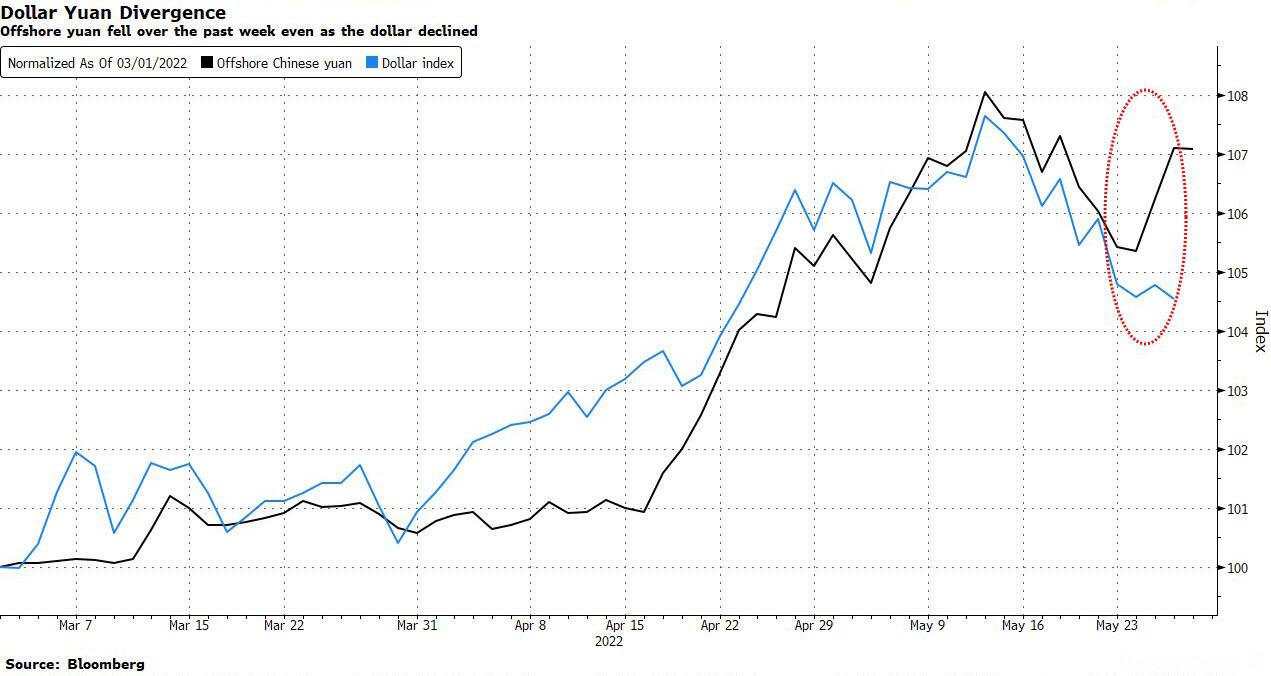
The last time a weaker greenback couldn’t help at all was in March: the dollar index lost 0.9% in the week ending March 18, while the onshore yuan dropped 0.34% and its offshore counterpart declined 0.14%. Since then, the Chinese currency has weakened more than 5.5%. Only the Turkish lira, Argentine peso and Hungarian forint lost more among 24 emerging-market peers tracked by Bloomberg.
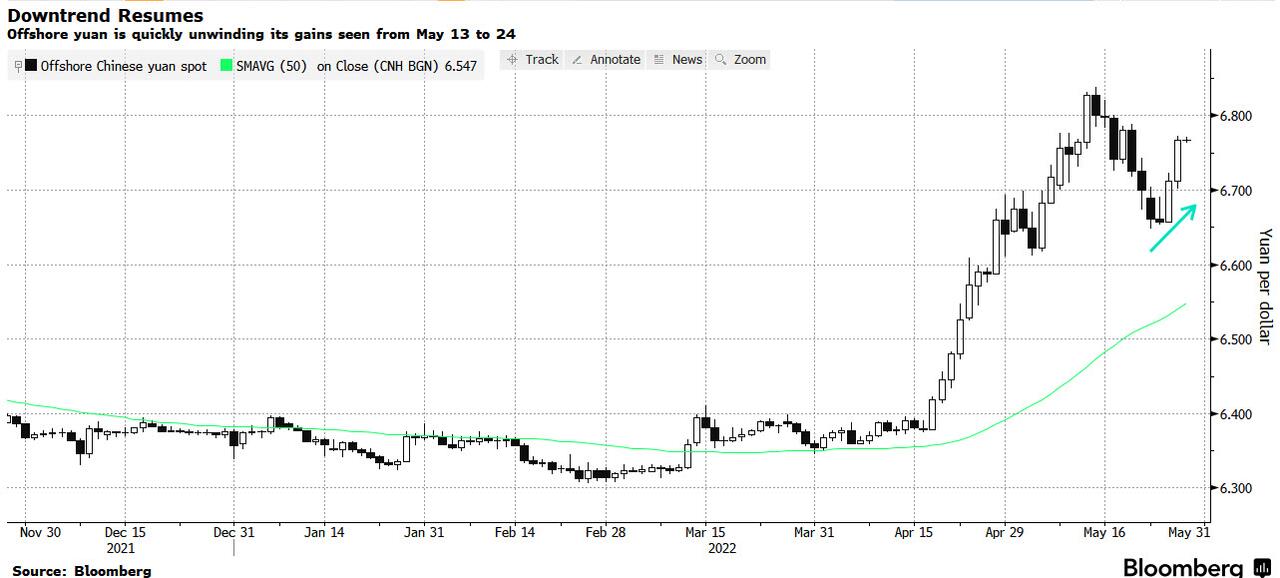
Following a brief rebound from May 13 to 24, the offshore yuan is sliding once again and is now poised to revisit 6.80 support. A breach may open up path toward year-to-date low at 6.8380, last seen on May 13, when the dollar index found its recent top. Further losses could send the currency toward 6.90, a level last seen in August 2020.
The discord between China’s top leaders over whether to prioritize Covid control or economic growth is paralyzing the implementation of policy responses, according to eight senior local government officials and financial bureaucrats. It may also amplify the negative sentiment toward broader Chinese assets and weigh heavily on the yuan, independent of what the dollar does.
On Thursday, China’s trade-weighted yuan fell below 100 for the first time in seven month, according to a Bloomberg replica of the CFETS RMB index that tracks the exchange rate against 24 peers. Fidelity International and Credit Agricole CIB both predicted more downside for the trade-weighted gauge, with the dollar-yuan pair possibly testing 7 level in the coming months.
“China and the US are moving in different directions and I don’t see PBOC stand in the way of depreciation,” said David Loevinger, Los Angeles-based managing director at TCW Group Inc. and a former China specialist at the US Treasury. He said the big selloff is over and the next 6- to 12-month view is a gradually weaker yuan.
China's Military Must Be Able To Destroy SpaceX's Starlink Satellites: Researchers
The Chinese military must be able to destroy SpaceX's Starlink satellites if they pose a threat to national security, according to an April publication by Chinese military researchers.
The researchers speculated that US military drones and stealth fighter jets could boost their data transmission speed by more than 100x using the Starlink network. Notably, SpaceX has signed a contract with the US Department of Defense to develop technology based on the Starlink platform - which includes instruments sensitive enough to track hypersonic weapons traveling at 5x the speed of sound or faster.
The paper also recommends developing a satellite surveillance system with 'unprecedented scale and sensitivity' in order to track every Starlink satellite, according to the South China Morning Post.
The study was led by Ren Yuanzhen, a researcher with the Beijing Institute of Tracking and Telecommunications under the PLA’s Strategic Support Force. Co-authors included several senior scientists in China’s defence industry. -SCMP
"A combination of soft and hard kill methods should be adopted to make some Starlink satellites lose their functions and destroy the constellation’s operating system," reads the paper, published in China's peer-reviewed journal Modern Defence Technology.
SpaceX founder and CEO Elon Musk is generally considered popular in China, however he received harsh criticism after two Starlink satellites came 'dangerously close' to the Chinese space station last year.
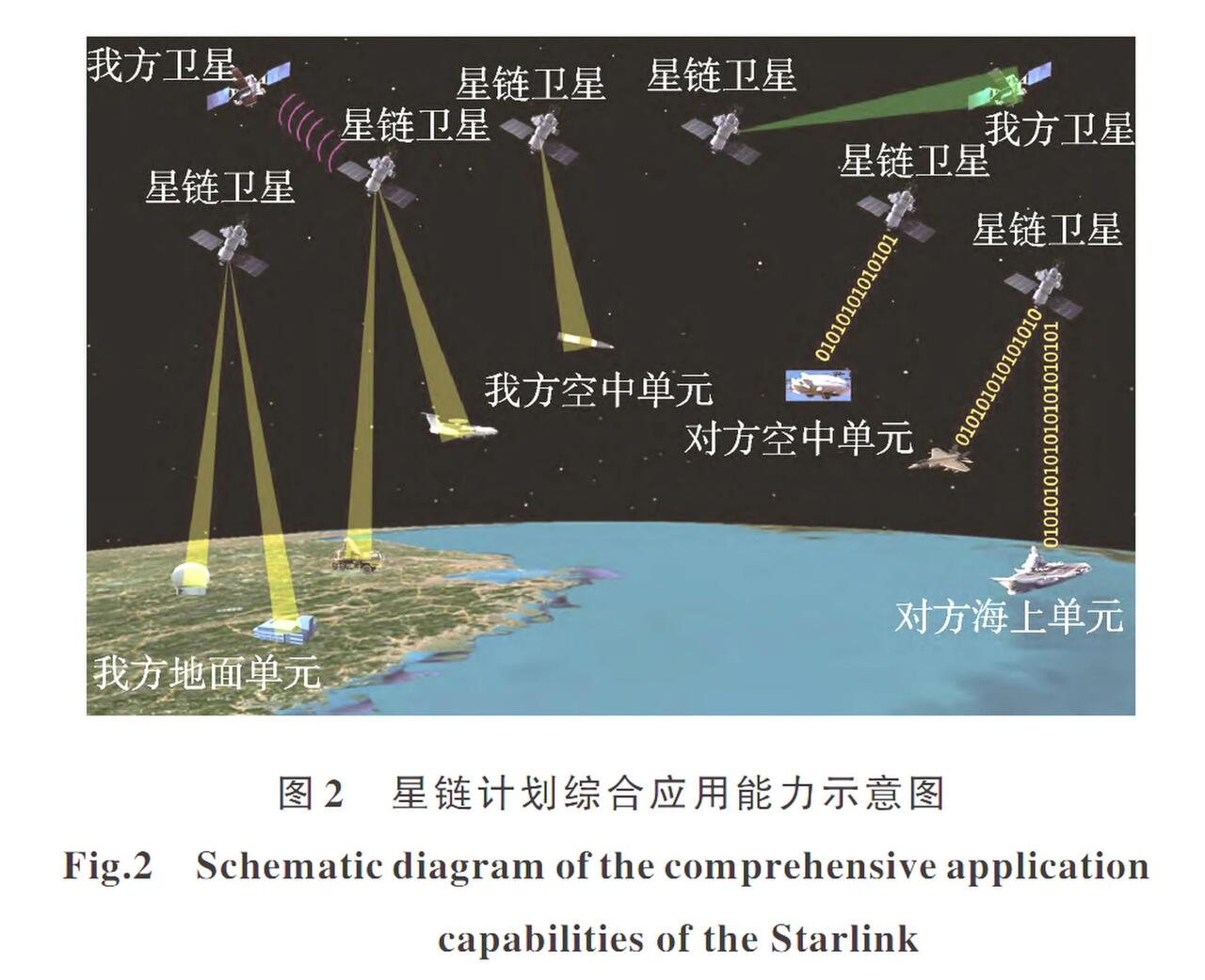

Starlink satellites could threaten China’s national security in space and on the ground, according to the researchers. Photo: Beijing Institute of Tracking and Telecommunications
Musk notably provided over 12,000 Starlink dishes to Ukraine to help facilitate broadband internet amid the war with Russia - which SpaceX is providing free of charge.
"All critical infrastructure uses Starlink, all structures that are needed for the state’s functioning use them," said Mykhailo Fedorov, Ukraine's minister for digital transformation. "We need to receive them constantly because they are one of the elements of the foundation of our fight and resilience.
Another concern from the Chinese researchers is that Starlink satellites all contain ion thrusters, which could allow them to rapidly change orbits for a rapid move against high-value targets in space.
On the public-facing side of things, Starlink's popularity has continued to grow - experiencing a 275% increase since January.
The research paper also suggests that the unprecedented scale and flexibility of the Starlink system would allow the West to insert military payloads into SpaceX commercial launches - necessitating the development of new anti-satellite capabilities and a surveillance system that can obtain super-sharp images of small satellites in order to identify unusual features.
China claims it has already developed numerous ground-based laser imaging devices that can photograph orbiting satellites at a millimetre-resolution, but in addition to optical and radar imaging, the country also needs to be able to intercept signals from each Starlink satellite to detect any potential threat, according to Ren.He said China had also showed its ability to destroy a satellite with a missile, but this method could produce a large amount of space debris, and the cost would be too high against a system consisting of many small, relatively low-cost satellites. -SCMP
"The Starlink constellation constitutes a decentralised system. The confrontation is not about individual satellites, but the whole system. This requires some low-cost, high-efficiency measures," wrote the researchers.
SCMP notes that Chinese scientists have already developed lasers for blinding or damaging satellites, as well as cyber weapons that can attempt to hack into the satellite communication network.