July 8, 2022
TWTR-Musk – OG Risk Arb’s Initial Comments on Musk’s Termination
Letter
TWTR-Musk – OG Risk Arb initial comments on Musk’s termination letter. As
a general matter, we agree with TWTR’s PR responding to Musk’s letter,
TWTR should be confident they will prevail in Delaware Chancery Court
where they plan on pursuing legal action to enforce the merger agreement.
Among other things, we note the following:
• Musk’s termination letter is weak and premature. The
letter makes essentially five arguments in favor of termination:
(1) failure to provide after repeated requests over a period of
time longer than the 30 day cure period requested information
regarding the percentage of bot accounts pursuant to section
6.4; (2) failure to provide information regarding TWTR’s financial
condition pursuant to 6.11 needed for the financing; (3) MAC
level misrepresentation of the percentage of bots in TWTR’s SEC
filings; (4) MAC based on deterioration of TWTR fundamental
performance; and (5) ordinary course violation due to TWTR
firing certain employees without prior consent pursuant to
section 6.1.
o Musk’s information request termination grounds (1
and 2 above) are contrary to the express language of
the merger agreement and would essentially create
a universal out from nearly any merger contract --
Musk attempts to manufacture grounds for termination
with respect to (1) and (2) above by sending repeated
increasingly specific requests for information which seem
designed to create an impression of non-compliance even
though Musk admits TWTR produced information in
response to many of his requests which he was unable to
use to prove his contention that the bot % is materially
higher than 5%; Musk’s claim amounts to saying TWTR
breached its information production obligation because
2
Musk was unable to prove his contention that there are
materially more than 5% bots;
§ TWTR produced information in good faith which likely
exceeded its obligations under section 6.4 of the
merger agreement which states in relevant part that
TWTR “shall (and shall cause each of its Subsidiaries
to) furnish promptly to such Representatives [Musk]
all information concerning the business, properties
and personnel of the Company and its Subsidiaries
as may reasonably be requested in writing, in each
case, for any reasonable business purpose related to
the consummation of the transactions contemplated
by this Agreement; provided, however, that nothing
herein shall require the Company or any of its
Subsidiaries to disclose any information to Parent or
Acquisition Sub if such disclosure would, in the
reasonable judgment of the Company, (i) cause
significant competitive harm to the Company or its
Subsidiaries if the transactions contemplated by this
Agreement are not consummated, …’);
§ Sect. 6.11 contains language which makes Musk’s
arguments regarding failure to provide information
regarding financing extraordinarily hard to win; in
this regard Sect. 6.11 provides in relevant part that:
“The parties hereto agree that any information with
respect to the prospects, projections and plans for
the business and operations of the Company and its
Subsidiaries in connection with the Financing will be
the sole responsibility of Parent, and none of the
Company, any of its Subsidiaries or any of their
respective Representatives shall be required to
provide any information or make any presentations
with respect to capital structure, the incurrence of
the Financing, other pro forma information relating
thereto or the manner in which Parent intends to
operate, or cause to be operated, the business of the
Company or its Subsidiaries after the Closing….
Notwithstanding anything to the contrary contained
in this Agreement, the Company will be deemed to
3
be in compliance with this Section 6.11(a), and
neither Parent nor any of its Affiliates shall allege
that the Company is or has not been in compliance
with this Section 6.11(a), unless Parent’s failure to
obtain the Bank Debt Financing was due solely to a
deliberate action or omission taken or omitted to be
taken by the Company in material breach of its
obligations under this Section 6.11(a).”;
§ in light of the contract language above, we find it
hard to believe a Delaware Court will find this basis
for termination to be persuasive as it essentially
would create a universal out for merger contracts by
allowing buyers with buyer’s remorse to serve
numerous increasingly specific information requests
and then if unsatisfied with the responses assert a
right to termination;
§ we also note that given TWTR’s production of
information it seems premature to declare the 30
day cure period has run out as essentially all of the
information requests are related so TWTR has been
complying with many of the requests so it is not
clear the cure period has passed;
§ finally, we note that Musk waived his due diligence in
the deal; his attempt to argue that section 6.4 and
6.11 essentially gives him the right to do due
diligence after the deal is announced is contrary to
the intent of these provisions which are meant to
supplement not replace pre-deal due diligence;
o Musk’s MAC arguments (grounds 3 and 4 above) lack
factual foundation and are premature -- Musk’s MAC
argument based on the 5% bot SEC representation is weak
because Musk admits that he does not have enough
information to prove TWTR’s 5% calculation is incorrect or
misleading; lack of information is not a valid basis for
asserting a MAC; absent a contrary bot %
calculation/methodology presented by Musk or proof that
TWTR intentionally decided not to use a more accurate
method to calculate bot percentages, this argument is not
4
really an independent grounds to get out of the merger
contract;
§ Musk’s MAC argument based on a generic allegation
of fundamental deterioration does not appear to be
based on any event or specific facts and seems
designed to allow for a fishing expedition where
Musk looks for a basis for a MAC argument after
asserting a MAC argument; Delaware requires an
event to be predicate for a MAC not generic
allegations of deteriorating performance;
o Musk’s ordinary course argument based on not
seeking consent to fire certain employees is not
supported by the language of Section 6.1; firing
employees is not an enumerated restricted behavior under
subsections (a) through (q) of section 6.1; there is no
credible argument that the general lead in ordinary course
language in section 6.1 implies TWTR need seek Musk’s
consent to firing employees; as Musk does not allege a
non-public disclosure schedule prohibits the firing of
certain employees, this portion of Sect. 6.1 language
applies: “x) the Company shall use its commercially
reasonable efforts to conduct the business of the Company
and its Subsidiaries in the ordinary course of business
(except with respect to actions or omissions that
constitute COVID-19 Measures), and to the extent
consistent therewith, the Company shall use its
commercially reasonable efforts to preserve substantially
intact the material components of its current business
organization, and to preserve in all material respects its
present relationships with key customers, suppliers and
other Persons with which it has material business
relations; provided that no action by the Company or its
Subsidiaries with respect to the matters specifically
addressed by any provision of this Section 6.1 shall be
deemed a breach of this sentence, unless such action
would constitute a breach of such relevant provision”;
nothing in this language requires TWTR to seek consent
from Musk to fire executives or suggests that such activity
5
in inconsistent with TWTR’s ordinary course obligations
under the merger agreement; and
• Musk’s decision to terminate now shows he knows he has
a weak position which he knows is unlikely to get
stronger -- this premature termination implies that Musk is
only seeking a small price cut before the shareholder vote; even
though we think TWTR’s position is very strong in court we think
it would be in TWTR’s interest to agree to a small price cut (sub
10%) in exchange for Musk waiving all his arguments; we
acknowledge that with Musk you cannot rule out that he might
refuse to close again even after agreeing to a price cut but since
we believe he actually wants to buy TWTR we think that is very
unlikely.
If you would like to discuss any of this in any more detail, please do not
hesitate to call me at 914-441-1629.
Eric K. Laumann
Head of North American Risk Arbitrage Research
Oscar Gruss & Son Incorporated
401 North Michigan Avenue, Suite 1200
Chicago, IL 60611
Ph: 212-419-4018
Cell: 914-441-1629
DISCLAIMER This information represents neither an offer to buy or sell any security nor, because it does
not take into account the differing needs of individual clients, investment advice. Those seeking investment
advice specific to their financial profiles and goals should contact their Oscar Gruss & Son Incorporated sales
representative. Oscar Gruss & Son Incorporated believes this information to be reliable, but no
representation is made as to accuracy or completeness. This information does not analyze every material
fact concerning a company, industry, or security. Oscar Gruss & Son Incorporated assumes that this
information will be read in conjunction with other publicly available data. Matters discussed here are subject
to change without notice. There can be no assurance that reliance on the information contained here will
produce profitable results. A security denominated in a foreign currency is subject to fluctuations in currency
exchange rates, which may have an adverse effect on the value of the security upon the conversion into
local currency of dividends, interest, or sales proceeds. The value of securities and depositary receipts of
foreign issuers that are denominated in United States dollars are also influenced by fluctuations in currency
exchange rates. © 2022 Oscar Gruss & Son Incorporated. All rights reserved.
Weekend Papers Summary
NEW YORK TIMES
-Shinzo Abe, Japan’s longest-serving prime minister, became perhaps the most transformational politician in the country’s post-World War II history.
His assassination sets off a race to lead one of the most powerful factions of the Liberal Democratic Party. And his influence, scholars say, will be lasting.
-Shinzo Abe’s assassination was especially hard to fathom because it involved a gun — an extremely rare type of crime in Japan.
-Japanese police said the man charged with killing Shinzo Abe had a “grudge” against a group he associated with the ex-prime minister. Mr. Abe’s body arrived Saturday at his home in Tokyo.
-Strong wage and jobs growth is keeping the Federal Reserve on track for big rate increase. The Fed is trying to cool down the economy to bring inflation under control, but the job market is still going strong.
-The US economy added 372,000 jobs last month, easing worries of a slowdown, but also complicating the Fed’s attempt to quell inflation.
-Elon Musk moves to end $44B deal to buy Twitter. In a regulatory filing on Friday, Mr. Musk said Twitter was in “material breach” of the acquisition agreement.
-The far-right Christian quest for power: ‘we are seeing them emboldened’. Political candidates on the fringe mix religious fervor with conspiracy theories, even calling for the end of the separation of church and state. Doug Mastriano, a Republican candidate for Pennsylvania governor, called the separation of church and state a "myth."
-As Russia looms, a Ukrainian city’s loyalties divide. Most residents have fled the eastern city of Sloviansk before an expected assault. About half of the 23,000 remaining are eager to welcome the invaders.
-Russia’s Lavrov was a pariah at Group of 20 Event, but only for some
Secretary of State Antony J. Blinken. And other Western foreign ministers refused to meet with the Russian diplomat, but for many others it was business as usual.
-Louisiana judge allows abortion ban to take effect. The fast-changing status in the state is emblematic of the chaotic national landscape that has unfolded since the Supreme Court overturned Roe v. Wade.
-Under pressure, Biden issues an executive order on abortion. Some of President Biden’s supporters wanted him to push harder to protect abortion access. But details about what his new order will do remain unclear.
-Health officials said the subvariants known as BA.4 and BA.5 were fueling a rise in cases after most Covid policies were relaxed. Catch up on pandemic news.
-Columbia University loses its no. 2 spot in the U.S. news rankings. US News & World Report said that it had “unranked” the Ivy League university after being unable to verify its data.
-A deadly confrontation at a Harlem store that drew attention from Mayor Eric Adams feeds a broader debate about crime and politics.
President Biden signals support for controversial Alaska oil project. President Biden’s administration took a key step toward approving the Willow project. Opponents say drilling would violate a pledge to rein in fossil fuel.
THE FINANCIAL TIMES
-Elon Musk has notified Twitter that he intends to terminate his agreement to buy the social media group for $44B, accusing it of disclosing “false and misleading” information about the number of fake and spam accounts.
Musk’s attempt to pull out of the deal sets the stage for a high-stakes legal battle between the billionaire Tesla chief executive and the social media platform. Twitter’s chair, Bret Taylor, responded swiftly, saying the board was “committed to closing the transaction on the price and terms agreed upon with Mr Musk” and would pursue legal action to enforce the agreement.
-Shinzo Abe, a polarizing, nationalist scion of an elite political dynasty and Japan’s longest-serving prime minister, defined an era of reform and invited the world to reassess the giant Asian economy under his Abenomics banner. He died after being shot during a campaign speech in western Japan at the age of 67.
-Labour is planning a vote of no confidence in Boris Johnson to try to force him out of Downing Street immediately, because of concerns he might abuse his role as caretaker prime minister. Angela Rayner, deputy Labour leader, said Johnson was “engulfed in sleaze” and should not be allowed to continue in office.
-Boris Johnson’s allies aim to stop Rishi Sunak becoming Conservative party leader and are accusing the former chancellor of treachery for triggering the prime minister’s premature exit.
-Russian president Vladimir Putin has threatened “catastrophic consequences” for world energy markets if western powers impose further sanctions on Moscow, as G7 members discuss plans to try to cap Russia’s oil revenues following its invasion of Ukraine. The Russian president admitted that sanctions were undoubtedly hurting Russia’s economy but said western powers stood to inflict more harm on themselves as they wrestle with rising inflation and a growing cost of living crisis.
-Federal Reserve vice-chair Lael Brainard has said recent crypto volatility has exposed “serious vulnerabilities” in an industry in need of tighter regulation. Brainard told a Bank of England conference in London on Friday that crypto is not yet “so large or so interconnected” with traditional finance to pose systemic risk but raises familiar regulatory concerns.
-20 Years ago, Wang Chuanfu, the Chinese billionaire, unveiled plans for his BYD group to buy a failing state car manufacturer that had attempted to develop a sideline in making missiles.
His logic: rip out the petrol guzzling internal combustion engines from the cars and replace them with batteries. For BYD shareholders who thought they had invested in a more humdrum maker of batteries for mobile phones, the strategy “seemed loaded with nutty ambition”, according to an analyst. But six years later, Wang pulled off a coup when Warren Buffett invested $232M in BYD. This week, Wang’s vision — and Buffet’s bet — was validated when BYD snatched Tesla’s crown as the most popular maker of battery-driven cars. Half-year sales figures showed that BYD — short for “build your dreams” — sold more vehicles than Tesla.
-Intense labor demand stoked another strong month of US jobs gains, defying expectations for a sharper slowdown and giving the Federal Reserve greater leeway to continue raising interest rates to stamp out soaring inflation.
-US president Joe Biden on Friday announced measures designed to maintain access to abortion and urged women to vote in November’s midterm elections, as his administration looks to limit the fallout of the Supreme Court’s decision to overturn Roe vs Wade. Biden spoke from the White House about how he intends to make sure Americans can still get abortions even after the country’s highest court struck down the decades-long precedent that guaranteed a right to an abortion, paving the way for multiple states to ban or restrict the procedure.
-Prosecutors on Friday said three former members of JPMorgan Chase’s precious metals trading desk “scammed the market” as part of a years-long criminal conspiracy to manipulate the global silver and gold markets.
-Prosecutors on Friday said three former members of JPMorgan Chase’s precious metals trading desk “scammed the market” as part of a years-long criminal conspiracy to manipulate the global silver and gold markets.
-Two of Europe’s largest airlines, Lufthansa and KLM, took the rare step of restricting sales of all but their most expensive tickets while cancelling another set of flights as the disruption gripping aviation worsened. The two airlines adopted the measures to help ease the travel problems caused by staff shortages and the rise in demand for seats since the relaxation of Covid-19 rules.
NY POST
-It’s official. Chris Cuomo is back.The disgraced former CNN anchor posted an Instagram Reel on Friday with shots of him shirtless, smoking a cigar and flexing his muscles. “Something’s coming . . . Summer ’22,” Cuomo, 51, teased, while he also showed off his chest tattoo.The journalist’s tease was greeted with much fanfare from his followers.
- The suspect who shot dead Shinzo Abe on Friday believed the former Japanese prime minister was involved in a “specific organization” — and that his grudge wasn’t political, police said. The suspected killer, Tetsuya Yamagami, 41, was tackled to the ground just moments after he allegedly opened fire on the 67-year-old former leader as he delivered a campaign speech in the western region of Nara. In an interview with investigators, Yamagami allegedly admitted to plotting to kill Abe because he thought the ex-prime minister was connected to an organization that he bore a grudge against.
-Former Clinton Treasury Secretary Larry Summers is defending his comments from last month in which he claimed that millions of Americans may need to lose their jobs in order for inflation to come under control. Summers, who has emerged as a chief critic of the Biden administration’s economic policies, told the London School of Economics recently: “We need five years of unemployment above 5% to contain inflation — in other words, we need two years of 7.5% unemployment or five years of 6% unemployment or one year of 10% unemployment.”
Barron’s Weekend Summary: Recent stock market returns did not make it easy to assemble Barron’s 17th annual list of top-performing CEOs
Cover Story:
Recent stock market returns did not make it easy to assemble Barron’s 17th annual list of top-performing CEOs. Still, a process was used that started with stripping last year’s list of names to none—similar to what the cost-cutters call zero-based budgeting. The Barron’s ‘judges’ then screened the market for signs of financial strength and improvement, but only lightly, in order to quickly turn the matter over to our panel of editors and beat reporters. Stages of their work included nominee selection, initial debate, further research, gradual compromise, advanced wrangling, and final agreement.
Interview:
This week Barron’s interviews Henry McVey, CEO of KKR. McVey is fond of saying that KKR “eats its own cooking” when it comes to investing. As a partner, chief investment officer of the investment firm’s $27.4B balance sheet, and head of its global macro and asset allocation strategy, McVey is responsible for forming a view on global macroeconomic trends that move asset prices. In addition, he allocates the firm’s own portfolio, using a balance sheet that allows KKR to invest alongside its clients across more than 30 investment strategies.
Tech Trader:
-There are six trends affecting tech stocks – and negatively. Analysts are rushing to cut estimates for tech stocks of every variety, cognizant that consensus forecasts don’t reflect the blizzard of recent ugly financial and geopolitical developments. You are going to hear talk in coming weeks that second-quarter results—and what will undoubtedly be soft guidance for the rest of the year—could serve as a “clearing event” and set the stage for improved market performance later. But keep in mind that there are many shoes left to drop, and more losses to absorb.
The Trader:
Why has the market reacted so enthusiastically to the week’s news? Investors entered the week hoping, if not for a recession, then for at least some signs that the economy is slowing enough to keep the Federal Reserve from aggressively raising interest rates further. But the ISM Non-Manufacturing Index came in stronger than expected, as did durable-goods orders and the Jolts job openings report. The June payrolls data, the highlight of the economic reports, looked particularly strong: The economy added 372,000 jobs last month, nearly 100,000 more than economists had predicted—and that initially caused the stock market to sell off.
-Top-performing shares, aka momentum stocks, typically stay hot because investors are naturally attracted to what’s been doing well. It’s a circular idea, but there’s usually no arguing with the results. That’s not the case right now. The iShares MSCI USA Momentum Factor ETF has dropped 24% in 2022, worse than the S&P 500SPX –0.08%’s 18% decline. Momentum is among the worst-performing factors this year, trailing only growth. But even growth stocks have rallied in July—the Invesco S&P 500 Pure Growth ETF has climbed 5.1%—while the Momentum ETF is up just 1%. So, chasing winners has been a losing strategy.
Features:
-On June 30, Manhattan federal Magistrate Judge Sarah Cave recommended class-action status for an antitrust case in which a trio of pension funds allege that the big brokers ran a cartel that extracts unfair profits from stock lending. Stock loans are a key part of short sales and options trades carried out by hedge funds, as well as a source of profit for pension and mutual funds.
-If Elon Musk succeeds in ending his deal to buy Twitter, it could be a positive for Tesla shareholders. The potential purchase of the social media platform has been an overhang for Tesla investors for weeks and Tesla stock has been underperforming the market. Musk said he would terminate the deal to buy the social media company, claiming it had breached the terms of agreement by refusing to provide detailed information about fake accounts on the site.
European Trader:
-Investors considering drinks maker Diageo have to ask themselves one question. “Do Americans feel the same way about tequila that Winston Churchill felt about Champagne?”
Britain’s World War II prime minister clarified his affection for Champagne in both good times and bad thus: “In victory I deserve it. In defeat I need it.”
Diageo, the world’s largest spirits maker and the owner of more than 200 brands including Smirnoff vodka, Johnnie Walker whisky, and Tanqueray gin, has made a big marketing bet on tequila and the U.S. market.
Emerging Markets:
-Brazil is back to being the market of the future, again. The iShares MSCI BrazilEWZ ETF enjoyed a brief turn as a world beater early this year, climbing 40% during the first quarter. It has cratered by 30% since then. Equities have overshot the swing in Brazil’s key export commodities. Iron ore prices have plunged since April 1, but oil and soybeans are about even. So, stocks look cheap, in theory. In practice, investors are crouched against more volatility. “It’s not a great setup from a top-down perspective,” says Verena Wachnitz, a portfolio manager for Latin American equities at T. Rowe Price. “We need to get past the election, and start to talk about rates coming down.”
Commodities:
Energy stocks are on sale, after a sharp selloff since oil and natural-gas prices peaked in early June. Oil is down 18% from its high, to $102 a barrel, while gas has fallen by a third, to about $6 per million British thermal units.
The Energy Select Sector SPDRXLE –ETF, dominated by Exxon Mobil and Chevron, has dropped 23%, to $71, and the more volatile SPDR S&P Oil & Gas Exploration & Production ETF is off 30%, to $119.
Streetwise:
-Beans and corn have caught Jack Hough’s attention, and not just because ShopRite put summer succotash on sale. Prices for America’s two biggest cash crops are well off recent highs. Corn is down 12% just since late June. Soybean oil has slipped 25% since mid-May. Meanwhile, shares of ingredient makers Archer-Daniels-Midland, Bunge, and Darling Ingredients have been falling much faster than the market.
"Social Peace Is In Great Danger": Germany Is Quietly Shutting Down As Energy Crunch Paralyzes Economy
Earlier today we wrote that Germany's largest landlord, Vonovia, had taken the unprecedented step of restrictring heating at night, a terrifying preview of what lies in stock for the "most advanced" European nation this winter. Alas, it's going to get worse, much worse.
According to the FT, Germany is now rationing hot water, dimming its street lights and shutting down swimming pools as the impact of its energy crunch begins to spread like the proverbial Ice-Nine wave, from industry to offices, leisure centers and residential homes.
The reason behind Germany's slow motion paralysis is well-known: the huge increase in gas prices triggered by Russia’s move last month to sharply reduce supplies to Germany has plunged Europe’s biggest economy into its worst energy crisis since the oil price shock of 1973 (see "What's Unfolding In Europe In Recent Days Is A Fresh Big Negative Supply Shock")
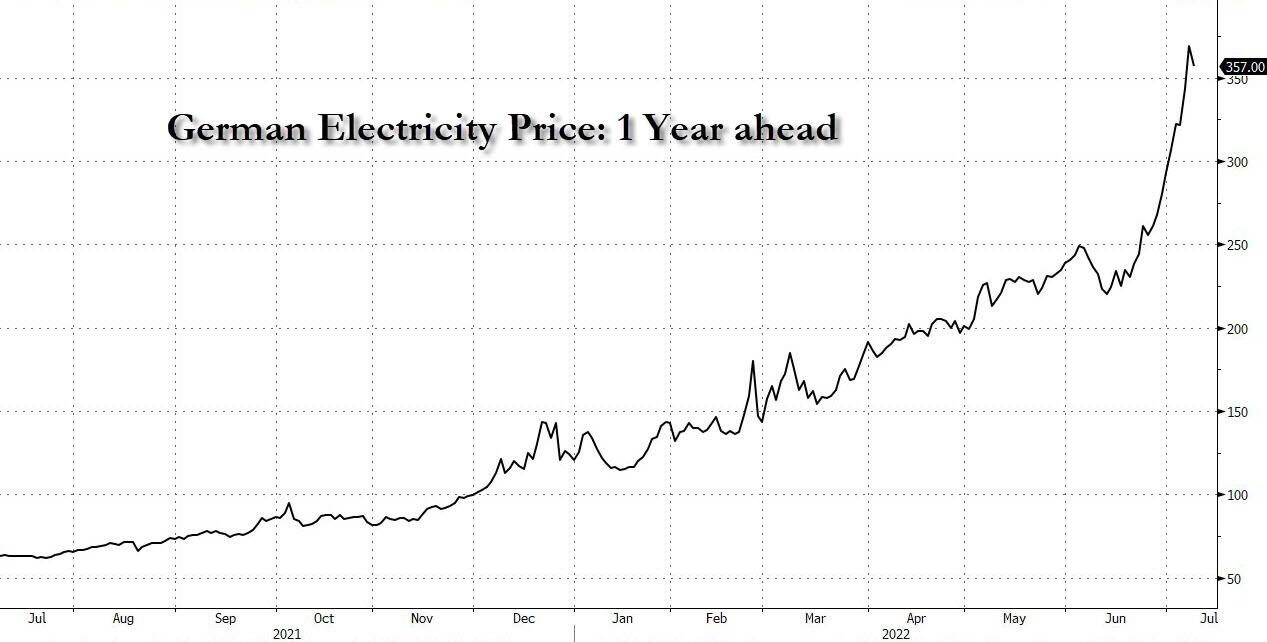
With electricity prices hitting never before seen levels, gas importers and utilities are fighting for survival while consumer bills are going through the roof, with some warning of rising friction (not to mention the infamous wheelbarrows full of cash).
“The situation is more than dramatic,” said Axel Gedaschko, head of the federation of German housing enterprises GdW. “Germany’s social peace is in great danger.”
Unfortunately, as tensions over Russia’s war in Ukraine escalate, officials fear the situation could get worse. On Monday, as we reported last week, Russia is shutting down its main pipeline to Germany, Nord Stream 1, for 10 days of scheduled maintenance. Many in Berlin fear it will never reopen.
Commenting on the infamous July 22 day when Russian gas flows are expected to resume, DB's Jim Reid writes that "while we all spend most of our market time thinking about the Fed and a recession, I suspect what happens to Russian gas in H2 is potentially an even bigger story. Of course by July 22nd parts may have be found and the supply might start to normalise. Anyone who tells you they know what is going to happen here is guessing but as minimum it should be a huge focal point for everyone in markets."
The bank also conveniently warns that "if the gas shutoff is not resolved in coming weeks this would lead to a broadening out of energy disruption with material upfront effects on economic growth, and of course much higher inflation."
Anticipating the worst case outcome, Germany last month took a crucial step towards rationing gas when economy minister Robert Habeck activated the second stage of the country’s gas emergency plan. “The situation on the gas market is tense and unfortunately we can’t guarantee that it will not get worse,” he said on Tuesday. “We have to be prepared for the situation to become critical.”
Habeck, who says he is now taking shorter showers, has appealed to the population to save energy — and municipalities and property owners have heeded the call.
As we reported this morning, Vonovia, the country’s largest residential landlord, said it would be lowering the temperature of its tenants’ gas central heating to 17C between 11pm and 6am. It said the measure would save 8 per cent in heating costs.
A housing association in the Saxon town of Dippoldiswalde, near the Czech border, went a step further this week, saying it was rationing the supply of hot water to tenants. From now on they can only take hot showers between 4am-8am, 11am-1pm and 5pm-9pm.
“As we announced in our general meeting, we have to save for the winter,” a notice in the affected blocks reads.
Such measures could become routine in the coming weeks. Helmut Dedy, head of the German Association of Towns and Cities, said the “whole of society” must now cut down on its energy consumption, saving in summer “so we have warm flats in winter”.
“Every kilowatt-hour we save helps to fill the gas storage a bit more,” he said as he appealed to town councils up and down the country to take emergency action. He had a few suggestions: turn off traffic lights at night; shut off hot water in council buildings, museums and sports centres; adjust air conditioners; and stop illuminating historic buildings
Some have already taken measures. The district of Lahn-Dill, near Frankfurt, is switching off the hot water in its 86 schools and 60 gyms from mid-September, a move it hopes will save it €100,000 in energy costs, and Düsseldorf has temporarily closed a massive swimming pool complex, the Münster-Therme. Meanwhile, Berlin has turned down the thermostat on open-air swimming pools, reducing their temperature by 2 degrees. In western Germany, Cologne is dimming its street lighting to 70 per cent of full strength from 11pm.
Residential customers are also taking action, reactivating wood-burning stoves and fireplaces. Sales of firewood, wood pellets and coal, as well as of gas canisters and cartridges, have shot up.
It is unclear how far such measures will soften the impact of higher heating bills, which which be through the roof. The GdW said the Ukraine war will push up energy prices for consumers by between 71 per cent and 200 per cent, amounting to additional annual costs of between €1,000 and €2,700 for a one-person household and up to €3,800 for four people, compared with 2021 levels.
Costs could increase even more as a result of a new law working its way through the German parliament. This would allow the government to impose an emergency levy on all gas consumers to spread the cost of higher prices more evenly. It is designed to prevent gas importers becoming insolvent, a scenario ministers fear could cause a Lehman Brothers-style meltdown of the whole sector. Uniper, the largest importer of Russian gas in Germany, is already in talks with officials on a state bailout that experts say could be as large as €9bn.
In the meantime, German consumers — both industrial and residential — are reverting back to East Gcutting their energy use. A study by the Hertie School in Berlin said industrial gas consumption fell 11 per cent in March and April this year, compared with the same period in 2021, and by 6 per cent in private households.
Much more needs to be done, said Lion Hirth, one of the study’s co-authors. “The decline in demand that we’ve seen up until now is unfortunately far from adequate to completely close the supply gap threatening us this winter,” he said. In his appeal to Germany’s municipalities this week, Dedy made a similar point. “The situation is very serious,” he said. “It’s already clear we’re going to have to leave our comfort zone.”
Let's just hope that by exiting the "comfort zone" Germany does not enter the "war zone" - it's traditionally not a happy ending for Europe when that happens...
Elon Musk Is Twitter’s Material Adverse Effect
A settlement would beat a protracted legal battle for both sides, but the social network will still have to contend with the aftermath
Elon Musk wants to leave Twitter TWTR -5.10% at the altar, having mistaken lust for love. Walking away will still cost him, but it is a better outcome for both sides. The question for Twitter’s shareholders is how much worse off it will be than before its brief dalliance with the famous billionaire.
In a filing Friday, Mr. Musk’s lawyers declared his intention to terminate the merger agreement he signed in April with the social-media platform. His claim is that Twitter breached their deal by failing to provide Mr. Musk with requested information to settle questions about bots and an allegedly inflated user count. Mr. Musk, through his lawyer, is also accusing the social network of “materially inaccurate representations,” and added for good measure his belief that the portion of spam and fake accounts in Twitter’s user base is “wildly higher” than the less-than-5% figure Twitter has historically claimed in its regulatory filings.
Twitter says it is planning a lawsuit to compel Mr. Musk to honor the agreement. In a strict legal sense, the social network might have the upper hand: Mr. Musk waived his due diligence rights in signing the deal, and the objections he raised came conveniently after electric-vehicle maker Tesla lost about one-third of its market value, thus denting the very net worth Mr. Musk was leveraging to finance the Twitter acquisition.
But a protracted legal battle isn’t in either side’s interest. Mr. Musk could be forced to write a big check years from now for the husk of a social-media company he once coveted. Or Twitter’s shareholders could walk away with a mere $1 billion consolation prize in that parlous state.
True, a settlement even significantly north of the $1 billion breakup fee agreed to in the merger won’t go far to erase the $14.7 billion difference between the $54.20 per-share deal price and the $35 that Twitter’s shares hit after-hours on Friday following Mr. Musk’s termination filing. Indeed, Twitter’s shares would likely be far lower even if the stock simply tracked the damage done to its social-network peers over the past three months, as concerns about the health of online advertising in a highly inflationary environment were affirmed by a warning from Snapchat parent Snap Inc. in late May. A drop in line with the Nasdaq CTA Internet Index would put Twitter’s shares slightly below the $30 mark now.
And, unfortunately, that is a base-case scenario that assumes Twitter emerges from the Musk melee unscathed. That appears unlikely. If Mr. Musk’s initial interest made Twitter seem like an undervalued darling, the problems he has both raised and arguably caused over the past few months could change a lot of minds.
One thing clear long before Mr. Musk raised his concerns is that it is impossible to know just how many “real” users Twitter’s platform has. Certainly it isn’t a problem unique to Twitter; all social-media platforms disclose their “best estimates” of their respective user bases, noting they are likely inaccurate to some degree. Meta Platforms, for example, recently disclosed in a filing that around 11% of monthly active users for its Facebook app could be duplicate accounts. Twitter has already said publicly that it misstated its users for 12 consecutive quarters through the end of last year, giving itself credit for multiple accounts being owned by a single user.
But Mr. Musk has one of the world’s loudest megaphones as one of only a handful of Twitter accounts with more than 100 million followers. That gives his public questioning of the integrity of the platform extra weight.
And even he seems to have overestimated Twitter’s external appeal. An analysis published by Pew Research last month showed nine in 10 journalists use Twitter for their jobs, but just 13% of American adults say they regularly get news on Twitter. That is nearly the same percentage who report getting their news from Instagram and significantly less than the 31% who said they get their news from Facebook.
Perhaps most concerning is what the past few months have done to Twitter’s management and talent base. As Mr. Musk’s own lawyers point out in Friday’s letter, three key executives have resigned from Twitter since the merger was announced. It is possible those departures were spurred by the prospect of the merger, especially after Mr. Musk showed a propensity to publicly criticize Twitter employees and made clear that, regardless of his title, things would be run his way or the highway. But the damage is still done, and Twitter under the glare of the new spotlight with or without the deal might remain an unappealing place to work.
At the end of the day, Mr. Musk’s case is all about “material adverse effects”—the user numbers, the bots, the management. But for Twitter’s investors, the Musk affair may prove to have the worst effects of all.
Experts say Musk faces uphill battle for victory in Twitter legal fight
Social media platform seeks to force the Tesla boss to go through with his takeover
Elon Musk faces an uphill battle if Twitter takes him to court over the Tesla founder’s attempt to pull out of an agreed $44bn takeover of the platform, legal experts predict.
On Friday, Musk said Twitter had been in “material breach of multiple provisions” of the deal contract, which gave him the right to walk away, putting an end to weeks of speculation over the billionaire’s desire to buy the company.
Twitter hit back, announcing plans to sue Musk in the Delaware Court of Chancery, where the company is incorporated, to force him to honour the deal at the agreed price of $54.20 per share.
The action and counteraction sets the stage for a costly legal battle that could plunge the company into further turmoil.
Twitter could opt to accept a settlement or negotiate with Musk for a lower price to avoid what would be hefty legal fees and further uncertainty amid lay-offs and rock-bottom morale inside the company.
But if the deal is contested to the end in the courts, Musk and his legal team face an uphill challenge, according to legal experts, who suggest that Twitter might have an edge.
“I think we are finally going to see if Elon Musk is ‘above the law,’ said John Coffee of Columbia Law School. “I am confident that in the Delaware courts the answer is no. The law is fairly clear that you cannot pull out from a deal in the manner he is seeking.”
Reticent buyers have historically tried to argue a company has experienced a “material adverse effect” (MAE) to void a merger agreement, citing a deterioration of the target company’s business results as proof.
However, the Delaware courts have only once ruled a company could escape via MAE, leaving skittish buyers like Musk to rely on other legal arguments to avoid a deal.
Musk alleges that Twitter violated three separate provisions of its deal contract. First, he said Twitter had repeatedly failed to provide adequate information about fake and spam accounts needed to facilitate financial planning for the transaction.
Second, Musk’s representatives say they carried out a preliminary assessment of what data they could access and found that the number of spam and fake accounts on the platform was “wildly higher” than the 5 per cent estimated by Twitter. Twitter’s public disclosures as part of the deal therefore contain “materially inaccurate representations”, they say.
Finally, Musk argued that departures of key Twitter employees since the deal’s signing demonstrated that Twitter was deviating from its obligation to “conduct its business in the ordinary course”, another violation that could provide an escape hatch for Musk.
Musk had for months been broaching the fake account issue in interviews and in his own tweets. Twitter has defended the 5 per cent figure as accurate and acquiesced to some of his data demands. However, the company has indicated that it cannot share the complete data set needed to make the assessment with third parties, as this includes sensitive user information protected by privacy laws.
“The information supplying requirement does not necessarily justify a refusal to close [the deal],” Coffee said.
More broadly, Twitter is likely to argue that Musk’s concerns simply mask buyer’s remorse over a pricey and highly leveraged deal. Musk has received $13bn in debt commitments from several Wall Street banks. Debt pricing has become markedly more expensive in recent weeks as banks have had trouble placing the loans and bonds that support other leveraged buyouts.
Musk has also committed to coming up with more than $30bn in equity himself. He has previously announced that he had lined up some co-investors including private capital firms such as Brookfield and Andreessen Horowitz to ease the burden. Shares in Tesla have crashed more than 35 per cent so far this year and Musk has himself sold $8.5bn worth of shares to help fund the deal.
“Musk will have to prove these are real breaches of the agreement,” said Ann Lipton, a corporate law professor at Tulane University. “But because his conduct up until now so brazenly demonstrated he was looking for any excuse to back out, he’s going to start the case with a serious credibility problem.”
The deal terms include a $1bn termination fee that Musk would owe if he was generally responsible for the transaction collapse. Twitter negotiated a so-called specific performance clause that commits Musk to finish the deal if all other closing conditions are met.
While the Delaware courts have generally been unimpressed with buyers arguing either a MAE or technical violations of covenants or representations, in a handful of instances buyers have been successful.
For example, the Delaware Court of Chancery ruled in 2020 that Korea’s Mirae could terminate an acquisition of a set of luxury hotels owned by China’s Anbang as the seller had not operated the business in a manner that was consistent with past practice after signing the deal.
Even if Twitter wins in court, the judge might balk at actually forcing through a deal, experts note.
“It’s very daunting to order specific performance in a situation like this. There’s external financing that has to be made to perform. And what if Musk flouts your order. It turns into a showdown over the court’s jurisdiction and power — what happens at ground level?” Morgan Ricks, law professor at Vanderbilt wrote on Twitter.
A courtroom battle between Musk and Twitter could prove lengthy as the proceedings would have to dive into the details of Twitter’s business and the company’s actions after signing. The sides could instead angle for a recut deal in order to avoid an expensive and potentially embarrassing trial.
In June, software company Anaplan agreed to cut its sale price to Thoma Bravo by $400mn on an $11bn deal, after the private equity firm said Anaplan had violated the merger agreement by paying out $32mn more in recent employee bonuses than had been disclosed in the merger contract.
Anaplan insisted in securities filings that it did not believe that the excess bonuses constituted a breach but to avoid a legal fight, agreed to take a lower price.
If Musk and Twitter were to agree to a damages payout instead of a revised price, the merger agreement caps that figure at $1bn. However, the sides could simply agree to a bigger number to cease the hostilities.
Should the conflict reach a courtroom, Musk’s testimony could prove the highlight.
In 2021, he dramatically jousted with a lawyer who represented Tesla shareholders who had accused him of improperly bailing out SolarCity, another Musk company that Tesla had acquired in 2017.
“I think you are a bad human being,” Musk told the lawyer who quizzed him. The Delaware court cleared him of any wrongdoing in that buyout.
The Week’s 10 Biggest Funding Rounds: Xpansiv Looks To Expand With $400M, Cyber Insurer Coalition Lands $250M
Maybe companies were reluctant to announce new funding after the July 4th holiday, or maybe it was another indication of a slowing venture market, but July has started off slow—very slow. Only three rounds raised by U.S.-based startups reached nine figures. In fact, you could make the top 10 list this week raising $20 million. That is something that would never have happened last year.
1. Xpansiv, $400M, financial services: Carbon off-sets and renewable energy credits have become big business, and firms need a place to buy and sell. Blackstone clearly sees that. Funds managed by the private equity giant’s energy-focused investment business—Blackstone Energy Partners—committed $400 million to lead a strategic investment in Xpansiv. The New York-based company has developed a market-infrastructure platform for global carbon and environmental commodities—like voluntary carbon offsets or energy credits. That has become important as companies try to reach their ESG goals. Founded in 2018, Xpansiv has raised nearly $580 million, according to Crunchbase data.
2. Coalition, $250M, cyber insurance: While there may be a slowdown in funding to cybersecurity startups, this week was not a perfect illustration of that as two such companies made the top five. San Francisco-based Coalition closed a $250 million round at a $5 billion valuation—less than a year after it raised a $205 million Series E at a $3.5 billion-plus valuation. Actually, in about 15 months Coalition’s valuation has nearly tripled. The new round comes as the insurer has seen significant growth, increasing revenue nearly 200% from the prior year. Such growth also shows the growing importance of cyber insurance as an increase in cyberattacks through the past few years has elevated the need for companies to look for protection. The new round included participation from Allianz X, Valor Equity Partners, Kinetic Partners and other existing investors, the company said in a release. Founded in 2017, Coalition says it has raised $755 million.
3. Flexe, $119M, logistics: Investors’ interest in logistics and supply chain tech remains high as the world continues to try to overcome distribution issues born out of the pandemic. Seattle-based startup Flexe is the latest to turn that interest into a big round. The company raised a $119 million Series D at a $1 billion-plus post-money valuation. The round included new investments from funds and accounts managed by BlackRock, as well as funds and accounts advised by T. Rowe Price Associates and T. Rowe Price Investment Management, and Tiger Global, among others. Flexe’s programmatic logistics technology platform helps large retailers and other brands. It provides things such as scalable warehousing solutions and retail distribution. This has become big business due to the supply chain gridlock. VC-backed logistics startups have raised nearly $11.5 billion this year, according to Crunchbase data. While not on pace to reach the nearly $24.5 billion raised last year, it still represents significant dollars. Founded in 2013, Flexe has raised more than $260 million, Crunchbase data shows.
4. Tebra, $72M, health care: Digital health care was growing incrementally before the pandemic, but certainly has taken off since COVID made many people reluctant to go out and see a doctor. Tebra is the latest to take advantage of that enlarging market and growing investor interest, as the Newport Beach, California-based startup closed a round worth more than $72 million led by Golub Capital at a valuation greater than $1 billion. The round is a mix of both growth equity and debt financing. The company offers a digital platform to independent practices to help with everything from scheduling to payments to telehealth. Tebra was formed late last year after the merger of Kareo and PatientPop.
5. Swimlane, $70M, cybersecurity: Like we said earlier, it was a good week for a couple of cyber companies as far as fundraising went. Boulder, Colorado-based Swimlane locked up a $70 million growth funding round to help companies automate some of their cybersecurity needs. That has become necessary due to both a talent shortage in cyber and dwindling IT budgets to pay the talent that is available. The round was led by Activate Capital. Founded in 2014, the company has raised nearly $155 million, according to Crunchbase data.
6. Zeem Solutions, $50M, electric vehicles: Inglewood, California-based Zeem Solutions closed a $50 million capital commitment from a fund managed by ArcLight Capital Partners. Zeem allows companies to operate commercial electric vehicle fleets for a flat monthly rate, which includes vehicle lease, charging, maintenance and insurance.
7. Calyxo, $32.7M, medical devices: Pleasanton, California-based Calyxo, a medical device company focused on kidney stone treatments, closed a $32.7 million Series C led by Questa Capital and CRG. Founded in 2016, the company has raised more than $47 million, according to Crunchbase.
8. Deuna, $30M, e-commerce: Palo Alto, California-based checkout commerce startup Deuna raised a $30 million Series A led by Activant Capital. Founded in 2020, the company has raised $37 million to date, according to Crunchbase.
9. Kernal Biologics, $25M, biotech: Cambridge, Massachusetts-based mRNA-technology company Kernal Biologics closed a $25 million Series A led by Hummingbird Ventures. Founded in 2016, the company has raised $25 million, Crunchbase data shows.
10. Traba, $20M, staffing: Miami-based Traba, a marketplace for jobs at fulfillment centers and event venues, raised a $20 million Series A round led by Khosla. Founded last year, the company has raised nearly $24 million, according to Crunchbase.
Big global deals
Although U.S. startups may have had a slow week raising money, there were several large rounds raised globally.
- Swedish electric vehicle battery manufacturer Northvolt raised $2.75 billion in a new funding round.
- China-based drug research platform ClinChoice raised a $150 million Series E.
- Brazil-based consumer loan startup Creditas raised a $150 million round of new funding.
Russia Says It Will Increase Gas To Europe Under One Condition
Russia will increase its gas supplies to Europe if a turbine necessary for Nord Stream 1 that is currently undergoing repair in Canada is returned, Reuters reported on Friday.
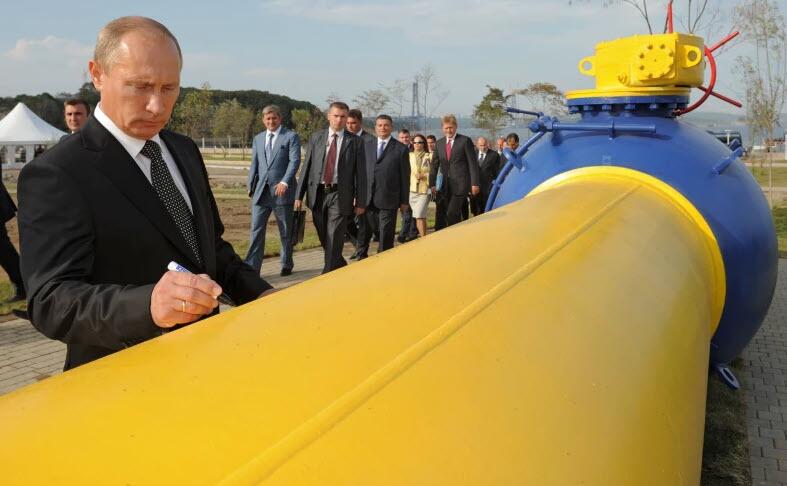
Ukraine urged Canada on Thursday not to return a gas turbine to Gazprom, claiming that the Russian major has enough turbines to keep gas flowing to Europe at full capacity. According to a Reuters report that cited a Ukrainian government official, if Canada returns the turbine to Gazprom, it would violate its own sanctions.
"The sanctions forbid the transfer of any equipment related to gas," the Ukrainian government source said."If, God forbid, this decision is approved, we will undoubtedly appeal to our European colleagues that their approach must be reassessed. Because if countries do not follow decisions they have agreed about sanctions, how can we talk about solidarity?" he added per Reuters.
Meanwhile, Germany's Economy Minister Robert Habeck called on Canada to release the turbine.
"I'll be the first one who will fight for a further strong EU sanction package, but strong sanctions means it must hurt and harm Russia and Putin more than it does our economy," Habeck told Bloomberg earlier this week."Therefore, I ask for understanding that we have to take this turbine excuse away from Putin."
The turbine affair began last month when Gazprom began to reduce gas flows via the Nord Stream 1. The Russian state company attributed the reduction to a missing turbine that had not been returned after maintenance.
Germany's Siemens Energy explained that "Due to the sanctions imposed by Canada, it is currently impossible for Siemens Energy to deliver overhauled gas turbines to the customer. We have informed the Canadian and German governments and are working on a viable solution."
As a result of this delayed delivery, flows via the Nord Stream 1 pipeline are now at just 40 percent of capacity, and Germans are bracing for a complete halt of the flow for scheduled maintenance, which begins next week, on July 11.
While normally Gazprom would divert flows to other pipelines, now there is fear it will not do so as relations between Russia and the European Union break records in reaching historically low point after low point.
Meanwhile, Canada has indicated that it has no intention of returning the turbine, with Natural Resources Minister Jonathan Wilkinson saying in late June that "If you talk to the Germans, they are very, very concerned about" their energy security. "I'm sure it'll come up at least in the corridors of the G7 ... I wouldn't hold my breath that we're going to find a resolution before the end."
A Ukrainian energy ministry source who spoke to Reuters, however, said they had information that Canada was preparing to make the transfer of the equipment, with another unnamed source saying that the decision had been made as Canada and Germany did not want to give Russia an excuse not to keep the gas flowing to Germany.