FT : Audemars Piguet expands into luxury hospitality with hotel opening

Audemars Piguet expands into luxury hospitality with hotel opening
Boutique Hôtel des Horlogers sits in the birthplace of Swiss watchmaking


A watch by Audemars Piguet (AP) is rarely designed to be discreet. It is a symbol, intended to be visible — a piece of ostentatious jewellery justified by the craft, workmanship, technical wonder, and invention that it embodies as a functional, rather than a decorative, object.

You might expect then, a hotel designed for AP by a starchitect — Denmark’s Bjarke Ingels — to be a similarly visible and high-tech affair. You would be disappointed.

The new Hôtel des Horlogers in the birthplace and nexus of Swiss watchmaking, the Vallée de Joux, does not even have a sign. Set back from the street behind a grass meadow in the village of Le Brassus, its low-slung, timber and glass facade displays little of the self-conscious luxe of watches that might be made of solid rose gold and retail for hundreds of thousands of pounds.

“The story of how watchmaking started here is fascinating,” Ingels tells me. In 1541, Geneva instituted Protestant reformer John Calvin’s ban on wearing jewellery. “But, because watchmaking was seen as an applied art, it fell outside the regulations and the goldsmiths transferred their skills to clocks.”

That story is supplemented by one just as quirky. The people in the valley, mostly cattle-farmers — many of them Huguenot refugees from France — had little to do in the winter when the valley was snowed in, the roads inaccessible and the schools shuttered. So they took to their attics and began crafting watch parts. Le Brassus’ most prominent buildings are still the AP head office and the Laiterie, with its shiny metal milk churns stacked outside.

The landscape was intimately connected to everyday life, here. When Ingels and his practice, the Bjarke Ingels Group (BIG), came to design the hotel, they made efforts to embed the building in the terrain, even to supplement it by envisaging its eccentric vertical ramps as a landscape within the landscape.

This is a modus operandi for Ingels, whose famous buildings include Amager Bakke, a waste incinerator in Copenhagen with a ski-slope on top, and a pyramidal mountain of a skyscraper, Via 57 West, in West Manhattan. They reflect a desire to create a landscape from, rather than just outside, the architecture, which perhaps stems from the flatness of Denmark. He cannot seem to resist it.

The hotel itself is slick and generous, from the lobby with its stripped tree roots hanging from the ceiling and its unfurled ammonite of a reception desk, to Le Gogant — the restaurant downstairs run by three Michelin star chef Emmanuel Renaut. This is an operation which looks well-engineered and runs, of course, like clockwork.

The interiors, designed by French agency AUM Pierre Minassian, attempt to echo elements of the landscape, from strange truffle-shaped light fittings to mountains inscribed on the walls in silvery op-art discs. It is occasionally a little much — the white elephant-ear light fittings looming over the beds can be a bit oppressive, making the interior at odds with what is, by Ingels’ standards, a relatively understated building.

General manager André Cheminade tells me that this is already becoming “a place of architectural, as well as horological, pilgrimage”. BIG designed the AP Museum next door — another building set deep into the earth and virtually invisible form the main road — so visitors get a two-for-one experience.

Ingels describes the design of the museum to me as “a spiral that takes you to the centre and unwinds again or, if you like, you can jump in time across the space.” He points out that, in watches, “miniaturisation is making things smaller and thinner, and skeletonisation removes plates and reveals the inner workings — the performance of the mechanism becomes the whole story.” So he went and removed everything he could. “The solid elements, the walls and the columns have been eliminated and the spiral mechanism revealed. It’s architecture as clockwork.”

The way he achieved this was to make curved walls of structural glass; the workings of the interior are visible from the valley and the landscape is ever-present inside. Vitrines containing unimaginably precious timepieces spanning the history of watchmaking clam up into black monoliths after closing, watchmakers can be seen in an atelier inside the building working at almost infinitesimally small scales, their labour visible, their actual actions and the microscopic screws and cogs they work with, remaining unseen. The whole thing is wrapped in a delicate bronze mesh, a net to contain the parts.

I could not help asking Ingels, rarely the subtlest and most self-effacing of architects, why these buildings, but particularly the museum, were made almost invisible. “The museum site was between two older buildings,” he says, “and it would have looked like we were a newcomer in between two old friends.”

Le Brassus has become a bit of construction site. These two structures may be complete but a new AP factory is being built along the winding mountain stream. Red tower cranes punctuate the sleepy skyline incongruously, competing only with church spires and the occasional oversized pine.

It is a curious kind of destination, with skiing and forest hiking as attractions besides watches, but it is also an emerging landscape of luxury. Watch and clock maker Jaeger-LeCoultre has its own museum nearby and the independent Espace Horloger in Le Sentier, four kilometres from Le Brassus, gives a fine historic overview of Swiss watchmaking. Blancpain and Breguet, inventors of the shock-absorbers that made watches more durable and practical, are here, too.

Ingels, of course, wears an AP on his wrist. “It’s an exposed escapement, and sometimes, when I’m sitting around, it feels a little like another pulse,” he says. “The clockwork captures energy from my movement and uses it. You take a lot of inanimate gears and springs and then harvest your energy to make an almost lifelike state.”

In a way, it is exactly what he has done with the landscape: harnessing the views, the potential, the movement of the sky and the grass, and using it to animate the interiors of the new hotel. Like the cowbells echoing the chimes of the church clocks, and AP’s incredibly-engineered minute-repeater chiming watches, its architecture is a capturing of the tension between movement, energy and the seemingly inanimate nature of materials.

>>> US After Hours Summary: LEVI +3.6% higher on earnings; WDFC -9.3%, NUS -5% l

After Hours Summary: LEVI +3.6% higher on earnings; WDFC -9.3%, NUS -5% lower on earnings/guidance; GME -5.5% as its CFO steps down

After Hours Gainers:

Companies trading higher in after hours in reaction to earnings/guidance: MRC +4.9% (raises revenue guidance for Q2 and FY22), LEVI +3.6% (also increases dividend by 20%)

Companies trading higher in after hours in reaction to news: LYV +1.3% (extends CEO's employment contract), OXY +0.7% (Berkshire Hathaway raises stake), VLO +0.6% (authorizes new $2.5 bln share repurchase program), BHR +0.3% (provides Q2 operating data), TRNO +0.2% (provides Q2 operating data), AHT +0.2% (provides Q2 operating data), COST +0.1% (reports June comps), GD +0.1% (awarded $280 mln US Army contract)

After Hours Losers:

Companies trading lower in after hours in reaction to earnings/guidance: WDFC -9.3%, NUS -5% (guides Q2 revs below consensus)

Companies trading lower in after hours in reaction to news: NRIX -9.2% (announces $55 mln registered direct offering; also reports earnings), GME -5.5% (CFO to step down, names new CFO; also co has laid off employees company-wide, according to Reuters), ALEC -4.4% (ABBV terminates CD33 collaboration program), TWTR -4% (Elon Musk's bid to buy co in jeopardy, according to WaPo; also laying off 30% of its talent acquisition team, according to WSJ), MARA -3.1% (publishes June bitcoin production and miner data), EBS -2.5% (enters into collaboration with Ridgeback to expand availability of Ebanga treatment for Ebola), KALU -1.8% (declares force majeure at Warrick Rolling Mill due to the limited availability of magnesium), MTTR -0.9% (acquires VHT), AUY -0.5% (provides Q2 operating data), RMAX -0.2% (updates strategic initiatives; expects to achieve goal of $100 mln in annual mortgage-related revs by 2028), PM -0.2% (Elliot Mgmt builds stake in Swedish Match AB, plans to oppose deal, according to Bloomberg), BA -0.1% (Qatar Airways indicates that provisional agreement to buy up to 50 737 MAX jets has lapsed, according to Reuters)

>>> US CLose Dow +1.12% S&P +1.50% Nasdaq +2.28% Russell +2.43%

Closing Stock Market Summary: Rebound effort held up ahead of jobs report

The stock market was looking to keep the momentum going from yesterday, and it did just that. The market opened on a high note and built on those gains with each of the three main indices exhibiting a gain of at least 1.0% at the close. With a gain of 1.5%, the S&P 500 closed just above the 3,900 level.

Buyers showed up today to support the rebound effort as evidenced by market breadth. Advancers led decliners by a roughly 3-to-1 margin at both the NYSE and the Nasdaq. 

There were a few factors acting like a positive feedback loop to the buying effort. The bounce coincided with the price action reversal in energy futures and the strength in semiconductors, which hold a leading indicator status.

Energy futures were increasing all day but natural gas futures saw a sharp upturn after the EIA natural gas inventories report this morning. They settled the session up 13.6% to $6.25/mmbtu. WTI crude oil futures settled the session up 4.0% to $102.68/bbl. Unleaded gasoline futures rose 7.0% to $3.68/gal.

Semiconductors had a good showing today with the PHLX Semiconductor Index closing up 4.5%. Every index component closed in the green with the biggest gains seen in ON Semiconductors (ON 51.94, +4.33, +9.1%), KLA Corp (KLAC 314.54, +21.54, +7.4%), and TSMC (TSM 80.75, +5.19, +6.7%).

Copper, another leading indicator commodity, saw big upside moves today, rising 3.5% to $3.55/lb.

Ten of the 11 S&P 500 sectors closed in positive territory with the lone laggard being utilities (-0.1%). Fellow countercyclical sectors, consumer staples (+0.1%) and health care (+0.1%), closed in the green but trailed behind the broader market. 

The top performing sectors were energy (+3.5%), consumer discretionary (+2.5%), information technology (+2.1%), and communication services (+2.0%).

Despite the bounce, the 2s10s spread remains inverted. The 2-yr Treasury note yield rose nine basis points to 3.03% while the 10-yr note yield rose ten basis points to 3.01%.

Reviewing today's economic data:

  • Weekly Initial Claims 235K (Briefing.com consensus 234K); Prior 231K; Weekly Continuing Claims 1.375 mln; Prior was revised to 1.324 mln from 1.328 mln
    • The key takeaway from the report is that claims have spent the past few weeks in a narrow range, suggesting little room left for improvement.
  • May Trade Balance -$85.5 bln (consensus -$84.9 bln); Prior was revised to -$86.7 bln from -$87.1 bln
    • The key takeaway from the report is that the deficit with China decreased by $2.8 bln to $32.2 bln, though this was largely due to reduced manufacturing activity as China implemented coronavirus lockdowns.
  • Crude oil inventories had a build of 8.24 mln barrels
    • Prior week showed a draw of 2.76 mln barrels
  • Gasoline inventories had a draw of 2.50 mln barrels
    • Prior week showed a build of 2.56 mln barrels

Looking ahead to Friday, market participants will receive the following economic data:

  • 8:30 ET: June Nonfarm Payrolls ( consensus 250,000; prior 390,000), Nonfarm Private Payrolls (consensus 275,000; prior 333,000), Unemployment Rate (consensus 3.6%; prior 3.6%), Average Hourly Earnings ( consensus 0.3%; prior 0.3%), and Average Workweek (Briefing.com consensus 34.6; prior 34.6)
  • 10:00 ET: May Wholesale Inventories (prior 2.2%)
  • 15:00 ET: May Consumer Credit (prior $38.00 bln)
  • Dow Jones Industrial Average: -13.6% YTD
  • S&P 400: -18.1% YTD
  • S&P 500: -18.2% YTD
  • Russell 2000: -21.2% YTD
  • Nasdaq Composite: -25.7% YTD

(ZH) "You Know What Would Be Really Irritating? A Crazy Rally To New Highs"

"You Know What Would Be Really Irritating? A Crazy Rally To New Highs"

It would be very irritating to have a rally suck in all the bears salivating for a crash from a bear-market rally peak and then decimate the shorts with a rally that soars rather than collapses to new lows.
As a contrarian, I'm always squinting at the consensus and wondering if it is really that easy to be right. Now that everyone is bearish for reasons we all know--global recession, a hot war, energy scarcities and stagflation-- I'm thinking, you know what would be really irritating? A bat-dung crazy rally to new highs in U.S. equities.
Irritating, indeed, because few are positioned for this eventuality due to odds of it happening appearing to be near-zero. What's odds-on is all the assets that bubbled up in the Everything Bubble sagging back to pre-bubble levels, or lower as global growth craters and stagflation stymies the easy fixes of money-printing and fiscal stimulus.
How could stocks soar in such confounding, catastrophic circumstances?
It doesn't seem remotely possible, but when the herd starts running, rationality is not high on its list. When the herd is spooked and panics, rationality is not exactly the order of the day. The herd might thunder off a cliff absolutely convinced of the rightness of the stampede.
Alternatively, rationalists stare with growing annoyance at a rally that makes no sense, and then with great reluctance are forced to join the herd in its irrational euphoria lest the rationalist fail to match the returns of the herd and suffer banishment to Financial Siberia.
What could cause such an irritating, bat-dung crazy rally? I see three potential sources of bat-dung craziness:
1. Market contrariness. As Jesse Livermore observed, the market tends to take along the fewest possible punters in big moves. Some will say sentiment is poor but positioning is still bullish, so sentiment doesn't matter. Perhaps. But a global recession is generally bad news for stocks, ditto hot wars, energy scarcities and stagflation (inflation in essentials and stagnant growth in employment, GDP, etc.).
What's the most punishing move for punters and pros alike--a crash or an irrational rally? I tend to think it's not a crash, as too many people expect that now and punters who HODLed or bought the dip have been ill-treated by this year's erratic decline.
The smart money sold early and heavily, rotated out of tech into commodities, but alas, that hot trade is blowing up, too as the speculative positioning that pushed commodities to the moon is evaporating like mist in high-noon Death Valley.
There are numerous powerful reasons to be in cash and remain wary of bear-market rallies. Given that backdrop, the most punishing move would be higher, tempting punters to short the bear-market rally every step higher, and then forcing them to cover with face-ripping losses.
2. Things aren't as bad as everything now expects. The consensus is the economy is going over the waterfall and the only sound we'll hear above the roar is the screams of punters who went long.
But just suppose the blow-torch of inflation cools, employment holds up and the consumer ignores all the prognosticators of doom. Weirdly, consumers have deleveraged during the pandemic and the debt to income ratio isn't that bad. Corporations that overshot staffing are slashing headcount by attrition and hiring freezes, along with layoffs. But lots of jobs are still going begging.
Corporate profits will take a hit but as commodity inflation cools and their super-costly headcount drops, profits will look better a quarter out, and the market being what it is, a bizarre combination of irrationality, price discovery and forward-looking crystal-ball gazing, the hope for fatter profits a quarter or two out could spark a frenzy.
3. Core and periphery. We tend to forget that we're all currency speculators, regardless of the asset we're holding, be it cash, commodities, bonds, stocks, cryptos or real estate. Everything is arbitraged against the super-liquid currencies, an exclusive club of the yen, euro and U.S. dollar. (The Chinese RMB, being pegged by the Chinese government to the USD, is a derivative of the USD).
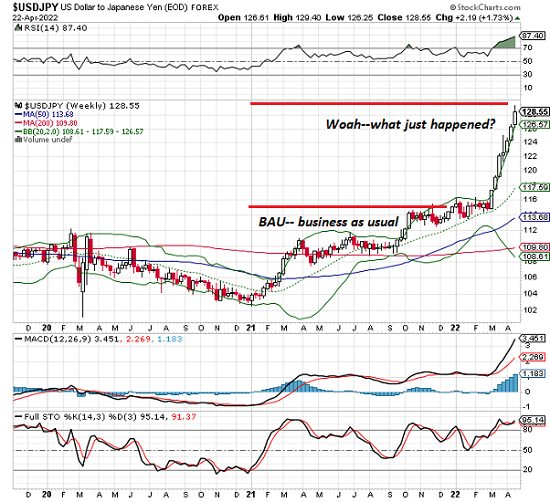
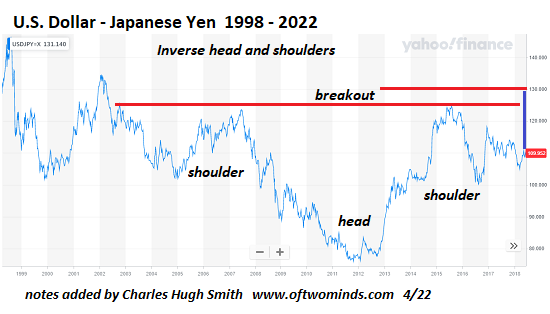
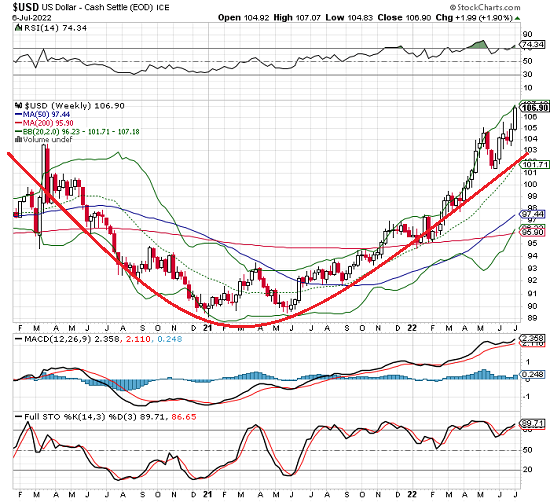
As the charts below reveal, the USD has formed a long-term bowl-bottom and an inverse heads-and-shoulders in the USD-JPY pair.
Yes, the USD may sag back to support but the bottom line is the USD rising makes everything cheaper for those holding U.S. dollars and much more expensive for everyone holding other currencies or assets in other currencies. Capital goes where it's treated well and U.S. markets are 1) a way to capture the gains of the U.S. dollar; 2) liquid and 3) relatively transparent compared to other markets.
A couple of trillion seeking safe haven here, a couple trillion seeking safe haven there and pretty soon that influx of capital starts pushing U.S. markets higher. Note that everyone who sold assets priced in yen in January and moved their stash into USD cash just made 20% in six months. That's a pretty nice return.
Capital moves from the periphery to the core when things start wobbling.
It would be very irritating to have a rally suck in all the bears salivating for a crash from a bear-market rally peak and then decimate the shorts with a rally that soars rather than collapses to new lows. The rally would be even more irritating if it left all the smart money on the sidelines because a rally simply doesn't make sense.
With great weeping and gnashing of teeth, the smart money is then forced to chase the rally higher.
Yes, this is implausible, impossible, etc. That's why it's increasingly likely. Is it really that easy to be right? As a general rule, no.
* * *

>>> Alaska On Fire: Stunning Satellite Imagery Shows Blackening Skies Over State

Alaska On Fire: Stunning Satellite Imagery Shows Blackening Skies Over State

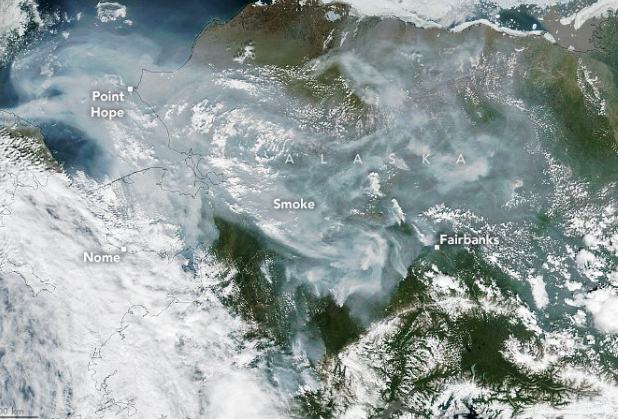
Alaska's fire season is off to a fiery start, possibly a historic one as more than 2 million acres burned, the earliest date for this milestone in decades.
As of Wednesday, more than 200 wildfires rage across the state, with worsening air quality over the central and eastern interior and the western Yukon Territory, Alaska Wildland Fire Information noted on their website.
New satellite imagery (via Visible Infrared Imaging Radiometer Suite on the NASA-NOAA Suomi NPP satellite) shows smoke and hundreds of wildfires blackening skies over the state.
The Alaska Interagency Coordination Center reported 210 active fires, and 42 were large, with firefighters working to control the blazes.
"Wildfires are a regular feature of Alaskan summers, but this year's fires have been exacerbated by drought, unusual heat, and several intense lightning storms. In early July, the area burned was on track to be among the largest on record," according to University of Alaska Fairbanks climatologist Rick Thoman, who NASA cited.

FT : Crypto Broker Voyager’s Marketing on Safety of Customer Accounts Draws FDIC

Voyager Digital Ltd. marketed its deposit accounts for cryptocurrency purchases as safe, protected by the nation’s banking insurance system in the event of a failure.

This week, when the company tumbled into bankruptcy, customers learned they didn’t exactly have the protection they expected and a banking regulator began an inquiry, according to a person familiar with the matter.

Voyager, a brokerage and lender, was caught in a spiral of plunging crypto prices that is collapsing hedge funds and companies and which blew a hole in its assets. Bitcoin, for example, has lost more than half of its value so far this year.

Voyager froze all activity, including withdrawals on $350 million in customer deposits that are stored at Metropolitan Commercial Bank, a small New York bank. Voyager said customers would be able to access those dollars after “a reconciliation and fraud prevention process is completed.”

The funds are expected to be paid in full to the customers, people familiar with the accounts said. That may not be the case for crypto assets held at Voyager.

Still, some customers online said they were only just learning their deposits weren’t insured by the Federal Deposit Insurance Corp. in the way they thought. Voyager had marketed the accounts as protected by that national safety net, an attractive pitch in the volatile world of cryptocurrency.

“In the rare event your USD funds are compromised due to the company or our banking partner’s failure, you are guaranteed a full reimbursement (up to $250,000),” Voyager wrote in 2019.

Thursday its website said “Your USD is held by our banking partner, Metropolitan Commercial Bank, which is FDIC insured, so the cash you hold with Voyager is protected.”

The individual customer accounts are eligible for insurance, but only in the case of a failure of the bank, not Voyager, Metropolitan Commercial Bank said this week. That is typical since the FDIC only backstops participating banks.

The confusion drew the attention of the FDIC, which is looking into Voyager’s marketing, according to a person familiar with the matter.

A Voyager spokesman declined to comment further.

Voyager has what is known as a For Benefit of Customers account at Metropolitan Commercial Bank.

That is standard for crypto firms and other fintech companies that act like banks in taking customer deposits but don’t have the licenses or ability to actually be a bank. At Voyager, the accounts hold the cash customers use for buying crypto assets or accumulate from selling them.

Metropolitan Commercial Bank held the money in one custodial account. Inside that, customers’ assets were separated into individual accounts by Voyager.

Voyager didn’t have access to the customer funds for its own purposes, according to bankers and analysts. The money is also segregated from Voyager’s assets in bankruptcy and protected from creditors, people familiar with the matter said.

The amount of cash in the customer accounts tripled in the last three months, a sign customers were pulling back on crypto assets.

Metropolitan Commercial Bank is one of a small group of banks willing to work with crypto firms. It held about $1.1 billion in deposits tied to crypto, 19% of its total, according to disclosures. It doesn’t hold any crypto assets and doesn’t make loans backed by crypto.

The bank has said it expects volatility in the deposit accounts due to swings in crypto markets. A hot market will have customers spending cash to buy crypto assets, while a crypto winter tends to see deposits increase.

For that reason, Metropolitan holds the deposits as cash and doesn’t use them for other investments or loans, said Keefe, Bruyette & Woods analyst Christopher O’Connell. The bank had $1.4 billion in cash and cash-like securities at the end of March.

Mr. O’Connell said losing Voyager’s deposit relationship would reduce Metropolitan’s earnings by only about 2% or 3%.

“We expect no additional fallout,” he wrote in a note.

WSJ : Twitter Defends Spam Accounting Amid Elon Musk Takeover

Twitter Defends Spam Accounting Amid Elon Musk Takeover
Company officials say spam accounts represent less than 5% of daily users based on closely held user data

Twitter Inc. TWTR 1.41% officials on Thursday doubled down on defending the accuracy of their calculation of spam on the platform, addressing an issue that has become a potential stumbling block in Elon Musk’s $44 billion deal to buy the company.

The officials, who asked not to be named, reiterated on a call with reporters Thursday that spam accounts make up less than 5% of the company’s daily monetizable users, which Twitter defines as daily users who are logged in and authenticated by Twitter. They added that it would be difficult for outsider auditors to accurately measure the figure that is based on private user information, such as internet addresses, geolocation data and contact information, that Twitter doesn’t share.

The issue of bots and spam has emerged as a complicating factor in Mr. Musk’s deal to buy Twitter. In May, Mr. Musk said his deal was “on hold,” as he questioned the way Twitter calculates spam and fake accounts. Mr. Musk has suggested he thinks the number could be closer to 20%, without providing evidence that the company’s disclosures were unreliable.

Twitter’s board has insisted it is moving forward on the deal as agreed. Executives have told employees that there is no such thing as a deal being put on hold, The Wall Street Journal previously reported. After some legal back-and-forth between the two sides, Twitter in recent weeks provided Mr. Musk with historical tweet data and access to its so-called fire hose of tweets, people familiar with the matter have said

In the briefing with reporters, the Twitter officials declined to say whether the company shared the private user information with Mr. Musk. They would only say that Twitter has fully complied with the obligations of the purchase agreement and that the privacy of user information was important to the company.

Twitter and rival platforms have spent years trying to stamp out bots and fake accounts through content-moderation teams and artificial intelligence tools, but many describe spam and fake accounts as a whack-a-mole problem since bad actors are constantly updating their methods.

The Twitter executives said their estimate of spam is based on sampling a portion of its accounts and human reviews of account activity. Those reviewers, Twitter executives said, analyze public information like what that account tweets and interactions with other accounts. They also factor in information that is available only to Twitter, including IP addresses, client and browser signatures and contact information.

Twitter said it typically removes more than one million spam accounts daily while they are being set up or soon after. Additionally, the company said, it locks millions of suspected spam accounts a week if humans can’t verify they aren’t spam.

Executives said that some legitimate users might appear to be fake because they kept automatically generated usernames and never took the additional step of making their username their own. There, private information, not available to the public, can help Twitter determine whether it is real.

Twitter officials added that because outsiders don’t have access to its internal data, those spam estimates can’t be accurate. They said the company hasn’t found a way to share this information with outside experts in a privacy-safe way.

FT : Watches of Switzerland defies downturn with high demand for luxury brands

Watches of Switzerland defies downturn with high demand for luxury brands
Maker of Rolex and Patek Philippe timepieces predicts sales will rise by a fifth this year

Watches of Switzerland has defied the growing gloom around consumer spending, predicting that sales will rise by around a fifth this year as buoyant demand continues to meet a scarcity of supply.

The group’s 171 stores in the UK and US sell brands such as Rolex, Patek Philippe and Breitling, with an average price of about £6,000.

Sales for the year to May 1 rose 40 per cent to £1.23bn as consumers spent savings that had piled up during lockdowns. Pre-tax profit almost doubled to £126mn.

Shares in Watches of Switzerland have almost halved this year following fears about the effect of a looming spending downturn on products that are both expensive and entirely discretionary.

But chief executive Brian Duffy said that while the group was “mindful” of the macroeconomic environment there was no indication of a slowdown in demand yet.

“Our average sales price is around £6,000 so it is clearly a higher-income demographic that is less affected by cost of living pressures but more conscious of asset valuations,” he said, adding that watches were increasingly regarded as an investment or an heirloom rather than straightforward consumer goods.

Supply is also constrained by the skilled nature of watchmaking and its concentration in one country. “The luxury watch industry is a microcosm, it’s a very conservative Swiss industry that has been producing below demand for some years now,” said Duffy.

“The numbers of people registered with us is many times the number of products we have to sell them,” he added. Around three-quarters of watch sales are of products for which there is a waiting list.

Geographic factors have also helped Watches of Switzerland. It is not present in either Russia or China, where demand has been more fragile, but has benefited greatly from its expansion in the US market.

Sales in America have gone from 19 per cent of the company’s total in 2019 to 35 per cent now, growing by almost half in the year just ended. Duffy forecasts that they will overtake UK sales in 2026 or possibly sooner.

Analysts at HSBC said there was “a clear supercycle of growth in the US market”. Per capita ownership of luxury watches is just 40 per cent of UK levels, partly because of a relative lack of dedicated retail outlets.

The company is in the early stages of expanding into Europe, with stores set to open in Ireland, Sweden and Denmark in this year.

Aside from the uncertain economic outlook, the only real trouble spot was travel retail. Since the start of 2021, it has no longer been possible for tourists to reclaim sales taxes on items purchased in the UK but then taken out of the country.

Watches of Switzerland has renegotiated its store at Heathrow airport to reflect its expectation that tourism-related sales will not recover to pre-Brexit levels because of this change.