WWD : Philanthropist and Society Fixture Lily Safra Dies at 87

Philanthropist and high society fixture Lily Safra has died in Geneva, Switzerland, at age 87.

Philanthropist and high society fixture Lily Safra has died in Geneva, Switzerland, at age 87.

Her death was revealed on Saturday by the Edmond J. Safra Foundation in a brief statement. Media reports indicate the cause as pancreatic cancer.

“For more than 20 years, Mrs. Safra faithfully sustained the philanthropic legacy of her beloved husband Edmond, providing support to hundreds of organizations across the globe,” said the organization, where Safra was chairwoman at the time of her death.

Born Lily Watkins in 1934 in Porto Alegre, Brazil, to Czech-British engineer Wolf Watkins and Annita Noudelman, she grew up in South America and was first married to businessman Mario Cohen. They had three children and divorced in the early 1960s.

A second marriage to Alfredo “Freddy” Monteverde ended with his death in 1969, after a struggle with mental health. Her third union was short-lived and ended in divorce.

Safra became a fixture of New York society after her fourth and final marriage in 1976 to banker Edmond J. Safra, to whom she stayed married until his 1999 death in a mysterious and controversial arson fire in Monaco that attracted significant media coverage because of his wealth. One of Safra’s nurses was convicted of starting the fire. Safra left half his fortune to charities while Lily Safra reportedly inherited $800 million.

In the decades that followed, she was known as “one of the leading philanthropists in the world with an enduring devotion to her late husband” and for “only [doing] splendid evenings,” wrote society columnist Aileen Mehle, best known under her pen name “Suzy.”

Her life-long connection to culture and couture also saw her regularly mentioned in the fashion world. A 2003 dinner she hosted in her New York home saw the likes of former British Prime Minister Margaret Thatcher; New York’s then-Mayor Michael Bloomberg; Evelyn and Leonard Lauder, and Carolina and Reinaldo Herrera among her guests.

At the 2004 Sidaction AIDS benefit dinner, she was spotted in conversation with Karl Lagerfeld and Lady Amanda Harlech.

Through several organizations she cofounded, Safra supported a large number of causes, with a particular focus on furthering education and research on brain diseases, especially Parkinson’s, which had affected her husband in the latter part of his life.

In 2012, she put her jewelry collection, with a sizeable section devoted to the jeweler JAR and a 32-carat ruby ring by Chaumet, up for auction at Christie’s Geneva.

The “Jewels for Hope” sale netted nearly $38 million, with proceeds distributed to some 32 charities including the Elton John AIDS Foundation, the Paris Opera, the Paris Ballet, the Royal Opera House London and Henry Street Settlement in New York.

After the 2019 fire that devastated the Cathédrale Notre-Dame de Paris, Safra pledged 10 million euros for its restoration.

According to a biography published by the Edmond J. Safra Foundation, Safra received a number of awards, among which honorary doctorates from prominent higher education institutions like the Hebrew University of Jerusalem and Imperial College London; honorary fellowships from King’s College London and the Courtauld Institute of Art, and France’s Legion d’Honneur.

She also served as trustee of New York’s Museum of Jewish Heritage and board member of the Michael J. Fox Foundation for Parkinson’s Research and the Foundation for the National Institutes of Health.

Safra is survived by her children, grandchildren, and great-grandchildren. A funeral service will be held on Monday in Geneva.
(ZH) Morgan Stanley: Soaring Dollar Will Crush Earnings Growth And Snuff The Ral

Morgan Stanley: Soaring Dollar Will Crush Earnings Growth And Snuff The Rally In Stocks

By Michael Wilson, Morgan Stanley chief US equity strategist
One of the more popular views over the past decade has been the eventual demise of the US dollar. After all, with the Fed printing so many dollars since the global financial crisis and then doubling down after the Covid pandemic hit two years ago, this idea has merit. Indeed, the meteoric rise in cryptocurrencies was essentially a bet on the entire fiat currency world coming unglued. However, after the GFC, these printed dollars never made it into the real economy as they were simply used to patch up broken balance sheets from the housing bust. Therefore, M2 growth never got “out of hand”, exceeding 10% on a year-on-year basis only briefly in 2009 when QE first began and then again in 2012 when QE3 was started to help to offset the sovereign debt crisis. In fact, during the entire period after the Fed first embarked on QE in November 2008 through the end of the cycle in March 2020, M2 growth averaged just 6% – right in line with the long-term trend of M2 and nominal GDP growth. As a result, the US dollar maintained its reserve currency status and rose almost 40% during that decade.
However, as we pointed out back in April 2020, the stimulus provided during Covid was very different. At the time, we suggested that the coordinated fiscal and monetary policy was unprecedented and akin to “helicopter” money as described by Milton Friedman in his seminal paper back in 1969 and referenced by Ben Bernanke in 2002 as a tool the Fed could always use to avoid a deflationary trap. In other words, the seeds of today’s inflation were sown in those early months right after the pandemic with the first dose of helicopter money. That first drop was arguably necessary to prevent a deflationary bust. But, handing out free money is very popular with the people, so there were two more doses – one by each party – administered in January and March 2021 after we had an effective vaccine to help to reopen much of the economy. The result is that M2 growth exploded and since February 2020 has averaged 17%, or 3x the long-term trend – a truly unprecedented outcome that left us with much more inflation than was desired. Consequently, the US dollar fell sharply from March 2020 to March 2021 but, once M2 growth peaked, so did the dollar’s decline. Now, with the Fed reversing course so quickly and the checks having stopped long ago, M2 growth has fallen all the way back to its long-term trend of just 6%. Given the projected path for rate hikes and quantitative tightening, M2 growth is likely to fall even further and the dollar is unlikely to show any signs of demise until the Fed pivots, which seems unlikely any time soon, especially after Friday's strong jobs report.
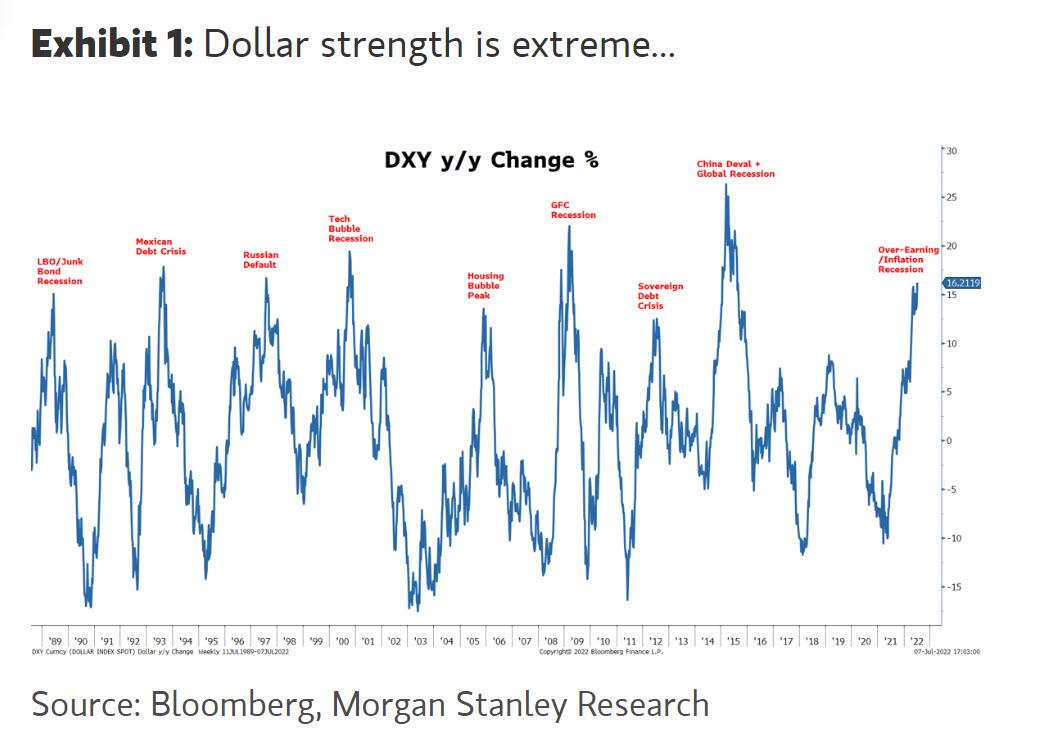
So why does this matter so much for stocks? Based on the extreme rally so far this year, the DXY is now up 16% year on year. This is about as extreme as it gets historically speaking and, unfortunately, it typically coincides with major financial stress in markets, a recession, or both.
Ultimately, the Fed wants a meaningful economic slowdown to curtail inflation and a stronger dollar is part of that cocktail. From the standpoint of stocks, the stronger dollar is going to be a massive headwind to earnings for many large multinationals. This could not be coming at a worse time as companies are already struggling with margin pressure from cost inflation, higher/unwanted inventories, and slower demand.
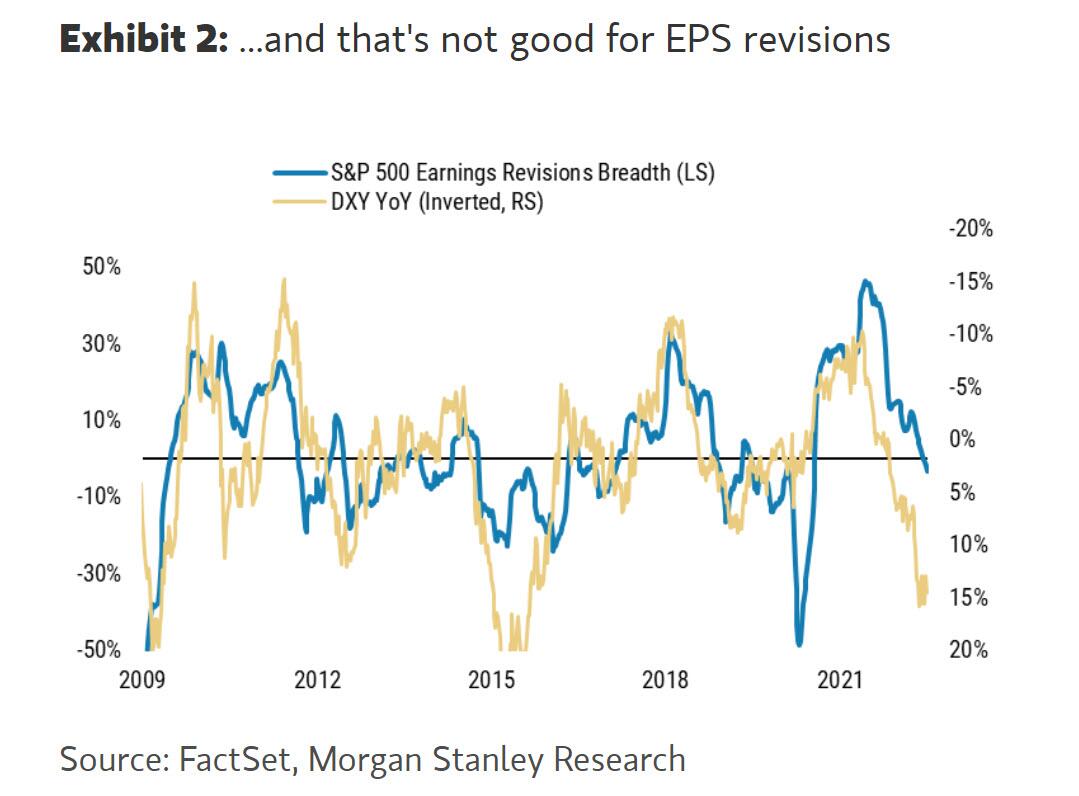
The simple math on S&P 500 earnings from currency is that for every percentage point increase on a year-on-year basis it’s approximately a 0.5x hit to EPS growth. At today’s 16% year-on-year level, that translates into an 8% headwind for S&P 500 EPS growth, all else equal.
Of course, things can change quickly, but it doesn’t seem likely until M2 growth stops slowing, which will require a Fed pivot. The main point for equity investors is that this dollar strength is just another reason to think earnings revisions are coming down over the next few earnings seasons, which starts next week. Therefore, the recent rally in stocks is likely to fizzle out before too long.

FT : Buyers challenge UK government’s decision to block Truphone deal

Buyers challenge UK government’s decision to block Truphone deal
Transaction to sell Abramovich-owned telecoms group under scrutiny on national security grounds

The prospective buyers of UK telecoms group Truphone, which is owned by Roman Abramovich and Russian associates, are challenging the British government’s decision to block the deal while it conducts a national security probe.

Hakan Koç, a German businessman who founded the used-car company Auto1, and his business associate Pyrros Koussios, a former telecoms executive and private equity investor, made an offer to buy the company for £1 in May, after sanctions imposed on Russian billionaire Abramovich threw the future of the group into doubt.

On Thursday, a day before Koç and Koussios were hoping to close the transaction, the purchase was “called in” under the UK’s new National Security and Investment Act, which gives the government the power to block or unwind deals it believes pose a risk to national security, according to people briefed on the situation.

The Department for Business, Energy and Industrial Strategy also issued an interim order to halt the deal while it makes its investigation, the people said.

Lawyers for the prospective buyers wrote to the government’s Investment Security Unit on Friday saying that the interim order increased the likelihood of Truphone entering insolvency, which could lead to hundreds of job losses, according to people with knowledge of the details.

They also said that delaying the deal meant Truphone would remain under the ownership of sanctioned individuals.

The business currently faces severe challenges to its cash flow and will lose customers and commercial viability if new capital is not invested soon, the lawyers noted in their letter.

Earlier this year Truphone appointed FRP to find a buyer for the company, which has received more than £300mn in investment from Abramovich and his two Russian business partners Alexander Abramov and Alexander Frolov. The company, which allows customers using its digital SIM cards to avoid roaming charges, was valued at £410mn in 2020 and has recorded 15 consecutive years of losses.

People close to the deal believe the government’s decision, which was first reported by Sky News, is linked to a contract Truphone has with British telecoms group BT that allows users to access their digital SIM card remotely. This process requires access to BT data.

The new owners are willing to avoid activities related to contracts with BT that have given rise to national security concerns until cleared by the government, according to one person with knowledge of their position.

The person added that the government could go ahead with its national security probe without blocking the deal.

The decision to delay the Truphone deal comes at a time of increased scrutiny of foreign involvement with UK telecoms assets. In May, the government called in French telecoms group Altice’s majority stake in BT, which increased from 12 to 18 per cent late last year.

The national security act gives the business secretary the power to call in any transaction they “reasonably suspect gives rise to or may give rise to a risk to national security”, according to a business department document.

If deemed “necessary and proportionate”, they can then “impose certain conditions, block or unwind it completely”.

According to its first interim report on the new powers, between January and March this year the UK government was notified about 222 transactions that may have an impact on national security, of which 17 were called in.

The business department said in a statement: “The Government routinely monitors acquisitions across the economy in case of national security concerns.”

FT : Twitter hires Wachtell legal firm to sue Elon Musk for ending $44bn acquisi

Twitter hires Wachtell legal firm to sue Elon Musk for ending $44bn acquisition
Social media company prepares to file suit at Delaware Court of Chancery, vowing to hold billionaire to original deal terms

Twitter has hired elite law firm Wachtell, Lipton, Rosen & Katz as it readies for a legal battle against Elon Musk, who has moved to terminate his $44bn acquisition of the social media company, according to two people familiar with the situation.

The San Francisco company is preparing to file its lawsuit with the Delaware Court of Chancery against Musk early this week, one of the people said.

Musk said on Friday that he planned to walk away from his deal to buy Twitter, citing three breaches of the merger agreement by the social media platform.

In response, Twitter vowed to hold the mercurial billionaire to his original deal terms and price of $54.20 per share, in what could develop into a messy legal fight that would dictate the future of the company.*

In addition to drafting merger agreements, Wachtell Lipton has perhaps the leading litigation practice in Delaware, where the majority of US public companies are incorporated. It defends companies in breach of fiduciary duty lawsuits and broken merger agreements in the state.

Both Twitter and Musk will also probably hire local counsel in Delaware to work alongside the lawyers whom they retain from other states.

The firm had initially defended Musk in a shareholder lawsuit brought in Delaware by Tesla shareholders who alleged that Musk had improperly bailed out SolarCity, another piece of the Musk empire, when Tesla acquired the clean energy company in 2017.

Earlier this year, Musk was cleared by a Delaware judge of any wrongdoing in that case. He was represented by the law firm Cravath, Swaine & Moore in the 2021 trial.

Twitter declined to comment on Wachtell’s appointment, which was first reported by Bloomberg. Wachtell did not immediately respond to a request for comment.

In a regulatory filing on Friday, Musk’s team argued that Twitter had failed to provide enough information to prove that the number of fake and spam accounts on its platform stands at less than 5 per cent, as it has long estimated.

The filing alleged that the true number may in fact be “wildly higher”, suggesting the company had made false statements in its regulatory filings. It also accused Twitter of failing to comply with its obligation to “conduct its business in the ordinary course”, by firing several senior employees after the agreement had been made.

Twitter, which denies Musk’s claims, has an incentive to push the deal through or extract a larger break-fee from Musk than the $1bn already agreed. Its share price has declined by more than 30 per cent since the Tesla chief made his offer and no other buyers have emerged.

The company is likely to argue that Musk’s concerns simply mask buyer’s remorse over a pricey and highly leveraged deal, amid a broader rout in tech stocks.

Additional reporting by Alexandra Scaggs in New York

WSJ : Argentina Heads for Another Crackup

Argentina Heads for Another Crackup
As it fails to honor its reform commitments, inflation is soaring. Sound familiar?

The resignation of Argentine Economy Minister Martín Guzmán on July 2 comes three months after he renegotiated his country’s $45 billion debt with the International Monetary Fund. The fund says the stabilization and growth program it worked out with Mr. Guzmán is still on track. But widespread fears that a sharp devaluation of the peso is coming, along with higher inflation, suggest otherwise. The country could be headed for another crackup.

The March rescheduling of the IMF debt wasn’t the first time Mr. Guzmán bought more time for the world’s most notorious deadbeat to repay what it has borrowed. In August 2020 he led a restructuring of some $65 billion in sovereign debt held by major bondholders such as Fidelity Management & Research Co., Monarch Alternative Capital LP, VR Capital Group, Greylock Capital Management and Pharo Management LLC.

The 39-year-old center-left economist should have been writing his own ticket inside the government of President Alberto Fernández. Instead, he found himself battling Vice President Cristina Fernández de Kirchner —no relation to the president—who opposes even the minor reform commitments he made to the IMF. Mrs. Kirchner won.

President Fernández quickly filled the vacancy created by Mr. Guzmán’s departure with Silvina Batakis, an ally of Mrs. Kirchner and her hard-left faction inside the Frente de Todos ruling coalition. Ms. Batakis’s resume isn’t reassuring. She’s a former minister of the economy for the province of Buenos Aires (2011-15) who left her successor with empty coffers and forced him to turn to the federal government for emergency help to pay the salaries of public employees.

On Wednesday IMF Managing Director Kristalina Georgieva tried to ward off panic. She tweeted that she’d had a “very good call” with Ms. Batakis, “to discuss implementation of Argentina’s program.” Reuters reported that Ms. Batakis “had already spoken with the head of the IMF’s Western Hemisphere department and committed to support the objectives of the [renegotiated] IMF program.”

Yet it’s worth recalling that a March 2022 IMF staff report on the Guzmán program warned that it is “subject to exceptionally high risks,” including that it “may fail to engender confidence and strengthen stability.” Those risks have now gone up. Both the Paris Club and Inter-American Development Bank say that any new lending arrangements require guarantees of reform commitments to the IMF.

Argentina is by far the fund’s largest borrower. To put its $45 billion debt in perspective, Egypt, the next-largest borrower, owes the Washington-based multilateral a mere $12 billion. Argentine borrowing at the IMF is now at 1,000% of its quota.

In December 2015 when center-right President Mauricio Macri took office, expectations were high that he would tackle the age-old Argentine practice of printing pesos to pay government bills. But he failed to right-size public spending, preferring a gradualist approach to working with a Congress he didn’t control.

By May 2018 international financing was drying up as markets began to lose faith in Mr. Macri. When the peso came under attack, the IMF stepped in with a $30 billion emergency package that soon became part of a $57 billion standby agreement. Mr. Macri lost his re-election bid in October 2019, but when he left office a few months later Argentina had drawn down $44 billion from that agreement.

Argentina had payments due of $19 billion this year and $20 billion in 2023. The “extended fund facility” that Mr. Guzmán secured delays those payments, pushing their start to the second half of 2026 and extending the life of the loan to 2034.

But that won’t save Argentines from another round of hyperinflation driven by government “experts” who believe in modern monetary theory—which posits that printing money to pay bills doesn’t have to cause inflation if tax rates are high enough.

The public knows better. Since 2017 the peso has lost 87% of its official market-rate value, which is now roughly 130 to the dollar. In the black market the currency now trades at around 265 to the dollar.

Argentine economist Aldo Abram told me last week that “inflationary expectations are spiraling out of control” because “the central bank is robbing the public of its purchasing power.” As demand to hold pesos collapses, triple-digit inflation is becoming more likely, he said. Even with lots of flexibility and latitude from the IMF, it’s hard to see how this doesn’t end in tears.

WSJ : What Happened to the Twitter-Elon Musk Deal?

What Happened to the Twitter-Elon Musk Deal?
Tesla CEO says he is seeking to terminate his $44 billion deal to buy the social-media platform, setting up a possible legal battle

Elon Musk said he is seeking to terminate his $44 billion deal to buy Twitter Inc., TWTR -5.10% nearly two months after saying the deal was “on hold” over his questions about the number of spam and fake accounts on the platform.

Twitter “is in material breach of multiple provisions of that agreement,” according to a letter from Mr. Musk’s lawyer filed with securities regulators. The letter also accused the company of making “false and misleading representations” when entering into the agreement.

Twitter said it intends to close the transaction at the agreed price of $54.20 a share, setting up a possible legal battle over what comes next for the social-media platform.

Here’s what to know.

Why did Elon Musk say he was pulling out of his deal to buy Twitter?
Mr. Musk said in a regulatory filing Friday that the company hadn’t provided the necessary data and information he needs to assess the prevalence of fake or spam accounts on the platform. In the filing, Mr. Musk’s lawyers said that Twitter had made material changes to the business without his consent, such as laying off some staff and implementing a hiring freeze.

What will happen next in the Twitter deal?
Twitter’s board on Friday said it would pursue legal action to enforce the terms of the deal at the price and terms originally agreed upon. “We are confident we will prevail in the Delaware Court of Chancery,” Bret Taylor, chairman of the board, tweeted.

Can Twitter sue Elon Musk?
Yes, and likely will. Under the terms of the agreement, Mr. Musk agreed to pay a $1 billion reverse termination fee to Twitter if the deal falls apart, though that is only triggered under certain scenarios including if his debt financing falls through or regulators try to block the deal. The merger agreement caps at $1 billion the amount either side can sue for damages for. So Twitter’s legal options now are to sue for a maximum of $1 billion, a fraction of what it stands to lose out on should the deal fall apart, or sue for specific performance. If it sues for specific performance and Mr. Musk agrees to settle, that could involve a payment of more than $1 billion.

What’s the current price of the Twitter stock?
Twitter shares closed at $36.81 on Friday, down 18% from the day Mr. Musk disclosed his offer. They fell 4.8% in after-hours trading following the disclosure.

Why were Twitter’s spam accounts a point of contention for Elon Musk?
Mr. Musk has said the spam and fake accounts issue is fundamental to Twitter’s business and financial performance, and that getting clarity is necessary for him to line up financing for the deal.

He tweeted in May that the deal was “on hold” over details about spam and fake accounts on the platform. The following month, he threatened in a letter to the company to end the deal if Twitter didn’t provide data he had requested. He has said the deal wouldn’t proceed unless he could see such data to evaluate the company’s claims about how many of its users are spam or fake accounts.

Many observers have speculated that Mr. Musk was using the fake accounts issue as leverage to renegotiate or exit the acquisition, given that he was aware of the issue long before agreeing to buy Twitter, and yet waived due diligence on the business prior to inking the deal.

Twitter has long estimated that spam or fake accounts represent fewer than 5% of its monetizable daily active users, which it most recently pegged at 229 million. Mr. Musk has said he thinks the number could be closer to 20%. Twitter provided access to the platform’s full fire hose of tweets, but data specialists say analyzing it isn’t easy.

Mr. Musk, as one of Twitter’s highest-profile users, is particularly susceptible to seeing spam on the platform, according to researchers.

In the regulatory filing, Mr. Musk’s lawyer said, “Twitter has ignored Mr. Musk’s requests, sometimes it has rejected them for reasons that appear to be unjustified, and sometimes it has claimed to comply while giving Mr. Musk incomplete or unusable information.”

What are the financial stakes in the deal?
Mr. Musk had agreed in April to buy Twitter for $44 billion, or $54.20 a share.

He said he didn’t care about making money from the deal: “Having a public platform that is maximally trusted and broadly inclusive is extremely important to the future of civilization. I don’t care about the economics at all,” Mr. Musk said in an April interview.

Mr. Musk, as he lined up financing for the deal, sold more than $8 billion in Tesla Inc. stock.

Shares in the electric-vehicle maker advanced more than 2% after Mr. Musk said he was done with his Twitter pursuit that had annoyed some of the billionaire’s Tesla fans.

Also potentially losing out in the deal are financial institutions looking to make it happen. Twitter’s bankers would stand to make tens of millions in advisory fees on closing, according to a previous regulatory disclosure. Goldman Sachs Group Inc. would stand to make around $80 million, including $15 million upfront, while JPMorgan Chase & Co. could make $53 million, including $5 million upfront.

Why was Elon Musk interested in the deal?
Mr. Musk has called Twitter the “de facto town square,” and said he wanted to buy the platform because he thought it was important for there to be “an inclusive arena for free speech.”

Mr. Musk, who has over 100 million followers on the platform, indicated he would seek to make substantial changes to the social-media site, including softening the way it moderates content and supporting an edit button for tweets—something the company was already working on. He also said he would try to eliminate bots, rely less on advertising and enable encrypted messaging. He said he planned to take the company private, which would have made it easier to implement desired changes without shareholder pressure.

FT : Europe regulator warns of ‘cautionary lesson’ from crypto crash

Europe regulator warns of ‘cautionary lesson’ from crypto crash
Verena Ross says investors cannot expect bailout because risks were so widely flagged

Crypto investors should take the market crash as a “cautionary lesson” about putting money into risky unregulated assets and cannot count on any kind of a bailout, Europe’s top securities regulator has said.

“We already warned earlier this year . . . about the serious risks retail investors were taking investing in some of the crypto assets,” said Verena Ross, chair of the European Securities and Markets Authority.

The global crypto market has fallen by more than 70 per cent in the past year and Ross said she was worried about the implications for small investors.

“I think there is a real question about whether many of these [crypto assets] will survive . . . I hope that some of these investors will see this and will take a cautionary lesson at least to think about how much of their money they invest in these kinds of assets.” 

She added there was no prospect of a European bailout for out-of-pocket investors because warnings about the dangers had been so widespread.

In March, ESMA and Europe’s other leading financial regulators warned consumers of the “very real possibility of losing all their invested money” if they bought cryptocurrency, using stronger language than a similar warning a year earlier.

“We have all said that this is something that is not currently regulated, not something where this is any control over the providers, [where] we know there is a lot of fraud and aggressive marketing going on,” Ross said, adding that regulators used social media to try to get their warnings across to audiences most engaged in crypto.

ESMA is preparing to assume licensing responsibility for Europe’s largest crypto asset services providers under a landmark deal agreed in Brussels last month, which also includes provisions such as mandatory environmental disclosures and some consumer protection for things like lost crypto wallets.

The deal comes into force from mid-2023 and has an 18 month implementation period. Ross said it was important to move as quickly as possible and to push for “convergence” of national rules already in place, echoing calls by the ECB last week.

ESMA is also watching developments in commodities and other markets as inflation and interest rates surge and the sharply deteriorating economic environment drives volatility.

“We see real risks of market reactions to the changing economic environment,” said Ross, adding that regulators are trying to understand “where those risks might be arising so that . . . at least we are conscious of what the significant market corrections are that could happen”.