(ZH) Why Was Hunter Paying Joe Biden $50k Per Month To Rent House Where Classifi

Why Was Hunter Paying Joe Biden $50k Per Month To Rent House Where Classified Documents Found?

A Thursday tweet from the NY Post's Miranda Devine containing a background check for Hunter Biden has people asking questions.

"The now-52-year-old began listing the Wilmington home as his address following his 2017 divorce from ex-wife Kathleen Buhle — even falsely claiming he owned the property on a July 2018 background check form as part of a rental application," the Post reported.
Of note, this is the same house where classified documents were found.
Yet, upon closer inspection, Hunter lists the "Monthly Rent" as $49,910 - or roughly $550,000 for the 11 months he indicated he lived there?
A Zillow search reveals that the most expensive home currently for rent in Wilmington, Delaware is going for $6,000 per month.
According to Town & Country magazine, Biden's home is worth around $2 million.
Could Hunter, a crackhead, have accidentally listed the annual rent payment to his father for the house which contained classified documents? Sure. But why was his wealthy ex-VP dad charging him rent in the first place, when Hunter was allegedly broke?
Trending Politics asks the quiet part out loud; was this Hunter's way of funneling money to his father?
After Hunter’s divorce was finalized in May of 2017, he was included in an email from his business partner James Gilliar about a venture with Chinese state-funded energy company CEFC China Energy. The email stated that Hunter and his partners would receive 20% of the shares in the new business, with 10% going to Hunter’s uncle James Biden and the other 10% being “held by H for the big guy.”
Tony Bobulinski, another one of Hunter’s former business partners, claims that he had a meeting with Joe Biden regarding the CEFC venture on May 2, 2017, and that the president was the individual referred to as the “big guy” in Gilliar’s email. Additionally, Gilliar himself confirmed that Joe Biden was the “big guy” mentioned in a message found on the laptop.
And as the NY Post reports, "The following year, federal investigators began looking into whether Hunter and his business associates violated tax and money laundering laws during their dealings in China and other countries. Emails and other records related to the deals were found on the laptop, which Hunter dropped off at a Delaware repair shop in 2019 and never reclaimed."
"I hope you all can do what I did and pay for everything for this entire family for 30 years," Hunter told his daughter Naomi in January, 2019. "It’s really hard. But don’t worry, unlike pop, I won’t make you give me half your salary."
As the Post continues:
The laptop doesn’t contain any direct evidence of such money transfers but shows Hunter was routinely on the hook for household expenses — including repairs to the Wilmington home.
In December 2020, weeks after his father was elected president, Hunter Biden announced that his “tax affairs” were being investigated by federal authorities in Delaware, and said he was “confident that a professional and objective review of these matters will demonstrate that I handled my affairs legally and appropriately.”
Recent reports have indicated investigators believe they have enough evidence to charge the first son with tax crimes — as well as with lying about his drug abuse on a federal form so he could buy a gun in 2018.
So, was the $49,910 'monthly' rent a simple crackhead mistake when that was in fact the annual payment amount, or did Hunter create "Exhibit A" for any honest prosecutors to pursue? We aren't holding our breath on the latter.

FT : Ford to cut dependence on VW for next generation of electric cars

Ford to cut dependence on VW for next generation of electric cars
US group prepares to launch vehicles using its own technology

Ford is poised to cut its dependence on Volkswagen technology for its next generation of electric cars in Europe, unravelling a core part of the alliance formed between the rival carmakers two years ago.

The US brand is preparing to launch two vehicles this year and in 2024 that use VW’s electric “MEB” system, which includes assembling VW-sourced batteries at Ford’s plant in Cologne, Germany.

But from the middle of the decade Ford expects to launch vehicles that use its own in-house system, which is being engineered by Ford in the US, said Martin Sander, the head of electric vehicles in Europe.

The new system had “no kind of integration [with VW], it is very versatile, very capable”, he said. “We are exploring all kinds of opportunities, how far can we go, what kind of segments can we cover with this.” 

He said a “final decision” was not taken on the future of its collaboration with VW on electric cars, saying Ford is “open” to building future vehicles on other systems, whether by VW or “another company”.

The two global carmakers formed an alliance in 2020 in order to join forces on electric cars, self-driving technology and commercial vehicles, one of several partnerships across the industry as auto groups team up in the face of rising development bills.

VW and Ford recently stopped joint work on driverless cars, after the closure of the Argo AI business, though the pair still work closely together on commercial vehicles for Europe.

The US group will still build VW’s next delivery van, as well as its next pick-up truck, and a future electric van.

Ford has been reshaping its business in Europe and positioning the brand to sell fewer types of vehicles. It hopes they will be more distinctive as the market becomes saturated with increasingly indistinguishable electric vehicles.

It recently announced the phaseout of the Fiesta, a historic small car that was the best selling model in the UK for several years, but has no plans to replace it with a battery version for the foreseeable future.

“We are not looking at entry-level vehicles at the moment,” said Sander, although it is something that the company is open to in future if battery costs fall sufficiently.

He said it depends on “the overall feasibility of making an entry level vehicle work financially”, adding: “We know we have a big customer base.” 

In 2021, Ford carved its company into three units — electric vehicles, engine models and commercial vehicle services — to help its teams work in a more focused way as it shifts towards an era selling only electric vehicles.

Sander said Ford expected to make a profit in the European wing of its electric car unit in 2025, which is in line with industry estimates that high costs and relatively low sales will hamper profitability in the short term.

The company would also pass through the rising costs of batteries into its models, he added.

The group may also withdraw petrol or hybrid models from sale before its 2030 deadline for ending engine sales, if demand has shifted to electric models faster than expected.

“We keep them running as long as our customers want them,” he said. “If we see in 2028 that there is no demand for [internal combustion engine] products, then maybe we make a call. But at the moment our plan is to keep Puma and Kuga [its two engine-based models] running until 2029, 2030.”

The EU plans to phase out new petrol and diesel sales by 2035 under plans that some carmakers want delayed.

Sander said a 2035 cut-off for passenger cars was a “very theoretical conversation because I can’t believe that there would be a big number of consumers asking for [internal combustion engine] products in 2035”.

The European Commission is also considering tightened rules on engine emissions from 2025, which some carmakers have said would force them to divert spending from electric cars into older models to keep them compliant.

Sander said the new rules would be “dramatic for the whole industry” if introduced in 2025, rather than later on in the decade, and would make it likely that Ford ended some vehicle production early.

Bringing in the new rules, which are not yet finalised, in 2025 would force Ford to make decisions “soon” including fewer engine variants, and “most likely that one of the other [internal combustion engine] products will be discontinued earlier”, he added.

FT : Bayer shifts pharma focus away from ‘innovation unfriendly’ Europe

Bayer shifts pharma focus away from ‘innovation unfriendly’ Europe
German group’s drugs chief warns EU and UK are dissuading investment as company prioritises US and China

Bayer has said it is shifting the focus of its pharmaceutical business to the US and away from Europe and the UK, where governments are making “big mistakes” in how they manage health budgets.

Stefan Oelrich, head of the German conglomerate’s drugs business, told the Financial Times that Europe was becoming “innovation unfriendly” because policymakers were making it more difficult to generate commercial returns on their investments. The expansion of a medicines levy in the UK designed to limit the NHS’s drugs bill and similar schemes in Germany were dissuading investment, he added.

“Europe is making some real big mistakes,” he said during an interview at the JPMorgan Healthcare conference in San Francisco, California.

“European governments are trying to create incentives for research investments, but they are making our lives miserable on the commercial side. If you have no sales, you can benefit on the cost side as much as you want but it is not a good equation,” said Oelrich.

He added that Bayer was “deprioritising Europe to some degree” and focusing on the US and China, where its pharma division has already established a significant market presence. Beijing was increasingly welcoming of innovation, while higher drugs prices in the US enabled the company to compensate for the explosion of costs caused by high inflation, said Oelrich.

“We are really shifting our commercial footprint and the resourcing of our commercial footprint much away from Europe,” he added.

The pharmaceutical industry is becoming increasingly concerned about new levies and taxes in Europe that threaten profits. The sector has warned that it risks denting EU and UK policymakers ambition for their countries to become leaders in life sciences research and innovation.

Bristol Myers Squibb said last month that the expansion of the UK’s voluntary scheme for branded medicines pricing and access could divert investment away from the country.

This scheme is an agreement between the Department of Health and the pharma industry that required drug companies to pay a portion of their revenues from their products to the government if the NHS’s overall bill for medicines rises by more than 2 per cent annually. In 2022, the rate was set by the department at 15 per cent, generating $1.8bn in industry rebates. In 2023, the rate increased to 26.5 per cent and is forecast to cost $3.3bn.

Oelrich said the UK levy increased rebates to the NHS and translated into lower net prices. These were “significant cuts” and Bayer was reducing its commercial footprint and jobs as a result, he added.

“It [the levy] means we reduced net pricing in an environment with 10 per cent inflation. And we have no opportunity to pass on pricing in countries like the UK to the market,” he said.

The UK corporate tax rate is also set to rise to 25 per cent on April 1, up from the current rate of 19 per cent, delivering a further blow to corporate profits.

Also, the German parliament passed a new law in October aimed at shrinking the nation’s drugs bill, amid rising healthcare costs and budget pressures.

Bayer’s criticism of European and British health policies coincided with a visit by Nus Ghani, the UK’s minister of state at the department of business, energy and industrial strategy, to JPMorgan Healthcare to promote the UK as a life sciences research hub.

The UK government said it disagreed with the assessment by Bayer.

“The Life Sciences Vision sets out our ambitious plan to make the UK the most attractive place in the world for life sciences innovation. It has attracted £1bn of investment to the UK from leading global companies,” said a UK government spokesperson.

Bayer’s pharma division generates about 40 per cent of its sales in Europe, the Middle East and Africa, while North America and the rest of the world make up 23 per cent and 37 per cent respectively.

Oelrich said the company was investing heavily in the US, where it recently acquired biotech companies Asklepios BioPharmaceutical and Vividion Therapeutics in deals worth up to a combined $5.5bn.

The US expansion was bearing fruit, he said. At the JPMorgan conference, Bayer more than doubled its combined peak sales forecast for its four key fastest growing drugs — Nubeqa, Kerendia, Asundexian and Elinzanetant — to €12bn, up from €5bn.

The success of Bayer’s US pharma unit stands in contrast to the company’s disastrous $63bn takeover of Monsanto in 2018, which has cost it $16bn in legal settlements so far linked to claims that its weed killer Roundup caused cancer.

Activist investor Jeff Ubben announced last week that his investment fund had taken a stake in the German conglomerate and called on it to hire a new chief executive from outside its management ranks.

FT : What the end of the US shale revolution would mean for the world

What the end of the US shale revolution would mean for the world
Fracking catapulted America to the top of the energy hierarchy, but low yields and a lack of reinvestment threaten that position

When the Decathlon, a 274-metre-long tanker, powered into the German port town of Wilhelmshaven last month it was tangible evidence of American geopolitical power.

Days earlier, an EU embargo on Russian seaborne crude had come into force, threatening yet more disruption in global energy markets. As the Decathlon unloaded its cargo, American oil was arriving in the nick of time.

Russia’s invasion of Ukraine has precipitated a global energy crisis — and the US has been among the biggest beneficiaries. As Moscow has cut natural gas shipments to Europe and western sanctions have targeted its oil, American exports of both have soared. About 500 tankers laden with American oil have sailed to Europe since February 2022, according to data firm Oilx, helping US crude exports hit a record high last year.

The milestone marked the apogee of the shale revolution — a 15-year energy and technology upheaval in which fracking made the world’s largest consumer of oil and gas also its biggest producer. Rapid shale growth delivered a huge stimulus to the global economy by keeping fuel prices low, and freed Washington’s hands to take on oil-rich rivals in Iran and Venezuela without fear of economic blowback for voters at home.

Soaring shale oil output helped soothe volatile crude markets — even as the Arab Spring brought turmoil to Middle Eastern producers and fresh conflict erupted in northern Iraq and the Arabian peninsula, including attacks on Saudi oil infrastructure. Today, the flotilla of American oil and gas exports traversing the Atlantic has helped to neutralise Vladimir Putin’s energy war.


The golden age of shale “vaulted the United States back to the top of the table in terms of geopolitical significance”, says David Goldwyn, a former senior energy adviser to Barack Obama and head of Goldwyn Global Strategies, a Washington consultancy. “The US is no longer in a position where it has to worry about the physical supply of oil or gas . . . and that gives it a great deal more freedom of action in international affairs.”

Additionally, the cumulative abundance of shale supply delivered over the past 15 years continues to shelter Americans from the sky-high natural gas and fuel prices that have rattled other developed economies, giving its industry a competitive advantage and its households more disposable income.

But that transformative age is drawing to a close, say analysts, with unpredictable consequences. High costs and labour shortages now bedevil the shale patch. Wall Street wants profits paid back to investors, not reinvested in new rigs. Even with crude prices at $80 a barrel, a price far above the long-term average, shale producers still fear to splurge capital. To top it off, new wells are yielding less oil.

“The aggressive growth era of US shale is over,” says Scott Sheffield, chief executive of Pioneer Natural Resources, the country’s biggest shale producer. “The shale model definitely is no longer a swing producer.”

There are scenarios where this might not matter: if China’s economy keeps sputtering and Russian oil exports remain robust, despite sanctions, then oil markets should be well supplied. And if an energy transition takes off quickly, the world may cope without fast-growing American oil supply. Indeed, some environmentalists will welcome slower fossil fuel growth from a major supplier.


But the evidence that the world’s consumers are losing their thirst for oil is thin, despite some governments’ efforts to decarbonise their economies and lower emissions. The International Energy Agency says the world will burn another 1.7mn barrels a day in 2023, reaching a record high of almost 102mn b/d. Goldman Sachs forecasts a demand leap this year of 2.7mn b/d, pushing oil prices back above $100 a barrel.

As the established global energy order rapidly unravels, the world may be entering a phase of yet more oil market volatility, analysts and executives warn.

This will be a problem for oil-importing countries, but an era of renewed power for some, especially Saudi Arabia, the United Arab Emirates and the other petrostates that form the Opec producer group.

Shale became the “readily available spare capacity that could compete with Opec, creating what we then called the ‘new oil order’,” says Jeff Currie, global head of commodities research at Goldman Sachs. “Today that flexibility is gone, pushing us back to the ‘old oil order’ of Opec dominance.”

Wil VanLoh, head of Quantum Energy Partners, one of the shale patch’s biggest private equity investors, puts it another way. “The world was really lulled into sleep by the success of the shale revolution,” he says. “The US took control of prices from Opec, because we became the sole source of growth for oil supply globally. Until suddenly, all of that changed.”

The shale boom
Nowhere encapsulates shale’s story better than North Dakota’s Bakken field. In the decade to 2020, the state’s oil production rocketed more than sevenfold to almost 1.5mn barrels a day, more than some Opec members produce.

A sleepy agrarian economy became an energy powerhouse. It made Harold Hamm, who bet the farm that he could blast oil from the Bakken’s brittle shales, America’s most famous oilman — and a billionaire.

An oil price crash in 2014 hurt the sector. But the pandemic crash of 2020 was near fatal, unleashing a wave of shale bankruptcies. It was the first sign of shale’s vulnerability, and it compelled then-President Donald Trump to beg Saudi Arabia and Russia to raise prices and spare America’s oil sector.

The Bakken’s output slumped to a little over 1mn b/d and has barely recovered. Just 39 rigs were operating across the field in the first week of January, down from more than 200 a decade ago. Continental Resources, Hamm’s company, has gone hunting for shale resources elsewhere. The Bakken’s heyday is over.

The Permian Basin in New Mexico and Texas has emerged as the new workhorse of the American oil industry. Output has hit a record high in recent months, enhancing its status as the world’s most prolific oilfield. Bumper wages have lured drivers, welders, and pipe fitters back to West Texas oil towns such as Midland and Odessa.

Even so, overall, US oilfield activity is not what it was; the pace of production is increasing at a fraction of the boom times.

As the Bakken and others were still emerging, between 2011 and 2014, US crude output rose each year on average by about 15 per cent. Production more than doubled in the 10 years to 2019, to a high of 13mn barrels a day just before the pandemic crash saw output go into reverse, as companies shut wells, mothballed equipment, and sacked tens of thousands of workers.

Output today remains well below the pre-Covid highs, and is now growing glacially by shale standards despite 18 months of strong oil prices. The Energy Information Administration, a government forecaster, expects supply over the next 12 months will rise by just 250,000 barrels a day, or 2 per cent — unable even to keep up with the forecast rise in the country’s oil demand. Output will only reach a new high again in late 2024.


Even this may overestimate the growth, some consultants believe, given recent falls in the number of operating rigs. Unless activity picks up again, consultancy Energy Aspects said shale’s decline rates would accelerate next year, “possibly even leading to outright year-on-year declines” in US output.

“What was once considered as the supply growth engine of the world may well be nearing its peak,” says Amrita Sen, the consultancy’s head of research.

Wall Street cashes out
Many headwinds now blow across the shale oil sector. Even in the Permian, which during the pandemic became the sole major area of production growth, operators say years of rampant drilling have shrunk the available acreage. The biggest producers there — Pioneer, Chevron, Devon Energy, ConocoPhillips, and a few others — still hold a healthy inventory of top-tier drilling locations, but smaller companies are running low.

Unlike conventional oil production, output from newly drilled shale wells plummets after a year or so of operation. To hold output steady each year, companies must keep drilling more wells. Tens of thousands have been drilled across the US in the past 15 years.

But “well performance and drilling inventory are emerging concerns”, in the shale patch, says Morgan Stanley. Last year, for the first time, the average volume of oil produced from each new well was down on the year before, estimates Rystad Energy, a consultancy.

Some Republicans and drillers blame the Biden administration for discouraging activity, but supply chain bottlenecks are a more tangible drag on the industry.

Goldman Sachs says labour shortages remain “severe”, with the jobs-to-workers gap running at about 20,000 people in recent months. The need to pay higher wages has contributed to rising costs; Enverus, an energy consultancy, says wells cost 30 per cent more to drill last year than in 2021 and expects the price to go up another 12 per cent in 2023.

The average shale well cost just $7.3mn to drill in 2019, but will cost $9mn this year, according to Rystad, while the price of drilling 100 feet has risen from $75,000 in 2020 to $100,000.

Some rigs and essential kit have lain without maintenance for months and now need refurbishing. Even if they had the will and capital to drill more wells, some operators say, they couldn’t do so quickly, given the poor state of some equipment and workforce constraints.

Perhaps the biggest obstacle to growth, however, is Wall Street. Shale’s boom years saw operators consistently outspend cash flows, chewing through tens of billions of dollars of outside capital to fund their drilling binges. Output soared, but the profligacy sparked an investor exodus.

With the help of an oil price recovery, shale operators pulled off a stunning business reversal: reining in capital spending and ploughing the windfall from a buoyant market into dividends and share buybacks. The transformation has made the sector the S&P’s best performer for the past two years — but only at the expense of growth.


“We produced too much oil and competed with Opec,” says Pioneer boss Sheffield. “We actually lowered the price by $20 to $30 per barrel over the past 10 years to the detriment of losing our entire investor base.”

The shift, says Sheffield, has been from an industry that spent 100 per cent of its cash flow on growing production to one that only reinvests 40 to 50 per cent, with the aim of growing between 0 and 5 per cent.

After a decade of deep shale losses, investors are enjoying the new model — and wary of making more risky bets on a sector with a bad record and an uncertain future in a decarbonising world.

“There’s almost no appetite from investors or companies to get back to reinvesting over 100 per cent of your cash flow,” says Arjun Murti, a veteran oil analyst who is now an adviser at Veriten, an energy consultancy. “We are looking at a slower pace of growth. It’s a meaningful development for oil markets.”

Return of the old world order
What is good for Wall Street will also, in this instance, be good for Riyadh.

Shale’s tepid growth is part of a wider period of chronic under-investment in global oil exploration elsewhere, argues Goldman’s Currie, and it will put oil market power — and geopolitical heft — back in the hands of Saudi Arabia and its Opec+ allies.

With decarbonisation on the horizon, investors are less willing to direct funds towards lengthy, expensive projects that often take years to pay off, such as those deep at sea, he argues. They have shifted instead to so-called “short-cycle” projects.

“And where are the world’s short cycle projects? Three places: US shale, Russia, and the Middle East,” says Currie. “You’ve taken out Russia for all the obvious reasons. Now you’re losing the second engine of growth of the three, with the US struggling. That really just leaves you with core Opec: the Middle East Gulf countries.”

This may not be a problem. Saudi Arabia, Opec’s linchpin, has often been a stabilising force in global oil markets. In 2020, it made deep output cuts to prop up prices, helping rescue shale and other producers from oblivion.

But this shift leaves the fate of the global crude market in the hands of countries with which the west has a volatile relationship. Should those producers choose not to ramp up, due to inability or unwillingness, then the only cure to high prices will be a rationing of oil demand, say analysts, probably through recession — akin to the price shock experienced by European natural gas consumers last year.

A hint of what may come was visible last year, when oil prices shot up to more than $130 a barrel after Russian tanks rolled into Ukraine. Shale operators held fast to their capital restraint, despite repeated pleas from the White House for more oil supply. It was an example of the kind of price discovery that will be a feature of a market lacking a supplier to rival Opec, argue some analysts.

“[The market] went up to test where some poor consumer can’t afford this anymore — and I think we found this at around $120 [a barrel],” says Raoul LeBlanc, vice-president for North American unconventionals at S&P Global Commodity Insights. “Because if the supply wasn’t going to happen, then it had to go to demand. And that’s where it went.”

But leaving the market to solve the problem does not make for good politics — especially in America — or comfortable geopolitics, especially during an era of unprecedented turmoil.

That is one reason why a Biden administration that entered office pledging to crack down on fracking has spent months fruitlessly imploring shale producers and their investors to ramp up drilling. It has also released millions of barrels of crude from strategic stockpiles, loosened sanctions on Venezuela’s oil sector and dispatched diplomats to Riyadh to ask for more supply.

Weaning the global economy off fossil fuels would help, while also cutting global greenhouse gas emissions — an ambition embedded in the Biden administration’s decarbonisation programme.

This approach, however, relies on bucking a century-old trend of ever-increasing oil consumption despite some forecasters’ models showing climate policy will break the world’s fossil fuel addiction.

“If . . . we end up being more thirsty for oil than the prevailing forecasts assume, then we’ve got big problems,” says Bob McNally, a former adviser to President George W Bush who now runs Rapidan Energy Group.

It would be an era of “economy-wrecking, geopolitically destabilising, boom and bust swings”, adds McNally. “That’s when you will wish for more shale.”

FT : US regulators crack down on private equity securitisation vehicles

US regulators crack down on private equity securitisation vehicles
Insurers would no longer be allowed to rely on rating agencies’ assessments of collateralised fund obligations

US regulators are cracking down on a type of investment vehicle used by private equity groups over fears that rating agencies are downplaying the dangers of the products and exposing insurers to under-appreciated risks.

The vehicles are known as “collateralised fund obligations” and echo the “collateralised debt obligations” that played a central role in the 2008 financial crisis. They parcel up stakes in hundreds of private equity-owned companies into products that are meant to diversify risk and win stellar credit ratings as a result.

But the National Association of Insurance Commissioners is moving to take over assessment of the products for US insurers, some of the main investors in the vehicles.

The planned move by the NAIC, which represents US insurance regulators, comes after a year-long investigation found that rating agencies can understate the risk of CFOs to insurers, according to people familiar with the matter. It is similar to steps the regulator took to rein in mortgage-backed securities in the wake of the financial crisis.

The changes “could have a profoundly adverse impact on the development and the issuance of CFOs”, said one adviser who has worked on several CFOs. The regulator’s involvement is “a huge deal”, they added.

The plans have taken the industry by surprise, said one executive working on plans to launch a CFO. “The NAIC has introduced a lot of uncertainty into the market and it has frozen a lot of activity.”

“It is not surprising that entities that have benefited financially by exploiting gaps in the NAIC’s regulatory guidance would be distressed when those deficiencies are being remediated by state regulators whose objective is the financial solvency of US insurers,” the NAIC told the Financial Times.

A CFO is, in effect, a box containing stakes in a range of different private equity funds, as well as private real estate, credit and infrastructure funds, in some cases. Typically, a CFO issues equity and senior and junior bonds, which offer fixed interest payments funded by cash that the funds pay out to their investors.

The NAIC has raised concerns about “the many . . . private layers” of CFOs. Its crackdown will also target similar structures.

The lack of disclosures of the assets underlying a CFO “den[ies] regulators, and possibly insurer investors, transparency into the true underlying risks, credit exposure and nature of the investment”, the NAIC said in a November report.

Some of the biggest names in the private equity industry, such as KKR and Blackstone, have issued CFOs, but the size of the mostly private market is almost impossible to measure.

The planned crackdown comes as several large financial institutions are considering setting up CFOs for the first time. Executives at JPMorgan Asset Management have held talks about potentially setting up a CFO, though no decision has been taken, according to a person with knowledge of the talks. JPMorgan declined to comment.

The private equity firms Eurazeo and Ardian have also discussed setting up CFOs, two people with knowledge of the matter said. Eurazeo and Ardian declined to comment.

One senior executive whose business stands to be hit by the reform said the move was “a huge land-grab” by the NAIC. “The regulator is being a market participant,” they said.

“The NAIC is not a ‘market participant’ but does respond when necessary to investment innovations . . . that are oftentimes used by market participants to circumvent regulatory guidance,” said the regulator, adding it is a non-profit organisation.

Under the current system, insurers can invest in CFOs at a low risk-based capital charge of less than 1 per cent. If the same insurer invested in the underlying private equity funds directly, it would face a much higher charge of as much as 30 per cent.

The NAIC report said it wanted to “eliminate this version of risk-based capital arbitrage”. Its new rules, which could be introduced this summer if US state-level insurance regulators agree them, would force insurers to share details of the product they were investing in with the NAIC, whose assessment would help determine the risk-based capital charge.

Fitch and KBRA rate CFOs, and S&P Global has rated ones set up by a unit of the Singapore state-owned investor Temasek. Typically, the ratings are paid for either by the organisations that issue the CFOs or by the investors in them.

Greg Fayvilevich, a senior director in Fitch’s funds and asset management business, said that while “some of the riskier structures may fall out” he thought “more diversified, traditional” deals were likely to continue.

KBRA said it was “aware of the NAIC’s efforts” and added: “We are always transparent and welcome the opportunity to discuss our rigorous analytical approach with the market.” S&P Global Ratings declined to comment.

Miss Tweed : What to expect for luxury this year

What to expect for luxury this year
By Astrid Wendlandt
15/01/23
The luxury goods industry is set to defy concerns about a global economic recession and rampant inflation thanks to a faster-than-expected re-opening of the Chinese market and price hikes of bestsellers. However, analysts predict the sector will grow at a slower pace than in 2022 and some luxury groups will fare better than others.
Management and designer changes at Kering, Richemont and LVMH are also on the cards. Miss Tweed has the details.
Brokerage Bernstein expects a normalization of Western demand as “America and Europe sober up from the post-pandemic euphoria and cope with a deteriorating macro-economic environment”. It expects Chinese luxury demand to rebound by between 25% and 35% in 2023 and Western demand to continue to grow by between 5% and 10%. The combined effect should drive like-for-like luxury sales to the mid-teens level.
Rival UBS has published lower forecasts. It sees luxury organic sales up by only 9 percent in 2023 against 16 percent in 2022. The broker says: “Valuations still below recent peaks suggest the market is still not pricing in the potential upside from China re-opening… The higher valuations were put to the test in 2022 amid rising interest rates, which the sector weathered well thanks to the resilience of demand. We believe that now a return of the Chinese luxury consumer could drive a return to peak valuations.”
The Chinese consumer will represent around 17 percent of sales in 2022 versus 33 percent in 2019, and that proportion will grow in 2023, UBS predicts.
Chinese shoppers may be coming back with a vengeance but their return’s full impact will only start being felt in March or April, analysts and industry insiders forecast. They will first travel to Hong Kong, which re-opened its borders with mainland China on Jan. 8, and to other places like Macau, Korea and Japan, before venturing as far as Europe or the United States, they say.
Western brand managers expect Chinese tourists will return to their shops in the spring. And the Chinese lady pushing that chic entrance door will more likely be a member of the ultra-wealthy elite, ready to spend a sizeable amount, than an aspirational middle-class shopper looking to buy her first Louis Vuitton handbag. The return of the Chinese also means many brands will need to hire more staff and may have to drop their new-found habit of making people queue in front of the shop until an assistant is free to chaperone them, a trend Miss Tweed reported on last year. Indeed, customers have been irritated to be told they had to wait to spend their money on luxury goods.
“Ironically, European luxury stores seem to find it difficult to cater to locals plus American and Middle Eastern tourists at present,” said Erwan Rambourg, global head of consumer and retail research at HSBC. “So a return of Chinese tourists will put some pressure on managers to be creative when it comes to appropriately welcoming more consumers in European stores.” Rambourg expects luxury sales will receive an artificial boost from Chinese shoppers in the second quarter as the comparative basis will be favorable. Sales in China were down in high double digits for many brands last year.
Even though the prices of popular Dior and Chanel handbags have already risen by 20 percent or more in the past two years, many brands are forecast to further lift prices this year, particularly in Europe where the depressed euro has made luxury goods cheaper than in other regions. Some analysts expect prices to rise by more than 10 per cent in Europe and in single digits in the U.S. and China.

KERING
The year 2023 will mark a turning point for Kering. The French group needs to get Gucci to regain momentum by hiring a new designer and generally infuse new life into the brand. But it may take some time, as most high-profile designers already working for other brands will be tied to non-competition agreements in their contracts, preventing them from starting in the next 6-12 months. “We expect the brand to lag behind its peers again in 2023 due to the transition associated with its creative director change and the overall muted brand momentum, which could also limit its pricing power even in a higher inflationary environment,” UBS said.
Kering is also facing pressure to renew its top leadership, which has lost the confidence of some investors. They were less than pleased to discover that Kering had not planned the succession of outgoing designer Alessandro Michele, who left the brand abruptly at the end of November.
Kering CEO François-Henri Pinault needs to reassure investors that he is in charge, not his strongman, Gucci CEO Marco Bizzarri, who has influenced many of the group’s strategic decisions. The fact that Pinault told WWD Bizzarri would stay in place and lead the brand in the post-Michele period is hardly reassuring. It means he does not see the future of the group without him. Bizzarri is directly responsible for Gucci’s underperformance in the past three years.
“He has my full trust. He already had,” Pinault told the trade publications at Gucci's fall 2023 men's fashion show in Milan on Friday. “It’s so obvious that Marco is the CEO for this next chapter of Gucci for sure.”
Then there is the question of Balenciaga, sucked into a scandal after publishing a series of ads that sexualized children. How fast will the brand recover from the media storm that followed that? Will CEO Cedric Charbit take responsibility and leave in six months when a replacement can be found? And what kind of fashion will Demna Gvasalia, designer of the offending bondage teddy bears, produce if he needs to censor himself?
Saint Laurent is now Kering’s fastest-growing brand and one of the group’s most important sources of good news for investors. Here it is possible that CEO Francesca Bellettini will move on after 10 years at the helm. On the other hand, industry experts say it would be a shame to destroy the winning duo Bellettini forms with designer Anthony Vaccarello.
Bottega Veneta is expected to continue to grow nicely, although under designer Matthieu Blazy, who arrived in late 2021, it may not expand as fast as it did under Daniel Lee, who has gone to work for Burberry. With Blazy, Bottega Veneta has renewed its focus on its traditional intreccio leather weaving, for which it is famous. This low-risk approach may excite customers less than Lee’s hot designs, such as his pouch bag and bright green mules, but could pay off in the long run.
In terms of strategy, Kering should soon provide an update on its plans to build a beauty unit from scratch, industry sources say. “Diversifying into beauty is not clear-cut from an investment perspective, as it all depends on how much they can grow the business and how much it will cost to get the Gucci license back from Coty,” Rambourg said. As Miss Tweed has reported, U.S.-listed Coty holds the Gucci license for at least another four years. It is estimated to generate $450-$500 million in annual revenue, which is way below Kering’s expectations, considering the brand has grown significantly in the past seven years.

RICHEMONT/FARFETCH
High up on the priority list for Cartier owner Richemont is supporting Farfetch in its attempt to turn around Yoox-Net-A-Porter. There is also concern that Richemont’s hierarchic top-down corporate culture clashes with Farfetch’s well-meaning philosophy. This may create some disruption at the online luxury specialist. The London-based company should make some senior leadership changes in the next six months, analysts predict. CEO José Neves is under pressure from investors to strengthen the company’s leadership. However, he has been resisting attempts to get him to relinquish control and pass on the daily running of the company to somebody else. This adds another layer of unpredictability to Farfetch’s stock price which has melted to $5 from $28 in the past year.
As Miss Tweed reported in December, Richemont’s biggest fashion brand Chloé may have to recruit a new designer, as Gabriela Hearst is proving difficult for the CEO and staff to work with. The storied French brand, founded by Gaby Aghion in 1952 as an alternative to the formality of couture, has been the property of Richemont since the 1980s. It became profitable last year thanks to drastic cost-cutting.
Another question is what will happen to AZ Factory, the fashion start-up Richemont has been backing since its inception? Since its much-fêted founder, former Lanvin designer Alber Elbaz, died in April 2021, only three months after the brand’s launch, AZ Factory has been turning itself into a platform for young designers. But that business model is difficult to turn into a profit-making venture, industry insiders say.
Department stores are not willing to commit to purchasing products from designers customers hardly know. As Miss Tweed reported last December, the high turnover in creative directors does not give potential clients enough time to get to know their work and stories. It is not clear how long Richemont will continue to fund the company. It may choose to turn it into a foundation, which would make more sense than trying to squeeze cash out of it like blood from a stone.

LVMH
LVMH’s Dior has achieved the industry’s most impressive growth rates for a brand of its size. Analysts estimate Dior’s revenue to have risen fourfold in five years to reach more than €8 billion in 2022. In 2023, growth is likely to slow, not because Dior will be led by a new CEO but because the comparative basis will be high. The company will also need to adjust to its bigger size, hire more staff and organize its management structure in view of recent changes.
The big news, of course, is that Delphine Arnault, the 47-year-old daughter of LVMH CEO Bernard Arnault, is to become CEO of Dior as of Feb. 1st, as Miss Tweed was first to report this week. Charles Delapalme, who was in charge of retail, will be managing director.
From now on, Delapalme will handle everyday affairs at Dior while Delphine Arnault will mainly look after products. Their personalities could not be more different.
She may be competent from a design point of view but she is not known for being the warmest, most empathic luxury executive in the world. He has a reputation for being a stickler. “Charles Delapalme is a pretty disciplined person and into optimization,” one industry insider said.
But who knows? If he and Delphine alternate in the roles of “good cop” and “bad cop”, their dynamics might just work.

(ZH) Visualizing The Biggest Global Risks Of 2023

Visualizing The Biggest Global Risks Of 2023

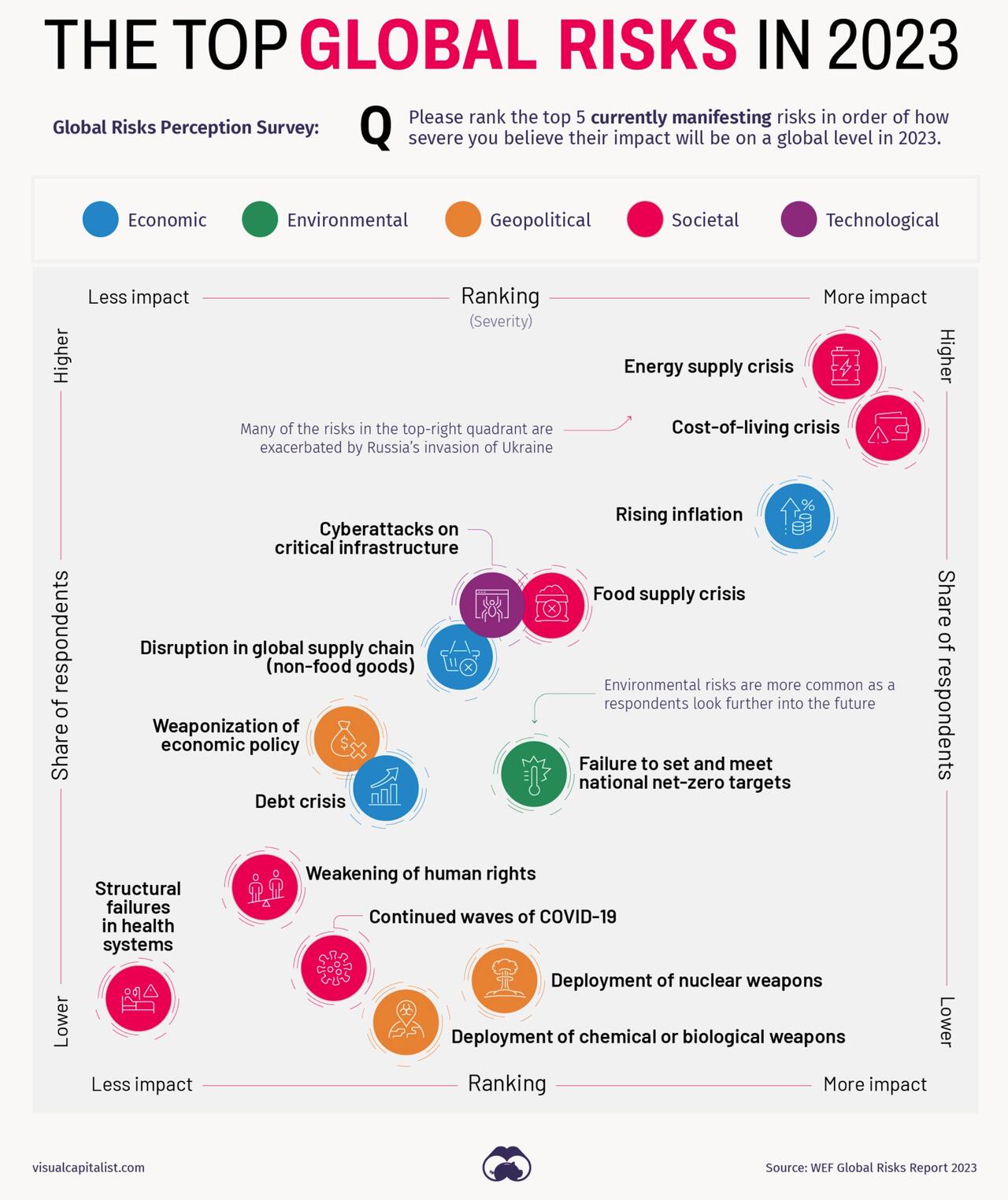
The profile of risks facing the world is evolving constantly. Events like last year’s invasion of Ukraine can send shockwaves through the system, radically shifting perceptions of what the biggest risks facing humanity are.
Visual Capitalist's Nick Routley created the graphic below to summarize findings from the Global Risks Report, an annual publication produced by the World Economic Forum (WEF).
It provides an overview of the most pressing global risks that the world is facing, as identified by experts and decision-makers.
These risks are grouped into five general categories: economic, environmental, geopolitical, societal, and technological.
Let’s dive into this year’s findings.

2023’s Risk Profile
In the lower–middle portion of the chart are the risks that could have serious impacts—such as attacks involving nuclear or biological weapons—but that were highlighted by fewer experts.
Over in the top-right quadrant of the chart are the risks that a number of experts mentioned, and that are causing a strain on society. Not surprisingly, the top risks are related to issues that impact a wide variety of people, such as the rising cost of living and inflation. When staples like food and energy become more expensive, this can fuel unrest and political instability—particularly in countries that already had simmering discontent. WEF points out that increases in fuel prices alone led to protests in an estimated 92 countries.
One risk worth watching is geoeconomic confrontation, which includes sanctions, trade wars, investment screening, and other actions that have the intent of weakening the countries on the receiving end. Efforts to mitigate this risk result in some of the key themes we see for the coming year. One example is the onshoring of industries, and “friend-shoring”, which is essentially moving operations to a foreign country that has more stable relations with one’s home country.

How Prepared Are We?
It’s one thing to be aware of risks, but it’s quite another to have the ability to head off negative events when they come to fruition.
The chart below is a look at how prepared we are globally to deal with specific types of risks that could arise in the next few years.
At the top of the chart are risks that experts feel society is better equipped to handle with current plans and resources. Moving towards the bottom of the chart are risks that experts feel are more of a threat since mechanisms for handling them are weak or non-existent.
Experts are generally more confident in solutions in the military or healthcare domains. Environmental and societal challenges leave policy and decision-makers less confident.
One telling observation from the data above is that none of the risks left a majority of experts feeling neither confident in our ability to prevent the risk from occurring, or prepared to mitigate its impact. As the 2020s are shaping up to be a turbulent decade, that could be a cause for concern.

Eugyppius : Energy Transition Farce Continues in Germany

Energy Transition Farce Continues in Germany: Regulators, fearing outages, announce plans to ration power for environmentally friendly, state-promoted electric vehicles and heat pumps
Once again: You can have intermittent windmill power, or you can put everyone in a battery-powered car, but you can't do both.

Klaus Müller, the president of the German Federal Network Agency [which regulates gas and electricity], has warned that the growing number of private electric car charging stations and electric-powered heat pumps could overload the power grid in Germany. “If very large numbers of new heat pumps and charging stations continue to be installed, then we’ll have to worry about overload problems and local power failures … if we do not act” …
According to the report, the … regulatory authority considers local low-voltage grids to be particularly susceptible to disruptions. The Agency has therefore published a strategy paper planning to ration the power consumption of heat pumps and electric car charging stations in times of high network utilisation. … Grid operators would then be forced to throttle the power supply to these systems … The plans for electricity rationing are slated to come into effect on 1 January 2024 …
Even in the event of power rationing, private charging stations would be able to draw enough power to charge an electric vehicle battery within three hours for a range of 50 kilometres, he said. Additionally … “nearly trouble-free continued operation” should still be possible for a large number of heat pumps.
It’s just great to hear that your driving might be limited to a 50-kilometre radius at any moment without notice, and also that your heaters will probably mostly work most of the time. This is what you get in Germany, for bending to generous state subsidies and messaging campaigns intended to accelerate the “energy transition,” a magical fantasy world of the future where everything will be powered by windmills and everyone will eat bio granola and wear Birkenstocks.
The Ukraine war is a catastrophe, but it has done us at least one crucial favor, by accelerating the German energy crisis. Because the truth is that we were always going to end up here, with too many electrical things and too little electricity to power them. It was just supposed to happen two or three decades from now, long after the reigning cast of Green luminaries had retired from public life.
Instead, all of these clowns are facing the mathematically certain and long-predicted consequences of their false promises right now. And it looks like their most committed supporters will be the first to suffer for their foolishness.