After Hours Gainers:
Companies trading higher in after hours in reaction to earnings/guidance: BJRI +5.1%, ASB +4.6%, CSX +4.3%, SAM +4.1%, BDN +2.8%, UFPI +0.5%, GBCI +0.4%, HTH +0.2%
Companies trading higher in after hours in reaction to news: PCT +8.3% (to set up JV to operate first polypropylene recycling plant in Asia), NR +3.2% (to sell its Excalibar mineral grinding business to Cimbar), CINF +1.6% (estimates Q3 catastrophe losses), MUSA +1.1% (increases dividend), LAC +0.8% (enters CBA with Fort McDermitt Paiute and Shoshone Tribe), STNG +0.6% (exercises purchase options on eight ships), AXS +0.4% (estimates Q3 catastrophe losses), ALSN +0.2% (named exclusive provider of transmissions for Xuzhou's newest cranes)
After Hours Losers:
Companies trading lower in after hours in reaction to earnings/guidance: SNAP -25.7% (also authorizes new $500 mln share repurchase program), THC -14.4% (also authorizes new $1 bln share repurchase program), SIVB -13%, RHI -7.3%, WHR -4.7%, WAL -3.4%, OZK -2.9%
Companies trading lower in after hours in reaction to news: IMUX -76.6% (reports Phase 1b interim analysis of IMU-935), SMMT -9.2% (Presents Ri-CoDIFy Trial Results), PINS -7.2% (in sympathy with weak SNAP earnings), TTD -5.7% (in sympathy with weak SNAP earnings), META -3.6% (in sympathy with weak SNAP earnings), ROKU -2.8% (in sympathy with weak SNAP earnings), SOCL -2.6% (in sympathy with weak SNAP earnings), GOOG -1.7% (in sympathy with weak SNAP earnings), TWTR -0.2% (in sympathy with weak SNAP earnings), MTCH -0.1% (in sympathy with weak SNAP earnings), FLT -0.1% (to acquire European workforce lodging provider Roomex), MSFT -0.1% (in advanced talks to provide more funding to OpenAI, according to The Information)

5 Signs That The Housing Crash Is Escalating A Lot Faster Than Many Experts Anticipated
The U.S. housing market is absolutely imploding, but nobody should be surprised. In fact, we were warned way ahead of time that this would happen. When the Federal Reserve told us that they would be aggressively raising interest rates, we all knew what this would do to the housing bubble. It was obvious that home prices would fall, home sales would plummet and home builders would get absolutely crushed. Sadly, that is precisely what we are witnessing. But instead of reversing course after witnessing all the damage that they have caused, Fed officials are insisting that even more rate hikes are necessary. So as bad as things are right now, the truth is that they are going to get even worse in the months ahead.

In recent days we have gotten some new data points, and they are sobering.
We haven’t seen numbers like this since 2008, and we all remember what happened back then.
Yes, just about everyone expected that the housing market would slow down, but hardly anyone thought that things would get this bad so soon.
The following are 5 signs that the housing crash is escalating a lot faster than many of the experts had anticipated…
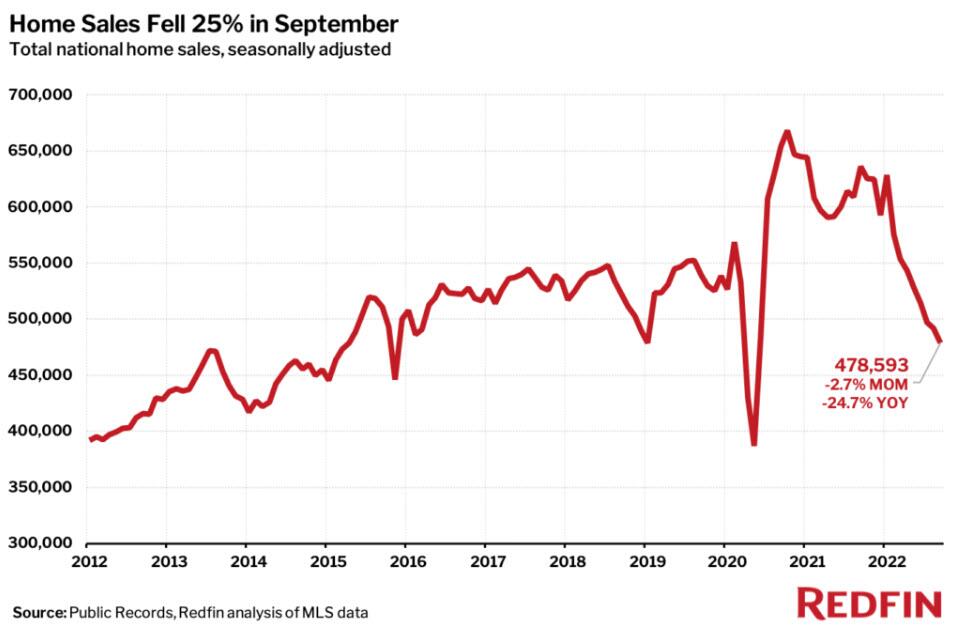
#1 According to Redfin, the number of homes sold in the United States during September dropped by 25 percent…
Home sales declined the most on record in September as mortgage rates surged and pushed prospective buyers out of the once-hot housing market, according to a new report.A report from the real estate company Redfin shows the number of homes sold fell by 25 percent and new listings dropped by 22 percent last month, marking the biggest declines on record in both categories — excluding numbers at the onset of the coronavirus pandemic in April and May 2020.
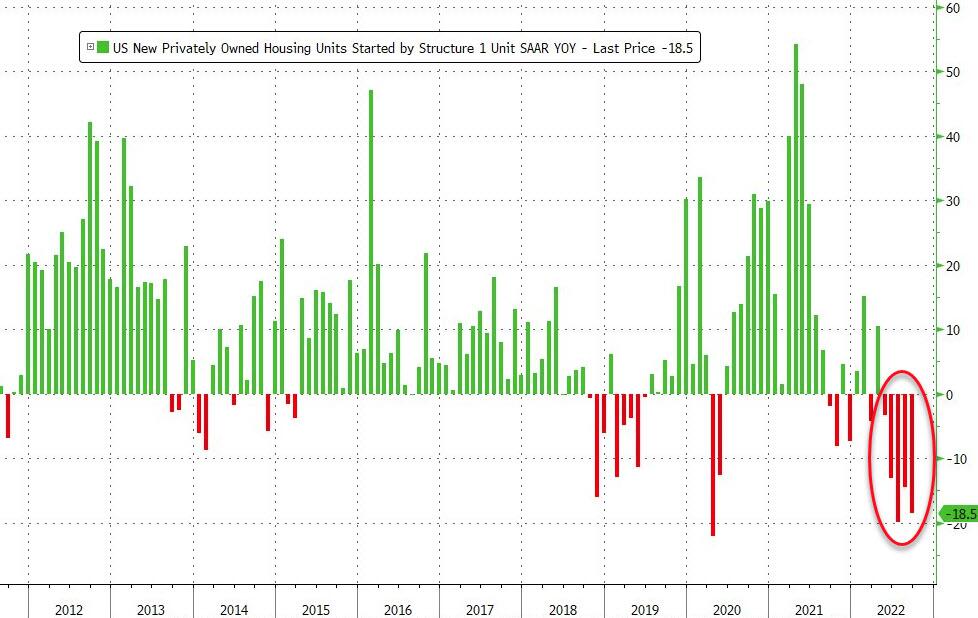
#2 The number of new housing starts in the United States fell by 8.1 percent in September…
Home building pulled back in September, as buyers faced spiking mortgage rates that have made homes increasingly unaffordable.[ZH: Single-family Housing starts are down 18.5% YoY...]September housing starts, a measure of new home construction, dropped 8.1% from August, and were down 7.7% from a year ago, according to the US Census Bureau. After a big drop earlier this spring, housing starts had been holding relatively steady up until July when rising mortgage rates spurred more prospective buyers to sit on the sidelines.
#3 The number of buyers touring new single family homes has fallen to a depressingly low level…
Traffic of prospective buyers of new single-family houses plunged to the lowest since 2012, excluding the two lockdown months April and May, and is now approaching even the levels of those two lockdown months, according to data today from the National Association of Home Builders.The NAHB index for traffic of prospective buyers dropped to 25, about where it was in mid-2007, well on the way down into Housing Bust 1.
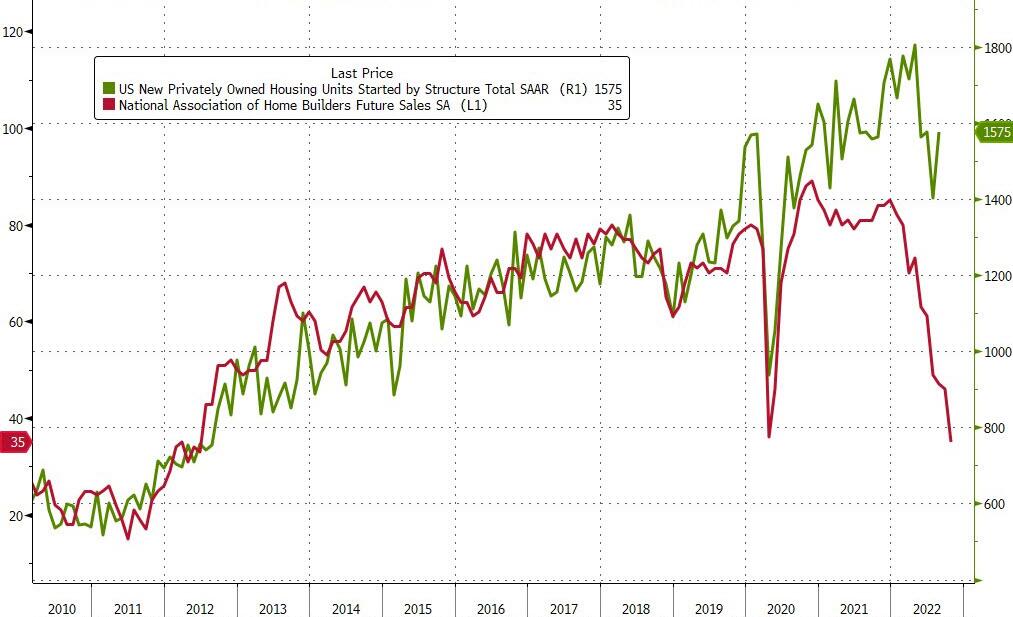
#4Homebuilder confidence has now dropped for 10 consecutive months…
The overall confidence of builders of single-family houses fell for the 10th month in a row in October, as “rising interest rates, building material bottlenecks, and elevated home prices continue to weaken the housing market,” the NAHB report said.With today’s index value of 38, the NAHB/Wells Fargo Housing Market Index is now nearly where it had been in May 2020 during the lockdown, and below where it had been in February 2007, on the way down into Housing Bust 1.

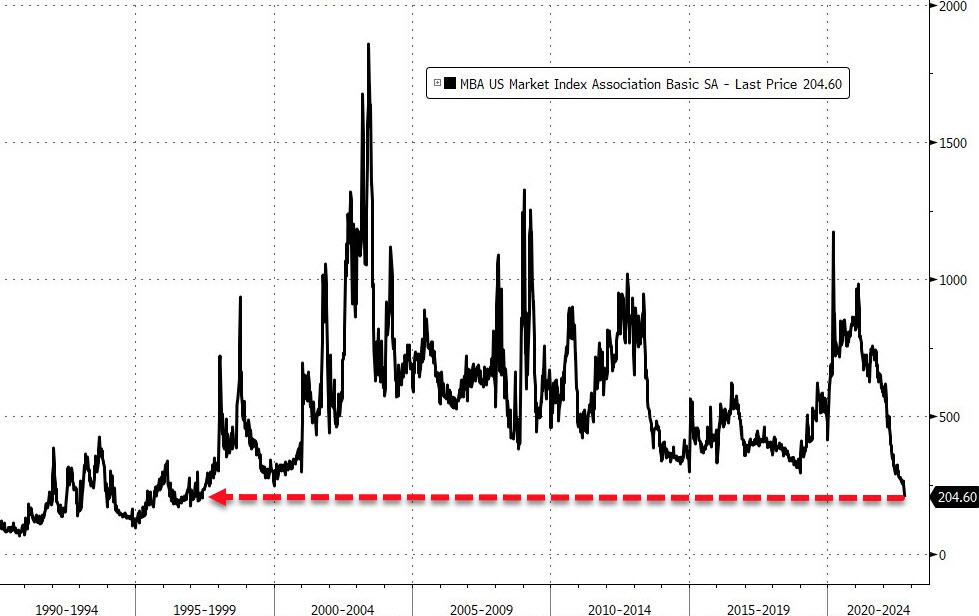
#5Demand for mortgages has plummeted to the lowest level that we have seen in 25 years…
Mortgage demand, which has suffered four straight months of declines, fell last week to the lowest level since 1997, as interest rates continued to rise.Homebuyers’ demand for mortgages dropped 4% for the week and was 38% lower than the same week one year ago, according to the Mortgage Bankers Association. Applications to refinance a home loan fell 7% compared with the previous week, in seasonally adjusted terms. Demand was 86% lower than the same week one year ago.
If you want to thank someone for this giant mess, you can thank the officials at the Federal Reserve.
They knew that raising rates would cause chaos for the housing market, but they did it anyway because they are scared to death of inflation.
But they actually played a major role in causing our inflation crisis. They should have known that pumping trillions of fresh dollars into the financial system over the years would cause rampant inflation, but they just wouldn’t stop.
Now they are trying to fix one crisis by causing another.
And in addition to absolutely crushing the housing market, they are also causing trillions of dollars in losses on Wall Street.
In fact, the financial markets are on pace for their worst year since 1969…
So far in 2022, both the stock and bond markets have posted serious losses. To find another market that looks like this one, you’d have to go all the way back to 1969, according to data from BlackRock.The S&P 500 is down nearly 24% year-to-date, and the Bloomberg U.S. Aggregate Bond Index has surrendered about 16%. Should both indexes finish the year in the red, it would be the first time that has happened in decades.
If officials at the Fed keep hiking rates, the markets could go down a whole lot more.
At this point, Bill Holter is warning that we could soon see “a crash that will make 1987 and 1929 blush”…
In closing, Holter warns, “The action you are seeing now is exactly what you saw in 1987, and this is what you saw in August and September of 1929. This is what happens prior to crashes. It’s massive volatility both ways . . . people are losing both ways. The longs get stopped out on the downside, and the shorts get stopped out on the upside. Then, the whole floor gives way, and that’s where we are. We are right on the doorstep of a crash that will make 1987 and 1929 blush. . . . Many people are going to lose everything overnight.”
Time will reveal whether Holter is right about this or if he is wrong.
But without a doubt, it certainly wouldn’t take much to push us over the edge.
Everywhere you look, economic conditions are getting worse, and the stage is being set for the sort of historic meltdown that I have been relentlessly warning about.
If officials at the Federal Reserve had any sense, they would stop raising rates immediately.
Unfortunately, they aren’t going to do that.
So much more pain is coming for the housing market, and this new crash could ultimately be even worse than what we experienced back in 2008.
Closing Stock Market SummaryIt was another choppy session for the stock market. The major averages had a lackluster start to the day before shifting into rally mode as longer dated yields pulled back from their overnight high (4.18%) and the S&P 500 found support at the 3,700 level. The stock market quickly shifted into retreat mode as the 10-yr note yield started to climb, ultimately settling at a fresh high for the year and its highest point since 2008 (4.23%).
The Treasury market reacted to Philadelphia Fed President Harker (2023 FOMC voter) saying he expects the fed funds rate to be well above 4.00% by end of the year, according to CNBC, "given our frankly disappointing lack of progress on curtailing inflation." That view ignited renewed selling pressure in longer dated Treasury securities.
The 2-yr note, which is more sensitive to changes in the fed funds rate, had a more mild reaction as the fed funds futures market was already positioned for a fed funds rate well above 4.00% by the end of the year. Still, the 2-yr note yield settled at a fresh high for the year (4.60%).
Market breadth reflected broad selling interest. Decliners led advancers by a greater than 2-to-1 margin at the NYSE and a 3-to-2 margin at the Nasdaq.
There were some bright spots in the market, however, that were driven by better-than-expected quarterly results from notable companies.
A big price gain in AT&T (T 16.74, +1.20, +7.7%) boosted the S&P 500 communication services sector (0.4%) to first place on the day. The information technology sector (+0.1%) held up better than the broader market thanks to the post-earnings responses in IBM (IBM 128.30, +5.79, +4.7%) and Lam Research (LRCX 355.87, +25.79, +7.8%). The latter also boosted the PHLX Semiconductor Index, which closed up 0.7%.
Meanwhile, the consumer discretionary sector (-1.7%) closed near the bottom of the pack thanks to heavy selling of Tesla (TSLA 207.28, -14.76, -6.7%) after it missed on Q3 revenue estimates. To be fair, Tesla said it sees excellent demand in the fourth quarter.
Energy complex futures settled in mixed fashion. WTI crude oil futures rose 0.1% to $84.49/bbl while natural gas futures fell 1.5% to $5.37/mmbtu.
In another notable development today, Liz Truss announced her resignation as UK Prime Minister roughly six weeks after starting the position. She will stay on until a leadership election is held in the next week.
Ahead of Friday's open, Verizon (VZ), HCA (HCA), American Express (AXP), and Schlumberger (SLB) headline the earnings reports.
There is no U.S. economic data of note tomorrow.
Reviewing today's economic data:
- Weekly Initial Claims 214K ( consensus 233K); Prior was revised to 226K from 228K; Weekly Continuing Claims 1.385 mln; Prior was revised to 1.364 mln from 1.368 mln
- The key takeaway from the report is that it covers the week in which the survey for the October employment report was conducted. The low level of initial claims will feed expectations for another solid increase in nonfarm payrolls. In turn, it will drive a belief that the Fed is going to stay aggressive with its rate hikes.
- October Philadelphia Fed Index -8.7 (consensus -5.0); Prior -9.9
- September Existing Home Sales 4.71 mln ( consensus 4.70 mln); Prior was revised to 4.78 mln from 4.80 mln
- The key takeaway from the report is that higher mortgage rates are taking a bite out of existing home sales, having created affordability pressures for prospective buyers and deferred listing decisions for potential sellers who see an expensive repurchase proposition.
- September Leading Economic Index -0.4 (consensus -0.3%); Prior was revised to 0.0% from -0.3%
Dow Jones Industrial Average: -16.5% YTD
S&P Midcap 400: -20.3% YTD
S&P 500: -23.1% YTD
Russell 2000: -24.1% YTD
Nasdaq Composite: -32.2% YTD
Research Calls
- Upgrades:
- Albertsons (ACI) upgraded to Equal-Weight from Underweight at Morgan Stanley; tgt raised to $30
- American Water Works (AWK) upgraded to Equal Weight from Underweight at Wells Fargo; tgt $140
- ASML (ASML) upgraded to Buy from Hold at Deutsche Bank
- Datadog (DDOG) upgraded to Buy from Hold at Canaccord Genuity; tgt lowered to $110
- Healthcare Services Group (HCSG) upgraded to Buy from Hold at The Benchmark Company; tgt $18
- Hudson Pacific Properties (HPP) upgraded to Neutral from Underperform at Credit Suisse
- Lam Research (LRCX) upgraded to Buy from Hold at Summit Insights
- Monarch Casino & Resort (MCRI) upgraded to Buy from Hold at Stifel; tgt raised to $77
- On (ONON) upgraded to Buy from Hold at Williams Trading; tgt $20
- Oracle (ORCL) upgraded to Neutral from Underweight at Piper Sandler; tgt $70
- ResMed (RMD) upgraded to Buy from Neutral at BofA Securities; tgt raised to $260
- Southern (SO) upgraded to Overweight from Sector Weight at KeyBanc Capital Markets; tgt $70
- Tango Therapeutics (TNGX) upgraded to Buy from Neutral at H.C. Wainwright; tgt $10
- Under Armour (UAA) upgraded to Hold from Sell at Williams Trading; tgt $6.50
- Wolverine (WWW) upgraded to Buy from Hold at Williams Trading; tgt $19
- Xcel Energy (XEL) upgraded to Outperform from Peer Perform at Wolfe Research; tgt $69
- Downgrades:
- Alliant Energy (LNT) downgraded to Peer Perform from Outperform at Wolfe Research
- American States Water (AWR) downgraded to Underweight from Equal Weight at Wells Fargo; tgt $85
- Ally Financial (ALLY) downgraded to Equal-Weight from Overweight at Morgan Stanley; tgt lowered to $28
- Ally Financial (ALLY) downgraded to Underweight from Equal Weight at Wells Fargo; tgt $23
- Boston Properties (BXP) downgraded to Neutral from Outperform at Credit Suisse
- Coupa Software (COUP) downgraded to Underweight from Neutral at Piper Sandler; tgt lowered to $55
- Dominion Energy (D) downgraded to Sector Weight from Overweight at KeyBanc Capital Markets
- Exelon (EXC) downgraded to Sector Weight from Overweight at KeyBanc Capital Markets
- FleetCor (FLT) downgraded to Neutral from Buy at BofA Securities; tgt lowered to $203
- Generac (GNRC) downgraded to Sell from Buy at ROTH Capital; tgt lowered to $75
- HarborOne Bancorp (HONE) downgraded to Neutral from Buy at Compass Point; tgt $14
- Northern Trust (NTRS) downgraded to Hold from Buy at Deutsche Bank; tgt lowered to $87
- Sunnova Energy (NOVA) downgraded to Peer Perform from Outperform at Wolfe Research
- Sunrun (RUN) downgraded to Peer Perform from Outperform at Wolfe Research
- Wingstop (WING) downgraded to Hold from Buy at Truist; tgt lowered to $125
- Others:
- Ascendis Pharma (ASND) initiated with a Buy at Goldman; tgt $174
- Boyd Gaming (BYD) resumed with a Hold at CBRE; tgt $60
- California Resources Corp (CRC) initiated with a Buy at Stifel; tgt $63
- Cerevel Therapeutics (CERE) initiated with a Buy at BofA Securities; tgt $39
- Denbury (DEN) resumed with a Buy at Stifel; tgt $146
- Golden Entertainment (GDEN) resumed with a Buy at CBRE; tgt $58
- Gossamer Bio (GOSS) initiated with a Buy at Goldman; tgt $22
- lululemon athletica (LULU) initiated with a Market Perform at CICC
- National Retail Properties (NNN) initiated with an Outperform at Oppenheimer; tgt $48
- Spotify (SPOT) initiated with a Neutral at Piper Sandler; tgt $87
- Spirit Realty Capital (SRC) initiated with a Perform at Oppenheimer; tgt $37
- Talaris Therapeutics (TALS) initiated with a Buy at H.C. Wainwright; tgt $18
- Talos Energy (TALO) resumed with a Buy at Stifel; tgt $27

Gapping down
In reaction to earnings/guidance:
- ERIC -14.8%, AA -10.7%, ALL -10.5% (estimates Q3 catastrophe losses; provides preliminary Q3 results), SSL -6.6% (Q3 update), NOK -5.7%, WDFC -5.2%, KNX -4.9%, TSLA -4.9%, PPG -4.1% (also names new CEO), WSO -3.3%, KEY -3%, HPE -2.9% (reiterates FY22 earnings and sales outlook; guides FY23 earnings in-line with consensus), EFX -2.7%, RLI -2.4%, TCBI -1.8%, KMI -1.8%, DHR -1%, FITB -0.9%, STLD -0.8%
Other news:
- TALS -25.2% (announces a status update on its Phase 3 FREEDOM-1 study in living donor kidney transplant recipients)
- BCLI -4.6% (Presents NurOwn Phase 2 Progressive MS Biomarker Data at the 38th ECTRIMS Congress)
- CENX -3.8% (in sympathy with AA earnings)
- DNLI -2.9% (prices offering of 10377359 shares of its common stock at $26.50 per share)
- RIVN -0.9% (fixes significant majority of its 12000+ recalled vehicles according to TechCrunch)
- RNR -0.9% (estimates 2022 catastrophe losses)
Analyst comments:
- COUP -3.2% (downgraded to Underweight from Neutral at Piper Sandler)
- ALLY -2.2% (downgraded to Equal-Weight from Overweight at Morgan Stanley; downgraded to Underweight from Equal Weight at Wells Fargo)
Gapping up
In reaction to earnings/guidance:
- SMCI +18.7% (increases guidance for EPS and revs for SepQ), BANC +5%, HRI +5%, LBRT +4.6%, MAN +3.8%, UMPQ +3.5%, IBM +3.4%, AAL +2.6%, T +2.3%, LVS +2%, PACW +1.8%, PM +1.6%, SNA +1.5%, TSCO +1.4%, SLG +1.1%, DGX +1.1%, WU +1.1%, IRDM +1.1%, POOL +1%, LSTR +0.9%, CVBF +0.8%
Other news:
- XERS +8.1% (announced topline results from its Phase 1 study of subcutaneous (SC) levothyroxine)
- CE +3.9% (increases dividend)
- MO +1.2% (Altria reaches agreement with Philip Morris International (PM) for IQOS Transition)
- NOG +0.8% (to acquire interest in Core Midland Basin development project for $330 mln)
Analyst comments:
- TNGX +3.9% (upgraded to Buy from Neutral at H.C. Wainwright)
- WWW +2.2% (upgraded to Buy from Hold at Williams Trading)
- ASML +1.6% (upgraded to Buy from Hold at Deutsche Bank)