(ZH) Germany May Stave Off Worst Of Energy Crisis As Mild Temps Forecast Through

Germany May Stave Off Worst Of Energy Crisis As Mild Temps Forecast Through Mid-November

Germany's national weather service, the Deutscher Wetterdienst (DWD), released a new report Friday showing temperatures across the country will be well above average through mid-November. This promising forecast could stave off a worsening energy crisis (for now).
DWD's month-ahead forecast expects warmer-than-normal temperatures in Germany through at least mid-November. A weather model via Bloomberg shows above-average weather.
A two-week forecast shows heating demand across the EU's largest economy will be below a 30-year trend line. This means less natural gas will be drawn out of storage.

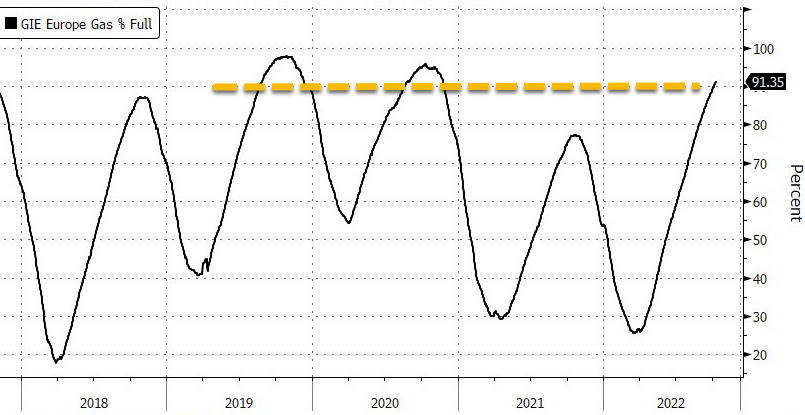
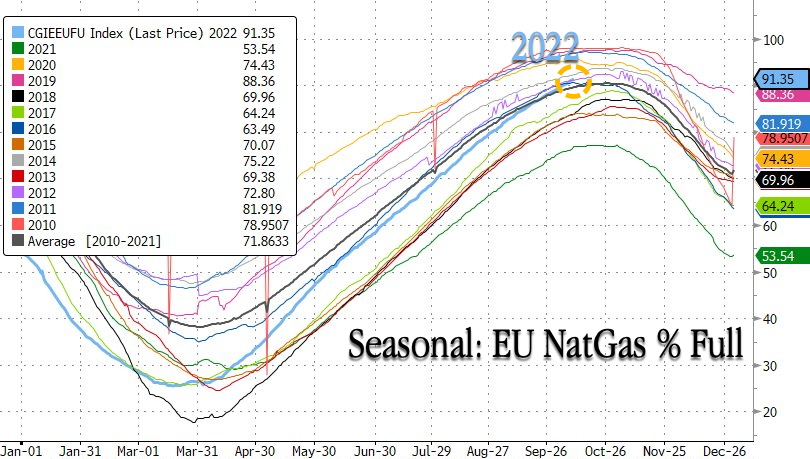
Regarding NatGas storage, the EU is about 91% full despite reduced NatGas shipments from Russia. Shipments via Ukraine are one of the last remaining Russian supply lines to western Europe after the bombing of Nord Stream pipelines.
Warmer weather plus EU storage is above a 10-year average for this time of year is good news (for now).
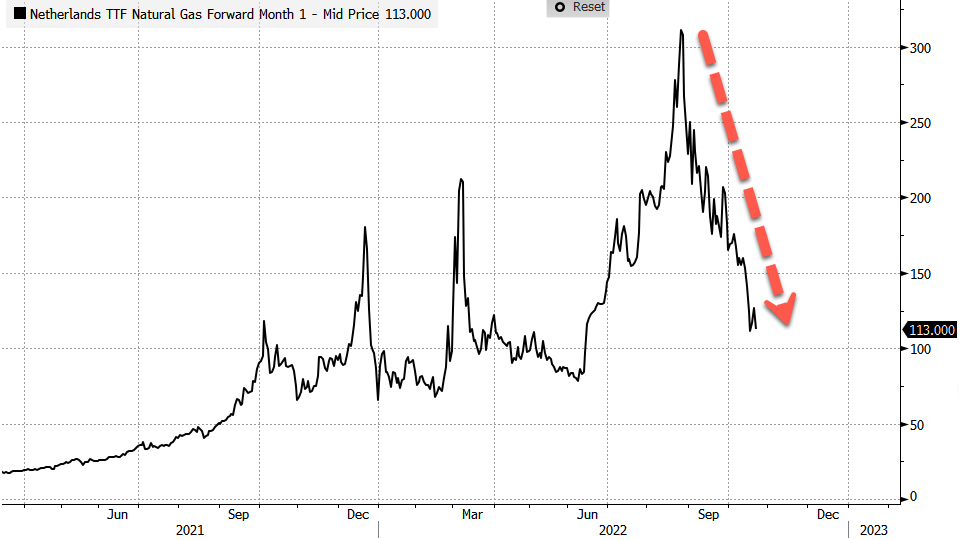
Dutch front-month gas futures, a European benchmark, has been halved and hit lows not seen since June of around 113 euros per megawatt-hour.
As for now, a worsening energy crisis has been delayed. But as explained recently by Russian energy giant Gazprom CEO Alexey Miller, all of that can change in the event of a cold snap and send "entire towns freezing" this winter.

CrunchBase : The Week’s 10 Biggest Funding Rounds: Sequoia Financial Group Grabs

The Week’s 10 Biggest Funding Rounds: Sequoia Financial Group Grabs $200M To Grow; Jasper Rides AI Momentum
This time last year, a startup would have needed to raise $100 million to make this list—those days are long gone. The VC pullback in the market is very real, and now a raise of less than $40 million can still get you on the list. Nevertheless, the market is strong for those in AI, biotech and finance, while others in formerly smoking hot sectors like crypto, blockchain and security remain noticeably silent.

1. Sequoia Financial Group, $200M, wealth management: The top round of the week is probably one that went under most people’s radar. Akron, Ohio investment adviser firm Sequoia Financial Group sold a minority stake to private equity firm Valeas Capital Partners for $200 million. Sequoia provides wealth management, asset management and financial planning services to clients ranging from individuals to family offices. Sequoia—with approximately $10 billion in client assets—plans to use the capital to continue to expand organically and inorganically. Two years ago, New York-based Kudu Investment Management also made a minority investment in Sequoia.

2. Jasper, $125M, AI: It seems like AI is having another moment. Just a day after London-based Stability AI became Europe’s newest unicorn with a $101 million raise, Austin, Texas-based Jasper closed a $125 million Series A funding round at a $1.5 billion valuation. The round was led by Insight Partners. Jasper uses AI to help people and companies with their content strategies. Its AI platform helps create original content while optimizing it for ROI, and even repackages it in different ways and in different languages. Jasper plans to use the new money for product development and enhancing customer experience. Since launching in January 2021, Jasper says it has more than 70,000 paying subscribers ranging from individual creatives to teams at large enterprises.

3. (tied) Swift Navigation, $100M, GPS: Logistics and navigation tech pretty much dominate our lives—from using a ride-sharing application to having your phone know exactly where you are. San Francisco-based Swift Navigation locked up a $100 million Series D this week, led by SK Innovation and Potentum Partners as it looks to grow its several markets with its location tech. The startup may be best known for its Global Navigation Satellite System and positioning technology for autonomous and driver-assisted systems. However, Swift also has built specific platforms for a host of other applications—from industrial machine control to improvements to mobile phone positioning. We now live in a culture where everyone—and everything—wants to know where we are every second. For that, navigation technology is a must. Founded in 2012, Swift has raised over $200 million in funding, per the company.

3. (tied) Tempus, $100M, biotech: Every week seems to be a big week for biotech, and this week is no different. Chicago-based Tempus announced a $275 million raise—a mix of equity from previous investors and debt financing from Ares Management. The startup’s platform combines drug discovery, clinical trials and diagnostics. It uses AI to help doctors understand disease progression and what is driving the disease. It can also find the proper patients for a clinical trial. Through genomic sequencing, the platform allows physicians to understand why a patient has a disease. That clearly is appealing to investors, as the company has raised over $1.3 billion, per Crunchbase.

5. Enable, $94M, finance: When someone hears the word “rebate,” they typically think of the money they get back when buying a car or an appliance. However, there are also B2B rebates, which can be harder to keep track of because they deal with certain benchmarks or milestones reached through a period of time. San Francisco-based Enable, a B2B rebate management platform, raised a $94 million Series C led by Insight Partners to help companies manage that problem. The company’s platform allows clients to more easily track potential rebates depending on order numbers and spend. Founded in 2016, Enable says it has raised $156 million.

6. Viome Life Sciences, $67M, biotech: Bellevue, Washington-based Viome, an at-home diagnostics startup, closed a Bold Capital Group-led $67 million extension round toward its Series C. The round brings total financing for the company to more than $150 million, according to the company.

7. Orionis Biosciences, $55M, biotech: Boston-based cancer therapeutics company Orionis Biosciences completed a $55 million financing round. New and old investors including Cormorant Asset Management and Novartis participated in the round. Founded in 2015, the company has raised nearly $80 million, according to Crunchbase data.

8. Landis, $40M, real estate: New York-based Landis closed a $40 million Series B led by GV. The company has developed a platform to help renters become homeowners. Founded in 2018, the company has raised $222 million, per Crunchbase.

9. OSSIO, $38.5M, medical device: Woburn, Massachusetts-based OSSIO, an orthopedic medical device company, closed a $38.5 million round led by MVM Life Science Partners. Founded in 2014, the company has raised nearly $61 million, according to Crunchbase.

10. RisingWave Labs, $36M, database: San Francisco-based streaming database company RisingWave Labs raised a $36 million Series A round, led by multiple partners including the investment arm of a leading global gaming firm, Yunqi Partners. Founded in 2021, RisingWave has raised more than $40 million, according to the company.

Big global deals
Much like in the U.S., there were not a ton of large rounds globally. The biggest round of the week went to a battery materials company.
  • China-based Hithium, which specializes in the R&D, production and sales of lithium-ion battery core materials, raised a Series B worth approximately $276 million.

FT : Transatlantic travel soars as Americans make most of strong dollar

Transatlantic travel soars as Americans make most of strong dollar
Virgin boss says UK holidays are ‘on sale’ for US tourists

Transatlantic travel is booming, driving airline revenue as Americans armed with a strong US dollar fly to Europe and the UK.

Revenue at United Airlines from trips between the US and Europe rose 40 per cent in the third quarter compared with the same period in 2019, to $2.5bn. The average fare on those trips climbed 30 per cent compared with a year earlier.

The strong dollar has been “useful” in prompting US travellers to book trips to Europe, said United’s chief commercial officer Andrew Nocella. What was an “incredible” summer season has maintained momentum into the autumn. The airline debuted multiple new routes last summer, flying 14 per cent more seats across the Atlantic than it did in 2019, and it plans to add more routes next year.

“It’s full speed ahead across the Atlantic,” Nocella said.


All three big US carriers reported an increase in transatlantic revenue compared with 2019, and many European airlines also have benefited from an uptick in demand. Executives and analysts attribute the increase to the rising value of the dollar against the pound and euro. The pound now trades at $1.12, while the euro is at $1.02.

The dollar’s influence appears in the direction of travel. Data from Dohop, a flight connections bookings platform used by more than 60 airlines including Spirit, Avianca and Air France, showed that passenger traffic from North America to Europe increased faster throughout the year than the reverse.

Outbound passenger traffic between May and August from North America was 2.8 times higher than between January and April. But Europe to North America passenger traffic during the summer was just less than double the level between January and April.

Bookings from the US to Europe are closer to pre-coronavirus pandemic levels. Olivier Ponti, vice-president of insights at travel industry data company ForwardKeys, said that as of mid-October, flight bookings from the US to Europe lagged 2019 levels by 6 per cent, while bookings from Europe to the US remained 19 per cent lower.


Norwegian start-up Norse Atlantic, which flew the first of its services between London and New York in August, said it had experienced “especially strong” demand from the US to London, a trend it put down to the weak pound. Virgin Atlantic boss Shai Weiss said that UK holidays were essentially “on sale” for American tourists.

“If I was someone in New York and wanted to buy a Hermes bag, I would come to London,” he said.

At American Airlines, transatlantic travel generated $1.9bn in revenue in the third quarter, rising 19 per cent compared with the same period three years earlier. A greater share of the airline’s flights are domestic than before the pandemic, said chief commercial officer Vasu Raja, but still “there is clearly demand . . . for the long-haul product”.

Delta’s international revenue increased 12 per cent in the third quarter, even with a smaller network, driven by leisure trips to Italy, Spain and Greece.

Flying capacity is increasing, too. Delta Air Lines has been slower than US rivals to restore seats and flights to its schedule after pandemic cutbacks. However, last week Delta president Glen Hauenstein said that Europe was the first region where its seating capacity on routes in October exceeded 2019 levels — including for US domestic travel.

Next summer United and Delta anticipate increasing the number of seats they offer on flights to Europe, according to aviation data company OAG. United, which historically operates more international flights, plans a 29 per cent expansion compared with 2019. Delta’s capacity is scheduled to rise by 5 per cent.

Would-be tourists have missed out on years of European travel, Hauenstein said, and the result is “robust demand” that Delta expects to last through next summer.

“People run out of time, myself included,” he said. “We think: ‘Gosh, how many years do I have left to do that?’ So I think we have a really good backdrop there.”

Washington DC resident Vince Ryan was one of the travellers itching to visit Europe this past summer. He paid $980 to fly to Istanbul — more than he was used to paying in his annual pre-pandemic trips — to shake off restlessness with weeks of sun and exploring ruins. It did not hurt that when he arrived $1 could buy 17 Turkish lira, while six months earlier it would have only been TL13.

But while airline executives expect transatlantic travel to remain robust, Ryan’s experience suggests there is a limit to wanderlust. He considered flying to Rome over the Christmas holidays before abandoning the plan in the face of pricey fares.

“I’m looking at economy-class flights for $1,300 to $1,700,” he said. “I’m not going over there on that.”

FT : Russia ramps up missile strikes on Ukraine’s energy infrastructure

Russia ramps up missile strikes on Ukraine’s energy infrastructure
Nearly 1.5mn Ukrainians lose power as Russians evacuate Kherson citizens ahead of expected battle

Russian forces fired dozens of cruise missiles at Ukraine’s power infrastructure on Saturday, triggering more electricity blackouts in the latest phase of the eight-month war.

Local officials said the latest barrage of missiles fired at the country’s infrastructure was the most intense yet in a campaign that started earlier this month to deplete Ukraine’s power stations and other infrastructure ahead of winter.

The campaign, which Russian president Vladimir Putin launched on October 10, has been condemned by Kyiv’s western backers, including German Chancellor Olaf Scholz who last week described it as a “war crime”.

“Another rocket attack from terrorists who are fighting against civilian infrastructure and people,” Andriy Yermak, chief of staff to Ukrainian president Volodymyr Zelenskyy, said in a Telegram channel post on Saturday.

Ukraine’s air force command said in a statement that the “massive” strikes, launched at 7am, targeted critical infrastructure and involved the launch of at least 33 cruise missiles, 18 of which were knocked down by air defence systems. Air raid sirens sounded in Kyiv and other cities after the statement, suggesting that additional strikes were happening.

Ukrenergo, Ukraine’s state power grid company, said “the scale of damage” from Saturday’s attack “is comparable or may exceed the consequences of the attack on October 10-12” .

Kyrylo Tymoshenko, deputy head of Zelenskyy’s administration, said Saturday’s strikes had cut off electricity for nearly 1.5mn Ukrainians in the affected regions.

Oleksiy Arestovych, an adviser in Zelenskyy’s administration, reported hits to power infrastructure and blackouts in cities including Khmelnytsky, Lutsk and Rivne in western Ukraine, as well as the southern Black Sea port city of Odesa. Photos and videos posted on social media showed plumes of smoke rising from the cities and other regions. The number of casualties was not immediately clear.

“We are paying the price for freedom,” Arestovych said in a Telegram channel post.

The capital Kyiv was also targeted, but all five incoming missiles were intercepted, Arestovych added.

Lieutenant-general Igor Konashenkov, a spokesperson for Russia’s defence ministry, was quoted by the Interfax news agency as telling journalists during a Saturday briefing that air strikes had destroyed a fuel depot in central Ukraine’s Dnipropetrovsk region as well as a missile factory in Kharkiv in the north-east. Interfax’s reports did not cite him mentioning the strikes on Ukrainian power infrastructure.

Ukraine last week introduced scheduled rolling blackouts in cities and towns across the country to conserve power as officials reported that 30-40 per cent of generation capacity had been damaged during nearly two weeks of air strikes. The authorities also asked citizens to conserve power.

Ukraine’s energy minister German Galushchenko and DTEK, the country’s largest thermoelectric power generation company, appealed last week to foreign countries and producers to help secure a speedy supply of power grid parts needed for repairs.

Ukraine has described the latest strikes as Russia’s retaliation for the counteroffensives by its army this autumn in far eastern and southern coastal regions that have liberated swaths of previously Russian-occupied territory.

The two weeks of air strikes, which have been conducted using cruise missiles and Iranian Shahed kamikaze drones, come as Russia’s army, which still holds more than 15 per cent of Ukrainian territory, prepares for a battle around the strategic southern city of Kherson.

Russia’s occupying forces last week started evacuating civilians from Kherson, which they captured early in the invasion, warning that Ukraine’s forces were advancing towards the city.

Kherson is a strategic port city where the Dnipro River flows into the Black Sea, and is the only provincial capital Russia has captured since launching its full-scale invasion of Ukraine in February.

>>> B arron’s Weekend Summary

Barron’s Weekend Summary: Not long ago oil companies appeared to be heading toward insignificance. But that’s no longer the case: Exxon is now a stock market star

Cover Story:
-Not long ago oil companies appeared to be heading toward insignificance. But that’s no longer the case: Exxon is now a stock market star, with a gain of more than 60% in the turmoil of the past 12 months. Chevron is up nearly 50%. Instead of being destroyed by the energy transition, Big Oil has emerged in a remarkably strong position to profit from it. Because of deals signed in just the past year, companies like BP, Shell, Exxon, and Chevron are building enough offshore wind farms to supply millions of homes on the East Coast with electricity and are preparing to produce hundreds of millions of gallons of fuel made from plants, garbage, and kitchen grease. They’re increasingly confident that they can get greener without sacrificing profits.

Interview:
-Barron’s interviews David Herro. Herro oversees $26B as chief investment officer for international equities at Harris Associates. He is known for digging for quality stocks in sectors and countries that others shun. His diligence has helped the $17B Oakmark International fund, which he co-manages, beat 98% of its peers over the past 15 years, with an average annual return of 2.2%. But Herro is getting pushback from clients about investing in Europe. That isn’t surprising, given a looming energy crisis triggered by the war in Ukraine, plus fiscal strains in Italy and financial trouble in the United Kingdom. Their reluctance makes this longtime value investor only more positive on the region.

Tech Trader:
-The tech sector continues to face fierce headwinds from the strong dollar, softening consumer spending, rising interest rates, stubbornly high inflation, and a potential recession. The market is yearning for some hint that the worst is over, but don’t hold your breath. This coming week, the world’s largest tech companies all report their September-quarter financial results. Alphabet, Microsoft, Meta Platforms, Apple, Amazon.com, and Intel, with special guest appearances from SAP, Shopify , Spotify , Seagate , ServiceNow, and Corning . Every one of these companies reports results in a three-day span, from Tuesday to Thursday. At least 25% of the S&P 500’s market value will be reporting during the stretch. The wave of reports could determine the next swing in stock prices. Paul Meeks, portfolio manager with Independent Solutions Wealth Management, has a long list of tech stocks he’d like to buy, but he’s waiting for lower lows. Meeks sees downward revisions ahead and worries that conditions in the March and June quarters could be even worse than the last two quarters of 2022.

The Trader:
-When in doubt, buy quality stocks—and there’s certainly a lot of doubt in the market right now. It might not feel that way after this past week’s rally. The DJIA rose 4.9%, its largest weekly gain since June, after The Wall Street Journal reported that Fed members are discussing when to slow down the pace of interest rate hikes. Needless to say, such a shift, if it were to occur, would likely be good for stocks. Still, those slowdown hopes remain hopes, not a likelihood. The consumer price index, after all, rose in September and is up more than 8% year over year, and the federal-funds futures market is predicting a peak rate in the ballpark of 5%. The 10-year Treasury yield is trading at just under a multiyear high, and rate hikes are already having an effect on earnings. It remains to be seen whether they will cause a recession. So is the recent rise the start of a new bull market or just another bear-market rally? If you can’t make up your mind, consider quality stocks. Barron’s suggests five quality stocks to consider based on relatively large weightings in some of the best ETFs now. Companies that made the list include Target, Exxon Mobil, Johnson & Johnson, Mastercard and Coca Cola.
-Faced with dwindling cash on its balance sheet, a tough environment for raising capital, and a falling stock price, home-internet start-up Starry Group Holdings is battening down the hatches. That means laying off half its staff, slowing its network expansion, cutting discretionary spending, and withdrawing 2022 guidance. Starry also released third-quarter operating metrics on Thursday showing that the business works—it just can’t grow without raising additional capital.

Features:
-Before Tesla reported third-quarter earnings this past week, investors had been hoping they would allay concerns that had been growing since the company released second-quarter numbers three months earlier. They did not. While earnings topped expectations, third-quarter deliveries, sales, and profit margins all fell short of Street projections. Tesla shares slumped 6.7% following the release, putting them down 22% since the end of September, their second-worst start to a quarter since the first few weeks of 2016. But for all the bad news, Tesla sees massive growth in 2023, as new plants in Germany and Texas continue ramping up. Tesla’s long-term bets on batteries and new vehicles should also help it lower costs and boost sales, though it remains to be seen whether growth comes at the expense of profits.
-Robert Half International’s quarterly results disappointed investors, but the staffing firm had more concerning news than its earnings—new hiring is cooling. The accounting and finance talent provider reported $1.53/share in earnings for the third quarter after markets closed on Thursday. That is lower than the consensus call of $1.62/share among analysts tracked by FactSet and indicates no growth in profit from a year ago. Revenue of $1.8B was below expectations of $1.92B.

European Trader:
-It’s easy to tar all semiconductor makers with the same brush. It also creates potential buying opportunities. That’s where German chip maker Infineon Technologies comes in. The Munich-based semiconductor giant designs, manufactures, and supplies chips used in autos, industrial machines, and consumer electronics. What sets the company apart is its exposure to autos, accounting for close to 50% of revenue, and especially electric vehicles. By the same token, Infineon is less exposed to the falling demand for consumer electronics, which has hit other sector heavyweights such as Advanced Micro Devices.

Emerging Markets:
-While press coverage has focused on the Belt and Road Initiative (BRI) debacles in Sri Lanka and Pakistan, the three top borrowers are oil powers Russia, Venezuela, and Angola, says Bradley Parks, executive director of the AidData project at The College of William & Mary. Implementation was haphazard at best, though. About 330 official sector lenders have some slice of the BRI pie, he reckons. Twenty are involved just in Zambia, the minerals-rich African nation now struggling to restructure debt. This open lending season produced a few winners. The Greek port of Piraeus has increased traffic more than six fold under Chinese management. A Beijing-financed Nairobi airport expressway, opened this summer, looks like a boon for Kenya. But these are overwhelmed by black holes like the $85B in BRI funds dumped into Venezuela. The $125B extended to Russia may also be jangling bankers’ nerves at the moment. Further down the income chain, Chinese lending has contributed to a “clear and present danger of default” in 10 countries, from Ecuador to Ghana and Laos, Parks says. The bright side may be that a sobered China is inching toward cooperation on cleaning up these multilateral messes, and that “enthusiasm for the BRI has reduced significantly,” according to Kung Chan, founder of Anbound Consulting in Beijing. “Future emphasis will be on ‘joint building’ with other participating countries.”

Commodities:
-Palladium has outperformed gold and silver, as well as sister metal platinum, so far this year, and the market is showing some signs of further gains to come. Palladium has outperformed other precious metals by a “healthy margin” in 2022, with the metal’s fortunes changing dramatically as events in Ukraine escalated, says Steven Dunn, head of exchange-traded funds at investment management firm abrdn. Financial sanctions on Russia could have “worsened an already tight supply challenge, which is why you saw such a violent rally in the price,” says Dunn, adding that 45% of global palladium reserves are in Russia. Palladium futures touched record intraday highs in March above $3,400 an ounce.

Streetwise:
-Jack Hough says that a long-term chip winter seems unlikely, given trends like rising artificial intelligence and self-driving cars. The SOX traded recently at 14 times forward earnings projections, down from an average of 18 times over the past five years. Time to buy? “It’s getting close,” says Needham analyst Quinn Bolton. “I don’t know if you have to buy today.” Bolton is waiting for companies to slash earnings predictions, perhaps later this year. For now, Bolton recommends companies that are less tied to the industry downturn. MaxLinear MXL +2.51% (ticker: MXL) makes products for broadband infrastructure like modems, and trades at seven times earnings—“way too low for the quality of the business,” says Bolton. Macom Technology Solutions Holdings is more expensive, at 18 times earnings, but Bolton likes that nearly half of sales are tied to defense. For investors seeking broader exposure now or later, there’s the iShares Semiconductor exchange-traded fund (SOXX). It includes US companies that make many kinds of products, including logic chips for processing information and memory for storing it, as well as machines for chip-making. Then there are a few of the rare companies that make machines for putting circuits on high-end chips: California’s Applied Materials, Tokyo Electron, and ASML Holding, which has a monopoly in the most advanced type of circuit-drawing, called extreme ultraviolet lithography.

Barrons : Big Oil’s Surprisingly Bright Future. The Case for BP and Exxon.

Big Oil’s Surprisingly Bright Future. The Case for BP and Exxon.

Just two years ago, the world’s giant oil producers seemed to be going the way of the typewriter industry. No one wanted oil—the price of a barrel fell below zero early in the pandemic. Exxon Mobil ’s stock crashed hard and was dumped from the Dow Jones Industrial Average after 92 years. It was starting to look like a prelude to the real extinction—the world’s transition to clean energy.

So much for that. The plunge turned into a surge, and the top oil-and-gas companies ended up rolling in cash. Exxon (ticker: XOM) is now a stock market star, with a gain of more than 60% in the turmoil of the past 12 months. Chevron (CVX) is up nearly 50%. What’s more, the future has brightened considerably. Instead of being destroyed by the energy transition, Big Oil has emerged in a remarkably strong position to profit from it.

Because of deals signed in just the past year, companies like BP (BP), Shell (SHEL), Exxon, and Chevron are building enough offshore wind farms to supply millions of homes on the East Coast with electricity and are preparing to produce hundreds of millions of gallons of fuel made from plants, garbage, and kitchen grease. They’re increasingly confident that they can get greener without sacrificing profits.

Photograph by Jamie Chung; Styling by Tierney Oberhammer

What saved the companies was a rebound in commodity prices, which climbed gradually before ripping higher when Russia invaded Ukraine. Those premium prices don’t look like they’re going anywhere. Most analysts expect oil to stay above $80 for the foreseeable future because demand is set to exceed supply. Generally, oil producers can deliver handsome profits as long as oil trades above $60 a barrel, analysts say.

Big Oil, which also includes France’s TotalEnergies (TTE) and Norway’s Equinor (EQNR), went from having problems to having options. In the next few years, the companies will have enough money to fund all of their drilling, pay off debt, send dividends to shareholders, and still place large bets on low-carbon businesses. New government subsidies for carbon-reduction technologies, both in the U.S. and Europe, will give those investments a nice kick.


Already, the transition is well under way. Renewable energy could account for 60% of power generation in Western Europe and 35% in the U.S. by 2030, up from 35% and 23%, respectively, according to S&P Global Commodity Insights. Companies everywhere are rushing to keep pace: Total capital investments in renewables in 2022 are on track to exceed oil and gas investments for the first year ever, according to Rystad Energy, a research firm based in Norway.

Still, convincing investors and the general public that Big Oil is changing won’t be easy. Two companies that could profit from clean energy, Exxon and BP, happen to be associated with the most notorious environmental disasters of the past 40 years—the grounding of the Exxon Valdez tanker and the explosion of the Deepwater Horizon drilling rig. And Big Oil long has been accused of misleading the public about the danger of climate change and slow-footing their transition efforts.

The size of the checks that big oil companies are signing today makes a compelling case that their investments aren’t just window-dressing. Earlier this month, Exxon inked a contract to help a corporate customer capture and store millions of tons of carbon dioxide underground, equivalent to switching 700,000 cars from gasoline engines to electric motors, the company says. BP just agreed to pay $4.1 billion for a company that replaces fossil-fuel gas from wells with naturally occurring biogas from landfills, one step in its goal to produce zero net-carbon emissions from the products it sells by 2050; some others have only said they’d reduce the emissions from their own operations.

Both stocks, however, trade as if the oil businesses are on the decline and the new projects will mostly be busts. BP fetches less than four times expected 2022 earnings, and Exxon, for less than eight, or about half of the multiple of the broad market. That could make for good entry points to the stocks.

The companies say their climate projects are likely to reward investors, though they will take time to scale up. “We see an opportunity for a lot of growth and solid returns,” says Dan Ammann, who leads Exxon’s low-carbon efforts.

The U.S. companies have announced much less ambitious emissions-reduction projects than their European counterparts, and seem much less willing to invest in wind and solar, where they say they don’t have competitive advantages.

In Europe, politics and social pressure have helped force more-aggressive moves. London-based Shell, for instance, says it will spend about half of its capital budget on low-carbon divisions by 2025. TotalEnergies and Equinor have also set lofty goals. Uncertainty about the results of those investments, and the shock of the European economic crisis, have caused their stocks to trail those of American energy companies over the past year.

Exxon has said it will invest only in low-carbon businesses that it thinks can generate returns on capital of at least 10%. BP has said it’s targeting 8% to 10%. At today’s sky-high oil prices, several companies are earning returns exceeding 20% on their fossil-fuel businesses, which can make those 10% levels look puny. But remember, oil producers spent 2016 to 2019 earning 0%, because they spent too much money on the wrong projects at the wrong time.

Oil and gas drilling is a volatile business—there’s something to be said for a safe 10% return over a risky 20% one. “The reality of how these [fossil fuel] projects play out isn’t always as” financial models predict, says McDermott. Renewables businesses have less commodity exposure and are more likely to be buttressed by government support or longer-term utility-style contracts.

Ironically, high fossil-fuel prices are the biggest reason that producers have the wherewithal to fund the energy transition. The world’s oil-and-gas companies are on pace to generate $1.4 trillion of free cash flow this year, according to Deloitte’s estimates. Free cash includes money left over after the companies pay for their operations, but before they spend money on dividends and buybacks, and pay off debt. Even after accounting for all of those costs, oil and gas producers should still have $1.5 trillion left over by 2030, with 70% of that excess cash piling up by 2024, according to Deloitte. That’s more than the entire size of the renewable-energy industry today, excluding electric vehicles.


The oil-and-gas companies won’t spend it all on renewables, of course, but they’ve now got the funds to make serious bets without bankrupting their core businesses. Deloitte projects that oil majors will spend 15% to 30% of their capital funds on low-carbon projects by 2030, up from 5% today—with some, including Shell, spending 50% or more.

There’s some cognitive dissonance, of course, in listening to “low carbon” pitches from fossil-fuel companies. Arguably, the best thing the companies could do for the environment would be to quickly wind down their operations. All new drilling would have to stop immediately for the world to avoid the most catastrophic impacts of climate change, the International Energy Agency said last year. But as long as demand exists for oil and gas products, the disappearance of some producers, even some of the biggest, wouldn’t change the climate equation much. Demand has already rebounded nearly to its old highs and is expected to hit records next year.

Some critics of Big Oil’s push into renewables object on financial grounds. “We’re concerned about the returns from these projects,” said Cole Smead, president of Smead Capital Management, which owns shares of Chevron, ConocoPhillips (COP), and other oil companies. Renewables are diluting the financial power of the big oil companies, he argues. Smead would rather that companies like Chevron spend the money to buy other oil companies.

Chevron, for one, says that it can invest in both new and old energy quite profitably. “These businesses need to generate attractive returns,” says Jeff Gustavson, the president of Chevron New Energies. They just may take time to come to fruition. “It’s not dissimilar from our exploration business where we’re drilling exploration wells that have different probabilities of success.” Gustavson previously oversaw some of Chevron’s drilling operations.

Some climate-conscious investors, meanwhile, say they’ll wait and see if these companies do more than just test new business lines. “This rhetoric has been going on for long enough that I think investors are going to wait till there’s steel in the ground,” said Andrew Logan, senior director of oil and gas at Ceres, an environment-focused shareholder advocacy organization. Ceres played a role in a successful effort to flip three board seats at Exxon in 2021 in the hopes of making the company more climate-conscious.

Still, the notion of Big Oil playing a major part in the transition to clean energy seems more plausible with each passing month. “These are not names that the average consumer associates with clean energy. But ultimately, these incumbents do bring certain positives to the mix, particularly their balance sheets,” Logan said. Despite piling on debt to make it through the depths of the pandemic, the companies have since paid off much of it. The big players are less levered-up than they were at the end of 2019.

Big Oil also will be helped by the way the green transition is being built and funded. Governments are contributing hundreds of billions of dollars to the effort, but for the most part, they’re not drilling the holes and pounding the steel. Companies with the equipment and staff to complete those tasks, and historical knowledge of how to handle and transport gases and other fuels, are in a strong position. The U.S. government is spending $369 billion on energy subsidies, loans, and tax credits, the result of the big climate and tax bill that President Joe Biden signed in August. Europe has already started spending what will amount to hundreds of billions.

The companies’ financial clout means they can afford to take their time and even make some mistakes. Investors have a margin of safety, too, since the stocks are trading at such low price/earnings ratios.

Part of the problem for the stocks is that they can’t seem to attract generalist investors, who don’t like their history of weak returns and the damage the companies do to the climate. But some climate-concerned institutional investors have signaled that they’re open to a different approach—forceful engagement, rather than divestment.

New York State Comptroller Thomas DiNapoli has vowed to prune fossil fuels from the state’s $226 billion pension fund, but has opposed full divestment. Instead, a committee is reviewing which of the big oil-and-gas companies really are aiming to move toward cleaner fuels; the state plans to keep investing in those. “Some companies that are at greatest climate change risk are also capable of providing the greatest investment opportunities” because they can adapt, his office wrote in response to questions from Barron’s. “Simply wiping away an entire sector, that has a significant diversity of companies within it, is not usually viewed as thoughtful investing.”

BP makes a solid case that it’s really changing. The London-based company has said that by 2025 it will invest at least 40% of its capital budget in five areas meant to transition away from oil and gas production—bioenergy, convenience (which includes an expansion of gas stations), electric-vehicle charging, renewables, and hydrogen. BP and Norway’s Equinor are installing wind turbines off the East Coast of the U.S. capable of providing 4.4 gigawatts of power, or enough to power more than 2½ million homes. With its agreement this past week to purchase leading renewable natural-gas producer Archaea Energy (LFG), BP is on track to become one of the key biofuels producers in the U.S. Its oil production, meanwhile, is set to decline by 40% by 2030 from the level in 2019, the last year before the Covid-19 pandemic.

Environmentalists have applauded BP’s net zero announcement, but they want verification that the company will follow through. This isn’t the first time the energy giant has said that it would transition to cleaner energy. Twenty years ago, the company dubbed itself “beyond petroleum” and announced aggressive plans to invest in wind and solar. Although it bought renewable assets, the effort didn’t amount to much. BP sold many of its wind and solar assets a decade ago, before its recent turnabout.

“We were ahead of where society was in terms of acceptance,” says Dave Lawler, chairman and president of bp America. “This time, though, if you look at the climate, if you look at the Rivians, the Teslas, the focus on carbon capture, the latest laws that have been passed, this is the inflection point for society. We think we’re in step with that.”

BP has begun detailing the financial impacts of the shift. By 2030, the company expects its earnings before interest, taxes, depreciation and amortization, or Ebitda, from the new businesses to top $10 billion. To put that in perspective, the company’s total Ebitda in 2019 came to $34 billion.

Assuming that its profit margins from fossil fuels stay consistent, the company should be able weather declining production and pull in at least $30 billion annually by 2030—$20 billion from the traditional businesses and $10 billion from the new one. And given the rate at which it’s buying its own stock—at least $4 billion in annual repurchases through 2025—those earnings will be spread across a smaller number of shares, helping earnings per share.

Perhaps the biggest draw for now is a 4.8% dividend yield, and the company’s plans to increase the payout by 4% a year. Longer term, BP’s renewable plans look realistic and clearly profitable, wrote Morgan Stanley analyst Martijn Rats earlier this year in upgrading the shares to Overweight. The company is investing in “well-defined markets where BP has increasingly well-defined plans,” he wrote.

That, combined with strong returns from oil and gas, makes the shares look undervalued. Rats sees the London-traded stock rising to 566 pence, or $6.35, for a 23% gain before accounting for dividends.

The outlook for Exxon also seems strong, though low carbon is a smaller part of the business and is likely to stay that way for the next several years. The company has pledged to spend $15 billion on hydrogen, biofuels, carbon capture, and a few other areas by 2027, roughly 11% of its expected capital budget. The August climate bill offered substantial support for several of its plans. Most notably, Exxon aims to become one of the biggest players in carbon capture and storage, a process of harnessing carbon emissions from fossil-fuel plants, compressing them and storing them underground indefinitely. It’s one of the few ways to decarbonize heavy industry like steel-making, but it does face challenges. Critics say that most carbon-capture projects have failed to reach their goals, and that the money could be better spent on other technologies that they view as more effective. Major carbon emitters should be replaced, not just mitigated, the critics say.

“This idea that we should invest in ways to prolong the use of fossil fuels, when you can have cleaner, cheaper energies—the jury’s still out, but the indications don’t seem promising,” says Danielle Fugere, president of As You Sow, a nonprofit that helps shareholders advocate for climate policies.

Fans of carbon capture say that enhanced subsidies and better technology mean it’s more likely to succeed now. Exxon, which has already been capturing carbon to use in oil pumping, is ready to bet big.

Earlier this month, it announced its first commercial project to store carbon underground, working with a pipeline company and fertilizer producer CF Industries to capture and sequester two million metric tons of carbon a year at a Louisiana plant. The companies didn’t release the economics of their deal, but the government subsidies alone should provide $170 million of support annually. “We have a tremendous amount of internal existing expertise on this,” says Exxon’s Ammann.

Given the “relatively modest amount of capital” the company is deploying and the amount of carbon that will be kept out of the atmosphere, “I think that has a very high payback, not just from a financial point of view, but in terms of the environmental benefit,” Ammann says.

Exxon’s 10% low-carbon profit hurdle, experts say, should be achievable for a fertilizer project like this (decarbonizing steel and coal will be less profitable).

And this is just the start. With over a dozen partners, Exxon has ambitions to capture and store 50 million metric tons of carbon from industrial companies along the Gulf Coast near Houston by 2030.

McDermott, the Morgan Stanley analyst, thinks Exxon stock is worth buying primarily for its oil-and-gas potential, which remains strong because of projects in the U.S. and overseas that the company started in recent years. But he thinks the low-carbon work will also pay off, and that Exxon will get more aggressive, raising its capital investments to $22.4 billion by 2027 from the current target of $15 billion.

The new law “opens up a broader set of opportunities in the low-carbon market,” he says. He also thinks the company can earn returns closer to 15%, and generate low-carbon earnings of $4.1 billion by 2030 and $8.2 billion by 2035. He sees the stock climbing to $113 over the next year from a recent $104.

Asked why Exxon isn’t investing as much as BP, given the prospects for renewables, Ammann says that more substantial investments are on their way. “You should measure the progress on the projects and the results from those projects. We have a very large backlog of projects that we’re working on, and you’ll see more to come from us.”

Consumers may never associate Big Oil with a green world. But if renewables bring real profits, the companies’ dirty baggage will weigh less heavily on their stocks.

>>> Weekend Papers Summary

Weekend Papers Summary

-Using Adoptions, Russia turns Ukrainian children into spoils of war. Russian authorities have celebrated the transfer of thousands of Ukrainian children to Russia, but the systematic resettlement is a potential war crime. It falls under Vladimir Putin’s strategy to cast his invasion as a noble cause, yet several children described a process of coercion, deception and force.
-The US and its allies are casting doubt on whether Russia’s military buildup in Belarus represents a serious threat.
-The Jan. 6 panel subpoenas Trump, setting up legal battle over testimony. The subpoena threatens to thrust former President Trump and the House committee into a precedent-setting legal battle that could land before the Supreme Court.
-Steve Bannon received a sentence of four months for contempt of Congress after defying a subpoena from the Jan. 6 panel.
-Senator Lindsey Graham asked the Supreme Court to spare him from testifying in a Georgia election inquiry.
-Former President Donald J. Trump in Mesa, Ariz released a lengthy, rambling letter that attacked the Jan. 6 committee’s work and reiterated false claims of widespread voting fraud but did not address whether he would comply with a subpoena.
-The Federal Appeals Court temporarily halts Biden’s student debt cancellation. The move puts President Biden’s debt relief plan on hold. Some 22M people have already applied since the program opened late last week.
-In a sign that New Hampshire is at risk of falling off the map of Senate battleground states, the super PAC said it was canceling $5.6M in ads.
-In the Arizona Governor’s race, a question looms: ‘Where’s Katie?’ Critics say the Democrat, Katie Hobbs, has been too subdued. Her Republican rival, Kari Lake, a former TV news anchor, is taking full advantage.
-In a race rife with concerns of antisemitism, Doug Mastriano’s adviser called Josh Shapiro “at best a secular Jew.”
-Twitter tries calming employees as deal with Elon Musk looms. With Mr. Musk’s $44B deal to buy Twitter set to close no later than Oct. 28, the company is trying to reassure workers about their employment. For months, the company’s 7,500 employees have worried how Elon Musk may change the service.
-New Questions Arise Over Actions of State Police in Uvalde Shooting
The Department of Public Safety moved to fire a sergeant, and a captain is under investigation for his role in the response at Robb Elementary School.
-Capt. Joel Betancourt’s actions are the subject of an internal investigation by the Texas Department of Public Safety into its own officers’ response to the May 24 school shooting in Uvalde, Texas.

THE FINANCIAL TIMES
-The top Republican in the US Senate called for the Biden administration to step up assistance for Ukraine, breaking with his counterpart in the House of Representatives who warned earlier this week that aid for Kyiv would be reined in should the GOP take control of the lower chamber.
“The Biden administration and our allies need to do more to supply the tools Ukraine needs to thwart Russian aggression,” Senate Republican leader Mitch McConnell said on Friday.
-It took less than 48 hours after Russia unleashed a massive missile and drone bombardment of Ukraine this month for the aptly named “You Have Enraged Ukrainians” crowdfund to raise almost $10M to buy 50 kamikaze drones.
-Pro-oil voices are suddenly much bolder again, swatting aside environmentalists for having the gall to worry about the climate during a global energy crisis. For every pink-haired teenager gluing herself to a wall, a shouty cohort of Twitter blowhards is ready to mansplain how petrochemicals made the glue she used.
-At the White House on Friday, the US president said Republican leadership in Congress “has made it clear they will crash the economy next year by threatening the full faith and credit of the United States”, by seeking cuts to social security and Medicare, the largest government pension and healthcare programs for seniors, in exchange for a debt-limit increase. “I will not yield,” Biden said.
-Investors and some Conservative MPs took fright on Friday as Boris Johnson considered running for a second stint as UK prime minister, with warnings that he risked triggering further political and economic chaos. Johnson’s allies are scrambling to secure the 100 nominations needed from Tory MPs to enter Monday’s ballot to replace Liz Truss, who resigned on Thursday after only six weeks in power.
-Giorgia Meloni is to become the first woman to lead Italy as the Eurozone’s third-largest economy wrestles with a severe energy crisis because of Russia’s invasion of Ukraine. Meloni, whose party won the largest share of the vote in elections last month, succeeds Mario Draghi, whose coalition collapsed in July. The chief of Brothers of Italy, a party with post-fascist roots, will be formally sworn in as Italy’s prime minister during a ceremony on today.
-EU leaders hailed a fall in gas prices hours after they endorsed plans for a price cap on the fuel, breaking months of deadlock over how to tackle Europe’s energy crisis. The main European benchmark index dropped 7% to €115 per megawatt hour in Friday trading, although it held above a four-month low hit earlier this week. Leaders at a summit in Brussels agreed to pursue work on the cap in an effort to reduce high energy costs that have fueled inflation and threaten a recession.
-Pakistan’s election commission has barred Imran Khan from holding office for allegedly incorrectly declaring his assets in a contentious case that threatens to stoke political tensions in the country. Khan’s Pakistan Tehreek-e-Insaf party confirmed the election commission’s judgment to the Financial Times on Friday, adding that it would challenge the decision in Islamabad’s high court.
-American Express set aside more money for bad loans than Wall Street expected, sending another potential warning about the health of the US consumer at a time of high inflation and rising interest rates. The credit card company built its reserves for bad loans by $387M in its third quarter, a reversal from the $393M “release” a year ago, it stated in its third-quarter results on Friday.
-Ebay CEO Jaimie Iannone is confident the booming second-hand luxury market, for items such as trainers or watches, will help turn round the online marketplace’s fortunes.
“We’re leaning into where Gen Z and millennials are,” he said. “There’s a bigger focus on sustainability, and ‘re-commerce’. Ebay is really the pioneer?.?.?. that gives us an opportunity.”
-Rio Tinto is to refocus on deal-making amid concern the miner missed out on growth opportunities because of the “baggage” of past deal disasters, its new chair has said. Dominic Barton, a former managing partner at McKinsey who took over at Rio in May, told the Financial Times Mining Summit he felt the company had missed opportunities in recent years, in part because of fears over investors’ reaction given its chequered past in mergers and acquisitions.
-A shortage of new jets is the latest challenge for the global airline industry, which has been grappling with resurgent passenger demand following the pandemic while at the same time facing an exodus of staff and spare parts. Deliveries of new jets have been hampered by severe constraints in the supply chain, particularly for engines, pushing back delivery times for many airlines.
-US stocks closed higher after a choppy week of trading, with investors on Friday buoyed by news that the Federal Reserve might begin to slow the pace of interest rate rises. The broad S&P 500 rose 4.7 per cent for the week, including a 2.4 per cent rise on Friday.

NY POST
-Former Israeli Prime Minister Benjamin Netanyahu says he’ll “look into” arming Ukraine if elected again to lead the nation. The country’s longest-running leader — who is eyeing a comeback as Israel braces for a fifth election in less than four years — made the comment in an interview with USA Today Friday. “I was asked about that recently,” he said when asked if Israel should join many of the world’s military powers in arming Ukraine to fight Russian invaders. “I said I’ll look into it when I got into office.”
-Defense Secretary Lloyd Austin spoke with Russian Defense Minister Sergei Shoigu on Friday for the first time since May as the war in Ukraine approaches its eight-month anniversary, according to the Pentagon. Austin initiated the call with his Russian counterpart, during which the secretary “emphasized … the importance of maintaining lines of communication amid the ongoing war,” deputy Pentagon press secretary Sabrina Singh told reporters.
-A family of four could pay as much as $1,100 to spend the day at Disneyland during the upcoming holiday season — and that’s before shelling out for food or souvenirs, according to a new report. The sum total — taking into account the latest price hikes at “the happiest place on earth,” which have risen even faster than inflation this year — was calculated for a group of two adults and two children between the ages of 3 and 9.
-After a surprise round of layoffs at Deutsche Bank on Tuesday - as well as a handful of senior executives this week, amid a slowdown in dealmaking - some senior bankers had expected to see surviving employees diligently showing up to the office for the rest of the week. And they were sorely disappointed, insiders told The Post.
“The lights are literally off,” one senior banker complained to The Post — referring to the fact that the motion-detector lights at Deutsche Bank’s posh Manhattan offices on Columbus Circle only turn on when they sense there are people in the room.

Barrons : Infineon Stock Is Dodging the Semiconductor Collapse. Chips for Cars A

Infineon Stock Is Dodging the Semiconductor Collapse. Chips for Cars Are Key.

Chip stocks have had a tough few weeks due to factors including weakening PC demand and new U.S. restrictions on semiconductor exports to China.

It’s easy to tar all semiconductor makers with the same brush. It also creates potential buying opportunities. That’s where German chip maker Infineon Technologies (ticker: IFX.Germany) comes in.

The Munich-based semiconductor giant designs, manufactures, and supplies chips used in autos, industrial machines, and consumer electronics. What sets the company apart is its exposure to autos, accounting for close to 50% of revenue, and especially electric vehicles.

By the same token, Infineon is less exposed to the falling demand for consumer electronics, which has hit other sector heavyweights such as Advanced Micro Devices (AMD).

Infineon was the global leader in the automotive semiconductor market in 2021, ahead of NXP Semiconductors (NXOU), according to the company’s data. The chip maker’s xEV business, which provides technology for all types of EVs including plug-in hybrids, topped revenue of 1 billion euros ($1 billion) in full-year fiscal 2022 for the first time.

Infineon announced the milestone earlier this month ahead of full-year results due to be released on Nov. 15. Infineon sees the EV chip market growing at a compound annual rate of 27%, with the company outgrowing the market.

“We believe accelerating EV demand can drive Infineon’s earnings growth outperformance,” UBS analyst François-Xavier Bouvignies said in a note earlier this month. He has a Buy rating on the stock and a price target of €40.

Global light-vehicle production is expected to grow in 2023 and 2024, according to S&P Global forecasts, which should boost an industry leader like Infineon.

It isn’t necessarily the auto-production increases that the company sees as a key growth driver, but rather the increasing number of chips needed per vehicle in feature-rich cars these days. The company sees itself as a “key enabler of the future car” in a growth market, it said in an analyst call.

The automotive unit remains Infineon’s most important long-term growth driver, Warburg Research analyst Malte Schaumann says. However, he now sees the division having a positive impact in the near term, too, due to “content growth, positive pricing effects, and probably production growth from levels in 2023.”

Analysts also see revenue growth in Infineon’s industrial power control and power & sensor systems units this year. Total revenue is expected to rise to €14 billion in the fiscal year ending in September, from €11.1 billion last year, according to estimates. Revenue in 2023 could hit close to €15 billion.

Infineon’s shares have fallen 39.2% in 2022 to a recent €24.77. It’s a similar story, if not worse, for its European and American competitors. Chip maker AMS (AMS.Austria) has slumped 64% over the same period, while AMD is down 60%. As a result, Infineon shares are historically cheap. The stock currently trades at 12.4 times forward 12-month earnings, considerably lower than its five-year average of 21.7, according to FactSet.

After a tumultuous few months, the sector’s bottom is “not that far off,” according to analysts at French financial-services group Oddo BHF, and could come toward the end of the first quarter of 2023. Oddo analyst Stephane Houri has a Buy rating, with a price target of €30.

The stock is popular among analysts, with 87% of those covering the company rating them Buy, according to FactSet. Their average target price of €37.96 implies a 60% upside to Tuesday’s price.

As the chips are down, Infineon stock may now be worth a look.