NXTMine : Perfect Storm Arrives: “Massive Wave” Of Car Repossessions And Loan De

Perfect Storm Arrives: “Massive Wave” Of Car Repossessions And Loan Defaults To Trigger Auto Market Disaster, Cripple US Economy


Perfect Storm Arrives: “Massive Wave” Of Car Repossessions And Loan Defaults To Trigger Auto Market Disaster, Cripple US Economy
For almost a year now, we have been dutifully tracking several key datasets within the auto sector to find the critical inflection point in this perhaps most leading of economic indicators which will presage not only a crushing auto loan crisis, but also signal the arrival of a full-blown recession, one which even the NBER won’t be able to ignore, as the US consumers are once again tapped out. We believe that moment has now arrived.
But first, for those readers who are unfamiliar with the space, we urge you to read some of our recent articles on the topic of car prices – which alongside housing, has been the biggest driver of inflation in the past 18 months – and more specifically how these are funded my the US middle class, i.e., car loans, and last but not least, the interest rate paid for said loans. Here are a few places to start:
  • Are We Headed For An “Auto Loan Crisis” As Delinquencies Begin To Rise? – July 7
  • A Flood Of Repossessed Vehicles Poised To Hit The Used-Car Market – July 25
  • American Drivers Go Deeper Into Debt As Inflation Pushes Car Loans To Record Highs – Aug 29
  • Credit Card Rates Just Hit A Record As The Average Car Loan Rises To Fresh All Time High – Oct 9
  • New-Car Loan-Rates Set To Hit 14-Year High As Affordability Crisis Worsens – Nov 3
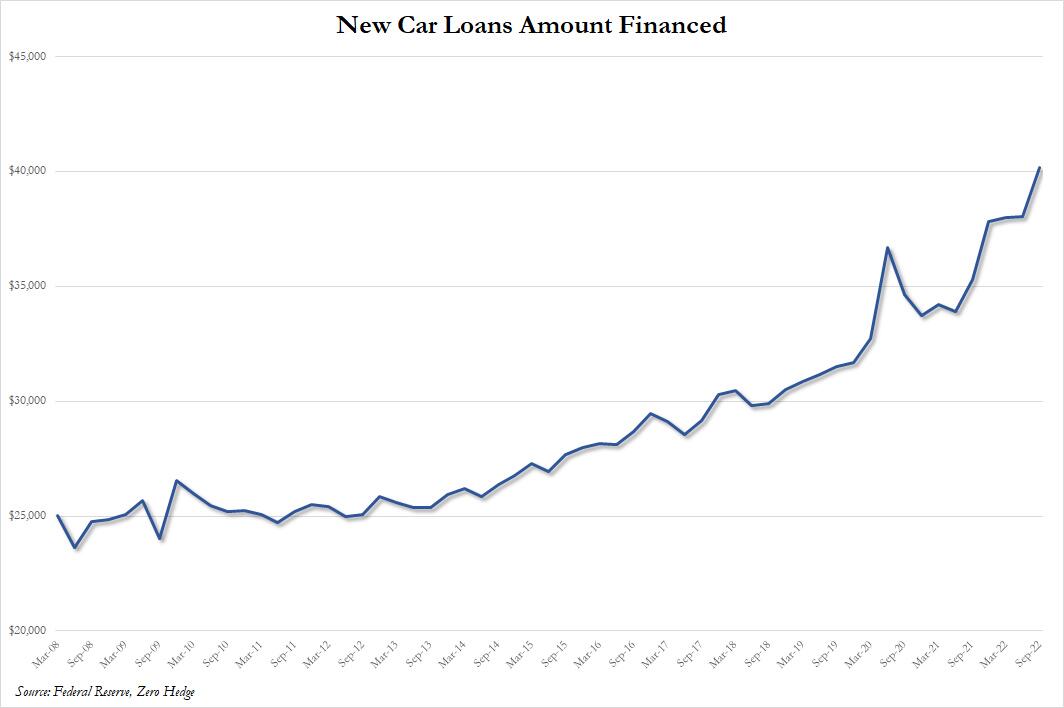
So while the big picture is clear – Americans are using ever more debt to fund record new car prices – fast-forwarding to today, we have observed two ominous new developments: the latest consumer credit report from the Fed revealed a dramatic spike in the amount of new car loans, which increased by more than $2,000 in one quarter, from just over $38,000 (a record), to $40,155 (a new record).
Now this shouldn’t come as a shock: a simple reason why new car loans have hit record highs is simply because new car prices have also soared to all time highs, as the next chart shows.
Here we will ignore for the time being cause and effect, or “chicken or egg” questions – i.e., whether record new car prices are the result of easy record credit, or whether record new car loans are simply tracking the explosive surge in car prices, and instead focus on something even more ominous: the explosion in the average interest rate on a new 60 month auto loans: according to Bankrate, as of Dec 16, the number is just over 6.50%, almost doubling since the start of the year, and the highest in 12 years.
It is this surge in nominal auto debt as well as the unprecedented spike in new auto loan rates, that we believe has finally pushed the US car sector to the infamous Wile Coyote point of no return.
Consider the following: according to various recent financial analysts, a growing number of consumers are falling behind on their car payments – a trend which will only accelerate – in a sign of the strain soaring car prices and prolonged inflation are having on household budgets.
As NBC reports, whereas repossessions tumbled at the start of the pandemic when Americans got a boost from stimulus checks and lenders were more willing to accommodate those behind on their payments, in recent months, the number of people behind on their car payments has been approaching prepandemic levels, and for the lowest-income consumers, the rate of loan defaults is now exceeding where it was in 2019, according to a recent report from Fitch.
Naturally, with the economy set to slump into a Fed-induced recession, the trend will only get much worse into 2023 with economists expecting unemployment to rise, inflation to remain relatively high (at least until the economy crashes) and household savings – already at record lows – set to dwindle. At the same time, a growing number of consumers are having to stretch their budgets to afford a vehicle; the average monthly payment for a new car is up 26% since 2019 to $718 a month, and nearly one in six new car buyers is spending more than $1,000 a month on vehicles. Other costs associated with owning a car have also shot up, including insurance, gas and repairs.

The silver lining is that while the US auto sector faces unmitigated disaster in 2023, for those in the repossession business, it’s been difficult to keep up. Jeremy Cross, the president of International Recovery Systems in Pennsylvania, said he can’t find enough repo men to meet the demand or space to hold all the cars his company has been tasked with repossessing. With the holidays approaching, he’s been particularly busy as people prioritize spending elsewhere, and he’s expecting business to keep up throughout next year and 2024.

“Right now, it’s really the perfect storm,” said Cross. “Over the last two years, vehicle prices were inflated because there was no new car supply, people were still buying like crazy because they had a lot of stay-at-home cash, they had inflated credit scores, so it was like a recipe for disaster.”

Ironically, at the same time, the number of repossession companies has shrunk by 30% as many firms closed up shop and the workers found jobs in other industries when repossessions tumbled during 2020, Cross said. Now, he told NBC, lenders are paying him premiums to repossess their cars first in anticipation of a continued increase in loan defaults (read: plunging prices).

Predictably, the coming auto crisis is an issue that’s raised concern among officials at the Consumer Financial Protection Bureau, who say they are seeing troubling signs in the auto market, particularly among so-called subprime borrowers, who have below-average credit scores, and those with loans taken out in 2021 and 2022 when auto prices were particularly high.

Yes: that 2008 deja vu feeling is back front and center….and so are the defaults.

“Loans taken out in those years are performing worse than prior years just because those consumers had to finance cars once the supply chains were jammed and the prices started to go up,” said Ryan Kelly, acting auto finance program manager for the CFPB. “Those consumers got hit with inflation twice. First, when they had to finance a car after the prices went up, and then when they had to put gas in the car after the Russia-Ukraine conflict started. So there’s just a lot of consumer stress.”

What happens next?

Well, as the economy continues to deteriorate in 2023, the number of those falling behind on their car payments will continue to rise, even as consumers tend to give priority to their car payment ahead of most bills because of the importance a car plays in getting to work or potentially providing shelter, industry analysts said.

For now, the rate of defaults and repossessions isn’t expected to reach 2008 and 2009 levels, when there was a spike caused by the financial crisis. The percentage of auto loans that were 30 days delinquent was at 2.2% in the third quarter compared with 2.35% delinquent over the same period in 2019, according to data from Experian. By contrast, just over 4% of auto loans went into default in 2009. However, that could quickly change once the 2023 economy unleashes the final whammy of mass layoffs (which have already slammed the tech sector).

Some, like Cox Automotive, remain optimistic: their analysts (who just may be a little conflicted) forecast that while loan defaults and repossessions will increase from their pandemic lows, long-term through 2025 they predict overall defaults and repossessions will remain at or below historic norms.

Still, the financial squeeze has been particularly difficult for lower-income consumers looking for budget vehicles, which have been particularly hard to find. While in the past, those car buyers would have purchased a used car for $7,000 to $15,000 they are now having to spend $20,000 to $25,000 for the same type of vehicle. Among dealers that cater to subprime and deep subprime consumers, the average listing price on their cars has almost doubled since the beginning of the pandemic, according to the CFPB.

Ally Financial, which has a significant share of loans to subprime borrowers, said in its October earnings report that it expects delinquencies to increase to as much as 3.8% compared with 3.1% in 2019. That estimate will prove to be overly optimistic.
Another risk to car buyers’ finances is the growing length of auto loans, many of which now exceed seven years. While those longer term loans can lower the monthly payments amid higher prices, consumers risk paying off the loan much more slowly than the car is depreciating, leaving them underwater if they need to sell the vehicle. It can also mean higher interest costs over the life of the loan on top of already inflated vehicle prices.
And speaking of interest rates, they have not been this high since 2009 and will stay at their current levels until the Fed finally pivots. As NBC notes, “for consumers, there is unlikely to be any relief over the next year. Interest rates are expected to remain high for those needing to borrow to buy a vehicle, and Covid-related plant closures and material shortages are continuing to ripple through the car manufacturing supply chain, limiting the number of new vehicles.”
“I dare think what happens to people who are signing up for new loans today,” said Drury. “It’s not going to be better when we see these payments so high.”
But wait, there’s more.
As twitter’s CarDealershipGuy – who claims to be an anonymous auto-industry CEO and whose analysis has been featured in places like the NY Post and who frequently Tweets about the state of the auto market – laid out a long thread on Thursday, all of the above may end up being an overly optimistic assessment of the perfect storm that’s about to hit the auto sector:
“This morning I discovered something *extremely* alarming happening in the car market, specifically in auto lending. I’m now convinced that there is a massive wave of car repossessions coming in 2023,” he wrote.
Recapping much of what we said above, he noted that over the past 2 years, many people took out exorbitant loans on cars and while car values were inflated (and still are) but many people simply had no choice and bought an overpriced a car. Then, echoing the Fitch assessment, he notes how those buyers are underwater: “Car valuations are now plummeting. Some cars have declined in value as much as 30% y/y. And these same people that took out these big loans are now ‘underwater’. Basically, they owe banks more on these cars than they are worth. And the banks are well-aware of this.”
The punchline is his personal experience from late last week. “This morning, one of our General Managers opened up DealerTrack — a portal that dealers use to communicate with auto lenders — and highlighted something very concerning. 9 of our lending partners have started WAIVING ‘open auto stipulations’ for consumers.”
What this means, he explained, is that once consumers are stuck with a vehicle they paid too much for, they can’t trade it in without putting some money up front to cover the difference of what is owed on it versus what it is worth. At that point, he notes, “Dealer can’t sell consumer a car, Consumer can’t buy a car, And, you guessed it, lender can’t finance a car!”
The lender then knows that most consumers are stuck and waives the open auto stipulation – meaning they allow the consumer to buy the new car with a second loan knowing they already have a first one. But the lender does it because they know that the buyer will default on the old, other car.
Cue default avalanche: “This is NOT normal. But it’s the only way lenders can finance cars and dealers can put cars on the road. And the implications of this will be tons of repossessions,” the CEO wrote.
He concluded: “I’ve been a doubter, but after what I saw this morning, I’m now FULLY convinced that a wave of car repossessions will hit in early/mid 2023. If lenders are willing to backstab each other in order to put more loans on the road, we’re in trouble.”
Here is a snapshot of his entire thread:
This morning I discovered something *extremely* alarming happening in the car market, specifically in auto lending. I’m now convinced that there is a massive wave of car repossessions coming in 2023.
Here’s what I discovered (and what no one knows):
Background:
Over the past 2 years, many people took out exorbitant loans on cars. Car values were inflated (and frankly, still are to some extent). But many people simply had no choice and bought an overpriced a car.
Well…
Car valuations are now plummeting. Some cars have declined in value as much as 30% y/y. And these same people that took out these big loans are now “underwater”.
Basically, they owe banks more on these cars than they are worth. And the banks are well-aware of this…
But there is no easy solution. You can’t just put the genie back in the bottle. This brings me to what happened this morning:
Every Friday I conduct a team meeting to recap our week.
This morning, one of our General Managers opened up DealerTrack — a portal that dealers use to communicate with auto lenders — and highlighted something very concerning:
9 of our lending partners have started WAIVING “open auto stipulations” for consumers.
Wait, wtf does that even mean?
Let me explain using a simple, hypothetical scenario:
1) Consumer takes out an auto loan in 2020/2021 on an overvalued car
2) 2022 comes around and that overvalued car is now rapidly declining in value
3) With the car declining in value, consumer now owes more on the car than it is worth
4) Consumer no longer wants the car. Maybe they outgrew it. Or maybe it keeps breaking. So consumer wants to trade it in.
5) But dealer can’t trade the car in because the consumer owes WAY too much on it. So dealer asks consumer for lots of money down to cover the difference.
6) But of course, the consumer doesn’t have $1,000s to cover the difference between what they owe on the car and what it’s worth. And here comes the perfect storm…
7) Dealer can’t sell consumer a car, Consumer can’t buy a car, And, you guessed it, lender can’t finance a car! Everybody loses! Oh no. So what happens next?
8) Lender knows that most consumers are stuck in this situation, and does the following:
WAIVES THE OPEN AUTO STIPULATION.
Meaning, the lender lets the consumer buy the car KNOWING that they already have an open auto loan with another bank!
Why the f*ck would they do this?
Surely the lender knows that consumers that take out a 2nd auto loan are MUCH riskier and have a MUCH high risk of default? Right? RIGHT?
Yes, but the lender does it because they know that the consumer will default on the other car !!!!
Dog eat dog style.
Let me be clear: This is NOT normal.
But it’s the only way lenders can finance cars and dealers can put cars on the road.
And the implications of this will be tons of repossessions.
I’ve been a doubter, but after what I saw this morning, I’m now FULLY convinced that a wave of car repossessions will hit in early/mid 2023. If lenders are willing to backstab each other in order to put more loans on the road, we’re in trouble.
This will not end pretty.
What does this mean in simple terms: well, besides the imminent devastation across the auto sector, including a surge in defaults and car repossessions, we are about to witness a historic collapse in car prices. In fact, in a subsequent tweet, the CarDealershipGuy noted the plunge in prices at troubled used-car dealer Carvana which will be the first domino to fall and be forced to liquidate much if not all of its inventory to stay afloat:
Translation: just as soaring car prices were the leading indicator for red-hot, runaway inflation in 2021 and 2022 (followed by housing, food, goods and finally services) so the plunge in car prices – first used, then new – is the canary in the recessionary coal mine of deflation that will send all prices – cars, houses, and everything else – sharply lower in the coming months.

CrunchBase : Truly Terrible SPACs Trade At Lower Lows At Year End

Truly Terrible SPACs Trade At Lower Lows At Year End
For anyone looking to evaporate a large pile of money, the past year has presented abundant options. Of those, one of the faster and more effective methods involved investing in tech companies going public via SPAC.
As we’ve documented several times over the past few quarters, venture-backed companies that went public via SPAC deals have mostly posted exceedingly poor returns. As we revisit a previously curated list of truly terrible SPAC performers, it’s clear they’re closing out the year at a particularly low point.

How bad? Out of a selected set of 50 completed SPAC deals, at least 24 were trading below $1 per share . Because most blank-check companies initially price at $10 per share, that means they’re down 90% or more to date.
Here’s a list of the 24 sub-$1 names from our sample:
No sector has been spared, as one can see from the broad array of industries represented among these beaten-down stocks. It includes autonomous driving (Embark, AEye), electric vehicles (Faraday Future, Lightning eMotors, Xos), telehealth (Babylon, Talkspace), and real estate (Offerpad, Doma), among others.
What’s also noteworthy is that the vast majority are trading at a lower point than they were a couple quarters ago. So no, things aren’t looking up yet.

And that’s not the worst
And trading below $1 isn’t necessarily the worst fate for a troubled SPAC. A few others have either declared bankruptcy or sold to acquirers for an even smaller pittance of their former price.
One of the higher-profile casualties was Enjoy Technology, a mobile retail company founded by former Apple store executive Ron Johnson, which filed for Chapter 11 bankruptcy protection in June. The company had previously raised more than $230 million in known venture funding from backers including Kleiner Perkins, Oak Investment Partners and L Catterton, and another $250 million from SPAC investors.
In the biotech space, meanwhile, Clarus Therapeutics, a developer of androgen-based medicines that went public in September 2021, is also winding down. The company announced in September that it has filed for Chapter 11 and is selling its sole commercial asset, a therapeutic for testosterone deficiency.
Metromile, the pay-per-mile car insurance provider, also took a hit. The one-time unicorn sold to fellow insurtech Lemonade at a valuation representing a roughly 95% cut from Metromile’s peak public share price.
Rounding out the list, Carlotz, a used car marketplace, sold this month to Shift Technologies, a used auto e-commerce platform trading for 23 cents a share, in a deal that appears to be valued at roughly $20 million. Carlotz previously raised over $160 million in venture and SPAC-related financing.
Any success stories out there?
No company on our sample list of 50 currently has shares trading above the $10 break-even threshold for SPAC deals. The top performer — consumer health platform Hims & Hers — was recently trading at a little over $7.
Meanwhile, there are 15 companies with shares between $1 and $2, listed below:

The remaining companies on our list are trading between $2 and $7.

This story isn’t over
For anyone who binge-watches drama shows, the SPAC plotline is looking sort of familiar. We’re at that point where the protagonist is looking outmatched and on the cusp of defeat.
If this was Hollywood, of course, the protagonist would suddenly summon the strength for a big comeback, overcome foes and declare victory. But we’re in the real world, where this kind of underdog story only occasionally plays out.
At any rate, this does look like the back-against-the-wall moment for many SPACs. It’d be nice if 2023 could bring us some of those much-awaited dramatic turnarounds.


  1. This total includes two companies — Embark and Hippo Holdings — which completed reverse stock splits, a move in which several lower-priced shares are combined into one higher-priced share. If these companies had not carried out reverse splits, their shares would be well below $1 each.
  2. Prices as of Tuesday, Dec. 13.

CrunchBase : The Week’s 10 Biggest Funding Rounds: Group14 Adds To Big Series C;

The Week’s 10 Biggest Funding Rounds: Group14 Adds To Big Series C; Dataiku And Snyk See Big Down Rounds
1. Group14 Technologies, $214M, batteries: Back in May, Woodinville, Washington-based Group14 Technologies announced a $400 million Series C led by Porsche AG. However, it apparently was far from done with the new round. This week, the manufacturer of advanced silicon battery technology, announced it had raised another $214 million from investors that included the Microsoft Climate Innovation Fund as part of the round. Group14 is dedicated to the “electrification of everything,” and has raised $650 million to date, per the company.

2. (tied) Dataiku, $200M, AI: This was a week for down rounds. New York-based Dataiku, an AI/ML platform developer for enterprises, closed a $200 million Series F led by Wellington Management at a $3.7 billion valuation. While that’s a high valuation, it represents a 20% drop from August 2021, when the startup raised a $400 million Series E at a $4.6 billion valuation. It’s fair to think Dataiku never planned on a Series F, and instead once thought their next round of funding would be an IPO. The company talked about such an event just back in March. The startup has now raised $600 million in primary funding.

2. (tied) Komodo Health, $200M, health care: It was reported this week that health data startup Komodo Health raised a “structured equity infusion” of $200 million led by Coatue Management. Along with the funding, it was also reported the company will be restructuring — laying off 9% of its workforce — and its CFO will be leaving for personal reasons at the end of the year. Similar to Dataiku’s hopes of an IPO, it was reported in March that Komodo was eyeing a summer listing. In March 2021, Komodo raised $220 million led by Tiger Global. The San Francisco-based startup has raised more than $500 million, per Crunchbase data.

4. Snyk, $196.5M, cybersecurity: As we said earlier, this was a week of downrounds. Boston-based application security developer Snyk raised a $196.5 million Series G led by Qatar Investment Authority at a $7.4 billion valuation. That’s a 13% drop from September 2021, when the company — which has now raised about $1 billion — closed a $530 million Series F co-led by Sands Capital Ventures and Tiger Global at an $8.5 billion valuation. The cyber startup — originally founded in Israel — also had long been rumored to be nearing an IPO before the public markets started falling. We will see if 2023 may be the year.

5. MasterControl, $150M, software: After 30 years, welcome to the unicorn club, MasterControl. The biotech SaaS startup closed a $150 million round led by Sixth Street at a $1.3 billion valuation — its first round since being founded nearly three decades ago. The company creates software for the life sciences industry to help companies navigate various research and development issues including supply chain and logistics problems. The company has worked with over 1,000 pharmaceutical, food and medtech companies over the past 30 years, including Pfizer, WD-40 and Thermo Fisher Scientific.

6. Nerdio, $117M, cloud computing: Chicago-based virtual desktop developer Nerdio raised a $117 million Series B from Updata Partners. Founded in 1998, the company has raised $125 million, according to Crunchbase.

7. HistoSonics, $85M, medical devices: Plymouth, Minnesota-based HistoSonics closed an $85 million round led by Johnson & Johnson for a device it says can destroy tumors in patients with liver cancer. Founded in 2009, the startup has raised nearly $227 million, according to Crunchbase.

8. Synchron, $75M, medical device: New York-based endovascular brain-computer interface startup Synchron raised a $75 million Series C led by Arch Venture Partners. Synchron says it has now raised a total of $145 million.

9. MessageGears, $62M, marketing: Atlanta-based customer engagement platform MessageGears raised a $62 million growth round led by Long Ridge Equity Partners. Founded in 2011, MessageGears has now raised $80 million, according to the company.

10. Shield AI, $60M, autonomous vehicles: San Diego-based Shield AI, a defense technology firm building AI pilots for aircraft, announced it raised an additional $40 million in equity from the US Innovative Technology Fund as part of its now $225 million Series E first announced in June. The round included $150 million in equity and $75 million in debt. Founded in 2015, the startup has raised nearly $575 million, according to Crunchbase.


Big global deals
The biggest round of the week came from a startup just north of the U.S.
  • Canada-based Svante, a developer of carbon capture technology, raised a $318 million Series E.

WSJ : Elon Musk’s SpaceX Prepares for Starship Launch

Elon Musk’s SpaceX Prepares for Starship Launch
Company pushes for first orbital test launch of rocket system for deep-space missions

SpaceX is gearing up for a key test of its immense rocket that is designed for commercial launches, as well as the Mars mission Elon Musk has long sought.

Near a beach east of Brownsville, Texas, employees at Mr. Musk’s space company are preparing for the inaugural orbital flight of Starship, the towering rocket system the company has been developing for years to one day launch into deep space. The initial test mission would last around 90 minutes, beginning with a fiery blast of the ship’s booster over the Gulf of Mexico, SpaceX has said in a regulatory filing.

It isn’t clear when SpaceX will attempt the first flight, after dates Mr. Musk has discussed came and went. Some officials at the National Aeronautics and Space Administration, a customer for a version of Starship, previously said they thought the mission could occur in early December.

Mr. Musk, who acquired Twitter Inc. and recently delivered Tesla Inc.’s first all-electric semitrailer trucks, has described getting Starship into orbit as one of his main goals. At SpaceX, which Mr. Musk founded in 2002 and still leads, he has said the rocket system is consuming significant resources and faces formidable technical hurdles.

The company is using new engines it developed on Starship and wants to be able to quickly and rapidly reuse the vehicle, akin to how airlines operate planes. Starship is also really big: Fully stacked, it stands taller than the rocket NASA recently used on its first Artemis moon mission.

“There’s a lot of risks associated with this first launch, so I would not say that it is likely to be successful, but I think we’ll make a lot of progress,” Mr. Musk said last year, during an appearance before a National Academies of Sciences, Engineering, and Medicine panel.

A spokesman for Space Exploration Technologies Corp., as the company is formally called, didn’t respond to requests for comment.

SpaceX’s Starship program has encountered setbacks on shorter-altitude flights, and it isn’t clear how much it would cost if something similar happened on an orbital mission.

The company’s strategy of accepting potential failures, and learning from them, has helped it develop spacecraft like Falcon 9, the workhorse rocket the company used on almost 60 launches this year through mid-December, former employees said.

“It’s better to lose them now than to lose them because you left data on the table, because you were too scared to have a failure in public during the development phase,” said Abhi Tripathi, who worked in several director roles at SpaceX and currently serves as mission operations director at the University of California-Berkeley Space Sciences Laboratory.

At SpaceX, “risk taking, as long as it is safe to personnel and to property, is highly encouraged,” Mr. Tripathi said.

Jeff Bezos ‘ space company Blue Origin LLC is also working on its own large rocket, as is United Launch Alliance, the launch company jointly owned by Boeing Co. BA 0.53% and Lockheed Martin Corp.

If it works, SpaceX’s vehicle would lower the cost to get to orbit and give the company a sophisticated new rocket system, Mr. Musk said earlier this year. If it doesn’t, the program could threaten to become a money pit for a company that already has two proven rockets—Falcon 9 and Falcon Heavy—that are partially reusable, according to space-industry analysts and executives.

NASA is a major backer for Starship, providing deals valued at more than $4 billion to use a moon-lander version of the vehicle for Artemis exploration missions. Senior agency officials have said the company has been meeting milestones under its contract.

Technology entrepreneur Jared Isaacman and the Japanese billionaire Yusaku Maezawa have both said they purchased flights using the vehicle. A Japanese satellite operator said in August that it would use Starship to deploy a company satellite.

Starship is made up of a 230-foot-tall booster called Super Heavy that would power a 164-foot-tall spacecraft, also called Starship, into orbit, according to SpaceX. The latter ship is designed to carry cargo or crew, with a user’s guide touting room for up to 100 people. The spacecraft is designed to be refueled in orbit, enabling longer-distance flights, according to company and NASA presentations.

SpaceX is spending heavily on the Starship program, according to space industry analysts. The privately held company has raised significant funds lately, selling at least $6.1 billion in stock over the past three years, according to securities filings. SpaceX recently began marketing employee shares for sale at a price that would value the company at around $140 billion.

Mr. Musk has warned that SpaceX could face bankruptcy if a severe global recession made capital and liquidity difficult to obtain while the company was investing in Starship and Starlink, its satellite-internet business.

Technical challenges with new rockets are common. In July, the company had to deal with a fiery blast underneath one of the Super Heavy boosters, though last month SpaceX said it completed a significant engine test. SpaceX also has lost Starship prototypes. Two years ago, a Starship spacecraft flew a short-altitude test flight without a booster, but smashed into the ground when trying to land.

In May 2021, the company landed a Starship spacecraft for the first time after another short flight.

For the first orbital test, SpaceX expects to bring the booster down in the Gulf of Mexico and land the Starship spacecraft in the Pacific Ocean, near a Hawaiian island, according to a company filing with the Federal Communications Commission.

Jeff Thornburg, a former SpaceX propulsion executive, said the company’s biggest challenge is ensuring the Starship spacecraft can safely return to Earth. The vehicle will endure enormous stress and heat as it re-enters the atmosphere from orbit, he said, but is designed to be used quickly and repeatedly.

“Reusability brings a lot of complicated engineering, because it can’t just survive once. It’s got to survive 10, 20, 100 plus times,” he said.

FT : Covid outbreak throws Chinese factories and supply chains into chaos

Covid outbreak throws Chinese factories and supply chains into chaos
‘Closed loop’ system to protect employees and production likely to be overwhelmed

The coronavirus sweeping across China is causing widespread business disruption as staffing shortages threaten to close down factory production lines and truck drivers fall ill, bringing chaos to supply chains.

The Omicron variant of the virus has begun to run rampant through several big cities since the sudden U-turn on president Xi Jinping’s former zero-Covid policy of containment earlier this month. The surge in infections is largest in the capital Beijing, where more than half the 22mn population is infected, according to some estimates.

Many office workers have begun to work from home but some factories are becoming thinly staffed as workers call in sick. Business owners and executives said this was causing increasing disruption to production and supply chains.

The boss of a printed circuit board factory in the eastern province of Shandong said only 20 per cent of staff came to work on Friday, the rest calling in sick with Covid. “One after another tested positive. I’m worried that I will have to shut the factory down,” they said.

Companies have been left with no direction on how to handle the sudden surge in cases, after previously operating under strict guidelines handed down by local governments. Factory bosses are now either loosening all controls or isolating workforces to keep production lines functioning.

A manager at a car assembly plant in the northern province of Hebei said his group plans to reinstate the “closed loop” system, whereby staff live and work on-site during Covid outbreaks, in order to keep production going while avoiding catching the virus.

“We will have no workers left otherwise,” he said.

Elsewhere, factory bosses have dropped restrictions such as PCR testing and fencing off workers from the wider population.

Jörg Wuttke, the president of the EU Chamber of Commerce in China, said it would be increasingly untenable for manufacturers to rely on the closed loop model. He said the huge scale of the exit wave and the lack of measures to suppress its spread meant these strategies would not work anymore.

There is some evidence that the disruption will be shortlived. Apple contract manufacturer Foxconn’s Zhengzhou campus — the world’s largest iPhone factory — is among those shedding its notorious restrictions, and production is rebounding according to one employee.

In October, workers at the Zhengzhou plant staged a walkout after a Covid outbreak resulted in them being locked in dormitories, with food and medical supplies running low.

By this month Foxconn had scrapped daily PCR testing mandates and dismantled metal barriers that had kept its staff confined to the Zhengzhou campus, according to a worker who asked to remain anonymous. “We’re free now. There are no longer metal fences erected or any other form of restrictions in effect,” they said.

They said Covid-positive workers could continue to work or isolate in the dormitory. The Foxconn employee added that “production is returning to normal” after the company recruited new workers and others who had “fled the factory” returned to work.

Foxconn did not respond to a request for comment.

Experts said factories would face worker shortages until February, after the lunar new year. The Omicron outbreak has brought forward the annual movement of more than 290mn migrant workers from the coastal provinces back to poorer regions in the west, which occurs ahead of the festive period.

“Sectors that rely on migrant workers are struggling because many people have gone home already for the Chinese new year holiday, which is only five weeks away,” said Chen Long, a partner at the Beijing-based research provider Plenum. “Things will be pretty quiet until the end of January.”

Factory bosses are also tackling supply chain problems. The EU Chamber of Commerce’s Wuttke said the rising number of Covid-positive truck drivers would be disruptive. Under the zero-Covid regime, drivers were subject to strict testing, which hampered supply chains but kept sick motorists off the roads.

Some plants would be forced to slow production due to a lack of components from suppliers forced to close their operations. “This is all about stocks and inventory,” he said.

Jacob Cooke, chief executive of WPIC Marketing + Technologies, which operates several warehouses across China, said he had experienced delivery delays as drivers fell ill.

“The delivery routes between major cities have multiple stops where the drivers exchange cargo. It only takes one driver to call in sick, and then things are held up for another day,” he said.

One cosmetics retailer in the southern city of Shenzhen said she was facing delays in sending packages to customers after many delivery drivers had tested positive. “The delivery system is very slow at the moment,” she said.

However investors are hoping that the period of short-term disruption will accelerate China’s opening up, after three years of being isolated from the rest of the world.

“If the virus continues to spread at its current pace, most cities will have passed the peak by mid-January. The resumption of activity will be pretty fast in February,” said Chen. “Investors will look through this period of short-term mess. The crucial question is how quickly things will normalise after this wave, and it looks like it could be much faster than expected.”

Shaun Rein, managing director of the China Market Research Group, warned that there would be no “revenge spending” from Chinese consumers after the initial wave of infections starts to ease.

“Many workers have had salary cuts in 2022 with all the lockdowns. Consumer confidence is very low. A lot of small and medium-sized enterprises have already gone out of business,” he said.

There are early signs of a rebound in domestic and international travel.

“We expect the ‘go home’ demand during Chinese new year could be better than our previous expectation,” Citi analysts wrote in a research note. They cited travel service provider Qunar’s data showing a more than eight-fold increase in bookings for airline tickets for the holiday period, made in the week after Covid restrictions were loosened on December 7.

There is also huge pent-up demand for international travel. Flight searches for the new year’s Eve period surged to the highest level in three years on the travel site Ctrip after restrictions were eased.

Hua Yifan, a manager at Shanhui Dress, a clothing manufacturer based in the eastern city of Jiaxing, is part of the first wave of Chinese exporters to benefit from more freedom to travel. Hua joined a 100-party delegation of exporters who travelled to Japan at the start of December for a week-long trip organised by the city’s commerce department.

“This is the first time I’ve attended the semi-annual Asia Fashion Fair in person since the pandemic began in 2020,” said Hua. “I was so excited about meeting clients I hadn’t seen for a long time.”

During the trip, Hua secured $5mn worth of orders from seven Japanese companies. The Japanese market usually contributes 50 per cent of Shanhui’s annual revenue, Hua added.

Cooke predicts that any further loosening of inbound quarantine restrictions will lead to an influx of foreign executives who have been unable to travel to China and meet local employees and business partners. “People with businesses here have not been able to come for three years. A lot of investments haven’t happened as a result,” he said.

FT : BlackRock weathers political storms to pull in more funds than its rivals

BlackRock weathers political storms to pull in more funds than its rivals
World’s largest asset manager, under fire over its environmental policies, boasts big retail inflows

BlackRock has pulled in much more money from US retail investors than its rivals so far in 2022, even as the world’s largest asset manager has come under attack from both the left and right over its approach to sustainable investing.

BlackRock’s mutual funds and exchange trade funds collectively had positive retail flows in nine of 11 months and ended up with $144bn in net new money at the end of November, according to Morningstar data.

Vanguard, the second-largest asset manager, said its personal investor clients added $22bn in new cash over the same period. The broader industry had net outflows of $138bn, and Fidelity suffered small outflows, according to Morningstar.

BlackRock’s positive numbers are due to its iShares index funds, which drew in $152bn, enough to outweigh $8bn in outflows from its BlackRock branded funds, which are a mix of active and passive. Morningstar calculates that BlackRock is on track to gather more new retail money than Vanguard for the first time since 2007.

The net inflows continued even as Republican politicians stepped up their attack on BlackRock over the use of environmental, social and governance factors in investing. Contending that the firm was hostile to fossil fuel, Republican states have pulled more than $3bn in funds from BlackRock and North Carolina’s treasurer has called for the ouster of founder Larry Fink from his role as chief executive.

On Thursday, Texas lawmakers held a hearing at which they excoriated BlackRock’s head of external affairs, over the group’s prodding of companies to cut carbon emissions and avoid risks associated with climate change.

State senator Bryan Hughes took particular issue with BlackRock’s decision to vote its shares in ExxonMobil, the Texas-based oil company, in favour of replacing three board directors with candidates nominated by activist hedge fund Engine No. 1. “We wish BlackRock did not have such a big stake in Exxon to push them around, bully them and vote against oil-and-gas exploration — vote against energy that Americans and Texans need,” Hughes said.

Democratic politicians for their part have lashed out at Fink and BlackRock for failing to do more to fight climate change, and a UK activist fund has called for his resignation over alleged “hypocrisy”.

The inflows come despite a grim year for the broader markets in which equity and bond prices tumbled, dragging down assets under management for the entire money management industry. BlackRock’s total AUM dropped 20 per cent to $8tn as of the third quarter and across the entire mutual fund and ETF industry assets fell 17 per cent to $28tn at the end of October, according to the Investment Company Institute.

Martin Small, head of BlackRock’s US wealth advisory business, said the money manager had benefited from the fact that its funds are exclusively marketed through financial advisers rather than directly to retail customers.

“Our strategy for the better part of a decade is to be a whole portfolio provider and make it easier for financial advisers to build great portfolios,” Small said. “These are real relationships we have with financial advisers who we speak with directly. It’s not the first time they have seen co-ordinated campaigns against the financial services industry. They understand that tides ebb and flow.”

Vanguard said in a statement: “Investors continue to adopt low-cost index ETFs as their vehicle of choice for broadly diversified exposure to the stock and bond markets.”

Fidelity said: “We are proud to help customers of all ages and from all life stages meet their investment goals of retirement, college tuition, philanthropy, etc. and are therefore redeeming.”

“Despite market declines that impacted our asset levels, Fidelity continued to experience customer growth and strong business results,” it added, noting that the number of retail accounts was up 11 per cent year on year.

>>> Weekend Papers Summary

Weekend Papers Summary

NEW YORK TIMES
-As world leaders pour into Qatar, world cup becomes backdrop for diplomacy. Dozens of top officials have flown to Qatar to cheer for teams while talking shop. The event has magnified the Gulf nation’s role as a diplomatic broker.
-Qatar paid David Beckham tens of millions of dollars to promote the country and its interests. It has not received much return on the investment.
-Dozens of missiles knocked out heat and electricity systems around the country including in Kiev, where two-thirds of its residents had no heat or water.
-Brittney Griner said she would return to the WNBA next season and pledged support for Paul Whelan.
-A Russian official working to gain influence in the Central African Republic was wounded by a package bomb, Moscow said.
-Hospitalizations for respiratory illnesses are at high levels for this time of year, making it hard to predict how bad this winter will be.
-The research was conducted in part when older variants of the coronavirus were spreading. Other factors may have influenced the conclusions.
-A NY Times investigation shows how Donald Trump stored classified documents in high-traffic areas of Mar-a-Lago where guests may have been within feet of the materials.
-A separate House committee is expected to vote on whether to release former President Trump’s tax records.
-Robert Crimo Jr., whose son is accused of killing seven people at a Fourth of July parade in Illinois this year, was charged with reckless conduct.
-The concert was supposed to be one of Mexico’s largest, sold out months before. Instead, one of the world’s biggest stars played to a half empty floor.
-In Peru, two government ministers resigned after the new president, Dina Boluarte, deployed the military to crack down on demonstrations.
-University of California academic workers reach deal to end strike. The tentative agreement comes more than a month after 48,000 employees walked out.
-J. Robert Oppenheimer has been cleared of ‘black mark’ after 68 years.
The physicist and architect of the American atomic bomb was stripped of his security clearance in 1954 after what is now called a flawed investigation.
-FTX was vastly different from stock exchanges, which are highly regulated and barred from engaging in many of the activities it pursued.
-The January 6 plot, which also included attacking an FBI office, was foiled by a witness who aided the authorities and recorded the defendant, court papers say.

THE FINANCIAL TIMES
-Goldman Sachs is preparing to lay off as many as 3,900 employees starting in January as chief executive David Solomon seeks to boost the bank’s profitability amid economic headwinds. Wall Street is contending with sharply reduced dealmaking and capital markets activity after a bumper 2021 that resulted in big hiring surges and large bonuses. Investment banking fees have tumbled 35% in the year to date, according to Refinitiv data.
-Hedge funds have been upping their short positions against shares of cryptocurrency miners, betting that more will go to the financial brink after the collapse of the FTX exchange.
With the bitcoin price down by nearly two-thirds this year and the cost of the power that miners require to fuel their energy-intensive computers having risen sharply, hedge funds are wagering that some companies’ business models are still far from viable.
-A globetrotting Italian union boss-turned-politician has emerged as the kingpin in a sprawling international investigation into allegations that Qatar and Morocco sought to bribe EU legislators to influence policy and used a network of non-governmental organizations to hide the corrupt dealings. Pier Antonio Panzeri, a Socialist member of the European parliament between 2004 and 2019, is one of four people charged with corruption, money laundering and being part of a criminal group after police seized €600,000 in cash at his residence in Brussels. A separate suitcase with €600,000 in cash was found in the possession of the father of Eva Kaili, a Greek MEP also charged in the case.
-A month after Donald Trump launched his third presidential campaign with a declaration that “America’s comeback begins now”, his attempt to recapture the White House is floundering amid a drumbeat of criticism from Republican lawmakers and ever mounting legal woes.
-Outflows from Binance accelerated to $6B in the first half of this week, while accounting firm Mazars has halted its work on crucial “proof of reserves” reporting, as the crypto exchange battles to avert a crisis of confidence.
Binance, which suffered $1B outflows in a single day on Tuesday, is battling to reassure investors of its financial strength following the collapse of rival crypto exchange FTX.
-The head of Elon Musk’s family office has approached investors who helped the billionaire buy Twitter for $44B in October to try and raise new funds as the social media company continues to bleed cash and faces heavy interest payments on its debts. Jared Birchall, a former Morgan Stanley banker, approached Twitter’s shareholders on Thursday afternoon, according to two people familiar with the matter. He offered new shares in the company at $54.20 — the same price Musk paid to take the company private.
-David Cameron, Britain’s former prime minister, is returning to public life with a new job teaching politics at a university in the Gulf state of Abu Dhabi. Cameron will lecture students on “practicing politics and government in the age of disruption” for a three-week course in January at the New York University Abu Dhabi. It will involve topics such as the war in Ukraine and the migration crisis.
-Explosions from the latest major barrage of Russian air strikes knocked out utilities in Kiev and scores of other Ukrainian cities on Friday, increasing officials’ pleas for more western air defense systems to protect critical infrastructure.
-Russian crude oil is being shipped to India on tankers insured by western companies, in the first sign Moscow has reneged on its vow to block sales under the G7-imposed price cap.
-Speaking just days after the Federal Reserve slowed down the pace of its policy tightening and raised the federal funds rate by half a percentage point, the heads of the New York and San Francisco branches of the Federal Reserve countered what they described as an “optimistic” view held by investors that elevated inflation will be close to extinguished next year, especially after recent positive data.
-The decision to buy crude again for the Strategic Petroleum Reserve follows a decline in oil prices in recent weeks. It is a reversal for the administration of Joe Biden, which has aggressively sold off supplies from the reserve in an effort to drive down fuel costs and alleviate fears of global energy shortages triggered by Russia’s war in Ukraine.
-US President Joe Biden pledged unparalleled support for labor unions. But the federal agency responsible for conducting an increasing number of union elections is on the verge of furloughing its own employees due to a funding crunch.

NY POST
-Oberlin College has forked over the $36M owed to a local bakery after the progressive Ohio school falsely accused the family-operated business of being racist. The substantial payout was awarded earlier this year after Gibson’s Bakery won a defamation lawsuit against the school that sided with three black students who claimed the store racially profiled them when they were caught stealing from the shop in November 2016. “We can confirm that all funds have been disbursed and that the family is continuing with the process of rebuilding Gibson’s Bakery for the next generations,” Brandon McHugh, the Gibson family’s attorney, told 3News on Thursday.
-King Charles will invite Prince Harry and Meghan Markle to his coronation in spite of the couple’s new Netflix docuseries containing fresh attacks on the royal family. The historic event at Westminster Abbey set for May 6.
“Harry is his son and His Majesty will always love him. While things are difficult at the moment, the door will always be left ajar,” one insider told the outlet.
-Former President Donald Trump on Friday publicly backed House Minority Leader Kevin McCarthy’s bid for speaker of the House in the next Congress. The 76-year-old former commander-in-chief also warned that GOP lawmakers opposing the California Republican are playing a “very dangerous game.” “Yeah, I support McCarthy,” Trump told Breitbart News during an interview from his Doral golf resort in Miami, Florida.
-FTX investor and former paid spokesperson Kevin O’Leary refused to condemn Sam Bankman-Fried or classify the doomed company’s meltdown as fraud during a tense television appearance on Friday. O’Leary, one of the sharks on the hit show Shark Tank, provided a toothless response when pressed to point a finger at who’s to blame.
“I don’t have all the facts,” he told the hosts of CNBC’s “Squawk Box.” Bankman-Fried faces up to 115 years in prison on eight federal charges for his alleged crypto con job and has drawn comparisons to the late Ponzi scheme mastermind Bernie Madoff. Prosecutors say Bankman-Fried is responsible for “one of the biggest financial frauds in US history.” He is locked in a Bahamian prison while he fights extradition. But O’Leary isn’t ready to convict his former benefactor.
-The managing director of Elon Musk’s family office is seeking new equity investors for Twitter, news platform Semafor reported on Friday, citing two people familiar with the fundraising effort. Musk’s money manager, Jared Birchall, reached out to potential investors this week, offering shares of Twitter at the same price, $54.20, that Musk paid to take the company private in October, according to the report. Musk sold another $3.6B worth of shares in Tesla earlier this week, making it nearly $40B worth of shares in the electric-vehicle company sold this year.

>>> Barron’s Weekend Summary

Barron’s Weekend Summary: After a selloff in the first half of 2023, equities could rebound as investors anticipate a return to economic growth, market strategists say

Cover Story:
-After a selloff in the first half of 2023, equities could rebound as investors anticipate a return to economic growth, market strategists say. Stocks could continue sliding as 2023 unfolds, particularly if the Fed’s interest-rate hikes push the economy into a recession. Yet, a more modest economic slowdown might be enough to reduce price growth to a level near the central bank’s annual target of 2%. Once the Fed pauses its tightening, the gloom shrouding Wall Street could lift, setting the stage for a stock market rally. Based on the average of the predictions of eight investment strategists recently canvassed by Barron’s, the S&P 500 SPX -1.11% could end 2023 at 4233, 9% above its current level.

Interview:
-Stephanie Lynch, co-founder of Global Endowment Management, a Charlotte, N.C.–based firm that oversees $11.2B for endowments, foundations, and nonprofits. Global Endowment Management, or GEM, acts as an outsourced chief investment officer, or OCIO, for clients, including the Rhode Island School of Design, the New York Blood Center, and the Woods Hole Oceanographic Institution. Barron’s recently spoke with Lynch about the challenges and opportunities facing endowments now that higher inflation and interest rates, and greater market volatility, have put an end to the easy money made during the bull market’s historic run.

Tech Trader:
-With just two weeks left in 2022, the NASDAQ Composite is off 32%, the worst year for tech since a 40% drop in 2008. Dozens of former highfliers are down 50%, 70%, even 90%. The IPO market is closed—new issue proceeds are down 97% in 2022. Crypto is in tatters. The ad market is soft, cloud computing is decelerating, enterprise tech spending is slowing, and the PC market has come unglued. Meanwhile, what sales there are have been hurt by the strong dollar. Meanwhile, the biggest problem of all is that the Federal Reserve keeps ratcheting up rates to fight inflation. Higher rates are poison to tech stocks, because earnings far into the future are less valuable as rates rise. And this year, the yield on the two-year Treasury note has climbed from 0.7% to 4.2%.

The Trader:
-The Federal Reserve may be making a huge mistake, and one that could mean another difficult year for the stock market in 2023. Those concerns came to the fore over the past week, following the Federal Open Market Committee’s December meeting. The Fed didn’t do anything to surprise the market as it raised the federal-funds rate by a half-point, just as everyone expected, and suggested a terminal rate of just over 5%, a level investors had slowly come around to. But the dot plot reflected the Fed’s belief that rates would have to go high and stay high, while Chairman Jerome Powell continued to strike a hawkish tone. The selling started immediately and continued through Friday. When it was finished, the S&P 500 had fallen 2.1% for the week, the Dow Jones Industrial Average fell 1.7%, and the NASDAQ dropped 2.7%. It was the second straight week that all three indexes notched a loss.
-Real estate investment trusts have not been the place to be in 2022—and while next year shouldn’t be worse, it might not be all that much better. Some REIT sectors will have a tougher time pulling that off than others. Some office REITs, in particular, could be forced to lower dividends as companies deal with changes in how—and where—people work and vacancies remain high, Citigroup’s Nicholas Joseph writes. Instead, he prefers REITs in sectors that address needs, not wants, and benefit from secular trends, including industrials, data centers, cell towers, and self-storage, among others, while underweighting the aforementioned offices and diversified REITs. He’s also underweight malls, due to continued problems faced by retailers, among other issues. Still, some mall REITs look attractive: Simon Property Group SPG, which could hold up better than most of its peers due to its exposure to luxury brands. Compass Point Research & Trading analyst Floris van Dijkum notes that luxury retailers are likely to hold up better in the months ahead if the economy slows because the rich will likely remain rich, while luxury brands look ready to expand from the coasts into middle America.

Features:
-Apple enters 2023 facing production issues in China, concerns about consumer spending, and a laundry list of long-term projects. Nevertheless, Apple stock is still Evercore ISI’s top “set and forget” pick within the tech-hardware space heading into 2023. “While we understand investors are concerned about the near-term iPhone outlook given manufacturing disruption issues in China, we see any headwinds as transitory and investors should remain focused on the long-term opportunity,” Evercore’s Amit Daryanani wrote in a Friday note to clients. In 2023, the smartphone giant has an opportunity to make progress on its “moonshot” endeavors, he continued.
-Barron’s features an article about what to eat, and where to invest, to reduce Alzheimer’s. First where to invest: Biogen has launched a new Alzheimer’s drug, lecanemab. But it’s not the only good news on the dementia front. Some might even say we’re making as much progress, or more, outside the drug labs as inside. Walking, crosswords, and meditation also lower your risk of dementia. And some fresh research from Rush University Medical Center in Chicago supports this and more. A long-running and detailed study of nearly 1,000 elderly people has found that those who ate certain foods in their diet—those that contain certain natural compounds known as flavonols—were less likely to get dementia. Seriously less likely. His study reports that flavonol consumption was “associated with slower decline in global cognition, episodic memory, semantic memory, perceptual speed, and working memory.” What foods are we talking about? Kale is on the list. So is broccoli. But there are happier foods too. Drinking tea is great for you: It has plenty of the key flavonols. Tomatoes, apples, spinach and beans all make the list. Researchers admit that they “do not fully understand” how flavonols fight cognitive decline, but the compounds have anti-inflammatory and antioxidant properties.

European Trader:
-In fact, the outlook for 2023 across the pond can be summed up in one word: grim. Germany and the United Kingdom, two of the region’s biggest economies, are probably already in recession. The 19-member euro area will likely experience a prolonged downturn as well, according to the latest forecasts from the European Central Bank and the International Monetary Fund. For analysts at J.P. Morgan, the best investment bet is to try to avoid companies that are more exposed to consumer spending. Along with higher prices, households will also be coping with rising European Central Bank interest rates. That means favoring healthcare, utilities, and possibly banks. In Germany, that could be Deutsche Telekom or Bayer, two of the best-performing stocks in the DAX this year. Aerospace giant Thales is the best performer in the French CAC 40 in 2022. In Spain, it’s the banks that have done well— Banco Sabadell and CaixaBank are among those with the biggest share gains of the past year.

Emerging Markets:
-A Federal Reserve pivot should boost emerging markets currencies and bonds, says Michael Arno, a global fixed-income analyst at Brandywine Global Investment. He’s betting on currencies in Thailand and Indonesia, which would also benefit from renewed Chinese tourism, and sovereign bonds of Colombia, which he thinks have overreacted to the election of leftist President Gustavo Petro. Omotunde Lawal, head of emerging markets corporate debt at Barings, is mining for gold amid the dross of distressed Chinese developers, as Beijing commits billions to rescuing its critical property sector.
There are a few problems with these hopeful scenarios: The Fed might not pivot, and China might not reopen. State Street’s Mallik is particularly cautious on that second premise. “Many times we’ve seen one step forward, two steps back from China,” he says. “We’re in a wait-and-see position for now.” Even if both conditions are fulfilled, managers’ eclectic picks are a rounding error on an emerging markets index topped by Chinese internet giants Tencent Holdings and Alibaba Group Holding, and chip makers Taiwan Semiconductor Manufacturing (TSM) and Samsung Electronics. No one seems very excited about the Big Four.

Commodities:
Next year, Wall Street banks are predicting that oil prices will rise from current levels around $75 per barrel to $100 or even higher. In a recession scenario, however, there’s precedent for petroleum to fall precipitously, perhaps as low as $50. In a bet between $50 and $100, we’d lean toward the high side. The setup for 2023 had looked extremely bullish just a few weeks ago. Europe’s ban on Russian oil shipments, and its price cap on exports to other countries, looked likely to force Russian oil completely out of the market, causing buyers to pay up for the limited global supply remaining. On the demand side, China has begun to loosen its Covid restrictions, which should jump-start oil and gas use there. Those factors are why almost all Wall Street analysts predict that oil will average more than $90 a barrel next year, with some expecting prices to sit comfortably above $100. The average 2023 estimate for Brent crude is $95. But the futures curve is telling a different story, forecasting oil at $80 in the middle of next year. Front-month Brent futures are at $79. Recession fears are outweighing supply shocks. Or, as analysts have become fond of saying, Powell has become more important than Putin.

Streetwise:
-This week, jack Hough asks why Roblox is not America’s most prosperous company. Its daily average users hit 56.7M in November, up 15% year over year. And its business economics could make a 19th century coal mine scrip store jealous. Most Roblox users are kids—half are under 12. They ask their parents for Robux to spend on hoodies, pets, dance moves, and more for their avatars. The company sets the exchange rate: For $9.99, you get 800 Robux. You can sweeten the rate by buying in bulk or signing up for Roblox Premium with recurring purchases. Users develop the games and digital merchandise. Roblox collects 30% of purchases—to start. For developers to convert their earnings to cash, they have to make 100,000 Robux. Most games flop, so users plow their Robux back into the game, or spend it on platform advertising to lure players. If a developer succeeds in earning 100,000 Robux, the exchange rate for sales will get them $350, even though the best exchange rate for purchasing that many Robux would cost $1,000. Also, only Roblox Premium users can sell.