>>> Is Binance.US a Fake Exchange?

Is Binance.US a Fake Exchange? https://bit.ly/3j7pYUp
Billions in customer funds transferred directly from Binance.US to offshore Binance exchange. Is this just a ploy to trick regulators?

In the final days of the FTX collapse, onlookers wondered about the solvency of FTX’s U.S.-based exchange, FTX.US. FTX.US was ostensibly held at arms length from the parent exchange. FTX leadership insisted that customers of the FTX.US division would be safe even if the parent company went under. However, when the end came for FTX, FTX.US met the same fate, freezing customer withdrawals and entering Chapter 11 with the rest of the FTX/Alameda network.

Despite being U.S.-regulated and theoretically walled off from FTX, FTX.US was in reality little more than an extension of its offshore owner. One might think that, perhaps, FTX.US was really just a ploy to trick U.S. regulators into focusing on the smaller American company instead of turning attention to the incoming financial hurricane in the Bahamas.

It turns out that FTX was not the only offshore exchange to create a U.S. based and regulated entity. Binance, the world’s largest exchange, created Binance.US in early 2019 in response to regulatory pressure. Binance.US was described as a separate entity from Binance that was merely licensing the name and certain features from the main company. Binance.US, based in Palo Alto, is licensed as a money services business in the United States. Note that it is not difficult to obtain these licenses, as we previously showed in our exposé of a network of fake crypto exchanges based in Colorado.

However, shortly after the creation of Binance.US, Forbes magazine published a report claiming that they had received a leaked document referred to as the “Tai Chi” document. According to this document, the Binance US exchange was a ploy to trick U.S. regulators into focusing on the compliant local exchange, while the parent exchange went free to do its own business. Binance responded by suing Forbes for defamation, only to drop the lawsuit a few months later. In February of this year Binance tried a different tack: they invested $200 million in Forbes’ parent company. If you can’t beat them, buy them!

However, this early reporting by Forbes was corroborated by a much more detailed report by Reuters in October 2022. With more sources and documents at their disposal, Reuters found essentially what the Forbes piece three years earlier suggested: Binance US was designed to trick regulators and U.S. customers:

It shows that in 2018, Zhao approved a plan by lieutenants to “insulate” Binance from scrutiny by U.S. authorities by setting up a new American exchange. The new exchange would draw regulators’ attention away from the main platform by serving as a “regulatory inquiry clearing house,” according to the proposal. Executives went on to set the plan in motion, company messages show.

In public, Zhao said the new U.S. exchange – called Binance.US – was a “fully independent entity.” In reality, Zhao controlled Binance.US, directing its management from abroad, according to regulatory filings from 2020, company messages and interviews with former team members. An adviser, in a message to Binance executives, described the U.S. exchange as a “de facto subsidiary.”

These problems, in addition to other legal issues at Binance, may explain Binance.US’s repeated trouble with their executive leadership. Binance.US’ first CEO, a young woman named Catherine Coley, led the firm from 2019 to June of 2021, when it was announced that the former Comptroller of the Currency Brian Brooks would be taking over as CEO.

Coley, a very public and vocal person during her time at Binance, seems to have disappeared after leaving Binance.US. While her social media accounts are still online, she does not appear to have made any posts since mid-2021. Her LinkedIn page has not been updated, with her last job listed as her role as Binance.US CEO. As far as we are aware, no one has ever publicly disclosed where Coley ended up after she left Binance.US.

Their second CEO, Mr. Brooks, lasted at the company for about four months before abruptly resigning.

These public issues have led many to wonder whether Binance and Binance.US are truly separate entities. We can now report that based on blockchain transfers, market data, and company disclosures, it appears that there is no meaningful separation between the two firms. In fact, we show that Binance.US both transfers customer deposits to Binance and pays customer withdrawals using transfers back from the offshore exchange’s wallets. Further, we demonstrate that trades allegedly happening on Binance.US’s exchange are likely being conducted directly on the main Binance exchange.

Binance and Binance.US have transferred billions of dollars in crypto between each other

Yesterday, Binance US temporarily halted withdrawals of the Tether stablecoin (USDT). USDT, along with other stablecoins like USDC and Binance USD (BUSD), are dollar equivalent tokens on the blockchain backed by real dollar assets (in theory). It turned out that Binance US apparently didn’t have enough USDT in its wallets to pay back customers for several hours. The USDT balance in the main Binance US wallet dropped to its lowest level ever ($197,000) during this time period.

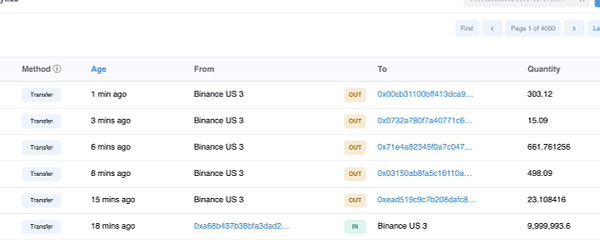
Twitter user @jconorgrogan was one of several people live-tracking the Binance.US withdrawal freeze. He noted that withdrawals restarted after Binance.US received a single transfer of $10 million USDT from an unidentified address. In turn, those funds had been pulled from two known Binance exchange wallets:
Conor @jconorgrogan
This did not gain as much attention as it should have. Remember, Binance and Binance.US are supposedly separate entities. However, Binance.US apparently had to pull money from the main Binance exchange to pay back customer withdrawals. In other words, Binance.US customers were paid back using funds transferred from the offshore Binance exchange! We must ask, why were U.S. customer assets held in Binance addresses?
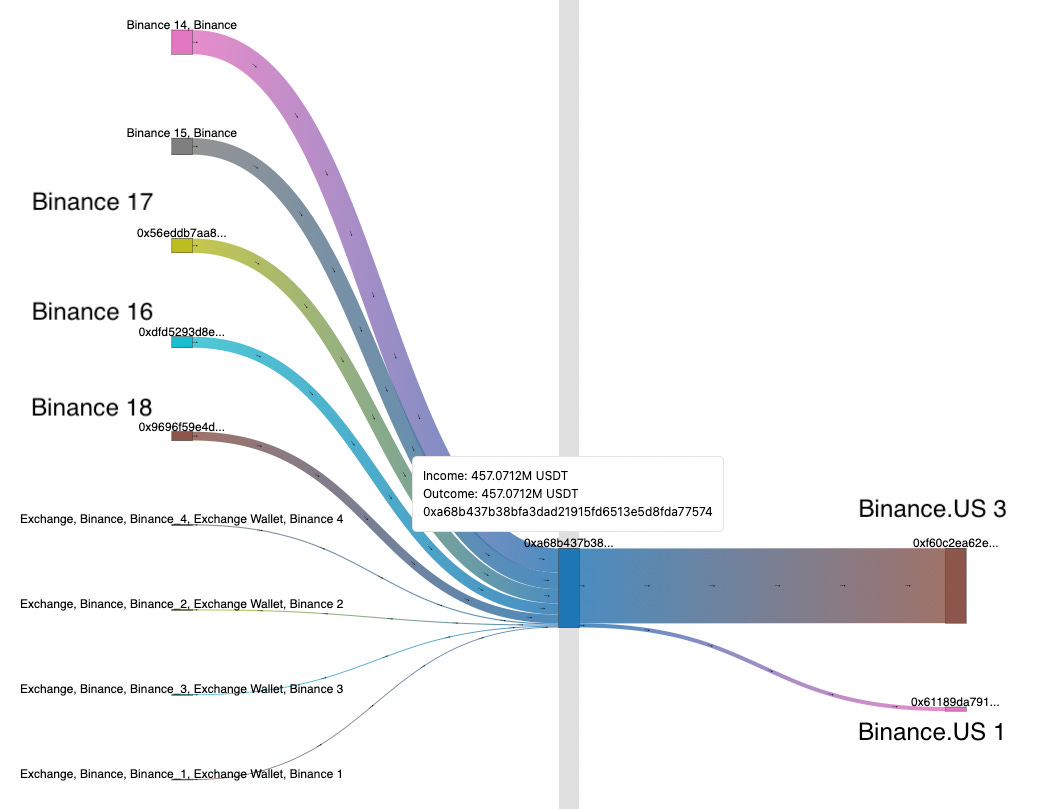
We examined this intermediary transfer address in more detail. This address behaves like what some blockchain analysts call a “rail,” an address used to move funds between main wallets. In this case, this address appears to have only one function: transferring assets from the main Binance exchange wallets to Binance.US. Since the creation of this wallet in July of 2020, it has moved over $1.4 BILLION in Ether, USDT, USDC, and MATIC tokens from Binance exchange wallets to Binance.US:
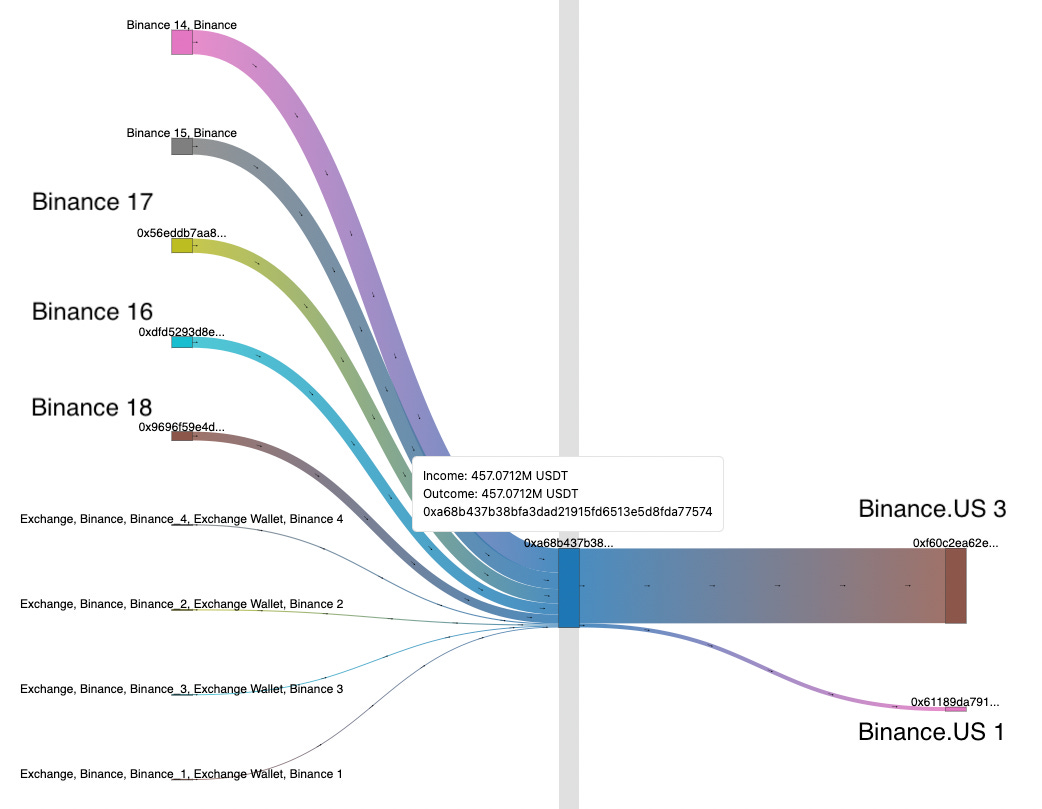
As one example, $457 million USDT flowed through this wallet from Binance exchange addresses to Binance.US addresses
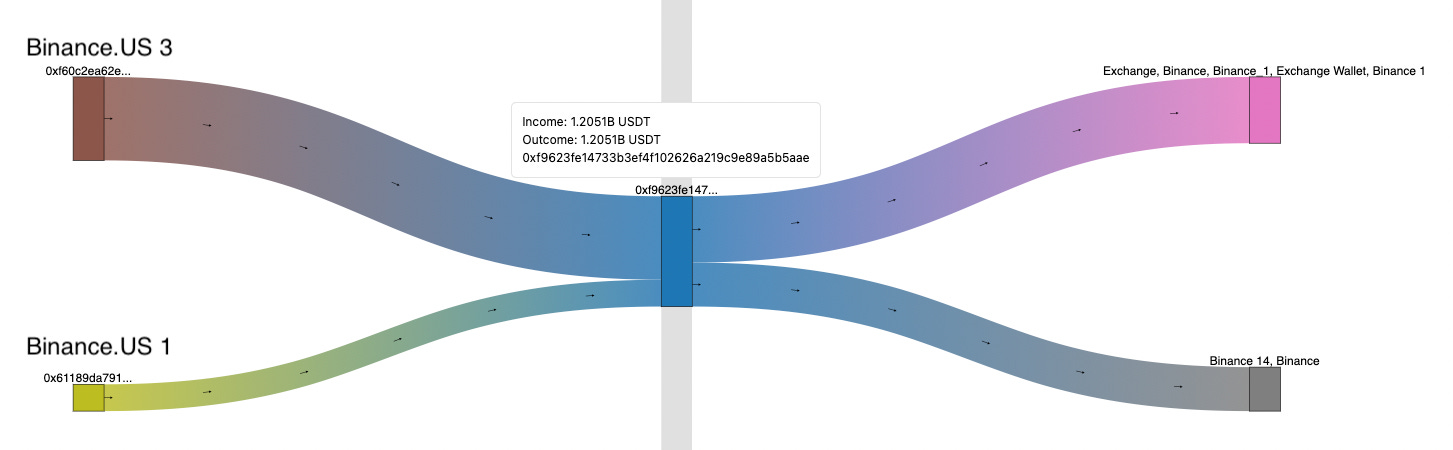
After a little more digging, we identified a second address that does the opposite job: It exclusively handles transfers from Binance.US addresses to Binance exchange wallets. While this address has only been active since August 2021, it has handled over $1.9 BILLION in transfers from Binance.US to Binance. Notably, over $1.4 billion of this was in stablecoins ($1.2 billion USDT, $236 million USDC):
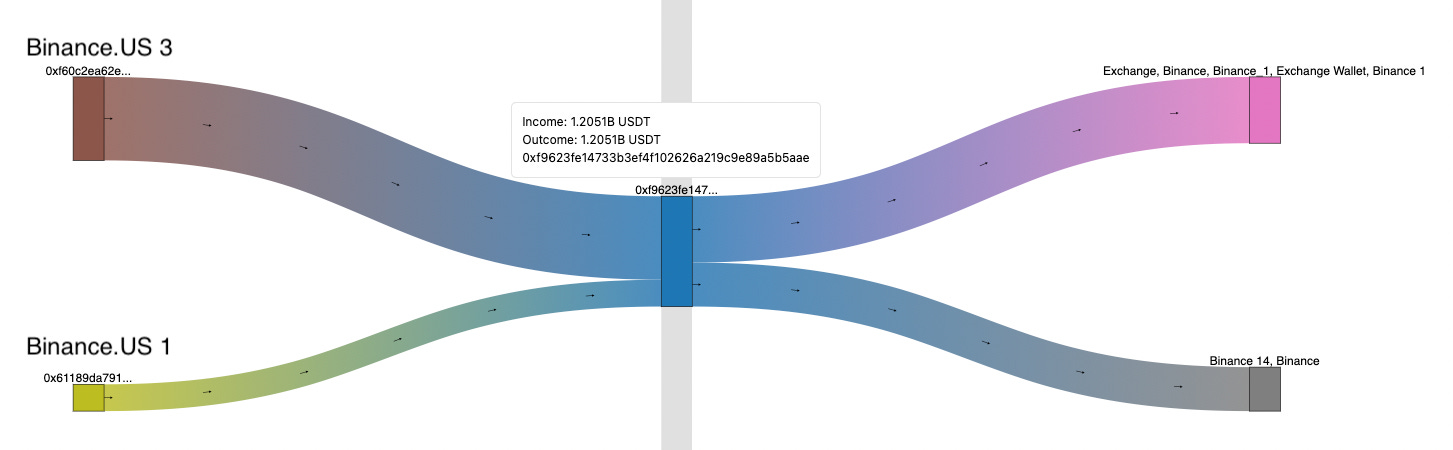
$1.2 billion USDT flowed from Binance.US to Binance over this wallet’s history
We performed some additional analyses showing that Binance exchange wallets received the largest amount of Binance.US transfers over these timeframes. In other words, Binance.US is sending customer funds to Binance. We conclude that a significant portion of Binance.US customer deposits are commingled with other deposits on Binance’s main exchange.
This revelation may explains the disconnect between Binance.US wallet holdings and the reported daily trading volumes on this exchange. Binance.US’s known wallets hold a total of ~$70 million in assets today (12/17). According to market aggregator CoinGecko, total 24 hour trading volume was $146 million, or roughly twice the exchange balance. Compare this with the main Binance exchange. Over the last 24 hours, Binance had some $7.3 billion in total volume, while having a total exchange balance of somewhere around $57 billion dollars. This means the much larger and more popular Binance exchange had volumes that were roughly 13% of their exchange balance.
In other words, the reported ratio of (volume:exchange balance) on Binance.US was 15 times higher than that ratio on the main Binance exchange. We hypothesize this discrepancy is due to Binance.US holding large amounts of customer deposits on Binance and executing most, or all, customer trades directly on Binance’s exchange.
This hypothesis is supported by Binance.US’s terms of service, where the company admits that:
BAM appoints market makers, including Related Parties and market makers that are incorporated or otherwise operating outside of the United States, to promote liquidity and facilitate trading on the Platform…
And in a recent Twitter Spaces meeting, CZ publicly admitted that he is a major shareholder in a “market making” firm that does business on Binance. Incredibly, he followed this admission with the claim that his market making service “does not make profits” and simply operates to “provide liquidity” to the markets (fast forward to ~14 minute in):
Binance @binance
Thank you to all 40k+ of you who tuned-in, it was certainly our largest Twitter space to date!

In case you missed it, you can listen to the replay below - action starts at 8m 25s.

Catch you all at the next one 🤝

https://t.co/4t8fJqQjbG
Our data suggest that Binance.US’s “market maker” is a single pair of addresses that exclusively transfer funds between Binance and Binance.US. These addresses move customer assets from the U.S.-based exchange to the much larger offshore entity to perform trades. This means that for all practical purposes, there is no real difference between having your money with Binance.US or directly with Binance. Given that Binance was barred from doing business in the United States, it certainly appears that Binance.US is little more than a convenient fiction to evade regulators.
Conclusion

We believe that these simple analyses demonstrate that Binance.US customer funds are being sent to Binance and commingled with Binance customer assets. Our data also suggest that Binance.US is using Binance to perform customer trades while pretending to be an independent entity. In reality, Binance.US appears to be little more than a facade to obfuscate the fact that an unregulated offshore crypto business currently under investigation for money laundering and sanctions violations is doing business in the United States despite being banned from the country.
These findings neatly dovetail with the previous reports by Forbes and Reuters indicating that Binance.US was a clever trick designed to fool regulators and customers. However, with the collapse of FTX everyone is taking a closer look at the crypto industry. We doubt that Binance’s regulatory Tai Chi will allow them to evade the long arm of the law for much longer…

ContainersNews : Atlantic spot rates about to collapse: Sea-Intelligence

Atlantic spot rates about to collapse: Sea-Intelligence


While freight rates have been dropping consistently on most trades, they have remained at high levels on the Transatlantic due to capacity issues.
However, according to Sea-Intelligence, this is about to change, as carriers are injecting serious amounts of capacity into the trade lane.
From North Europe, capacity growth is scheduled to begin spiking from mid-December 2022, reaching a temporary apex at the end of the month, with capacity growth at 43% Y/Y. Once we head into February, the current deployment indicates a capacity growth of 48%.
Compared to 2019 (pre-pandemic), from mid-December 2022, the operating capacity on North Europe-North America East Coast will shift from being roughly at the same level as in 2019 to being 20% higher.
"And as we get into mid-February 2023, this is poised to jump even further to 30%. However, this is not even the largest increase, as capacity from the Mediterranean will grow at an average of 25% over 2019 in January-February 2023," said Sea-Intelligence's report.
This is at odds with demand growth (or lack thereof), as demand was down by 3.4% Y/Y in Aug-Oct 2022, certainly not warranting the level of capacity injection currently planned, according to the Danish maritime data analysis firm.
Source: Sea-Intelligence.com, Sunday Spotlight, issue 594
In accordance with the calculation of vessel utilisation by matching capacity and demand on the head-haul, (with the assumption that demand continues to decline at the same -3.4% rate), and then matching it against the spot rates, we get the data in figure 1.
"There is a link between spot rates and vessel utilisation, but what is also clear is that there is a time lag of several months," commented Alan Muprhy, CEO of Sea-Intelligence, adding that "given this time lag, and based on the current drop in utilisation, spot rates on the Transatlantic are primed to collapse in the coming months."

FT : Stella McCartney and LVMH back $200mn climate-linked venture capital fund

Stella McCartney and LVMH back $200mn climate-linked venture capital fund
Collab SOS is focused on fashion materials, energy and supply chain start-ups

British designer Stella McCartney has ushered mycelium leather handbags, plant-based faux furs and bioengineered “MicroSilk” dresses down the runway, and is now deepening ties with start-ups behind those materials through a $200mn climate-linked fund that counts LVMH as a backer.

McCartney, a sustainability adviser to LVMH, is a founding investor in the Collab SOS venture capital fund that will be managed by New York-based asset management group Collaborative Fund. Her fashion group is also a customer of companies the fund invests in, providing them with revenue.

“I had already developed an R&D relationship with so many young businesses, was giving them orders and then PR-ing them,” McCartney said in her first interview about the fund at her flagship store on Bond Street in London. “Now I’m starting a fund to invest [in them further].”

The Collab SOS fund is focused on early stage materials, energy and supply chain start-ups that have the potential to have an environmental benefit and turn a profit, said Collaborative Fund partner Sophie Bakalar.

It is designed to accelerate the go-to-market timelines of portfolio companies by signing up potential customers, such as McCartney and LVMH.

“We like to invest in companies doing $500,000 to $1mn of revenue per year,” Bakalar said. “Then Stella’s team can come in, scale them up to $3mn-to-$5mn of revenue, de-risk the technology, and at that point hopefully LVMH comes in as a customer, and $5mn hopefully becomes $30mn.”

The fund’s 14 initial investments span start-ups that are beyond fashion materials, such as vertical farms, through the New York-based Square Roots, co-founded by Elon Musk’s brother Kimbal, as well as “carbon negative” cement, through Brimstone Energy, which includes the Bill Gates-backed Breakthrough Energy fund among its early investors.

Biomaterials companies in the fund with a clear application for fashion include Brooklyn-based Keel Labs, which has created a seaweed-based yarn that McCartney believes could be a viable vegan alternative to wool.

Another investment is in Connecticut-based Protein Evolution, a recycling company that is attempting to make plastics, including complex polyester, acrylic and nylon mixes, infinitely recyclable.

To that end, McCartney is handing over leftover polyester and nylon from past collections to Protein Evolution to recycle into “good as new” fibres to be shown in future runway collections.

At present, textile-to-textile recycling at scale relies on chemical recycling, a process in which plastic waste is broken down into chemicals or oils, and has its critics.

It was McCartney who alerted the start-up to the challenges of recycling mixed textile waste in the fashion industry, co-founders Connor Lynn and Scott Stankey said in a phone interview, an area they had not previously explored.

Technology start-ups with a sustainability focus were drawing more investors as the cost of development and risk decreased, said Collaborative partner Bakalar.

“We are now at an inflection point where climate tech is a venture-backable space. And climate is now part of culture in a way it wasn’t a decade ago.”

McCartney said of the Collab SOS model: “We’ll incubate these technologies, I’ll put them on my runway and then, when they’re ready and the price point is right, we can roll it out and I can say, Mr Arnault, let’s do this,” referring to LVMH chief executive Bernard Arnault.

>>> Europe : Brokers Upgrades & Downgrades - 19th of December 2022 V2(+)

>>> Up
* Danone Raised to Outperform at RBC; PT 69 euros
* Freenet Raised to Buy at Deutsche Bank (+)
* Inwido Raised to Buy at Handelsbanken
* Moderna Raised to Buy at Jefferies on Rebound Potential in 2023
* OMV Raised to Buy at Deutsche Bank; PT 51.10 euros
* Suedzucker Raised to Buy at M.M. Warburg; PT 17.50 euros (+)
* TietoEVRY Raised to Buy at Nordea; PT 31.80 euros
* Warner Music Raised to Overweight at Atlantic Equities; PT $41 (+)

>>> Down
* Currys Cut to Hold at Investec; PT 59 pence (+)
* Marks & Spencer Cut to Underweight at JPMorgan; PT 100 pence
* OVS Cut to Hold at Equita; PT 2.60 euros (+)
* Tokmanni Cut to Hold at Nordea
* Waste Management Cut to Hold at Stifel; PT $171

>>> Initiation
* AstraZeneca ADRs Rated New Hold at Baptista Research; PT $77
* Las Vegas Sands Rated New Hold at Baptista Research; PT $52
* MGM Resorts Rated New Buy at Baptista Research; PT $45.10

>>> Call
* Bernstein Strategists Warn Tech Stocks Are Still Expensive (+)
* Citi Constructive on Media/Internet; WPP, Prosus Among Top Picks
* Danone ‘Rising to the Challenge,’ Raised to Outperform at RBC
* Freenet Raised to Buy; Deutsche Bank Sees Defensive 2023 Play (+)
* Morgan Stanley’s Wilson Says Peaking Inflation to Hurt Profits
* NN Cut at Berenberg; Solvency Ratio Limits Payout Prospects
* Underweight US Industrials as Capex to Slow: Goldman’s Kostin (+)

(ZH) Flu Hospitalizations In England Outstrip COVID Admissions

Flu Hospitalizations In England Outstrip COVID Admissions

More people have been admitted to hospital with influenza than Covid for the first time since the coronavirus pandemic began, according to the latest figures by the UK Health Security Agency.
As Statista's Anna Fleck details below, the rate of flu hospitalizations hit 6.8 per 100,000 people in the week leading up to December 11, while admissions for Covid patients hit 6.6 per 100,000.
You will find more infographics at Statista
Flu hospitalizations rose 40 percent in that period, up from 3.9 per 100,000 people as of the week ending December 4.
If these admissions continue to rise, they could be on track to surpass the figures recorded in the winter of 2017/18, which killed some 30,000 people, the Telegraph reports.
The over-85s and under-fives are seeing the highest rates of flu hospitalizations, with 23.1 per 100,000 people and 20.7 per 100,000 people, respectively.
While the admissions levels for both infectious diseases are rising as we head into winter, the rate of flu hospitalizations is climbing more steeply.
This surge hits as an already-overburdened NHS faces long waiting lists and a Strep A outbreak. In light of this, experts are calling for people to get a flu shot as soon as possible.
Dr Conall Watson, Consultant Epidemiologist at the UK Health Security Agency (UKHSA), explains: “The flu vaccine offers the best protection against severe illness and it’s not too late for everyone eligible to get it. Uptake is particularly low in those aged 2 and 3 so if your child is eligible please take up the offer.”

Les Echos : Renault-Nissan : opération dernière chance

Renault-Nissan : opération dernière chance
Entre l'invraisemblable chute de Carlos Ghosn et la révolution de l'alliance qui se discute actuellement, les deux partenaires ont avancé dans un tunnel long de quatre ans, ponctué d'éruptions et de tensions. Retour dans les coulisses de ces années noires.

L'alliance entre Renault et Nissan survivra-t-elle à Carlos Ghosn ? Quatre ans après l'arrestation spectaculaire du patron déchu des deux constructeurs, c'est l'heure de vérité : si les négociations en cours capotent , les jours de l'attelage baroque né il y a vingt ans risquent bien d'être comptés. « C'est un peu l'accord de la dernière chance… » souffle un protagoniste de l'affaire.

Depuis plusieurs mois, Français et Japonais ont engagé une véritable révolution : le rééquilibrage de leurs participations croisées (Renault détient 43,3 % de Nissan, qui possède 15 % du Losange sans droits de vote). Une remise à plat réclamée de longue date au Japon.

...

WSJ : The Backstory of ChatGPT Creator OpenAI


From: Laurent Chekroun (MAKOR CAPITAL MARKET) At: 12/18/22 21:49:47 UTC+1:00
Subject: WSJ : The Backstory of ChatGPT Creator OpenAI
The Backstory of ChatGPT Creator OpenAI
Behind ChatGPT and other AI breakthroughs was Sam Altman’s fundraising—but skeptics remain

ChatGPT, the artificial-intelligence program captivating Silicon Valley with its sophisticated prose, had its origin three years ago, when technology investor Sam Altman became chief executive of the chatbot’s developer, OpenAI.

Mr. Altman decided at that time to move the OpenAI research lab away from its nonprofit roots and turn to a new strategy, as it raced to build software that could fully mirror the intelligence and capabilities of humans—what AI researchers call “artificial general intelligence.” Mr. Altman, who had built a name as president of famed startup accelerator Y Combinator, would oversee the creation of a new for-profit arm, believing OpenAI needed to become an aggressive fundraiser to meet its founding mission.

Since then, OpenAI has landed deep-pocketed partners like Microsoft Corp. MSFT -1.73% , created products that have captured the attention of millions of internet users, and is looking to raise more money. Mr. Altman said the company’s tools could transform technology similar to the invention of the smartphone and tackle broader scientific challenges.

“They are incredibly embryonic right now, but as they develop, the creativity boost and new superpowers we get—none of us will want to go back,” Mr. Altman said in an interview.

Shortly after he became CEO, Mr. Altman received $1 billion in funding after flying to Seattle to demonstrate an artificial intelligence model to Microsoft CEO Satya Nadella. The deal was a marked change from OpenAI’s early days, when it said its aim would be to build value for everyone rather than shareholders.

The deal with Microsoft gave OpenAI the computing resources it needed to train and improve its artificial intelligence algorithms, leading to a series of breakthroughs.

First, there was Dall-E 2, a project made public in September that enabled users to create realistic art from strings of text like “an Andy Warhol-style painting of a bunny rabbit wearing sunglasses.” And then there was ChatGPT, the chatbot where users get entertaining and intelligent responses to prompts such as “describe a debate between two college students about the value of a liberal arts education.”

In October, Microsoft said it would integrate OpenAI’s models into the Bing search app and a new design program called Microsoft Design.

OpenAI is now in advanced talks about a sale of employee-owned stock, people familiar with the matter said. In a previous tender offer, OpenAI’s stock was valued at around $14 billion, the people said, and it has discussed a higher price for the current offering. Microsoft is also in advanced talks to increase its investment in the company, The Wall Street Journal reported.

Despite the recent progress, some investors and researchers have expressed skepticism that Mr. Altman can generate meaningful revenues from OpenAI’s technology and reach its stated goal of achieving artificial general intelligence. Mr. Altman’s first startup, a social networking app called Loopt, sold for close to the amount of money investors put in.

Mr. Altman has also faced broader concerns from members of the AI community for steering the company away from its pledge to make its research transparent and avoid enriching shareholders. Instead, OpenAI has grown more closed over time, researchers said.

“They want to acquire more and more data, more and more resources, to build large models,” said Emad Mostaque, founder of Stability AI, a competing startup that has placed fewer restrictions on its image-generation program Stable Diffusion, making it open-source and free to developers.

An OpenAI spokeswoman said the company has made its technology available in several ways, including by open-sourcing certain AI models.

OpenAI began as a nonprofit in 2015 with grants from Mr. Altman, Tesla Inc. CEO Elon Musk, LinkedIn co-founder Reid Hoffman and other backers. Working out of an office in San Francisco’s Mission District, the team sought to form a research counterweight to big tech companies like Alphabet Inc.’s Google, which closely guarded their AI initiatives from the public.

Instead of pursuing corporate profit, OpenAI pledged to advance technology for the benefit of humanity. The group’s founding charter promised to abandon the race to develop artificial general intelligence if a competitor got there first.

That approach changed. In 2019, OpenAI brought on its first group of investors and capped returns at 100 times the cost of their contributions. Following Microsoft’s investment, Mr. Altman pushed OpenAI to bring in more revenue to attract funding and support the computational resources needed to train its algorithms.

The deal also gave Microsoft a strategic foothold in the arms race to capitalize on advancements in AI. Microsoft became OpenAI’s preferred partner for commercializing its technologies, an arrangement that allows Microsoft to easily integrate OpenAI’s models into products such as Bing. Microsoft declined to comment.

Aided by the funding, OpenAI accelerated the development and release of its AI models to the public, an approach that industry observers have described as more aggressive than the tactics of larger, more heavily scrutinized competitors such as Google.

To help with employee compensation, Mr. Altman also instituted occasional tender offers to help employees sell their stock. He said OpenAI doesn’t have any plans to get acquired or go public.

OpenAI has limited some venture investors’ profits to about 20 times their investments, with the ability to earn greater returns the longer they wait to sell their shares, people familiar with the terms said. Mr. Altman has said the capped investment structure was necessary to ensure that the value from OpenAI accrues not only to investors and employees, but also to humanity more generally.

Mr. Altman in recent conversations with investors has said the company would soon be able to generate up to $1 billion in yearly revenue, in part from charging consumers and businesses for its own products, the people said.

Mr. Altman has previously said he would solicit input about how to make money for investors by posing the question to a software program demonstrating general intelligence, which would then provide the answer.

So far, OpenAI has generated tens of millions of dollars in revenue, mostly from the sale of its programmable code to other developers, people familiar with the company’s financial details said. Mr. Altman said OpenAI is early in its strategy for monetizing products.

Some early users of ChatGPT have reported issues asking the program to perform basic math problems. Mr. Altman has acknowledged that the program’s outputs often contained factual errors.

“It does know a lot, but the danger is that it is confident and wrong a significant fraction of the time,” he wrote on Twitter this month.

FT : EU deal signals breakthrough for global minimum tax on multinationals

EU deal signals breakthrough for global minimum tax on multinationals
Bloc’s pledge to introduce levy expected to trigger wave of implementation across world

A global deal to set a minimum tax rate for multinationals of 15 per cent achieved a big breakthrough last week, with the EU’s promise to introduce the deal across member states expected to trigger a wave of implementation across the world.

Plans, tabled at the OECD in Paris, to implement a tax floor of 15 per cent were agreed by 136 countries in October last year. But progress in implementing the floor has been slow, with none of the signatories so far making the pledges law.

In the EU, viewed as key to making the tax work because of the large number of multinationals based in the region, Warsaw and Budapest had taken it in turns to block the legislation. But on Thursday, the Council of the European Union, which is made up of ministers from member states, approved a directive to introduce a minimum levy on large multinational businesses, ending months of fraught negotiations.

EU countries must now translate the proposals set out in the directive into domestic legislation by the end of 2023. Failure to do so could lead to a country being referred to the European Court of Justice.

The OECD estimates that between 1,800 and 2,000 companies headquartered in the EU will fall within scope of the tax, of a global total of around 8,000.

Achim Pross, acting deputy director at the OECD’s tax centre, said the approval of the directive was a “big moment” for the success of the tax deal and would “have a domino effect”, leading to other countries speeding up their efforts to implement the measure.

The UK, South Korea and Switzerland have already produced draft legislation, while the UAE, Australia, Hong Kong, New Zealand and Singapore have launched consultations on the OECD’s rules. A further eight countries have formally indicated their support for the levy.

Peter Barnes, a tax specialist at the Washington law firm Caplin & Drysdale, said the EU agreement “was quite remarkable” and gave “cover to other countries that support a global minimum tax but do not want to be first-movers”.

Julian Feiner, director of tax at law firm Clifford Chance, said the EU agreement would “proliferate wider adoption”.

The tax deal was part of a wider package of measures approved at the EU leaders’ summit on Thursday evening last week.

The deal, designed to eliminate tax avoidance and end a race to the bottom in corporate taxation, will apply to all multinational companies with annual revenues of more than €750mn.

The next two to three months would be an “important window” for countries to adopt the tax, with enough time for businesses and the authorities to prepare ahead of the deadline, said Feiner.

The tax is expected to raise an additional $150bn annually around the world. The levy is also designed to have knock-on effects, with countries risking missing out on revenue if they do not implement it. Fiscal authorities complying with the tax floor can scoop up additional revenue by imposing a levy of up to 15 per cent on the income of foreign subsidiaries based in countries that do not comply with the deal.

The US attempted to introduce the 15 per cent floor earlier this year but omitted important elements of the OECD deal, including measures aimed at eliminating the practice of multinationals setting up subsidiaries in tax havens.

It would be “very challenging for US companies” to comply with both US and OECD rules, and the EU decision “should prompt” the US Congress to seek to align the systems, said Barnes. Doing so would ease the burden on multinationals forced to comply with multiple tax codes instead of one global standard, he added.

Progress in implementing a deal that many in the tax industry thought was destined to fail comes at a critical time for the OECD. The Paris-based organisation’s tax department had also come under attack from some developing countries for creating a framework that is “not inclusive” and is too complicated to administer, according to Christine Kim, a professor of tax at Cardozo School of Law in New York.

Countries in Africa, many of which have not signed up to the OECD deal, are increasingly turning to the United Nations to obtain a bigger voice in global tax affairs. A resolution put forward by the African Group, one of five UN regional groupings, to draft proposals for a possible UN convention on tax, was passed in November.

FT : Hedge funds raise bets against bitcoin miners


From: Laurent Chekroun (MAKOR CAPITAL MARKET) At: 12/16/22 10:32:24 UTC+1:00
Subject: FT : Hedge funds raise bets against bitcoin miners
Hedge funds raise bets against bitcoin miners
Sharp falls in the token’s price and the rising cost of energy prompt managers to short several key players

Hedge funds have been upping their short positions against shares of cryptocurrency miners, betting that more will go to the financial brink after the collapse of the FTX exchange.

With the bitcoin price down by nearly two-thirds this year and the cost of the power that miners require to fuel their energy-intensive computers having risen sharply, hedge funds are wagering that some companies’ business models are still far from viable.

Bearish investors have been betting that the implosion of Sam Bankman-Fried’s FTX will further deepen the malaise for a corner of the crypto market that expanded rapidly last year, often with borrowed money, in the hope of cashing in on high prices of tokens like bitcoin.

Miners, which use a network of powerful computers to solve cryptographic calculations in return for new tokens, face the constant need to upgrade their technology and are also highly dependent on the price of the cryptocurrencies they sell.

“Because crypto is trading vastly below where it was before, and they [miners] have a lot of expenses, it’s not clear they will ever be able to turn a consistent margin,” said Chris Crawford, chief investment officer at Crawford Fund Management in Boston, which runs a hedge fund for Eric Sturdza Investments and has been shorting some crypto miners. Shorting means betting that prices in the future will be lower.

Short interest in US group Marathon Digital, one of the largest US listed miners, rose sharply again last month to more than 36 per cent of the outstanding shares in the weeks after FTX collapsed, according to data from Nasdaq.

Last year Marathon paid its former chief executive Merrick Okamoto just under $220mn in stock. This was driven by awarding him shares based on the company’s market capitalisation, which is heavily influenced by the bitcoin price. And in October this year it paid him $24mn to settle a dispute over previous stock awards.

The company has repeatedly been lossmaking. This year it has fallen well short of its own production targets set last year of mining 55 to 60 bitcoin a day and predictions of generating mining profits of between $86.5mn and $103.6mn a month.

Investors had already swelled their bets on Marathon in the past year and have been rewarded as the company’s shares have plummeted 86 per cent.

Funds have also more than doubled their bets against Stronghold Digital Mining — whose shares are already down 96 per cent this year — to nearly 10 per cent of the shares since the start of the year.

Short interest in Greenidge Generation has risen from less than 1 per cent to 4.7 per cent, while Hut 8 Mining and Riot Blockchain, the largest US listed operator, have also attracted more attention from short sellers this year.

Already hard hit by the bear market in risky assets this year, crypto prices fell further last month following the dramatic failure of FTX, which was once valued at $32bn, and whose former chief executive Sam Bankman-Fried was arrested in the Bahamas this week after US government prosecutors filed criminal charges.

“The profitability of miners is a discussion that comes up every time bitcoin is down — and then perceived as a problem for all crypto,” said Anders Kvamme Jensen, co-fund manager of the AKJ Digital Assets fund.

“Bitcoin mining misses the whole point behind digital assets: the goal, after all, is to decouple from the traditional world and all its players, and not go in reverse by camping out on the power grid,” he added.