WSJ : The Backstory of ChatGPT Creator OpenAI

The Backstory of ChatGPT Creator OpenAI
Behind ChatGPT and other AI breakthroughs was Sam Altman’s fundraising—but skeptics remain

ChatGPT, the artificial-intelligence program captivating Silicon Valley with its sophisticated prose, had its origin three years ago, when technology investor Sam Altman became chief executive of the chatbot’s developer, OpenAI.

Mr. Altman decided at that time to move the OpenAI research lab away from its nonprofit roots and turn to a new strategy, as it raced to build software that could fully mirror the intelligence and capabilities of humans—what AI researchers call “artificial general intelligence.” Mr. Altman, who had built a name as president of famed startup accelerator Y Combinator, would oversee the creation of a new for-profit arm, believing OpenAI needed to become an aggressive fundraiser to meet its founding mission.

Since then, OpenAI has landed deep-pocketed partners like Microsoft Corp. MSFT -1.73% , created products that have captured the attention of millions of internet users, and is looking to raise more money. Mr. Altman said the company’s tools could transform technology similar to the invention of the smartphone and tackle broader scientific challenges.

“They are incredibly embryonic right now, but as they develop, the creativity boost and new superpowers we get—none of us will want to go back,” Mr. Altman said in an interview.

Shortly after he became CEO, Mr. Altman received $1 billion in funding after flying to Seattle to demonstrate an artificial intelligence model to Microsoft CEO Satya Nadella. The deal was a marked change from OpenAI’s early days, when it said its aim would be to build value for everyone rather than shareholders.

The deal with Microsoft gave OpenAI the computing resources it needed to train and improve its artificial intelligence algorithms, leading to a series of breakthroughs.

First, there was Dall-E 2, a project made public in September that enabled users to create realistic art from strings of text like “an Andy Warhol-style painting of a bunny rabbit wearing sunglasses.” And then there was ChatGPT, the chatbot where users get entertaining and intelligent responses to prompts such as “describe a debate between two college students about the value of a liberal arts education.”

In October, Microsoft said it would integrate OpenAI’s models into the Bing search app and a new design program called Microsoft Design.

OpenAI is now in advanced talks about a sale of employee-owned stock, people familiar with the matter said. In a previous tender offer, OpenAI’s stock was valued at around $14 billion, the people said, and it has discussed a higher price for the current offering. Microsoft is also in advanced talks to increase its investment in the company, The Wall Street Journal reported.

Despite the recent progress, some investors and researchers have expressed skepticism that Mr. Altman can generate meaningful revenues from OpenAI’s technology and reach its stated goal of achieving artificial general intelligence. Mr. Altman’s first startup, a social networking app called Loopt, sold for close to the amount of money investors put in.

Mr. Altman has also faced broader concerns from members of the AI community for steering the company away from its pledge to make its research transparent and avoid enriching shareholders. Instead, OpenAI has grown more closed over time, researchers said.

“They want to acquire more and more data, more and more resources, to build large models,” said Emad Mostaque, founder of Stability AI, a competing startup that has placed fewer restrictions on its image-generation program Stable Diffusion, making it open-source and free to developers.

An OpenAI spokeswoman said the company has made its technology available in several ways, including by open-sourcing certain AI models.

OpenAI began as a nonprofit in 2015 with grants from Mr. Altman, Tesla Inc. CEO Elon Musk, LinkedIn co-founder Reid Hoffman and other backers. Working out of an office in San Francisco’s Mission District, the team sought to form a research counterweight to big tech companies like Alphabet Inc.’s Google, which closely guarded their AI initiatives from the public.

Instead of pursuing corporate profit, OpenAI pledged to advance technology for the benefit of humanity. The group’s founding charter promised to abandon the race to develop artificial general intelligence if a competitor got there first.

That approach changed. In 2019, OpenAI brought on its first group of investors and capped returns at 100 times the cost of their contributions. Following Microsoft’s investment, Mr. Altman pushed OpenAI to bring in more revenue to attract funding and support the computational resources needed to train its algorithms.

The deal also gave Microsoft a strategic foothold in the arms race to capitalize on advancements in AI. Microsoft became OpenAI’s preferred partner for commercializing its technologies, an arrangement that allows Microsoft to easily integrate OpenAI’s models into products such as Bing. Microsoft declined to comment.

Aided by the funding, OpenAI accelerated the development and release of its AI models to the public, an approach that industry observers have described as more aggressive than the tactics of larger, more heavily scrutinized competitors such as Google.

To help with employee compensation, Mr. Altman also instituted occasional tender offers to help employees sell their stock. He said OpenAI doesn’t have any plans to get acquired or go public.

OpenAI has limited some venture investors’ profits to about 20 times their investments, with the ability to earn greater returns the longer they wait to sell their shares, people familiar with the terms said. Mr. Altman has said the capped investment structure was necessary to ensure that the value from OpenAI accrues not only to investors and employees, but also to humanity more generally.

Mr. Altman in recent conversations with investors has said the company would soon be able to generate up to $1 billion in yearly revenue, in part from charging consumers and businesses for its own products, the people said.

Mr. Altman has previously said he would solicit input about how to make money for investors by posing the question to a software program demonstrating general intelligence, which would then provide the answer.

So far, OpenAI has generated tens of millions of dollars in revenue, mostly from the sale of its programmable code to other developers, people familiar with the company’s financial details said. Mr. Altman said OpenAI is early in its strategy for monetizing products.

Some early users of ChatGPT have reported issues asking the program to perform basic math problems. Mr. Altman has acknowledged that the program’s outputs often contained factual errors.

“It does know a lot, but the danger is that it is confident and wrong a significant fraction of the time,” he wrote on Twitter this month.

(ZH) SBF Changes Mind On Extradition To US After Four Days In Bahamian Jail

SBF Changes Mind On Extradition To US After Four Days In Bahamian Jail

After spending just five days in a Bahamian jail cell, FTX founder Sam Bankman-Fried is backpedaling on his decision to contest extradition to the United States to face fraud charges, Reuters reports, citing a person familiar with the matter.
According to the report, SBF will appear in court on Monday to formally consent to extradition - which will pave the way for him to appear in US court to face charges that he commingled customer deposits to cover expenses and debts, and to make investments through his crypto hedge fund, Alameda Research LLC.
That said, legal experts tell Reuters that a trial is likely over a year away.
As Fox News reported last week, the Bahamas prison where SBF was reportedly heading - Fox Hill - is "harsh" due to "overcrowding, poor nutrition [and] inadequate sanitation," along with cells that are "infested with rats, maggots, and insects."
File video from 2022 shows squalid condition as Nassau, Bahamas' correctional facility known as Fox Hill Prison. (Nassau Guardian via Reuters / Reuters Photos)
"He will be in sick bay for orientation purposes and then we will determine where best to place him," said Bahamian Commissioner of Correctional Services Doan Cleare in a statement to Reuters.
A 2021 U.S. State Department report said prisoners at Fox Hill described "infrequent access to nutritious meals and long delays between daily meals."
"Maximum-security cells for men measured approximately six feet by 10 feet and held up to six persons with no mattresses or toilet facilities. Inmates removed human waste by bucket. Prisoners complained of the lack of beds and bedding," according to the report. "Some inmates developed bedsores from lying on bare ground. Sanitation was a general problem, and cells were infested with rats, maggots, and insects."
"Overcrowding, poor sanitation, and inadequate access to medical care were problems in the Bahamas Department of Correctional Services men’s maximum-security block," the report continued. "The facility was designed to accommodate 1,000 prisoners but was chronically overcrowded."
On Thursday, Bankman-Fried sought bail from the Bahamas Supreme Court following his Dec. 12 arrest. On Tuesday he was remanded to Fox Hill Prison after Chief Magistrate JoyAnn Ferguson rejected his request to remain at home while awaiting a hearing on his extradition to the US.

(ZH) Kissinger: It's Time For Negotiated Peace In Ukraine To Avoid World War

Kissinger: It's Time For Negotiated Peace In Ukraine To Avoid World War

Former US Secretary of State Henry Kissinger has again called for urgently finding a path of negotiated settlement to the war in Ukraine, warning that the entire world is in danger as nuclear-armed superpowers inch closer toward disastrous direct confrontation.
The celebrated diplomat penned an essay entitled "How to Avoid Another World War" for the new issue of The Spectator wherein he spelled out that the ambition of hawks in the West to break apart Russia is likely to unleash nuclear chaos. "The time is approaching to build on the strategic changes which have already been accomplished and to integrate them into a new structure towards achieving peace through negotiation," Kissinger wrote.
Former US diplomat Henry Kissinger, via AP
"A peace process should link Ukraine to NATO, however expressed. The alternative of neutrality is no longer meaningful," he emphasized. He warned that continued attempts to render Russia "impotent" could result in an uncontrollable and unpredictable spiral. He laid out that along with the sought after "dissolution" of Russia would come a massive power vacuum out of which new threats to the whole world would emerge as bigger powers rush in.
"The dissolution of Russia or destroying its ability for strategic policy could turn its territory encompassing 11 time zones into a contested vacuum," Kissinger continued.
"Its competing societies might decide to settle their disputes by violence. Other countries might seek to expand their claims by force. All these dangers would be compounded by the presence of thousands of nuclear weapons which make Russia one of the world’s two largest nuclear powers."
The 99-year old statesman who has long been seen as the quintessential national security state and military-industrial complex insider had last May angered other hawkish pundits and "insiders", ironically enough, for daring to propose that Ukraine be willing to recognize Crimea as under Russia, and in return Russian forces would fall back to their lines before the Feb. 24 invasion. Previously he's been on record as saying "It was not a wise American policy to attempt to include Ukraine into NATO."
Kissinger's newest proposal is already receiving similarly fierce pushback - this despite his clearly expressing support for militarizing Ukraine. The most controversial aspect to the new Kissinger op-ed is sure to be found in the following lines wherein he suggests "internationally supervised referendums" for self-determination in eastern territories occupied by Russia and which are even now being intensely fought over. Below are Kissinger's words:
"This process has mooted the original issues regarding Ukraine’s membership in Nato. Ukraine has acquired one of the largest and most effective land armies in Europe, equipped by America and its allies. A peace process should link Ukraine to Nato, however expressed. The alternative of neutrality is no longer meaningful, especially after Finland and Sweden joined Nato. This is why, last May, I recommended establishing a ceasefire line along the borders existing where the war started on 24 February. Russia would disgorge its conquests thence, but not the territory it occupied nearly a decade ago, including Crimea. That territory could be the subject of a negotiation after a ceasefire."
"If the pre-war dividing line between Ukraine and Russia cannot be achieved by combat or by negotiation, recourse to the principle of self-determination could be explored. Internationally supervised referendums concerning self-determination could be applied to particularly divisive territories which have changed hands repeatedly over the centuries."
Kissinger then emphasizes that "The goal of a peace process would be twofold: to confirm the freedom of Ukraine and to define a new international structure, especially for Central and Eastern Europe. Eventually Russia should find a place in such an order."
Critics, and Ukraine itself, are sure to reject the Kissinger plan, given he floated the possibility of referendums for those contested territories "which have changed hands repeatedly over the centuries" [i.e.: particularly the Donbas]. Indeed this has already begun, with some outright dismissing his peace plan as "delusional"...
Without doubt there will also be forthcoming howls of Kissinger having turned 'pro-Kremlin' or even accusations the elderly diplomat has been "compromised" by Putin.
This is especially as he seemed to directly appeal to the hawks in Washington and NATO in writing, "The preferred outcome for some is a Russia rendered impotent by the war. I disagree. For all its propensity to violence, Russia has made decisive contributions to the global equilibrium and to the balance of power for over half a millennium. Its historical role should not be degraded."
And followed with a warning of nuclear disaster on the horizon: "Russia’s military setbacks have not eliminated its global nuclear reach, enabling it to threaten escalation in Ukraine."

WSJ : Problem Gambling Is On the Rise Among Young Men

Problem Gambling Is On the Rise Among Young Men
More time spent online, legalization of sports betting in more states and an increase in gambling-like elements in videogames are contributing to problems, say counselors and addiction experts

Jonathan Jones traces his gambling struggles back to a videogame he played in the fifth grade.

Using lunch money or stealing small amounts from his parents, he would buy gaming gift cards and redeem them to spin a virtual wheel of fortune to collect prizes, like weapons or armor, that could help him win the game, Zu Online, which is now discontinued. He would keep paying to spin again and again, a behavior that he says became compulsive and continued into other games.

By the time he was 20, Mr. Jones says he’d spent nearly $40,000 playing videogames and entered a residential treatment program for videogame addiction.

Gaming and gambling problems are surfacing among young men, and increasingly, teen boys, say counselors, therapists and addiction experts. They cite the rise in time spent online during the pandemic, the legalization of sports betting in a growing number of states, and the increasing presence of gambling-like elements in videogames.

“There’s been a big surge of younger and younger people” in gambling support and recovery programs, says Marc Lefkowitz, who chairs the recovery committee for the National Council on Problem Gambling. One addiction-group moderator observed there were so many young men at a recent meeting that the parking lot looked like a fraternity gathering.

Teens are affected, too. The number of 11th and 12th grade males experiencing gambling problems, such as lying about how much they lost, or being unable to control their gambling, rose to 8.3% in 2022 from 4.2% in 2018, according to one survey of 7,500 7th through 12th graders in Wood County, Ohio.

People who research and treat problem gambling say the line between gambling and videogaming is blurring. Videogames, which are often played on smartphones as well as computers and game consoles, include features that mimic gambling activities like roulette and slot machines.

William Ivoska, an addiction researcher who has been conducting the biennial survey in Ohio on youth gambling since 2014, says videogames can start off as free to play, but require purchases to increase chances of winning. One common feature, he says, is a loot box, which can be purchased with an adult’s credit or debit card and can include virtual items, like swords or uniforms, that increase players’ abilities.

“Problematic gaming among adolescents can lead to problematic gambling as an adolescent and as an adult,” Dr. Ivoska says.

For those over 21, the legalization of mobile sports betting in 26 states has made wagering easily available by downloading smartphone apps.

Young men, who tend to be impulsive and overconfident, are particularly at risk when it comes to sports betting, says Jeff Derevensky, director of the International Centre for Youth Gambling Problems and High-Risk Behaviors. Players can place multiple bets, such as the number of passes completed by a quarterback, rather than just betting on the final score, compounding losses, he says.

Jesse Suh, a clinical psychologist in Philadelphia, says more male college students are coming in for treatment, often at the insistence of parents who discover tuition money and other college expenses have gone towards sports betting and other gambling. Online sports betting is legal in Pennsylvania for those 21 and older.

These young men “have distorted thinking that they are in control and can predict the outcome,” he says, adding that they have easy access to money, but don’t really understand the degree of their spending. “It’s hard to recognize the value of money with online transactions,” he says.

To many parents, drugs and alcohol are a bigger worry than gambling. Plenty of young adults and teens bet as a social activity and most don’t develop problems.

Some addiction counselors, educators and parents are calling for gambling to be included in substance-abuse education. This year, Virginia passed the first state law requiring all public schools to teach students about the risk of gambling. Several other states, including North Carolina and Wisconsin where some forms of gambing are legal, as is the case in Virginia, have gambling prevention and education programs for middle schools and high schools.

The American Gaming Association, which represents casinos and gaming vendors, says its members have responsible protocols in place, including age verification, to thwart underage gambling.

The Entertainment Software Association, which represents the videogame industry, says gaming is not the same as gambling, which involves chance. Videogamers receive items in loot boxes or from prize wheels that enhance their experience, it says. Parental controls are also available on consoles and other devices to limit or restrict a child from making purchases within games.

Young people with gambling addictions often start with compulsive play on videogames as a way to cope with depression and anxiety, says Hilarie Cash, founding member and chief clinical officer of reSTART, which offers residential and outpatient gaming addiction treatment.

Mr. Jones, now 25, said his parents didn’t know the extent of his gambling, or that he used videogames to escape depression and anxiety. He was a star athlete and straight-A student, so his parents considered the games as a way he could unwind. He started skipping family dinner, saying he had to study. His computer and internet had parental controls installed, but he overrode them.

They took him to a therapist when he was in high school and quit giving him cash after he told them that he had stolen from them and used it on videogames. He found other ways to get money, selling birthday or holiday gifts online to get gaming gift cards. If a textbook cost $50, he would tell his parents it cost $100 and use the difference to play games. At one point, he says he cashed his savings and sold stocks that his parents purchased for him.

“I would lie about how much I spent, mostly because of the shame around it,” says Mr. Jones.

Mr. Jones spent more than a year at reSTART, returned to college and is working in a research lab. He uses a flip phone, rather than a smartphone where videogames are readily accessible, and continues to see a therapist.

He’s learned a lot, he says, and is concerned that kids and parents don’t understand how easily gambling can be done on mobile videogames, or how damaging it can be.

“You don’t have to go to a casino to lose a lot of money,” he says.

WWD : Inside Sir James Dyson’s Dyson-land

Inside Sir James Dyson’s Dyson-land
The Dyson Group saw record profits in 2021, 1.5 billion pounds from 6 billion pounds of sales.

LONDON — Bagless vacuum cleaners, bladeless fans and wand-like hair dryers are just some of the products that British technology brand Dyson makes from its base in Malmesbury, a small town in southwest England.

The brand is the town’s main employer with more than 3,500 recruits. Malmesbury’s population is 5,380.

The inventor Sir James Dyson, who has multiple patents to his name, has sat at the top of his empire since 1991 with no plans to sell out, slow down or take the company public.

“Dyson is a global technology company, but it remains family-owned and that really matters to me. Without external shareholders to hold the company back, we are free to think for the long-term and take radical decisions,” Dyson said in an interview with Beauty Inc.

“I have no interest at all in going public because this would spell the end of the company’s freedom to innovate in the way it does. When you own the whole company, from the early days, for better or worse, all decisions are your own. The company has grown now, and we have professional management and a highly capable board. Like me, the majority of our leaders are engineers — I want to keep it that way,” Dyson added.

Over the past 30 years, Dyson has become a leading name in international engineering, as its owner is one of Britain’s wealthiest families. He ranks number two on the Sunday Times Rich List, with a net worth of 23 billion pounds.

The Dyson Group saw record profits in 2021, with 1.5 billion pounds from 6 billion pounds of sales.

Those billions are generated at the Dyson campus, which is not just a place of work, but a large community that lives and breathes the brand, and hones emerging talent.

In September 2017, Dyson opened its doors to the Dyson Institute of Engineering and Technology. Every year, the program accepts 40 undergraduate students, providing them with on-campus housing and the opportunity to work on projects. Each student also earns a salary.

“We have 160 undergraduate engineers. They question things, challenge things and approach problems with an untrained eye,” Dyson said.

At the end, they’re offered a job with Dyson’s global engineering team which is constantly expanding, and, of late, putting the focus on hair care.

In 2012, the company invested 50 million pounds in developing its first hair care product — the process took four years, and the Dyson Supersonic hair dryer was launched in 2016. It costs 330 pounds and looks like a wand, or a lollipop — but nothing like a traditional hair dryer.

Hair care has become a booming business and the company continues to put money behind it. Over the next four years, Dyson said it plans to support the launch of 20 new beauty products and open new beauty research labs with an investment of half a billion pounds.

“We are dedicated to understanding the science of hair; this is the foundation that underpins all of our beauty technology. We have been researching the science of hair for a decade, and have already invested over 100 million pounds into hair laboratories,” Dyson said.

In October, the company unveiled its first Dyson Beauty Lab in South Florida at Saks Fifth Avenue Bal Harbour. There, customers can purchase and receive one-to-one service about their products.

On the Dyson campus, there are assigned spaces for each part — however small — that goes into making the beauty products. There are sound and frequency rooms to trial the products and hair testing rooms, where the final product is used on every type of hair, over and over again. The hair is then taken to a lab to assess the damage from multiple blow dries.

There are special facilities dedicated to the improvement of hair. The 3D printing room is one of the most expensive on the campus. It contains four machines worth between 500,000 pounds and 2 million pounds each. Each machine produces a different 3D component in order to speed up the pace of production.

Employees and guests are instructed to wear specially provided footwear and white robes with a strict no photography rule when moving between facilities.

Dyson said that, in the past, “hair dryers relied on bulky motors and crude heating systems, making them slow and top heavy. They often used very high temperatures, which is damaging to hair. We realized that if we took an entirely new approach that the core technologies in them — motors, fluid dynamics, thermodynamics — could be vastly improved.”

With a robust balance sheet, billions of poundsand multiple inventions to his name, Dyson said his proudest professional achievement has been his commitment to sustainability, and reducing energy consumption.

“This has been primarily through our long-standing commitment to progressing the state of the art in motors technology. This enabled us to develop hand dryers that use 10 percent of the energy of hot air hand dryers — and do away with unsustainable paper towels,” he said, adding that the company’s high-speed digital motors have enabled it to develop machines that use 200 watts instead of 2,000 watts, reducing electric consumption by 90 percent without affecting the performance of the product.

In 2019, following the U.K.’s decision to leave the European Union, Dyson made the decision to relocate the company’s headquarters to Singapore. It means that Dyson will be near its fastest-growing markets, which are in Asia Pacific. The company will also be able to swerve new trade restrictions between the U.K. and the EU.

The Malmesbury base will remain and it will not affect any of the employees, however, it will give internal staff the opportunity to work abroad.

The company has taken over St James Power Station, Singapore’s first power station which previously operated as a 110,000-square-foot nightclub. It completed the restoration in March 2022.

“We are about to enter entirely new fields and these will spark other opportunities,” said Dyson, naming the newly Dyson Zone, noise-canceling headphones with air purification.

Business Of Fashion : For Nike, Is the Worst Over?

For Nike, Is the Worst Over?
The activewear giant has struggled this year with inventory problems and a slowdown in China. Its results this week may show it’s turned a corner. That, plus what else to watch for in the coming days.


When France plays Argentina in the World Cup final on Sunday, it’ll also mark the latest clash between sportswear’s two giants: Nike, which sponsors the French team, and Adidas, which outfits their opponent. As with any high-profile football matchup, there’s even some drama behind the clash of logos – the Argentine star Lionel Messi, likely playing at the last World Cup of his career, was a longtime Nike ambassador before signing a lifetime contract with Adidas in 2017. His arguable successor as the sport’s biggest star, France’s Kylian Mbappé, wears Nike.

Off the pitch lately, the Nike vs. Adidas rivalry has more closely resembled Spain’s 7-0 blowout win over Costa Rica earlier in the tournament. Even before its Yeezy troubles, Adidas was struggling to connect with consumers (a BoF Insights poll of Gen-Z shoppers found that 22 percent named Nike as one of their three favourite brands, double Adidas’ share).

Nike had its own ugly moment with a celebrity ambassador this fall, when NBA star Kyrie Irving shared a link to a film promoting anti-semitic conspiracy theories. But the athlete’s now-cancelled sneaker line was nowhere near as important to the main brand as Yeezy was to Adidas.

Even so, Nike has had to grapple with some more conventional problems: it ordered too much inventory heading into 2022, and it has seen sales slump in China due to the country’s strict Covid policies. Analysts who follow the company say the worst may be over. Nike stores were crowded over Black Friday as it put its excess inventory on steep markdown. And China is edging out of its Zero Covid isolation.

There’s still a chance both issues could drag on Nike’s sales and margins in the coming year – the scope of the company’s inventory overhang surprised the market in September and could do so again. China’s path forward is also murky, and homegrown activewear brands have gained ground during the pandemic. Adidas has a new CEO, Puma’s Bjorn Gulden, to chart the company’s post-Yeezy path.

But it’s not hard to imagine a return to form in 2023, either. Nike’s strong brand gives it an automatic head start when it tests new markets or sales channels, whether it’s a web3 platform or the first Jordan brand store.

Business Of Fashion : Will 2023 Be Luxury’s Year of Succession?

Will 2023 Be Luxury’s Year of Succession?
Ageing billionaire founders still control luxury’s biggest groups. Recent appointments at LVMH and Prada have pushed the long-taboo topic of succession into the spotlight.

This week, the luxury sector was abuzz with executive shuffles that appeared to open the way for a changing of the guard at some of the industry’s top companies.

Tuesday, Milan-based Prada Group — which last week announced Andrea Guerra as its first-ever external CEO — confirmed it would also hire a new CEO, Gianfranco D’Attis, to run its flagship Prada brand. The appointments are aimed at “easing the succession” between co-CEOs Miuccia Prada and Patrizio Bertelli and the next generation of their family, the company said. The pair’s eldest son Lorenzo Bertelli, who joined the company in 2017, is being positioned as the group’s future leader.

The matter of succession at LVMH was in the news, too, albeit for a more incremental appointment. Antoine Arnault, chairman Bernard Arnault’s second-oldest child, was named CEO of the holding company Christian Dior SE, replacing longtime executive Sidney Toledano at the helm of the listed entity through which the family patriarch controls his luxury empire.

Dior SE no longer has operations independent of LVMH since merging its namesake brand with the group’s wider portfolio in 2017. That makes Antoine Arnault’s appointment as CEO largely a symbolic step — but symbols have their importance, too.

The move was part of a broader plan to “perpetuate long-term family control” of LVMH, the company said. It also suggested that after years of pushing off questions regarding Bernard Arnault’s succession, taboos surrounding the topic may finally be breaking.

The stakes for fashion couldn’t be higher. Arnault, aged 73, is now the world’s richest man (after surpassing Elon Musk this week), largely as a result of luxury’s comparative resilience in a challenging global economy. Dubbed the “wolf in cashmere” for his soft-spoken but aggressive approach to business, Arnault has long been the ultimate decider for nearly all matters at LVMH, which towers above the rest of the sector with 75 brands, over €64 billion in annual revenue and 175,000 staff.

Of Arnault’s five children from two marriages, aged 24 to 47, all are now employed in various roles across the group: Antoine oversees group image and communications, as well as the Berluti brand, while his sister Delphine is executive vice-president for product at flagship Louis Vuitton. Alexandre Arnault is executive vice-president for product and communication at Tiffany & Co., while Frédéric is CEO of watchmaker Tag Heuer. The youngest, Jean, joined Louis Vuitton’s watchmaking division in 2021.

While the heirs each exhibit varying degrees of ambition, leadership skills, business acumen and creative sensibility, none has emerged as a clear successor to Bernard Arnault as the group’s chief executive.

Earlier this year, Arnault passed a motion to raise LVMH’s CEO age limit from 75 to 80, meaning he could continue to serve as chief executive of the company for another seven years. Still, he has also started to make moves to prepare the company’s transition to shared family control, restructuring his private holding companies that sit atop LVMH so that his controlling stake in the conglomerate would be controlled by a joint-stock partnership called Agache, to be held equally by his five children.

Arnault has also provided opportunities to the next generation of star managers like Dior CEO Pietro Beccari, Tiffany CEO Anthony Ledru and former Sephora CEO Chris de Lapuente, who now oversees retail and beauty at the group level, all of whose support LVMH will need to smooth a transition.

But luxury’s succession challenges go well beyond Prada and LVMH: Richemont’s chairman Johann Rupert is also in his 70s, as are the secretive Wertheimer brothers who control privately-held Chanel. The brothers recently brought in an external CEO, Leena Nair, and consolidated the firm’s governance and accounting in the UK in a bid to bolster oversight.

Plans for 88 year-old designer Giorgio Armani’s succession are similarly clouded: the designer has placed his company in a trust to ensure its perpetual independence, but in 2021 said it was exploring a deal with an Italian partner thought to be Ferrari-owner Exor, though talks have reportedly stalled.

Whether luxury giants will face more pressure to clarify their succession plans next year could depend on their performance: if most investors have stayed silent regarding their concerns for what comes after the generation of billionaire founders who have led the industry since the 1980s, that’s because the sector continues to outperform the market in terms of both growth and profits.

This year, luxury sales rose 22 percent according to Bain. Shares in LVMH are down 6 percent this year, less than a 13 percent drop in the Stoxx 600 index of Europe’s biggest companies.

But luxury growth is forecast to slow to 3 to 8 percent in 2023 due to a sluggish global economy. While LVMH has used its unrivalled marketing heft to shake off previous crises, in a murky present redirecting the narrative to its plans for future success may be smart business.

WSJ : Toyota President Says ‘Silent Majority’ Has Doubts About Pursuing Only EVs

Toyota President Says ‘Silent Majority’ Has Doubts About Pursuing Only EVs
Akio Toyoda says electric vehicles are one option alongside hybrids and hydrogen-powered cars

BURIRAM, Thailand— Toyota TM -0.87% Motor Corp. President Akio Toyoda said he represented a silent majority of auto-industry people who are questioning whether electric vehicles should be pursued exclusively as the future of cars.

“People involved in the auto industry are largely a silent majority,” Mr. Toyoda said Sunday to reporters in Buriram, a small agricultural town 190 miles northeast of Bangkok. “That silent majority is wondering whether EVs are really OK to have as a single option. But they think it’s the trend so they can’t speak out loudly.”

While major rivals, including General Motors Co. , Ford Motor Co. and Honda Motor Co. , have set dates for when their lineups will be all-EV, Toyota has stuck to a strategy of investing in a diverse lineup of vehicles that includes hydrogen-powered cars and hybrids, which combine batteries with gas engines.

The world’s biggest auto maker has said it sees hybrids, a technology it invented, as an important option when EVs remain expensive and charging infrastructure is still being built out in many parts of the world. It is also developing zero-emission vehicles powered by hydrogen.

Toyota said Wednesday it would work with Charoen Pokphand Group of Thailand to produce hydrogen and introduce delivery trucks running on the fuel to the Thai conglomerate’s fleet.

“Because the right answer is still unclear, we shouldn’t limit ourselves to just one option,” said Mr. Toyoda, who was visiting Thailand to mark the 60th anniversary of Toyota’s business in the country. Over the past few years, Mr. Toyoda said, he has tried to convey this point to industry stakeholders, including government officials—an effort he described as tiring at times.

With many governments moving to subsidize and mandate sales of EVs, auto makers have been nudged into competing over EV sales targets, Mr. Toyoda said. Vehicles such as hybrids can reduce emissions today, and continuing to promote them is “more effective than setting targets for EVs that will either be met or fallen short of in the future,” Mr. Toyoda said. “It’s about doing what can be done now.”

Mr. Toyoda’s cautionary tone toward EVs has caused some concern from investors and consumers that the auto maker could be falling behind in the EV race. Toyota has been slower than rivals to roll out fully electric models in major markets such as the U.S., with its flagship bZ4X electric sports-utility vehicle being recalled earlier this year because of a potential safety problem.

Mr. Toyoda said the auto maker was taking all types of vehicles seriously, including EVs. Toyota said in late 2021 that it planned to spend up to $35 billion on its EV lineup through 2030. Since then, it has disclosed sizable investments in EV manufacturing capacity in the U.S.

In August, Mr. Toyoda drove a hydrogen-powered vehicle in the World Rally Championship held in Belgium. He said he sensed such alternatives to EVs were beginning to get a warmer reception from government officials, members of the media and others involved in the auto industry.

“Two years ago I was the only person making these kind of statements,” Mr. Toyoda said.

(ZH) : Perfect Storm Arrives: “Massive Wave” Of Car Repossessions And Loan De

Perfect Storm Arrives: “Massive Wave” Of Car Repossessions And Loan Defaults To Trigger Auto Market Disaster, Cripple US Economy


Perfect Storm Arrives: “Massive Wave” Of Car Repossessions And Loan Defaults To Trigger Auto Market Disaster, Cripple US Economy
For almost a year now, we have been dutifully tracking several key datasets within the auto sector to find the critical inflection point in this perhaps most leading of economic indicators which will presage not only a crushing auto loan crisis, but also signal the arrival of a full-blown recession, one which even the NBER won’t be able to ignore, as the US consumers are once again tapped out. We believe that moment has now arrived.
But first, for those readers who are unfamiliar with the space, we urge you to read some of our recent articles on the topic of car prices – which alongside housing, has been the biggest driver of inflation in the past 18 months – and more specifically how these are funded my the US middle class, i.e., car loans, and last but not least, the interest rate paid for said loans. Here are a few places to start:
  • Are We Headed For An “Auto Loan Crisis” As Delinquencies Begin To Rise? – July 7
  • A Flood Of Repossessed Vehicles Poised To Hit The Used-Car Market – July 25
  • American Drivers Go Deeper Into Debt As Inflation Pushes Car Loans To Record Highs – Aug 29
  • Credit Card Rates Just Hit A Record As The Average Car Loan Rises To Fresh All Time High – Oct 9
  • New-Car Loan-Rates Set To Hit 14-Year High As Affordability Crisis Worsens – Nov 3
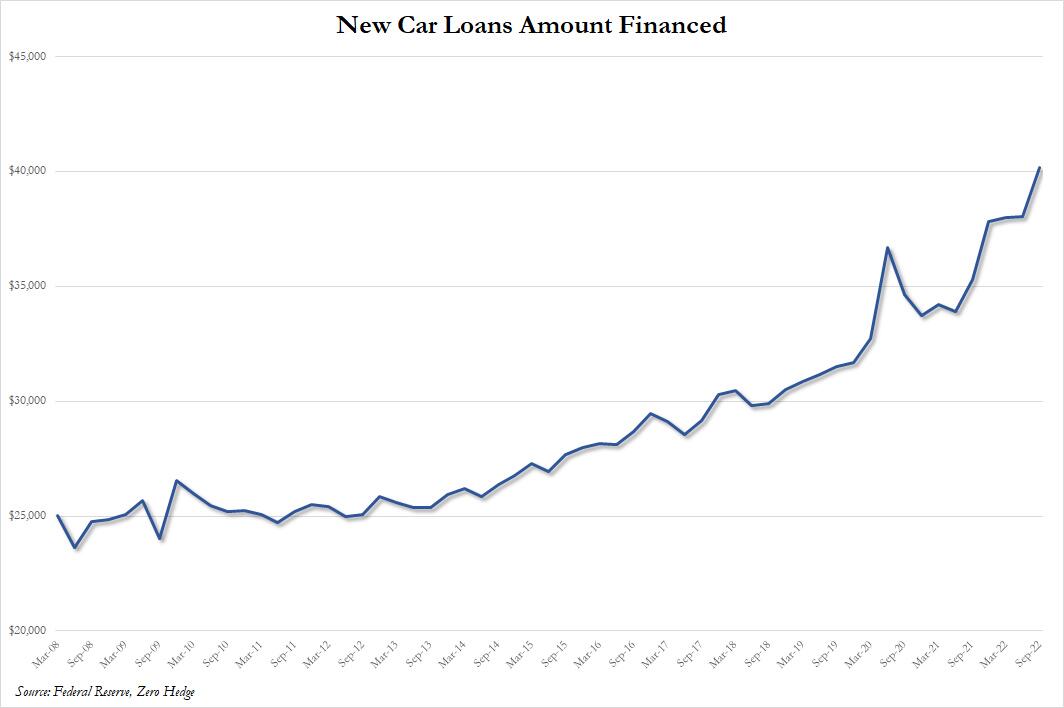
So while the big picture is clear – Americans are using ever more debt to fund record new car prices – fast-forwarding to today, we have observed two ominous new developments: the latest consumer credit report from the Fed revealed a dramatic spike in the amount of new car loans, which increased by more than $2,000 in one quarter, from just over $38,000 (a record), to $40,155 (a new record).
Now this shouldn’t come as a shock: a simple reason why new car loans have hit record highs is simply because new car prices have also soared to all time highs, as the next chart shows.
Here we will ignore for the time being cause and effect, or “chicken or egg” questions – i.e., whether record new car prices are the result of easy record credit, or whether record new car loans are simply tracking the explosive surge in car prices, and instead focus on something even more ominous: the explosion in the average interest rate on a new 60 month auto loans: according to Bankrate, as of Dec 16, the number is just over 6.50%, almost doubling since the start of the year, and the highest in 12 years.
It is this surge in nominal auto debt as well as the unprecedented spike in new auto loan rates, that we believe has finally pushed the US car sector to the infamous Wile Coyote point of no return.
Consider the following: according to various recent financial analysts, a growing number of consumers are falling behind on their car payments – a trend which will only accelerate – in a sign of the strain soaring car prices and prolonged inflation are having on household budgets.
As NBC reports, whereas repossessions tumbled at the start of the pandemic when Americans got a boost from stimulus checks and lenders were more willing to accommodate those behind on their payments, in recent months, the number of people behind on their car payments has been approaching prepandemic levels, and for the lowest-income consumers, the rate of loan defaults is now exceeding where it was in 2019, according to a recent report from Fitch.
Naturally, with the economy set to slump into a Fed-induced recession, the trend will only get much worse into 2023 with economists expecting unemployment to rise, inflation to remain relatively high (at least until the economy crashes) and household savings – already at record lows – set to dwindle. At the same time, a growing number of consumers are having to stretch their budgets to afford a vehicle; the average monthly payment for a new car is up 26% since 2019 to $718 a month, and nearly one in six new car buyers is spending more than $1,000 a month on vehicles. Other costs associated with owning a car have also shot up, including insurance, gas and repairs.

The silver lining is that while the US auto sector faces unmitigated disaster in 2023, for those in the repossession business, it’s been difficult to keep up. Jeremy Cross, the president of International Recovery Systems in Pennsylvania, said he can’t find enough repo men to meet the demand or space to hold all the cars his company has been tasked with repossessing. With the holidays approaching, he’s been particularly busy as people prioritize spending elsewhere, and he’s expecting business to keep up throughout next year and 2024.

“Right now, it’s really the perfect storm,” said Cross. “Over the last two years, vehicle prices were inflated because there was no new car supply, people were still buying like crazy because they had a lot of stay-at-home cash, they had inflated credit scores, so it was like a recipe for disaster.”

Ironically, at the same time, the number of repossession companies has shrunk by 30% as many firms closed up shop and the workers found jobs in other industries when repossessions tumbled during 2020, Cross said. Now, he told NBC, lenders are paying him premiums to repossess their cars first in anticipation of a continued increase in loan defaults (read: plunging prices).

Predictably, the coming auto crisis is an issue that’s raised concern among officials at the Consumer Financial Protection Bureau, who say they are seeing troubling signs in the auto market, particularly among so-called subprime borrowers, who have below-average credit scores, and those with loans taken out in 2021 and 2022 when auto prices were particularly high.

Yes: that 2008 deja vu feeling is back front and center….and so are the defaults.

“Loans taken out in those years are performing worse than prior years just because those consumers had to finance cars once the supply chains were jammed and the prices started to go up,” said Ryan Kelly, acting auto finance program manager for the CFPB. “Those consumers got hit with inflation twice. First, when they had to finance a car after the prices went up, and then when they had to put gas in the car after the Russia-Ukraine conflict started. So there’s just a lot of consumer stress.”

What happens next?

Well, as the economy continues to deteriorate in 2023, the number of those falling behind on their car payments will continue to rise, even as consumers tend to give priority to their car payment ahead of most bills because of the importance a car plays in getting to work or potentially providing shelter, industry analysts said.

For now, the rate of defaults and repossessions isn’t expected to reach 2008 and 2009 levels, when there was a spike caused by the financial crisis. The percentage of auto loans that were 30 days delinquent was at 2.2% in the third quarter compared with 2.35% delinquent over the same period in 2019, according to data from Experian. By contrast, just over 4% of auto loans went into default in 2009. However, that could quickly change once the 2023 economy unleashes the final whammy of mass layoffs (which have already slammed the tech sector).

Some, like Cox Automotive, remain optimistic: their analysts (who just may be a little conflicted) forecast that while loan defaults and repossessions will increase from their pandemic lows, long-term through 2025 they predict overall defaults and repossessions will remain at or below historic norms.

Still, the financial squeeze has been particularly difficult for lower-income consumers looking for budget vehicles, which have been particularly hard to find. While in the past, those car buyers would have purchased a used car for $7,000 to $15,000 they are now having to spend $20,000 to $25,000 for the same type of vehicle. Among dealers that cater to subprime and deep subprime consumers, the average listing price on their cars has almost doubled since the beginning of the pandemic, according to the CFPB.

Ally Financial, which has a significant share of loans to subprime borrowers, said in its October earnings report that it expects delinquencies to increase to as much as 3.8% compared with 3.1% in 2019. That estimate will prove to be overly optimistic.
Another risk to car buyers’ finances is the growing length of auto loans, many of which now exceed seven years. While those longer term loans can lower the monthly payments amid higher prices, consumers risk paying off the loan much more slowly than the car is depreciating, leaving them underwater if they need to sell the vehicle. It can also mean higher interest costs over the life of the loan on top of already inflated vehicle prices.
And speaking of interest rates, they have not been this high since 2009 and will stay at their current levels until the Fed finally pivots. As NBC notes, “for consumers, there is unlikely to be any relief over the next year. Interest rates are expected to remain high for those needing to borrow to buy a vehicle, and Covid-related plant closures and material shortages are continuing to ripple through the car manufacturing supply chain, limiting the number of new vehicles.”
“I dare think what happens to people who are signing up for new loans today,” said Drury. “It’s not going to be better when we see these payments so high.”
But wait, there’s more.
As twitter’s CarDealershipGuy – who claims to be an anonymous auto-industry CEO and whose analysis has been featured in places like the NY Post and who frequently Tweets about the state of the auto market – laid out a long thread on Thursday, all of the above may end up being an overly optimistic assessment of the perfect storm that’s about to hit the auto sector:
“This morning I discovered something *extremely* alarming happening in the car market, specifically in auto lending. I’m now convinced that there is a massive wave of car repossessions coming in 2023,” he wrote.
Recapping much of what we said above, he noted that over the past 2 years, many people took out exorbitant loans on cars and while car values were inflated (and still are) but many people simply had no choice and bought an overpriced a car. Then, echoing the Fitch assessment, he notes how those buyers are underwater: “Car valuations are now plummeting. Some cars have declined in value as much as 30% y/y. And these same people that took out these big loans are now ‘underwater’. Basically, they owe banks more on these cars than they are worth. And the banks are well-aware of this.”
The punchline is his personal experience from late last week. “This morning, one of our General Managers opened up DealerTrack — a portal that dealers use to communicate with auto lenders — and highlighted something very concerning. 9 of our lending partners have started WAIVING ‘open auto stipulations’ for consumers.”
What this means, he explained, is that once consumers are stuck with a vehicle they paid too much for, they can’t trade it in without putting some money up front to cover the difference of what is owed on it versus what it is worth. At that point, he notes, “Dealer can’t sell consumer a car, Consumer can’t buy a car, And, you guessed it, lender can’t finance a car!”
The lender then knows that most consumers are stuck and waives the open auto stipulation – meaning they allow the consumer to buy the new car with a second loan knowing they already have a first one. But the lender does it because they know that the buyer will default on the old, other car.
Cue default avalanche: “This is NOT normal. But it’s the only way lenders can finance cars and dealers can put cars on the road. And the implications of this will be tons of repossessions,” the CEO wrote.
He concluded: “I’ve been a doubter, but after what I saw this morning, I’m now FULLY convinced that a wave of car repossessions will hit in early/mid 2023. If lenders are willing to backstab each other in order to put more loans on the road, we’re in trouble.”
Here is a snapshot of his entire thread:
This morning I discovered something *extremely* alarming happening in the car market, specifically in auto lending. I’m now convinced that there is a massive wave of car repossessions coming in 2023.
Here’s what I discovered (and what no one knows):
Background:
Over the past 2 years, many people took out exorbitant loans on cars. Car values were inflated (and frankly, still are to some extent). But many people simply had no choice and bought an overpriced a car.
Well…
Car valuations are now plummeting. Some cars have declined in value as much as 30% y/y. And these same people that took out these big loans are now “underwater”.
Basically, they owe banks more on these cars than they are worth. And the banks are well-aware of this…
But there is no easy solution. You can’t just put the genie back in the bottle. This brings me to what happened this morning:
Every Friday I conduct a team meeting to recap our week.
This morning, one of our General Managers opened up DealerTrack — a portal that dealers use to communicate with auto lenders — and highlighted something very concerning:
9 of our lending partners have started WAIVING “open auto stipulations” for consumers.
Wait, wtf does that even mean?
Let me explain using a simple, hypothetical scenario:
1) Consumer takes out an auto loan in 2020/2021 on an overvalued car
2) 2022 comes around and that overvalued car is now rapidly declining in value
3) With the car declining in value, consumer now owes more on the car than it is worth
4) Consumer no longer wants the car. Maybe they outgrew it. Or maybe it keeps breaking. So consumer wants to trade it in.
5) But dealer can’t trade the car in because the consumer owes WAY too much on it. So dealer asks consumer for lots of money down to cover the difference.
6) But of course, the consumer doesn’t have $1,000s to cover the difference between what they owe on the car and what it’s worth. And here comes the perfect storm…
7) Dealer can’t sell consumer a car, Consumer can’t buy a car, And, you guessed it, lender can’t finance a car! Everybody loses! Oh no. So what happens next?
8) Lender knows that most consumers are stuck in this situation, and does the following:
WAIVES THE OPEN AUTO STIPULATION.
Meaning, the lender lets the consumer buy the car KNOWING that they already have an open auto loan with another bank!
Why the f*ck would they do this?
Surely the lender knows that consumers that take out a 2nd auto loan are MUCH riskier and have a MUCH high risk of default? Right? RIGHT?
Yes, but the lender does it because they know that the consumer will default on the other car !!!!
Dog eat dog style.
Let me be clear: This is NOT normal.
But it’s the only way lenders can finance cars and dealers can put cars on the road.
And the implications of this will be tons of repossessions.
I’ve been a doubter, but after what I saw this morning, I’m now FULLY convinced that a wave of car repossessions will hit in early/mid 2023. If lenders are willing to backstab each other in order to put more loans on the road, we’re in trouble.
This will not end pretty.
What does this mean in simple terms: well, besides the imminent devastation across the auto sector, including a surge in defaults and car repossessions, we are about to witness a historic collapse in car prices. In fact, in a subsequent tweet, the CarDealershipGuy noted the plunge in prices at troubled used-car dealer Carvana which will be the first domino to fall and be forced to liquidate much if not all of its inventory to stay afloat:
Translation: just as soaring car prices were the leading indicator for red-hot, runaway inflation in 2021 and 2022 (followed by housing, food, goods and finally services) so the plunge in car prices – first used, then new – is the canary in the recessionary coal mine of deflation that will send all prices – cars, houses, and everything else – sharply lower in the coming months.