FT : Delaware decision shows how private equity preys on vulnerable CEOs

Delaware decision shows how private equity preys on vulnerable CEOs
Software founder sold too cheaply after falling for Vista Equity Partners

Rick Stollmeyer built a software company from his California garage and realised a dream when he took it public in 2015 at a valuation approaching $1bn. Much of what came next seems to have been a nightmare for the former US Navy submarine officer. As a guest on an entrepreneurship podcast, he lamented the shareholders of his company who would not countenance him selling down his stock, describing his periodic divestitures as the equivalent of “sucking through a very small straw”.

Mindbody, Stollmeyer’s software business that powered the systems of gyms and fitness studios, announced just before Christmas 2018 that it had a deal to sell itself to Vista Equity Partners. The deal allowed Stollmeyer to both cash out as well as keep his job and get a stake in the privatised company. But last month, a Delaware judge ruled that he breached his fiduciary duties to the other Mindbody shareholders by putting his liquidity needs first and selling at too low a price in a leveraged buyout.

“Stollmeyer tilted the sale process by strategically driving down Mindbody’s stock price and providing Vista with informational and timing advantages during the due-diligence and go-shop periods,” according to a decision from Kathaleen McCormick, the chief judge of the Delaware Court of Chancery.

McCormick awarded base damages to Mindbody shareholders of $1 per share on the $36.50 per share deal, or roughly $40mn to be paid by Stollmeyer and Vista, the latter who was found liable for separate misconduct.

McCormick’s ruling is a detailed window into how private equity firms can prey on the neuroses of chief executives for their own gain.

A Mindbody shareholder, the hedge fund Luxor Capital, had sued after the Vista deal was announced arguing that Mindbody’s board, including Stollmeyer, had breached their so-called Revlon duty, which required that once they sought to sell the company that they seek the best possible price for all shareholders.

Luxor had come to believe that the company could have maximised value if it had stayed public. McCormick was convinced by the evidence presented that Stollmeyer was desperate for liquidity. Beyond the podcast taping where he complained about being constrained from selling stock, Stollmeyer had family demands for money, had made a multimillion-dollar pledge to a college and was tapping cash from a bank credit line.

His banker at the boutique, Qatalyst Partners, in the summer of 2018 had introduced him to Vista, the software specialist, whom Stollmeyer would quickly covet as a buyer. Vista had invited him to its annual portfolio company convention, CXO, later that year. There he met a series of Vista executives including Robert Smith, the billionaire founder and another heavy hitter, Brian Sheth.

At CXO, he learned that Vista had bought another company Marketo, for $2bn and flipped it for $5bn, an example of how Stollmeyer could profit further down the road.

Even as Qatalyst tried to rein in its client at times, the bank’s behaviour also drew the rebuke of the Delaware court. Just as Stollmeyer was pledging his allegiance to Vista, Mindbody’s banker was greasing the wheels for Vista’s victory in the auction. Evidence showed that the adviser had tipped off Vista about Stollmeyer’s price expectations and provided it with subtle deal process advantages.

Vista’s mandate is to buy companies at prices that allow their investors to make good returns. Cultivating CEOs of potential targets is their job in the hypercompetitive world of leveraged buyouts.

But it now faces liability alongside Stollmeyer as the court found that the firm had failed to ensure that securities filings accurately described interactions with Stollmeyer that had commenced prior to the official sales process.

A Silicon Valley financier, who had got to know Stollmeyer, ultimately felt sympathy for him. The entrepreneur, this person said, was not excessively greedy. Rather, Stollmeyer was tired after 20 years at the helm, susceptible to Vista’s siren song and naive about the dark arts of cut-throat M&A.

Better oversight from his fellow Mindbody directors and advice on the norms he needed to observe during the auction would have proved useful too. Securities filings at the time showed that Stollmeyer owned $60mn in company stock based on the deal price, funds that may soon be shipped back to those Mindbody public shareholders he once found so exasperating.

(ZH) Echoes Of New Century's Collapse Amid Sudden Firesale Of Real Estate Loans

Echoes Of New Century's Collapse Amid Sudden Firesale Of Real Estate Loans As One Bank Sees 40% Downside

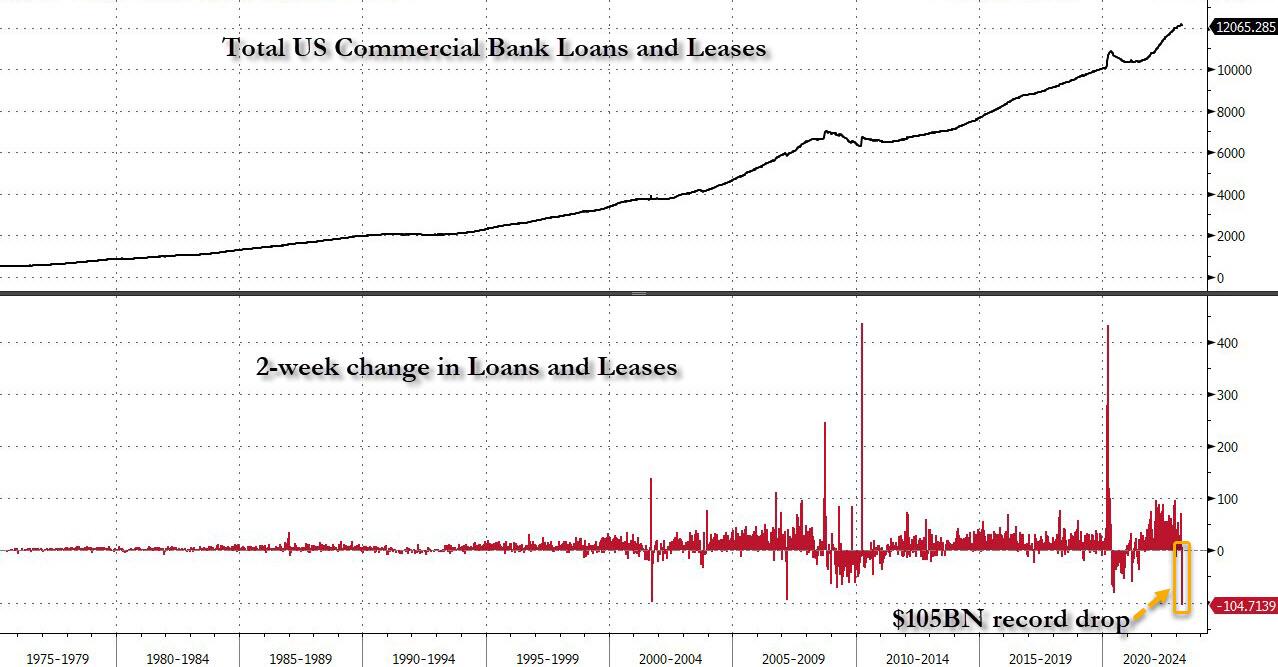
Those who peaked below the surface of the latest H.8 statement which, as discussed previously, saw the biggest drop on record in bank loans and leases in the last two weeks of March...
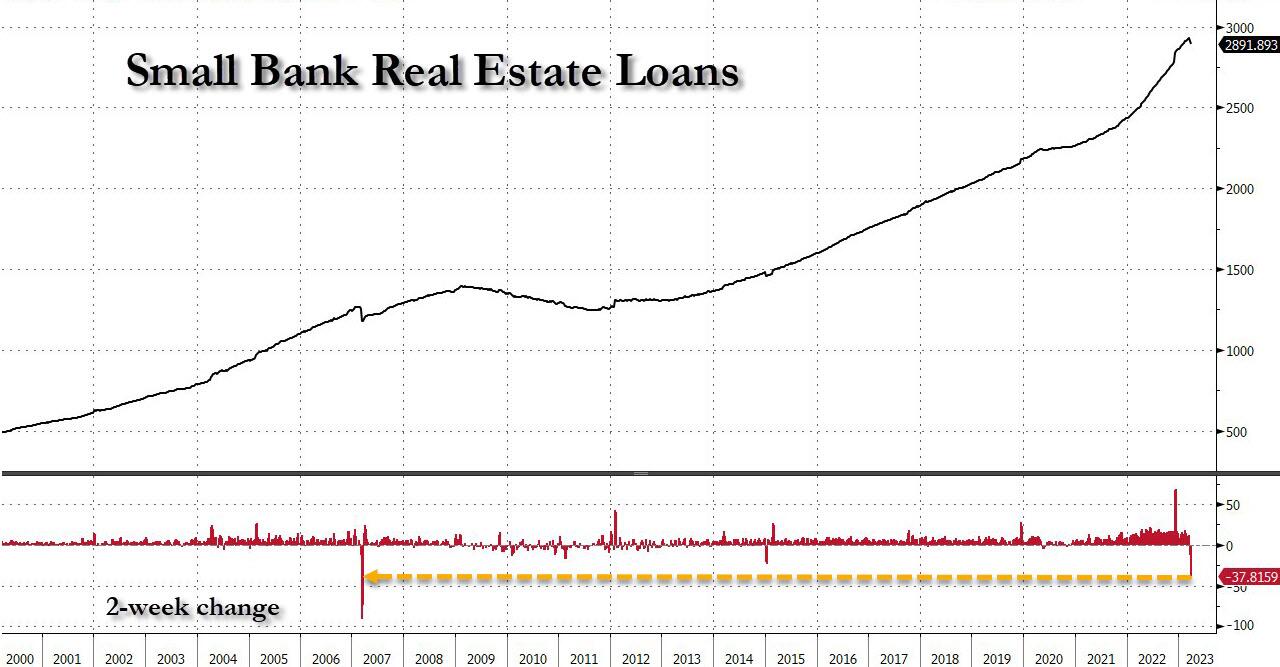
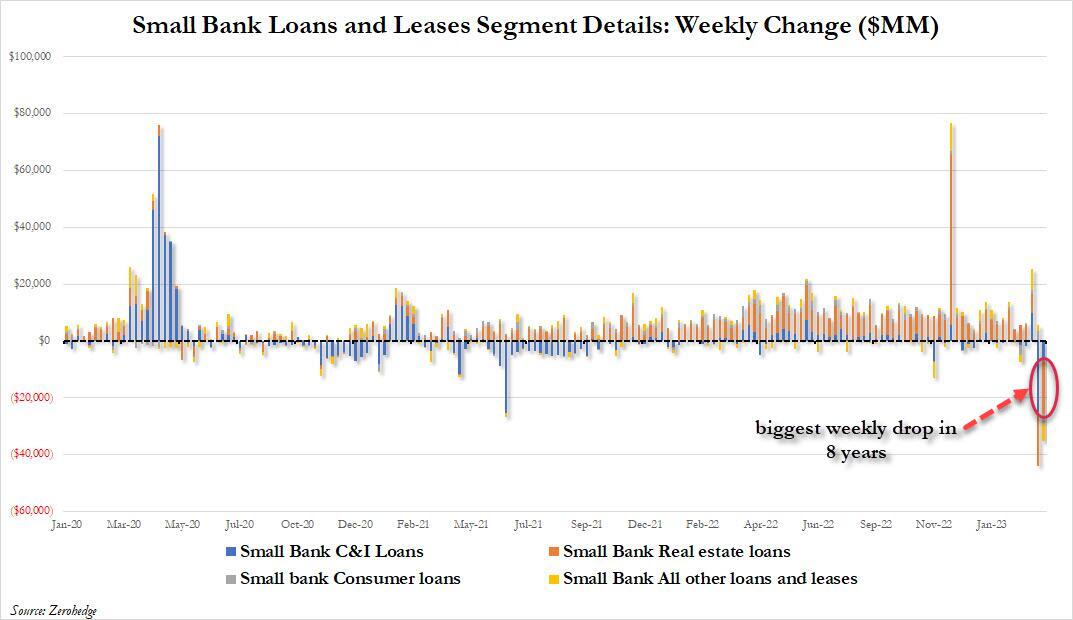
... found another, perhaps even bigger surprise. As we detailed over the weekend when breaking down the weekly change in small bank loans and leases by their subcomponents, we found that whereas in the first week after the bank crisis (the one ending March 15) the bulk of the collapse in loans was in the traditionally volatile C&I space, the latest week was a surprise: that's because while the plunge in C&I loans moderated substantially to just $6.9BN from $25BN the week before, the biggest slide was in one of the anchor pillars of the small bank sector: real estate loans.
In fact, while the biggest drop among small bank loans in the latest week was the $18.7BN decline in real estate loans, this was a continuation of the $19.2BN drop in the previous week. Combining the two weeks adds to a $37.8BN plunge in real estate loans in the second half of March. This number is notable because it is the biggest since the collapse of the country's then-second largest subprime lender, New Century Financial in March 2007, which as most traders over 40 recall, was the catalyst that ushered in the global financial crisis, and within the year led to the collapse of Bear Stearns and, eventually, Lehman.
Of course, for the past month we have been warning that real estate and especially Commercial Real Estate is the ticking solvency time bomb within both large and small banks, now that the liquidity crisis that crushed several "small" banks has been contained courtesy of nearly half a trillion in reserve injections by the Fed. And while we previously discussed at length the coming multi-trillion CRE maturity wall, (see "New "Big Short" Hits Record Low As Focus Turns To $400 Billion CRE Debt Maturity Wall")...
... increasingly more are also seemingly starting to notice and, what is far more ominously, are taking a page out of the Margin Call playbook and quietly selling out of their real estate loan exposure: or to quote Kevin Spacey, "this is what the beginning of a firesale looks like."

To be sure, it's no longer just us that are focusing on the potential of CRE to be the next market crash catalyst. As Bloomberg wrote over the weekend, "almost $1.5 trillion of US commercial real estate debt comes due for repayment before the end of 2025. The big question facing those borrowers is who’s going to lend to them?"
Well, there is another even bigger question as the video clip above suggests, but we'll get back to it in a second.
Bloomberg quotes a recent must-read note by Morgan Stanley titled "Scaling Maturity Walls" (available to pro subs in the usual place) in which the bank's credit strategists write that “refinancing risks are front and center” for owners of properties from office buildings to stores and warehouses, adding that “the maturity wall here is front-loaded. So are the associated risks.”
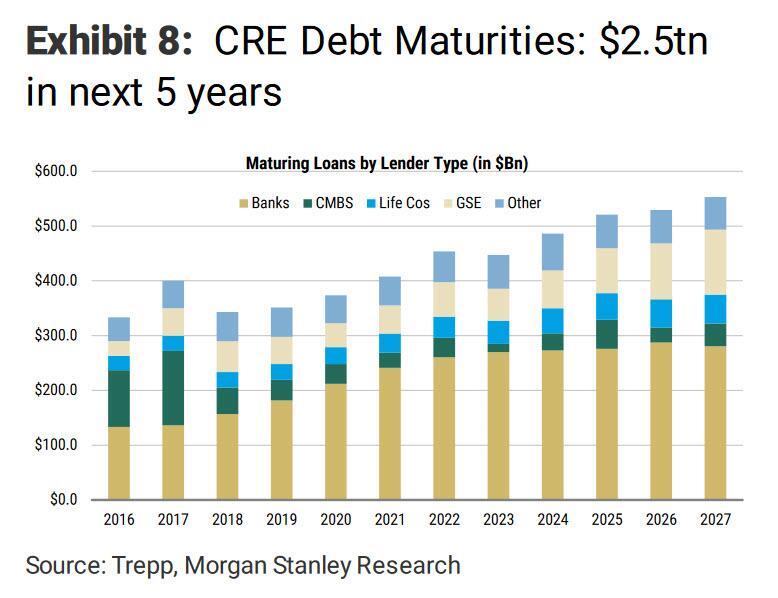
Looking at the charts below, Morgan Stanley's James Egan writes that "roughly $400-450bn worth of CRE loans are scheduled to mature in 2023. This is on par with 2022, and both of those years are the largest on record ( Exhibit 12 ). From there it doesn't get any easier, as maturities climb each year until 2027, reaching over $550bn." And "while the maturity walls within other asset classes might not be very front loaded, the issue within commercial real estate is happening right now."
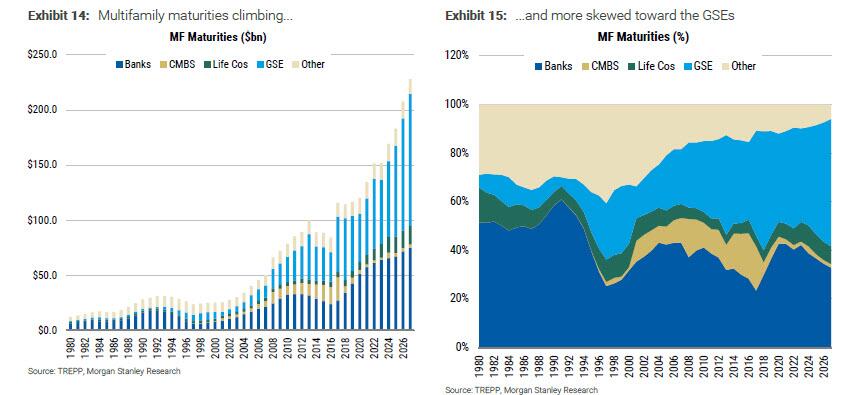
As these maturities come due, Egan warns that he is left many more questions than answers, "chief among them: who is going to be responsible for refinancing these loans as they mature? That story differs depending on property type. The multifamily space has grown very reliant on the GSEs over the years. From 2023 through 2027, 46% of maturities are currently guaranteed by the GSEs. As a reminder, in the GSE space, borrowers will ask lenders for a loan, and if the property meets the eligibility criteria for agency guarantee, then the lender should generally feel comfortable that the loan will be guaranteed by the agency when quoting a rate lock. The agencies will inspect the property at different times depending on the exact program, but given that the majority of agency guaranteed multifamily properties are held by borrowers with multiple properties, there is incentive to continue to work with the agencies."
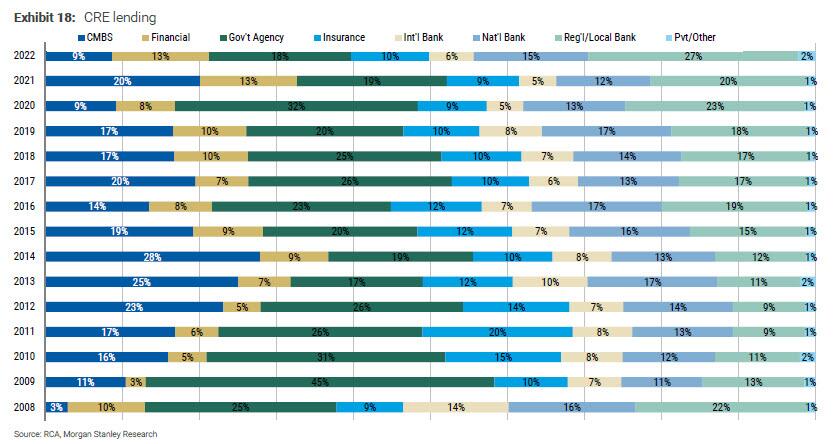
But the real punchline is that as these maturities are picking up, the single largest lender in the Commercial Real Estate landscape is the one that is now under the most scrutiny: regional banks, something we have been warning about for months. As Morgan Stanley notes in the next chart, in the years since the GFC, origination volumes and the share of that volume has varied, but since 2014 the trend has clearly been away from CMBS and toward regional banks.
Meanwhile, as we discussed previously, rising rates and worries about defaults have already hurt CMBS deals. Sales of the securities without government backing fell about 80% in the first quarter from a year earlier, according to Bloomberg calculations.
“The role that banks have played in this ecosystem, not only as lenders but also as buyers,” will compound the wave of refinancing coming due, the analysts wrote.
Unfortunately, when apartment blocks are excluded, the scale of the problems facing banks becomes even starker. As much as 70% of the other commercial real estate loans that mature over the next five years are held by banks, according to the Morgan Stanley report.
“Commercial real estate needs to re-price and alternative ways to refinance the debt are needed,” the analysts said.
To be sure it's not all doom and gloom, and as Bloomberg notes, there are some slivers of good news. Conservative lending standards in the wake of the financial crisis provide borrowers, and in turn their lenders, with some degree of protection from falling values. Additionally, sentiment toward multifamily housing also remains much more positive as rents continue to rise, one reason why Blackstone Real Estate Income Trust had a positive return in February even as rising numbers of investors lodge withdrawal requests. The availability of agency-backed loans will help owners of those properties when they need to refinance.
Alas, with regional banks now undergoing cardiac arrest, and unlikely to reboot their lending activity as long as deposit flight continues - which as discussed last week has slowed modestly but remains an existential risk to the regional banks and which is unlikely to be resolved as long as the Fed refuses to cut rates and remove depositors' preference from shifting funds from banks to safer, and higher yielding money markets (see "JPM Asks If The Fed Will Restrict Reverse Repo Use To Short Circuit $1.5 Trillion Bank Run")...
.... it doesn't take rocket science to realize that, just like in March 2007 when the collapse of New Century finally shocked everyone into a state of brutal realization that the party was over, it's about to get a whole lot worse.
How much worse? Well, according to Morgan Stanley office and retail property valuations could fall as much as 40% from peak to trough, creating a feedback loop of liquidations, bank failures, defaults and from there even more liquidations:
US securitized credit - CRE: $1.35-1.46 trillion (30-32%) of CRE debt matures by YE 2025 and banks hold ~42-56% of maturing debt. Recent attention on US CRE is understandable as the asset class faces a trifecta of risks:
  • (1) Maturity walls are front loaded. Acknowledging the variance in the numbers reported by different sources, we estimate that nearly $566-615 billion (22-24%) of the outstanding $2.6 trillion core CRE debt (excluding multifamily) matures by year-end 2024 and another $275-340 billion (11-13%) is due in 2025.
  • (2) Bank dependence is high - both as direct lenders to the asset and also as buyers of both agency and non-agency CMBS. Banks hold 36-64% of debt maturing each year and account for nearly half the agency CMBS and 10-15% of the non-agency CMBS investor base.
  • (3) Valuation concerns have increased in specific sectors such as office and retail.
Our equity colleagues expect a 30-40% peak to trough correction in both asset classes.
We are glad that one month after we called CRE the "BIg Short 3.0", one of the largest and most respected US banks agrees. We are not glad that if, or rather when we are proven right that with trillions in loan maturities which nobody wants to roll CRE is about to become the next Subprime, the US financial system will suffer another existential shock, or as some call it "credit event."
Morgan Stanley's conclusion: “commercial real estate needs to re-price and alternative ways to refinance the debt are needed."
And while it may not have been Morgan Stanley's intention, yelling "re-pricing" in a burning theater can be even worse than yelling fire: it's the green light for everyone else to start selling... something the collapse in real estate loans suggest may have already started.
Much more in the must-read MS notes (here and here) available to pro subs.

WSJ : New Details on Intelligence Leak Show It Circulated for Weeks Before Raisi

New Details on Intelligence Leak Show It Circulated for Weeks Before Raising Alarm
The secret documents were first posted in January to a small group on a messaging channel that trafficked in memes, jokes and racist talk

One of the most significant leaks of highly classified U.S. documents in recent history began among a small group of posters on a messaging channel that trafficked in memes, jokes and racist talk.

Sometime in January, seemingly unnoticed by the outside world, an anonymous member of a group numbering just over a dozen began to post files—many labeled as top secret—providing details about the war in Ukraine, intercepted communications about U.S. allies, such as Israel and South Korea, and details of American penetration of Russian military plans, among other topics.

The documents, which appear to have numbered in the hundreds, stayed among the members of the tiny group on the Discord messaging platform until early March, when another user reposted several dozen of them to another group with a larger audience. From there, at least 10 files migrated to a much bigger community focused on the Minecraft computer game.

On Wednesday, with the U.S. government apparently still unaware, a Russian propaganda account on Telegram posted a crudely doctored version of one of the documents, alongside a few unedited ones.

The Federal Bureau of Investigation and the Justice Department are now on a sprawling hunt for answers on how the dozens of images that purport to show secret documents surfaced online. A government probe, launched Friday at the request of the Defense Department, is searching for the source of the leak.

A Pentagon spokeswoman said Sunday night the department was reviewing and assessing the validity of the photographed documents “that appear to contain sensitive and highly classified material.” She said the U.S. had discussed the matter with allies over the weekend and was weighing the potential national security impact of the breach.

The intelligence leak is shaping up to be one of the most damaging in decades, officials said. The disclosure complicates Ukraine’s spring offensive. It will likely inhibit the readiness of foreign allies to share sensitive information with the U.S. government. And it potentially exposes America’s intelligence sources within Russia and other hostile nations.

A decade after National Security Agency contractor Edward Snowden leaked a giant cache of top-secret documents about surveillance and other intelligence activities, the U.S. government is still unable to protect against such breaches.

“How the heck are we back here again?” said Brett Bruen, president of Global Situation Room, a national security consulting firm, and a former White House official in the Obama administration. “These kinds of large scale security breaches were supposed to be a thing of the past. New controls and checks were put in place. Yet, clearly it wasn’t enough and we need a major rethink [and] revision to the classified protection process.”

Who had access
The Wall Street Journal wasn’t able to independently authenticate the documents, but they contain enough detail to give them credibility. Defense officials have said they believe some of the documents could be authentic.

In total, just over 50 documents with Secret and Top Secret classification markings have surfaced so far, and have been viewed by the Journal and a variety of independent intelligence analysts. A critical question is who had access, and when, to the hundreds of others that were posted in the original group between January and March, and how significant are the secrets that these files contain.

The U.S. intelligence community is expected to take measures to protect the sources and methods used in the collection of data in that material. “You have to assume it is compromised,” said Thomas Rid, professor of strategic studies at Johns Hopkins University. “But assuming that the adversary has it is one thing, knowing it is another.”

The probe into the leak will be among the FBI’s top priorities as investigators search for who had access to the information, and who would have motive to make it public, said Joshua Skule, a former FBI senior executive who is now the president of the government contracting firm Bow Wave.

“They are going to be looking to get to the bottom of who did it as expeditiously as possible, they are going to be sparing no resource,” Mr. Skule said. “The FBI is approaching this as if someone has committed a treasonous act.”

The leaked documents are photographs of presentations and files that had been printed out on A4 paper. They appear to have been folded twice, perhaps to be smuggled out of a secure facility. A variety of items can be seen in the margins of the photos, including Gorilla glue, shoes and instructions for a GlassHawk HD spotting scope, details that could facilitate the search for the leaker.

Mykhailo Podolyak, an adviser to Ukrainian President Volodymyr Zelensky, said in a Telegram post that it was unlikely that Russia was behind the original intelligence breach.

“If you have an operating channel to obtain intelligence from the Pentagon, you don’t burn it for a one-day publicity drive,” he wrote. By publicizing the leak, he added, Russia aimed to distract attention from Ukraine’s preparations for the offensive, and to “sow certain doubts and mutual suspicions” between Kyiv and its partners.

Mr. Zelensky reacted to the leak by ordering new measures to clamp down on unauthorized disclosures of military information. The U.S. has also changed how military personnel access such documents, defense officials said last week.

The most damaging files, security analysts say, are the roundups of vetted intelligence material compiled in the Central Intelligence Agency’s operations center intelligence update. They include information on conversations that the U.S. had intercepted within allied governments, such as communications of the leaders of Israel’s Mossad intelligence service and discussions among members of South Korea’s national security council on whether to sell ammunition that could end up in Ukraine.

Even more sensitive is the information that appears derived from the U.S. penetration of the Russian government, such as details on how a Russian hacker shared screenshots with the FSB security service on accessing Canada’s natural-gas infrastructure, internal Russian ministry of defense deliberations on supplying ammunition to the Wagner paramilitary group, and plans by Russian military intelligence to foment an anti-Western and anti-Ukrainian campaign in Africa.

Aric Toler, head of research and training at the Bellingcat investigative consortium, which has carried out several probes of Russian intelligence operations, said that he has been in touch with three original members of the Discord group.

The group’s members saw hundreds of classified files before the channel was wiped clean, he said. Most members are based in the U.S. The identity of the original poster remains unknown.

Baffling pattern
Document leaks have emerged as a common tactic during the war in Ukraine, but the posting of the apparent U.S. intelligence files on Discord, an online chat service favored by videogame players, follows a different, somewhat baffling pattern, according to analysts.

Once global attention was drawn to the leak, members of the Discord groups scurried to delete their accounts and to purge their servers, fearing retribution by the U.S. government and unwelcome attention from foreign intelligence agencies.

“I left that server and I really hope that I am safe,” one of the users, who had uploaded some of the leaked files to the Minecraft community, posted on Friday, adding a crying emoji.

Founded eight years ago in San Francisco, Discord first gained popularity as software that gamers could use to talk to each other in a group. The majority of these chat servers are private—shared by friends—but they can be public, too. Discord also hosts communities supporting Ukraine’s cause.

Discord is cooperating with law enforcement on the leak investigation, a Discord spokesman said. “It is Discord’s highest priority to ensure a safe experience for our users,” he said. “As this remains an active investigation, we cannot provide further comment at this time.”

On Sunday, Discord’s website listed more than 20,000 public servers, the majority of them concerning gaming. “It’s a very reliable service when the games are acting glitchy,” said Levi Gundert, chief security officer with the intelligence firm Recorded Future.

Researchers at Mr. Gundert’s firm have also found unsavory content on the platform, such as terrorist propaganda and tools for hackers. “It really looks more like a kind of free-for-all in terms of the content that’s available,” he said.

Discord would likely have information about the users of the original group’s server that would be of use to law enforcement investigators, Mr. Gundert said.

The latest leak isn’t the first time sensitive documents have shown up on a gaming-related server. Last year, a player of the WarThunder military vehicle combat game posted real classified information on the British Challenger 2 tanks, while a year earlier another user posted a classified manual for the French Leclerc tanks.

The new disclosures are far more significant. They include information about the types of heavy weapons and equipment held by the nine Ukrainian brigades that the U.S. and allies are preparing for the coming spring offensive; precise details on the quickly dwindling ammunition of the Ukrainian air defense systems; the level of protection of critical infrastructure sites; and details on how many tanks, artillery pieces and military aircraft Ukraine operates.

The slide initially publicized on Wednesday and Thursday by Russian propaganda Telegram accounts had been doctored to inflate Ukrainian battlefield casualties and to minimize Russian ones. The crude nature of the alteration suggests this wasn’t a high-level intelligence operation, security analysts said.

Another purported Pentagon document that emerged on Friday contained the same estimate of Ukrainian and Russian battlefield fatalities as the unaltered slide: up to 43,000 Russian troops and up to 17,500 Ukrainian troops, in addition to as many as 41,000 Ukrainian civilians.

Separately from the war, one of the items in the CIA update said that Mossad leaders “advocated for Mossad officials and Israeli citizens to protest against the new Israeli government’s proposed judicial reform, including several explicit calls to action that decried the Israeli government.” The update cited signals intelligence, an indication that conversations among the Mossad leadership have been intercepted by the U.S. government.

Mossad Sunday took the rare step of publicly denying the report, calling these allegations “mendacious and without any foundation whatsoever.”

Changes in security
U.S. national security entities have taken steps to prevent a repeat of the 2013 breach, when Mr. Snowden, then a contractor to the National Security Agency, left the country with a large number of classified documents, and provided them to journalists.

Mr. Snowden, who became a Russian citizen, has said his leak was meant to shine light on what he described as abuses of U.S. surveillance, and chose to provide them to journalists so that they would vet the documents.

There has been no explanation so far of the motives behind the latest leak.

In the current case, the U.S. is considering a range of possibilities over how it occurred, including that someone with a top-secret security clearance leaked the information or that U.S. intelligence systems were hacked, U.S. officials said Saturday.

Leak probes usually begin by determining who had access to the documents, current and former officials said. Potentially hundreds of government employees have security clearances that would give them the ability to view the documents.

Marc Raimondi, a former Justice Department official, said that the pool of people who have access to some of the highest levels of classified information expanded in the years after the 9/11 terrorist attacks. A congressional commission that investigated the attacks pointed to the lack of intelligence sharing as one of the reasons the U.S. government didn’t uncover the plot.

Since then, efforts have focused on sharing intelligence more widely, “but with having that wider pool of people having access, obviously, you run the risk that one of those people may not take their oath as seriously as they should, and you have an improper release of national defense information,” said Mr. Raimondi, chief of staff at the Silverado Policy Accelerator, a Washington, D.C., based think tank focused on security and trade issues.

Mr. Raimondi said sharing intelligence remains critical for protecting the U.S. and its allies, even if it comes with risks.

“An extraordinarily small number of clearance holders violate their obligation,” he said. “But when it does occur, it can be devastating.”
WSJ : Ukraine May Run Out of Air Defenses by May, Leaked Pentagon Documents Warn

Ukraine May Run Out of Air Defenses by May, Leaked Pentagon Documents Warn
Kyiv is depleting its last reserves of S-300 missiles, making it possible for Russia to achieve air superiority, according to purported Pentagon presentations

Russia could achieve its long-sought goal of air superiority in Ukrainian skies as early as May because Ukraine is running out of antiaircraft missiles, according to purported Pentagon presentations that have leaked on social media.

The Pentagon and the Justice Department began an investigation last week into document leaks when some purported U.S. Department of Defense presentations were posted by Russian propagandists on Telegram on Thursday. The Wall Street Journal, which viewed these documents and a larger trove that emerged on Friday, hasn’t been able to independently verify their authenticity.

Pentagon spokeswoman Sabrina Singh said Sunday that the U.S. continued to assess the validity of the documents “that appear to contain sensitive and highly classified material.” She said the U.S. had discussed the matter with allies over the weekend and was weighing the potential national security impact of the breach.

Col. Yuri Ihnat, a spokesman for the Ukrainian Air Force, said that he couldn’t comment on the veracity of the information in the leaked slides as such data is classified in Ukraine. He confirmed, however, that Ukraine’s air defenses face a serious challenge and said that Ukraine urgently needs its Western partners to speed up assistance.

“If we lose the battle for the skies, the consequences for Ukraine will be very serious,” he said. “This is not the time to procrastinate.” After more than a year of war, he said, Ukraine faced a serious challenge finding the Soviet-designed ammunition for the backbone of its air-defense system, the S-300 and the Buk batteries.

Russian bombers and helicopter gunships haven’t ventured beyond the immediate vicinity of Ukraine’s front lines for nearly a year, after Ukraine’s air defenses shot down several aircraft in the initial weeks of the war. As a result, Russia has only been able to strike deep inside Ukraine with expensive cruise missiles and long-range Iranian drones, rather than the much more abundant and more powerful unguided bombs.

Ukraine’s air defense has also made it impossible for Russian aircraft to target moving Ukrainian convoys, troop concentrations and other military targets in the rear, offsetting Moscow’s vast superiority in the number and quality of combat aircraft.

If true, the alarming assessments in the leaked presentations shed new light on the urgency with which Kyiv has been lobbying the U.S. and North Atlantic Treaty Organization allies to speed up deliveries of Western-made air defense systems and to provide Ukraine with Western-made jet fighters, such as F-16s, so that it would be able to prevent incursions by Russian bombers.

According to one of the documents, a likely consequence of the looming air defense crisis is that Ukraine will lose its ability to mass ground forces near the front lines, and to conduct a counteroffensive. Kyiv said it is planning to launch a massive offensive to recapture Russian-occupied territories in coming weeks, using several new reserve brigades trained and equipped by the U.S. and NATO partners.

So far, Ukraine has been successful in denying Russia the ability to use its manned aircraft deep inside Ukraine largely because of its network of Soviet-vintage long-range air-defense systems, primarily S-300 and Buk, which can intercept targets at altitudes above 20,000 feet.

However, according to a secret purported Pentagon slide dated Feb. 28, Ukraine will have completely depleted its stock of Buk missiles by April 13, and of S-300 missiles by May 3, at current consumption rates.

By then, according to a map in another purported Pentagon presentation, also from Feb. 28, most of Ukraine’s critical national infrastructure outside the Kyiv region and two other areas in southwestern Ukraine will no longer have air-defense cover. The number of unprotected critical sites will soar from six to more than 40, it said.

Russia has fired several hundred cruise missiles and launched hundreds of Iranian-made Shahed drones since October in an effort to destroy Ukraine’s electricity system and to force a humanitarian crisis during the winter. While that effort has failed, with rolling blackouts no longer occurring and Ukraine even resuming electricity exports to the European Union, the barrages have severely depleted Ukraine’s air-defense ammunition stocks.

While the U.S., Norway, Canada and Germany have provided Ukraine with two NASAMS and one Iris-T air-defense batteries in recent months, these systems, too, were on track to run out of ammunition by May, according to the document.

Ukraine’s S-300 batteries were expending roughly 200 missiles a month, while Buk batteries fired about 69 missiles a month, the document said. NASAMS and Iris-T expended a combined 64 missiles a month.

After months of Ukrainian requests for help, President Biden in late December authorized the deployment of one Patriot missile battery to Ukraine. Ukraine is scheduled to receive an additional Patriot battery from Germany while France and Italy are providing one comparable SAMP-T system. While Ukrainian crews have already been trained, none of these systems are currently deployed, Col. Ihnat said.

Ukraine also operates portable air defense systems such as Stinger missiles. Valuable in the battlefield, they can’t reach high-flying aircraft or offer much protection to critical infrastructure.

While the Patriots and SAMP-T are more sophisticated than S-300, the three batteries due to arrive in Ukraine won’t be able to replace the breadth of coverage afforded by the 25 currently operating Ukrainian S-300 batteries, the leaked Pentagon presentation said.

The U.S. military’s European command estimates that Ukraine needs 12 Patriot or SAMP-T batteries, and 16 batteries of NASAMS or Iris-T class to provide adequate coverage, according to the document. “Multiple mitigating options must be simultaneously pursued to increase decisions for more sustainable solutions,” it said.

Short-term, the document recommended trying to find additional S-300 and Buk munitions abroad, a difficult endeavor as most of Ukraine’s allies that possessed such systems have already transferred them. The only major exception is Greece, which operates two S-300 batteries. Ukraine’s Defense Minister Oleksii Reznikov visited Athens for talks on military supplies last month, but no details have been provided.

Over the medium-term, the Pentagon analysis recommended expediting the procurement of NASAMS, Patriot, Iris-T and other Western systems, as well as the so-called FrankenSAM project to repurpose air-defense tasks for more widely available missiles and systems that had been designed for other purposes.

Long-term, the only proposed solution was to deliver enough Western air defense systems to cover the whole country, and to digitally integrate them.

Ukraine’s outdated jet fighters are no match for the vastly larger and more modern Russian air force, and have little to no capacity for air-to-air defense against Russian air sorties, which is why Kyiv is clamoring for F-16s. “This kind of aircraft would solve many of our issues in protecting the airspace, and it is available in sufficient numbers to make a difference,” said Col. Ihnat. The Mig-29 jets that Ukraine is on track to receive from Slovakia and Poland, while useful for other missions, wouldn’t be able to withstand air-to-air combat against more modern Russian jet fighters, he said.

While several NATO governments have said that they support giving F-16 jets to Ukraine, especially as they are being replaced with more modern aircraft, the Biden administration so far has stopped short of approving such a transfer. Ukraine “doesn’t need F-16s now,” Mr. Biden said in an ABC News interview in late February, rejecting calls by some Democratic and Republican members of Congress to consider such a transfer.

FT : Sweden’s Wallenberg hits out at ISS over dual-class share attack

Sweden’s Wallenberg hits out at ISS over dual-class share attack
Scion of industrial dynasty accuses proxy adviser of misusing law to take on unequal voting rights

One of Europe’s leading industrialists has lambasted proxy adviser ISS for attacking a central plank of Swedish capitalism, accusing it of misusing a law to take aim at unequal voting rights.

Jacob Wallenberg, whose family investment vehicle owns large stakes in companies such as Ericsson, Nasdaq, Electrolux and Saab, told the Financial Times he was troubled by a proposal from ISS that from next year it will recommend voting against directors at businesses that have different classes of shares with unequal voting rights.

“If they’re successful, it would mean a significant change to the Swedish stock market,” he said. “There is a reason why all shareholders have agreed to this set-up. I don’t see why a third party should force through a change because they have a different view.”

Almost three-quarters of the market capitalisation on Stockholm’s stock market is for companies with dual-class shares, which give higher voting rights to holding companies such as Investor, the Wallenberg investment vehicle.

ISS, which provides voting recommendations for mostly international shareholders, has said that from February it will suggest voting against individual directors or against the discharge from liability of board members if there are unequal voting rights.

Wallenberg conceded that dual-class shares were a legitimate topic to discuss but that it was an issue to take up with shareholders, not board directors whose job is to oversee companies’ management.

Wallenberg said being denied discharge from liability was meant to be “a punishment” that opened up the board to damage claims.

“It’s misusing a tool to make noise. It’s an obvious and deliberate attempt to circumvent the purpose of the law to make noise.” In the worst case, he argued, it could hamper recruitment of board members in Sweden.

Georgina Marshall, global head of research at ISS and chair of its global policy board, disagreed, saying three-quarters of investors in a survey the proxy adviser conducted wanted it to consider issuing “adverse voting recommendations” over unequal voting rights and other poor governance structures.

Wallenberg claimed that A and B shares worked well “for those who want to be a long-term shareholder and maintain control”, such as Investor. But he said the dual class of shares only made a difference at a few of its holdings, such as Ericsson, Electrolux and Investor itself. At Investor, Wallenberg foundations own 22 per cent of the capital but enjoy 47 per cent of the voting rights.

Wallenberg stressed that under the “freedom to contract”, other investors had agreed to the different voting rights.

He added that he found nobody to talk to at ISS about the issue and that it had decided on this issue without “free discussion”.

“There’s no oversight of proxy advisers. I find that troubling. They have very significant impact.”

Marshall underscored that ISS was a registered investment adviser subject to oversight from the US Securities and Exchange Commission.

She added that data showed ISS did not wield too much power, as it had recommended voting against about 21 per cent of large European companies’ remuneration reports in 2022 but just 1.6 per cent failed to pass, “demonstrating that investors make up their own minds”.

FT : European commercial real estate: the cracks are starting to show

European commercial real estate: the cracks are starting to show
The recent banking crisis has added to fears that credit will become less available and more expensive, just as prices are slumping

From Canary Wharf in London to La Défense in Paris and Frankfurt’s Bankenviertel, the logos of major banks adorn Europe’s grandest office buildings. But there is early evidence that these buildings could become liabilities for banks and investors as they are buffeted by rising costs and post-Covid workplace changes.

Offices are the largest component of a commercial property market which lenders and investors have backed with €1.5tn of debt in Europe alone. About €310bn of new or replacement borrowing is issued to keep the market moving in a typical year, according to Bayes Business School at City, University of London.

Developers and landlords were already having to adjust to life since the pandemic began. This has involved an increase in hybrid working among their professional services tenants such as banks, law firms and consultancies, some of whom are reducing their office space. Now, in a key difference from the last downturn, property owners are having to contend with a rapid increase in borrowing costs as central banks ratchet up interest rates to contain a sharp rise in inflation.

Leverage has always been a central feature of commercial real estate but recent bank failures in the US and the state-brokered rescue of Credit Suisse by its rival UBS have added to fears that credit will become less available and more expensive. Property prices have already fallen sharply in recent months while older buildings in peripheral locations are becoming much harder to sell.

Analysts at Citi warned clients late last month that European real estate values had still not fully factored in rising interest rates and could fall by up to 40 per cent by the end of 2024.


“You can definitely see the cracks starting to happen,” says Mark Bladon, head of real estate at Investec. In Frankfurt, the Korean owners of the 45-storey Trianon tower have hired advisers to begin restructuring the €375mn of debt secured against the building. Cheung Kei, a China-based investor, has put two buildings in London’s Canary Wharf business district up for sale to reduce its debt load, according to Bloomberg.

Blackstone, the world’s largest commercial real estate investor, defaulted on a loan secured against a Finnish office and retail portfolio last month, while loans against German apartment buildings backed by Brookfield were downgraded by the rating agency Moody’s in March.

The question worrying investors is whether what are fairly isolated cases of stressed assets will accelerate into a sector-wide crisis like that seen in 2008-2009, and inflict serious damage on Europe’s banks.

The European Central Bank has warned of “growing vulnerabilities” in property markets. “The commercial real estate sector is considered vulnerable to the impact of the pandemic, while medium-term risks of price corrections continue to grow in the residential real estate sector,” the central bank said in a supervisory report in February.

Most analysts think a rerun of the financial crisis, where souring loans against commercial property undermined banks’ capital, sometimes fatally, is unlikely. They predict a long period of painful adjustment rather than a short, sharp shock.

“This time around I am much more confident than I was in the global financial crisis, when I knew that something was going to go horribly wrong,” says Nicole Lux, senior research fellow at Bayes Business School. She does not expect problems in commercial real estate to infect the banking system, as they did in the global financial crisis.

But some investors worry it will be the other way around: the shock to commercial real estate may spare the banks but will be harder on asset owners. “I see losses hitting on the equity side and some distressed debt. The question is how long is it going to take?” says Raimondo Amabile, chief investment officer at PGIM real estate.

A different market
As anxiety hangs over European lenders after Credit Suisse’s travails, real estate executives have been quick to point out that commercial property borrowing has undergone a big shift since 2009.

“The danger with real estate is that people look at what happened in the [global financial crisis],” says Dan Riches, co-head of real estate finance at asset manager M&G. The market today has “more lenders, more equity, lower leverage in the system”, reducing the chance of large-scale stress.


In the run-up to 2008, lenders routinely offered loans of 80 or even 100 per cent of a building’s value, sometimes basing their lending on optimistic forecasts about rental income or capital values. Bayes’ research found that European lenders would now rarely go beyond 60 per cent of a property’s value, making it less likely that the outstanding debt would end up exceeding the value of the property.

German lenders are more liberal, the research found, with maximum LTVs of 80 per cent for good-quality assets. In the UK, the consultancy Capital Economics said that four-fifths of loans were below a 60 per cent loan-to-value ratio — and that overall UK bank exposure to commercial real estate was half what it was in the run-up to the financial crisis.

But another vital difference between then and now is the trajectory of borrowing costs. As the world’s financial system threatened to seize up in 2008, central banks slashed interest rates and then flooded money markets with emergency cash. That made it relatively easy for even heavily indebted landlords to wait for the crisis to pass. Banks, keen to avoid crystallising losses that would further erode their own capital, were often happy to extend borrowing facilities.

This time, stubbornly high inflation has meant central banks have continued to push debt costs higher — despite the cracks in the banking sector and strains on commercial real estate. Bayes research suggests the cost of borrowing against prime real estate in Europe has doubled year on year. Some industry experts predict that, faced with steep increases in their own funding costs, banks will be less inclined to show forbearance towards struggling borrowers.

“You could describe a better story going into the global financial crisis than you could today,” says one senior executive at a large property investor. “There is no way out that will be fixed by the market.”

The first domino
First in line to take losses will be the owners of lower-grade office buildings. Amabile, of PGIM, says they face a “perfect storm” of weaker underlying demand for space, higher construction and maintenance costs, fewer potential buyers or lenders, and higher interest charges.

“We are really talking about stranded assets I think. We haven’t really seen that emerge since the retail [property] crash in 2018 and 2019,” says Zac Gauge, a real estate strategist at UBS. “I can’t see anything changing on the upside that is going to create tons of demand for secondary offices.” 

In the US, a slower return to in-person work has left even some prime offices facing financial difficulty. The vacancy rate there at the end of 2022 was 19 per cent, according to the real estate adviser JLL. But while the headline European vacancy rate is half that, the market is split between robust appetite for attractive buildings that meet the latest environmental standards and little demand for other space.

One US investor in European real estate says that occupiers there “are taking smaller footprints and moving into better buildings”. Prices for less desirable offices could fall by more than 50 per cent, some investors predict, as developers will have to totally repurpose the buildings. Both the EU and the UK are phasing in new energy efficiency standards that will require heavy investment from the owners of old buildings.

“Your bigger problem is the guy who has to refinance in the next few years for five [years] and thinks the building is a security, [then] realises he has a $10mn bill to bring it up to [environmental standards],” says Andrew Coombs, chief executive of Sirius Real Estate.


All the headwinds and uncertainty are making it harder to find investors with the confidence to buy offices or lend to their owners. “The big question everyone is asking is: what is the value of an office?” says Isabelle Scemama, global head of alternatives at French insurance group AXA.

It is a question that will take some time to answer because the European market typically reflects pricing changes more slowly than the UK or the US. “Generally speaking, valuers in Europe look at comparative transactions. If you have periods of lower transaction volumes with less evidence, valuers take a bit longer,” says Oliver Moldenhauer, analyst at Moody’s. That slow pace of deals can become a vicious cycle, where fewer transactions result in fewer yardsticks for the true value of buildings and more difficulties pricing sales.

Who takes the hit?
When values do start to fall in earnest, borrowers will be pushed closer to lender-imposed conditions about loan-to-value ratio and interest cover. That could lead to painful conversations with creditors, especially as old loans near expiry and need to be refinanced with much more expensive borrowings.

“You have some companies that have not been savvy enough to fix their debt or refinance early,” says Colm Lauder, analyst at the brokerage Goodbody. Germany’s listed landlords have among the highest debt levels; UBS forecasts that major German landlords’ average loan-to-value ratio will rise to nearly 50 per cent this year, up from 44 per cent in 2021.

Some assets, and likely some companies, will need a fresh injection of equity to reduce the leverage in their capital structures. In more extreme scenarios, they may have to sell assets to pay down debt. Real estate executives will find themselves heading into these high-stakes talks just as banks have less room to be lenient because turmoil in the financial sector has damped their tolerance for risk.

“There were a lot of borrowers who were on borrowed time,” says Gauge. “That may accelerate, and they may find that they have even fewer options to refinance when the time comes, if any.”

Euan Gatfield, an analyst at rating agency Fitch, says it is “fair to say that commercial real estate is among the weaker of the range of assets that banks have exposure to”.

“In the very short term we may see banks navel gaze a bit and make sure that they go over what they have got on their balance sheet, at the expense of new origination.” 

Net lending to commercial property in the UK turned negative to the tune of £288mn in February, for the first time since August. Capital Economics analysts expect that pull back will accelerate given the banking turmoil, “which will constrain the eventual recovery in investment and construction”.

The chief concern is a wave of forced selling from over-extended asset owners or debt funds, which would further depress the value of assets and create a downward spiral.

The ECB this month urged regulators to develop policies that prevent liquidity mismatches in open-ended property funds, which own assets that take a long time to sell but promise to repay investors on demand. It fears that fire sales of assets to meet redemptions could amplify existing stresses.

Commercial real estate makes up 9 per cent of European banks’ loan book, on average, according to Goldman Sachs, and 15 per cent of non-performing loans. That is notably less than US banks, which have 25 per cent of their loan books in the sector, rising to 65 per cent for the smaller US lenders that have been the focus of recent stress.

But the European average hides a wide range. Nordic banks had the largest commercial property exposure, according to an S&P Global Market Intelligence report late last year, such as Sweden’s Svenska Handelsbanken, which had 40 per cent of its retail and corporate loans out to commercial property. HSBC, whose real estate lending has grown in recent years, still had only 11 per cent exposure, S&P said.

Banks are not the only lenders, however. “What concerns me is outside the banking sector, what is called ‘shadow banking’,” says Lux, of Bayes Business School. “Private debt funds are unregulated at this point.” 

Bladon, of Investec, says that alternative lenders now occupy the terrain that banks held during the financial crisis. “The debt funds that have stepped into that highly leveraged space have got to be in a worse position [than banks].”

But the growth of alternative sources of lending such as asset managers, sovereign wealth funds and private equity firms could also provide a key source of financing for the industry as banks draw in their horns, according to Ron Dickerman, president of investment group Madison International Realty.

Some of the demand for loans and fresh investment could be met by funds that raised large amounts of cash in recent years and have yet to deploy it, as well as overseas investors. But they may also choose to invest those funds outside the challenged office and retail markets. Citi analysts say that logistics, self-storage and some residential assets should fare better than traditional office space.

“A lot of funds and investors are very hungry for deals . . . The fundamentals are still strong and there are opportunities in certain key market sectors, unlike the past,” said Anthony Mongone, real estate partner at the law firm Ropes & Gray. “I think it may not be a total gloom and doom story. It may be more of an isolated doom and gloom story.”

(ZH) Over 100 More Classified Docs Appear Online: US Secrets 'From Ukraine To Mi

Over 100 More Classified Docs Appear Online: US Secrets 'From Ukraine To Middle East To China'

A more expanded document dump and leak of highly classified materials is being reported in the wake of the initial disclosure that memos related to US strategy in the Ukraine war appeared online, including material marked "Top Secret".
This time the leak appears more expansive: "A new batch of classified documents that appear to detail American national security secrets from Ukraine to the Middle East to China surfaced on social media sites on Friday, alarming the Pentagon and adding turmoil to a situation that seemed to have caught the Biden administration off guard," The New York Times reported Friday evening.

"The scale of the leak — analysts say more than 100 documents may have been obtained — along with the sensitivity of the documents themselves, could be hugely damaging, U.S. officials said," the report continues.
One senior intelligence official was quoted in the report as saying the leak is "a nightmare for the Five Eyes" - in reference to the intelligence-sharing nations of the US, UK, Canada, Australia and New Zealand.
Like the Ukraine war plans earlier reported on by the Times, some of these latest documents appeared on Twitter and other social media platforms, and they include reports labeled with one of the highest classification ratings of "Secret/NoForn" - which means they are sensitive enough to not be shared with even foreign allies.
Interestingly, the NY Times notes that one intelligence slide which is circulating features "an alarming assessment of Ukraine’s faltering air defense capabilities." But these leaks, some of which actually appeared on a Discord server devoted to discussing Minecraft and other unusual places, include more than the initial content on Ukraine war planning:
But the leaked documents appear to go well beyond highly classified material on Ukraine war plans. Security analysts who have reviewed the documents tumbling onto social media sites say the increasing trove also includes sensitive briefing slides on China, the Indo-Pacific military theater, the Middle East and terrorism.
The report quotes one analyst who warns this is likely "the tip of the iceberg" and that more major leaks are coming, or possibly have already happened, in something which could begin to rival the 'Pentagon Papers' of the Vietnam war era.
A former senior Pentagon official, Mick Mulroy, was also quoted as saying this could possibly hinder Ukrainian military planning given that "many of these were pictures of documents" and thus "it appears that it was a deliberate leak done by someone that wished to damage the Ukraine, U.S., and NATO efforts."
This assessment suggests a leak from inside allied forces, and not from a foreign adversary, even though US officials are accusing Russian-linked entities online of being the chief spreaders of the leaked documents.
US officials are also warning that some of the documents may have been digitally altered to fit a more pro-Kremlin narrative, as we detailed earlier. Twitter has acknowledged that US officials are requesting that it act to scrub classified materials from the platform.
There's growing concern that the leaks could be coming from within the Ukrainian military...
Pentagon and US intelligence officials are also scrambling to discover the source of the leak in an ongoing investigation. Likely this is to result in greater scrutiny on Kiev and how its chain-of-command handles sensitive data shared from the Pentagon.

FT : 20 stocks account for 90% of Wall Street’s gains this year

20 stocks account for 90% of Wall Street’s gains this year
Banking sector turmoil has driven down interest rate expectations and boosted Big Tech stocks

Just 20 stocks account for almost 90 per cent of the US benchmark index’s $2.36tn gains so far this year, as instability in the banking sector has driven down interest rate expectations and boosted the attraction of Big Tech.

Among the big gainers, shares in chipmaker Nvidia have climbed by 83 per cent so far this year, while Facebook owner Meta is up 76 per cent and Salesforce has climbed 42 per cent, underlining the heavy concentration in the world’s most influential stock market.

The market value of those and the other 17 best performing stocks in the S&P 500 have surged by $2.05tn in 2023. Apple’s valuation alone has shot up by almost $600bn, or 30 per cent, in the past three months.

The market capitalisation of the other stocks in the index — which is up almost 7 per cent so far in 2023 — has risen just $320bn over the same period, according to private equity firm Apollo Global Management.

Ignoring gains for megacap growth stocks, the S&P 500 rose just 1.4 per cent in the first three months of 2023, said UBS.


“People are looking for safety and comfort given the cross-currents in the market, and tech gives them plenty of ease,” said JPMorgan sales trader Jack Atherton. Noting the well-worn phrase that “whenever the Fed hits the brakes, someone goes through the windshield”, he added that megacap tech appears to be “wearing an eight-point harness”.

US technology companies in particular were left battered by rising borrowing costs in 2022, with the tech-heavy Nasdaq Composite tumbling a third from an all-time high as the present value of tech groups’ future cash flows declined.

The US Federal Reserve has continued to increase rates in 2023, but the fallout from the collapse of California-based Silicon Valley Bank in March is expected by some investors to tighten lending standards and cool economic activity to such an extent that further aggressive rate rises are no longer necessary.

Turmoil in the banking sector has lopped half a percentage point off the level at which investors expect rates to peak, with markets now split on whether the Fed will lift rates by 0.25 percentage points to a target range between 5 and 5.25 per cent or leave them unchanged when it next meets in early May. One month ago, before the failure of SVB, investors had expected rates to peak at about 5.5 per cent in September.

Technology stocks have been among the main beneficiaries of this recalibration. Many of those that suffered in 2022 but dominate US equity indices are now “exploding higher on the violent rates reset”, said Charlie McElligott, analyst at Nomura.

High inflation means the zero interest rate environment that spurred tech stocks to record highs in 2021 is unlikely to return any time soon, however, and the sector’s nascent rally may already be fading. Analysts at Bank of America have noted the first aggregate outflows from tech stocks in six weeks in the five days to March 31.

FT : Italy races to review deal to sell Russia-owned refinery in Sicily

Italy races to review deal to sell Russia-owned refinery in Sicily
US had privately raised concerns about the sale of the site to a little-known fund in Cyprus

Italian officials are racing to review a deal to sell the country’s largest refinery after the US government privately raised concerns about the sale of the Russian-owned site to a little-known fund in Cyprus.

Russia’s Lukoil agreed in January to sell its Sicilian ISAB refinery to GOI Energy, a newly established branch of the Cypriot private equity group Argus.

The €1.5bn deal, which overtook a competing offer from US-based Crossbridge Energy Partners and oil trader Vitol, also involves commodity trader Trafigura. Trafigura will provide working capital and crude oil to the facility, and market the refined fuels its produces.

The transaction was expected to close by March 31, but Italian officials are taking extra time to review crucial details, according to two people briefed on the talks.

The additional time was required partly after the US government informally asked Rome to confirm that there is no Russian involvement in GOI Energy, the two people and one other also briefed on the talks said.

The ISAB refinery is one of the largest industrial sites in western Europe. It can process 320,000 barrels of oil a day, about a fifth of Italy’s refining capacity. Rome stopped short of nationalising it last year after Russia invaded Ukraine but placed it under a temporary trusteeship, giving it a veto over any deal to sell it that could jeopardise operations or jobs.

Trafigura confirmed that executives including its co-head of crude oil trading Ben Luckock had met Italian officials this week to “answer their questions” but said the meeting had been “positive” and that the process was advancing.

GOI Energy is run by chief executive Michael Bobrov, who used to head Trafigura’s operations in Israel.

One Italian official and one person close to GOI Energy said they were “optimistic” the deal would be approved next week.

The US State department declined to comment on any communication between US and Italian officials over the deal. It added that Lukoil and its Italian operations are not subject to US sanctions but stressed the need for scrutiny of any transaction involving Russian energy assets.

“It is important to recognise that the Russian government works aggressively to undermine judicial processes in the United States and Europe, especially in regard to sanctioned entities, so these cases must be treated with utmost scrutiny and security,” the US department said.

GOI Energy said it had provided the Italian government with full guarantees on governance, production, financial and employment continuity as well as energy security.

It categorically denied any Russian involvement in its funding or operations, saying its investor mix is “exclusively of Greek, Israeli and Cypriot”. It added that GOI Energy’s chair, Christodoulos Damianou, is Ukraine’s consul in Cyprus.

But two of the people briefed on the talks said Italian officials were still worried about some aspects of the transaction.

One senior Italian energy executive said it was worrying that “a group of unknown investors, running a newly created entity out of Cyprus, could acquire an asset deemed strategic by Rome”.

A spokesperson for Italy’s government declined to comment.