TechCrunch : Apple (re)invents the iPod

Apple (re)invents the iPod

Image Credits: Apple

Apple has devised a pocket-sized companion that (hypothetically) does it all: music, videos AND books, sans the nagging smartphone or clumsy smartwatch. Cupertino, you’re so close.
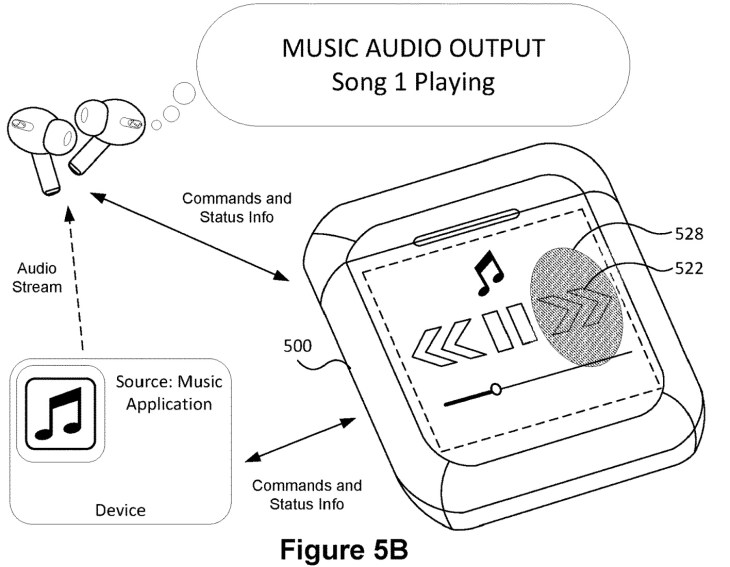
In a patent application published recently by the U.S. Patent Office, Apple sketched out such a device, a headphone-case-meets-pocket-computer with a touchscreen display and the prerequisite guts for flicking through songs, watching movies, peeping the weather or even navigating somewhere via a mapping app. Put another way, time is a flat circle and Apple invented the iPod all over again.
Judging by the filing, Apple sought to patent something reminiscent of a teensy iPod Touch or iPod Nano, but with a nook for charging a pair of wireless earbuds. This is only a patent application, which means there’s currently no (zilch! zero!) indication a supercharged AirPods case like this will exist beyond some doodles.
Sure, the company could be exploring such a device, given its wellestablished interest in smarter earbuds. However, Apple may simply wish to lay down some metaphorical roadblocks for the competition via this filing. In any case, an iPod renaissance? Sounds dreamy to me.
“The coolest thing about iPod is that you can take your entire music library with you, right in your pocket,” Apple co-founder Steve Jobs said millennia ago, in 2001. In the years since, everything and nothing has changed; music is arguably still the coolest thing about the iPhone, and it’s one reason why iPod nostalgia bubbles up time and time again — in the form of an unauthorized, iPod-inspired app; wistful tweets; a silly smartwatch accessory; movie cameos; letters to an editor; and so on.
The iPod is dead, but our great yearning for devices that do less? That lives on.

WWD : Hermès Inaugurates New Factory in Normandy

Hermès Inaugurates New Factory in Normandy
The Kelly bag will be a focus of the facility, which will also be the first outside of Paris to make saddles

PARIS — Hermès cut the equine-embossed ribbon on its newest leather goods factory on Friday, just days after its market cap soared past the 200 billion-euro mark.

“We’ve had good results this year,” chief executive officer Axel Dumas acknowledged during the symbolic cutting ceremony, slightly underplaying the stellar sales numbers. “This development allows us to open another leather workshop to create local jobs that export goods to the four corners of the world.”

The in-demand Kelly model will be the focus of its production, as well as being the only workshop outside of Paris that produces saddles. The new facility in Louviers, Normandy, sits two hours outside of the French capital.

Guillaume de Seynes, executive vice president, manufacturing division and equity investments, said the production of the popular Kelly depends on several factors and couldn’t quantify how many bags the Louviers facility will add to the tight supply.

“We never think about additional quantity, we think about the additional number of hours and then of course these hours can be used on five different models,” he told WWD. Each bag takes between 15 and 18 hours to make. All artisans first train on the Kelly model, as it brings together several complex processes, and can go on to specialize in other bags.

As the “quiet luxury” craze gets buzzier, Hermès continues to focus on its craftsmanship. The method of making a handbag is the same as it was 50 years ago, he said, limiting production to two or three bags per worker per week. It’s the opposite of fast fashion since a customer may have to wait months for a bag.

The company has been accused of artificially restricting supply, particularly on its most popular models, which Dumas denied during a call with analysts in February. “We are trying to produce as many as we can,” he said at the time.

De Seynes added that Hermès is hiring hundreds of people per year, but that it takes 18 months of training before an artisan hits the factory floor. “We are trying to increase the production, but we want to maintain the approach to quality that is for us absolutely essential,” he said. There are around 4,700 artisans in leather goods production at its various facilities in France, he added.

While other luxury goods companies have acknowledged issues with recruiting and hiring enough workers to fulfill demand, De Seynes said Hermès’ combination of training, education and commitment to hiring from all age ranges somewhat insulates them from hiring issues. However he acknowledged that “in some activities — not leather — we really have to convince people that we can be attractive.”

At Louviers, the new facility will employ 260 artisans in its airy 66,700-square-foot facility.

Designed by French Lebanese architect Lina Ghotmeh, the factory sits as a series of arches and wide windows to bring in light. The space is anchored by artwork from sculptor Emmanuel Saulnier. His structure of intertwined steel beams is meant to invoke sewing needles, a nod to craft. (The original iteration made out of glass shattered upon installation, depicted in a short film about the construction shown during the opening.)

Inside, artisans were on hand to show off their skills in cutting, sewing and finishing the bags, while rows of Kellys sat at a quality control station ready to be examined.

The factory sits on four hectares previously occupied by Philips, which had remained a brown site slated for environmental cleanup before it could be repurposed.

The new factory was constructed of 500,000 locally made bricks, and uses geothermal energy. It is also topped with 25,000 square feet of solar panels. The company says it’s “energy-positive,” meaning it puts more kilowatts back into the power grid than it uses.

The Louviers facility was built to be carbon-neutral, while the company is also working to decarbonize its existing plants by moving to wood or natural gas, said Olivier Fournier, executive vice president, corporate development and social affairs.

Fournier told WWD that the company is starting out with a lower carbon footprint than the other luxury groups due to its craftsmanship model. Hermès produces 78 percent of its products in France, and 65 percent are in made within its own workshops. Most other facilities are in close countries, with watches in Switzerland, for example.

“This gives us very good traceability because we have strong vertical integration regarding raw materials,” Fournier said. Again, most are sourced from France, with some coming from nearby nations, such as the Netherlands. Hermès keeps tight reigns on its supply chain. “It’s not a question of quantities, it’s a question of quality,” he said.

Though the company produces the majority of its goods in France, it is not untouched by global supply chain problems, de Seynes said. “In the case of silk, for example, [due to] the turmoil of the war and inflation, the time frame for investing in new capacities has been extended,” he said.

The company is finishing an extension of its silk facility in Lyon, which is now slated for opening in July. It is also expanding watchmaking capacity in Switzerland, while continuing to invest in tanneries and increase leather goods production. “We are looking at the process of increasing future capacities in every field — which is a good problem, but it is a problem,” De Seynes said of demand continuing to outpace supply.

“2022 was above all expectations,” he added. “There was growth in every division, so we need to invest in every activity and try to increase capacity.”

Producing more enamel is also in the cards. The tableware division “is doing extremely well, so we need to increase the facilities and invest in that activity,” he said. To that end, they are modernizing an existing site, the location of which has not been announced.

There are four other leather factories in the works, with two expected to open later this year and two additional facilities rolling out over the next two years.
CrunchBase : The Week’s 10 Biggest Funding Rounds: HeartFlow And Cybereason Lead

The Week’s 10 Biggest Funding Rounds: HeartFlow And Cybereason Lead Another Down Week

For the third week in a row, rounds were down noticeably in the U.S. Only two rounds hit nine figures — one in the health care AI sector and one to a company that has been in the news recently for layoffs and a possible sale. We wondered last week if this may have been an effect of the Silicon Valley Bank collapse, but perhaps there are more forces at play.

1. HeartFlow, $215M, health care: The use of AI for health diagnostics is front and center in the largest funding this past week to a heart precision care technology startup. The Mountain View, California-based company raised a $215 million Series F led by Bain Capital Life Sciences. Its noninvasive technology provides a 3D model to analyze the risk of a heart attack. The technology has been used so far by 180,000 patients across 725 hospital systems globally. Founded in 2010, HeartFlow has raised about $793 million, according to Crunchbase data.

2. Cybereason, $100M, cybersecurity: Times seem to have changed for Cybereason. The Boston-based startup raised a $100 million investment led by SoftBank, but also along with it announced a CEO change. Executive Vice President of SoftBank Eric Gan will now serve as the company’s CEO, with Lior Div, current CEO and co-founder, transitioning to the role of adviser. The news comes after reports in October that the company hired JPMorgan Chase & Co. to find a buyer for the company. It has been reported the company has had two rounds of layoffs, cutting 100 jobs in June and then another 200 in October. Just more than a year ago the company confidentially filed for an initial public offering that would have valued it at more than $5 billion, Reuters reported at the time. In July 2021, the startup announced it had raised $275 million in a financing led by Liberty Strategic Capital, the fund started by former U.S. Treasury Secretary Steven Mnuchin. No valuation was given by the company, but reports at the time in both the Globes newspaper in Israel and The Boston Globe said the round valued the company at about $3.1 billion. Cybereason is one of the best-funded startups in cybersecurity, with more than $800 million raised, per Crunchbase data. Now the question is: What will investors get for all that money?

3. Covariant, $75M, robotics: It’s one thing to have robots, it’s another thing to know how to train them or tell them exactly what to do. Emeryville, California-based Covariant added an additional $75 million to its Series C — previously $80 million — to do just that. The round was co-led by returning investors Radical Ventures and Index Ventures. The startup’s “Covariant Brain” is a robotics platform that enables robots to interact with and learn from their environments. The platform can be used by retailers and logistics providers for warehouse work. Founded in 2017, Covariant has now raised $222 million, per the company.

4. (tied) Everstream Analytics, $50M, logistics: Thanks to the pandemic and the snarled supply chain it caused, logistic startups saw a flood of funding in 2021, with over $21 billion invested into the space, according to Crunchbase data. That funding cooled last year, with around $11 billion invested, a 48% drop year over year. That, however, did not stop San Marcos, California-based supply chain startup Everstream Analytics from raising a $50 million Series B funding co-led by StepStone Group and Morgan Stanley Investment Management. The company, which was founded in 2012, provides risk performance insights in the world of logistics. It works with the various touchpoints of the supply chain system to improve efficiency. The startup has now raised $79 million, per Crunchbase.

4. (tied) Honeycomb, $50M, developer tools: Engineers depend more and more on observability tools to understand what goes wrong as the cloud environment gets more complex. That likely helped San Francisco-based Honeycomb lock up a $50 million Series D led by Headline this week. The startup has doubled its revenue — and headcount — in the past year, as engineering teams continuously seek data on how users are using applications in real time. Founded in 2016, Honeycomb says it has raised $150 million to date.

6. Mercy BioAnalytics, $41M, biotech: The promise of early diagnosis of cancer will always bring out investors, and this week Natick, Massachusetts-based Mercy BioAnalytics closed a $41 million Series A led by Novalis LifeSciences. The new cash will be used to further develop its Mercy Halo test for high-risk lung cancer screening. Lung cancer is the leading cause of cancer death globally — and more than 350 Americans die from lung cancer daily, per the company’s release. The company also hopes to advance clinical programs to detect ovarian cancer. Founded in 2018, the company has raised more than $68 million, according to Crunchbase data.

7. Phlow, $35M, health care: Richmond, Virginia-based Phlow is a public benefit corporation that manufactures affordable medicines using advanced technology. It raised a Series B funding from strategic partners. The company partners with hospitals, industry and the government to provide needed medicines in the U.S. Founded in 2020, the company has raised a little over $80 million, per Crunchbase.

8. Richmond National Group, $30M, insurance: Richmond, Virginia-based Richmond National Group, a property, casualty and professional liability insurance company, raised more than $30 million from existing shareholders including HF Capital and Bonhill Capital. Founded in 2021, Richmond National has now raised more than $100 million, per the company.

9. Oxos Medical, $23M, medical devices: Atlanta-based Oxos Medical, a developer of digital imaging devices, closed a $23 million Series A from Parkway Venture Capital and Intel Capital. Founded in 2016, Oxos has raised a total of $45 million, per the company.

10. (tied) Strivacity, $20M, cybersecurity: Herndon, Virginia-based cybersecurity startup Strivacity raised $20 million in a Series A2 led by SignalFire. Founded in 2019, the company has raised more than $30 million, according to Crunchbase.

10. (tied) Vytelle, $20M, agtech: Lenexa, Kansas-based Vytelle, a startup that helps cattle producers optimize their herds, raised a $20 million Series B led by Forage Capital Partners. Founded in 2015, the company has raised more than $33 million, per Crunchbase.

Barrons : Banks Will Merge. Where to Find Winners.

Banks Will Merge. Where to Find Winners.

With the best-case scenario for bank stocks this earnings season being the proverbial “better than feared,” investors may want to ponder what the industry will look like in the future to find today’s opportunities. Here’s a hint: Expect a wave of consolidation after there’s a bit more distance from last month’s collapse of Silicon Valley Bank and Signature Bank.

It’s long been said that the U.S. is overbanked compared with the rest of the world. We lead with 4,135 banking institutions, according to the Federal Deposit Insurance Corp. The United Kingdom comes in a distant second with 311, and the remainder of the top 25 countries have between 64 and 251 banks. Even on a per capita basis, the U.S. stands near the top, with 12.8 banks per million people, lagging only financial megacenters such as Luxembourg, Switzerland, Singapore, and Hong Kong.

While banking consolidation has been a decadeslong trend in the U.S.—there were 14,434 U.S. banks in 1980—Wall Street expects that the pace of mergers will soon accelerate as the costs of running a small bank are expected to soar thanks to the likelihood of more regulation.

“Banks are a commoditized product. It’s a cost game,” Mark Fitzgibbon, a research head at Piper Sandler , tells Barron’s. “With the overlay of the cost of regulation, there is downward pressure on profitability.”

Since the failure of Silicon Valley Bank and Signature Bank, everyone from Wall Street to Washington has wondered if greater regulatory scrutiny—similar to what JPMorgan Chase JPM –0.11% (ticker: JPM) and Bank of America BAC +0.72% (BAC) have to endure—would have prevented the smaller banks’ demise.

In his annual letter to shareholders this past week, JPMorgan CEO Jamie Dimon said he expects “some changes to the regulatory system,” while saying “knee-jerk,” “politically motivated” responses should be avoided. Sen. Elizabeth Warren (D., Mass.) has pushed for more regulation, including reversing a bill from the Trump administration that lowered the oversight for medium-size banks. In an interview with CNBC, she said that banks should be “boring.”

For investors, boring means less profits, which is why smaller banks will likely band together in hopes that greater scale will mitigate the costs of higher capital requirements and dealing with other regulations. For now, Fitzgibbon expects that bank merger activity will be tepid, as banks will want to make sure that their own houses are in order before acquiring others. Any mergers that do happen over the next few months will likely be situations of distress, such as New York Community Bancorp’s (NYCB) and First Citizens Bancshares ’ (FCNCA) respective acquisitions of Signature and SVB.

While the typical investor playbook for M&A leads investors to seek likely targets, Fitzgibbon suggests a “buy the good buyers” approach. With the SPDR S&P Regional BankingKRE +1.48% exchange-traded fund (KRE) down 27% this year, many banks are looking like bargains, making it difficult to distinguish which ones are likely takeover targets. Instead, it makes sense to look at banks that have a good track record with their previous acquisitions and balance sheets that will allow them to be flexible in this environment.

Fitzgibbon and his team like M&T Bank ( MTB ), New York Community, Old National Bancorp (ONB), Prosperity Bancshares (PB), and Truist Financial (TFC). All have outperformed the index—and trade well above tangible book value—and offer dividend yields in excess of 3.5%.

If the prospect of consolidation years from now isn’t enticing enough for investors, they should pay close attention to earnings season, which starts on April 14 with JPMorgan, Wells Fargo WFC +2.74% (WFC) and Citigroup C +0.20% (C) and continues later this month with regionals like Western Alliance Bancorp (WAL) and Regions Financial (RF). This quarter, it will be the health of the banks’ balance sheets and not their bottom line that will be getting Wall Street’s attention.

Analysts at Keefe, Bruyette & Woods are taking an average 8% haircut to earnings forecasts for 2023 and 11% for 2024, expecting to see narrowing net interest margins along with higher expenses and fewer buybacks as banks hold on to capital.

But even with lowered forecasts, some analysts are of the mind that many of the sector’s weaknesses are already priced in and the risk/reward for many banks actually looks favorable.

“Sentiment in recent weeks has been abysmal, and market participants seem to be pricing in permanent profitability destruction, which we think is unlikely,” wrote Baird analyst David George.

If true, it could be a good time for investors and acquirers alike.

Barrons : Saudi Arabia Is About Much More Than Oil. Pizza, Toll Roads, and Other

Saudi Arabia Is About Much More Than Oil. Pizza, Toll Roads, and Other Stocks to Play.

OPEC showed it still matters in oil markets this past week, pushing crude prices up more than 5% by announcing a one million barrel-a-day output cut. Its core Middle Eastern members increasingly count in equity markets, too.

Saudi Arabia entered MSCI’s global emerging market indexes in June 2019. Since then, the iShares MSCI Saudi ArabiaKSA +0.28% exchange-traded fund (ticker: KSA) has gained 20% while global emerging markets are flat.

That’s not just about oil. Six of the top 10 Saudi stocks are banks, which benefit from a large base of zero-interest deposits thanks to Islamic Sharia law. Most of their assets are floating-rate corporate loans, which has spelled soaring profits as interest rates rise, says Dipanjan Ray, head of global equities research at Emirates NBD Asset Management. A pegged currency protects that bottom line in dollar terms.

Crown Prince Mohammed bin Salman’s drive to liberalize Saudi society has extended to capital markets that formerly kept global capital out. “They’ve executed on a plan to transform the stock market by making foreigners welcome,” says David Aserkoff, J.P. Morgan’s regional equity strategist.

Neighboring leaders have followed suit. That’s led to a flood of initial public offerings, and broader portfolio choices. Last year smashed all records, with 51 IPOs raising $22 billion across the Middle East. “It’s a bit like a gold rush now,” says Emre Akcakmak, a Dubai-based senior consultant to emerging markets investor East Capital. “The region emerged as a winner after Covid.”

Investors won’t find treasure under every rock. The Saudi index fell by a quarter last May to December as oil prices cooled and markets looked toward the end of the global tightening cycle driving bank profits. Some new market entrants shone nonetheless.

Shares in Saudi payments processor Elm (7203.Saudi Arabia) have doubled since an IPO in February 2022. Arabian Internet & Communications Services (7202.Saudi Arabia), a spin-off from state-owned Saudi Telecom, has gained 40% since hitting markets in late 2021.

Americana Restaurants (6015.Saudi Arabia), the regional franchisee for KFC and Pizza Hut, is up by a third since going public last December. Dubai-based toll road operator Salik (SALIK.United Arab Emirates) has climbed by a quarter since October.

“This is a very young market on the consumer side, with some very interesting companies going public,” Akcakmak says.

Oil is not irrelevant for any Middle Eastern stock. “Oil lubricates the non-oil economy,” says Tarek Fadlallah, CEO of Nomura Asset Management, Middle East. “The correlation between stock and oil prices remains high.”

But the region may be catching structural tailwinds beyond petroleum cycles. Saudi Arabia could be in line for a world-class “demographic dividend,” with a median age below 30. (The U.S. figure is 38.5.) The surge of women heading into the workforce following bin Salman’s reforms provides an extra economic charge.

Global interest rate expectations are shifting toward higher for longer, a potential boon for those banks that get so many of their deposits for free. Most surprisingly, after half a century as the world’s presumed powder keg, the Middle East could be tacking toward stability, while U.S.-China tensions roil East Asia. Foreign ministers from Saudi and archrival Iran met in Beijing this week, building on a surprise agreement to restore diplomatic relations.

“I’m always seeing new faces at the investment conferences,” Emirates NBD’s Ray says. “Sooner or later, they’ll become investors.”

Keep it in mind.

FT : Hydrogen: pipe dream of domestic supply would be blender extender

Hydrogen: pipe dream of domestic supply would be blender extender
A national distribution system for hydrogen would give producers the chance to invest in at-scale facilities

It takes a lot of effort to make clean hydrogen. So it seems like an odd idea to then shove it back into gas pipelines, mixed with fossil fuel, to burn in boilers or power stations. So-called blending has plenty of drawbacks — but one big potential upside.

Developed nations have extensive gas supply networks. Cutting methane with hydrogen allows the latter to be deployed quickly at scale. Gas suppliers can mix in a modest amount of hydrogen — say 10 to 20 per cent — without requiring pipe or appliance upgrades.

A small UK pilot scheme operated successfully last year. Portugal is set to tender for blended gas supplies later this year.

The biggest bugbear is cost. In the future, “green” hydrogen from electrolysis might cost less than $1 per kilogramme, or $25 per megawatt-hour. But in the UK today it costs about $10/kg or $250/MWh. “Blue” hydrogen — from gas with carbon capture — costs about $4/kg.

Blended hydrogen would be sold for the price of accompanying fossil fuel, about €50/MWh in Europe at the moment, plus the carbon price industrial and power generation customers would avoid paying. That carbon price would be equivalent to less than €2/MWh. That would leave the input cost much higher than charges to recoup it.

Rationale is another stumbling block. Hydrogen is seen as a primarily industrial fuel, not a method of heating homes.

That leaves the argument looping back to blended hydrogen’s single strength: easy deployment. If hydrogen filled 10 per cent of the UK grid, it would be equivalent to about 70 terawatt-hours of hydrogen a year.

Making hydrogen in tiny distributed plants for small-scale uses will always be expensive. But a national distribution system would allow producers to invest in at-scale facilities, driving down costs.

Governments should see blended hydrogen as an adjunct to natural gas in their plans to transition to zero carbon. When they switch off the gas, hydrogen supplies would divert to industrial use and energy storage.

FT : UAE refuses to extradite two Gupta brothers to South Africa

UAE refuses to extradite two Gupta brothers to South Africa
Atul and Rajesh Gupta are wanted by Pretoria for alleged fraud and money laundering

The United Arab Emirates has refused to extradite two members of the Gupta family to face accusations of systematic looting of the South African state over the past decade.

The denial by a UAE court of the request from South Africa to extradite Atul and Rajesh Gupta, who are wanted by Pretoria for alleged fraud and money laundering and were arrested in the UAE last year, was “shocking” and “inexplicable”, South Africa’s justice minister Ronald Lamola said on Friday.

The UAE government notified South African authorities on Thursday that the court had ruled in February that the Guptas could not be handed over despite an extradition treaty between the two nations, Lamola added.

“We have complied with every letter of the extradition treaty between ourselves and the UAE . . . that’s why we are bemused by this judgment that cites technicalities,” said Lamola. UAE authorities would have to file any appeal on South Africa’s behalf, he added.

The refusal deals a major blow to South Africa’s efforts under President Cyril Ramaphosa to seek justice for the country’s biggest post-apartheid scandal — the so-called capture of the state under his predecessor, Jacob Zuma, for the alleged benefit of businesses controlled by the Guptas.

A landmark South African judicial inquiry concluded last year that Zuma “readily opened the doors” for the trio of brothers to loot the Eskom state electricity monopoly, which is now stricken with regular rolling blackouts, and other resources with the connivance of the ruling African National Congress.

The Guptas fled South Africa and their mining-to-media empire collapsed when Zuma fell from power in 2018. The Guptas and Zuma have always denied any wrongdoing.

Atul and Rajesh Gupta were arrested in the UAE in June last year after they were placed on Interpol’s red notice list over a case in South Africa.

At the time, the arrest was a major boost for the anti-corruption battle under Ramaphosa, which had been making slow progress with prosecutions. South Africa had been seeking the brothers’ extradition since July 2022.

The UAE said in a statement that the Dubai court of appeal had rejected the extradition request for Atul and Rajesh Gupta because it “did not meet the strict standards for legal documentation” in the extradition treaty.

The UAE received the extradition file in November after several meetings with South African authorities and the request was referred to public prosecution for investigation, the statement added. After three hearings, the court of appeal decided that the two men could not be handed over.

“At every step, UAE judicial authorities briefed their South African counterparts on proceedings,” the statement said. The South African authorities could resubmit the extradition request, it added.

The UAE court ruling indicated that the Guptas, who were born in India, are citizens of Vanuatu, the South Pacific island nation, said Lamola. Vanuatu is one of a number of countries that offer so-called golden visas, which provide citizenship in exchange for inward investment.

Africa Intelligence reported this week that the Guptas had been seen in Switzerland, despite officially being in custody in the UAE. The South African justice ministry said it did not have information on the report.

Atul and Rajesh Gupta could not be reached for comment.

TechCrunch : Anthropic’s $5B, 4-year plan to take on OpenAI

Anthropic’s $5B, 4-year plan to take on OpenAI
Anthropic plans to train a powerful model with billions in new funding

AI research startup Anthropic aims to raise as much as $5 billion over the next two years to take on rival OpenAI and enter over a dozen major industries, according to company documents obtained by TechCrunch.

A pitch deck for Anthropic’s Series C fundraising round discloses these and other long-term goals for the company, which was founded in 2020 by former OpenAI researchers.

In the deck, Anthropic says that it plans to build a “frontier model” — tentatively called “Claude-Next” — 10 times more capable than today’s most powerful AI, but that this will require a billion dollars in spending over the next 18 months.

When contacted for comment, an Anthropic spokesperson said: “We are planning additional product announcements and will be talking about them soon.”

The Information reported in early March that Anthropic was seeking to raise $300 million at $4.1 billion valuation, bringing its total raised to $1.3 billion. The deck confirms that target number, though only half was raised at the time of the document’s creation from a “confidential investor.”

Anthropic describes the frontier model as a “next-gen algorithm for AI self-teaching,” making reference to an AI training technique it developed called “constitutional AI.” At a high level, constitutional AI seeks to provide a way to align AI with human intentions — letting systems respond to questions and perform tasks using a simple set of guiding principles.

Anthropic estimates its frontier model will require on the order of 10^25 FLOPs, or floating point operations — several orders of magnitude larger than even the biggest models today. Of course, how this translates to computation time depends on the speed and scale of the system doing the computation; Anthropic implies (in the deck) it relies on clusters with “tens of thousands of GPUs.”

This frontier model could be used to build virtual assistants that can answer emails, perform research and generate art, books and more, some of which we have already gotten a taste of with the likes of GPT-4 and other large language models.

“These models could begin to automate large portions of the economy,” the pitch deck reads. “We believe that companies that train the best 2025/26 models will be too far ahead for anyone to catch up in subsequent cycles.”

The frontier model is the successor to Claude, Anthropic’s chatbot that can be instructed to perform a range of tasks, including searching across documents, summarizing, writing and coding, and answering questions about particular topics. In these ways, it’s similar to OpenAI’s ChatGPT. But Anthropic makes the case that Claude is — thanks to constitutional AI — “much less likely to produce harmful outputs,” “easier to converse with” and “more steerable.”

Anthropic released Claude commercially in March following a closed beta late last year, allowing around 15 partners initial access. It counts among its beta users and potential customers the following industries (with the asterisk indicating that a human is in the loop to supervise the model):

  • Legal document summary and analysis*
  • Medical patient records and analysis*
  • Customer service emails and chat
  • Coding models for consumers and B2B
  • Productivity-related search, document editing and content generation*
  • Chatbot for public Q&A and advice
  • Search employing natural language responses
  • HR tasks like job descriptions and interview analysis*
  • Therapy and coaching
  • Virtual assistants*
  • Education at all levels*

Dario Amodei, the former VP of research at OpenAI, launched Anthropic in 2021 as a public benefit corporation, taking with him a number of OpenAI employees, including OpenAI’s former policy lead Jack Clark. Amodei split from OpenAI after a disagreement over the company’s direction, namely the startup’s increasingly commercial focus.

Anthropic now competes with OpenAI as well as startups like Cohere and AI21 Labs, all of which are developing and productizing their own text-generating — and in some cases image-generating — AI systems.

“Anthropic has been heavily focused on research for the first year and a half of its existence, but we have been convinced of the necessity of commercialization, which we fully committed to in September [2022],” the pitch deck reads. “We’ve developed a strategy for go-to-market and initial product specialization that fits with our core expertise, brand and where we see adoption occurring over the next 12 months.”

The pitch deck reveals that Alameda Research Ventures, the sister firm of Sam Bankman-Fried’s collapsed cryptocurrency startup FTX, was a “silent investor” in Anthropic with “non-voting” shares — responsible for spearheading Anthropic’s $580 million Series B round. Anthropic expects Alameda’s shares to be disposed of in bankruptcy proceedings within the next few years.

Google is also among Anthropic’s investors, having pledged $300 million in Anthropic for a 10% stake in the startup. Under the terms of the deal, which was first reported by the Financial Times, Anthropic agreed to make Google Cloud its “preferred cloud provider” with the companies “co-develop[ing] AI computing systems.”

Other Anthropic backers include James McClave, Facebook and Asana co-founder Dustin Moskovitz, former Google CEO Eric Schmidt and founding Skype engineer Jaan Tallinn.