(ZH) Inside The Credit Crunch: Biggest Drop For Small Business Credit Availabili

Inside The Credit Crunch: Biggest Drop For Small Business Credit Availability In Over 20 Years

Over the weekend we reported that the credit crunch had entered the crash phase when we showed that in the last two weeks of April, a record $105 billion in commercial bank loans and leases were either sold, discharged or otherwise transferred from bank balance sheets...
... and we followed that up by showing that the bulk of loan declines was due to Small bank real estate loans, a clear indicator that the commercial real estate collapse was starting to impact bank solvency (something we warned about one month ago).
Yet while credit was clearly collapsing at the fastest pace in years, until we get the Fed's next SLOOS report it would be very difficult to answer the next key question: was this credit plunge the result of falling demand, or supply... or both?
It was therefore a stroke of luck that today's NFIB's latest Small Business Optimism report hit (it showed a modest drop from 90.9 to 90.1, just above the consensus estimate of 90.1), providing some key insight into where exactly the credit plumbing was clogged.
The report was rather gloomy and downbeat as has been the case for much of Biden's tenure, marking the 15th consecutive month below the 49-year average of 98 with 24% of owners reporting inflation as their single most important business problem, and a net negative 47% of small business owners expecting better business conditions over the next six months (so not really), which in turn is hammering hiring plans.
“Small business owners are cynical about future economic conditions,” said NFIB Chief Economist Bill Dunkelberg. “Hiring plans fell to their lowest level since May 2020, but strong consumer spending has kept Main Street alive and supported strong labor demand.”
But what we found most notable in the context of the credit crunch is how difficult it was for small US businesses to obtain a loan in March after multiple bank failures led to a further tightening of credit conditions. According to the NFIB, a net 9% of owners who borrowed frequently said financing was harder to get compared to three months earlier, the most since December 2012. Worse, the 4 point monthly drop in the series was the biggest collapse in credit availability in more than 20 years.
The same share expects tougher credit conditions in the next three months, matching the highest level in a decade and confirming that the credit crisis is only just starting, at least when small businesses are asked how they perceive coming supply or the lack thereof.
Adding insult to injury, some 26% of owners who borrow said they paid a higher interest rate in March compared to three months earlier, the biggest share since 2006.
Hilariously, even though credit is getting a bit more difficult, it ranks well below inflation and quality of labor as the single biggest problem for small businesses. So Biden and his central bank are damned if they keep fighting inflation - as credit conditions now mean a collapse in growth - and damned if they focus on rebooting credit growth instead, which in turn would lead to a fresh burst in inflation.
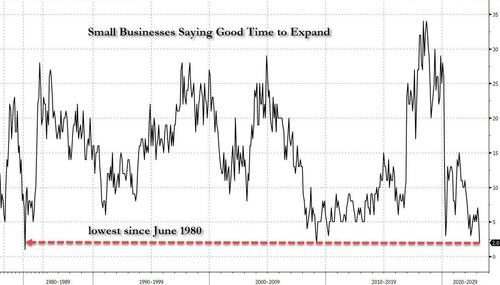
Bottom line: the politically-charged NBER may not admit it yet - after all there are presidential elections coming up in the not too distant future - but for all intents and purposes the credit crunch is here... and so is the recession, which is why just 2% of small businesses said it it was a good time to expand, the lowest in over 20 years. The last time we saw a lower print: June 1980.

FT : SoftBank’s Masayoshi Son set to sign off on Nasdaq listing for Arm

SoftBank’s Masayoshi Son set to sign off on Nasdaq listing for Arm
Billionaire chief takes first formal step to put in motion New York IPO of UK-based chip designer

SoftBank chief Masayoshi Son will this week sign off on an agreement with Nasdaq to list chip designer Arm, setting in motion a blockbuster initial public offering as early as this autumn.

According to two people familiar with the situation, the Japanese investment group and New York exchange reached a tentative agreement over Arm’s proposed listing on Monday, with Son expected to sign off officially later this week.

The move represents the first formal step in the IPO process, as SoftBank continues to work towards submitting filing documents for Arm. That would end speculation over Son’s plans for the Cambridge-based company after a deal to sell it to rival Nvidia collapsed in early 2022.

SoftBank and Arm declined to comment.

Son recently stepped back from front-line management of SoftBank’s other investment activities to concentrate on the turnround and float of Arm.

Long-term holders of SoftBank stock in the US, Japan and UK say they continue to wrestle with a realistic valuation of Arm, which SoftBank bought for £24.3bn in 2016.

Investors said that given the difficulty of directly comparing Arm with any other company, and of knowing whether Son has yet hit on a formula to make the company more profitable, a realistic valuation could be as low as $30bn or as high as $70bn.

People close to SoftBank had previously identified Goldman Sachs, JPMorgan and Mizuho Securities as those likely to be selected to run the IPO process, though the final list is expected to draw in other global investment banks.

Those familiar with the Nasdaq agreement said the proposal, as it stood, did not envisage Arm being dual-listed on another exchange.

Efforts by London to secure a dual or secondary listing for Arm have involved direct interventions from the most senior tiers of the UK government, including Prime Minister Rishi Sunak.

The success of the IPO will be critical for SoftBank to engineer a turnround as analysts expect the group to log two straight years of losses when it reports its results next month.

To bolster its balance sheet, the highly leveraged conglomerate has sold shares in Chinese ecommerce group Alibaba, but the valuation of its technology investments have continued to suffer amid a global tech rout and rising interest rates.

Ahead of the IPO, Son has focused on revamping Arm’s business model to drive up its profits. The Financial Times reported last month that Arm was seeking to raise prices for its chip designs in one of the biggest shake-ups to its business strategy in decades.

FT : Glencore offers $8.2bn cash sweetener in takeover bid for Teck

Glencore offers $8.2bn cash sweetener in takeover bid for Teck
Mining group’s proposal comes a day after Teck chief described deal as a ‘non-starter’

Glencore has added a cash sweetener to its hostile takeover bid for Teck Resources as it tries to woo the Canadian miner, whose chief reiterated the board’s rejection of the deal.

Under the revised proposal, the FTSE 100 mining group has offered to pay a cash element that could amount to $8.2bn to buy Teck shareholders out of their stake in a coal-focused spin-off, while also granting them a 24 per cent stake in a separate industrial metals business that would be created off the back of the deal.

The revised offer allows investors to choose cash instead of shares or a combination of both in the coal spin-off and the valuation of the total proposal remains the same as the original bid at almost $23bn.

“Glencore acknowledges that certain Teck investors may prefer a full coal exit and others may not desire thermal coal exposure,” it said in a statement.

Teck said that it will evaluate the new proposal, adding that it “does not provide an increase in the overall value to be received by Teck shareholders or appear to address material risks previously raised”.

The revised offer comes just a day after Teck chief executive Jonathan Price told the FT that the deal was a “non-starter”.

Glencore’s original proposal was to buy Teck for a 20 per cent premium to its share price on March 26 in an all-share transaction.

A takeover of Teck would lead to a vast reshaping of Glencore’s business. The Swiss company would create “MetalsCo” — a combination of Teck’s copper and zinc mines in the Americas with its own portfolio of metal mines and oil trading business — and “CoalCo” — putting Teck’s steelmaking coal assets together with its thermal coal and ferroalloys mines.

Teck has a shareholder vote scheduled for April 26 on its own plans to split into a steelmaking coal business and a metals company, which Glencore urged the Canadian group’s board to delay in order to engage with its proposal.

“We believe that it is in your shareholders’ interests to engage with Glencore and we see no valid reason not to delay your shareholders meeting,” Nagle wrote in a letter to Teck’s board.

The offer — the largest made by Glencore since buying Xstrata in 2013 — marks one of the biggest takeover battles launched by a London-listed company in recent years, in addition to a return to dealmaking for the mining industry that has focused on returns for a decade.

The revised offer represents a bold move by chief executive Gary Nagle to simultaneously increase the company’s exposure to vital commodity copper and address longstanding shareholder concerns over the company’s exposure to coal.

However, the dual-class share structure of Teck hands effective acceptance of Glencore’s proposal to the family of 85-year-old mining magnate Norman Keevil, which owns the majority of class A supervoting shares, each worth 100 votes.

Keevil, who is now chair emeritus of the company, has said that he would not sell to Glencore regardless of the price.

Tyler Broda, analyst at RBC, said that the speed of the revised bid showed “how serious Glencore management are on the merits of this transaction” and the cash component addresses some key concerns raised by Teck’s management team. “We would expect that there would be increasing probability of [Class] B share investors calling for proper engagement,” he said.

FT : KKR takes 29% stake in public relations group FGS Global

KKR takes 29% stake in public relations group FGS Global
Minority investment values WPP-backed communications company at about $1.43bn

Private equity firm KKR has acquired a 29 per cent stake in FGS Global, marking the latest investment by a buyout group into the niche sector of communications focused on providing strategic and crisis advice to corporations and executives.

The minority investment values the WPP-backed financial communications company at about $1.43bn, confirming an earlier Financial Times report.

Following the investment, WPP will remain the majority shareholder in FGS, the advertising group announced, allowing it to continue consolidating the group’s accounts. FGS shareholder Golden Gate Capital will sell the entirety of its 6 to 7 per cent stake in the deal.

“Stakeholder engagement is a boardroom issue and we are today establishing a powerful strategic partnership between WPP and KKR to support FGS Global,” said KKR’s co-head of European private equity Philipp Freise.

FGS has been formed over the past few years through the merger of three communications and lobbying companies controlled by UK-listed WPP. Those groups — London-based Finsbury, Frankfurt-based Hering Schuppener and Washington, DC-based Glover Park Group — agreed to merge in 2020.

The trio bought US-based Sard Verbinnen a year later to take on their biggest competitors. Rivals to FGS include US-listed FTI Consulting as well as privately held Teneo, which is controlled by private equity company CVC, and Brunswick Group, which has also received outside investment.

FGS is led by its chair Roland Rudd, a Briton who founded Finsbury in 1994, and chief executive Alexander Geiser, a German-Canadian who joined Hering Schuppener in 1998. It employs 1,300 people and has about 200 partners.

The firm’s senior leadership and partners previously owned about 36 per cent of the company, and were expected to sell almost half of their collective stake. The deal values FGS at about 15 times this year’s earnings before interest, taxes, depreciation and amortisation.

Under the terms of the roll-up of groups, FGS was aiming for an initial public offering by 2024. The investment from KKR is likely to postpone that target.

Globally, FGS topped its competitors as the lead public relations business last year for mergers and acquisitions based on deal volume and value, advising on 322 deals with a total value of more than $657bn in 2022, according to Mergermarket.

Some of FGS’s biggest clients include EY, UnitedHealth, Bayer and SoftBank. KKR has been a longstanding client of FGS.

This deal comes amid a recent bout of consolidation in the financial communications industry.

CVC-owned Teneo acquired its smaller UK rival Tulchan for more than £65mn earlier this year. US public affairs company APCO Worldwide last month acquired London-based financial communications company Camarco in a deal worth about £20mn.

US-listed KKR said last week that it had closed its largest European fund and raised $8bn. That new vehicle will provide financing for this deal.

Shares of WPP have traded down about 6 per cent over the past year, underperforming peers even as the group defies fears of an advertising slowdown.

The transaction is expected to close before the end of the third quarter of this year.

Vogue : Fan de vintage ? 250 pièces Hermès sont mises aux enchères

Fan de vintage ? 250 pièces Hermès sont mises aux enchères
Rendez-vous du 12 au 18 avril pour l'incontournable vente aux enchères Hermès Vintage signée Artcurial.

Artcurial donne rendez-vous aux inconditionnels de belles pièces pour sa nouvelle vente aux enchères Hermès Vintage. Et pour satisfaire tous ses fidèles, l'événement se tiendra, une fois de plus, en ligne. Il mettra à l'honneur le savoir-faire de la maison de maroquinerie de luxe en présentant un éventail de créations des années 1950 à aujourd'hui.

Birkin, Constance… Si les sacs iconiques de la maison seront largement représentés, la vente sera également l'occasion de découvrir l’art de vivre Hermès avec une multitude d'objets divers. Elle présentera aussi une sélection pointue de vêtements et de chaussures. Et, pour les amateurs de jolies pépites, entre deux Kelly 32, il leur sera possible de mettre la main sur quelques bijoux et montres. Pour celles et ceux qui rêvent de s'offrir un de ces véritables objets de désir qui traversent les décennies, la vente Hermès Vintage Artcurial est un rendez-vous à ne pas manquer !

WSJ : China Lays Out Strict Rules for ChatGPT-Like AI Tools

China Lays Out Strict Rules for ChatGPT-Like AI Tools
Proposals come as Alibaba, Huawei, other Chinese companies rush to offer AI-powered services

SINGAPORE—China’s top internet regulator proposed rules Tuesday to control artificial-intelligence tools similar to ChatGPT, putting it at the forefront of efforts by governments worldwide to tame the new technology amid concerns over the challenges it poses.

The rules come as the country’s top technology companies push ahead with plans to integrate the nascent technology into their services.

The Cyberspace Administration of China will require companies to go through a government security review before providing such services and make companies responsible for the content their AI services generate, according to a draft of the rules. Content generated by such services shouldn’t contain elements that could subvert state power, incite secession or disrupt social order, the rules state.

The proposals show China’s leaders want to maintain a strong hand in regulating new technology even as it eases up on a two-year crackdown on the country’s internet companies.

Governments around the world are discussing whether and how to govern the new wave of generative AI tools, with some of the world’s leading tech figures warning they could be used to spread harmful information or discriminate. In the U.S., the Biden administration has begun examining whether checks need to be placed on the tools. Italy temporarily banned ChatGPT, saying the AI chatbot has improperly collected and stored information.

The Chinese regulator’s announcement came the same day that Alibaba Group Holding Ltd. BABA -1.25% rolled out its large language model, called Tongyi Qianwen, which it plans to integrate across products including its search engine and voice assistant, as well as entertainment and e-commerce.

A day earlier, SenseTime Group Inc., 20 -0.90% best known for surveillance products such as facial-recognition systems, launched a ChatGPT-like service, SenseChat, and a cluster of apps based on its large AI model system SenseNova. Huawei Technologies Co. on Saturday said it has rolled out services based on Pangu, a collection of large AI models that it has been developing since 2019, to enterprise clients in industries including finance, pharmaceuticals and meteorology.

While Chinese tech companies have said their AI products still lag behind OpenAI’s ChatGPT, which is unavailable in the country, they are pushing to develop their own versions of the technology. Generative AI could open new revenue opportunities for them after the internet sector was battered in recent years by tighter regulatory oversight and a sluggish economy.

The companies have to navigate through constraints including U.S. curbs on them buying advanced chips that are required for training AI models, as well as China’s rigid censorship policies.

China’s proposed rules are more detailed than general guidelines that are being discussed in other jurisdictions, said You Chuanman of the Chinese University of Hong Kong, Shenzhen, who specializes in tech regulation and global governance. China’s rules would include a prohibition on profiling users and impose strict controls on AI-generated content, which could jeopardize innovation as China battles the U.S. in developing advanced technologies, he said.

“AI is a challenge for global governance,” Dr. You said. “Governments from different countries should work together to deliver a global standard.”

According to the draft rules, companies would be responsible for protecting users’ personal information, while data that developers use to train their AI products should be compliant with Chinese laws.

China’s censorship rules not only restrict the content AI could produce but limit the materials Chinese developers can use to train their products to a much smaller pool than their foreign rivals, industry observers say.

China’s internet regulator didn’t state when the rules, which are open for public consultation until May 10, would be rolled out.

Last month, China’s search-engine company Baidu Inc. BIDU -0.87% became the country’s first internet company to launch an AI-powered chatbot, Ernie Bot.

More Chinese tech companies have followed, seeking to commercialize AI technologies that have cost hundreds of millions of dollars to develop.

Alibaba has been building its own large language models since 2019 and last September launched its proprietary system Tongyi that groups together several generative AI models.

It will first integrate Tongyi Qianwen, which translates as “thousands of questions for universal truths,” into its workplace messaging app DingTalk. It could be used to summarize meeting notes as well as draft emails and business proposals. The AI model will also be embedded into Alibaba’s voice assistant Tmall Genie, including being able to provide recipes and offer travel tips, it said.

Alibaba’s chatbot is able to generate text, lines of computer code and do mathematics, but hasn’t allowed users to produce pictures yet. Alibaba said it is capable of handling tasks in both Chinese and English.

During a live demonstration Monday, SenseTime’s chatbot, designed to mainly handle Chinese-language questions, was able to produce text, computer code and images. The company also used the service to summarize academic papers and offer medical advice. Hong Kong-based SenseTime is backed by Alibaba and SoftBank Group Corp.

“Having a model itself isn’t sufficient,” said Boris Van, an analyst at Bernstein Research, referring to Chinese tech companies’ AI efforts more generally. “You need to have products and applications to incorporate the model and use the model to deliver actual things that customers want.”

(ZH) US Is Spying On Zelensky: Here's What's Known So Far From The Leaked Intell

US Is Spying On Zelensky: Here's What's Known So Far From The Leaked Intelligence Files

US Is Spying On Zelensky: Here's What's Known So Far From The Leaked Intelligence Files

The highly classified Pentagon documents which were leaked online in recent weeks, but which began being confirmed and reported as authentic by The New York Times and others only in the past few days, contain some embarrassing revelations. This has sent DOJ and US intelligence officials scrambling to discover the source of the leaks.
CNN is confirming Monday based on one of the documents which appeared online that the US has been spying on Ukrainian President Vladimir Zelensky - a disclosure which has caused officials in Kiev to be "deeply frustrated".
"One document reveals that the US has been spying on Zelensky," CNN reports. "That is unsurprising, said the source close to Zelensky, but Ukrainian officials are deeply frustrated about the leak."
The US intelligence document suggests that American officials have been worried about possible Zelensky decision-making to strike deep into Russian territory, which would escalate the war and potentially bring Russian and NATO into direct clashes:
The US intelligence report, which is sourced to signals intelligence, says that Zelensky in late February "suggested striking Russian deployment locations in Russia’s Rostov Oblast" using unmanned aerial vehicles, since Ukraine does not have long-range weapons capable of reaching that far.
An additional possibility is that the US intelligence community might be monitoring the Ukrainian presidency's office as part of efforts to oversee and account for how the tens of billions in aid sent to Kiev is being utilized.
The Washington Post details that "many of the documents seem to have been prepared over the winter for Gen. Mark A. Milley, chairman of the Joint Chiefs of Staff, and other senior military officials, but they were available to other U.S. personnel and contract employees with the requisite security clearances."
Here are 14 more major revelations contained within the leaked intel document trove based on various media sources:
  • Locations of CIA recruitment efforts focused on human agents which have access to closed-door conversations of world leaders
  • Russia's Wagner Group tried to obtain weapons from a NATO member: Turkey. Also, some of the internal future plans of Wagner are apparently known to US intelligence
  • Details of sensitive satellite technology used to track Russian forces, namely the "LAPIS time-series video" - described as an advanced satellite system, which up until now has been a closely guarded secret
  • Ukraine battlefield assessments prepared by the Pentagon
  • The Guardian: "One slide suggested that a small contingent of less than a hundred special operations personnel from NATO members France, America, Britain, and Latvia were already active in Ukraine."
  • Descriptions of intelligence collection activities by the CIA, NSA, the Defense Intelligence Agency, law enforcement agencies and the National Reconnaissance Office (NRO)
  • One Feb. 23 review of the battlefield situation in Ukraine’s Donbas forecasts a "grinding campaign of attrition" by Russia that "is likely heading toward a stalemate, thwarting Moscow’s goal to capture the entire region in 2023."
  • WaPo: "The U.S. intelligence community has penetrated the Russian military and its commanders so deeply that it can warn Ukraine in advance of attacks and reliably assess the strengths and weaknesses of Russian forces."
  • WaPo: "A single page in the leaked trove reveals that the U.S. intelligence community knew the Russian Ministry of Defense had transmitted plans to strike Ukrainian troop positions in two locations on a certain date in February and that Russian military planners were preparing strikes on a dozen energy facilities and an equal number of bridges in Ukraine."
  • WaPo: A summary of analysis from the CIA’s World Intelligence Review, a daily publication for senior policymakers, says that Beijing is likely to view attacks by Ukraine deep inside Russian territory as "an opportunity to cast NATO as the aggressor," and that China could increase its support to Russia if it felt the attacks were "significant."
  • Ukraine's robust Soviet-era air defenses -- which have thus far minimized the participation of Russian aircraft - could run out of ammunition in next several weeks.
  • A purported CIA intelligence update -- claims Israel's Mossad supported protests against Prime Minister Netanyahu's Supreme Court reform scheme.
  • One report says internal discussions show that South Korean officials are wary of requests to hand over artillery shells to the United States to replenish American stockpiles, out of concern they'd end up in Ukraine.
  • Another report says that Ukrainian Air Defense is in peril if it's not reinforced by Western allies
Meanwhile, the expanding breadth of subject matter has many suggesting a US source is responsible. It's being called "a nightmare for the Five Eyes" - and could damage intelligence-sharing relationships between the US and its partner countries.
The breach could also prove embarrassing for Russia as it deals with the claims that US intelligence has deeply penetrated some key areas of government, such as the Defense Ministry.
"The focus now is on this being a U.S. leak, as many of the documents were only in U.S. hands," former Pentagon official Michael Mulroy told Reuters. As opposed to electronic downloads, it appears most or all of these leaks are in the form of photographs of paper documents.