FT : Brookfield/Triton: infrastructure funds find goodies within containers

Brookfield/Triton: infrastructure funds find goodies within containers
The question is how will BIP earn a suitable investment return

A shipping container leased by Triton International can contain all sorts of goodies. Triton shareholder portfolios will soon share the feeling. On Wednesday, the logistics company announced a deal to sell itself to Brookfield Infrastructure Partners for a $13.3bn transaction value. BIP will pay in its shares for a fifth of the consideration.

Instead of pure cash, Triton shareholders gain exposure to BIP’s investments across energy pipelines, electricity utilities, data centres and the like. Investors such as Brookfield have aggressively swallowed up and even redefined what constitutes infrastructure assets, bidding up their prices.

According to Triton, shippers such as Denmark’s Maersk and Cosco of China appreciate opportunities to rent containers. Triton has said supply chain snarls during the pandemic boosted volumes. Shippers required more containers per unit of cargo. Since their nadir early in the pandemic, Triton share price has roughly tripled.

Contracted lease revenues help fund meaningful capital expenditure. In turn they will plump up equity returns via Triton’s debt leverage capacity. Of the transaction’s $13bn, under $5bn goes to acquiring equity. Triton refinanced most of its balance sheet debt between 2020 and early 2022 while interest rates were at rock-bottom levels. Those interest costs should remain in place post-buyout.

Given a 35 per cent implied premium paid to Triton, that implies an all-time high share price. The question is how will Brookfield earn a suitable investment return.

Firstly, Triton could become a platform for future shipping deals that create savings. Next, infrastructure funds have more modest return requirements relative to classic private equity vehicles who seek to earn between 20 and 25 per cent over five to seven years.

Infrastructure deals can persist for more than decade. Stable cash flows compensate for lower returns. Triton shareholders will hope so, having traded the cash flows of one company for those of a broader portfolio.

FT : US energy secretary signals plan to rebuild oil reserve

US energy secretary signals plan to rebuild oil reserve
Crude prices jump after Jennifer Granholm says purchases could begin in second half of year

US energy secretary Jennifer Granholm said on Wednesday that the federal government could begin buying oil to replenish an emergency stockpile later this year, “if it is advantageous to taxpayers”.

The comments indicated that the US could quickly shift tack after completing congressionally mandated sales from the Strategic Petroleum Reserve, ending more than 18 months of historic releases that were designed to hold down petrol prices and counter high inflation.

Purchases would start in the second half of the year, Granholm indicated, after the completion of sales “in the June-July timeframe.

“Then we will look to take advantage of prices if it is advantageous to the taxpayer in the rest of the year. We hope to be able to start to refill.”

Granholm’s comments at an energy conference at Columbia University in New York marked a contrast with her remarks to Congress amid an oil market rout last month. She said then it would be “difficult for us to take advantage of this low price”, in remarks that had sent oil prices even lower.

Crude prices rose sharply on Wednesday after Granholm’s new comments, with US benchmark West Texas Intermediate trading up 1.6 per cent at $82.94 a barrel, its highest intraday price this year.


The White House had previously said it would begin replenishing the emergency reserve if US oil prices fell to a range of $67-$72 per barrel — an effort to stabilise future oil prices at a level high enough to spur more shale drilling.

The Biden administration has released record volumes of oil from the reserve in a bid to cool petrol prices that were driven higher in part by Russia’s full-scale invasion of Ukraine again last February.

The volume of emergency oil is at its lowest level since the early 1980s, prompting concerns that the US would have less firepower to respond to sudden supply shortages.

“We are planning on refilling it. We want to get to where it would have been if it had not been for the war in Ukraine,” Granholm said on Wednesday. “The fill rate is significantly slower than the sell rate. But we are doing it. We have a plan to do it.”

Analysts said the plan to restock the reserve would remain hostage to oil prices.

“The secretary sent a buy signal but she seems to be bargain hunting,” said Kevin Book at consultancy ClearView Energy Partners. “The worst time to buy oil insurance is when you need oil insurance.”

Oil prices have risen in the past week after a surprise decision from Saudi Arabia and other Opec+ countries to slash production — a move partly motivated by Granholm’s comments to Congress last month, said people familiar with the kingdom’s oil strategy.

But Granholm’s new comments were “welcome to those concerned about energy security and to those in Opec+ concerned about price stability”, said Bob McNally, head of Rapidan Energy Group.

FT : Germany reviews Chinese group’s acquisition of port stake

Germany reviews Chinese group’s acquisition of port stake
Cosco’s interest in Hamburg terminal may be blocked after causing split in ruling coalition

Germany is reviewing its decision to allow Chinese shipping conglomerate Cosco to buy a stake in a container terminal in Hamburg port, in a move that could reignite a damaging row within the German government over the deal.

The economy ministry said the decision would be reviewed after it emerged that the Tollerort terminal had been classified as critical infrastructure earlier this year.

The ministry said it was now being determined whether and under what conditions the Chinese shipping giant would be allowed to acquire a stake.

The Cosco transaction triggered a row in Olaf Scholz’s coalition late last year after the chancellor expressed his support for the investment over the objections of several ministries, which opposed it on security grounds.

The renewed doubts about the transaction come shortly before a hotly anticipated trip to China by Annalena Baerbock, her first official visit as German foreign minister.

They also coincide with German efforts to reassess its relationship with Beijing as concerns mount that its companies have become too reliant on the Chinese market and its supply chains too dependent on critical raw materials from China.

Cosco Shipping Ports agreed in 2021 to buy 35 per cent of Tollerort, a container terminal in Hamburg, from logistics company HHLA for €65mn.

Scholz’s government, a coalition of Social Democrats, Greens and liberals, finally decided that the deal could go through but that Cosco would be limited to acquiring a 25 per cent stake.

Some Green and liberal politicians remained unhappy with the compromise, however, arguing that Cosco’s entry into Tollerort would increase China’s influence over German transport infrastructure.

But in a statement on Wednesday, HHLA confirmed that Tollerort was classified as part of Germany’s critical infrastructure earlier this year. The decision was taken by Germany’s national cyber security agency, the BSI, according to the Süddeutsche Zeitung newspaper, which first reported the development.

According to Germany’s law on foreign investment, such a classification gives the economy ministry greater powers to block acquisitions by companies from non-EU states.

It was still unclear on Wednesday evening whether the Cosco transaction could go through or be blocked. The economy ministry said it had not given the deal final approval, regardless of the change in the terminal’s status.

The Green party, which has always been sceptical of Cosco’s attempts to acquire a stake in Tollerort, welcomed the latest development.

“The government should see this new assessment as an opportunity to once again subject Cosco’s participation in the port of Hamburg to closer scrutiny,” Katharina Dröge, head of the Greens’ parliamentary group, told the DPA news agency.

Dröge said critical infrastructure must be protected. “Particularly in this area, we mustn’t allow ourselves to become dependent on authoritarian states that can blackmail us,” she went on. “That endangers our security and sovereignty and ultimately damages the German economy.”

FT : Finnish client sues Vestas over terminated Russian turbine contract

Finnish client sues Vestas over terminated Russian turbine contract
Fortum alleges Danish windpower company failed to return advance payment on project cancelled over sanctions

Danish turbine maker Vestas is being sued for more than €200mn by a Finnish client, Fortum, over the termination of contracts to deliver wind turbines into Russia.

The case is among the largest sanctions-related contractual disputes to become public so far. Lawyers expect more to come, across a range of industries, over deals terminated because of sanctions compliance.

The dispute centres on a contract for Vestas to deliver around 50 wind turbines to client WEDF, which is jointly owned by Fortum and Rusnano, a Russian state-owned nanotechnology company.

Vestas terminated the contract in June 2022, a move it says was necessary to comply with EU sanctions following Russia’s invasion of Ukraine.

Fortum, a power company that is majority owned by the Finnish state, alleges Vestas failed to return any of an advanced payment made as part of the order, and is pursuing its case in the International Chamber of Commerce in Stockholm. For a typical wind turbine order, the prepayment represents around 25 per cent of the total contract, according to Vestas.

Vestas chief executive Henrik Andersen said he was “astonished and dismayed” at the lawsuit and that the company would “defend itself vigorously”.

He added that “questioning whether sanctions apply, can only benefit the interests of Russia and its sympathisers”.

Fortum said that it had no choice but to pursue legal action after several months of discussions with Vestas proved unsuccessful.

“We are at a loss to understand why our longstanding business partner Vestas would suddenly question our adherence to EU sanctions in this case,” said Fortum’s general counsel Nora Steiner-Forsberg in a statement. “There is absolutely no doubt about Fortum’s commitment to upholding and defending EU laws, EU sanctions, and ultimately EU unity.”

Vestas spent years building its business in Russia, and had nearly 1GW of turbine orders there before the war began in February 2022.

The company exited Russia last year, and took a writedown of €269mn related to the impact of the war, including for inventories stranded in Ukraine and in Russia. It also had two manufacturing facilities in Russia — a blade factory in Ulyanovsk and a factory for turbine components in Dzerzhinsk — both in conjunction with Rusnano.

Andersen said Vestas had worked well with Fortum over many years. “I would compare it with something like natural marriage,” he told the Financial Times in an interview. “And I would say that the partners have now decided to break away from each other.”

FT : LVMH warns growth in US stalling even as China rebounds

LVMH warns growth in US stalling even as China rebounds
World’s biggest luxury group says end of zero-Covid policies by Beijing is supporting sales

China’s luxury market has begun to rebound from the downturn it experienced during the country’s draconian zero-Covid policies, but growth in the US — luxury’s biggest market — has plateaued, according to LVMH.

The world’s biggest luxury group, which is controlled by billionaire Bernard Arnault, reported global sales for the first quarter of the year of €21bn. The rise of 17 per cent compared with the same period a year ago was ahead of analyst expectations. Sales of fashion and leather goods, the company’s biggest division, continued to be strong, growing 18 per cent to €10.7bn. 

“We’re definitely out of the zero-Covid period now, the page has turned,” LVMH chief financial officer Jean-Jacques Guiony told the Financial Times.

The group does not provide specific numbers on China but LVMH’s Asia-wide sales grew 14 per cent in the first quarter of 2023, compared with falling 8 per cent in the last three months of 2022.

“We were very affected by events in China in December, our business was practically at a standstill,” Guiony said, noting that China accounted for about 80 per cent of the group’s activity in the region. “This gives an indication of the magnitude of the improvement.”

“We expect this to continue, and we are very optimistic about the normalisation of the Chinese market,” Guiony added, which the group expects will happen this year.

The picture was different in the US, however, where Guiony said sales growth stalled over the same period as American consumers grappled with higher interest rates and an uncertain economic outlook. “It is not at all catastrophic, but it is not growing as fast as two years ago,” he added, noting that many US buyers also travelled to Europe so some of their activity was displaced there.

The luxury sector proved to be resilient throughout the pandemic with the exception of a short downturn as the world shut down in March 2020. However, China’s decision to pursue strict zero-Covid measures as the disease spread at the end of last year dented many groups’ performance in their fastest-growing market.

Many luxury brands were forced to temporarily close stores and warehouses at the end of last year because of sick employees, which affected fourth-quarter results at LVMH, Burberry and Cartier-owner Richemont.

Despite a challenging end of the year in Asia, LVMH — which owns brands including Louis Vuitton, Dior and Moët & Chandon — has gone from strength to strength, reporting its second consecutive year of record profits and sales in January. Louis Vuitton, the company’s flagship brand, became the world’s first luxury house to surpass €20bn in annual sales at the beginning of this year.

The group reported a 30 per cent rebound in sales in its travel retail and department stores division to €3.9bn, led by the performance of beauty retailer Sephora and the return of travel.

There had been “no travel retail in Asia” for the past two years to popular destinations for Chinese shoppers such as Hong Kong and Macau, but it was now coming back step by step as travel restrictions were lifted, Guiony said. “It will take time for it to come back to normal in Asia, and even longer in Europe,” he added.

FT : Washington and London crack down on financial fixers for Russian oligarchs

Washington and London crack down on financial fixers for Russian oligarchs
Latest moves target those who helped blacklisted individuals hide their assets in ‘complex financial networks’

The US and the UK on Wednesday announced a fresh package of sanctions against several “financial fixers” who have assisted Russian oligarchs, including Alisher Usmanov, the metals executive, in their attempts to hide their assets.

The latest sanctions come as western allies are broadening the net of individuals and companies around the world — including outside of Russia — who are helping Moscow evade sanctions, prop up its economy and fund its war in Ukraine.

The US Treasury department said Usmanov had “a wide network of businesses in financial safe havens and family members through which to conduct financial transactions, enabling him to potentially circumvent sanctions”. The US crackdown targeted Cypriot, Uzbek and Russian nationals connected to entities stretching from Liechtenstein and Switzerland to the United Arab Emirates.

The US actions came a few hours after the UK blacklisted “those who have knowingly assisted sanctioned Russia oligarchs to hide their assets in complex financial networks”, including two Cypriot nationals who are thought to have assisted Usmanov and Roman Abramovich.

The UK government stated that it was targeting further family members of individuals that it had previously imposed sanctions on — part of an effort to prevent the circumvention of the escalating restrictions imposed since Vladimir Putin’s full-scale invasion of Ukraine in February 2022.

James Cleverly, foreign secretary, said: “We are closing the net on the Russian elite and those who try to help them hide their money for war. There’s no place to hide. We will keep cutting them off from assets they thought were successfully hidden.”

Christodoulos Vassiliades, a Cypriot lawyer, was the target of sanctions for his role providing services to Usmanov. Vassiliades’s formal designation by the UK government also cites his directorship of Sberbank Investments Limited, a Cypriot subsidiary of Sberbank, which is owned by the Russian state and is subject to US, UK and EU sanctions.

Vassiliades’s London office hung up the phone on the Financial Times when approached for comment.

Demetris Ioannides was the subject of sanctions along with the Cypriot firm of which he now serves as managing director, MeritServus HC Limited, for his work in assisting Abramovich, the former owner of Chelsea FC.

According to the Foreign Office, they were responsible for “crafting the murky offshore structures which Abramovich used to hide over £760 million assets ahead of being sanctioned following Putin’s illegal invasion of Ukraine”.

Ioannides’s website credits him with establishing the Cyprus presence of Deloitte, and describes him as chair emeritus of Deloitte Cyprus. MeritServus and Ioannides have been approached for comment.

In addition, the US imposed sanctions on businesses in the UAE, Turkey and China that have helped ship dual-use technology to Russia for the war in Ukraine.

“As the Kremlin seeks ways around the expansive multilateral sanctions and export controls imposed on Russia for its war against Ukraine, the United States and our allies and partners will continue to disrupt evasion schemes that support Putin on the battlefield,” Brian Nelson, the US Treasury under-secretary for terrorism and financial intelligence, said in a statement on Wednesday.

The US also imposed sanctions on the International Investment Bank, a Russia-controlled development bank based in Hungary, saying it “enables Russia to increase its intelligence presence in Europe, opens the door for the Kremlin’s malign influence activities in central Europe and the Western Balkans, and could serve as a mechanism for corruption and illicit finance, including sanctions violations”.

The US ambassador in Budapest, David Pressman, told journalists on Wednesday that the Biden administration had repeatedly asked Prime Minister Viktor Orbán to sever ties with the bank. The Hungarian government retorted by accusing the embassy of launching a “pro-war campaign in Hungary” and vowed to “resist any kind of allied, diplomatic, or even friendly pressure”.

Epoch Times : Biden Admin Proposes Reducing Water Supply From Colorado River Bas

Biden Admin Proposes Reducing Water Supply From Colorado River Basin Amid Drought

The Biden administration has proposed a federal mandate to reduce the supply of water to 40 million Americans who live in western states dependent on the Colorado River Basin to address long-term severe drought and low run-off conditions.

The actions were part of a draft report by the Department of the Interior’s (DOI’s) Bureau of Reclamation.

The draft Supplemental Environmental Impact Statement proposes to revise the current guidelines for the near-term operation of Glen Canyon and Hoover Dams.

According to the DOI, the move forms part of the Biden administration’s efforts to invest in climate change resilience for the Colorado River Basin and all the communities that rely on it.

The draft report explores different alternatives to ensure continued water deliveries and hydropower production for the 40 million Americans who depend on the river system.

Two man-made reservoirs along the Utah–Arizona border, Lake Powell and Lake Mead, have dropped to dangerously low levels, nearing the so-called dead pool levels, which threaten water supplies and the hydropower-generated electricity for tens of millions of Americans.

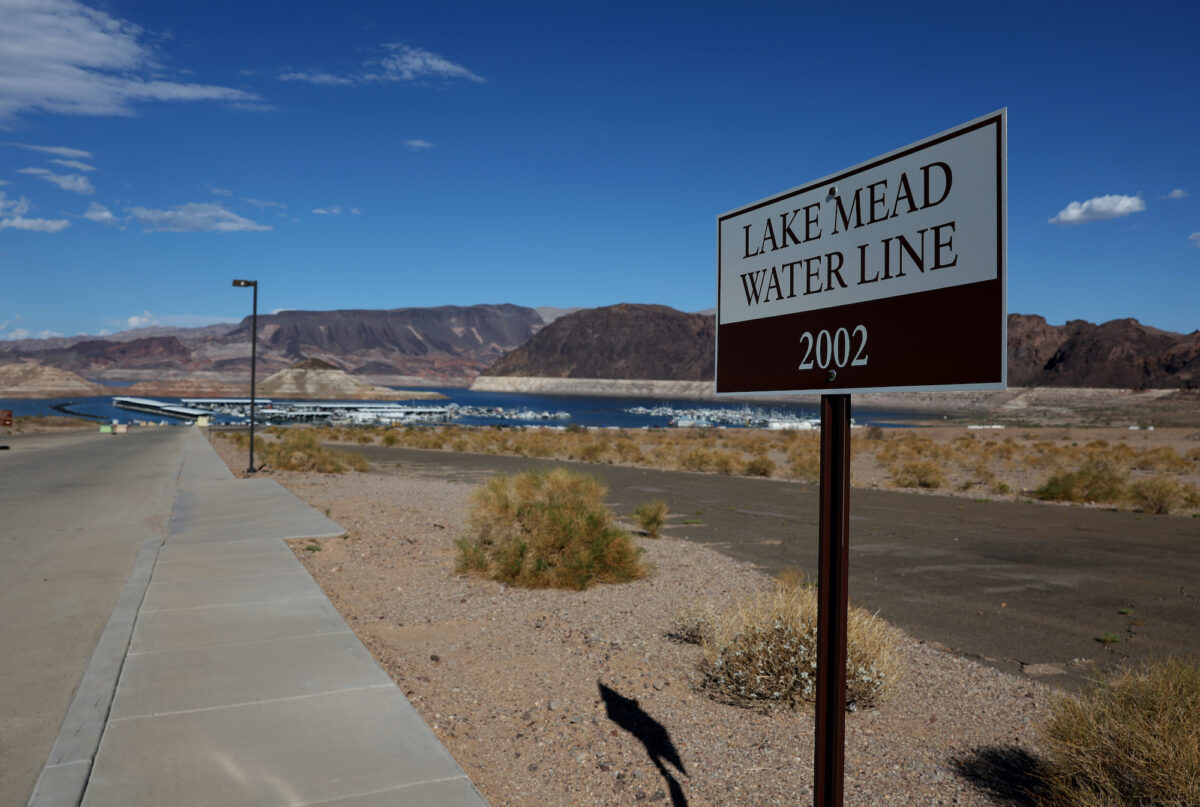
A sign showing where Lake Mead water levels were in 2002 is posted near the Lake Mead Marina in Lake Mead National Recreation Area, Nevada, on Aug. 19, 2022. (Justin Sullivan/Getty Images)

DOI Deputy Secretary Tommy Beaudreau has said failure to act is not an option.

“Recognizing the severity of the worsening drought, the Biden-Harris administration is bringing every tool and every resource to bear through the President’s Investing in America agenda to protect the stability and sustainability of the Colorado River System now and into the future,” Beaudreau said in a statement.

Bureau of Reclamation Commissioner Camille Calimlim Touton said drought conditions in the Colorado River Basin have worsened over two decades.

“To meet this moment, we must continue to work together, through a commitment to protecting the river, leading with science and a shared understanding that unprecedented conditions require new solutions,” Touton said in the same statement.

Proposed Action Alternatives
The draft report proposes two ways to change how the dams are operated. Both involve using less water from the Glen Canyon Dam and dealing with additional water shortages. The main difference between the two proposals is how the shortages are shared out.

The first option, referred to as “Action Alternative 1,” modeled the shortages based on who has the highest priority water rights.
The second option, referred to as “Alternative 2,” modeled the shortages being shared out equally among all water users in the Lower Basin.

Both proposals predict that there will be more and more water shortages as the water levels in Lake Mead get lower and there will be bigger shortages in 2025 and 2026 than in 2024.

But the total amount of water shortages in 2024 is limited to 2.083 million-acre-feet because this was the maximum amount analyzed in the 2007 Interim Guidelines’ final environmental impact statement.
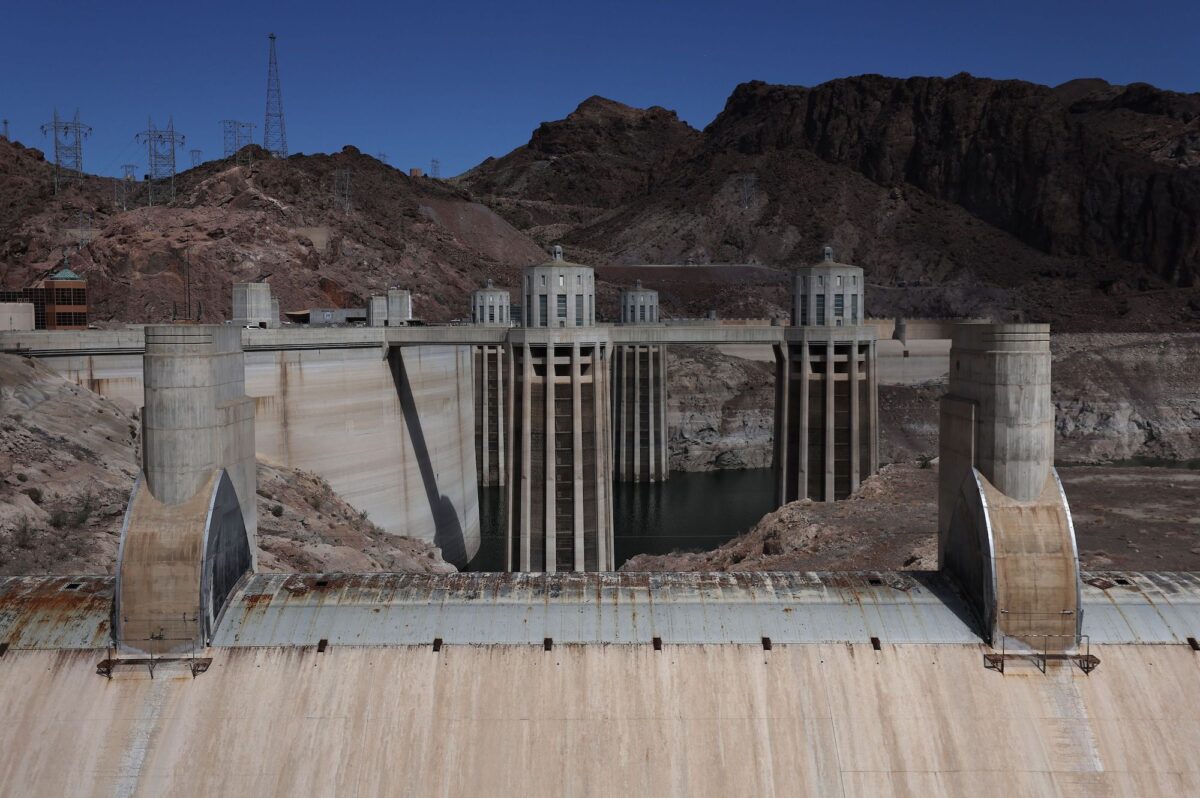
Water intake towers at the Hoover Dam stand next to a dry spillway at Lake Mead in Lake Mead National Recreation Area, Arizona, on Aug. 19, 2022. (Justin Sullivan/Getty Images)

The DOI’s first proposed action would benefit the agriculture industry in California but would disproportionately negatively impact junior water rights holders like an Arizona entity that supplies water to Phoenix.

The DOI’s second proposed action would result in even water supply reductions across the Lower Basin states regardless of seniority.

Both actions would entail progressively deeper supply reductions based on how much Lake Mead’s level declines.

According to the DOI, the alternatives analyzed in the draft report address potential shortages in the event that such measures are required to protect Glen Canyon and Hoover Dam operations, system integrity, and public health and safety in 2024 through 2026, after which the current operating guidelines expire.

The draft report will be available for public comment for 45 days, and a final decision is expected to be made in the summer.