Weekend Papers Summary
FINANCIAL TIMES
-Parts of the US government are expected to shut down from Sunday after Republican dissidents in the House of Representatives defeated the party’s own stop-gap funding bill in a severe blow to Speaker Kevin McCarthy. The final vote tally showed 232 House lawmakers opposing the legislation, while just 198 supported it — a humiliating result for McCarthy that further complicates the prospects for a deal to avoid a shutdown and will cast new doubts on his ability to remain as Speaker.
-The likely shutdown on Sunday will trigger the furlough of hundreds of thousands of federal workers, leave troops without pay, and shutter a broad swath of government services. With no quick political solution in sight, it could be days or even weeks before it ends.
-Parts of the US government are expected to shut down from Sunday after Republican dissidents in the House of Representatives defeated the party’s own stop-gap funding bill in a severe blow to Speaker Kevin McCarthy. In a tense vote on Friday, 21 Republican rebels voted against McCarthy’s bill that would have funded the government for 30 days, joining all Democrats who opposed it because it included deep cuts to government programs.
-The allegations that prompted Bernard Looney’s resignation from BP included an accusation that the chief executive promoted women with whom he had undisclosed past relationships. The romantic relationships with BP colleagues that are in question all allegedly occurred before Looney became chief executive in 2020 but had not been disclosed to the company.
-Dianne Feinstein, the veteran Democratic senator from California and a pioneer for women in American politics, has died, aged 90. Feinstein passed away at her home in Washington late on Thursday, James Sauls, Feinstein’s chief of staff, confirmed on Friday.
-China has started its longest holiday break of the year with officials predicting record tourist travel that they hope will help to lift an economy struggling to emerge from its post-pandemic doldrums. Economists will be watching in particular whether Chinese consumers will use the eight-day break, which combines the October 1 National Day and the mid-Autumn festival holidays, to spend not only on restaurants and outings but also on bigger ticket items, particularly property.
-Su Zhu, co-founder of collapsed crypto hedge fund Three Arrows Capital, has been imprisoned for four months for failing to co-operate with investigations into its failure, its liquidator said on Friday. Zhu was arrested in Singapore’s Changi airport earlier in the day while trying to leave the country after Teneo won a court order earlier this week for his committal to prison, the advisory firm said in a statement.
-Eurozone inflation has fallen to its lowest level for almost two years and US price rises last month were less than expected, raising the prospect that interest rate rises on both sides of the Atlantic have come to an end. Bond markets steadied on Friday after a month of turmoil, helped by the news that consumer prices in Europe’s single currency bloc rose 4.3% in September, below economists’ expectations of 4.5% and August’s rate of 5.2%.
-The United Auto Workers will expand its strike against Ford and General Motors, while sparing Stellantis from further action, citing progress with the company at the bargaining table.
-The SEC on Friday charged broker-dealers and investment advisers — including Perella Weinberg Partners and Interactive Brokers — for “widespread and longstanding failures to maintain and preserve electronic communications”. The move is the latest salvo by the regulator against Wall Street’s messaging practices. The enforcement actions have pushed banks to revisit their messaging policies and sack some employees.
-Suicide bombers killed at least 56 people and injured scores of others on Friday in three separate bomb attacks in Pakistan’s volatile border region near Afghanistan. The attacks will heighten security concerns in Pakistan as the nuclear-armed south Asian nation of 220M people grapples with escalating economic and political crises.
-Financial transactions between billionaire LVMH owner Bernard Arnault and Russian businessman Nikolai Sarkisov are being investigated by the Paris prosecutor’s office. The office on Friday said the transactions had been added to a preliminary probe launched in 2022.
-Credit Suisse has warned that it expects at least $2.2B of losses in the third quarter as UBS integrates the business it rescued six months ago and looks to wind down an investment contract the stricken bank signed with Apollo.
NEW YORK TIMES
-Rain eases in New York, but officials warn that flood risks remain. Heavy rainfall pounded New York City and the surrounding area on Friday, bringing flash floods, shutting down subway lines and turning roadways into lakes.
-A Looming Shutdown. Hard-right Republicans defied Speaker Kevin McCarthy and defeated their own party’s bill, making a lapse in funding at midnight on Saturday all but certain.
-Dianne Feinstein, the oldest senator and a fixture of California politics, dies at 90. She achieved remarkable breakthroughs as a woman, becoming San Francisco’s first female mayor and California’s first woman elected to the Senate.
-A man is charged with murder in Tupac Shakur Case. The man, a former gang leader named Duane Keith Davis, has said the four shots that killed the rapper in 1996 came from the vehicle he was riding in. Tupac Shakur became an almost mythical figure in the decades since his killing.
-Scott Hall, a Donald Trump supporter who is among the 19 people charged in a racketeering case involving the former president, is the first to plead guilty.
-Why Evergrande’s problems are only getting worse. The Chinese property developer’s efforts to restructure more than $300B in debt are being complicated by criminal investigations.
-China’s property crisis is testing its too-big-to-fail banks. Banks hold enormous amounts of real estate debt, and regulators are nervous. But a fast-moving crisis is unlikely because of government control.
-Saturn’s Rings May Have Formed in a Surprisingly Recent Crash of 2 Moons
Researchers completed a simulation that supports the idea that the planet’s jewelry emerged hundreds of millions of years ago, not billions.
-Finland Raced to Join NATO. Now Comes the Hard Part.
-Prosecutors reassert need for gag order on trump in elections case. Prosecutors argued that Donald Trump has continued to make threatening statements after their initial request to limit his public discussion of the case.
-IRS contractor charged with leaking tax returns. The federal charges are said to involve disclosure of tax information from Donald Trump and other wealthy taxpayers to two news organizations.
-Police investigate about 100 suicides linked to Canadian man. The Canadian police charged Kenneth Law with aiding 14 suicides, including that of Ashtyn Prosser, and 88 other deaths are being reviewed.
NY POST
-White House hopeful Robert F. Kennedy Jr. will drop his bid to challenge President Biden for the Democratic presidential nomination and instead mount a third-party campaign for president, according to a report. The scion of the Kennedy political dynasty plans to announce that he’ll run as an independent on Oct. 9 in Philadelphia, Mediaite reported on Friday. “Bobby feels that the DNC is changing the rules to exclude his candidacy so an independent run is the only way to go,” a Kennedy campaign insider told the outlet.
-An inflation measure closely watched by the Federal Reserve ticked higher in August as steep prices continue to squeeze millions of US households.
The personal consumption expenditures index showed that consumer prices rose 0.4% from the previous month, according to the Labor Department. On an annual basis, prices climbed 3.5% – up from 3.3% recorded the previous month, underscoring the challenge of taming high inflation.
Arnaud Benedetti : «Wokisme et macronisme, vers une convergence des luttes ?»
TRIBUNE - Les différentes facettes du progressisme ne sont pas nécessairement antagonistes, analyse le rédacteur en chef de la Revue politique et parlementaire.
Arnaud Benedetti est professeur associé à l’université Paris-Sorbonne. Il est rédacteur en chef de la « Revue politique et parlementaire », dont le rendez-vous annuel, la Cité des débats, se tient à partir de ce vendredi à Saint-Raphaël. Il a publié « Comment sont morts les politiques ? Le grand malaise du pouvoir » (Éditions du Cerf, 2021).
De quoi le wokisme et la « cancel culture » sont-ils le nom ? Ils sont la pointe avancée de la radicalisation du progressisme. Qu’est-ce que le progressisme ? C’est une croyance selon laquelle il existerait un sens de l’histoire dont l’objectif serait de libérer l’homme. Qu’est-ce qu’au vu de ce progressisme la libération de l’homme ? C’est l’idée que l’homme, stricto sensu, s’appartient à lui-même, qu’il s’autodétermine lui-même, loin de tout ce qui pourrait le déterminer de manière telle qu’il s’affranchirait de son héritage familial, de genre, culturel, etc.
Pour aller au but, le progressisme aujourd’hui est un détournement du progrès. Il en constitue le bug, la version déréglée. Il n’est pas le progrès, mais son inversion, il n’a pas de sens, si ce n’est celui de produire non pas une société mais d’en revenir aux règnes des agrégats communautaires qui ne sont rien d’autre que l’expression recommencée des temps tribaux. Il se fixe pour priorité de défaire pour mieux les enrégimenter nos cadastres mentaux. Encore faut-il saisir que cette « autodétermination/autodestruction » a pour les néoprogressistes une cible : l’Occident et rien que l’Occident. L’Occident est le mal fondateur de leurs obsessions : il a colonisé, il aurait patriarcalisé, il a hyper-genré. Comme si sous d’autres cieux et à d’autres époques, colonisation, patriarcat et genre n’avaient pas traversé l’ensemble des sociétés et servi de ressorts à bien des dynamiques historiques.
Du progrès, le progressisme revendique le mot mais détourne le contenu. Il est le symptôme d’une idée devenue folle. Il s’attaque tout d’abord aux œuvres de l’esprit, en particulier à la littérature, laquelle se trouve particulièrement fragilisée et désarmée par le déclin des études littéraires. D’autant plus que, dans un monde technicien, le savoir spécialisé est un puissant auxiliaire de la déculturation, et, sur ce terreau déculturé, les engrais de la déconstruction trouvent matière à optimiser le rendement de leurs mots d’ordre. Nous y sommes : Ortega y Gasset en son époque l’avait prophétisé, voyant dans l’homme spécialisé, dans l’homme-rouage, l’expression d’une nouvelle barbarie. D’autres également, comme Bernanos ou Ellul, y décelèrent le mal à venir d’un « nouveau monde ». Le parti de la déconstruction se nourrit de la crise de la transmission, il se renforce à proportion que l’inculture se développe.
Rien ne serait plus trompeur que de considérer ce néoprogressisme comme l’ultime avatar de l’ultragauche. L’ultragauche, de ce point de vue, a le mérite et l’honnêteté d’avancer sans masque, elle dit ce qu’elle pense et pense vraiment ce qu’elle dit. Mais les effets de ses luttes se diffractent loin de ses seules rives. Ils instituent une atmosphère dont le politiquement correct est le réceptacle et s’étendent ainsi jusqu’aux franges modérées de nombre de courants qui, sans être extrémistes, s’en accommodent selon des modalités propres à leur agenda programmatique. Le macronisme, pour une part, sous une forme euphémisée, y cotise, en fonction des circonstances, du rapport de force du moment et de son système d’alliances, notamment avec son aile droite. Il en est surtout porté par son élan originel, celui de la campagne de 2017, de l’exaltation à Marseille des communautés jusqu’à la stupéfiante affirmation selon laquelle il n’existerait pas de culture française, en passant par l’interview à la presse américaine où le président professait la nécessité de déconstruire l’histoire nationale.
Le cabotage idéologique est tactiquement consubstantiel à ce nouveau « marais », lointain héritier de ceux qui, sous la Convention, à partir de 1791, penchaient à gauche mais s’adaptaient aux opportunités de l’heure au regard de la plasticité de la conjoncture. Le destin ministériel fugace de Pap Ndiaye constitue à sa façon l’illustration minérale de cette prédisposition. Nommé pour soigner la gauche de la majorité présidentielle, l’universitaire aura été remercié pour complaire à sa droite. Pour autant, le macronisme, dans sa genèse, s’inscrit pleinement dans cette trajectoire néoprogressiste qui voit dans la mondialisation et la société des individus une perspective irénique. Il est une version « light » du progressisme révolutionnaire dont les Insoumis comme une grande part des Verts sont les hérauts.
Le « partage des eaux » entre modérés et radicaux de ce néoprogressisme se situe pour une part essentielle dans le rapport à l’économie, mais pour tout ce qui touche au sociétal et à la civilisation les lignes se recoupent dans une même communion où seuls les moyens et le rythme pour atteindre leur fin en viennent à se différencier. Ainsi, nonobstant ces nuances, il existe bien une intersectionnalité des néoprogressismes dont la vocation consiste à imposer irréversiblement leur vision du monde. Ce projet-là n’est pas plus libéral qu’il n’est démocratique mais il est à coup sûr d’un grand danger pour des sociétés libres, pluralistes et soucieuses de ne pas brader leur héritage sur l’autel de cette dystopie qui vient.
Biden administration plans record-low number of offshore drilling leases
Final five-year plan offers drastic reduction compared to Trump-era proposal despite industry lobbying
The Biden administration on Friday unveiled plans to hold a record low number of offshore lease sales over the next five years, in a blow to the oil and gas industry.
Just three lease sales are planned in the Gulf of Mexico from 2025 to 2029 under the final terms of a government programme, which was delayed for months amid bitter debate between climate and fossil fuel groups.
The lease sales are significantly lower than the Donald Trump administration’s original proposal that planned up to 47 lease sales, which would have opened up nearly all of the US coast for drilling.
The restrictions will disappoint the oil and gas sector, which has lobbied hard to gain greater access to the Gulf of Mexico — an area that provides about 15 per cent of total US crude oil production.
The White House said the three proposed lease sales were compliant with the provisions of the Inflation Reduction Act, the landmark climate law which tied offshore wind leasing to offshore oil and gas development.
The IRA does not allow the Bureau of Ocean Energy Management to issue a lease for offshore wind development unless the agency has offered at least 60mn acres for oil and gas leasing in the previous year.
Publication of the plan by the Department of the Interior comes as President Joe Biden walks a tightrope on climate action and energy security, passing aggressive climate policies while at the same time calling on oil producers to boost production.
While the plan released by Biden will restrict future sales in the Gulf, it will still probably disappoint Democrats and environmentalists, who had urged the administration not to issue multiple lease sales, arguing they were not necessary to meet its goals for offshore wind.
Earlier this month, six congressional Democrats wrote a letter to the White House urging the administration to issue no new lease sales.
“We cannot drill our way to a safe climate, healthy environment, and thriving economy,” the lawmakers wrote, adding energy security concerns “will not be fixed by introducing new leases”.
Analysts are sceptical that the five-year plan will have much of an impact on US oil production. Offshore leases do not guarantee oil discovery and can take up to 10 years to explore and develop.
“Even if they were the most oil and gas friendly administration in the world, these sales wouldn’t specifically have much impact on production,” said Hunter Kornfeind, oil market analyst at Rapidan Energy Group, calling the fears of production impacts “overblown”.
US oil production is predicted to reach an all-time high this year as more efficient shale extraction techniques propel output to 13mn barrels a day despite limited investments from companies.
Biden had promised no new oil and gas leasing on federal lands as president, signing an executive order in his first month of office to pause new sales. This was struck down by a federal judge months later.
Jasper, an Early Generative AI Winner, Cuts Internal Valuation as Growth Slows
Jasper AI, an early darling of the generative artificial intelligence boom, has cut the internal value of its common shares 20%, according to former employees who were notified by the company.
The drop in Jasper’s internal valuation could indicate that the growth of its AI-powered writing tool for marketers has slowed since the company raised venture funding at a $1.5 billion valuation in June. Jasper has long relied on OpenAI’s technology to power its product, but last fall OpenAI launched ChatGPT, which has effectively turned into a direct competitor.
THE TAKEAWAY
• Jasper’s writing software competes with OpenAI’s ChatGPT
• Startup cut revenue targets early this year
• Co-founder Dave Rogenmoser stepped down as CEO
A representative for Jasper did not respond to requests for comment.
As of January, Jasper told some investors it was generating $90 million in annual recurring revenue, a measure of the subscription sales it expected to generate in the following 12 months, according to a person familiar with its financials. In February, it said it could reach $140 million in ARR by the end of this year and $250 million by the end of 2024.
This summer, however, it told staff it had cut 2023 ARR projections by at least 30%, according to two people familiar with the discussion. In July, it laid off staff.
By lowering the internal share price, known as a 409A valuation, the company is reducing the value of employees’ stock, which it uses to set the price for their equity awards. This price usually differs from the one set by investors for preferred stock purchased in private funding rounds. Still, the internal valuations set by companies such as Instacart over the last year gave an indication of how future investors ultimately valued the company.
In Jasper’s case, the company has told people holding equity compensation awards that the new value of their shares is about $3.34, down from more than $4.20 previously. That 20% drop indicates Jasper’s overall paper valuation could be $1.2 billion. In the meantime, the valuations of other AI startups have continued to rise.
On Thursday, the Austin, Texas, startup announced that its CEO and co-founder, Dave Rogenmoser, was stepping down from his role. Former Dropbox president Timothy Young replaced him.
Jasper burst into public view last year thanks in part to OpenAI’s software, which powers its product. Clients such as Airbnb and HarperCollins paid for the Jasper software, which creates blog posts and other copy based on text descriptions of what customers want to see. With three-quarters of its customers paying $80 a month for the service, Jasper’s recurring revenue swelled to $80 million by the end of last year, more than double its ARR at the end of 2021.
Investors rushed to pour money into the startup. Jasper sold shares to investors at increasingly high prices last year, ultimately raising $125 million from Insight Partners, Coatue Management and Bessemer Venture Partners in a round that valued it at $1.5 billion. As the ink dried on that deal, which was announced in November, Jasper started to reel from the impact of a new, less expensive competitor: OpenAI’s ChatGPT.
In July, Jasper's head of product and some other leaders left. At the time, Rogenmoser said Jasper would transition to a business focused on selling to marketing teams at midsize and enterprise startups, rather than a mix of consumers and businesses.
Research Calls
-
Upgrades:
- Anheuser-Busch InBev (BUD) upgraded to Buy from Neutral at BofA Securities
- Ball Corp (BALL) upgraded to Buy from Hold at Jefferies; tgt raised to $64
- Baytex Energy Trust (BTE) upgraded to Outperform from Market Perform at BMO Capital Markets
- Brinker (EAT) upgraded to Buy from Hold at Stifel; tgt raised to $45
- Bumble Inc. (BMBL) upgraded to Buy from Hold at Loop Capital; tgt $18
- Editas Medicine (EDIT) upgraded to Buy from Hold at Stifel; tgt raised to $17
- Restaurant Brands Int'l (QSR) upgraded to Buy from Hold at Loop Capital; tgt raised to $81
- Spire (SR) upgraded to Buy from Neutral at Mizuho; tgt lowered to $66
- Texas Roadhouse (TXRH) upgraded to Buy from Neutral at Northcoast; tgt $118
- Trimble (TRMB) upgraded to Outperform from Mkt Perform at Raymond James; tgt $65
-
Downgrades:
- Badger Meter (BMI) downgraded to Sell from Neutral at Northcoast; tgt $120
- Berkshire Hathaway (BRK.A, BRK.B) downgraded to Hold from Buy at Edward Jones
- ResMed (RMD) downgraded to Peer Perform from Outperform at Wolfe Research
- Sunoco LP (SUN) downgraded to Neutral from Buy at Mizuho; tgt $53
- USA Compression Partners (USAC) downgraded to Underperform from Neutral at Mizuho; tgt $22
- WPP plc (WPP) downgraded to Neutral from Buy at Goldman
-
Others:
- AbbVie (ABBV) initiated with an Outperform at Raymond James; tgt $177
- Adobe (ADBE) initiated with a Hold at HSBC Securities; tgt $519
- Akamai Tech (AKAM) initiated with a Hold at HSBC Securities; tgt $106
- Allegro Microsystems (ALGM) initiated with a Neutral at BofA Securities; tgt $36
- Alnylam Pharma (ALNY) initiated with an Outperform at Raymond James; tgt $208
- American Homes 4 Rent (AMH) initiated with a Neutral at UBS; tgt $35
- AtriCure (ATRC) initiated with a Buy at UBS; tgt $56
- Autodesk (ADSK) initiated with a Hold at HSBC Securities; tgt $214
- Customers Bancorp (CUBI) initiated with a Strong Buy at Raymond James; tgt $60
- Fair Isaac (FICO) initiated with a Reduce at HSBC Securities; tgt $729
- FedEx (FDX) initiated with a Buy at HSBC Securities; tgt $330
- First Citizens BancShares (FCNCA) initiated with a Neutral at Citigroup; tgt $1520
- Fortinet (FTNT) initiated with a Buy at HSBC Securities; tgt $75
- Fusion Pharmaceuticals (FUSN) initiated with an Outperform at Oppenheimer; tgt $13
- Huntington Banc (HBAN) initiated with a Buy at Citigroup; tgt $12
- Intuit (INTU) initiated with a Hold at HSBC Securities; tgt $520
- Invitation Homes (INVH) initiated with a Buy at HSBC Securities; tgt $38
- Ingredion (INGR) initiated with an Outperform at Oppenheimer; tgt $120
- Ionis Pharma (IONS) initiated with a Strong Buy at Raymond James; tgt $63
- Jazz Pharma (JAZZ) initiated with a Mkt Perform at Raymond James
- Lantheus Holdings (LNTH) initiated with an Outperform at William Blair
- Lattice Semi (LSCC) initiated with a Neutral at BofA Securities; tgt $95
- Movado Group (MOV) initiated with a Buy at The Benchmark Company; tgt $41
- New York Community (NYCB) initiated with a Neutral at Citigroup; tgt $12
- NICE (NICE) initiated with a Neutral at DA Davidson; tgt $190
- Opendoor Technologies (OPEN) initiated with a Neutral at UBS; tgt $2.75
- Palo Alto Networks (PANW) initiated with a Hold at HSBC Securities; tgt $242
- Paragon 28 (FNA) initiated with an Outperform at William Blair
- Petco Health and Wellness (WOOF) initiated with a Peer Perform at Wolfe Research
- ShockWave Medical (SWAV) initiated with a Neutral at UBS; tgt $218
- Synopsys (SNPS) initiated with a Buy at HSBC Securities; tgt $551
- Treace Medical Concepts (TMCI) initiated with a Buy at UBS; tgt $24
- Telefonica Brasil (VIV) resumed with an Outperform at Itau BBA; tgt $11
- Tractor Supply (TSCO) resumed with an Outperform at Wolfe Research; tgt $239
- UPS (UPS) initiated with a Hold at HSBC Securities; tgt $170
- Zions Bancorp (ZION) initiated with a Buy at Citigroup; tgt $42
The $109 Trillion Global Stock Market In One Chart
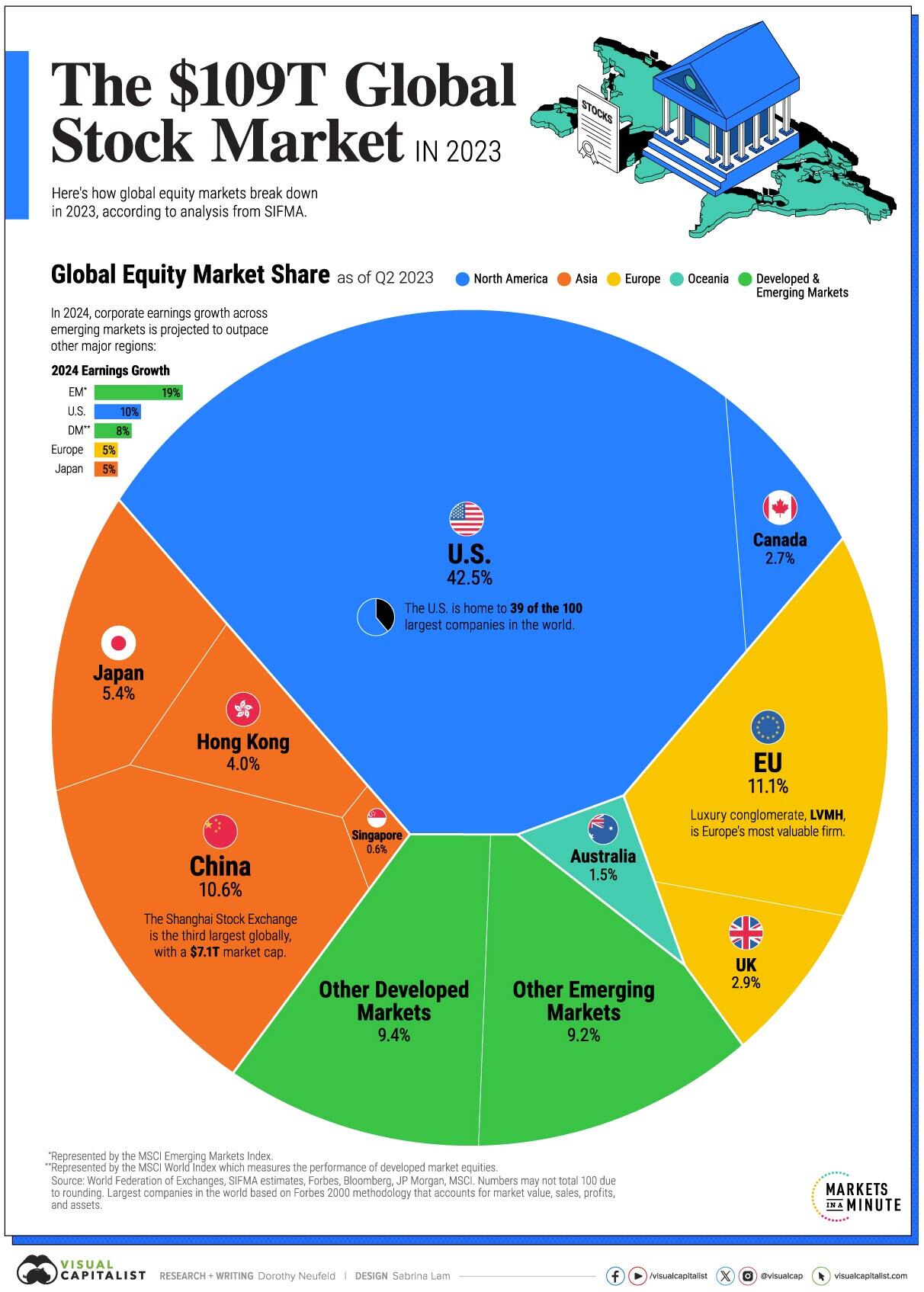
Global equity markets have nearly tripled in size since 2003, climbing to $109 trillion in total market capitalization.
Over the last several decades, the growth in money supply and ultra-low interest rates have underpinned rising asset values across economies.
Given this backdrop, Visual Capitalist's Dorothy Neufeld created the graphic below to show the size of the global stock market in 2023, based on data from the World Federation of Exchanges (WFE) and the Securities Industry and Financial Markets Association (SIFMA).
The Global Stock Market, by Share
With the world’s deepest capital markets, the U.S. makes up 42.5% of global equity market capitalization, outpacing the next closest economy, the European Union by a significant margin.
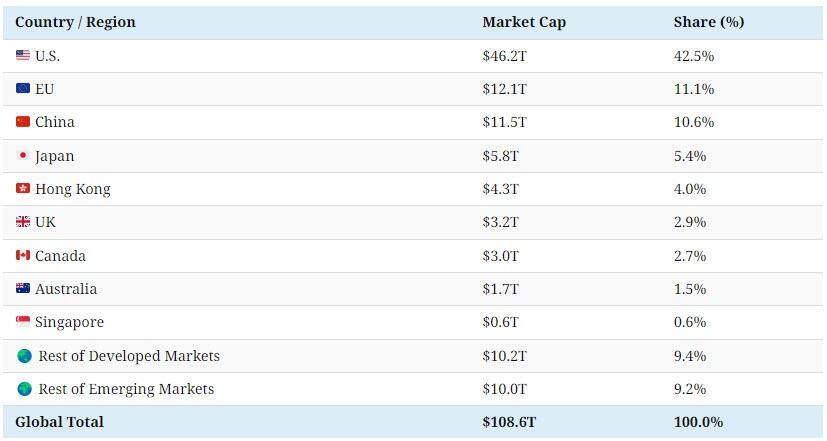
Here are the world’s major equity markets based on global market cap share as of Q2 2023:
Data as of Q2 2023. Numbers may not total 100 due to rounding..
Today, U.S. equity markets total over $46.2 trillion in market capitalization.
Compared to other rich nations, U.S. stocks have often outperformed over the last several decades. If an investor put $100 in the S&P 500 in 1990 this investment would have grown to about $2,000 in 2023, or four-fold the returns seen in other developed countries.
The second-largest equity market is the European Union at 11.1% of global share, followed by China, at 10.6%.
In the last 20 years, China’s economy has increased by roughly 12-fold, reaching $19.4 trillion this year. China’s equity markets have also grown considerably, fueled by the incorporation of Chinese domestic stocks into the MSCI Emerging Market Index in 2018, and earlier, with the internationalization of its equity markets in 2002.
Japan’s equity markets account for 5.4% of the global share, followed by Hong Kong, at 4%.
The Future Investment Landscape
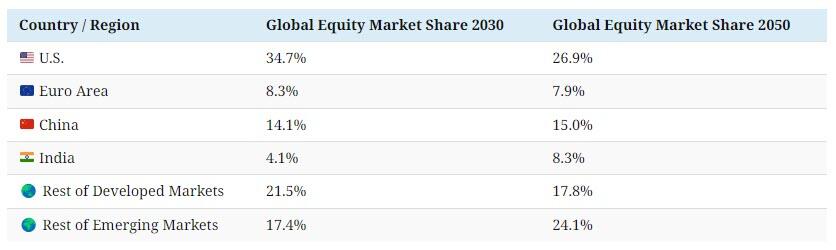
Goldman Sachs projects that U.S. equity market capitalization will fall to 35% of the overall global market by 2030.
Meanwhile, emerging markets, including China and India, are collectively forecast to reach the 35% mark in the same timeframe. By 2050, the EM share is anticipated to far surpass the U.S., rising to 47% of global stock markets.
Numbers may not total 100 due to rounding.
The first factor underscoring this shift is the rapid growth projected for emerging economies.
Historically, as GDP per capita grows, capital markets in an economy become more sophisticated. We can see this in richer countries, which tend to have higher equitization of their markets.
India is projected to rise the fastest globally. By 2030, it is projected to account for 4.1% of global equity market cap. Furthermore, by 2050, this share is projected to outrank the euro area due to strong GDP per capita growth and demographic drivers.
The second factor, although to a lesser extent, is emerging market rising valuation multiples driven by higher GDP per capita. Richer countries, as seen in the U.S., often trade at higher earnings multiples because they are viewed to have lower risk.
Implications for Investors
What does this mean from an investment standpoint?
While the U.S. has outperformed in recent decades, it may not mean that it will continue on this trend, according to Goldman Sachs. Given the structural shifts stemming from growing populations and GDP growth, investors may consider diversifying their portfolios geographically looking ahead.