WSJ Intervie of Benoit Couere

An Interview With ECB Executive Board Member Benoît Coeuré

European Central Bank executive board member Benoît Coeuré sat down with The Wall Street Journal’s Brian Blackstone and Todd Buell to discuss the prospects for quantitative easing, the inflation outlook and reasons for optimism in Europe. Here are edited excerpts:

WSJ: What are the prospects for quantitative easing after the results of the four-year ECB loans to banks and purchases of covered bonds and asset backed securities so far?

Mr. Coeuré: For me the question is not so much whether what we are now implementing works, as the measures that you mentioned were meant to address the environment that we had in the summer. The key issue now is whether the environment is changing to a point where we need to do more. What has changed is the confirmation of low growth and low inflation, and the oil shock which is obviously new.

I see a broad consensus around the table in the Governing Council that we need to do more. If we had been in a position to cut rates at the last meeting, we would probably have done so. It’s not that much of a question on whether we should do something, but more a discussion on the best way to do it.

WSJ: What other assets should you buy? Government bonds?

Mr. Coeuré: If we want to do more we obviously have to reach out to market segments where there is more liquidity and that is why the government bond market is the baseline option, which doesn’t necessarily mean we would only buy government bonds. That’s a discussion we will have in the Governing Council.

WSJ: Will you have the information you need by your next policy meeting on Jan. 22?

Mr. Coeuré: I don’t know what the flow of data will show between now and then. Ideally you would need enough time to assess what exactly is the pass-through from lower oil prices to core inflation and to know more about the second-round effects. On the other hand we don’t want to be behind the curve and act too late. I would expect the discussion at the Governing Council to be a balancing act between those considerations.

WSJ: How important is a very strong majority on the Council for QE?

Mr. Coeuré: It’s certainly desirable to have as much support as possible when it is about introducing a new instrument. No instrument is perfect. We have to weigh the pros and cons, and understand the unintended consequences. The more Governors standing by this new instrument, the safer you feel that the pros and cons have been weighed in the right way.

We need to design a solution in a way that mitigates the concerns of as many people around the table as possible. We have a good precedent with Outright Monetary Transactions. This was a new instrument that raised concerns around the table. We were able to design it the right way because we took concerns on board, and we are now going through exactly the same process.

WSJ: What about arguments that QE wouldn’t be effective in the eurozone?

Mr. Coeuré: That’s exactly why we want to discuss the way we design it. We are starting from a different place than the U.S. We need a European solution to a European problem. Moreover, our economy is more bank based which implies that any new instrument would have to complement what we’ve already done. Even if we buy government bonds, that does not suppress the need to buy ABS or covered bonds. It does not suppress the need to do our liquidity operations. It has to be a combination of instruments.

WSJ: What is your message to the QE skeptics in Germany and the financial markets?

Mr. Coeuré: The starting point is simple: the ECB has a narrow mandate which is medium-term inflation (of close to but below 2%) and today we are far from this number. We have both a moral and legal responsibility to deliver on our mandate.

I absolutely agree that very low sovereign yields weaken the incentives to run sound fiscal policies. The answer is not to ask the ECB to be an agent of the fiscal authorities. That’s not the way the European people have drafted and approved the EU Treaty. The answer is to be as strict as possible in enforcing fiscal rules, and that’s the role of institutions that are not the ECB.

WSJ: Inflation was 0.3% in November and is expected to weaken more. Are you behind the curve?

Mr. Coeuré: Our mandate is to bring inflation back closer to 2% over the medium term. Monthly headline inflation can be low provided it does not contaminate longer term inflation expectations. That is what we want to understand today. Headline inflation will be very low, maybe even negative in early 2015. That is mechanical. Is it bad or not? It all depends on the impact on longer term inflation expectations. It has the potential to be net positive only if you can reap the benefits on purchasing power and consumption without de-anchoring longer term inflation expectations.

WSJ: Is an inflation rate of 2% even achievable in the eurozone?

Mr. Coeuré: I may be old fashioned, but I still believe that inflation is always a monetary phenomenon, and so the question is more how fast do we go back to 2% and what is the kind of shock that keeps us from 2%. It is also true that in the eurozone we have an environment where markets are more rigid than in the U.S. and U.K. So it is likely that given any particular shock, inflation will take more time to go back to our objective.

WSJ: Economic output is still below its 2008 peak in the eurozone. Is there a risk that a Lost Decade turns into a Lost Generation?

Mr. Coeuré: Reforms are working in the periphery. You can see growth in Ireland. You can see unemployment going down in Spain. You can see the economy improving even in Cyprus. All eurozone countries are reforming their economies, but at different paces. It’s all moving in the right direction but it’s frustrating because it’s not fast enough in our view.

WSJ: Is it time for the eurozone to be more of a contributor to the global economy, rather than just depending on growth elsewhere through exports?

Mr. Coeuré: I think that there’s certainly a strong case to support domestic demand. As long as eurozone growth generally remains driven by external demand, it’s vulnerable to external shocks. We are living in a risky world. There are geopolitical risks. You cannot count on consumers in other regions to support your well-being. That’s why the discussion on investment and structural reforms is so important.

WSJ: Given the divergence in monetary policies among major central banks, will the euro be weaker?

Mr. Coeuré: We don’t have an exchange rate target. The likely course of events over the foreseeable future is interest rates remaining at an extremely low level in Europe and a normalization in other places, including the U.S. The logical market outcome would be for the exchange rate to adjust. I don’t want to pass a judgment on how much it can adjust or how much it should adjust.

WSJ: What will the ECB’s meeting minutes look like next year?

Mr. Coeuré: The Governing Council still has to make the final decision. It is likely that the minutes will be substantial. I expect the arguments not to be attributed, but they will give you a sense of the balance of views in the Governing Council. We will decide this week whether we disclose the names for the votes. In terms of substance and granularity they will compare favorably with Fed minutes.

WSJ: How long between meetings and the publication of minutes?

Mr. Coeuré: Four weeks. We want to publish the minutes after the second non-monetary policy meeting in case we would need to discuss them, which I don’t expect should usually happen.

WSJ: Europe has been heavily criticized in recent years. What are some reasons to be optimistic?

Mr. Coeuré: We are a group of highly advanced, rich economies with extremely good human capital and an extremely good capacity to innovate. The question is more how to move on and get rid of the legacy of the crisis, which we haven’t been able to do fast enough, partly because we had to rebuild the house while it was still on fire. We need further discussion on how to complete monetary union to make it more robust, which will in my view require some degree of fiscal union, with appropriate democratic underpinnings. It will be a long discussion, so we’d better start it early.

WSJ : ECB’s Coeuré Sends Strong Signal on Asset Purchases

ECB’s Coeuré Sends Strong Signal on Asset Purchases
Executive Board Member Sees ‘Broad Consensus’ Among ECB’s Governing Council

FRANKFURT—European Central Bank executive board member Benoît Coeuré sent one of the clearest signals to date that the ECB is poised to embark on large-scale asset purchases centered on government bonds early next year, as the bank grapples with a weak economy and ultralow inflation.

In an interview with The Wall Street Journal, Mr. Coeuré also provided details of the ECB’s plans to publish minutes of its policy meetings starting next year, saying the accounts should be released four weeks after meetings and will be “substantial” in providing the balance of views among officials.

“I see a broad consensus around the table in the governing council that we need to do more” to raise inflation and boost the economy, Mr. Coeuré said in the interview, conducted late on Tuesday at his office in the ECB’s new skyscraper headquarters in Frankfurt.

Other officials, including ECB President Mario Draghi , have signaled that the bank is ready to embark on broad-based asset purchases, known as quantitative easing, if needed to keep inflation from staying significantly below the ECB’s 2% target for too long.

Mr. Coeuré’s comments were noteworthy in that they suggest the threshold for action has now largely been met, and that officials have moved to the design phase of a quantitative-easing program. Central banks in the U.S., U.K. and Japan have used this policy extensively to reduce long-term interest rates.

“It’s not that much of a question on whether we should do something, but more a discussion on the best way to do it,” he said. “If we want to do more we obviously have to reach out to market segments where there is more liquidity and that is why the government bond market is the baseline option, which doesn’t necessarily mean we would only buy government bonds.”

His comments underscored the divergent paths being taken by major central banks. The Federal Reserve and Bank of England are expected by analysts to start raising interest rates next year. However, the ECB’s easy-money policies will stay in place for the foreseeable future, Mr. Coeure said. The “logical market outcome” of these trends is that the euro’s exchange rate should adjust further, he said, adding, “I don’t want to pass a judgment on how much it can adjust or how much it should adjust.”

Mr. Draghi said after the ECB’s last meeting on Dec. 4 that officials would reassess their policies in early 2015. Expectations for further action have intensified amid plunging oil prices, which economists expect to pull eurozone consumer prices into negative territory on an annual basis.

“What has changed is the confirmation of low growth and low inflation, and the oil shock which is obviously new,” Mr. Coeuré said.

He declined to say whether the ECB would have enough information when it meets on Jan. 22 to pull the trigger on QE. “Ideally you would need enough time to assess what exactly is the pass-through from lower oil prices to core inflation and to know more about the second-round effects. On the other hand, we don’t want to be behind the curve and act too late,” he said.

If the ECB does embark on QE it would likely be despite the objections of one of its most powerful members, German central bank head Jens Weidmann, who has signaled fierce resistance to the program, partly on the grounds that it may weaken pressure on European governments to shrink debt and reform their economies.

Mr. Coeuré appeared sympathetic to these concerns. “I absolutely agree that very low sovereign yields weaken the incentives to run sound fiscal policies,” he said. The answer, he said, is to enforce budget rules set by the European Union, which is outside the ECB’s remit.

But he stressed that the ECB can’t turn a blind eye to low inflation, which was 0.3% on an annual basis last month. “We have both a moral and legal responsibility to deliver on our mandate,” Mr. Coeuré said.

He played down concerns that the ECB would only be able to move forward with QE over a considerable number of objections from the bank’s 24-member executive board. He offered the ECB’s conditional bond purchase plan in 2012, known as Outright Monetary Transactions, as an example of how the ECB could reach a strong majority in favor of QE.

Mr. Weidmann was the sole dissenter on the OMT program, which hasn’t been used and has been credited with easing euro breakup fears.

“We were able to design [OMT] the right way because we took concerns on board, and we are now going through exactly the same process,” Mr. Coeuré said. “The more governors standing by this new instrument, the safer you feel that the pros and cons have been weighed in the right way.”

Turning to the minutes of ECB meetings, Mr. Coeuré said the description of the policy discussion won’t include individual board members’ arguments, and that officials haven’t decided yet whether to keep votes anonymous.

Barron's : The Best Stock Market Timers Are Bullish Now

The Best Stock Market Timers Are Bullish Now
Although recent market weakness is unnerving investors, those who excel at calling market turns remain bullish.

Next year will be as good for stocks as this year was. That at least is the judgment of the market timers who have done the best job in the past of calling the market’s turns. In contrast, the timers who have the worst track records have most of their money out of equities.

Another bullish straw in the wind comes from a ranking of industry sectors according to their popularity among the best-performing investment advisors. The sectors that the top performers currently like the most are not those that have performed the best prior to past bull market tops.

None of this amounts to a guarantee that the bull market in stocks will last another year, of course. But to be bearish right now, you in effect have to bet that those who have exhibited the worst market timing abilities will now get it right, while those with the best records will be wrong.

Late last year, I devoted a column (see “Top Market Timers Stay Bullish,” Nov. 2, 2013) to the contrasting market outlooks of the best and worst market timers, reporting that—as they are today—the best were overwhelmingly bullish and the worst were not. Since then, the stock market has produced a double-digit return; the Wilshire 5000 index, which represents the combined market value of all publicly traded stocks, has gained more than 15% (assuming dividends were reinvested).

Consider the 25% of Hulbert Financial Digest-monitored stock market timers with the best track records over the last 20 years. Currently, they on average are allocating 84.9% of their stocks-versus-cash portfolios to equities, which is almost identical to their consensus exposure in November 2013. The worst-performing quartile of market timers, in contrast, are allocating an average of just 38.1% to equities.

A similarly bullish conclusion emerges regardless of the performance period used to define the best and worst quartiles of market timers. Over all time periods from as short as the last 12 months to as long as the last two decades, the best timers are far more bullish than the worst timers.

You may be wary of drawing a bullish conclusion from this best-versus-worst contrast, given that the exposure level among the best quartile of timers for 20-year performance is almost identical to where it was 13 months ago. Might those top timers always be bullish? If so, their current bullish posture tells us more about the bullish market environment of the last 20 years than about what the future may hold.

But the top timers are not perma-bulls. Each of them has outperformed a buy-and-hold in the stock market over the last two decades, which would not be the case if they were always recommending a fully invested posture.

Sectors Most Popular With Top Performers
Next let’s look at which sectors are most and least popular among the best-performing investment advisors. For this purpose, I need to focus on a different group of advisors than the market timers who are the basis of my best-versus-worst contrast. These advisors recommend specific stocks, unlike the market timers who call turns in the overall market.

Over the years, I have found that one of the best ways of defining this group of top advisors is to include only those who have great track records over both the short and long terms. By doing that we eliminate from consideration those advisors whose good record is due primarily to chance, as well as those whose recent advice has been out of sync with the market.

Specifically, I include only those Hulbert Financial Digest-monitored advisors who have beaten a stock market index fund over the last 15 years, and I then narrow the group even further to include just the 15 with the best returns over the trailing 12 months. The accompanying table shows the number of stocks from these top performers’ model portfolios that appear in each of the broad industry groups (as defined by the Dow Jones industry classification system).

To place the data in this table into context, I turn to Ned Davis Research. They studied sector performance in the last three months of every bull market since 1970, and found some distinct patterns. The two consumer-oriented sectors typically perform the best during late-bull-market periods, while Financials and Utilities do the worst.

The popularity ranking in this table therefore is not what we would be seeing if we were in the last three months of a typical bull market. Perhaps the best piece of data is the popularity of the Financials group, which is the third most popular of the 10 groups. Furthermore, as you can see from the column in the table showing the number of times stocks in this sector have been upgraded by a top performer over the last three months, the Financials group’s popularity is increasing.

It’s important to stress that the market timing insight we can get from the sector popularity rankings is primarily for the longer term—as, indeed, is also the case for the best-versus-worst contrast discussed above. During the market correction in 2011, for example, both of these indicators remained bullish. So it would not be inconsistent with the top performers’ bullishness for a correction to occur during 2015.

But, assuming the top performers are right, such a correction—if it were to occur—would not be the beginning of a major bear market.

(GS) The new oil order: Finding a new equilibrium (interesting read)

1.The decline in oil prices continues unabated. We believe the oil market is experiencing a cost re-basement which makes determining when the market is oversold extremely difficult, as the price at which rebalancing occurs is now a moving target to the downside. For the market to be oversold, it requires prices to be far below costs, which are in flux as much as the oil price given the sharp declines in other commodities, currencies, rig rates and oil services costs. On top of downward cost pressures, efficiency is being forced on the industry with evidence of ‘high grading’ where rigs in non-core areas are being re-directed towards core, lower-cost resource plays. All this suggests that costs are falling nearly as fast as the price, which means oil producers can spend less to get the same or potentially even more in terms of production.
2.Although we are not willing to take a strong directional view at current price levels, there is some evidence of rebalancing beginning to happen, and it is trending faster than our forecast which was based upon $70/bbl. But the rebalancing is far from sufficient which creates more downside risks. While the overall rig count in the US dropped by 29 last week, this was almost entirely in vertical rigs, not the horizontal rigs used in shale production. Since early November, 12 US producers representing an estimated 8% of 3Q 2014 US oil production have issued 2015 capex/production growth guidance. Weighted average capex budgets are down 12% yoy. However, each is still forecasting production growth on average in 2015 vs. 2014, except one which is guiding to flat yoy production. So while reductions in capex are coming faster than expected, it is unlikely to translate into less supply than expected, highlighting both the rapid cost reductions with rig rates already down by 15-20% and efficiency gains through high grading.
3.Slowing the rebalancing and creating further downside risk is a very strong consensus view that this pull back is temporary and that oil prices will quickly rebound as they did in 2009. According to a recent Bloomberg survey, the median WTI forecast for 2016 is $86/bbl (even we forecast it going back to $80/bbl). All of these forecasts are based upon now outdated cost data that is shifting as fast as the price. It is precisely this strong view for a rebound in prices and the behavior it creates, that not only suggests that oil prices can go lower for longer, but also that the new normal is far lower than we thought just one month ago. Instead of optimizing against a lower price environment, many oil producers are trying to position themselves for the rebound in prices. There are many options available to an oil producer than just simply cutting production in response to lower oil prices – lower costs and increase volumes, sell more equity, tap a revolver or preserve liquidity to survive until another player with deeper pockets buys them even if the cost is more leverage.
4.As we argued several months ago, this sell-off has been driven by long-dated prices (a proxy for the normal price) as opposed to a weakening in the forward curve timespreads as in past bear markets. The current shape of the forward curve does not incentivize the storage of oil. Although the spot price is only at $58/bbl, the 5-year forward oil price is already lower today at $69/bbl than it was in December 2008 ($70.50/bbl) when spot WTI prices fell to $33/bbl. The reason that the forward curve was in such a deep “contango” in 2008 was that OECD inventories had swelled by 60 million barrels on a seasonally adjusted basis in October and November of that year. This October and November, the seasonally adjusted build was only 18 million barrels – far from being a significant surplus that challenges storage capacity and requires a deep contango. It is instead the expectation for forward balances to be in severe surpluses that is driving the longer-dated price decline and will ultimately help rebalance the market. We have used the phrase “long-term surpluses create near-term shortages” to characterize this trading pattern i.e. sell the forward prices on concerns of long-term surpluses that can make the reality of surpluses self-negating.
5.While this is the first time we have seen a backend driven bear market, the bull market of the 2000s was also backend driven but with weak timespreads, i.e. “long-term shortages create near-term surpluses” – the near opposite of what we are seeing today. As low-cost oil supplies were exhausted in the early 2000s the market turned to higher cost resources and input costs escalated quickly as demand increased. The higher oil prices resulting from higher costs slowed US growth, weakened the US dollar which in turn strengthened the commodity producer currencies which further drove up the cost of producing other commodities that were inputs into oil. It was a reinforcing dynamic to the upside that created cost inflation that drove up the long-dated (normal) oil price. Now it is all working in reverse as the market searches for a new equilibrium – lower oil prices, weaker commodity currencies, lower material and oil service costs and increased efficiency are all reinforcing to the downside.
6.The natural gas experience of 2011-13 is the rule, not the exception. Despite the collapse in natural gas prices several years ago, US natural gas production has continued to grow above expectations. It is often cited as an exception as the higher oil prices subsidized the associated gas output and new low-cost fields such as the Marcellus and Utica were available. In other words, the industry just shifted its activity to the lower part of the cost curve and continued to grow output. The reasons we see this as the rule, and not the exception is that we have seen this in iron ore, coal and gold as well. So there is a likelihood we could see this in oil as producers shift all their efforts to the lower part of the cost curve.
7.With no obvious new low-cost US shale oil field, beyond the high grading to each play’s sweet spot, we believe that the oil market’s Marcellus is most likely to come from abroad. Kurdistan and Southern Iraq will likely continue to grow production, with Iran potentially contributing medium term as well. Further, in a market anchored at shale’s marginal cost of production, it is in OPEC’s interest to maximize revenue through volumes, pointing to potential increases in production over time in core OPEC too. Russia could be the oil market’s Marcellus field as well. It is important to stress that the Russian ruble has weakened almost as much as the oil price has declined, leaving oil prices in Russian ruble near an all-time high. This is important as all costs are Ruble denominated while revenues are USD denominated, leaving Russian oil companies’ margins insulated despite the dollar decline in price. In addition, the Russian government is easing the export taxes which further improve the profitability of Russian oil.
8.While core-OPEC such as Saudi Arabia have substantial dollar reserves to weather low oil prices for a very long time, distressed-OPEC like Venezuela are in a very difficult position. In fact, these producers are some of the top candidates to aide in the rebalancing of the market in 2015. In addition, Libya has experienced setbacks with increased fighting over the weekend leading to another output loss to below 500 thousand barrels per day. While this may help keep the market from experiencing near-term surpluses, the temporary nature of it doesn’t help solve the longer-term imbalances.
9.While historically a 40% pull back in prices would stimulate demand by 50bp, the responsiveness of demand and global growth is likely far less than what it was historically. In the US, net imports are around 25% of demand, levels only seen during the depths of the early 1980s recession. In China and other emerging markets, governments are taking advantage of the decline in oil prices to reduce subsidies and/or introduce consumption taxes as nearly all developed markets have. Further, the sharp decline in nearly all commodity prices and the weakening in commodity currencies creates headwinds for oil demand in the commodity producing emerging markets in Latin America and the Middle East. Historically these regions didn’t contribute much to oil demand, today they do.
10.It is important to emphasize that this is a supply driven bear market and not demand driven. We have to go back to the mid-1980s to find another supply driven bear market. Because the surplus is supply driven it is easily observable in the future unlike demand shocks that are instantaneous, so the market is trying to rebalance the future, not so much the present. In the 2000s we forecasted severe supply driven shortages that never came, because long dated prices dragged the market high enough to slow demand and bring on marginal supplies –hence long-term shortages created near-term surpluses. Once again the market is trying to rebalance the future, by re-basing industry costs to take out the excess marginal production. As the industry takes the ‘fat’ out of the system that was built up over the past decade, the new equilibrium price is dropping sharply – where it settles is unknown right now, but we can comfortably say it is likely below our estimates from last month. Once we have cost data early next year from this time period we will have a better idea, but in the meantime volatility will likely remain high with risks skewed to the downside as the market searches for a new equilibrium.

TechCrunch : Snapchat Plans Music Feature, Acquired QR Scan.me For $50M And Verg

Snapchat Plans Music Feature, Acquired QR Scan.me For $50M And Vergence Eyeglass Cam For $15M,

Leaked emails from the Sony Pictures hack have uncovered several acquisitions made by Snapchat, as well as plans for a music feature and meetings to discuss partnerships with Twitter.
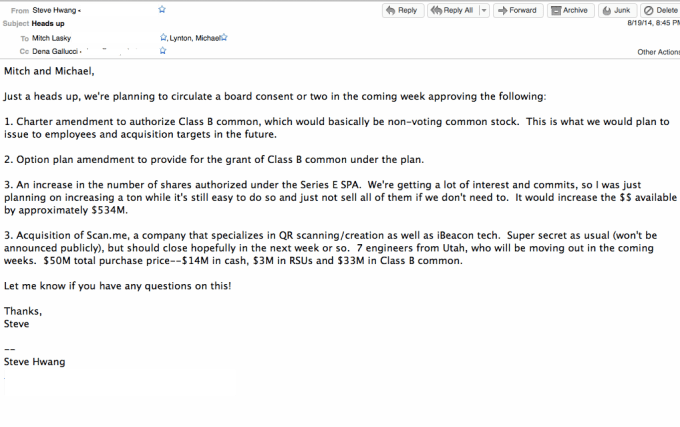
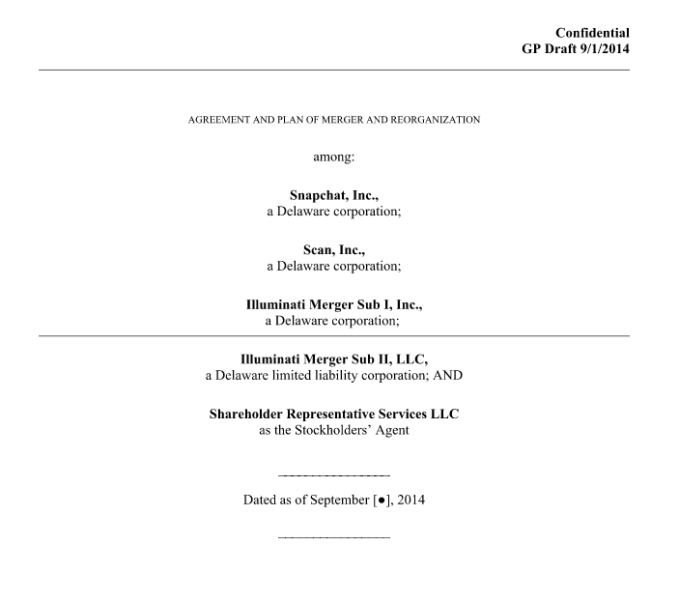
According to emails between Snapchat, Sony Entertainment CEO Michael Lynton, and Snapchat board member Mitch Lasky, Snapchat bought a QR scanning and iBeacon startup called Scan.me for $14 million in cash, $3 million in restricted stock units, and $33 million in Class B common Snapchat stock. It also acquired Vergence Labs, makers of an eyeglass video camera, for $11 million in cash and $4 million in stock.
Snapchat also apparently paid $10 million in cash and $20 million in stock and bonuses for AddLive, the startup Snapchat bought to power its real-time video chat feature but didn’t have the price for.
Other info in the emails include that Snapchat has recently been working on a music feature, and CEO Evan Spiegel has grand aspirations to promote artists through his app and capitalize on their success. Snapchat negotiated with Vevo for a feature that sounds like it would bring music video viewing inside Snapchat in August, but hit a snag over the revenue sharing on advertising. Valleywag reported earlier today that emails indicate the acquisition deal from Facebook that Snapchat turned down was more than $3 billion.
Scan.me
Snapchat’s Steve Hwang emailed Lasky and Lynton telling them the acquisition of Scan.me is “Super secret as usual (won’t be announced publicly)”, that the company “specializes in QR scanning/creation as well as iBeacon tech”, and that “7 engineers from Utah, who will be moving out in the coming weeks.”
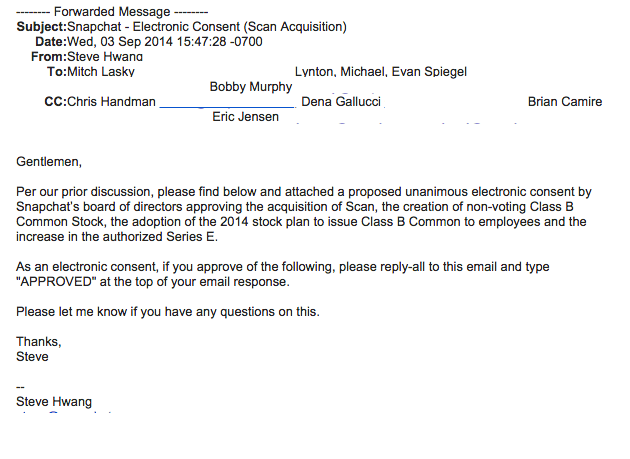
Scan.me acquisition consent form sent to Snapchat board members
Scan price details
Scan.me acquisition confirmation

>>> US Early premarket gappers

Early premarket gappers

Gapping up: ASPX +83.3%, VOLC +55.4%, CERS +23.6%, APP +20.7%, PTRY +9.3%, PLAY +9.1%, CYRN +5.7%, GFI +5.3%, PBR +4.8%, RIO +3.8%, SNE +3.4%, IDRA +2.8%, STO +2.8%, VALE +2.7%, SWC +2.6%, AREX +2.4%, RDS.A +2.4%, DRI +2.3%, TOT +2.2%, SDRL +2.2%, AUY +2%, NGG +2%, TRGT +1.7%, MTZ +1.7%, AA +1.6%, MGM +1.6%, ABX +1.5%,GG +1.4%, HAL +1.3%, GDX +1.2%, SLV +1.1%, MT +1.1%, BP +1.1%, HBAN +1%

Gapping down: NVGN -36.2%, POZN -19.2%, CLF -13.5%, FRO -11.4%, RT -3.9%, YGE -1.9%, CFX -1.7%, HEI -1.7%, PHG -1.6%, HSBC -1%, PNR -0.9%, TSLA -0.5%

>>> FedEx misses by $0.08, reports revs in-line; reaffirms FY15 EPS guidance

FedEx misses by $0.08, reports revs in-line; reaffirms FY15 EPS guidance

Reports Q2 (Nov) earnings of $2.14 per share, $0.08 worse than the Capital IQ Consensus Estimate of $2.22; revenues rose 4.4% year/year to $11.9 bln vs the $12 bln consensus.
  • Operating margin of 8.5%, up from 7.3% a year ago.
  • FedEx Express Segment: Revenue of $7.02 billion, up 3% from last year's $6.84 billion; Operating margin of 6.9%, up from 5.2% the previous year.
    • U.S. domestic package volume grew by 7%; FedEx International Economy volume grew 5%
  • FedEx Ground Segment: Revenue of $3.06 billion, up 8% from last year's $2.85 billion; Operating margin of 15.2%, down from 15.4% the previous year F
  • FedEx Freight Segment: Revenue of $1.59 billion, up 11% from last year's $1.43 billion; Operating margin of 7.1%, up from 5.8% the previous year.
    • Less-than-truckload (LTL) average daily shipments increased 8%, including a 10% increase in demand for Priority service. LTL revenue per shipment grew 3% due to higher weight per shipment, higher rates and increased fuel surcharges.
Guidance
  • Co reaffirms guidance for FY15, sees EPS of $8.50-9.00, excluding non-recurring items, vs. $9.11 Capital IQ Consensus Estimate. The outlook assumes continued moderate economic growth and a modest net benefit from fuel. The capital spending forecast for fiscal 2015 remains $4.2 billion.
Fuel Surcharges
  • FedEx regularly reviews its fuel surcharge tables and will update certain tables at FedEx Express, FedEx Ground and FedEx Freight effective February 2, 2015. Details on these changes will be available on fedex.com by December 23, 2014.