>>> Amazon could be planning to bring its checkout-free grocery stores to Europe

Amazon could be planning to bring its checkout-free grocery stores to Europe
UK and European regulators approved Amazon’s trademark request

Amazon could be looking to expand its cashier-free grocery stores to the UK and Europe in the future. The company recently filed several trademark applications related to its Go stores with the UK’s Intellectual Property Office and its European Union equivalent.

The company filed applications to trademark four slogans: “No Lines, No Checkout. (No, Seriously),” “No Queue, No Checkout. (No, Seriously),” “Every Queue is a Defect,” and “Every Line is a Defect.” The slogans are similar to one used by the company when it first announced its Go stores last December. At the time, there were reports that the company intended to open around 2000 stores, although Amazon denied those plans. We’ve reached out to Amazon for comment, and will update if we hear back.

Amazon’s Go stores are designed for customers to walk in, take what they want, and leave, all without having to go through a checkout line. Customers scan their Amazon account when they enter, and the store tracks what items they pick up, charging them when they leave. The stores reportedly will only require six to ten employees per location.

Amazon still has a ways to go before it expands its stores into foreign markets, however. The first store was reportedly supposed to open in March, but technical problems have apparently pushed that back: the stores reportedly break down if there’s more than 20 people inside, while there are also issues with tracking products put back in the wrong place.

According to Bloomberg, UK grocery chains such as Tesco and Sainsbury are concerned about Amazon’s potential entry into local markets, especially as they face competition from discount grocers such as Aldi and Lidl. Last year, Amazon launched delivery service Amazon Fresh in parts of London.

Recode.net : The big six tech companies grew by $18 billion in total revenue and

The big six tech companies grew by $18 billion in total revenue and $4.5 billion in profit last quarter

First-quarter results are in for the big six tech companies: Alphabet, Amazon, Apple, Facebook, Microsoft and Netflix all saw increases in their top and bottom lines compared to the same quarter the year before, according to data from FactSet.
Combined, the companies grew by $18 billion in total year-over-year revenue and $4.5 billion in profit last quarter to generate $146 billion in total revenue and $25 billion in total profit.

Of note: Netflix — where investors usually focus on subscriber growth — saw profit jump to $178 million this quarter, up more than 500 percent from a year earlier.
Facebook’s growth isn’t slowing as fast as Wall Street expected, as the company continues to add new users and expand its mobile advertising business. Of the six, it added the most Q1 profit year-over-year, $1.3 billion, while Amazon added the most revenue, about $6.6 billion more than during Q1 2016.
Apple saw revenue and profit growth of nearly 5 percent — small, percentage-wise, compared to the other tech giants, but a continued reversal from its prior slump.

>>> Hedge Fund Wisdom : 13F filing Analisys. (see attached document)

>>> Consensus New Buys
* T-Mobile (TMUS): During Q1, Glenview Capital, Paulson & Co, Third Point, and Lone Pine Capital all established stakes in this wireless service company. Now that the FCC spectrum auction and quiet period are over, the thought is that merger activity might pick up in the telecom sector. A new Republication administration and antitrust approach has companies and investors weighing if industry consolidation will be allowed. TMUS has a few options. They can either continue taking market share as they have as an independent company, they can try to merge with Sprint (S), or they could potentially be a takeover target for other companies looking to break into the industry (such as cable companies or tech firms).
* Humana (HUM): Omega Advisors, Pennant Capital, Bridger Management, and Lone Pine Capital all acquired shares of this health insurer during Q1. There’s been a lot of uncertainty in the sector given that many of these companies tried to merge, were sued by the Department of Justice to block the mergers, and now face Obamacare’s uncertain future and a potential Republican program replacement. There’s a lot of moving pieces here. That said, HUM shares have slowly churned higher thus far in 2017.
* Conduent (CDNT): This company was spun-off from Xerox (XRX) recently. While some funds received shares due to their XRX ownership (like Greenlight Capital and Icahn Capital), others bought in once the company started trading independently (such as Pennant Capital).
* Formula One (FWONK): During Q1, Liberty Media (former ticker LMCK) acquired automotive racing franchise Formula 1. As part of the transaction, they issued shares at $25 per share and many hedge funds took part in this offering, including Coatue Management, SPO Advisory, and Viking Global. After the transaction closed, the ticker symbol switched to FWONK to designate the new Formula 1 assets the company holds. Former media titan Chase Carey has been given the CEO role in an effort to expand the global brand further.

>>> Consensus Increased Positions
* Shire (SHPG): This stock lands on this list for the second consecutive quarter. This time around Omega Advisors, Bridger Capital, and Maverick Capital were out accumulating more shares. As mentioned last quarter, SHPG has been listed by a few sellside firms as a ‘best idea for 2017.’
* TransDigm Group (TDG): This stock would have been a consensus ‘new buy’ as well if you included all the hedge funds that bought that aren’t tracked in the newsletter. During Q1, funds such as Blue Ridge Capital, Pennant Capital, and Tiger Global added to their positions. A short seller issued a report that highlighted the company’s pricing practices and status as almost a monopoly in some of the end markets it sells to. The aerospace company is basically run like a private equity style roll-up that acquires other aerospace companies that sell replacement parts. TDG shares were quite volatile in the quarter and tons of hedge funds jumped on the opportunity.
* Time Warner (TWX): Hedge funds like Paulson & Co, Farallon Capital, and Third Point all added to their TWX stakes. Two of those funds are merger arbitrage focused firms and TWX certainly fits the bill as it is being acquired by AT&T (T), pending regulatory review. At first, there was some skepticism that this deal would go through given that Donald Trump talked negatively about the deal on the campaign trail. However, nowadays analyst sentiment seems to be that the deal is likely to pass given that it is a vertical integration rather than a horizontal one.
* Rice Energy (RICE): During the first quarter, hedge funds such as Third Point, Lone Pine, and Viking Global all added to their existing positions.

>>> Consensus Sold Positions
* Ambarella (AMBA): Blue Ridge Capital, Coatue Management, and Maverick Capital all liquidated their positions in this stock during the first quarter.
* Williams Companies (WMB): Funds that sold WMB stakes in Q1 include Lone Pine Capital and Omega Advisors.
* Southwestern Energy (SWN): This is another energy stock that hedge funds including Third Point and Blue Ridge Capital dumped during the first quarter.
* 21st Century Fox (FOXA): Shares of this media company were exited by the likes of Berkshire Hathaway and SPO Advisory.

>>> Consensus Decreased Positions
* Charter Communications (CHTR): Believe it or not, this is the fifth straight quarter CHTR positions have been trimmed by various managers. The company has been well on its way to integrating the acquisitions of Time Warner Cable and Bright House and it’s now the second largest cable player in the US. The stock is up 80% over the past year and the funds that have been selling are trimming their positions by 10-20% for the most part to lock-in some profits and for risk management purposes most likely, as position sizes have swelled due to the share gains. Funds that trimmed their stakes in Q1 include Bridger Capital, Glenview Capital, Farallon Capital, Hound Partners, Third Point, Blue Ridge Capital, Tiger Global, and SPO Advisory.
* Alphabet (GOOG): This is the second consecutive quarter this stock appears on this list. Hedge funds that reduced their exposure to Google’s parent company during the first quarter included Paulson & Co, Tiger Management, Tiger Global, Farallon Capital, Coatue Management, Appaloosa Management, and Viking Global.
* Fleetcor Technologies (FLT): Maverick Capital, Hound Partners, Pennant Capital, Farallon Capital, Tiger Global, and Lone Pine Capital all reduced their position sizes in FLT. This has been a longstanding position for many of these firms as the company has executed on its roll-up strategy in the payments industry.
* Allergan (AGN): Hedge funds such as Bridger Capital, Omega Advisors, Farallon Capital, Baupost Group, Appaloosa, and Paulson & Co all trimmed their stakes in this company that is the combined entity of two previously popular hedge fund stocks: Actavis and Allergan.

FT : It is time to talk about eurobonds again

It is time to talk about eurobonds again
The ability to issue debt is implied in Macron’s call for a fiscal union

The election of Emmanuel Macron as French president brings the first opportunity since the start of the eurozone for a serious discussion about eurobonds. Debt instruments for the eurozone come in different flavours, and can be used for different purposes. It makes no sense to say that you are in favour of or against them unless you talk specifics.

It is true that Mr Macron has never suggested a eurobond to mutualise legacy debt. Over the past 10 years, there have been several proposals in that direction. The Bruegel think-tank in Brussels proposed a scheme in 2010 to mutualise parts of the existing national debt, but no more than 60 per cent of a country’s gross domestic product. The German Council of Economic Advisers proposed a debt redemption bond, a eurobond with the explicit purpose for debt reduction.

A more recent discussion focused on a clever securitisation scheme: the EU would buy up a portion of national sovereign debt and turn it into European Safe Bonds. This is similar to the way banks used to buy up mortgage-backed securities and turned them into hideously complicated collateralised debt obligations. We all know how that went.

The only indirect mutualisation that is taking place is the European Central Bank’s programme of asset purchases. Mutualisation is not the officially declared goal but a side effect. But the purchases will eventually end.

The eurobonds we are discussing today are different. They are the eurobonds implicit in Mr Macron’s proposal for a fiscal union. A fiscal union worth the name requires limited tax-raising powers and the ability to issue debt — eurobonds in other words. Germany’s Social Democrats also want something they call a “fiscal union”, a joint eurozone budget, funded by member states, for the explicit purpose of funding investment. But this is not a fiscal union. It is a slush fund. So we should beware of grand labels and always ask what is behind them.

The extreme options of creating a federal state or just reclassifying some portions of national spending as European are either unfeasible or not useful. Much more interesting is the intermediate option of a clearly focused eurozone budget limited to a few areas.

I would like the eurozone to do three things: first, set up a re-insurance system for national unemployment funds. If one member state suffers a shock, its unemployment insurance system would receive compensation. This is not redistribution from the north to the south. The flows could go in the opposite direction.

The second would be a defence procurement union. Defence procurement represents one of the few areas where harmonisation achieves large cost savings. Finally, there should be the capacity to create a fiscal backstop for the financial sector in a crisis.

Such a fiscal union would be small. It would act as only a very limited macroeconomic stabiliser. But it would be preferable to the current rules-based system that leaves little room for counter-cyclical policies.

Over time, the eurobonds would replace national sovereign debt. If a country wants to default on its legacy debt, let it. The eurobonds would dismantle the toxic nexus between banks and governments. The no bailout rule would suddenly make sense. This is an environment in which states can default.

Others have raised a further issue: a fiscal union is neither necessary nor sufficient for the sustainability of the eurozone because it does not address internal imbalances. I agree that a limited fiscal union would not be able to get Germany to raise wages. But we should think about it as the beginning of a process. More political integration will need to follow.

There are alternatives to a fiscal union, but they are either implausible or politically unpalatable. For example, it is theoretically possible to allow member states to drop out of the eurozone. But this is not an outcome that policymakers are actively seeking or discussing because it is too risky, and would threaten the cohesion of the EU.

Another frequently mentioned minimalist solution is a pure banking union. Since banks are the most fragile part of the economy, a banking union would provide sufficient reinsurance against financial crises. But for this to work, it has to be perfect. It would require a fiscal resolution capacity and a common deposit insurance system. The eurozone has neither.

The reason pro-Europeans like me keep banging on about eurobonds and fiscal union is not that we seek the maximum possible degree of European integration (although some of us do). More important is that this option is the most effective among the choices available and, yes, also the most realistic. There really are no alternatives in the long run.

NY Post : Art sales aren’t booming despite record sell-off

Three billionaire art collectors sold trophy works at Christie’s and Phillips auction houses last week, but the sell-off doesn’t mean the market has peaked.

“I don’t see it as a top,” Kenny Ackerman of Ackerman’s Fine Art told The Post. “It’s just a good time to be flipping things around.”

The market is certainly healthy. Jean-Michel Basquiat’s “Untitled” sold for a record $110.5 million at Sotheby’s Thursday.

But hedge funders selling their art aren’t desperate to unload, sources said. Steven A. Cohen likely auctioned off his “La Hara” by Basquiat for practical reasons, said fellow hedgie Ackerman, a former trader who locates investment-quality pieces for collectors.

“The guy’s worth $12 billion and sells a painting for $35 million — that’s not even the tip of the iceberg,” Ackerman said. “He might have bought two Basquiats a month ago and doesn’t have room for all three on his wall.”

Cohen offered the painting anonymously, as did the other billionaires, but was outed by those familiar with his $1 billion collection.

His sale of “La Hara” for $35 million easily cleared the estimated range of $22 million to $28 million.

Francois Pinault, who auctioned off Rudolf Stingel’s “Untitled (After Sam),” was even less motivated to sell than Cohen. The French businessman, worth over $20 billion, sold the piece through his own auction house, Christie’s. It fetched $10.6 million, barely above its low-end estimate of $10 million.

Leon Black of Apollo Global Management did better with his sale of Wassily Kandinsky’s “Oben und links.” The work commanded $8.3 million — well outside of its top estimate of $7 million, but a mere rounding error for the private-equity titan who’s worth $5.2 billion.

If Black is ever forced to sell his “The Scream” by Edvard Munch, that would be a cry for help. Black paid $120 million for the iconic artwork in 2012 — a record price, at the time, for an auctioned piece — then kept his identity as the buyer secret for two months.

>>> France and Germany in dispute over where EU's top financial regulator should

France and Germany in dispute over where EU's top financial regulator should be located after Brexit as infighting begins over institutions that will be moved out of London - financial press (update) 
- Officials say France won’t support the relocation of the European Banking Authority (EBA) to Frankfurt from London after the Brexit. France wants the EBA located in Paris in order to secure its status as the new financial center for the EU. 
- Officials say that because of the dispute Paris and Frankfurt will likely be taken off the table as hosts for the EBA. 
- The EBA will have to vacate its offices in London by March 30, 2019.
- A variety of EU members are also hoping to get the European Medicines Agency when it moves from London post- Brexit.

REuters - Decisively re-elected, Rouhani defies hardliners, pledges to open Iran

Decisively re-elected, Rouhani defies hardliners, pledges to open Iran

President Hassan Rouhani pledged on Saturday to open Iran to the world and deliver freedoms its people have yearned for, throwing down a defiant challenge to his hardline opponents after securing a decisive re-election for a second term.

Rouhani, long known as a cautious and mild-mannered establishment insider, reinvented himself as a bold champion of reform during the election campaign, which culminated on Friday in victory with more than 57 percent of the vote. His main challenger, hardline judge Ebrahim Raisi, received 38 percent.

In his first televised speech after the result, Rouhani appeared to openly defy conservative judges by praising the spiritual leader of the reform camp, former President Mohammad Khatami. A court has banned quoting or naming Khatami on air.

"Our nation's message in the election was clear: Iran's nation chose the path of interaction with the world, away from violence and extremism," Rouhani said.

U.S. Secretary of State Rex Tillerson, whose country has had no diplomatic relations with Iran since 1980, said he hoped Rouhani would use his second term to end Tehran's ballistic missile program and what he called its network of terrorism.

Iran denies any involvement in terrorism and says its missile program, which U.S. President Donald Trump recently targeted with new sanctions, is purely for defense purposes.

Although the powers of the elected president are limited by those of unelected Supreme Leader Ayatollah Ali Khamenei who outranks him, the scale of Rouhani's victory gives the pro-reform camp its strongest mandate in at least 12 years to seek the sort of change that hardliners have thwarted for decades.

Rouhani's opponent Raisi, a protege of Khamenei, had united the conservative faction and had been tipped as a potential successor to the 77-year-old supreme leader. His defeat leaves the conservatives without an obvious flag bearer.

The re-election is likely to safeguard the nuclear agreement Rouhani's government reached with global powers in 2015, under which most international sanctions have been lifted in return for Iran curbing its nuclear program.

And it delivers a setback to the Revolutionary Guards (IRGC), the powerful security force which controls a vast industrial empire in Iran. They had thrown their support behind Raisi to safeguard their interests.

CHEERING AND DANCING

Thousands of people gathered in central Tehran to celebrate Rouhani's victory. Videos on social media showed young people clapping and chanting "We love you Hassan Rouhani, we support you."

Some youngsters wore wristbands in violet, the color of Rouhani's campaign. Others wore green, representing the reformist movement crushed by security forces after a 2009 election, whose leaders have been under house arrest since 2011.

During campaigning, Rouhani promised to seek their release if re-elected with a stronger mandate.

"We won. We've done what we should have for our country. Now it's Rouhani's turn to keep his promises," said coffee shop owner Arash Geranmayeh, 29, reached by telephone in Tehran.

Videos from the cities of Kermanshah, Tabriz and the holy city of Mashhad showed hundreds of people in the streets, cheering and dancing.

Rouhani, 68, faces the same limits on his power to transform Iran that prevented him from delivering social change in his first term, and that thwarted Khatami, who failed to deliver on a reform agenda as president from 1997-2005.

But by publicly thanking "my dear brother, Mohammad Khatami" in his victory speech, Rouhani seemed to take up that mantle. It was a remarkable challenge to the Shi'ite Muslim religious judicial authorities, who have blacklisted Khatami from public life for his support for other reformists under house arrest.

Many experts are skeptical that a president can change much in Iran, as long as the supreme leader has veto power over all policies and control over the security forces. Some said the pattern was all too familiar from Rouhani's first victory four years ago and Khatami's victories the previous decade.

"The last two decades of presidential elections have been short days of euphoria followed by long years of disillusionment," said Karim Sadjadpour, senior fellow at the Carnegie Endowment who focuses on Iran.

"Democracy in Iran is allowed to bloom only a few days every four years, while autocracy is evergreen."

The re-elected president will also have to navigate a tricky relationship with Washington, which appears at best ambivalent about the nuclear accord agreed by former U.S. President Barack Obama. Trump has repeatedly described it as "one of the worst deals ever signed", although his administration re-authorized waivers from sanctions this week.

Trump arrived on Saturday in Saudi Arabia, his first stop on the first trip abroad of his presidency. The Saudis are Iran's biggest enemies in the region and are expected to push hard for Trump to turn his back on the nuclear deal.

Speaking at a joint news conference with his U.S. counterpart in Riyadh, Saudi Foreign Minister Adel al-Jubeir said Iran's presidential election was an internal matter. "We want to see deeds, not words" from Iran, he added.

Kuwait's emir Sheikh Sabah Al-Ahmad Al-Jaber Al-Sabah, an ally of Saudi Arabia, congratulated Rouhani on his re-election.

BREAKING TABOOS

Rouhani's reinvention as an ardent reformist on the campaign trail helped stir the passion of young, urban voters yearning for change. At times he broke rhetorical taboos, attacking the human rights record of the security forces and the judiciary.

During one rally he referred to hardliners as "those who cut out tongues and sewed mouths shut". In a debate last week he accused Raisi of seeking to "abuse religion for power". The language at the debate earned a rare public rebuke from Khamenei, who called it "unworthy".

The contentiousness of the campaign could make it more difficult for Rouhani to secure the consent of hardliners to carry out his agenda, said Abbas Milani, director of the Iranian Studies program at Stanford University.

"Rouhani upped the ante in the past 10 days in the rhetoric that he used. Clearly it's going to be difficult to back down on some of this stuff."

The Guards could also use their role as shock troops of Iran's interventions across the Middle East to try to derail future rapprochement with the West, said Meir Javedanfar, an Iranian-born lecturer at Israel's Interdisciplinary Center Herzliya.

"Since the 1979 revolution, whenever hardliners have lost a political battle, they have tried to settle scores," he said.

"I would worry about the more confrontational policy of the IRGC in the Persian Gulf ... and more confrontational policy with the U.S. and Saudi Arabia."

Among the congratulatory messages sent to Rouhani by world leaders, Iran's battlefield ally Syrian President Bashar al-Assad looked forward to cooperating "to strengthen the security and stability of both countries, the region and the world".

The biggest prize for Rouhani's supporters is the potential to set Iran's course for decades by influencing the choice of a successor to Khamenei, who has been in power since 1989.

A Raisi victory would have probably ensured that the next supreme leader was a hardliner. Rouhani's win gives reformists a chance to build clout in the body that chooses the leader, the Assembly of Experts, where neither reformists nor conservatives dominate.

Khamenei praised Iranians for their big turnout after voters queued up for hours to cast their ballots. The strong turnout of around 73 percent of eligible voters appeared to have favored Rouhani, whose backers' main concern had been apathy among reformists disappointed with the slow pace of change.

Many voters said they came out to block the rise of Raisi, one of four judges who sentenced thousands of political prisoners to death in the 1980s, regarded by reformers as a symbol of the security state at its most fearsome.

"The wide mobilization of the hardline groups and the real prospect of Raisi winning scared many people into coming out to vote," said Nasser, a 52-year-old journalist.

"We had a bet among friends, and I said Raisi would win and I think that encouraged a few of my friends who might not have voted to come out and vote."
(TechCrunch) Bitcoin just surged past $2,000 for the first time

Bitcoin just surged past $2,000 for the first time


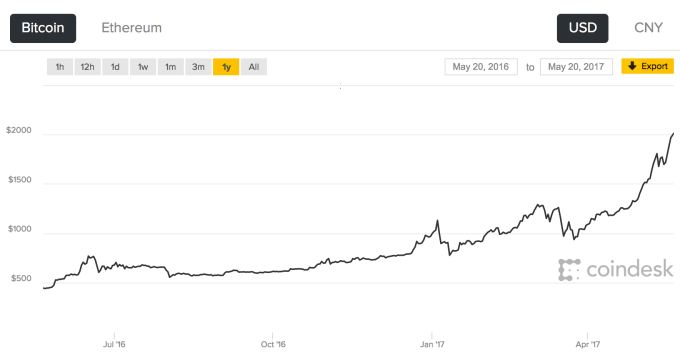
The world’s most popular cryptocurrency is now worth over $2,000 per coin. That’s according to a range of bitcoin exchanges, including Coinbase and Kraken. That valuation puts the total market cap of bitcoin — the total number of coins in circulation — at $32.92 billion.
Bitcoin has been on a tear this year, as this chart from Coindesk shows.
Bitcoin first broke the $1,000 valuation mark way back in 2013, but a combination of factors — including the implosion of then-top exchange Mount Gox — saw the currency drop in value. Support from financial institutions trialed bitcoin and blockchain-based services, and a general stability following new regulation in China, saw bitcoin return to the $1,000 mark again at the end of last year. Since then, its valuation has continued to grow consistently through 2017.
When we wrote about bitcoin (and ethereum) hitting all-time highs back at the end of April, you could buy a bitcoin coin for $1,343. Now, some three weeks later, the valuation is up 50 percent. The price of a coin rose 12 percent over the past week alone.
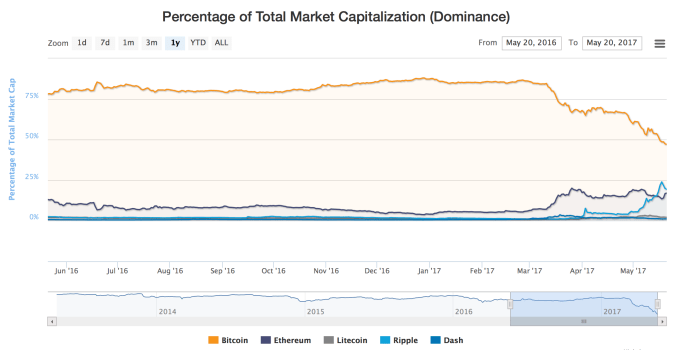
But bitcoin isn’t the only cryptocurrency on the rise. Ripple, the centralized currency that is aiming to be a settlement protocol for major banks, has surged more than 10x, or 1000% in under a month making it now the second most valuable cryptocurrency (only behind bitcoin) in circulation.
Similarly, ethereum, a cryptocurrency designed to function as a blockchain-based computing platform for developers, is now trading $130 per coin with a total market cap of just under $12B, which represents a a little more than a 2x increase over the last month.

The result of these increases is that bitcoin no longer constitutes the majority of the market cap for all cryptocurrencies. Today the total market cap of bitcoin represents just 47% of total cryptocurrencies – up until a few months ago it consistently hovered around 80%.
Why have these other cryptocurrencies been performing so much better than bitcoin? Some say it’s because of bitcoin’s scaling issue. The currency has grown so large that the network is having trouble quickly confirming transactions unless users attach hefty fees for minors. And while the problem can be fixed with solutions like SegWit or Bitcoin Unlimited, the most powerful miners (who effectively control the codebase of bitcoin) haven’t been able to come to a consensus on which new protocol to implement.
While increases of 10x in a month would typically be an obvious sign of a bubble, it’s a little different with cryptocurrencies because no one really knows how much they should be worth. Unlike a company there are no assets or revenues we can use to assess a predictable valuation. So in one sense, a total cryptocurrency market cap of $70B is insane – considering there is no tangible value behind it.
But on the other hand, if (any of) these cryptocurrencies actually replace or supplant a global store of value like gold, then $70B is nothing. For example, the total estimated value of all gold mined is around $8.2 trillion USD. Meaning that right now all cryptocurrencies put together don’t even equal 1% of the world’s gold reserves. Similarly, there is currently about $1.5 trillion USD in circulation, meaning that all cryptocurrencies today are still worth less than 5% of USD in circulation.
The currency is in unchartered waters at $2,000, but some pundits believe it has the potential to reach $10,000 (or more). To achieve this the community would likely have to sort out the scaling issue, which would give investors confidence that bitcoin’s infrastructure be able to support it as it grows.

FT : Athens calls on creditors to strike a deal

Athens calls on creditors to strike a deal
Greece says it has pushed through painful reforms and upheld bailout agreement

Greece is calling on its creditors to strike a deal that would allow it to honour billions of euros in debt repayments, arguing that it has upheld its side of the bargain by pushing through painful tax and pension reforms.

IMF officials and eurozone finance ministers will hold talks on Monday intended to pave the way for Athens’ next tranche of bailout aid so that it can make more than €7bn of debt repayments in July.

“Greece has done its bit, most would say more than its bit,” Euclid Tsakalotos, Greece’s finance minister, told the Financial Times.

He added that a deal would open the door to the country’s participation in the European Central Bank’s economic stimulus programme and provide “the signal to the markets that so many investors have been waiting for”.

The aid is dependent on bringing the IMF into the bailout programme as a financial partner.

But the fund has clashed with Greece’s eurozone creditors and, in particular, Germany, warning repeatedly that the country’s debt is unsustainable.

In response to the fund’s concerns, Greece has adopted tax, pension and labour market reforms that have brought protesters on to the streets in force. Last week the government was rocked by a 24-hour general strike, with further strikes either planned or under way in the shipping industry and local government.

The fund also insists that Greece’s eurozone creditors make more specific commitments to debt relief to make Athens’ burden more manageable.

But Wolfgang Schäuble, the finance minister for Germany, which holds a general election in September and whose public is increasingly resistant to further aid for Athens, argues that the need for further debt relief has yet to be established.

The European Commission has warned that the delays are wreaking economic damage on the country. Last week it slashed its growth forecasts for Greece saying that the uncertainty is already acting as a brake on investment.

Pierre Moscovici, the EU’s economy commissioner, echoed Mr Tsakalotos’ call for a swift deal. “It is clear that the Greek authorities are working hard to keep their end of the bargain,” he said. “I hope that all Greece’s partners will now keep theirs.”

EU officials warn that the Greek programme will run into logistical problems if a deal is not reached soon, especially given that approval procedures will be needed in some national parliaments to sign off the release of bailout aid.

One senior EU official puts the prospect of an accord on Monday at “50-50”.

According to people briefed on the talks, the sides have made progress in recent days with a tentative agreement that Greece’s current target of a primary surplus of 3.5 per cent of gross domestic product should be maintained for a further four years after 2018.

The main forms of debt relief envisaged by euro zone governments are maturity extensions for older bailout loans, and deferral of interest payments. Governments have firmly ruled out any cut in what Greece owes, while interest-rate caps also pose political and practical obstacles.

The talks have become snarled up on competing IMF and European predictions for Greece’s budget surpluses and growth stretching decades into the future. One person involved said planning debt relief based on the most pessimistic IMF forecasts would lead to Greece not paying off some bailout debts until after 2100, an outcome no one is seriously considering.

>>> Barrons weekend summary: positive cover story on select retailers; positive

Barrons weekend summary: positive cover story on select retailers; positive on Berkshire 
* Cover story: As AMZN continues to shake up the retail sector, forcing traditional players to adapt or close, “nine retail plays could thrive in a marketplace growing more competitive by the hour” (Positive on COST, WMT, LOW, BID, GGP, PRTY, BBY, HD, JWN). 
* Features: 1) The 2017 Barron’s 500, measuring operating performance based on cash flow and revenue growth, is topped by ABC, ABBV, MAR, SLF, and NVR; 2) Positive on Berkshire Hathaway: Company’s results are driven more by wholly owned businesses such as Burlington Northern and Berkshire Energy than its big equity portfolio. 
* Tech Trader: Cautious on PI, MRAM: Small chip companies offer genuine innovations and real breakthroughs that could put them at the forefront of new trends, though a bet on their stocks comes with some risk. 
* Trader: Leuthold Group chief investment officer Doug Ramsey said market breadth is too strong to suggest a top, while Marketfield Asset Management isn’t letting the threat of impeachment proceedings against Donald Trump change its outlook; At the recent SALT Conference, “the one thing everyone could agree on was that the turmoil that had engulfed the president is bad for the U.S.”; At the SALT conference, many investors agreed that master limited partnerships are investable again. 
* Profile: Sumanta Biswas and Bernard Horn, managers of the Pear Tree Polaris Foreign Value Small Cap fund, say this is an era of great opportunity for investors in foreign stocks (top 10 holdings: Dragerwerk, WorleyParsons, PrimaMeat Packers, Arcadis, Crest Nicholson Holdings, DFDS, freenet, BBA Aviation, Loomis, Taiwan Union Technology). 
* Interview: Dana Telsey, chief executive of the Telsey Advisory Group, says retailers are still good investments, though the sector is going through changes in how and what people buy. 
* Follow-Up: 1) Jeremy Siegel of the Wharton School says that if Donald Trump is impeached, the Dow could rise by 1,000 points, or 5%, even before vice president Mike Pence takes the helm; 2) Positive on FDC: Shares still trade at attractive below-market levels, and investors should hold onto them; 3) Cautious on Badger Daylighting: A number of questions about the company’s business remain, and investors should avoid shares until they understand what’s going wrong. 
* European Trader: Positive on VOD: British mobile phone operator seems to be improving its performance after struggling with competition and regulatory pressures. Asian Trader: “As the U.S. becomes ever more entangled in investigations of its recent presidential election mess, China is quietly easing itself to the forefront of the world stage.” 
* Emerging Markets: The MSCI index will next month likely confirm that Argentina will rise from a frontier to an emerging market in 2018, attracting new funds and investors. 
* Commodities: Oil prices are rising ahead of a May OPEC meeting at which the group will revisit last year’s decision to reduce production in order to boost prices. 
* Streetwise: With 51% of active managers beating their benchmarks this year, up from 31% in 2016, bullish strategists are struggling to persuade investors to keep buying stocks a little longer.