(Eveningstandard) Unilever on the City’s lips as chatter lays foundation for Es

Unilever on the City’s lips as chatter lays foundation for Estée Lauder bid

Rumours were bubbling that Estée Lauder, the American cosmetics giant with a market value of almost $40 billion (£31 billion), is being circled by interested parties.
City sources said the frontrunner is consumer goods giant Unilever. The company, which fended off a £115 billion takeover from Kraft Heinz so far this year, is weighing an approach, they said.


Unilever chief executive Paul Polman, keen to prove to shareholders the company is better off alone than as part of Kraft, is thought to be keen to bulk up in case the American firm returns with another bid. It is in the middle of selling its spreads business, including Flora, for around £6 billion.
The sources said Unilever, off 15.82p today at 4510.5p, will probably face competition from the likes of French cosmetics heavyweight L’Oréal, as well as 3G and Warren Buffett’s Berkshire Hathaway, who together control Kraft.
JAB, the owner of Rimmel-to-Max Factor group Coty which is selling shoemaker Jimmy Choo, is also tipped to join the fray, although there are questions about whether it would be able to finance a deal of that size.

Any bidder will have to win over the Lauder family. It still owns around 40% of Estée Lauder and nearly 90% of the voting rights. Unilever declined to comment. Estée Lauder and JAB could not be reached for comment.

>>> Fox-IT eyed by KPN - report (translated)

Fox-IT eyed by KPN - report (translated)
26 AUG 2017
Fox-IT, the Dutch cybersecurity company, is being eyed by telco KPN [AMS:KPN], De Telegraaf reported, citing unnamed sources.
Fox-IT is the prime provider of cybersecurity solutions for Dutch banks and the government of the Netherlands, the report noted.
KPN's overtures are still in the preliminary phase, the item added, as it is yet unclear whether the company is actually up for sale. The telco has not yet reached out to NCC Group [LON:NCC], Fox-IT's current owner.
The target's turnover stood at EUR 30m in 2015, the item added.
KPN and NCC Group would not respond to a request for comment by the Dutch-language newspaper.

>>> Barrons weekend summary: Cover story positive on suppliers for milita

Barrons weekend summary: Cover story positive on suppliers for military space tech; positive features on PYPL, MDT, YUMC, VNO, SLG 

* Cover story: With rocket launch costs falling during the past decade and tech billionaires pouring money into space ventures, a “new space age” is here; Private startups such as Arianespace, Blue Origin, OneWeb, and SpaceX pose a risk to incumbent satellite companies, but companies that cater to the military, such as BA, LMT, OA, and VSAT, are safer bets for investors. 

* Features: 1) Positive on VNO, SLG: Continued growth in commercial real estate development in Manhattan has dinged the shares of the two REITs, but industry pressure is already priced in, and each looks inexpensive; 2) Positive on MDT: Shares are down amid investor skepticism about the medical-device company’s ability to deliver continued growth, but the concern seems overblown, and new product launches should boost margins; 3) Positive on YUMC: As China’s middle-class population continues to grow the company is set to add 15,000 locations during the next 15 years, boosting profit growth and creating the possibility for a 30% return over the next year or two; 4) Positive on PYPL: Payment company’s deals with V and MA and its Choice feature have paid off, and new innovations it plans to release could send shares up by another 16%.

* Tech Trader: Positive on INTC: Sectors in which the tech giant once dominated, including servers and personal computers, have slowed down, but after missing the mobile revolution it could still gain ground in the computer-networking area dominated by CAVM, NXPI, QCOM, and Imagination Technologies. 

* Trader: The upcoming U.S. payrolls report could go a long way toward determining whether the Fed will raise rates, as the futures market is predicting, or keep tightening; Value stocks have lagged so badly during the past 10 years that may now be time to buy them; Canadian Tire—“a blend of SHLD, WMT, and TGT rolled into one”—has so far avoided being disrupted by AMZN, partly because Canada is a low-density market. 

* Profile: Mike Buckius and Paul Stewart of Gateway fund, one of the largest and oldest alternative mutual funds, employ an options strategy to get around high asset prices and geopolitical tension. 

* Interview: Doug Ramsey of Leuthold Group believes a short-term downturn is ahead, to be followed by an uptick in 2018 that could be the bull market’s last. 

* Follow-Up: Positive on AVGO: Shares still have room to run as the chipmaker benefits from AAPL’s new iPhone and ANET’s ongoing success, and for now the shares are reasonably priced. 

* European Trader: The rally in Polish stocks doesn’t seem likely to end yet; valuations remain attractive and the country’s economic and monetary policy backdrop is helping. 

* Asian Trader: Shares of South Korean stocks have taken a hit amid growing tensions between the U.S. and North Korea, presenting a buying opportunity for investors who can look past the situation. 

* Emerging Markets: Positive on INFY: Despite the recent board shakeup, company’s shares are “too cheap to ignore,” and several catalysts—including a major buyback—could push them higher. 

* Commodities: “When it comes to major oil producers’ market-share struggle against their U.S. shale rivals, there has been no clear winner—and that could keep prices stuck between $40 and $50 a barrel for the rest of the year.” 

* Streetwise: Fundstrat’s Thomas Lee expects companies to respond to tightening labor markets by spending more on technology and automation, and suggests investors look at “wage insensitive” companies with large market caps and sales per employee (Positive on Liberty Media, FB, OLED, AAPL, SBAC, ABMD).

Sky News : Chinese-backed fund closes in on bid for chipmaker Imagination

Chinese-backed fund closes in on bid for chipmaker Imagination
Canyon Bridge has hired Citi to advise on a formal bid for the struggling British chipmaker Imagination, Sky News learns.

A Chinese-backed fund is to test Theresa May's pledge to subject foreign takeovers‎ of British companies to closer scrutiny by lodging a formal bid for the struggling chipmaker Imagination Technologies.
Sky News has learnt that Canyon Bridge Capital Partners has hired advisers from the Wall Street bank Citi to work on an offer for Imagination, one of Britain's leading technology businesses.
Sources said this weekend that Canyon Bridge had made significant progress during talks with Imagination in recent weeks, with a formal bid expected to be presented to the London-listed group in the next fortnight.
They added that talks between Imagination and other unidentified parties were ongoing, and cautioned that Canyon Bridge could yet decide against making a formal bid.
Canyon Bridge has offices in Silicon Valley and Beijing but is ultimately funded by entities connected to the Chinese government.
Its interest in buying Imagination comes after the Hertfordshire-based company said in June that the loss of its contract to supply Apple with graphics technology for iPhones and iPads‎ meant it would put itself up for sale.
That move has left Imagination in dispute with Apple, with the British company telling the stock market last month that it had made "no progress" in resolving it.
It also said that it was examining the sale of two of its divisions, MIPS‎ and Ensigma, as well as listening to offers for the whole company.
Imagination designs and makes chips for smartphone manufacturers, and ‎also specialises in providing general purpose processing, where it counts the likes of Qualcomm and Broadcom among its key customers.
Despite the decline in its stock market value, with its shares down more than 42% over the last year, Imagination continues to be regarded as one of the UK's most technology companies.
That status was reinforced by the £24bn takeover of ARM Holdings, its fellow chip designer, by Japan's Softbank last year.
The deal came shortly after Mrs May became Prime Minister, since when she has vowed in the pages of the Conservatives' manifesto to reform the rules governing mergers and takeovers.
"We will require bidders to be clear about their intentions from the outset of the bid process; that all promises and undertakings made in the course of takeover bids can be legally enforced afterwards; and the Government can require a bid to be paused to allow greater scrutiny," the manifesto said.
It added that foreign ownership of companies controlling "important infrastructure" would not be allowed to undermine national security or "essential services".
A forthcoming green paper is expected to set out the Government's thinking on these issues in greater detail, but City sources believe that a Beijing-backed bid for Imagination‎ would force ministers to extract firm commitments about British technology jobs from Canyon Bridge.
The private equity firm has already been struggling to persuade US officials that it should be allowed to own Lattice Semiconductor, a manufacturer of specialist microchips, for which it offered $1.3bn last year.
Canyon Bridge has twice refiled an application to the Committee on Foreign Investment in the United States (CFIUS), which has a history of blocking sensitive takeovers of American assets.
Imagination's investors will be watching closely for details of the value attached to any offers for the company.
Its share price, which has fluctuated wildly in the last year, has left it with a market value of just £350m, down from about £2bn at its peak.
Rothschild, the investment bank, is advising Imagination on the talks with bidders.
Spokesmen for Canyon Bridge and Imagination both declined to comment this weekend.

>>> US Close Dow+0.14% S&P +0.17% Nasdaq -0.09% Russell +0.26%

Closing Market Summary: Stocks Finish Week on a Positive Note

Investors pushed the stock market modestly higher on Friday to end a largely positive week on a positive note. The S&P 500 and the Dow added 0.2% and 0.1%, respectively, while the tech-heavy Nasdaq underperformed, shedding 0.1%. For the week, the S&P 500 added 0.7%.

Arguably the most-anticipated events of the week--Friday speeches from Fed Chair Janet Yellen and ECB President Mario Draghi--turned out to be nonevents as the two central bankers provided the market with little to no new information.

Ms. Yellen praised the Fed's regulatory efforts while Mr. Draghi spoke in favor of open trade and argued for raising potential output growth, which was received as dovish. The two central bankers delivered their speeches at the annual Jackson Hole Symposium, which will wrap up on Saturday.

The U.S. Dollar Index (92.49, -0.74, -0.8%) moved sharply lower following the speeches, ending the day at its lowest level since January 2015. Meanwhile, U.S. Treasuries finished mostly higher; the 10-yr yield dropped three basis points to 2.17% while the 2-yr yield settled flat at 1.33%.

In the equity market, nine of the eleven sectors finished Friday in positive territory, but gains were modest for the most part. The telecom services group (+0.8%) showed relative strength while the remaining advancers settled with gains of 0.5% or less. Technology (-0.1%) and health care (-0.1%) were the two laggards.

Within the tech sector, chipmakers showed relative weakness, sending the PHLX Semiconductor Index lower by 0.5%. Broadcom (AVGO 245.59, -9.46) led the semiconductor retreat, dropping 3.7%, despite beating bottom-line estimates.

Meanwhile, within the health care group, biotech names underperformed, evidenced by the 0.6% decrease in the iShares Nasdaq Biotechnology ETF (IBB 311.05, -1.82).

On a positive note, the Dow Jones Transportation Average, which is seen as a leading indicator, registered its third win of the week, climbing higher by 1.3%.

Reviewing Friday's economic data, which was limited to July Durable Orders:

  • July durable goods orders declined 6.8%, which is more than the 6.0% decrease expected by the consensus. The prior month's reading was revised to +6.4% (from +6.5%). Excluding transportation, durable orders increased 0.5% (consensus +0.5%) to follow the prior month's revised uptick of 0.1% (from 0.2%).
    • The upshot of the report was in the shipments and new orders for nondefense capital goods excluding aircraft. Shipments for that component, which factors into GDP computations, increased 1.0% while orders, which are considered a proxy for business spending, increased 0.4%. The key takeaway from the report, then, is that it connotes good growth news for the manufacturing sector early in the third quarter.

On Monday, investors will receive two pieces of economic data--July International Trade in Goods and Advance Wholesale Inventories. Both reports will cross the wires at 8:30 ET.

  • Nasdaq Composite +16.4% YTD
  • Dow Jones Industrial Average +10.4% YTD
  • S&P 500 +9.1% YTD
  • Russell 2000 +1.6% YTD

Medium : The Logic of Risk Taking

A central chapter that crystallizes all my work. In forth. Skin in the Game
Time to explain ergodicity, ruin and (again) rationality. Recall from the previous chapter that to do science (and other nice things) requires survival but not the other way around?

The difference between 100 people going to a casino and one person going to a casino 100 times, i.e. between (path dependent) and conventionally understood probability. The mistake has persisted in economics and psychology since age immemorial.
Consider the following thought experiment.
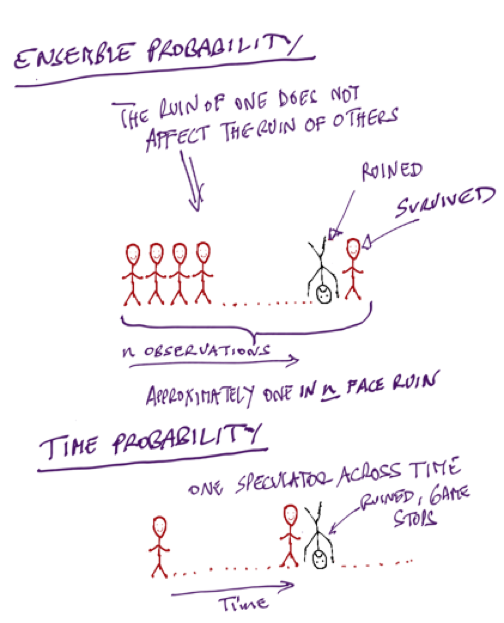
First case, one hundred persons go to a Casino, to gamble a certain set amount each and have complimentary gin and tonic –as shown in the cartoon in Figure x. Some may lose, some may win, and we can infer at the end of the day what the “edge” is, that is, calculate the returns simply by counting the money left with the people who return. We can thus figure out if the casino is properly pricing the odds. Now assume that gambler number 28 goes bust. Will gambler number 29 be affected? No.
You can safely calculate, from your sample, that about 1% of the gamblers will go bust. And if you keep playing and playing, you will be expected have about the same ratio, 1% of gamblers over that time window.
Now compare to the second case in the thought experiment. One person, your cousin Theodorus Ibn Warqa, goes to the Casino a hundred days in a row, starting with a set amount. On day 28 cousin Theodorus Ibn Warqa is bust. Will there be day 29? No. He has hit an uncle point; there is no game no more.
No matter how good he is or how alert your cousin Theodorus Ibn Warqa can be, you can safely calculate that he has a 100% probability of eventually going bust.
The probabilities of success from the collection of people does not apply to cousin Theodorus Ibn Warqa. Let us call the first set ensemble probability, and the second one time probability (since one is concerned with a collection of people and the other with a single person through time). Now, when you read material by finance professors, finance gurus or your local bank making investment recommendations based on the long term returns of the market, beware. Even if their forecast were true (it isn’t), no person can get the returns of the market unless he has infinite pockets and no uncle points. The are conflating ensemble probability and time probability. If the investor has to eventually reduce his exposure because of losses, or because of retirement, or because he remarried his neighbor’s wife, or because he changed his mind about life, his returns will be divorced from those of the market, period.
We saw with the earlier comment by Warren Buffet that, literally, anyone who survived in the risk taking business has a version of “in order to succeed, you must first survive.” My own version has been: “never cross a river if it is on average four feet deep.” I effectively organized all my life around the point that sequence matters and the presence of ruin does not allow cost-benefit analyses; but it never hit me that the flaw in decision theory was so deep. Until came out of nowhere a paper by the physicist Ole Peters, working with the great Murray Gell-Mann. They presented a version of the difference between the ensemble and the time probabilities with a similar thought experiment as mine above, and showed that about everything in social science about probability is flawed. Deeply flawed. Very deeply flawed. For, in the quarter millennia since the formulation by the mathematician Jacob Bernoulli, and one that became standard, almost all people involved in decision theory made a severe mistake. Everyone? Not quite: every economist, but not everyone: the applied mathematicians Claude Shannon, Ed Thorp, and the physicist J.-L. Kelly of the Kelly Criterion got it right. They also got it in a very simple way. The father of insurance mathematics, the Swedish applied mathematician Harald Cramér also got the point. And, more than two decades ago, practitioners such as Mark Spitznagel and myself build our entire business careers around it. (I personally get it right in words and when I trade and decisions, and detect when ergodicity is violated, but I never explicitly got the overall mathematical structure –ergodicity is actually discussed in Fooled by Randomness). Spitznagel and I even started an entire business to help investors eliminate uncle points so they can get the returns of the market. While I retired to do some flaneuring, Mark continued relentlessly (and successfully). Mark and I have been frustrated by economists who, not getting ergodicity, keep saying that worrying about the tails is “irrational”.

Mark Spitznagel explaining (politely) that finance professors are probability challenged
Now there is a skin in the game problem in the blindness to the point. The idea I just presented is very very simple. But how come nobody for 250 years got it? Skin in the game, skin in the game.
It looks like you need a lot of intelligence to figure probabilistic things out when you don’t have skin in the game. There are things one can only get if one has some risk on the line: what I said above is, in retrospect, obvious. But to figure it out for an overeducated nonpractitioner is hard. Unless one is a genius, that is have the clarity of mind to see through the mud, or have such a profound command of probability theory to see through the nonsense. Now, certifiably, Murray Gell-Mann is a genius (and, likely, Peters). Gell-Mann is a famed physicist, with Nobel, and discovered the subatomic particles he himself called quarks. Peters said that when he presented the idea to him, “he got it instantly”. Claude Shannon, Ed Thorp, Kelly and Cramér are, no doubt, geniuses –I can vouch for this unmistakable clarity of mind combined with depth of thinking that juts out when in conversation with Thorp. These people could get it without skin in the game. But economists, psychologists and decision-theorists have no genius (unless one counts the polymath Herb Simon who did some psychology on the side) and odds are will never have one. Adding people without fundamental insights does not sum up to insight; looking for clarity in these fields is like looking for aesthetic in the attic of a highly disorganized electrician.

The clarity of the mind of psychogists and economists
Ergodicity
As we saw, a situation is deemed non ergodic here when observed past probabilities do not apply to future processes. There is a “stop” somewhere, an absorbing barrier that prevents people with skin in the gamefrom emerging from it –and to which the system will invariably tend. Let us call these situations “ruin”, as the entity cannot emerge from the condition. The central problem is that if there is a possibility of ruin, cost benefit analyses are no longer possible.[i]
Consider a more extreme example than the Casino experiment. Assume a collection of people play Russian Roulette a single time for a million dollars –this is the central story in Fooled by Randomness. About five out of six will make money. If someone used a standard cost-benefit analysis, he would have claimed that one has 83.33% chance of gains, for an “expected” average return per shot of $833,333. But if you played Russian roulette more than once, you are deemed to end up in the cemetery. Your expected return is … not computable.
Repetition of Exposures
Let us see why “statistical testing” and “scientific” statements are highly insufficient in the presence of ruin problems and repetition of exposures. If one claimed that there is “statistical evidence that the plane is safe”, with a 98% confidence level (statistics are meaningless without such confidence), and acted on it, practically no experienced pilot would be alive today. In my war with the Monsanto machine, the advocates of genetically modified organisms (transgenics) kept countering me with benefit analyses (which were often bogus and doctored up), not tail risk analyses for repeatedexposures.
Psychologists determine our “paranoia” or “risk aversion” by subjecting a person to a single experiment –then declare that humans are rationally challenged as there is an innate tendency to “overestimate” small probabilities. It is as if the person will never again take any personal tail risk! Recall that academics in social science are … dynamically challenged. Nobody could see the grandmother-obvious inconsistency of such behavior with our ingrained daily life logic. Smoking a single cigarette is extremely benign, so a cost-benefit analysis would deem one irrational to give up so much pleasure for so little risk! But it is the act of smoking that kills, with a certain number of pack per year, tens of thousand of cigarettes –in other words, repeated serial exposure.
Beyond, in real life, every single bit of risk you take adds up to reduce your life expectancy. If you climb mountains and ride a motorcycle and hang around the mob and fly your own small plane and drink absinthe, your life expectancy is considerably reduced although not a single action will have a meaningful effect. This idea of repetition makes paranoia about some low probability events perfectly rational. But we do not need to be overly paranoid about ourselves; we need to shift some of our worries about bigger things.
Who is “You”?
Let us return to the notion of “tribe” in Chapter x. The defects people get from studying modern thought is that they develop the illusion that each one of us is a single unit, without seeing the contradiction in their own behavior. In fact I’ve sampled ninety people in seminars and asked them: “what’s the worst thing that happen to you?” Eighty-eight people answered “my death”.
This can only be the worst case situation for a psychopath. For then, I asked those who deemed that the worst case is their own death: “Is your death plus that of your children, nephews, cousins, cat, dogs, parakeet and hamster (if you have any of the above) worse than just your death? Invariably, yes. “Is your death plus your children, nephews, cousins (…) plusall of humanity worse than just your death? Yes, of course. Then how can your death be the worst possible outcome?[1]
Thus we get the point that individual ruin is not as big a deal as the collective one. And of course ecocide, the irreversible destruction of the environment, is the big one to worry about.
Figure 9 The layers of risk –Taking personal risks to save the collective are “courage” and “prudence” since you are lowering risks for the collective.
To use the ergodic framework: My death at Russian roulette is not ergodic for me but it is ergodic for the system. The precautionary principle, in the formulation I did with a few colleagues, is precisely about the highest layer.
About every time I discuss the precautionary principle, some overeducated pundit suggests that “we cross the street by taking risks”, so why worry so much about the system? This sophistry usually causes a bit of anger on my part. Aside from the fact that the risk of being killed as a pedestrian is one per 47,000 years, the point is that my death is never the worst case scenario unless it correlates to that of others.
I have a finite shelf life, humanity should have an infinite duration.
Or
I am renewable, not humanity or the ecosystem.
Even worse, as I have shown in Antifragile, the fragility of the components is required to ensure the solidity of the system. If humans were immortals, they would go extinct from an accident, or from a gradual buildup of misfitness. But shorter shelf life for humans allows genetic changes to accompany the variability in the environment.
Courage And Precaution Aren’t Opposite

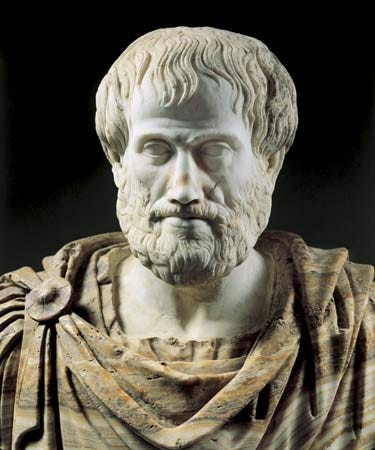
Aristotle
How can courage and prudence be both classical virtues? Virtue, as presented in Aristotle’s Nichomachean Ethics includes: sophrosyne (σωφροσύνη),prudence, a form of sound judgment he called more broadly phronesis. Aren’t these inconsistent with courage?
In our framework, they are not at all. They are actually, as Fat Tony would say, the same ting. How?
I can exercise courage to save a collection of kids from drowning, and it would also correspond to some form of prudence. I am sacrificing a lower layer in Figure x for the sake of a higher one.
Courage, according to the Greek ideal that Aristotle inherited–say the Homeric and the ones conveyed through Solon, Pericles, and Thucydides, is never a selfish action:
Courage is when you sacrifice your own wellbeing for the sake of the survival of a layer higher than yours.
As we can see it fits into our table of preserving the sustainability of the system.
A foolish gambler is not committing an act of courage, especially if he is risking other people’s funds or has a family to feed. And other forms of sterile courage aren’t really courage.[2]
Notes
[1] Actually, I usually joke my death plus someone I don’t like such as the psychologist Steven Pinker surviving is worse than just my death.
[2] To show the inanity of social science, they have to muster up the sensationalism of “mirror neurons”
[i] The following question arises. Ergodicity is not statistically identifiable, not observable, and there is no test for time series that gives ergodicity, similar to Dickey-Fuller for stationarity (or Phillips-Perron for integration order). More crucially: if your result is obtained from the observation of a times series, how can you make claims about the ensemble probability measure?
The answer is similar to arbitrage, which has no statistical test but, crucially, has a probability measure determined ex ante (the “no free lunch” argument). Further, consider the argument of a “self-financing” strategy, via, say, dynamic hedging. At the limit we assume that the law of large numbers will compress the returns and that no loss and no absorbing barrier will ever be reached. It satisfies our criterion of ergodicity but does not have a statistically obtained measure. Further, almost all the literature on intertemporal investments/consumption requires absence of ruin.
We are not asserting that a given security or random process is ergodic, but that, given that its ensemble probability (obtained by cross-sectional methods, assumed via subjective probabilities, or, simply, determined by arbitrage arguments), a risk-taking strategy should conform to such properties. So ergodicity concerns the function of the random variable or process, not the process itself. And the function should not allow ruin.
In other words, assuming the SP500 has a certain expected return “alpha”, an ergodic strategy would generate a strategy, say Kelly Criterion, to capture the assumed alpha. If it doesn’t, because of absorbing barrier or something else, it is not ergodic.
FT : An outbreak of realism in Britain over Brexit

An outbreak of realism in Britain over Brexit

There has been a shift in what the UK believes it can achieve in EU talks

This has been an important week in Britain’s approach to the Brexit negotiations. Until a few days ago, Theresa May’s government appeared vague in its stance on the talks, providing little detail about what kind of Brexit it seeks. The publication of seven official papers by Whitehall over the past 10 days marks a shift and suggests the UK is becoming more realistic about what it can achieve.

The most significant paper concerns how the UK and EU could resolve future disputes over trade standards and rules. Until now, Britain has been tied by Mrs May’s insistence on leaving the remit of the European Court of Justice. However, London now recognises that (in the words of one minister) it will have to keep “half an eye” on the ECJ if the UK is to retain a privileged trading relationship with EU members.

The government has also been a little clearer about its intentions as regards the customs union. Britain will leave the customs union but it wants a new long-term agreement that replicates present arrangements. Precisely how this will be achieved is left unclear. But Britain’s position paper helps to soften talk of a decisive departure from the EU, mitigating the potential economic damage of Brexit.

The May government has one overall aim in publishing these papers now. It wants to persuade the EU to move from phase one of the talks (the divorce) to phase two (the wider trading relationship) at the next big meeting of EU heads of government in October. UK ministers know the clock is ticking towards departure and they want to make progress towards a final deal. 

However, it is unclear whether Brussels will agree to the UK’s demand. EU leaders do not want to blur their insistence that there should be sufficient progress on three issues (rights for European expatriates, the Irish border and the UK’s financial settlement on departure) before they move to phase two. And while the UK has produced papers on the first two of these issues, it has produced no paper on the third, which is in some ways the most politically charged.

Even so, it is striking that foreign secretary Boris Johnson has on Friday shifted language on the financial settlement. A few weeks ago, he said the EU could “go whistle” over demands for a hefty bill. Now he is more emollient. “Of course we will meet our obligations,” he told the BBC on Friday morning. We are law-abiding, bill-paying people. We will certainly have to meet our obligations.”


Many commentators are struck by how the government is sounding more realistic on other fronts too. The cabinet now agrees on the need for a post-Brexit transition lasting three years, and on the need to grant generous citizens’ rights for EU nationals. There is also consensus about the potential influence of the ECJ. As Rupert Harrison, the former adviser to chancellor George Osborne, tweeted this week: “A sensible UK approach is hiding in plain sight.”

Whether this will be enough to take the UK-EU talks to a new and more harmonious level remains to be seen. Financial market operators are clearly worried by the prospect of a stalemate. One sign of their concerns came on Wednesday when sterling fell to its lowest closing level against the euro for eight years. Hans Redeker, global head of forex strategy at Morgan Stanley, forecasts euro-sterling parity by the end of this year. For analysts such as him, the UK economic environment looks increasingly fragile. 


Please use the sharing tools found via the email icon at the top of articles. Copying articles to share with others is a breach of FT.com T&Cs and Copyright Policy. Email licensing@ft.com to buy additional rights. Subscribers may share up to 10 or 20 articles per month using the gift article service. More information can be found at https://www.ft.com/tour.

Article 50: The Brexit divorce paper

Further reading
Whittling away at Brexit
Martin Kettle writes that the case for Britain to remain in the EU’s single market and customs union is growing stronger and more irresistible by the day. (Guardian) 

Not whistling now
Boris Johnson has conceded that the UK will pay money to the EU as part of the Brexit process. He previously said the EU could “go whistle” over a reported bill of between €60bn and €100bn. (Politico.eu)

The Efta option
Carl Baudenbacher, the President of the Court of the European Free Trade Association (EFTA) — which judges cases concerning Iceland, Liechtenstein and Norway — argues that Britain could use his court to resolve disputes. 

Hard numbers
From FastFT Not quite parity? 


Paul McClean writes: The pound will continue to slide against the euro in the coming months and will take longer than previously expected to recover, but is unlikely to reach parity with the single currency, according to analysts at ING.

Foreign exchange experts at the bank have revised their forecasts for euro-sterling, and now forecast more short-term pressure for the pound in the face of a crucial month of political events, with the Tory party conference, the final round of opening Brexit talks, and the EU summit all to come in October.

They also forecast a more gentle recovery; having previously thought the euro would retract to £0.80 against the pound by the end of 2018, they now forecast it will not fall below £0.85 by then.

But Viraj Patel, head of foreign exchange at the Dutch bank, insists that parity with the euro is not on the horizon, unless the UK suffers “a nightmare Brexit scenario” with a “complete breakdown” of negotiations.

“We do think the growing consensus within Theresa May’s cabinet over a transitional arrangement means that the tail risks of a cliff-edge Brexit are diminishing,” he said, adding that progress towards a transition deal was also likely to boost the pound.

ING also argue that the pound is “extremely undervalued” at present, with euro-sterling 20 per cent higher than it should be, and also note that parity with the euro would not be “in the economic interests” of the Bank of England, given its contribution to higher inflation and squeezed household incomes.

>>> Fed's Mester on CNBC

Fed's Mester on CNBC
  • Does not have to have an economist in charge but there needs to be economists surrounding a decision maker.
  • Says not looking at possible shut down when making decision on rates.
  • Reiterates need to remove some accomodat