>>> HTC Corp VR business attracts interests from Baidu, Alibaba, Tencent and Goo

HTC Corp VR business attracts interests from Baidu, Alibaba, Tencent and Google

The Taiwan-based consumer electronics company HTC Corp’s (TPE: 2498) Virtual Reality (VR) business, has attracted interests from Baidu (NASDAQ:BIDU), Alibaba Group (NYSE:BABA), Tencent (HKG:0700) and Google (NASDAQ:GOOAV), the Apple Daily reported, citing an industry source’s Weibo.
The Chinese-language report Apple Daily cited Lengxi Dev’s Weibo which said it seems that HTC Corp intends to have more contact with Google. Lengxi Dev is a Taiwan-based source from the supply chain industry. The VR business has a value of approximately USD 1bn, he wrote in Weibo.
Bloomberg News, citing an unnamed source familiar with the situation, reported that HTC Corp has met several potential buyers, including Google. However, the source emphasized that the parties are not likely to make decision on any deal.
Baidu (NASDAQ:BIDU), Alibaba Group (NYSE:BABA), Tencent are China-based internet enterprises and Google is an US-based company engaged in providing internet-related services.

Recode.net : SpaceX’s Hyperloop Pod speed competition winner tops 200 MPH

SpaceX’s Hyperloop Pod speed competition winner tops 200 MPH
SpaceX held its second Hyperloop Pod design competition for student feeds at the test track built near its test track today. The mile long track saw three finalist teams battle it out for speed supremacy, including WARR Hyperloop from Germany, Switzerland’s Swissloop and Paradigm, a North American team with members from Northeastern and Memorial University in Newfoundland, Canada.
The winner was WARR, which was built by students at the Technical University of Munich, ran at a speed of 324 km/h, which is over 201 mph. That easily topped the next place team, and the WARR unit was the only to even attempt to reach its top speed during the runs.
The team earned the praise of SpaceX co-founder and CEO Elon Musk with the victory, who said that it was extremely impressive as a result from a student initiative. Musk ramped up the stakes immediately, however, saying that he believes with work it would be possible to get up to above 500 km/h even in the relatively short mile-long test track SpaceX currently has in place.

There will be more opportunities to compete, too – Musk also announced that as of today, SpaceX has decided to host the competition again next year, marking the third running of the pods. The competition itself is a volunteer effort but on by SpaceX (and, notably this year, The Boring Company) employees who volunteer their time on race day and also help mentor the students working on the pods, and prepare for the tests.
    The three teams that competed on Sunday were selected from the larger group based on satisfying a number of pre-run criteria, including tests designed to ensure their vehicles can run in the mile of test track with a relative guarantee of safe performance. WARR’s Pod also did well in the January Hyperloop Pod competition, achieving the top speed, then, too. WARR’s January speed was only 58 mph, however, to give you an idea of just how far its come.
    The WARR pod is built entirely of a carbon fiber, which helps it keep weight down and lends to it ability to reach high speeds in the functional vacuum conditions of the depressurized tube interior. Both the other competitors in the final faced some technical issues, including a tube pressurization problem for Paradigm that meant they did their run in less than vacuum conditions, and some connectivity problems for Swissloop.
    Paradigm was the only team to use air bearings, as described in the original Hyperloop white paper released by Elon Musk, and WARR’s pod won thanks to its electric motor and lightweight 176 lb frame.

    9to5Mac : Apple to host Star Wars-themed in-store sessions in celebration of For

    Apple interested in Star Wars Franchise...maybe first step of more collabaration, tied up between Apple and Disney... I still think this will make a lot of sens...long Disney...L.C.

    Article :

    Apple to host Star Wars-themed in-store sessions in celebration of Force Friday II

    As we approach “Force Friday II” this week, Apple is ramping up its commitment to the celebration. On its website, Apple has outlined a handful of different Star Wars-themed events it will be hosting for free in its retail stores over in the coming week…

    As outlined by MacRumors, Apple will host these events from Friday, September 1st through Saturday, September 9th in the following countries:

    United States, Australia, Canada, Mexico, Taiwan, UK, France, Belgium, Germany, Netherlands, the United Arab Emirates, Spain, Hong Kong, Italy, Switzerland, and Sweden

    Headlining the events and being offered at most retail stores in participating countries is a session dedicated to helping attendees build their own Star Wars trailer with an iPad and iMovie:

    How To: Build Your Own Star Wars Trailer

    Explore how to create a Star Wars trailer with authentic footage from the films. You’ll discover signature Star Wars trailer-making techniques in an exclusive video from The Last Jedi director, Rian Johnson. Then you’ll create your own trailer complete with titles, transitions, sound effects, and official Star Wars music using iPad and iMovie.

    Another popular session will be part of Apple’s “Kids Hour” series, which helps children between the ages of 6 and 12 learn how to code. The Star Wars-themed session will focus on programming a BB-8 droid:

    Kids Hour: Coding the Droids from Star Wars

    Join us for an exciting Kids Hour starring the galaxy’s favorite droids. Using the same code developers use every day, kids will bring Star Wars droids to life by programming simple movements, loops, and more. Then they’ll design a maze and navigate their droids through the obstacles. Kids can bring their own iPad and Sphero robot, or we’ll provide them. Recommended for ages 6 to 12.

    A variety of other sessions are being offered as part of Apple’s celebrations of Force Friday II. For instance, visual effects and animation studio Industrial Light & Magic of Lucasfilm will talk about how they’re using animation and 3D modeling during a session at the Union Square store in San Francisco:

    Join ILM’s Hal Hickel, Landis Fields, and Colie Wertz and explore how they use animation and 3D modeling to bring the Star Wars galaxy to life. They’ll share their creative process, and give you a behind-the-scenes look at their journey from stop motion to CG. Then you’ll create your own Star Wars droids using the same techniques used at ILM—all with iPad Pro and Apple Pencil.

    In addition to the in-store sessions, it was previously announced that augmented reality Star Wars characters would appear in Apple retail stores next week as well. Force Friday II will begin at midnight PDT (3am ET) on September 1st. As for The Last Jedi,itself, you’ll need to wait for that to hit theaters on December 15.

    FT : Who is the sucker when robot trades against robot?

    Who is the sucker when robot trades against robot?  
    https://www.ft.com/content/d3d14d3a-8974-11e7-8bb1-5ba57d47eff7
    Quant funds struggle for returns as sector becomes more crowded

    It turns out that the robots are human after all.

    There has been an explosion of interest in computer-powered investing of all kinds in recent years. Barclays estimates that the assets managed by so-called quantitative hedge funds have doubled over the past decade and hit a record $500bn last year.

    Unfortunately, the performance has atrophied in tandem with their trendiness. The average equity hedge fund has gained 7.7 per cent this year, according to HFR, while quant equity funds have gained only 4.9 per cent. Quant “macro” funds, which invest across markets, have lost 1.4 per cent.

    “There have been some unison screams this year,” says Wesley Chan, a quantitative fund manager at Acadian Asset Management.

    There have been no major blow-ups, but for many funds until recently basking in the ravenous appetite for nearly all algorithmic strategies, it makes for an uncomfortable period and raises questions over whether quants are merely suffering a sour spell, or if something more fundamental is occurring.

    Neal Berger, chief investment officer of Eagle’s View Asset Management, a fund-of-funds, thinks it may be the latter. In a letter to investors he said that the “fantastic returns” of many quants has attracted too much money. This is in turn eroding the opportunities for everyone, and turning once-profitable strategies into duds, a phenomenon known as “crowding”.


    “With all the geniuses in quant, high-powered computers and enormous data, where are the ‘suckers’ who are providing the juice for all of these absolute return quantitative strategies?” Mr Berger asked. “We have a condition among the traditional quantitative strategies whereby we have robots trading against robots.”

    Quants scoff at this. Philippe Jordan, the president of Capital Fund Management, points out that eight months of performance is far too short a timeframe to make sweeping judgments, and highlights how many funds and strategies are still doing well. “These numbers are completely within the normal distribution,” he says.

    Indeed, quantitative investing is a broad church that can include everything from the relatively simple to achingly complex algorithmic strategies that mine vast seas of digital data for faint but profitable signals across financial markets. That makes it difficult to draw general conclusions.

    “The quant term is kind of useless,” says Anthony Morris, head of quantitative strategies at Nomura. “It’s a sloppy description, which like ‘hedge fund’ can mean almost anything.”


    Indeed, HFR’s average performance numbers obscure a wide divergence in performances among different funds and strategies, which offer clues on what has worked and what has fizzled this year — and why.

    Some traditional powerhouses of the quant investing world continue to do well. Renaissance Technologies’ main equity fund is up 10 per cent in the year to August 4, and two of its other funds have returned 7.6 per cent and 11.3 per cent, according to a person familiar with the matter. But these are primarily equity funds with a bias towards betting on stocks gaining — which they have for most of the year.

    Mr Jordan says other quant equity strategies, such as “market neutral” or “statistical arbitrage”, have had a harder time. But many of the poorer-performing funds are so-called “trend followers”. Again, the details vary greatly, but they primarily surf market momentum, going short when an asset class is falling, or piling in when the trend is positive.

    Several big names have struggled. AHL’s Alpha and Dimension funds have gained only 1-2 per cent this year; BlueTrend, a fund run by Leda Braga’s Systematica, has lost 6.4 per cent, while David Harding’s $9.9bn Winton Futures Fund has trod water.

    But some have done well. For example, AHL’s Evolution fund is up 9.6 per cent in the year to the end of July, and Systematica’s Alternative Markets Fund has returned 11.4 per cent. Crucially, however, these two funds take advantage of momentum in less liquid, less efficient markets, not the major ones that tend to be popular with trend-followers.

    Mr Morris points out that the divergence is probably caused by their asset mix. Some trend-followers lean towards equities — which have enjoyed strong, positive momentum this year — while others tilt towards fixed income or commodities, which have been jittery. “Asset allocation matters in quantitative investing, as it does in everything else,” Mr Morris says.

    That’s not to say that crowding isn’t part of the answer in some cases. A 2016 paper by the academics Jeffrey Pontiff and David McLean kicked the tyres of 96 separate investment “factors” and discovered that their market-beating returns on average halved after they became known. In other words, once a signal is discovered, it rapidly loses its value, a process known as “alpha decay”.

    Nonetheless, quants are well aware of this, and are constantly scouring markets for new signals to mine. And investors are likely to keep faith. Emma Bewley, head of fund investment at Connection Capital, points out that all strategies suffer periodic downturns, and expects quant allocations to continue.

    “They can’t all perform brilliantly all the time, and they don’t,” she says. “I’m not convinced that crowding is an issue. It might become one eventually but I don’t think that is the issue today.”

    WWD : CEO Talks: Michael Ward, Harrods’ Managing Director, on His Vision for the

    CEO Talks: Michael Ward, Harrods’ Managing Director, on His Vision for the Retailer
    Ward, who tried — unsuccessfully — to step down last year, wants to make the store more experiential.

    LONDON — Before Michael Ward arrived at Harrods, management was one big merry-go-round under the mercurial, controversial — and ever-colorful — Mohamed Al Fayed, who eventually sold the store to Qatar Holding LLC, the investment company linked to the royal family of the Gulf state, for $2.22 billion.

    Ward, who joined Harrods in 2005, broke the spell. A charmer and diplomat with a nose for numbers and a passion for product — he speaks as enthusiastically about his new Big Green Egg barbecue as he does about the rare pink diamonds in Harrods’ fine jewelry department — Ward knew how to manage Al Fayed (not an easy task) and drive sales and profits at the iconic Knightsbridge retailer.

    He was also the man who helped Harrods transition successfully to new ownership under the Qataris in 2010, and has been instrumental in attracting and accommodating tourists from China, the Middle East and Africa. On Ward’s watch, the store has grown alongside competitors such as Selfridges, and continues to invest and expand.

    In fiscal 2016, Harrods saw a 4 percent uptick in sales to 1.4 billion pounds, and a 40 percent rise in operating profit to 178 million pounds, with particularly strong trading in fine jewelry and watches.

    The store has also been budgeting about 50 million pounds a year in capital expenditure, with recent launches including the Wellness Clinic and an expanded Salon de Parfums. There are more changes on the way.

    Ward tried to resign last year, but the Qatari investors wouldn’t let him and instead asked him to stay and oversee further expansion and refurbishment. He’s now back at Harrods indefinitely and preparing to upgrade the food hall and beauty, fine watches and men’s wear departments.

    Ward, who is from northeast England and has homes in the Midlands and in London, started his career in chartered accountancy, training originally with Ernst & Young in 1980 before becoming group finance director for Bassett Foods Plc in 1986, gaining an MBA at the same time. In 1989, he took up a similar role at the drinks company H.P. Bulmer Holdings Plc.

    In 1994, he became managing director of Lloyds Chemists Plc, and later held retail roles at companies including the private equity group Apax Partners. The shift to fashion and luxury retail wasn’t a difficult one.

    “We are very simple retailers,” said Ward. “If you’ve got beautiful stock, great ambience and amazing, knowledgeable service, you’ll do well.”

    Here, he talks about expansion at Harrods, the devils on his shoulders and the reason he decided to stay at the store.

    WWD: What’s been the thinking behind all the structural changes at Harrods?

    Michael Ward: I always say I’ve got two little devils on my shoulder. One of them is Hermès, and the other is Chanel. When somebody presents me with something, I look over on one shoulder and say, “But would Hermès do this?” And I look at the other shoulder and think, “Well, would Chanel do this?” If the answer is no, then why would Harrods do it? And that’s been a great big guiding light in terms of “How do we make this building just exceptional?”

    We can’t afford to stand still, and we really believe in the growth in the luxury industry. We believe that if we make the store experiential, if we stretch the consumer’s imagination and expectation of a department store, we will be successful.

    WWD: What projects do you have in the pipeline?

    M.W.: We want to make the food halls the gourmet capital of London once again. We want to bring excitement and entertainment into them, and put the product at the core. Over the next three years we’re redoing all four food halls. We’ve been getting the best patisserie chefs from the best culinary schools in Europe and are bringing them to London. We’ll have an amazing sourdough bakery, and a chef — effectively — who controls coffee roasting. We’re going to build a new wine and spirits area, and a new cigar lounge.

    We are doubling the size of our watch space. Our job is to make sure we get the really unique and amazing pieces. There will be private consultation areas and amazing amounts of stock. Most retailers fall down because they don’t have the stock. If you go to our Rolex department in general and say, “I would like a Daytona,” they will give you the choice of every one other than the one that’s on the waiting list. The customer wants to walk in and see the gold, the rose gold, the steel and gold, and the steel. They want to choose, and they want to walk away with it, which means we have to have millions of pounds worth of watches in stock, which we do. It’s about making the consumer happy.

    WWD: Do people buy fine jewelry in the same way?

    M.W.: When we started the journey in fine jewelry I remember that big sales were a rarity. Now they are the norm. What we’ve done is created that environment where we have the best jewelers in the world in one place. Today, people ring us up and say, “I’m thinking about buying a 3-carat pink diamond.” Pink diamonds are like hens’ teeth, but we can present them with a number of examples from the jewelry room.

    WWD: Can you talk about your plans to expand the ground floor beauty hall?

    M.W.: People want the experiential side of beauty: They want to understand how to sculpt, to contour, to do that eye look, which is why we’ve seen the emergence of these disruptor brands like Huda, which has gone from nothing to being in our top five brands. We’ve seen the emergence of Charlotte Tilbury. It’s about the immersion and the education. That’s central. What we want to do is create a new area for beauty, and we’re going to broadly double the size of our beauty business to be able to engage with those new trends.

    On the ground floor, the beauty rooms will become fashion accessories rooms, while the whole run at the back will become beauty, with the lower ground floor turned into beauty and consulting rooms. That means we’re going to have to relocate men’s. Our men’s wear business is one of our fastest-growing apparel businesses, so we’re going to put them on the entirety of the second floor. Our intention is to create a replica of what we’ve done for women’s with Super Brands, and to take men’s retailing to a totally different level.

    WWD: Harrods has always been a magnet for tourists. What sort of trends are you seeing?

    M.W.: People love coming to London, and that’s why we’ve seen strong tourism. It’s been very strong from China and from Southeast Asia, and there is continued strength from the Middle East. There is also an increasing interest and growth from America. For Americans, the cost of coming to London is a lot less, so it’s become more accessible.

    WWD: Aside from the weaker pound, has the prospect of Brexit impacted the business at all?

    M.W.: At the moment there’s just so much noise from every different direction that it would be wrong to say there is any trend. We know if we carry on doing what we’re doing, we’ll collect customers. Customers really don’t think of Brexit. In the U.K. we’re fixated on it, but if you’re looking to buy and to come to London shopping, Brexit is irrelevant. The prices of all of the brands are the same as they are in Paris. What consumers are saying is: “London’s a cool place to be, and I want to go and see what Harrods is doing.”

    WWD: I know you won’t talk numbers beyond what’s been published on Companies House, but can you say where growth is coming from?

    M.W.: We’re seeing good growth across the business, which is why we’ve also been investing in restaurants because they complement our core. It’s why we’re tackling the food halls. You can’t leave one part of the business behind. You’ve got to take the whole thing.

    WWD: Are you seeing increased competition from the big, fast-growing e-commerce businesses like Yoox Net-a-porter, Matchesfashion.com, MyTheresa.com and Farfetch?

    M.W.: There is a growth in the market that we were all fulfilling — and they are making [products and services] more accessible in certain areas. If we sat back and said that we’re just happy being a department store then we’d lose market share. If we decide we are going to grow and make this a really intriguing experience, then we can win. I really believe we can do that. They are great competitors, they’ll compete with us on the Internet and in the dot-com business, but we’ve just got to make sure we are that little bit more special.

    WWD: What have you been doing to up your e-commerce game?

    M.W.: We’ve just spent a lot of money re-platforming our dot-com business. We’ve gone live with it, and we’re just getting out all of the bugs. Being Harrods, we’re going to be careful and cautious and make sure that the customer journey is right. When we feel that we can really push the button on it — which will be early next year — we’ll push that button.

    For us, e-commerce is not going to be about innovation. All we’re going to try and do is provide a great service to our customer, and do it in a way that we don’t lose our market share. We won’t be doing all the fancy things like having butlers turning up to people’s houses and things like that because we won’t make any money out of it. We’ll be focusing on what is really important to the customer.

    WWD: Last year, you said that you were stepping down. What made you U-turn a few months later?

    M.W.: Two or three things. It was a conversation that I had about my time scale, and we probably didn’t do the transition and recruitment as well as we could have done. When the time came for me to leave, we didn’t have anyone whom the owners really wanted to put into place. So they said, “Would you stay for a little while?” During my last years here, I had also wanted to start this piece of work about the next vision, of what Harrods would look like. The owners took one look at it and said: “You’ve got to do this because it’s reasonably complex and you know the individuals.”

    WWD: How long do you plan do stay on?

    M.W.: I’m not putting any timelines on it because then all people will do is fixate on a timeline.

    WWD: Can you talk a little bit about how the Qatari owners are different from Al-Fayed?

    M.W.: Mohamed was an individual. He was all about personalities. He wasn’t formal and he managed Harrods in a different way. Everybody thought he was really hands-on — but he really wasn’t. He walked the store every day, and as long as you dealt with the concerns that came from what he saw, he was fine. He would have never thought about repositioning this, doing that, he wouldn’t have.

    WWD: What is the new owners’ management style?

    M.W.: They are professional shareholders. They want to have regular board meetings, to make sure their returns are there. We’re in the very fortunate position that Harrods is a great asset for them, it’s doing well. So it gets quite a lot of ticks in their portfolio. They want us to have high levels of corporate governance, which of course we do, and they want to see us performing as we say we’re going to perform. They expect us to manage the business.

    WWD: How would you describe your management style?

    M.W.: It’s about engaging people and making sure we get the best out of people. All of the things we talk about come through debate: What do you think we should be doing? How can we push this barrier? But why would we do that? How can we do that? It’s that constant wanting to try and strive for something that’s better. It’s not me. It’s the teams that do it all.

    WWD: What are you doing when you’re not working?

    M.W.: I’m very compartmentalized in terms of my home and work. I love cooking. I love gardening. My weekends are very much my time. I don’t dwell on the Blackberry. In fact I don’t think, in the house in the Midlands, I can get reception. I get it on certain days, certain weekends, but not every weekend. Usually, as I’m driving into London around five o’clock on a Monday morning, I get to a certain part in the journey, just as I’m approaching the M40, when I can hear this “beep beep beep beep beep” as the signal clicks in.

    WWD: Tell me about your new house in London.

    M.W.: My wife and I have three grown children and since I’ve been working at Harrods, they have all gravitated to me in London. My wife was left in the Midlands asking “Where have my children gone?” So I bought a house in London and my wife comes down for a couple of days every so often, with the dogs.

    We did the house in a relatively cool style, and everything is from Harrods. In the kitchen there are the beautiful pastel Smeg colors: A pale blue toaster, kettle and juicer, and this great brand from Australia called Mud. I’ve got this gorgeous red teapot and an amazing barbecue from the Big Green Egg.

    I bought the house without my wife seeing it and I furnished it all. She never saw one thing that went into the house until it was finished. She loves it. At Harrods, we do over a hundred shop fits every year, so if we can’t get that right then we really have got something wrong.

    Reuters - China's regulators preparing new rules for digital coin offerings: Cai

    China's regulators preparing new rules for digital coin offerings: Caixin 


    BEIJING (Reuters) - Chinese regulators are preparing new regulations on digital coin offerings and may ban them until the rules are in place, the financial magazine Caixin reported on Monday, as interest in the new fundraising channel grows rapidly in a regulatory grey area.

    Digital currencies, also called cryptocurrencies, such as bitcoin and a growing stream of alternatives, allow anonymous peer-to-peer transactions without the need for banks or central banks.

    They are also used by companies seeking to raise capital, in the form of initial coin offerings (ICOs) or initial token offerings (ITOs).

    The currencies exist in a legal grey area, however, with regulators scrambling to come up with rules that will not stifle innovative funding models while also protecting investors.

    ICOs have become a bonanza for digital currency entrepreneurs, allowing them to raise millions quickly by creating and selling digital “tokens” with no regulatory oversight.

    But Chinese regulators, including the People’s Bank of China and the China Securities Regulatory Commission, are now considering how to handle ICOs, including whether to ban them outright until regulations are in place, Caixin reported citing sources.

    The report on China’s plans follow comments from the United States Securities and Exchange Commission (SEC) in July that the tokens can be considered securities, and therefore, may need to be registered unless a valid exemption applies.

    The PBOC and CSRC did not immediately respond to requests for comment.

    The popularity of coin offerings has surged in China this year, with 65 ICOs and 2.62 billion yuan ($394.6 million) raised from 105,000 individuals in the country, state-run Xinhua reported in July citing data from a government organization that monitors online financial activity.

    Marketing events for an upcoming ICO held over the weekend at five-star hotels in Beijing and Shanghai saw standing-room only crowds with several hundred prospective investors at each event.

    The government issued draft rules targeting illegal fundraising on Thursday, as the authorities step up a campaign to crack down on risky and illicit behavior in the country's financial sector.

    In China's rapidly developing financial markets, regulators periodically crack down on what they deem to be illegal fundraising schemes, including online peer-to-peer (P2P) lending platforms and pyramid schemes.

    FT : Waterland raises €2bn in group’s largest and fastest fundraising

    Waterland, the Dutch mid-market buyout fund, has raised €2bn in under two months, the latest sign of a booming fundraising environment for private equity.

    The firm’s seventh fund was “significantly” oversubscribed, according to Waterland’s chief executive Frank Vlayen, as large institutional investors seek yield in a low growth world.

    This is the buyout group’s largest and fastest fundraising after raising €1.55bn in three months in April 2015, Mr Vlayen said.

    The new fund drew large investors with 40 per cent coming from Europe, roughly the same investing out of the US and the rest from the Middle East and Asia Pacific.

    The largest investor base comes from public pension funds, including the Massachusetts Pension Reserves Investment Management Board, a person familiar with the fundraising said. The US pension fund was not immediately available for comment.

    Waterland has over the last two decades implemented a so-called buy-and-build investment strategy by which the firm acquires a company and subsequently purchases similar peers to create a larger group, which it then sells on.

    As part of this strategy Waterland, which has recently opened offices in the UK and Denmark, has invested in 80 “platform” companies to which it has added 330 smaller companies to help them grow.

    Mr Vlayen said his company, which has €6bn of assets under management, should implement the same strategy in lower and mid markets in Northern Europe, including the UK and Ireland and that it has already spotted “many attractive opportunities”.

    Waterland has invested in assets like nursing homes, web hosting businesses, fitness clubs and recycling firms as part of a strategy that spots growth trends in Europe. This fund is expected to have the same investment focus.

    “This fundraising is the result of the confidence from our existing and new investors given the consistency of our strategy implemented over time,” said Mr Vlayen.

    MVision Private Equity Advisers were the global strategic fundraiser counsel.

    It is becoming faster to raise funds in private equity with funds in 2017 closing in the first five months compared to an average of 20 months in 2013, according to Preqin, the data provider.

    In the last two years private equity groups in the US and Europe have raised the largest amount of capital since before the financial crisis a decade ago.

    Some notable examples include CVC Capital Partners, which raised over €16bn earlier this year, and Apollo Global Management, the US buyout fund which raised nearly $25bn, the largest ever fund of its kind.

    However, this huge firing power has meant that some prices of assets have been equally pushed to record multiples as shops compete in highly aggressive auctions – raising concerns of returns coming down later on.

    NY Post : Rolex watch expected to auction off for $1M

    How many buyers are there for a watch priced at a cool $1 million?
    Quite a few, hopes Phillips Auction House — which is prepping for the most important Big Apple timepiece auction of the decade on Oct. 26.
    Up for bid is Paul Newman’s iconic Cosmograph Daytona — considered the most influential Rolex ever made. First launched in 1963 — and still in production today — Newman’s model dates to 1968. It was given to him by wife Joanne Woodward.
    Newman later gave the watch to a boyfriend of his daughter, Nell, who kept it under wraps for decades.
    Now the timepiece — which is expected to fetch at least seven figures — will anchor Phillips’ first-ever New York City watch auction.
    The event is crucial for Phillips — which is far smaller than rivals Sotheby’s and Christie’s — because Phillips’ timepieces division was just established in 2014.
    Since then, Phillips has scored major wins, including the world’s most expensive wristwatch — a stainless steel Patek-Philippe 1518, which Phillips sold for $11 million last year.
    Proceeds from the sale of Newman’s watch will benefit the Nell Newman Foundation.


    Articles :

    Recode.net : Where does Blue Apron go after Amazon wraps up its Whole Foods deal

    Where does Blue Apron go after Amazon wraps up its Whole Foods deal?

    Last week, Amazon said that its massive $13.7 billion deal to acquire Whole Foods is wrapping up on Monday — giving it access to one of the strongest food brands in the United States, as well as hundreds of grocery stores in metropolitan areas.
    That means it’s going to be easier and easier for people to get access to great ingredients, and there’s been a continued trickle of suggestions that Amazon will be gunning for a massive business that helped Blue Apron go public — a trickle that has since tempered Wall Street’s appetite for that business.
    All this raises a ton of questions as to what the future of Blue Apron is as Amazon looks primed to bulldoze into its territory in a very Amazon move. But as the specter of Amazon getting into meal-kit delivery looms, let’s review really quickly what Blue Apron has going for it:
    • It has a strong brand in meal-kit delivery. The company wouldn’t have been able to go public, much less sustain unicorn status even as its stock continues to plummet. Originally pricing its shares between $15 to $17, and then subsequently dropping that while Amazon ruined its road show, it showed that there was a strong amount of good will for the Blue Apron brand as it approached its IPO.
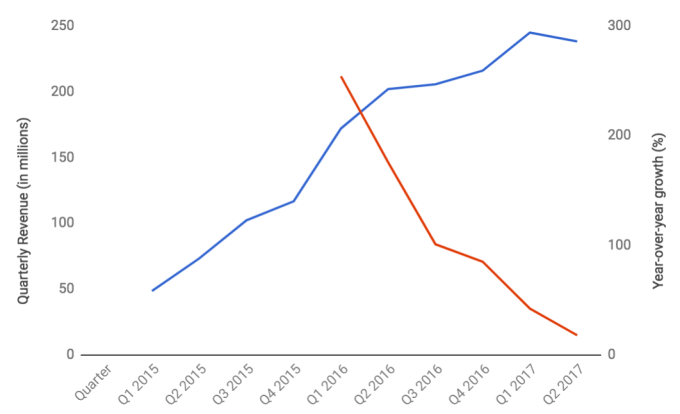
    • It exposed a $800 million business in annual revenue at a minimum. That clearly got Amazon’s attention, as the company seems constantly looking to build new lines of consumer businesses where it can duct tape Prime into the package. Even at the kind of margins that Blue Apron may operate at given its complex web of operations and delivery, if that’s able to work at a large scale, it’s a non-trivial business.
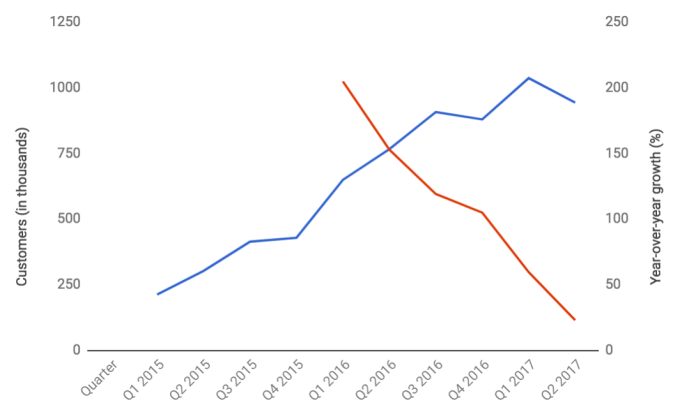
    • Its customer base is still growing year-over-year, despite its challenges in holding on to customers for a long time. In its most-recent quarterly results, Blue Apron said its customer base grew 23%. Even as its customer base declined quarter-over-quarter, as it pares back marketing, it shows that consumers still want a product like Blue Apron’s — if it can capitalize on that brand.
    • The lifetime value of those customers is theoretically very high given the cost of the product. Churn is going to be a perpetual problem for Blue Apron as people hop on and hop off the service, especially based on promotions and other factors. But the company is trying to pull back on marketing and, in a past life, showed that the business could be profitable in an earlier quarter.
    Still, Blue Apron’s stock fell quite dramatically again after it released its most-recent quarterly earnings report, even though the business showed some signs of life. It signaled that the company would likely continue to see losses going forward — projecting a net loss between $121 million and $128 million. Investors looking for a kind of performance like the flash of life that it showed earlier even amid a heavy burn rate to acquire customers seem likely to be disappointed in the near term as the company calibrates for a future where Amazon may go after its business.
    While Blue Apron requires an aggressive marketing engine — especially as it tries to expand beyond metropolitan areas, which are probably its sweet spot — still seems primed for a product that could grow organically. One example would be that the product seems like a very natural fit for a gift for occasions like weddings, birthdays or the holidays. This seems like obvious low-hanging fruit, where it can turn around and rely on that branding and consumer experience in order to convert those customers to more long-term ones and start the cycle again.
    Blue Apron can again lean on that strong brand that it’s built as one of the big anticipated consumer IPOs for 2017, even if it was a flop. Blue Apron at the beginning of 2018 — if it can last out to the holiday quarter — may end up looking like a much healthier Blue Apron at the middle of 2017.

    To be sure, Blue Apron’s growth has greatly decelerated (in the same fashion most companies do as they mature), and there really isn’t a lot of data to predict that forward:
    One of Blue Apron’s biggest challenges may end up being Amazon’s Prime business. The company said Prime members will soon see “special savings” when it comes to Whole Foods, which could end up being pretty much anything. Knowing Amazon, it’s likely to run a ton of experiments to figure out how to quickly quash any competitors and then decide how to grow it into a mature, profitable business later.
    In the end, the drip-drip-drip of aggressive news about a potential Amazon competitor will probably continue to put a lot of pressure on Blue Apron, especially as it still seems to be racking up losses. But the company has shown that it’s willing to re-orient itself following the IPO, including making some changes in the executive ranks and some organizational changes.
    And while Amazon even seems to be testing a product in the vein of Stitch Fix, that company has still filed confidentially to go public — and is going to charge forward despite the specter of Amazon. There are still a lot of things going for the company and, if it’s able to lean on what initially made it able to expose that huge business, Blue Apron may have a shot to be a company that continues to exist even if the Amazon behemoth tries to get into its market.

    >>> Abertis suitor ACS woking on making direct offer - reports (translated)

    Abertis suitor ACS woking on making direct offer
    Abertis [BME:ABE] suitor the Spanish construction group ACS [BME:ACS] is working to make an offer directly and no longer through its German unit Hochtief [ETR: HOT], Europa Press reported citing sources close to the process.
    ACS is analysing how to finance a bid to counter Atlantia’s [BIT:ATL] EUR 16.5 per share offer, probably offering around EUR 17 per share or EUR 17bn in total excluding debt, the Spanish-language report said.
    ACS’s advisers for the transaction are JPMorgan, Lazard and Key Capital, the item added.
    A report in the Spanish-language paper Expansion said that ACS advisers in the transaction, including Key Capital, have already contacted various investment funds, including TCI, which is the largest private investor in Aena. The the airport holdings manager studied at the time a counterbid for Abertis, finally discarded by its main shareholder the state-owned Enaire.