Q3 Begins on Higher NoteThe stock market began the week on a higher note, but the major averages were only able to keep a portion of their gains through the close. The S&P 500 gained 0.8% after being up 1.0% at the start while the tech-heavy Nasdaq rose 1.1% after starting the session with a 1.7% gain.
The strong open was owed to a positive view of Saturday's meeting between President Trump and China's President Xi Jinping. While the meeting did not yield concrete steps toward reaching a trade deal, it also did not lead to an escalation of the dispute. Instead, President Trump agreed to relax restrictions on sales of components to Huawei and agreed to not impose additional tariffs on imports from China at this time.
Stocks surged out of the gate with chipmakers leading the opening rally, which was not a surprise given the group's sensitivity to trade-related matters. The PHLX Semiconductor Index was up nearly 5.0% at the start of the session but trimmed its gain to 2.7% by the close. Huawei supplier Inphi (IPHI 53.67, +3.57, +7.1%) was the top performer within the group, rallying 7.1%. Semiconductor giant, Intel (INTC 48.05, +0.18, +0.4%), jumped above its 200-day moving average (48.85) at the start, but narrowed its gain to just 0.4% as the session wore on.
The technology sector (+1.5%) remained atop the leaderboard into the close, but like the rest of the market, the top-weighted group settled closer to its session low than its high.
Equities backed off their starting levels during intraday action, as optimism about the weekend outcome of the Trump-Xi meeting was partially offset by the realization that the economic situation in major export centers remains weak. To that point, China's Manufacturing PMI (actual 49.4) remained in contractionary territory in the final June reading, Japan's Manufacturing PMI decreased to 49.3 from 49.5, and the Manufacturing PMI for the eurozone slipped to 47.6 from 47.8. Adding insult to injury, South Korea reported that its exports decreased 13.5% yr/yr in June.
To be fair, the U.S. ISM Manufacturing Index also decreased in June (to 51.7 from 52.1), but it remained in expansionary territory, serving as a reminder that the U.S. economy is still a pocket of relative strength. On that note, the U.S. economic expansion entered its 121st consecutive month today, representing the longest expansionary streak on record.
Relative strength in U.S. data gave a boost to the U.S. Dollar Index, which climbed 0.7% to 96.82, reclaiming its 200-day moving average in the process.
Treasuries ended in the red with shorter tenors leading the retreat. The 10-yr yield rose three basis points to 2.03% while the 2-yr yield rose five basis points to 1.79%.
Today's economic data was limited to the June ISM Manufacturing Index and Construction Spending for May:
- The ISM Manufacturing Index for June checked in at 51.7% ( consensus 51.5%), down from 52.1% in May. The dividing line between expansion and contraction is 50.0%.
- The key takeaway from the report is that it shows weakening manufacturing activity. June was the third straight month in which there was a decelerating pace of growth. This should capture the Fed's attention as it contemplates a rate-cut decision at its July 30-31 FOMC meeting.
- Total construction spending declined 0.8% m/m in May (consensus 0.0%) following an upwardly revised 0.4% increase (from 0.0%) in April. Overall, construction spending was down 2.3% yr/yr.
- The key takeaway from the report is that private construction spending remains noticeably weak, held back by a downturn in residential spending.
Market participants will not receive any noteworthy data tomorrow.
- Nasdaq Composite +21.9% YTD
- S&P 500 +18.3% YTD
- Russell 2000 +16.4% YTD
- Dow Jones Industrial Average +14.5% YTD

Ban Forces Trading Shift for Europe’s Biggest Stocks
Switzerland’s benchmark equity gauge climbs, mirroring rally in global stocks
Investors and traders moved quickly Monday to shift trading of Europe’s largest stocks from London to Switzerland after a major diplomatic breakdown threatened to reverse decades of financial market integration.
Swiss stocks led by Credit Suisse Group AG and Roche Holding AG showed few signs of disruption as the new curbs on their trading within the European Union kicked in.
Starting this week, shares in Swiss companies can be traded only on local exchanges after a long-running showdown over rules that govern ties between Switzerland and the EU ended in deadlock.
The country’s benchmark index advanced 0.9% Monday, following European and Asian stocks higher as investors cheered the resumption of trade talks between the U.S. and China.
The muted consequences to curtailing trading of Swiss shares in London and other European financial centers may provide some cheer to market-watchers concerned about the U.K.’s pending divorce from the bloc.
Talks between the EU and Switzerland over the myriad treaties that govern their relationship dragged on for years and Brussels’ line grew tougher as the EU started negotiating with the U.K. over the terms of its exit.
The EU followed through with its pledge to withdraw a special status, known as “equivalence,” that allowed Swiss equities to be traded on platforms within the EU after the two sides failed to reach an agreement by the end of June. Bern retaliated with a decision to prohibit exchanges in the EU from trading Swiss shares.
There is little indication that talks between the EU and Switzerland are likely to advance or that the trading limits may be overturned. Mina Andreeva, spokeswoman for the European Commission, said there was no suggestion Switzerland intends to make further progress with the talks.
The new limits, which mean virtually all trading of Swiss stocks has to be done in Switzerland, had minimal impact Monday as investors can simply reroute trades to comply with the rules, according to traders in London.
Still, the ban is a sign of growing dislocation in global markets, according to Ben Ritchie, a senior investment manager on the U.K. and European equities team at Aberdeen Asset Management.
“It’s probably more of a shift in terms of the ‘Balkanization’ of things,” and marks a retrenchment from “a world where we’re breaking down borders and encouraging flows of capital across borders,” said Mr. Ritchie.
Officials in Europe have acknowledged the Brexit talks made the EU and its governments more determined not to make concessions to Switzerland and to demonstrate that there is a cost to not striking a deal.
A spokesperson for Zurich’s SIX exchange said it was too early to draw any conclusions on the impact that the withdrawal of stock market equivalence and Switzerland’s countermeasures will have on trading volumes.
Some 17.6 million shares of companies included in the Swiss market index traded hands by midmorning, compared with 46.7 million Friday.
For the 30 largest Swiss blue-chip companies, 70% of trading used to happen at exchanges in Switzerland, primarily on Zurich’s SIX exchange, while the other 30% was elsewhere in Europe—mostly in London. Swiss companies make up one-fifth of the Stoxx Europe 50 benchmark, which tracks the region’s premier companies, by market value.
Markus Ferber, a conservative member of the European Parliament from Germany, flagged concerns that the new rules mean the bloc has lost one liquid center for trading just as it prepares for Brexit, which could see London’s status as a regional trading hub overhauled.
“The commission is interested in getting this general agreement between Switzerland and the EU and therefore they are not granting anything else, but honestly if you fulfill the criteria of equivalence you should be granted it,” he said.
Longer term, the impasse may have more meaningful consequences for Switzerland’s economy, according to ING Bank economist Charlotte de Montpellier.
“Tensions between Switzerland and the EU aren’t good for trade, business investment, or for the funding of scientific research in Switzerland that depends on European funds,” she said Monday.
OPEC agrees to extend current production cuts by 9 months, sources say
KEY POINTS
- * The deal is now subject to approval from non-OPEC allies at a meeting on Tuesday, with Iraq’s oil minister saying he did not anticipate any complications.
- * Iranian Oil Minister Bijan Zanganeh told reporters he had “no problem” with supporting oil supply cuts by nine months.
OPEC agreed on Monday to extend supply cuts by nine months, CNBC’s Brian Sullivan reported through sources, after several members of the Middle East-dominated producer group endorsed a policy designed to support oil prices amid a weakening global economy.
The deal is subject to approval from non-OPEC allies at a meeting on Tuesday, with Iraq’s oil minister saying he did not anticipate any complications. Earlier in the day, Iranian Oil Minister Bijan Zanganeh told reporters he had “no problem” with supporting oil supply cuts by nine months.
Tehran, which had been OPEC’s third-largest producer prior to the re-imposition of U.S. sanctions, has previously objected to policies put forward by arch-rival Saudi Arabia.
“It is going to be an easy meeting as my stance is very clear,” Zanganeh told reporters in Vienna, Austria.
OPEC deliberated the oil production cuts during its meeting on Monday. The deal endorsed now has to be endorsed by non-OPEC members, such as Russia, on Tuesday.
The producer group and its allies have been reducing oil output since 2017 to prevent prices from sliding amid soaring production from the U.S. — which has become the world’s top producer this year ahead of Russia and Saudi Arabia.
The U.S. is not a member of OPEC, nor is it participating in the supply pact. Washington has demanded Riyadh pump more oil to compensate for lower exports from Iran after slapping fresh sanctions on Tehran over its nuclear program.
Saudi Arabia and Russia
Speaking to reporters in the Austrian capital on Sunday, United Arab Emirates Minister of Energy and Industry Suhail al-Mazrouei said an extension of a deal originally struck in December last year — which called for an output cut of 1.2 million barrels per day — would likely be necessary.
“The current condition of the market, in my view, would require an extension,” al-Mazrouei said. The output-cutting pact expired on Sunday.
Al-Mazrouei’s comments came after Russian President Vladimir Putin announced over the weekend that Russia had reached an agreement with Saudi Arabia to extend the oil output deal by six to nine months.
“We will support the extension, both Russia and Saudi Arabia,” said Putin, who met Saudi Crown Prince Mohammed bin Salman at a Group of 20 (G-20) summit in Japan. “As far as the length of the extension is concerned, we have yet to decide whether it will be six or nine months. Maybe it will be nine months.”
Saudi Energy Minister Khalid al-Falih said Sunday that the deal would most likely be prolonged for nine months and no deeper cuts were required.
Asked about the deal extension potentially being decided at the G-20 summit instead of the meeting of OPEC and its allies, al-Mazrouei said: “OPEC is ... an organization that each country can veto a decision, that’s why ... every vote counts.”
OPEC and Iran also reached a compromise on a long-term partnership with Russia.
“It’s meant to be formalizing the relationship with Russia in particular,” said John Kilduff of Again Capital. “Within OPEC, every country has a veto over every deal no matter how little oil they produce. Iran didn’t want to be seen to be losing any power to any country outside of OPEC, which seems to be what has been happening with Saudi Arabia and Russia cooking up the production deals.”
Iran’s oil minister had criticized “unilateralism” among some members of the energy alliance, warning it could ultimately lead to the death of OPEC.
Speaking to reporters in Vienna, Austria on Monday, Zanganeh said: “The important thing to me is that OPEC remains OPEC. It has lost its authority and it is on the verge of collapse.”
“Iran is not going to leave OPEC… But I believe OPEC is going to die if these processes continue, ” Zanganeh said, referring to Russia-Saudi decision.
As Megacaps Soar, A Vast Majority Of Public Companies Are Struggling To Rebound
While Deutsche Bank's Aleksandar Kocic already made the argument that the US economy finds itself in an odd "quantum superposition" state, where like Schordinger's Cat, it is both booming and headed for a recession, one can make a similar argument about two other key aspect of capital markets: stocks and liquidity.
While global equity markets have surged in 2019, rebounding strongly from their 2018 sell-off and the more recent slump in May, SocGen's Andy Lapthorne reminds us that stocks, too, now exist in two separate worlds: consider that while the overall MSCI World index has added 6.5% in June - its best month in decades - and is up 15.6% in 2019 with most markets doing well, "it is worth reminding ourselves that apart from the US, Hong Kong, Finland and Switzerland, the remaining MSCI indices in USD terms are still well below their January 2018 highs."
However, even more important than the geographic breakdown of performance is a divergence that the SocGen strategist observes in terms of company size, and specifically how it affects both company returns and liquidity.
As Lapthorne writes in a Monday note, "there have been quite a few headlines recently surrounding “liquidity issues," which he finds surprising given the strong performance of asset markets this year:
"That investors flee at the first sign of a problem appears to confirm that investors are shuffling towards the exit door, in anticipation of a need to leave the party in haste."
But, as he adds, there are other dynamics in play.
First and foremost, Lapthorne brings attention to a key barometer he watches, which is equal-weighted versus market cap-weighted performance, because "Not only as many our quant models tilted towards an equal-weighted structure, but it is clearly healthier for the majority to be outperforming the more concentrated large cap-tilted index and of course passive and associated top-down flows favour market cap rather than equal-weighted ones."
What is worrying, is that as in 2018, so again this year, the MSCI World equal-weighted index has slumped versus the more closely watch market cap index. In other words, a majority of companies are struggling.
And here a remarkable observation: pointing out the divergences shown in the chart below, which splits the global universe of 17,000 stocks into market-cap grouped portfolios and measures their median annual performance over the last 12 months, the SocGen strategist notes that the megacap group (those companies with a market cap above $100BN) is powering ahead while those small-caps in the sub-$1BN market cap range "are still struggling to make back last year’s loss."
What is even more remarkable is that this $100BN portfolio represents just 77 companies but 27% of the global market cap.Meanwhile the sub $1BN universe represents just 7% of the market capitalisation yet contained over 11,000 companies, or 65% of total numbers!
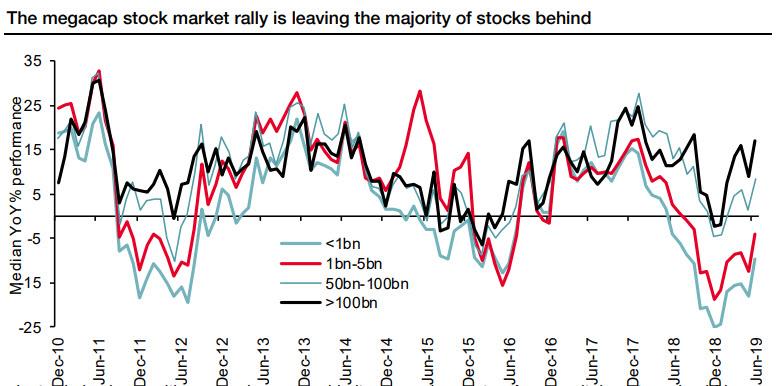
This, to SocGen, is the problem: "our increasing focus on a few large cap indices populated by just a fraction of the world’s companies is giving investors a false impression."
Lapthorne's conclusion: "Corporates are struggling", but since confirmation bias - both structural and that in traders' heads - only looks at those names that keep on levitating and pushing the S&P to new record highs, expect conventional wisdom to be firmly grounded in the belief that this is a bull market for everyone... not just a handful of companies which dominate the stock market with their gargantuan market cap.
Woodford’s Russian adventure shows how far his UK mission drifted
Funds has demonstrated how biased it had become in totally different directions
And so the thousands of investors trapped in Neil Woodford’s Equity Income Fund must wait another 28 days — at least — for it to reopen. On Monday, the fund’s corporate director told the City regulator that extra time was needed to sell holdings and deliver Mr Woodford’s promise of a “much more liquid portfolio”. Once this is done, the manager has insisted his fund will pursue “the same investment strategy . . . it will continue to demonstrate a strong and selective bias towards undervalued companies that are exposed to the UK economy”. But earlier on Monday, it merely demonstrated how biased it had become in totally different directions.
In its latest move to release cash, the Woodford Equity Income Fund sold its entire holding in Raven Property Group back to the company itself. For the still-suspended fund, as well as the smaller Income Focus Fund, it was a way to realise £26m, and took total holdings liquidated in the past four weeks to £459m, according to Citywire. For Raven, it was a chance to buy back and cancel shares, lifting its earnings per share by 11 per cent.
However, for Woodford fund investors, it was a reminder of how far the manager’s UK exposure has drifted: in this case, to Moscow, St Petersburg, and Nizhny Novgorod — as that is where Raven’s warehouse properties are located. It might be London-listed, but it is about as invested in the UK economy as Vladimir Putin’s favourite British politicians.
Nor is it the only Woodford holding with tenuous economic links to Britain. While the manager has core stakes in builders Barratt and Taylor Wimpey, his second largest is in litigation funder Burford Capital, where performance is uncorrelated to the economy or geography. As is that of insurance claims manager Redde.
His greatly increased holdings in early-stage life-sciences groups further weaken the “undervalued” and “UK economy” claims — and make “Equity Income” a complete misnomer. Among his top 25 holdings are unprofitable non-dividend paying biotechs based in the US, such as unlisted Viamet and Nasdaq-listed Prothena.
Arguably, though, his financial holdings show most mission creep. Oakley Capital backs ventures in German education, Dutch e-commerce and Italian price comparison. Sabina Estates facilitates a more literal UK overexposure: it builds villas in Ibiza.
All of which raises two questions. First, why did Mr Woodford diverge so far from his UK value mandate? In the case of Raven, Sabina and some of the unlisted holdings, it seems to be an enthusiasm for working with Anton Bilton, co-founder of the first two and backer of the firm that sponsored listings for several others. Second, why did the Woodford fund continue to be marketed, named and — until March 2018 — officially classified as UK Equity Income? Hargreaves Lansdown, the fund platform that has 130,000 clients trapped in the fund, once warned: “Fund sectors should only be seen as a rough guide to what a fund does and are no shortcut for looking under the bonnet. For too many, that bonnet — like the fund — has remained closed.
Telit: scot-free on Cats
Telit Communications, the “internet-of-things”hardware supplier, just got off scot-free, writes Kate Burgess. On Monday, the London Stock Exchange announced it was fining the Israeli-Italian group £350,000 for breaching Aim admission rules — but then waived the fine in its entirety.
The LSE had denounced the Telit board after it revealed a previously undisclosed US indictment against ex-chief executive Oozi Cats under the equally slinky moniker “Uzi Katz”. The watchdog waived the “scot” or fine because of the “real difficulties faced by the board and advisers in being able to a reasonably uncover information”. Really? Uzi Katz has only one more z than Oozi Cats and no glyphs or runes.
Aim, having made a big play for small company listings, talks hotly about ratcheting up the pressure to ensure directors hold to the best standards of governance and disclosure. Nominated advisers are encouraged to use corporate sleuths and forensic bean-counters to unearth past misdemeanours. The LSE has pledged bigger fines.
Yet the regulator has ducked the chance to show it really means business. True, Telit’s admission to Aim was 14 years ago, when it was advised by the now defunct broker Seymour Pierce, more than a decade after the indictment. And Telit’s board and advisers have since changed umpteen times. Imposing a large fine on the current board and shareholders might have been heavy handed. Nonetheless, waiving all sanctions sends the wrong message to future Aim bosses from more exotic non-English speaking stops on the road to Xanadu, where a conviction might be recorded in logographic and syllabic scripts. By letting Telit off scot-free, the LSE has done nothing to free Aim of its reputation for slack restraints.
Gapping down
In reaction to disappointing earnings/guidance:
- WLK -5% (Q2 guidance)
M&A news:
- PFGC -0.9% (to acquire Reinhart Foodservice from Reyes Holdings, L.L.C. in a transaction valued at $2.0 billion; co also reaffirms FY 19 adj. EPS outlook)
Select metals/mining stocks trading lower:
- HMY -5.3%, SBGL -5.1%, AU -4.7%, AUY -4.4%, FSM -3.5%, GFI -3.5%, KGC -3.4%, GOLD -3%, GDX -2.7%, NEM -2.6%, PAAS -1.6%, AG -1.5%, GLD -1.4%
Analyst comments:
- ZM -2.6% (downgraded to Sell from Neutral at Goldman)
- GSKY -0.8% (downgraded to Hold from Buy at SunTrust)