China PBOC Dep Gov Pan Gongsheng: Urges financial institutions to increase loans to poverty-stricken areas in education, medical and housing sectors
Antofagasta rises on $6bn win in legal fight with Pakistan
World Bank tribunal rules in favour of Antofagasta-Barrick joint venture
Shares in copper miner Antofagasta climbed to the top of the FTSE 100 leaderboard on Monday after it was awarded almost $6bn in damages from a legal fight with the government of Pakistan.
A seven-year battle over an all but forgotten copper project ended on Saturday when a World Bank international arbitration tribunal ruled in favour of Tethyan Copper Company, a joint venture between Antofagasta and Canada’s Barrick Gold.
The case was filed with the World Bank’s International Centre for Settlement of Investment Disputes in 2011 after Tethyan was unexpectedly denied a mining lease for the Reko Diq project, one of the world’s biggest undeveloped copper and gold projects.
Among the reasons given by Pakistan for the surprise decision was security and opposition from local communities.
“This is positive news for Antongasta on an all but forgotten project, but one that obviously cannot be fully relied on until the money is in the bank,” said analysts at Investec.
Shares in Antofagasta were up 39.4p, or 4.8 per cent, at 904p in early trading on Monday.
The damages include compensation of $4bn - the market value of the project at the time of the “unlawful” mining lease denial, plus interest.
“We remain willing to discuss the potential for a negotiated settlement with Pakistan and will continue to protect our commercial interests and legal rights until the conclusion of this dispute,” said Tethyan chairman William Hayes.
Pakistan said it was disappointed by the ruling but had taken note of the statement by Mr Hays.
“The Government of Pakistan welcomes this approach to work towards a mutually beneficial solution that works for both sides,” it said.
The ruling comes at a delicate time for Pakistan, which has just secured a $6bn bailout from International Monetary Fund to help tackle a balance of payments deficit caused by high imports and sluggish exports.
Reko Diq was discovered by BHP, the world’s biggest mining company in the late 1990s at the foot of an extinct volcano near Pakistan’s frontier with Iran and Afghanistan.
BHP effectively quit the project when it struck a joint venture agreement with Mincor, a junior Australian, miner in 2000. Reko Diq was later demerged and subsequently acquired by Antofagasta, which is best known for its copper mines in Chile.
“Given the size of the award, we expect the government of Pakistan to appeal by any route possible and to defer and delay to all and any extent possible,” said Edward Sterck, analyst at BMO Capital Markets.
“The end amount, form and timing of any eventual payment is very hard to determine and we do not believe the market is pricing in anything like the full settlement, and arguably nor should it.”
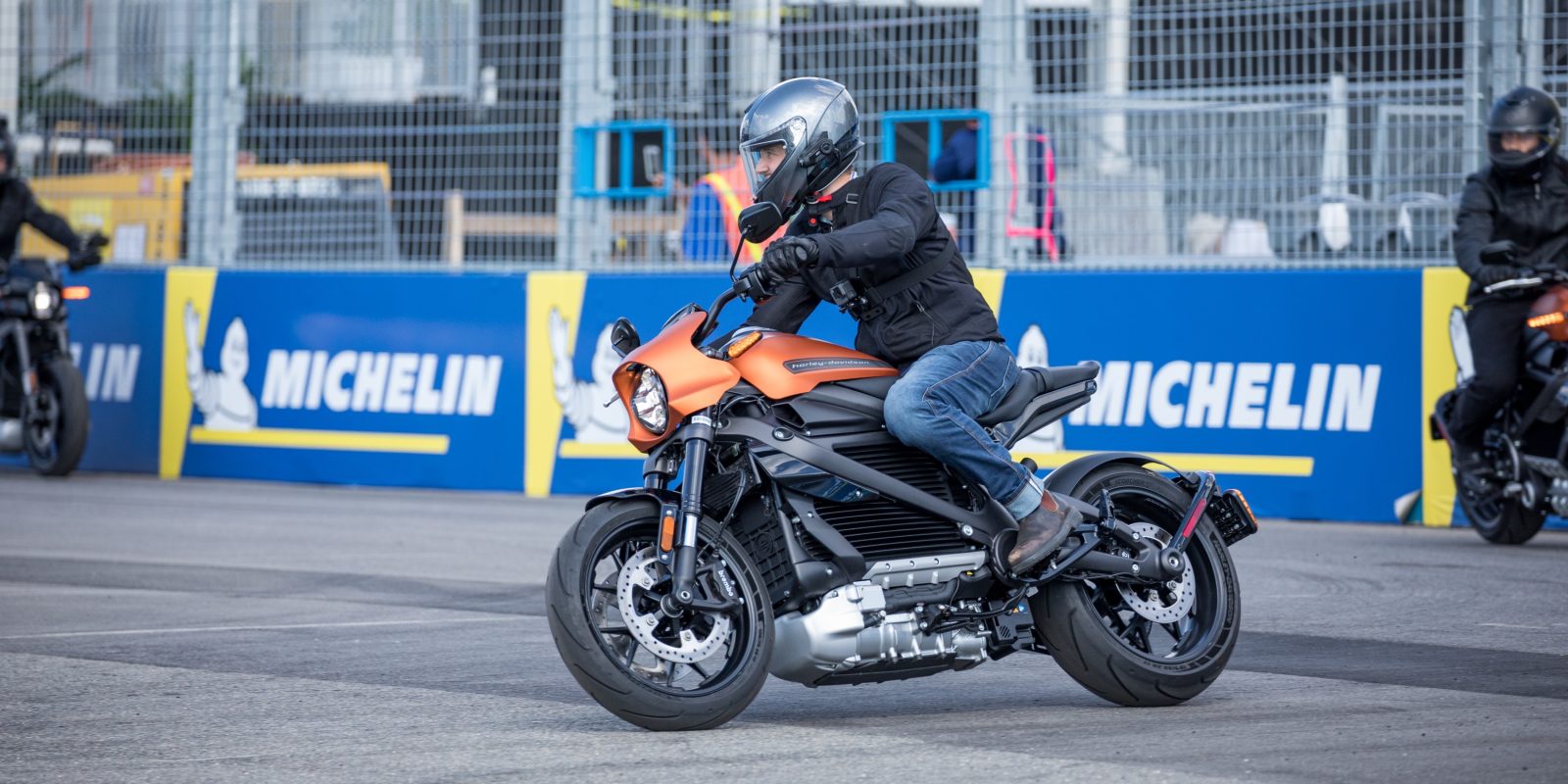
This weekend I had the opportunity to test ride Harley-Davidson’s much anticipated new electric motorcycle, the LiveWire. As excited as I was to finally get a chance to ride the LiveWire before its release, I didn’t have the highest of expectations. I thought the LiveWire would be a bike that looked better than it rode. But as it turns out, the LiveWire is a high power beast just waiting to be unleashed.
Harley-Davidson LiveWire test ride
Harley-Davidson invited a select group of journalists to Brooklyn this weekend to take the LiveWire for a test on the Formula E track. The tight and twisty track was designed for the low and grippy race cars – not for motorcycles.
But even with zero runoff and walls closing in on me at every corner, I did my best to push the LiveWire hard. And boy was I surprised by what this electric motorcycle could do!
This weekend we finally learned the important tech specs that Harley-Davidson had been keeping under wraps for so long. Most importantly, we learned that the motor is rated at 78 kW (105 hp) and the battery capacity is 15.5 kWh. Those are both huge for an electric motorcycle and were the first clues that the Harley-Davidson LiveWire isn’t just for show.
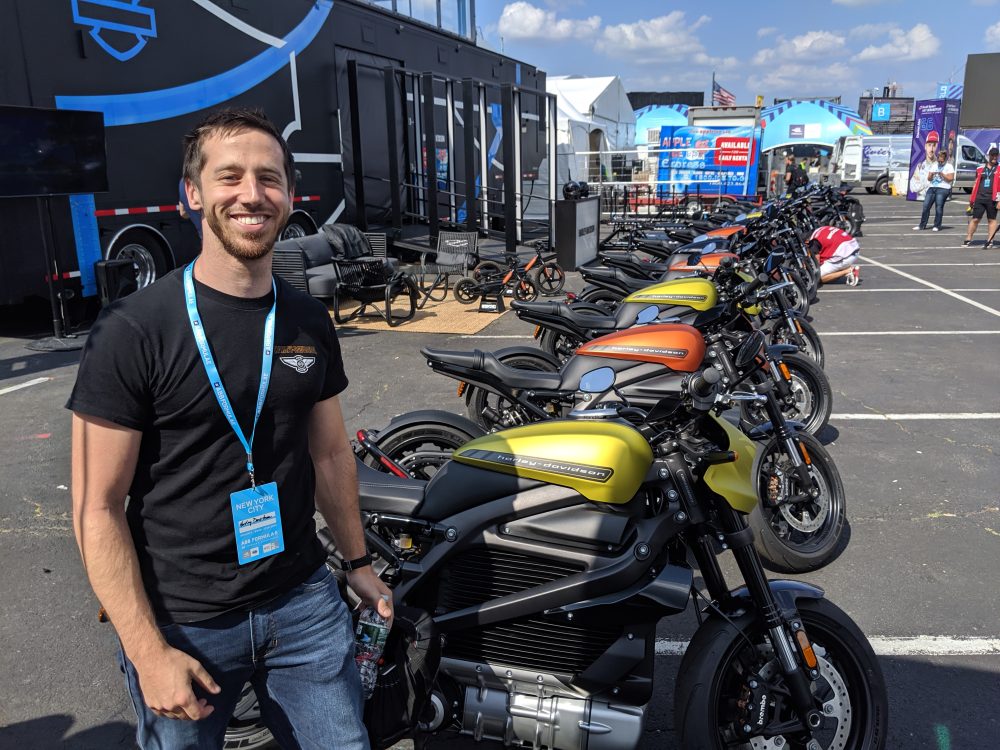
That’s the grin of an Electrek writer who is about to become one of the first LiveWire riders ever
But you don’t really get the sense of what 78 kW feels like in a 549 lb (249 kg) vehicle until you really open it up.
And fortunately I had some straightaways to do just that, as you’ll see in my video ride below.
Harley-Davidson LiveWire video ride
The LiveWire can hit a top speed of 110 mph (177 km/h).
However, I maxed out at 87 mph (140 km/h) before I ran out of short straightaway and had to rely on those Brembo Monoblock brakes to drop an anchor before I ran out of track.

Fortunately the rider assist systems on the LiveWire work beautifully. The ABS brakes and anti rear wheel lift worked great when screeching to a halt. The traction control is also a nice feature, though I wasn’t about to go testing that in these tight turns. Save that for when you accidentally need it on the highway. And the anti-wheelie system meant I could get the most out of the powerful acceleration of the LiveWire without worrying about having to keep the front wheel down.
With a 0-60 mph (0-97 km/h) time of just 3.0 seconds, and another 1.9 seconds to reach 80 mph (129 km/h), the LiveWire accelerates like nothing I’ve ridden before. And part of the thrill of that insane acceleration is that there are no gears to worry about. With the twist of a wrist (and an attempt to hold on) you’re rocketing forward listening to the sweet whine of the drivetrain.


Speaking of that whine, make sure you check out the video above to hear it. That sound from the LiveWire isn’t coming from any artificial noisemakers. That’s the combined sound of the 90º bevel gears and the unique longitudinally mounted motor, plus a bit of belt whirr for good measure. And to be honest, it sounds pretty sweet. The bike is quiet, don’t get me wrong. But it is by no means silent. Anyone who enjoys the aural feedback of winding up an engine will understand the joy of hearing and feeling the LiveWire respond to your inputs.
There’s nothing really “Harley” about the sound, despite what the company will try to tell you. And I think that’s fine. The LiveWire is designed for a new generation of young (and wealthy, let’s be real) riders that don’t necessarily connect with the throaty, chromed out Harleys of old. And this new generation is likely to connect better with the aggressive whine of a high power and high torque electric motor than a century-old gas engine. The LiveWire just seems to connect with the rider in a way that gas bikes aren’t able to. Instead of sitting on a rumbling and vibrating bike, the silent idle and electric scream create a more intimate bond. And as someone who has now ridden both gas and electric Harley-Davidson motorcycles, I definitely feel more connected with the latter.
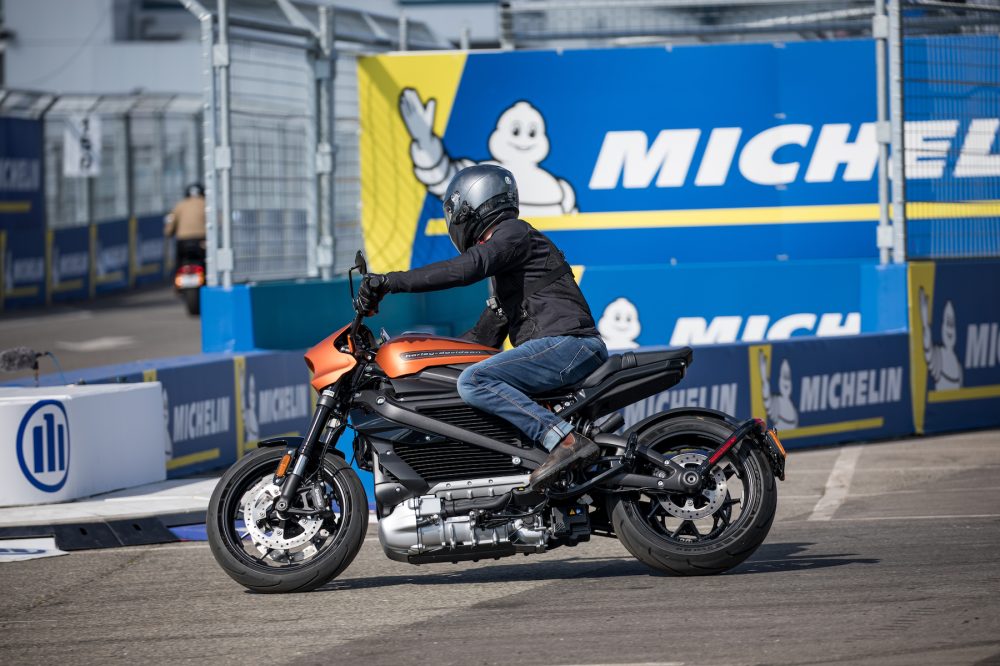
Another way the LiveWire creates a connection with the rider is through its “heart beat pulse”. This one through me for a loop when they described it to us in the presentation, but feeling it made all the difference. Essentially, when you’re sitting still but the bike is on and ready to ride, there is a slight haptic response in the handlebars in the form of a pulsing feeling. It’s not overpowering, but you feel it. And the point is to let the rider know that the bike is on and capable of rocketing off at any moment, lest the lack of engine noise lull him or her into a false sense of security. Essentially it is a gentle reminder that the bike is ready to lurch, even though you can’t hear anything.
Is it a necessary feature? No. But it’s a pretty cool added touch that I enjoyed, and anyone who doesn’t like it can turn it off in the settings.
Speaking of the settings, there are four ride modes and three customizable modes. I probably should have tried out Rain and Eco mode, but I was having too much fun in Road and Sport mode that I forgot anything else existed.
Hilton Plays Catch-Up in Luxury-Travel Market
Hotel operator to add 11 high-end properties this year, aiming to draw closer to Marriott and Hyatt
Hilton Worldwide Holdings Inc. HLT -1.15% plans to open more luxury hotels globally this year as it tries to catch up to its competitors in the growing luxury-travel market.
Major hotel brands such as Hilton are expanding their luxury hotel offerings, which range in cost from a few hundred dollars a night to thousands of dollars, to lure business travelers, loyalty members and the wealthy, particularly those from China, with lavish stays.
This year, Hilton is on track to open 11 new luxury properties under its brands Waldorf Astoria, Conrad Hotels and LXR, a high-end brand Hilton launched last year, Hilton executives say. That is on top of the company’s 65 existing luxury hotels, as well as more than 30 other luxury properties it plans to open from 2020 through 2025.
Over the past decade, Hilton has expanded its luxury presence from 15 countries and territories to 29.
In comparison, Hilton’s main competitors already have a much larger luxury presence. Marriott International Inc. MAR 0.46% has about 410 open luxury hotels and 190 in the pipeline under seven brands, such as JW Marriott and Ritz-Carlton. InterContinental Hotels Group PLC has 296 open luxury hotels and 109 in the pipeline across four brands, including InterContinental and Kimpton. Hyatt Hotels Corp. operates more than 130 luxury hotels and expects to add more than 80 across its five brands, which include Grand Hyatt and Park Hyatt.
“We were a little bit later to the game,” said Martin Rinck, executive vice president and global head of luxury and lifestyle for Hilton. “Our portfolio is very young, homogeneous and doesn’t have any legacy issues. That’s the advantage of a latecomer.”
Global household wealth is expected to rise almost 26% to nearly $400 trillion by 2023, according to the most recent Credit Suisse Global Wealth Report. During the same period, the number of millionaires is projected to reach 55 million, up from 42.2 million in mid-2018.
“An increase in the number of business travelers and customers’ penchant for luxurious lifestyles has fueled the demand for luxury stays in luxury hotels,” said Ralph Hollister, travel-and-tourism associate analyst at analytics firm GlobalData. At the same time, he added, “the number of affluent Chinese consumers and their demand for personalized and unique staying experiences is also increasing demand.”
Luxury properties are important for the loyalty program, Mr. Rinck said.
“Anybody who stays within the loyalty program with Hilton, of course, looks to the opportunity to use their points at aspirational properties and resorts,” he said.
The number of luxury hotels is expected to increase at a compound annual growth rate of 3.6% between 2019 and 2022, according to GlobalData.
“This could mean market saturation eventually, but for now as luxury travel is growing, things are looking positive,” Mr. Hollister said.
There is more of an opportunity to open ultraluxury hotels in the Asia-Pacific region, particularly in China, where Chinese premium travelers want luxury accommodations and tend to be attracted to Western hotel brands, said Sanford C. Bernstein analyst Richard J. Clarke.
Global luxury-hotel occupancy, average daily rate and revenue per available room—all significant industry metrics—have generally increased in the past five years. However, RevPAR has started to fall so far this year, compared with 2018, according to data through May from hotel analytics firm STR.
Hotel companies have signaled they expect RevPAR to ease this year because of pressure from a maturing economy, a relative slowdown in China and worries about the effects of the U.K.’s planned exit from the European Union.
Historically, customer demand for luxury hotels has been the most volatile during economic downturns, resulting in luxury customers such as business travelers—not just millionaires—tightening their wallets, said C. Patrick Scholes, a lodging analyst with SunTrust Robinson Humphrey.
In the U.S., luxury hotels are seen as attractive investments because the valuable real estate generally reduces risk. Properties in top cities can easily be turned into condos or apartments, Mr. Clarke said.
But Hilton isn’t concerned about how an economic slowdown could affect its luxury expansion, Mr. Rinck said. He added that the market needs additional luxury supply and that the company has management and ownership contracts that last from 30 years to 100 years.
“We are in the business for the long run,” Mr. Rinck said. “And we do believe that our business model, our service offering, our product offering, is highly competitive, which will also prevail during periods where we see slight corrections in the marketplace.”
Manufacturers Move Supply Chains Out of China
Tariff costs prompt executives to shift production to other countries; ‘Once you move, you don’t go back’
U.S. manufacturers are shifting production to countries outside of China as trade tensions between the world’s two biggest economies stretch into a second year.
Companies that make Crocs shoes, Yeti beer coolers, Roomba vacuums and GoPro GPRO -1.62% cameras are producing goods in other countries to avoid U.S. tariffs of as much as 25% on some $250 billion of imports from China. Apple Inc. also is considering shifting final assembly of some of its devices out of China to avoid U.S. tariffs.
Furniture-maker Lovesac Co. is making about 60% of its furniture in China, down from 75% at the start of the year. “We have been shifting production to Vietnam very aggressively,” said Shawn Nelson, chief executive of the Stamford, Conn., company. Mr. Nelson said he plans to have no production in China by the end of next year.
The moves by U.S. companies add up to a reordering of global manufacturing supply chains as they prepare for an extended period of uneven trade relations. Executives at companies that are moving operations outside China said they expect to keep them that way because of the time and money invested in setting up new facilities and shifting shipping arrangements. Companies said the shifts accelerated after the tariff on many Chinese imports rose to 25% from 10% in May.
“Once you move, you don’t go back,” Mr. Nelson said.
Yeti Holdings Inc. YETI -1.62% said it plans to move most production of soft-sided coolers out of China by the end of this year. iRobot Corp. said it would start a new Roomba production line in Malaysia this year. Crocs Inc. CROX 2.54% said it expects less than 10% of U.S.-bound products to be made in China by next year, down from 30% in June. And diesel-engine maker Cummins Inc. said it has avoided $50 million in tariff expenses by moving some production to India and other countries.
Imports from China fell 12% in the year through May, compared with a year earlier, according to the U.S. Census Bureau, the biggest decline since the financial crisis a decade ago.
The biggest beneficiaries of that decline have been other countries in Asia where production costs are low, such as Vietnam, India, Taiwan and Malaysia. Many of those countries have recorded sharp increases in exports, although there have been allegations that some of the added traffic stemmed from goods made in China that were routed through those countries without significant alterations to avoid tariffs.
U.S. imports from Vietnam are expected to reach $64.8 billion this year, up 36% from 2018, according to consulting firm A.T. Kearney.
“We’re moving production to other parts of the world,” Marvin Edwards, CEO of CommScope Holding Co. , said in June. The Hickory, N.C., company is making antennas for sale in the U.S. at its plant in India instead of China.
There is little evidence, though, of U.S. manufacturers bringing production from China back to the U.S., a move the Trump administration hoped the tariffs would encourage.
While imports from other Asian countries have climbed, U.S. manufacturing output has declined 1.5% through May from a recent peak reached in December, according to the Federal Reserve. The Institute for Supply Management said earlier this month that its manufacturing index slipped again in June to the lowest level since 2016.
“If we were to try to do a factory in the U.S., it would be enormously expensive,” said John Hoge, co-owner of Sea Eagle Boats Inc., which makes 85% of its inflatable kayaks, canoes and fishing boats through contract manufacturers in China. Mr. Hoge said the network of manufacturers and suppliers in China that makes boats for Sea Eagle and many of its competitors isn’t as comprehensive in any other country.
“It took us 20 years to build up the supply chain in China,” he said. Mr. Hoge estimated the 25% duty on his products that took effect in May would double the Port Jefferson, N.Y., company’s tariff expenses to about $500,000 a year.
Crown Crafts Inc. analyzed manufacturing costs in a half-dozen countries before deciding to keep making its baby blankets in China despite the tariff costs. “It’s very difficult to find a country that can do it competitive with China,” Randall Chestnut, CEO of the Louisiana company, told analysts in June.
One is Zoom Telephonics Inc., which said it lost $1.1 million during the first quarter and likely more in the second as a result of the tariffs on the cable-television modems it imports from China and sells through Amazon.com Inc., Best Buy Co. and other retailers. “I don’t think anybody makes them in the U.S.,” said Frank Manning, CEO of the Boston-based company, in an interview. “We’re bleeding.”
Ardagh to spin off metal packaging business in $2.5bn deal
Merger of unit with Exal to create one of world’s biggest metal packaging groups
Packaging group Ardagh plans to spin off its food and speciality metal business in a $2.5bn deal, merging it with aluminium container maker Exal Corporation, to create one of the biggest metal packaging companies in the world.
The new company, Trivium, will be 43 per cent owned by Ardagh, while Exal’s parent, the Ontario Teachers’ Pension Plan Board, will hold the remaining 57 per cent.
The deal comes two years after Ardagh, once a small Irish glass bottle maker, first floated its shares on the New York Stock Exchange. It has grown rapidly under Irish tycoon Paul Coulson, its chairman and chief executive, who acquired an initial stake in 1998.
The transformation of the one-time struggling minnow has catapulted Mr Coulson — a former accountant nicknamed “The Cooler” — into a position as one of Ireland’s richest men.
Trivium, which will be led by Exal chief executive Michael Mapes, will be headquartered in the Netherlands and will operate 57 production plants, mainly in Europe and the Americas, employing 7,800 people. It had pro forma revenues of $2.7bn in the year to March, and adjusted earnings before interest tax depreciation and amortisation of $496m.
“Ardagh is delighted to partner with Ontario Teachers’ as shareholders in Trivium, a combination of two highly complementary and well-invested businesses,” said Mr Coulson, who will become chairman of the new company.
“Trivium has the products, customers, innovation capabilities and leadership team to deliver continued growth and success, as brand owners and consumers increasingly seek sustainable packaging solutions.”
Ardagh was founded in Dublin in 1932 as the Irish Glass Bottle Co and has expanded through a series of acquisitions since Mr Coulson became involved. It is currently valued at around $4.5bn.
The deal is expected to close in the fourth quarter of 2019.
-
Galapagos (GXE TH) +11%
- Gilead’s Higher Stake De-Risks Galapagos Investment Story: Citi
- BT (BTQ TH) +2.2%
- BAT (BMT TH) +1.6
- Persimmon (OHP TH) +1.6%
- Polymetal (PM6 TH) +1.3%
-
Rio Tinto (RIO1 TH) +1.2%
- Watch Luxury, Miners as China Slows But Shows Stabilizing Signs
- Glencore (8GC TH) +1.1
- ArcelorMittal (ARRD TH) +1
-
Evotec SE (EVT TH) +0.8%
- DGAP-News: EVOTEC EXPANDS ITS IPSC DISCOVERY PLATFORM
- Unilever (UNI2 TH) +0.8%
- Pandora (3P7 TH) -0.8%
- TAG Immobilien (TEG TH) -0.9%
- Commerzbank (CBK TH) -1%
-
Glaxo (GS7 TH) -1.4%
- Glaxo Says Ovarian Cancer Drug Zejula Met Main Goal
- Novo Nordisk (NOVC TH) -1.6%
-
Anheuser-Busch (1NBA TH) -2.1%
- AB InBev Seeks Plan B After Investors Bail on Year’s Biggest IPO
DAX:
- Deutsche Bank (DBK TH) +0.9%
- Deutsche Bank to Boost Asian Corporate Bank, Wealth Mgmt: SCMP
- ThyssenKrupp (TKA TH) +0.8%
- Wirecard (WDI TH) +0.8%
- Daimler (DAI TH) -0.5%
- Some Daimler Investors Resist Zetsche Move to Supervisory Board: HB
- Bayer (BAYN TH) -0.5%
MDAX:
- Telefonica Deutschland (O2D TH) +1.7%
- Rocket Internet (RKET TH) +1.1%
- Evotec SE (EVT TH) +1%
- Aareal Bank (ARL TH) +0.7%
- Fuchs Petrolub (FPE3 TH) +0.7%
- United Internet (UTDI TH) -0.7%
- 1&1 Drillisch (DRI TH) -0.7%
- TAG Immobilien (TEG TH) -0.9%
- Fielmann (FIE TH) -0.9%
- Commerzbank (CBK TH) -1%
SDAX:
- S&T (GROA TH) +2.3%
- Wacker Neuson (WAC TH) +2.1%
- Krones (KRN TH) +2%
- Kloeckner (KCO TH) +1.8%
- Schaeffler (SHA TH) +1.5%
- Adler Real Estate (ADL TH) -0.8%
- Ceconomy (MEO TH) -1%
- Rhoen Klinikum (RHK TH) -1.8%
- CTS Eventim (EVD TH) -2.9%
- Steinhoff (SNH TH) -3.3%