TechCrunch : SPAC growing pains

SPAC growing pains
Special Purpose Acquisition Companies are sure to provide valuable lessons, as a growing group of startups use these investment vehicles to ease into public markets. Here’s the latest look at the action, starting with this disturbing quote that Connie Loizos got from one expert this week.
According to Kristi Marvin, a former investment banker who now runs the data site SPACInsider, she’s having, and hearing about, conversations with a much wider range of people interested in launching SPACs than in past years — and not all of them are necessarily equipped to manage the vehicles.
“You ask, ‘Have you ever acquired a company for $500 million or more? Do you have operating experience in the vertical that you’re targeting? Do you understand the reporting requirements involved?’ Often,” she says, “the answers are no.”
That was in the context of a controversial former Uber executive starting a SPAC; Connie also looked at gender representation in this emerging slice of high finance. Like other parts of that world, the people involve are almost entirely men (which is also continuing to be the case in startup funding, actually, Alex reports).
Meanwhile, Catherine Shu examined how troubled electric vehicle startup Faraday Futures is approaching SPAC plans, while Alex took a closer look at the challenges and opportunities facing Opendoor.

WSJ : Daily U.S. Coronavirus Cases at Highest Level Since Mid-August

Daily U.S. Coronavirus Cases at Highest Level Since Mid-August
U.S. reported more than 57,000 cases on Friday; White House draws up $1.8 trillion relief package

The U.S. reported more than 57,000 cases of the coronavirus on Friday, the highest tally in nearly two months, as the Trump administration sweetened its offer to Democrats for a virus-related relief package.

New daily infections were above 50,000 for the third day in a row. Total confirmed cases in the U.S. neared 7.7 million, according to data compiled by Johns Hopkins University. The nation’s death toll stood at more than 213,000.

Nationwide hospitalizations are around 35,000, up from 30,000 a week ago but well under the numbers seen in the earlier months of the pandemic, according to the Covid Tracking Project. The number of hospitalizations in the U.S. peaked at nearly 60,000 in mid-April and again in mid-July.

On Friday, Treasury Secretary Steven Mnuchin presented to House Speaker Nancy Pelosi (D., Calif.) a relief-package proposal of more than $1.8 trillion, in the largest bid the Trump administration has made to Democrats to date. The two sides have been engaged in a stop-and-start effort to deliver new aid for households and businesses before the election.

President Trump plans to resume in-person events after being treated for a coronavirus infection with a gathering at the White House on Saturday. In addition, officials said, he would travel to Florida for a campaign rally on Monday.

Also Friday, the Commission on Presidential Debates said it would cancel a planned matchup next week between Mr. Trump and Joe Biden. The move followed the president’s decision to not participate in a virtual debate.

Treatments
Mr. Trump’s endorsement of an experimental Covid-19 drug from Regeneron Pharmaceuticals Inc. has raised expectations for a type of medicine that could be authorized for public use within weeks or even days.


Regeneron is racing against Eli Lilly & Co. to bring the first monoclonal antibody drug on the market to treat Covid-19 patients who aren’t sick enough to be hospitalized. Both companies said they asked the U.S. Food and Drug Administration to authorize use, and they had already made tens of thousands of doses for patients.

If greenlighted, the shots would begin to fill a big hole in the Covid-19 medicine chest for treatment of early and less-severe cases. After more testing, they could offer temporary protection against infections until vaccines arrive.

U.S.
New Jersey: On Saturday, former New Jersey Gov. Chris Christie announced that he was released from the hospital after testing positive for the coronavirus last week. At the time, Mr. Christie said he checked himself into the hospital on Oct. 3 as a precautionary measure due to his history of asthma. “I will have more to say about all of this next week,” he wrote in a tweet.

South Carolina: Clemson University’s football team will host the University of Miami on Saturday night, with about 19,000 fans expected to file into the school’s 81,000-seat stadium. The matchup gives some semblance of normalcy to the South Carolina campus, even as case numbers continue to rise. Clemson has had 3,962 positive tests among students since June, equivalent to roughly 15% of the student population. School spokesman Mark Land said the share is likely lower, as some individuals received multiple positive tests.

Clemson said 4.3% of this week’s tests so far were positive, according to data reported Friday. That puts the campus positivity rate far below the statewide level of 11.4%.

More than 530 of the roughly 6,000 students living on campus are currently in isolation or quarantine. The school said in its reopening plan that it has space for 650, and Mr. Land said they are looking to identify more space in case it is needed.

The school doesn’t currently plan to shift to entirely online classes, and hasn’t quarantined any full residence halls, as some other schools have needed to do. Mr. Land said compliance has been good regarding requirements to wear masks indoors, as well as outdoors when social distancing isn’t possible.

South Carolina’s governor allowed restaurants to reopen to 100% capacity last week, up from 50% capacity in recent months.

World
South Korea: South Korea reported 72 new cases on Saturday, bringing the country’s total to 24,548. It is the third straight day of double-digit cases, though authorities remain concerned about a potential surge emerging from two sets of recent national holidays. Health authorities are expected to decide this weekend whether to continue more restrictive social distancing measures. Officials in Seoul had banned rallies of 10 or more people until Sunday, after mass demonstrations in mid-August were linked to a surge in cases that peaked at 441 new daily infections.

India: On Saturday, India reported 73,272 new cases of infection, taking its total to 6,979,423, according to the Ministry of Health and Family Welfare. It reported 926 new deaths, raising the total to 107,416.

Guam: Guam recorded 55 new cases, bringing the total to 2,989. Hospitalizations on Guam are now at their highest level since early September. There are now 50 people in the hospital, three of whom are in a U.S. Naval facility.

NY post : Fashion firms scrapped $16 billion in apparel orders amid COVID-19 cri

American and European fashion brands scrapped billions of dollars in apparel orders amid the coronavirus pandemic, stiffing garment workers out of more than $1 billion in the process, labor watchdogs say.

The value of apparel imports to the US and the European Union plummeted by $16.2 billion from April through June as Western retailers canceled or refused to pay for orders they placed before the COVID crisis began, according to researchers at the Center for Global Workers’ Rights and the Worker Rights Consortium.

Ten percent of that would have gone to pay workers who make the clothes in developing countries such as Vietnam, Bangladesh and Honduras — meaning they likely lost out on about $1.6 billion in wages as the pandemic ravaged the global economy, the watchdogs say.

“This loss in value translates into suppliers dramatically reducing operations, suspending operations, or even going out of business,” the researchers wrote in a Tuesday report. “In the process, millions of workers faced reduced hours of work and thus reduced income, temporary suspension of work, or job termination.”

The losses underscore the power imbalance in the global apparel industry, where suppliers in poor countries produce goods for Western buyers upfront and don’t get paid until after the goods are shipped, according to the report.

The researchers developed their estimates from trade data that showed a $9.7 billion plunge in the value of clothing imports to the US in the second quarter, plus a $6.5 billion drop in imports to the EU. Those reflected decreases of 49 and 45 percent, respectively, from last year’s import levels, the report says.

Fashion brands scaling back new orders during the pandemic couldn’t have caused most of that shortfall because of how long it takes for factories to produce and ship goods after they’re ordered, the researchers say. Most orders placed after the start of the virus crisis didn’t start arriving at American ports until July, the report says.

The watchdog groups estimate that fashion firms broke their financial commitments for about $40 billion worth of orders in the early weeks of the crisis. At least $15 billion of that has been paid since advocates started raising awareness about the problem, the report says.

But 19 big-name retailers still have not committed to paying for orders that have been completed or are in production, including bankrupt department-store chain JCPenney and French fashion house Balmain, according to a tracker the groups launched.

(ZH) Poll Which Correctly Called 2016 Election Sees Another "Shocking" Outcome I

Poll Which Correctly Called 2016 Election Sees Another "Shocking" Outcome In November

With the help of Paul Hoffmeister, chief economist at Camelot Portfolios
With Election Day less than a month away, we look at which party will likely control the White House, Senate and House in 2020… and what to watch for on Election Night.
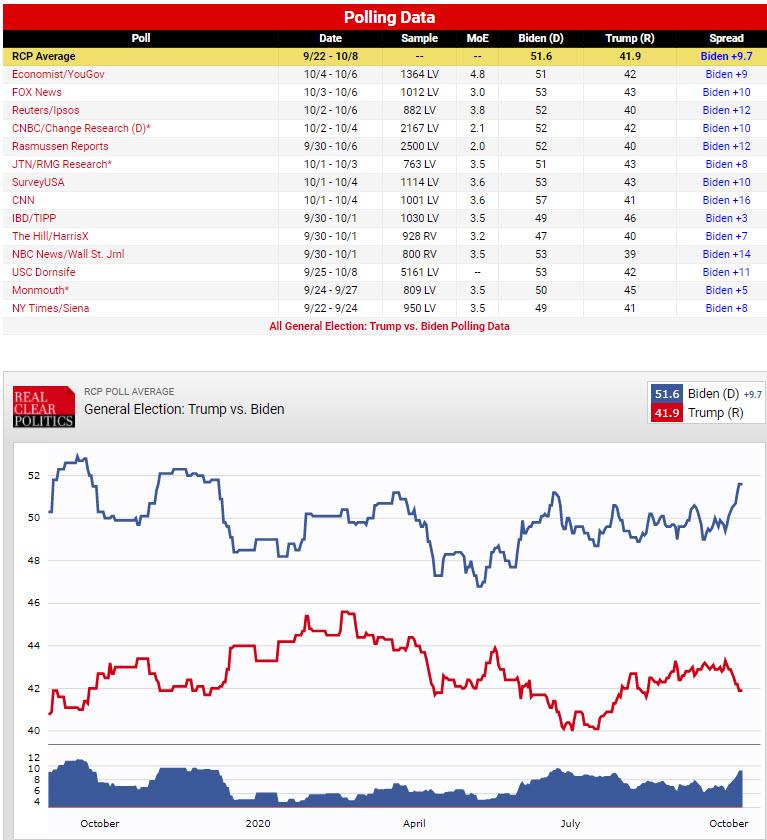
Currently, the major polls give former Vice President Biden more than a 9-point lead nationally against President Trump – according to RealClearPolitics National Average.

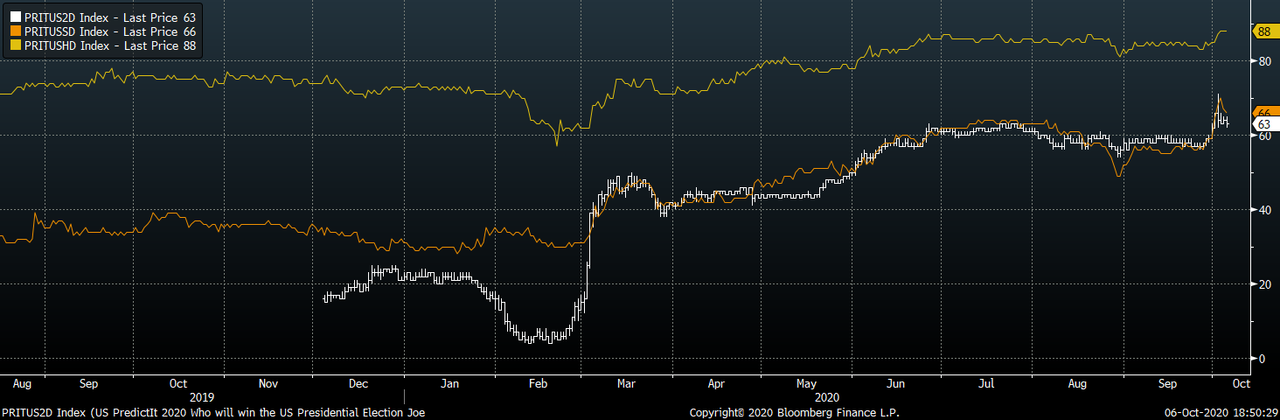
And the Predictit markets imply a 67% probability of Biden winning on November 3rd. Additionally, those markets suggest that Democrats will win both the Senate and House (66% and 88% probabilities, respectively). Quite simply, it appears that a Blue Wave is fast approaching, something which the market has not only priced in, but has successfully digested as a favorable narrative for risk assets.
It would be easy to simply close the books and call the November contest over. But, of course, the major polls were all wrong in 2016; notably about the presidential race.
In the following Election Review from Camelot Portfolios, we look at what some of the polling firms that called 2016 correctly are seeing today. "Shocking", their polling suggests that President Trump will be re-elected, either narrowly or by a large margin. Therefore, as Camelot notes, "capital allocators today cannot easily assume next month’s results."
It’s very possible that Trump will win Florida, North Carolina and Arizona. If so, a win in Pennsylvania or Michigan will likely put him over the top in the electoral college. And speaking of "shocking", Camelot notes that as far as the Senate and House are concerned, it also appears that Republicans will keep control of the Senate, especially if Trump has a strong night. On the other hand, the House is highly likely to remain in Democratic control.
First, a few quick notes, on what happened over the past four years, and a look at the "Market Narrative" of Trump's presidency prior to Covid-19:

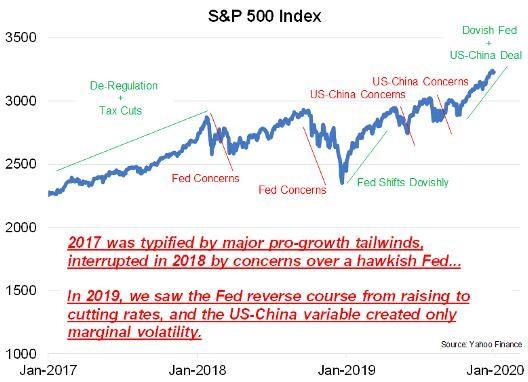
  • In 2017, the S&P 500 rallied in a relatively consistent fashion; due primarily, in our view, to the tailwinds of major deregulation and tax cuts.
  • Contrary to warnings that a Trump presidency would lead to a market crash, most notably by Paul Krugman, the S&P has returned 57.7% since President Trump’s election in 2016 (November 7, 2016 through October 6, 2020) – not including dividends.
Fast forward to today, when according to online betting site PredictIt.org, the probability of Democrats winning White House 63%, win Senate 66%, win House 88% (here, a question should be asked: since the contracts are relatively illiquid, is there one or more major players who have "cornered" the PredictIt market and are swaying public opinion with relatively low sums of cash).
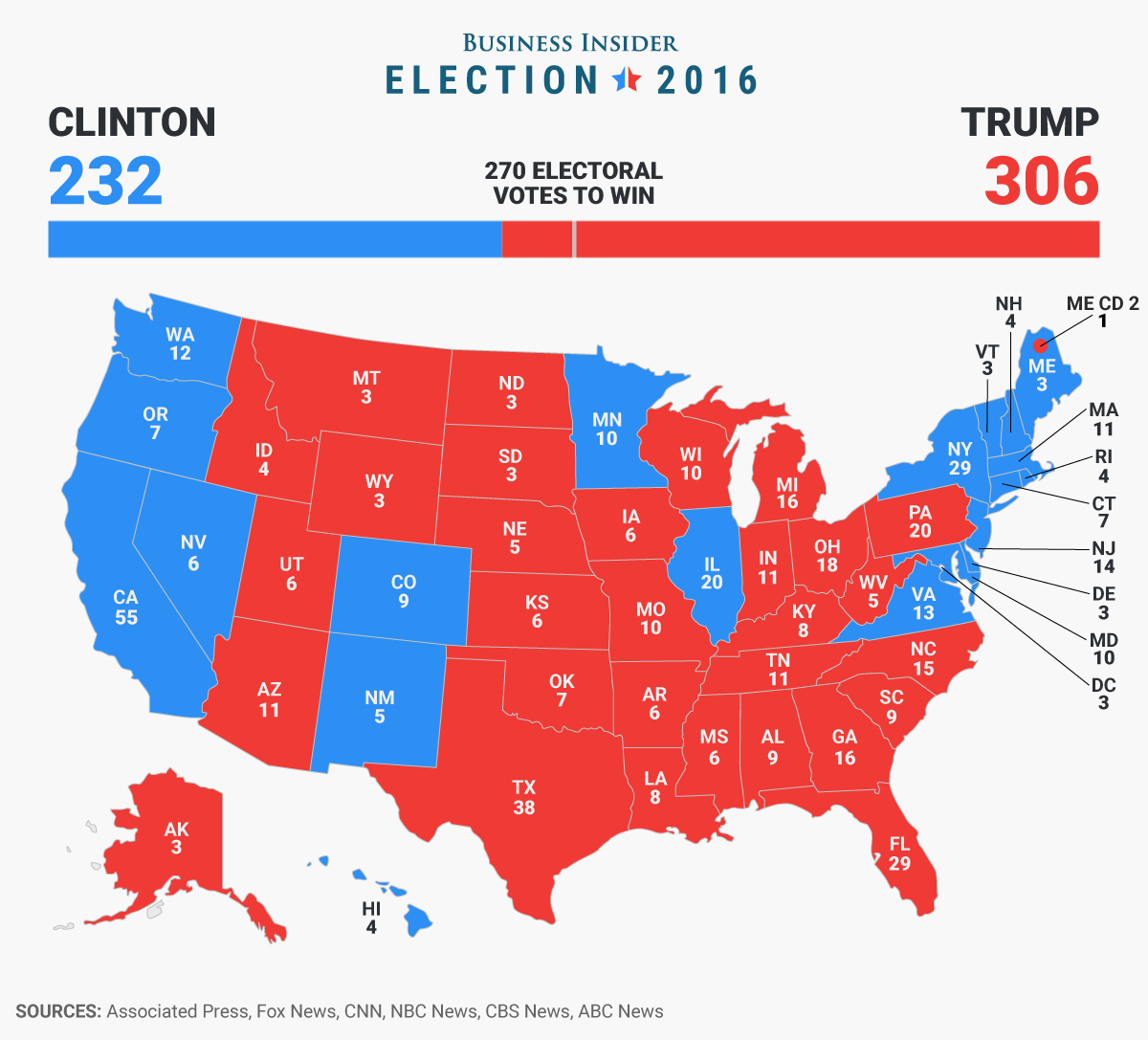
Next, we look at the Electoral College Map after the 2016 election:
  • In 2016, Secretary of State Clinton received 65,853514 votes, or 48.2% of the popular vote. Donald Trump received 62,984,828 votes, or 46.1%. (source: Federal Election Commission)
  • In terms of the electoral college, however, Trump handily beat Clinton with 306 votes versus 232 for Clinton. (source: Business Insider)
  • Trump won the key swing states in the Rust Belt: PA, OH, MI and WI.
  • And, Trump won the key swing states of FL, NC and AZ.
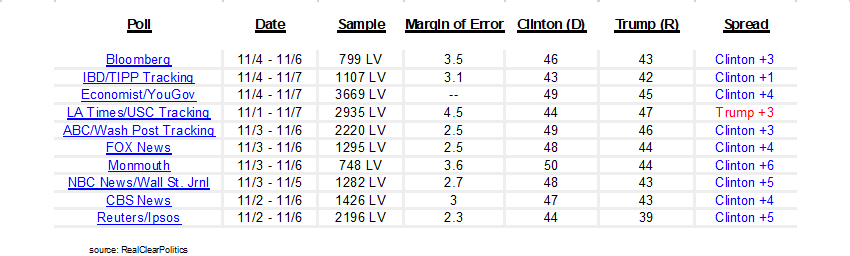
This outcome was not predicted by virtually any pollster in 2016, when most of the major polls were wrong, but not all:
Among these major polls, Clinton led Trump by 3.2% during the week prior to Election Day. More accurate pollsters incorporated likely voters and attempted to adjust for ‘shy voters’.
Trafalgar Group was named best polling firm of 2016 presidential race. It was one of few pollsters to predict Trump would win PA and MI (sources: Trafalgar Group and RealClearPolitics) and also Trump's victory. This is what Politico wrote in its post-election mea culpa about the Trafalgar Group:
The signs of a polling disaster were all there, but almost no one besides Donald Trump was paying attention.
There were surveys showing Trump winning, but they were ignored by most news outlets, dismissed as partisan polls conducted using automated phone technology that eschews calling cell-phone users.
the state polling this year was sparse, especially in the closing days. Of the 11 states POLITICO identified as Electoral College battlegrounds earlier this year, four of them didn’t see a nonpartisan, public, live-interview poll for the final week of the campaign: Colorado, Nevada, Ohio and Wisconsin. Taken together, it was a recipe for an epic polling failure.
* * *
Few, it seems, paid attention to the surveys from the Trafalgar Group – a Georgia-based consulting firm that, on its website, celebrates the time RealClearPolitics picked up one of its Florida primary polls – showing Trump ahead. The group’s Pennsylvania poll was the only one of dozens since late July to show the GOP nominee in the lead there – but it was also the only poll conducted into this past weekend, as voters made their final choices.
The Trafalgar Group was somewhat prolific on Monday, the day before the election, releasing surveys in Florida (Trump ahead by 4 points), Michigan (Trump ahead by 2 points) and Georgia (Trump ahead by 7 points).
At a time when the polling industry was crushed by its collectively incompetence, the praise for Trafalgar continued:
The secret to Trafalgar's success is that it best adjusted its polling to include ‘shy Trump voters’ and the votes missed in other polls. Democracy Institute also correctly predicted Trump’s victory in 2016, as well as Brexit.
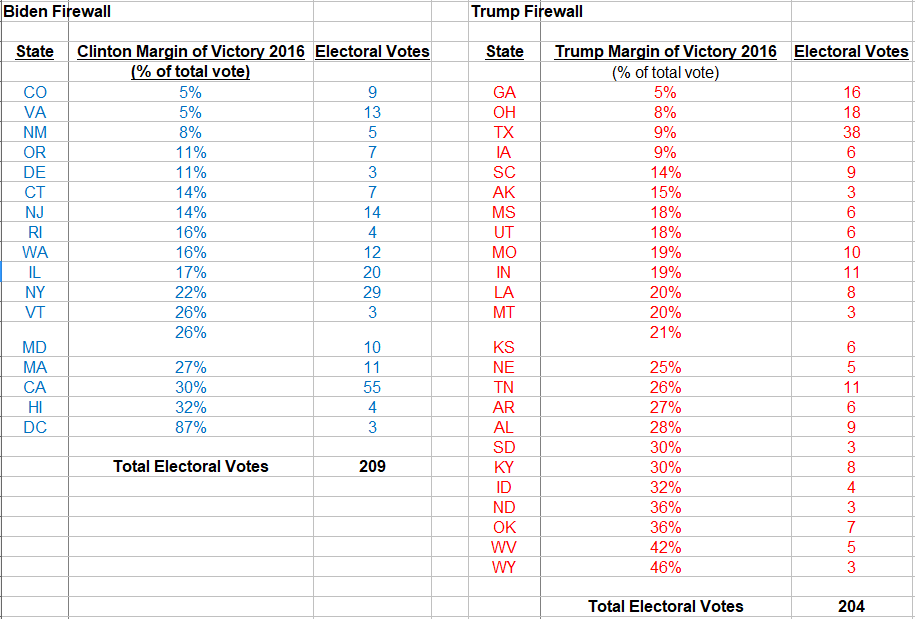
Which brings us to today, and what Camelot Portfolios sees as the likely firewall states for Trump and Biden:
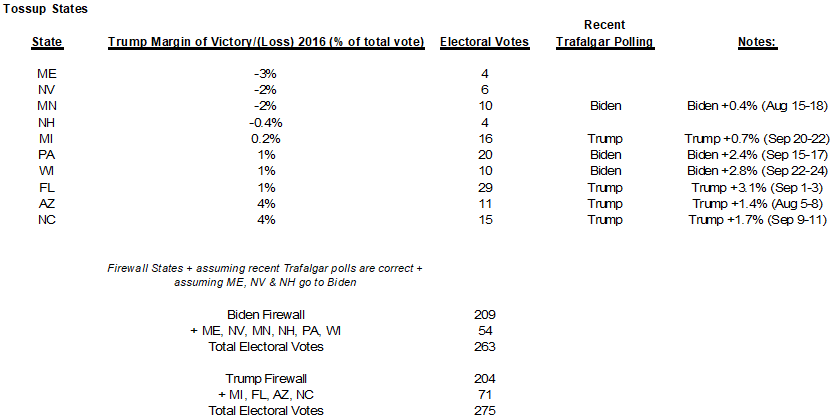
Which brings us to the punchline, and what Trafalgar sees as the outcome on Nov 3. In a nutshell, based on Trafalgar swing state polls, Trumps wins with 275 electoral votes:
What about the the "winner" in the 2016 polling fiasco, the Democracy Institute, and its Latest Poll for September:
  • Only asks likely voters, and asks about so-called ‘shy votes’.
  • Trump leads Biden 46%-45%, nationally.
  • Trump leads in swing states (FL, IA, MI, MN, PA, WI) 47% to 43%.
  • Trump’s swing state leads would give him 320 electoral votes, and Biden 218.
  • 77% of Trump voters would not admit to friends and family.
  • Amy Coney Barrett nomination has little impact on approximately 8 in 10 voters.
  • Law and order is top issue (32%). Economy is second (30%).
  • Voters trust Trump more on economy than Biden: 60% to 40%, respectively
But wait, there's more shocks, because according to Camelot, Republicans are also likely to retain their control of the Senate.
  • Current Senate makeup is 53 Republicans and 47 Democrats and Independents.
  • 35 Senate seats up for grabs.
  • 23 seats are held by Republicans; 12 held by Democrats.
  • Republicans at disadvantage; need to protect more seats.
  • Most vulnerable incumbents are in: Alabama (Jones-D), Colorado (Gardner-R), Maine (Collins-R), Michigan (Peters-D).
  • Assuming Trump polling in these four states will determine the Senate race: Republicans likely to pick up AL, Democrats likely to pick up CO and Maine – for net gain of one seat in Senate.
  • Outlier Scenarios: Trafalgar polling shows Republican in Michigan (John James) with slight lead; and Democrat in North Carolina with slight lead.
  • Likely November: Republicans keep Senate control with 52 seats.
Finally, in what may be the worst possible news for markets which are now convinced a blue sweep is inevitable, Camelot says that Democrats will continue their dominance in the House, where they have a clear advantage:
  • 2016: RealClearPolitics Average had Democrats +0.6 near Election Day -> Final was Republicans +1.1 -> GOP lost 6 seats; maintained majority 241-194
  • 2018: RealClearPolitics Average had Democrats +7.3 near Election Day -> Final was Democrats +8.4 -> Democrats gained 41 seats; retook majority 235-199
  • 2020: RealClearPolitics Average has Democrats +6.0 during the last week.
Readers curious for more can register for the next Camelot call, which will take place next Tuesday, Oct 13 at the following link.

(ZH) Robinhood Users' Accounts Mysteriously Looted And There's No One To Call

Robinhood Users' Accounts Mysteriously Looted And There's No One To Call


In what is likely anybody's nightmare scenario, Robinhood users who have experienced theft from their accounts say they have nobody at the company to call and are not being attended to in a timely fashion, a new report from Bloomberg says.
Soraya Bagheri is one such example. She had 450 shares of Moderna liquidated from her account and saw that $10,000 in withdrawals were pending. She tried to alert Robinhood, but instead got an email back saying the company would investigate and respond within "a few weeks". In the interim, her money is gone.
The article notes that at least 4 other users have had similar situations and, because Robinhood doesn't have an emergency phone number to call, users had to sit back and "watch helplessly as their money vanished".
Bagheri says she contacted the SEC and FINRA alongside of three other users who had a similar problem. Two of the four users have said that the SEC has sought more information from them.

Another user, Pruthvi Rao, said his Netflix shares were liquidated from his account and $2,850 was withdrawn from it. He says he has sent "more than a dozen" email to Robinhood and has tried to even message some of the brokerage's executives on LinkedIn. His account was frozen by Robinhood due to the activity and has since been reinstated.
Rao said: “I’m in tremendous mental stress right now because this is all of my savings.”
From Robinhood, he got a boilerplate response: “We understand the sensitivity of your situation and will be escalating the matter to our fraud investigations team. Please be aware that this process may take a few weeks, and the team working on your case won’t be able to provide constant updates.”
Even more interesting is that Rao says he had set up two-factor authentication on his account and Begheri said she was "certain" she had a unique password for her Robinhood account.
Their accounts showed their money went to a receiver at Revolut, which is a money transfer and exchange app. “Revolut has been made aware of the issue and is investigating urgently,” the app said.

Bill Hurley, who lost $5,000 from the same type of hack, simply said Robinhood has "had more than enough time to deal with this".
Mark Arena, CEO of security firm Intel 471, said: “Unfortunately, it’s a common occurrence that online accounts of monetary value are bought, sold and traded by cyber-criminals. This shows the importance of people practicing common information-security hygiene such as not re-using the same password across multiple accounts and enabling two-factor authentication."
Robinhood also issued a statement to Bloomberg: “A limited number of customers appear to have had their Robinhood account targeted by cyber criminals because of their personal email account (that which is associated with their Robinhood account) being compromised outside of Robinhood. We’re actively working with those impacted to secure their accounts.”
“They don’t have a customer service line, which I’m quite shocked about,” Bagheri concluded.

WSJ : U.S. Covid-Testing Plan Aims to Open New York-London Travel by Holidays

U.S. Covid-Testing Plan Aims to Open New York-London Travel by Holidays
Airlines, governments hope testing will spur more travel for business and pleasure

U.S. officials are aiming to open travel between New York City and London with shortened traveler quarantine periods as soon as the holidays, according to people familiar with the matter.

The growing availability of Covid-19 tests in the U.S. has prompted officials at the Transportation Department, Department of Homeland Security and other agencies to revive efforts to establish safe travel corridors between the U.S. and international destinations, the people said. Establishing those routes would require travelers to be tested for Covid-19 before their flight and again upon arrival, allowing them to avoid lengthy quarantines at their destinations.

The Trump administration and foreign governments must both agree to the plan, according to one U.S. official familiar with the efforts. A Homeland Security official said the agency’s work to “safely encourage trans-Atlantic travel while mitigating public-health risks” was in its early stages.

Federal officials have recently focused their talks about an initial corridor with their U.K. counterparts, and discussions have also involved German officials, people familiar with the matter said.

Limited availability of testing in the U.S. earlier this year and long wait times for test results stalled previous efforts to open international travel.

Currently, American citizens traveling to the U.K. must quarantine for 14 days and for the most part cannot travel to the European Union. The U.S. bars entry to travelers from the U.K. and Europe unless they are U.S. citizens or permanent residents.

After coming to a halt in the early weeks of the pandemic, air travel has remained slow due to travelers’ fears of contracting the coronavirus and closed borders or mandatory quarantine periods for incoming travelers. International travel has been particularly hard-hit, and the scarcity of fliers has put some global airlines out of business and wiped out billions of dollars in profits.

U.S. government and aviation-industry officials involved in the planning talks cited one big obstacle in negotiations with foreign leaders over easing travel restrictions, even with testing: America’s persistently high Covid-19 infection rates. The U.S. and the U.K. have both experienced recent upticks in infections, and the U.S. had more than 56,000 new cases of Covid-19 on Thursday, according to Johns Hopkins University data.

The White House’s National Security Council approved the corridor plan to move forward in recent weeks, people familiar with the matter said. A spokesman for the security council declined to comment.

A Transportation Department spokesman said the agency was ready to support the effort and noted officials’ talks with international and industry counterparts were continuing. Easing quarantine requirements has been debated in the U.K., and Transport Minister Grant Shapps said this week that a task force there would study the potential role of airport testing.

Reviving popular vacation and business routes has been a priority for airlines and governments whose economies depend on travel. Some carriers have already worked with governments in states like Hawaii and destinations like Costa Rica and Jamaica on testing plans that shorten travelers’ mandatory quarantine periods.

Like a lot of virus-related travel measures, these early efforts are a patchwork, with different testing options depending on the airline, from rapid-testing at the airport to at-home test kits. Travelers pay for the tests, most of which cost $100 or more.

Under these guidelines, tests aren’t mandatory for every flier as they would be in the plans federal officials are considering.

“We want to ease into this,” said Julie Rath, vice president of customer experience and reservations at American Airlines Group Inc. AAL 0.34%

Many airline executives say it will take a proven and widely available vaccine to make fliers comfortable and return flying to 2019 levels. Airlines currently mandate that passengers wear masks and have ramped up cabin cleaning.

Eventually, “proof of a vaccination will replace proof of a negative test result” as a travel-must, said Aaron McMillan, United Airlines’s UAL 0.32% managing director of operations policy and support.

Nations’ and carriers’ attempts to reopen world travel have been uneven. In addition to U.S. and EU traveler bans, some countries, like Argentina, have remained largely shut. Others are open, but subject travelers to an array of rules and restrictions regarding the lengths of quarantines and types of tests travelers need to take.

Such restrictions, along with fears of infection on longer flights, have left international travel even more depressed than domestic flying, according to the International Air Transport Association, a trade group. Global international air traffic was down 88% in August from the previous year, according to IATA.

Airline executives on both sides of the Atlantic have been pushing since July for governments to use testing in lieu of quarantines and other international restrictions. Airports in North America, Europe and Asia have also been working to develop a common testing framework.

For now, testing bottlenecks have eased and the U.S. has more testing capacity than it is using. The seven-day average of new daily tests conducted in the U.S. is about 961,000 or just under 30 million tests a month, while the Department of Health and Human Services said about 90 million tests were available in September.

Rapid tests are expected to be a primary tool to maintain Covid-free corridors, the people briefed on the matter said. Rapid tests typically trade some accuracy for speed, so it wasn’t immediately clear whether other tests—such as polymerase chain reaction tests run in labs—and shorter periods of self-isolation might be required.

FT : Why talk of a TalkTalk trade buyer was all talk

Why talk of a TalkTalk trade buyer was all talk
Takeover approach came in the end from the hedge fund that is the UK broadband provider’s second-largest shareholder

UK broadband provider TalkTalk joined the growing list of listed telecoms companies set to go private this week when it said it was considering a takeover approach from the hedge fund that is its second-largest shareholder.

Britain’s fourth-largest provider, with 4.2m customers, has in effect been up for sale for years, but there was a widespread expectation that it would eventually be snapped up by one of its larger rivals, as a key asset in the consolidation of the UK market.

Instead it is Toscafund, which already owns a near-30 per cent stake, that has lodged a 97p-a-share offer that amounts to £1.1bn, or £2bn including debt. The deal is contingent on the participation of Charles Dunstone, the billionaire chairman who also owns close to 30 per cent of the business.

If agreed, it would represent another example of the creeping privatisation of European telecoms — following on from Patrick Drahi’s move to buy out Altice, the sale of assets to infrastructure funds and the acquisition of MasMovil by KKR and Cinven — which is being driven by low valuations and investor pressure on management teams to consider new options.

Talk of a TalkTalk takeover is not new. Both Vodafone and Virgin Media have considered it in the past, according to multiple people with direct knowledge of the situation but were put off by its valuation, even as its shares sank to less than a third of their peak this year.


Virgin Media’s decision to merge with O2 this year has rekindled consolidation talk. That deal creates a combined broadband-mobile business that can compete with BT and its EE mobile business. It also narrows the options for smaller providers Vodafone, Three, Sky and TalkTalk.

Toscafund’s latest approach is not its first: it offered to buy out TalkTalk at 135p last year but was rejected. It may now succeed with the lower offer, which reflects the collapse in the value of listed European telecoms companies. TalkTalk’s board, like most others in the sector, has become frustrated that progress strengthening the company’s balance sheet and improving its operating performance have made no difference to its share price according to one board member.

Although 97p a share is a hefty-sounding 26 per cent premium to the average price in the past six months, it is half the level of 2017, when TalkTalk was still recovering from the effects of a damaging cyber attack.

Neither would the takeover address the imbalance in the market between the two large integrated providers and the rest. One investment banker said European telecoms markets are starting to split into two distinct camps: large combined groups like BT-EE and Virgin-O2, and lean, low-cost operators including Iliad and MasMovil. “If you’re caught in the middle ground, it is a problem,” he said.

Barclays calculated that after the Virgin-O2 deal closes, BT-EE will make up around 50 per cent of UK industry earnings, Virgin-O2 around 30 per cent, with Vodafone accounting for around 10 per cent and Hutchison’s Three only 6 per cent.


Yet there is no sign of a trade buyer preparing a TalkTalk counter bid in the wings. One person with direct knowledge of one potential bidder’s strategy said that even at 97p-a-share, Toscafund valued TalkTalk at a much higher price than anyone else. Another company said there was little point considering a rival offer because TalkTalk going private would do nothing to change the structure of the market.

For a company like Vodafone, which has been very acquisitive in global telecoms, its own strategy to reduce debt and buy broadband network assets looks at odds with any move on TalkTalk, despite the attractions of its 4m customer base and £1.6bn of UK revenues. Taking on TalkTalk, a value player with scant network assets that is midway through a restructuring, could also disrupt its own recovery plan in the UK after years of underperformance in its home market.

Three’s UK management team has called for consolidation in recent months to help settle a “dysfunctional” market. It has highlighted a desire to expand into the business telecoms market to compete with BT, Virgin Media and Vodafone. TalkTalk has a good foothold in this business.

However Three’s owner CK Hutchison has not previously shown an interest in buying into the broadband market.

Investment bankers argue a combination of mobile phone businesses Vodafone and Three in the UK is a more likely scenario in the long term even though European regulators have blocked mergers in the past. Vodafone merged with Three in Australia a decade ago and this year combined with broadband player TPG, a model that could be followed in the UK over time.

TalkTalk may go private having failed to attract a trade buyer as a listed business, but it could still play a role in future consolidation as UK telecoms groups plot the best way to stay in the black.

FT : Engie’s new CEO sets out with the goal of simplifying the energy group

Engie’s new CEO sets out with the goal of simplifying the energy group
Catherine MacGregor must keep the French state onside while making the company more understandable for investors

Catherine MacGregor has worked beside roughnecks in the Gulf of Mexico and on oil rigs in Congo Brazzaville, but the task facing her as the new boss of French energy group Engie might be her most daunting yet.

An engineer by training who has spent much of her career outside France, Ms McGregor will in January become the only female leader of a CAC 40 company.

The year was meant to have gone differently for the 48-year-old. Ms MacGregor had been due to become chief executive of half of Franco-American oil services group TechnipFMC, which was due to separate into two companies.

She turned down a first approach by Engie’s headhunters in March.

But a plunging oil price and the coronavirus pandemic forced Technip to delay its split — and Ms MacGregor to rethink her plans. When she got the call again in August she said yes, and went into a short, intense round of interviews.

Ms MacGregor, who was born and brought up in Morocco, has long sought a CEO role. 

In recent years she came close to the top jobs at pipemaker Vallourec, cabling company Nexans and Schlumberger, the oilfield services group where she spent 23 years. 

At Engie, she was up against three main competitors: Gwénaëlle Avice-Huet, an internal candidate running its renewables business; Laurent Guillot, an executive at building materials group Saint Gobain; and Catherine Guillouard, who runs the Paris region transport system RATP.

Engie was under pressure from the French state, its largest shareholder, to appoint a woman. The finance ministry demanded more options after reviewing the short list in July, according to people familiar with the matter. 

After the ousting of previous Engie CEO Isabelle Kocher in February, the CAC 40 was left without a single female boss — a glaring diversity problem for French President Emmanuel Macron.

Few people question Ms MacGregor’s credentials, even if she has yet to prove herself at a company the size of Engie, which boasts €60bn in annual revenue and employs 160,000 people worldwide. 

The hope is that her time at Schlumberger, which moves promising executives rapidly between jobs and is something of a training ground for hard-working industrial bosses, will equip her to take the reins at one of Europe’s largest energy companies. 

“One should not reduce Catherine MacGregor to someone who comes from the oil industry . . . She is someone who has major operational experience in complex environments and who has overcome all those challenges successfully,” said Engie chairman Jean-Pierre Clamadieu after her appointment.

A French citizen but to many still an outsider, Ms MacGregor, say advisers, wants to simplify Engie.

Ms Kocher, a former civil servant, wanted to reinvent the former state-owned gas monopoly by making it a green energy champion, with an emphasis on services.

Her push to sell off billions in fossil fuel assets led to her being ranked the world’s third-most powerful woman in business outside the US by Fortune magazine in 2017, but Engie’s stock price lagged rivals.

Ms MacGregor’s task is to make the group more understandable for investors. She will start by executing a new strategy led by Mr Clamadieu involving a pull back from services and asset sales in non-core sectors. 

Going further, including overhauling management and putting in place her own strategy, will take months as Ms MacGregor gets to grips with the company.

She will also have to clearly delineate her role from that of her Mr Clamadieu, who has taken on a more visible and executive role since Ms Kocher’s departure.

Engie has been riven in the past by fights between chairman and CEO and is a company where the board plays a big role in shaping strategy. That will put pressure on Ms MacGregor to make her mark quickly.

However, “it’s not as if she took this job without talking to Clamadieu”, one Engie adviser said. “There is enough work to do in the coming months for both the chairman and the CEO . . . and Jean-Pierre has a network in Paris which she lacks and which will be valuable.”

A chunk of that work will involve maintaining a good relationship with the French state, which owns 23.6 per cent of the group and has outsized voting rights and three board seats. 

Ms MacGregor has at least been spared one problem, the question of what Engie should do with its stake in water and waste group Suez. This month it sold the vast majority of its 32 per cent holding to Suez’s arch-rival Veolia, kicking off a nasty takeover fight but freeing up capital.

That sale was against the wishes of the government, a signal it might be less beholden to Paris in the future.

But Ms MacGregor, who has two daughters with her Scottish ex-husband, has moved back into her flat in the trendy 9th arrondissement of Paris and is unlikely to escape being drawn into the capital’s corporate and state nexus. 

She recently read a biography of French president Charles de Gaulle, the founder of the Fifth Republic, with one person close to her archly suggesting that “it can’t hurt to have a bit more insight into how this country works”.