>>> TradeGate Pre-Market Indications

DAX:
  • Daimler (DAI TH) +1.5%
    • Daimler Raised to Buy at Goldman; PT 60 euros
  • Linde (LIN TH) +1.2%
  • Infineon (IFX TH) +1.2%
  • VW (VOW3 TH) +1%
    • ASIC, Volkswagen Financial Services Settle Court Proceeding
  • HeidelbergCement (HEI TH) +0.9%
  • Continental AG (CON TH) +0.2%
  • Delivery Hero (DHER TH) +0.2%
MDAX:
  • Fraport (FRA TH) +1.4%
  • Thyssenkrupp (TKA TH) +1.2%
  • Evotec SE (EVT TH) +1.2%
  • Hochtief (HOT TH) +1.2%
  • Telefonica Deutschland (O2D TH) -0.3%
  • Cancom (COK TH) -0.5%
  • Aareal Bank (ARL TH) -0.6%
  • Osram (OSR TH) -0.6%
  • HelloFresh (HFG TH) -1.2%
SDAX:
  • 1&1 Drillisch (DRI TH) +2.2%
  • Dr Hoenle (HNL TH) +2.2%
  • Bilfinger (GBF TH) +1.7%
  • Talanx (TLX TH) +1.4%
  • SMA Solar (S92 TH) +1.2%
  • Eckert & Ziegler Strahlen- und Medizintechnik AG (EUZ TH) -0.5%
  • Borussia Dortmund (BVB TH) -0.5%
  • Fielmann (FIE TH) -0.6%
  • KWS Saat (KWS TH) -0.9%
  • Zeal Network (TIMA TH) -1.3%

>>> Stoxx 600 Pre-Market Indications

  • Rolls-Royce (RRU TH) +3%
    • For Rolls-Royce Shareholders a Month Is a Very Long Time: Chart
  • Orsted (D2G TH) +2.6%
    • Berenberg Switches Up ESG Picks List, Adding Nestle and Orsted
  • Hexagon (HXGB TH) +2%
  • BP (BPE5 TH) +1.9%
  • Swedish Match (SWM TH) +1.8%
  • Ericsson (ERCB TH) +1.8%
  • Teleperformance (RCF TH) +1.7%
  • Vestas (VWS TH) +1.7%
  • Recordati Industria Chimica e Farmaceutica SpA (RER1 TH) +1.5%
  • Daimler (DAI TH) +1.5%
    • Daimler Raised to Buy at Goldman; PT 60 euros
  • Mowi (PND TH) -0.7%
  • Husqvarna (HRZ TH) -0.9%
  • Telefonica Deutschland (O2D TH) -0.9%
  • Ryanair (RY4C TH) -0.9%
  • Cellnex (472 TH) -0.9%
  • HelloFresh (HFG TH) -1%
  • Siemens Gamesa (GTQ1 TH) -1.2
  • Rational (RAA TH) -1.5%
  • Carnival Plc (POH1 TH) -2.4%
  • Altice Europe (6AT TH) -2.6%
    • Altice Europe Raised to Equal-Weight at Barclays; PT 4.11 euros

>>> What to look at today - 12th of October 2020

The offshore yuan fell after Chinese policy makers acted to restrain its strength by making it easier to bet against. Most Asian stocks gained led by China.
The yuan fell as much as 0.7% against the dollar, which ticked higher against major peers. S&P 500 futures fluctuated after the benchmark ended higher last week, with some traders betting lawmakers are moving closer to reaching an agreement on stimulus. Chinese shares led regional gains as investors mulled an expected visit by President Xi Jinping to Shenzhen this week amid optimism he could unveil plans to further open parts of the economy to foreign investment. Hong Kong stocks also climbed, with a more modest rise seen in South Korea and Australia. MSCI’s gauge of Asia Pacific stocks was at the highest since June 2018.
Elsewhere, Japanese equities bucked the trend and retreated. Crude oil declined and gold slipped. Treasuries won’t trade Monday due to a U.S. holiday.

Nikkei -0.22% Hang Seng +2.32% CSI +2.67% Shanghai +2.44% Shenzen +2.81%

Eur$ 1.1828 CNH 6.7139 CNY 6.7169 JPY 105.46 GBP 1.3040 RUB 76.9041 CHF 0.9103 WTI$40.52 -1.63%

S&P +0.31% Nasdaq +0.50% EuroStoxx +0.65% FTSE +0.15% Dax +0.65% SMI

Macro :
- EU Weighs Creating Bad-Banks Network, Boersen-Zeitung Says
- The Case for Buying Asia Stocks Over U.S. Ones as Election Nears
- U.K.’s Johnson Will Make Statement to MPs on Monday: Sky
- Europe’s Record Cash Pile Set to Prime Next Stage of Bond Rally
- ECB’s Schnabel Tells Germany Not to Fear Rising Public Debt
- JPMorgan Says U.S. Capital Gains Tax Hike May Briefly Hit Stocks

Spacs :
- Och-Ziff Founder Seeks to Raise Up to $750M for Blank Check Co.
- Boston Red Sox Owner Said to Be in Talks With Beane’s RedBall
- Blank-Check Firm Backed by Boston Omaha Cuts IPO Size to $150M

Keep an eye on :
- AIR FP : Aerospace Executives Urge Conditions for Green Fuel Use: FT
- AAPL US : Apple Starts Shipping Devices From Stores to Speed Up Deliveries
- ASML NA : ASML Traders See More Earnings-Day Swings; Philips Expect Less
- AZN LN : AstraZeneca to Get About $486M for Covid-19 Monoclonal Antibody
- IAG LN : London to New York ‘air corridor’ could be in place by November
- BZU IM ; Buzzi Unicem Plans Special Dividend EU0.75/Share
- CSGN SW : Vatican Sold Charitable Assets to Repay EU242m CS Loan: FT
- DBK GY : Deutsche Bank Executive Says Private Bank Key for Lender’s Goals
- DWNI GY : Deutsche Wohnen ‘Different’ to Vonovia, CEO Tells Handelsblatt
- EDP PL : EDP-Energias Says Nine-Month Electricity Generation Falls 5%
- ENGI FP : Engie Says Will Appeal Court Decision on Veolia-Suez: AFP
- ENX FP : S&P Places Euronext ‘A-’ Ratings on Watch Negative
- FIT US : EC Still Talking to Fitbit/Google Competitors in Review: CTFN
- IHG LN : U.K. Hospitality Industry to Challenge New Lockdown Rules: Rtrs
- SHBA SS : Handelsbanken Shares Worth Buying, Dagens Industri Says
- KPN NA : EQT Is Said to Explore Takeover of $11 Billion Carrier KPN (2)
- LAND SW : Landis + Gyr First Half Adjusted Ebitda $50.1 Mln
- NSKOG NO : Norske Skog Hires KPMG for Review of N.Z. Newsprint Operations
- PSON LN : Pearson Investors Push for Chairman Departure, FT Says (Earlier)
- SEV FP : Veolia Says Court Ruling Doesn’t Affect Ownership of Suez Shares
- RDSA LN : Shell Reploying Drill Ships, Offshore Crews After Delta Passes
- SOW GY : Software AG Confirms Public Data Release After Malware Attack
- STM GY : Stabilus Prelim Full Year Adjusted Ebit Margin 11.7%
- TECN SW : Tecan to Join SMIM Index on Oct. 16 Following Sunrise Takeover
- VIE FP : Veolia Says Is Appealing Interim Order by Paris Judge on Suez
- VNA GY : Deutsche Wohnen ‘Different’ to Vonovia, CEO Tells Handelsblatt
- VOW3 GY : Audi Sees Loss in 2020 on Coronavirus, CEO Tells Automobilwoche

>>> Europe : Brokers Upgrades & Downgrades - 12th of October 202

>>> Up
* Altice Europe Raised to Equal-Weight at Barclays; PT 4.11 euros
* Daimler Raised to Buy at Goldman; PT 60 euros
* Eiffage Raised to Buy at SocGen; PT 95 euros
* Iberdrola Raised to Buy at HSBC; PT 12.20 euros
* Kojamo Raised to Buy at Kempen & Co; PT 21 euros
* Konecranes Raised to Neutral at Goldman; PT 28 euros
* LondonMetric Raised to Neutral at Kempen & Co; PT 235 pence
* SocGen Raised to Buy at Jefferies; PT 17.60 euros
* VGP NV Raised to Buy at Kempen & Co; PT 130 euros
* Wartsila Raised to Buy at SEB Equities; PT 9 euros
* Workspace Raised to Neutral at Kempen & Co; PT 610 pence

>>> Down
* Aeroports de Paris Cut to Add at AlphaValue
* Catena Cut to Neutral at Kempen & Co; PT 400 kronor
* Montea Cut to Sell at Kempen & Co; PT 95 euros
* Orsted Cut to Hold at HSBC; PT 1,010 kroner
* Pan African Cut to Underweight at Nedbank CIB; PT 27.97 pence
* Segro Cut to Neutral at Kempen & Co; PT 980 pence
* Stroeer Cut to Underweight at Barclays; PT 68 euros
* Xior Student Housing Cut to Sell at Kempen & Co; PT 51 euros

>>> Initiation
* Argan Rated New Neutral at Kempen & Co; PT 85 euros
* Intervest Offices Reinstated Buy at Kempen & Co; PT 25 euros
* Knights Rated New Sell at Investec; PT 320 pence
* Oht Rated New Buy at Pareto Securities; PT 30 kroner
* VIB Vermoegen Rated New Buy at Kempen & Co; PT 33 euros
* Zignago Vetro Rated New Buy at Berenberg; PT 16.50 euros

>>> Call
* Buy U.K. Banks as Valuations Below Financial-Crisis Levels: Citi
* Berenberg Switches Up ESG Picks List, Adding Nestle and Orsted
* Disappointing Cash-Rich Firms Have Room to Recover: Bernstein

Mediapart : Suez-Veolia: un maquillage d’Etat


Suez-Veolia: un maquillage d’Etat

Rien ne colle dans la version officielle donnée par le gouvernement sur la cession Suez-Veolia. Les nouveaux éléments collectés par Mediapart montrent, en dépit des démentis, que l’Élysée s’est directement impliqué dans le dossier. Et que les cartes, comme le dénoncent les salariés de Suez, « étaient truquées dès le début ». Révélations.

La première réplique à l’invraisemblable opération de cession de Suez à Veolia n’a pas tardé. Dés le 9 octobre, le tribunal judiciaire de Paris a donné un coup d’arrêt à cette vente. Saisi par le comité social d’entreprise de Suez en référé après le refus d’Engie de répondre à ses demandes d’information, le tribunal a ordonné la suspension de toute l’opération de cession de Suez à son concurrent.

« Une procédure d’information-consultation doit être menée loyalement sur la base d’informations suffisamment précises pour assurer aux élus la bonne compréhension du projet », rappelle le tribunal. Or Engie comme Veolia se sont refusés à respecter la loi sur l’information-consultation des salariés, condamnant les représentants du CSE de Suez à aller chercher dans la presse les informations sur ce qu’il pourrait advenir aux salariés du groupe. Estimant que les deux groupes les ont placés devant « le fait accompli », le tribunal juge que cette situation constitue un « trouble manifestement illicite » et a « ordonné la suspension de l’opération résultant de l’offre de Veolia », tant que les salariés de Suez n’auront pas été informés (l’ordonnance de référé est ici).

À ce stade, cette décision de justice est de portée assez limitée. Prévenus des risques de voir l’opération bloquée – l’audience s’est tenue le 29 septembre –, Engie et Veolia ont agi de façon à rendre la vente irréversible. Selon nos informations, les titres Suez détenus par Engie ont été livrés dès le 5 octobre, à l’issue du conseil d’administration actant la cession. En retour, le virement de 3,38 milliards d’euros de Veolia a été reçu dans la matinée du 6 octobre. Une célérité rarement vue, qui tend à accréditer que tout avait été préparé longtemps à l’avance : habituellement, il faut au moins de 48 heures, voire de 72 heures avant d’exécuter ce type d’opération, compte tenu de son ampleur. Nous avons cherché à comprendre cet empressement auprès d’Engie, qui ne nous a pas répondu (voir Boîte noire et onglet Prolonger).

« Depuis le début, on a tout de suite compris que les cartes étaient truquées. Comment l’État peut-il laisser le vendeur dicter ses conditions, son calendrier ? », s’énervait Carole Pregermain, secrétaire du comité de groupe France Suez et membre de l’intersyndicale (CGT, CFDT, FO, CFE-CGC) de Suez vendredi. Avant de connaître l’ordonnance du tribunal de Paris, elle insistait sur la détermination des salariés de Suez à utiliser toutes les armes à leur disposition pour faire toute la lumière sur les conditions obscures de cette opération, pour s’opposer à ce projet « hostile ».

Un match truqué : c’est l’impression que semblent en retirer nombre d’observateurs. Déchaîné, Arnaud Montebourg, ancien ministre du redressement productif, dénonce un scénario à la russe. « Nous sommes dans un scénario de distribution de privilèges à une petite oligarchie », tonne-t-il. À sa suite, des élus de droite comme de gauche dénoncent cette opération « insensée ».

Quel est l’intérêt de l’État à soutenir un projet qui ne peut aboutir qu’à la destruction d’un groupe industriel, à des pertes sociales immenses, à la mise à sac de positions internationales et à la création d’un monopole privé ? Tout au long de ce processus, officiellement lancé le 31 août, l’État n’a été capable d’articuler un seul argument convaincant pour défendre cette opération.

Mais aucune mise en garde, aucun avertissement n’est parvenu à arrêter ou même à retarder ce projet. Le PDG de Veolia, Antoine Frérot, qui a obtenu le feu vert de l’Élysée lors d’une entrevue avec Emmanuel Macron dès le 2 juin, selon nos informations, a réussi à orchestrer son attaque éclair contre son concurrent, avec l’appui constant et déterminé du président d’Engie, Jean-Pierre Clamadieu. En face, le ministère des finances, censé incarner l’État actionnaire, a tenté de donner le change.

Manifestation des salariés de Suez contre le projet de Veolia le 8 septembre. © Ludovic Marin / AFP
La mise en scène de l’impuissance de l’État actionnaire

« Ce qui s’est passé au conseil d’Engie du 5 octobre aurait dû normalement déclencher un séisme, une réaction immédiate de l’État actionnaire : l’État ne peut pas accepter d’être mis en minorité de cette façon sur une question aussi importante. Il aurait pu demander une annulation de la décision du conseil, exiger un conseil extraordinaire et la démission de Jean-Pierre Clamadieu. Or il n’a rien fait », constate un connaisseur de longue date du fonctionnement de l’État.

Il n’a non seulement rien fait mais il a en plus justifié son impuissance, et sa défaite. Dans un entretien au Figaro, le ministre des finances, Bruno Le Maire, revient sur le camouflet subi par l’État : « Ce vote résulte de l’arithmétique : l’État a trois voix sur treize au conseil d’administration d’Engie. Il a exprimé son choix, la majorité du conseil en a exprimé un autre. Cela est déjà arrivé dans d’autres occasions. »

« Bruno Le Maire est en train de reprendre la jurisprudence Lagardère : incompétent plutôt que malhonnête [cette ligne de défense avait été adoptée par Arnaud Lagardère au moment du délit d’initiés chez EADS – ndlr] », ironise un connaisseur du dossier. « Sa décision de demander aux administrateurs de l’État de voter contre le projet d’Engie visait sans aucun doute à le protéger politiquement et judiciairement. Mais la vente de Suez est en train de faire scandale d’État et je doute que cela suffise à le protéger », explique un autre.

Depuis le début de cette affaire, les interrogations sur les réelles convictions de Bruno Le Maire se multiplient. Était-il vraiment hostile au projet tel qu’il a été conçu par Veolia ? A-t-il vraiment cherché à l’amender ou à trouver des solutions alternatives ? A-t-il perdu tous ses arbitrages face à plus puissant que lui au sein de l’État ? Ou a-t-il seulement cherché à donner le change afin de préserver son avenir politique ?

Personne ne paraît avoir la réponse. La décision du tribunal, cependant, place le ministère des finances dans une position embarrassante. Celui-ci ne pouvait pas ignorer l’existence d’un référé heure à heure déposé dès le 22 septembre par le CSE de Suez et l’audience au tribunal du 29 septembre. Alors que les procédures d’information-consultation des salariés sont parfaitement connues, le ministère des finances ne pouvait ignorer qu’Engie et Veolia ne se conformaient pas à la loi. Si comme le ministre des finances, Bruno Le Maire, l’a affirmé, « il demandait d’éviter toute précipitation », pourquoi n’a-t-il pas souligné ce non-respect de la loi pour demander un report du vote ? C’était un excellent argument.

À ce stade, la direction de Veolia est incapable de donner les moindres garanties sociales. « Il ne s’agit que de déclarations d’intention sans indication de durée et sans aucune valeur juridique », avertit le président du conseil de Suez, Philippe Varin, dans une lettre adressée le 5 octobre au ministre des finances, dont Mediapart a eu connaissance (voir page 2).

Contrat bloqué après le veto de l’État

Étrange situation où le premier actionnaire d’un groupe, qui nomme le président, n’est pas capable de se faire entendre. D’autant plus étrange qu’Engie est une entreprise stratégique, qui travaille avec des tarifs régulés : plus de 40 % de son résultat d’exploitation est lié à ses activités de stockage et de réseau, infrastructures publiques en situation de monopole, dont les tarifs – très protecteurs – sont fixés par la commission de régulation de l’énergie (CRE).

Quand l’État a décidé de se faire entendre chez Engie, il le peut. Il l’a fait pas plus tard que le 2 octobre, comme l’a révélé La Lettre A, et nous confirmons leurs informations. Ce jour-là, le conseil d’Engie doit approuver la signature d’un contrat Nextdecade Rio Grande LNG, qui doit permettre au groupe d’importer du gaz américain. Mais les représentants de l’État au conseil du groupe sont contre ce projet, car il s’agit de l’importation de gaz de schiste. Jean-Pierre Clamadieu a beau insister, expliquer que son projet est finalement très écologique car il permet d’exploiter du gaz de schiste qui serait sinon torché (brûlé), ce qui limite les émissions de CO2, que la signature du contrat est fixée, rien n’ébranle l’opposition du commissaire du gouvernement et des administrateurs de l’État. Face à cette opposition, Jean-Pierre Clamadieu a fini par retirer le sujet du conseil.

Mais pourquoi les représentants de l’État ont-ils pu bloquer ce sujet mais semblent-ils avoir été impuissants à se faire écouter et à emporter la décision sur la cession de la vente de Suez, sujet aux implications autrement plus importantes que celles du gaz de schiste, même si le signal envoyé aurait été très négatif ?

Vendredi 2 octobre, Philippe Varin et Bertrand Camus, directeur général de Suez, sont reçus par le secrétaire général de l’Élysée, Alexis Kohler. Il leur demande de présenter une offre alternative crédible dans les meilleurs délais, avant lundi soir. Le porte-parole du gouvernement, démentant nos informations, a pourtant affirmé que « le secrétaire général de l’Élysée n’est pas intervenu […] sur ce dossier »…

La veille, le fonds Ardian a publiquement déclaré son intérêt pour Suez et s’est engagé à monter une solution de reprise de l’ensemble du groupe. Mais il demande « six semaines » pour bâtir son projet. Cette proposition est accueillie favorablement par l’ensemble du conseil de Suez et par l’ensemble des organisations syndicales du groupe. Elle a le mérite de résoudre tous les problèmes : elle maintient l’intégrité du groupe, préserve les emplois et offre même la garantie d’un traitement égalitaire et équitable à tous les autres actionnaires minoritaires, en dehors d’Engie.

Cette offre, semble-t-il, n’aurait pas plu à Jean-Pierre Clamadieu. Selon nos informations, ce dernier aurait appelé la dirigeante d’Ardian, Dominique Senequier, pour lui indiquer que « si elle déposait une offre, celle-ci serait perçue comme inamicale ». Interrogé sur ces faits, le groupe Engie n’a pas répondu à nos questions mais semble les avoir réfutées auprès du Monde. Le ministère des finances, interrogé, ne nous a pas répondu.

Il reste cependant une trace écrite de cet épisode dans la lettre de Philippe Varin adressée à Bruno Le Maire. « Le conseil d’administration de Suez a soutenu unanimement le projet porté par Ardian et ses partenaires dont les salariés actionnaires du groupe Suez. Monsieur Jean-Pierre Clamadieu, président du conseil d’administration d’Engie, a évoqué le caractère “inamical” que cette offre revêtirait à l’égard d’Engie. »

En quoi disposer une autre offre aurait été inamical à l’égard d’Engie ? Jean-Pierre Clamadieu a-t-il parlé en son nom seulement ? Le ministère des finances a-t-il réagi par la suite ? Autant de questions que nous avons posées et qui n’ont obtenu aucune réponse.

Une chose est sûre : alors que le fonds Ardian est réellement disposé à déposer une offre le dimanche soir, il a publié un communiqué le lundi après-midi pour annoncer son retrait.

« L’intransigeance de Jean-Pierre Clamadieu tout au long de cette procédure interpelle. Jamais il ne se serait montré aussi inflexible, jamais il n’aurait défié à ce point le ministère des finances, s’il n’avait pas eu des assurances au plus haut sommet de l’État », analyse ce même connaisseur du fonctionnement de l’État.

Un conseil parfaitement orchestré.

Dans la matinée du 5 octobre, le ministre des finances fait savoir publiquement qu’il a donné ordre aux administrateurs représentant l’État au conseil d’Engie de voter contre la cession de Suez à Veolia. Cette décision jette un certain trouble au sein du groupe. On s’est beaucoup téléphoné, semble-t-il, cet après-midi-là.

Jean-Pierre Clamadieu, président du conseil d'administration d'Engie. © ERIC PIERMONT / AFP
Le conseil d’administration prévu à 18 heures est repoussé à 19 heures. Officiellement, le ministère des finances a demandé ce report afin de tenter de rallier à sa cause d’autres administrateurs, d’éviter un camouflet cuisant.
Durant cette heure, selon nos informations – ni Engie ni la CFDT n’ont répondu à nos questions sur ce sujet –, les administrateurs représentants de la CFDT, Alain Beullier et Christophe Aubert, ainsi que le responsable CFDT du groupe, José Belo, sont en réunion avec Jean-Pierre Clamadieu. Que se sont-ils dit ? Le secret de ces conversations restera sans doute entier.

« Alexis Kohler a téléphoné aux représentants de la CFDT pour leur demander de ne pas participer au vote », nous avait-on informés. Cette information a été démentie par le porte-parole du gouvernement et par Laurent Berger une fois qu’elle a été publiée. Interrogée expressément sur le sujet avant la parution de notre article, la CFDT nous avait expliqué « ne pas être au courant ». Malgré ces démentis, nous maintenons nos informations.

Favorables au projet de cession de Suez, les administrateurs de la CFDT s’apprêtaient à voter pour. Jusqu’à ce que Laurent Berger intervienne. À la suite de la position de la fédération Énergie de la CFDT, qu’il soutient, le secrétaire de la confédération donne consigne aux administrateurs de la CFDT le lundi 5 octobre de voter contre ou de s’abstenir lors du vote sur la vente de Suez, « jugeant qu’il fallait prendre du temps et pas se précipiter ». Ce que le porte-parole de la confédération nous a confirmé le 6 octobre.

Mais les administrateurs de la CFDT ne respecteront pas cette consigne. Au moment du vote, Jean-Pierre Clamadieu intervient, comme s'il connaissait déjà la suite. Il demande publiquement « à ce que toutes les personnes qui comptent ne pas participer au vote sortent de la salle ».Et les deux administrateurs de la CFDT sortent. Cette sortie permet d'éviter toute ambiguïté: s'ils étaient restés dans la salle, leurs positions auraient pu être analysées comme des abstentions et décomptées comme des votes contre. Nous avons demandé à Engie et à la CFDT de nous expliquer. Il n’y a pas eu de réponse.

Le résultat est là. Les représentants de l’État sont les seuls, avec le représentant de la CGT, à voter contre la cession de Suez. Quatre contre sept : la défaite de l’État semble cuisante.

Les explications embarrassées de la CFDT

Sans le vouloir, la CFDT se retrouve partie prenante au cœur d’une affaire d’État. Dans un premier temps, Laurent Berger a soutenu la position qu’il avait officiellement prise d’opposition à ce projet, « qui n’offrait aucune garantie ». Puis l’affaire s’enflammant et prenant une vilaine tournure politique, le secrétaire confédéral a changé de ligne de défense : démentant nos informations, il a repris les explications données par la CFDT d’Engie : « Les administrateurs de la CFDT n’ont pas pris position parce que le dossier ne le leur permettait pas. » Curieusement, deux jours plus tôt, quand ils s’apprêtaient à voter favorablement pour la cession, ils estimaient alors avoir suffisamment d’éléments.

L’attitude des représentants de la CFDT intrigue les connaisseurs du monde syndical. Car, habituellement, ceux-ci ont pour habitude de respecter à la lettre les consignes de la confédération. À plusieurs reprises dans le passé, notamment sur des sujets aussi sensibles que la rémunération des dirigeants, ces mêmes administrateurs ont voté selon les instructions de leur syndicat, tout en déclarant qu’ils auraient voté autrement s’ils avaient eu une liberté de vote. Pourquoi, cette fois-ci, se sont-ils sentis libérés de toute obligation ?

« Une honte ! » Lorsqu’ils ont appris la sortie des représentants de la CFDT du conseil, les délégués de la CFDT Suez ont vécu cela comme une trahison. Depuis, Laurent Berger essaie de recoudre à petits points l’unité syndicale. « Je suis bien conscient que le conseil d’administration d’Engie met la CFDT de Suez dans une situation difficile », a-t-il écrit au représentant de la CFDT de Suez. « Nous n’avons pas pu y faire prévaloir une position conforme au communiqué interfédéral CFDT de vendredi et à mon tweet de samedi. C’est regrettable parce que c’est par l’action combinée et cohérente de toute la CFDT que nous pourrons peser », poursuit-il, avant d’affirmer qu’il reste convaincu que « tout cela ne devait pas se faire dans la précipitation » (l’intégralité du message de Laurent Berger est ici).

« Cela n’a pas cassé l’intersyndicale de Suez. Au contraire, nous sommes plus déterminés et mobilisés que jamais », explique Carole Pregermain, secrétaire du comité de groupe France Suez. À la suite des échanges entre Antoine Frérot et Philippe Varin, la direction et les salariés de Suez ont compris que Veolia n’avait rien à leur offrir, si ce n’est le démantèlement de leur groupe. Ce qui est très loin de la « solution amicale » prônée par Bruno Le Maire. La seule concession qui ait été offerte aux gens de Suez est que le fonds Ardian pourrait peut-être prendre la place du fonds Meridian pour porter les activités d’eau du groupe en France.
Excédé par les mises en cause, le représentant CFDT d’Engie, José Belo renvoie désormais la balle à l’État. « Si l’État avait vraiment voulu bloquer cette opération, Macron n’avait qu’à appeler Clamadieu pour tout arrêter », a-t-il expliqué.

C’est effectivement là où se situe la responsabilité dans toute cette affaire : à l’Élysée. Malgré toutes les mises en garde venues de tous côtés, l’exécutif s’est obstiné à mener coûte que coûte, une opération à la hussarde qui risque de n’aboutir qu’à la destruction d’un groupe français, et à la mise à mal du second. Pour quel bénéfice ?

Sentant que l’affaire s’envenime, au point de créer des divisions jusque dans les rangs de la majorité, l’entourage présidentiel tente d’écarter Emmanuel Macron, dans l’espoir de le préserver. Mais les mèches politiques, judiciaires, sociales sont désormais allumées. Tous les ingrédients sont réunis pour faire un scandale d’État
(ZH) Goldman: Here Are The Three Key Things For Markets In The Next Two Months

Goldman: Here Are The Three Key Things For Markets In The Next Two Months

Back in June we reported that Goldman clients first voiced their concerns over the looming specter of the November election, saying that "the most important equity market implication was the potential for higher corporate tax rates" which would be the result of a Democratic Sweep. Three months later, in September, JPM chimed in with a counter-narrative that a contested election was the "worst case scenario for the market into year end." All of this culminated last week when in a rapidly-cobbled together consensus, Wall Street concluded that not only is a contested election unlikely but that a Democratic Sweep - and thus higher corporate taxes - is actually good for stocks. And then, just to assure investors that no matter what happens - even a massive increase in the top long-term capital gains tax from 20% to 39.6% under the Biden admin - they shouldn't sell, JPMorgan came out with a late Friday report according to which while a spike in cap gains taxes could be negative for market in late 2021, it would have little to no impact over the long-run.
Putting it all together, was another JPM analyst, this time from the company's Private Bank, whose conclusion was that no matter what happens, one should not sell:
Since the end of World War II, there’s been this one constant, regardless of the occupant of the White House and the composition of Congress: equity markets have increased in value over time. Some stocks, sectors or styles do better at some times than others, depending on specific, often unpredictable factors—a fact that underlines the importance of diversification. That is why, to ensure the long-term health of one’s portfolio, we think that time in the market, rather than market timing, is key. Consequently, we advise clients to stay invested, regardless of specific events—including election results.
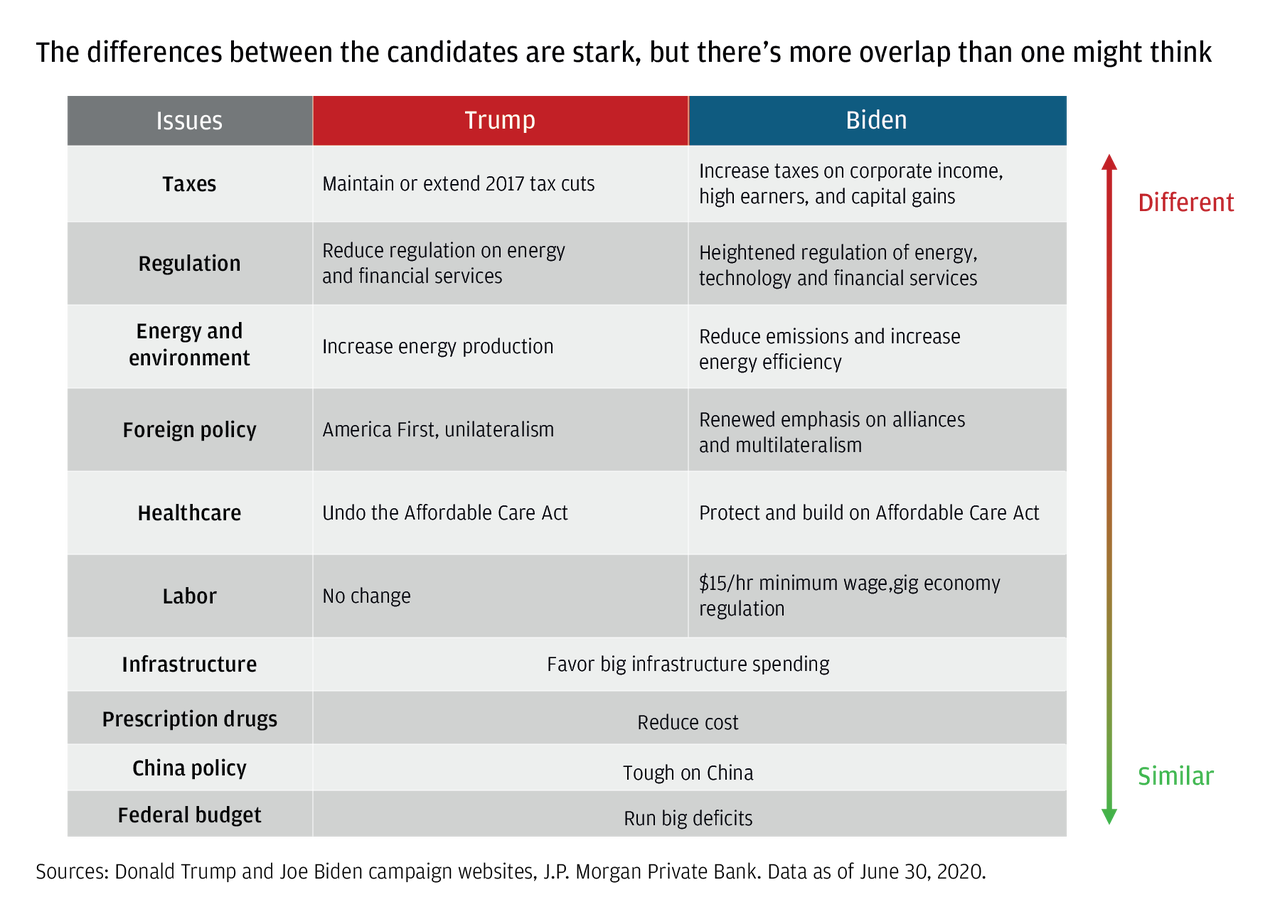
The punchline: despite the clear differences to the tax regime between the Trump and Biden administrations...

... JPMorgan says ignore it all, and in fact, "don't let the passions of this election lead you to make any key planning or investment decisions."
And yet, despite an unprecedented effort to minimize the impact of the election, not everyone agrees. In a Saturday note published by Larry McDonald's Bear Traps report, he echoes what we said on Friday namely that "the race is a lot closer than people think, Trump could still win the electoral college with media polls showing him trailing by 10 points. The mainstream media is making the same mistakes they made in 2016, they are firing up Trump's base. Polling data looks far too urban -Trump won 2630 counties to Clinton’s 489, so in an electoral college world, polling must be VERY disbursed."
A lot of Republicans that did not vote for Trump in 2016, will support him now. We know Polls ignore Trump’s silent support and Nixon-like, law, and order support. In our view, he gets 8 to 9% of the African American vote vs. 6% in 2016 -this is a meaningfulneedle mover. However, Biden will definitely bring out more voters than Clinton. Biden could win the popular vote by 5 million and still lose the EC, there is that much dispersionbetween large cities and the country. Trump is loud-mouth with large scale connection to middle-class voters.
This, as McDonalds concludes, "means a contested election risk is now mispriced. November and December volatility has come down a lot."
Another group of investors who remain concerned about the outcome of the elections are Goldman clients.

As Goldman's chief equity strategist David Kostin writes in his latest Weekly Kickstart report, "new information on the election, vaccines, and upcoming 3Q earnings represent substantial cross-currents for equities during the next two months." Of course, in keeping with the Goldman party line according to which a Blue Sweep is now very likely, Kostin seeks to downplay election concerns, and writes that "following the Vice Presidential debate this week, investors remain focused on the likelihood of a “Blue Wave” on November 3rdand the equity market implications of such an outcome. Prediction market probability of a Democratic sweep of the White House and both houses of Congress has climbed to 60% from 47% one month ago."
And in another attempt to deflect attention from the election which is in less than 4 weeks as a key markets catalyst, Kostin then writes that "the vaccine represents a more important factor than the election result for the recovery in S&P 500 fundamentals. Good Judgment asks its superforecasters when enough doses of an FDA-approved COVID-19 vaccine to inoculate 25 million people will be distributed in the US. The odds of distribution by 1Q 2021 rose from 39% on Aug. 23rd to 71% on Sep. 8th. However, that probability has dropped to 42% and the odds for 2Q-3Q 2021 are now the greatest (48%)."
Which is ironic, because it was Goldman which in mid-August raised its year-end S&P price target to 3,600 on the assumption that a vaccine would be discovered and delivered by the end of 2000/early 2001. While that is no longer the base case, Goldman forgot to cut its S&P price target.
Still, Goldman is unwilling to throw in the towel on its vaccine optimism, and as Kostin writes, Goldman's Pharmaceutical and Biotechnology equity analysts Terence Flynn and Salveen Richter hosted a virtual conference "Inoculating the Recovery" with speakers from most of the major companies leading the fight against COVID. "Their assessment of both vaccines and treatments remains optimistic", of course. Here are the key takeaways:
  1. Multiple vaccines are advancing in late-stage development based on encouraging initial data and one panelist estimated the vaccines have a 90%+ probability of success;
  2. FDA guidance as it relates to requirements for emergency use authorization for vaccines was described as a non-binary “continuum” by MRNA;
  3. amidst investor debate on timelines, HHS Secretary Azar offered upbeat commentary noting that, contingent on success, 100mn vaccine doses could be available in the US by year-end for vulnerable populations, with widespread availability by March/April 2021;
  4. the biggest challenge to vaccine uptake will not necessarily be cold-storage and distribution but rather convincing the broader population to get vaccinated (something Zero Hedge first warned about back in August ). Aside from the vaccine, therapeutic antibodies from LLY and REGN have demonstrated a benefit on hospitalizations/ER visits in early studies, offering a potential bridge to broader availability of vaccines, a dynamic potentially underappreciated by investors.
So elections and vaccines aside, the third key theme for investors over the next 1-2 months is naturally corporate earnings. This is how Kostin previews 3Q earnings season which kicks off next week and will provide investors with another look at the impact of COVID-19 on fundamentals:
During the quarter, the Goldman Sachs equity analyst US re-opening scale averaged between 4 and 5 on a continuum between 1 (lockdown) and 10 (fully re-opened). The consequences of the semi-frozen economy on an uneven road to recovery will be visible in 3Q results.
Consensus expects 3Q S&P 500 EPS will decline by 21% on a year/year basis, following a 32% drop in 2Q and a 15% fall in 1Q. Including the anticipated 14% fall in 4Q, our full-year 2020 EPS estimate of $130 reflects a 21% year/year decline from the 2019 level. Looking forward, we project a strong 30% earnings rebound to our baseline 2021 EPS forecast of $170, followed by 11% growth to $188 in 2022. In other words, there will be NO EPS GROWTH the end of 2018 and the end of 2021 even as the stock market has risen nearly 40% since then.
More to the point, Goldman expect three themes will characterize 3Q results across most sectors:
  • First, a collapse in margins, with aggregate index-level margins compressing by 220 bps on a year/year basis to 8.7%. For context, although the margin decline in 3Q will represent a slight improvement from the peak pandemic decline in 2Q (-223 bp to 8.6%), it will still register as the lowest level of margins since 2010.
  • Second, the modest 3% decline in aggregate sales will mask the bi-modal story beneath the surface. Cyclical sectors will suffer sharp revenue declines led by Energy (-32%). In Industrials, a 15% fall in sales will lead to a 62% plunge in EPS as the sector suffers from elevated operating leverage. Banks earnings are expected to decline by ~25% as pre-provision net revenues continue to deteriorate, despite smaller expected reserve builds. In contrast, Health Care (+5%), Consumer Staples (+4%), and Info Tech (+3%) are expected to post positive sales growth. Large-cap stocks appear better positioned for 3Q than small-cap stocks. Investors have exhibited a preference for size in 2020 with the S&P 500 climbing by 8% YTD vs. -1% for the Russell 2000. The 5 largest S&P 500 stocks –AAPL, MSFT, AMZN, GOOGL, and FB –are expected to grow 3Q sales and EPS by +13% and +1%, respectively, compared with -5% and -24% for the rest of the S&P 500. The disparity is even more apparent across indices. While S&P 500 EPS is expected to fall by 21%, consensus forecasts earnings for the small-cap Russell 2000 index will fall by 40%.
  • Third, most managements will still be reluctant to provide forward earnings guidance.The uncertain timeline of a vaccine that is essential for the normalization of the economy, the stalled talks between the Trump administration and Congress on an interim fiscal package, and the contentious election that is only 25 days away are all valid reasons for executives to minimize forward-looking commentary. However, consensus 2021 EPS estimates have recently troughed and started to turn positive. S&P 500 earnings revision sentiment sits at the 95th percentile.
In other words, Kostin insinuates that earnings also don't matter much in determining the direction of the market.
Going back to the election outcome, Kostin writes that it poses "upside and downside risks to future S&P 500 earnings.
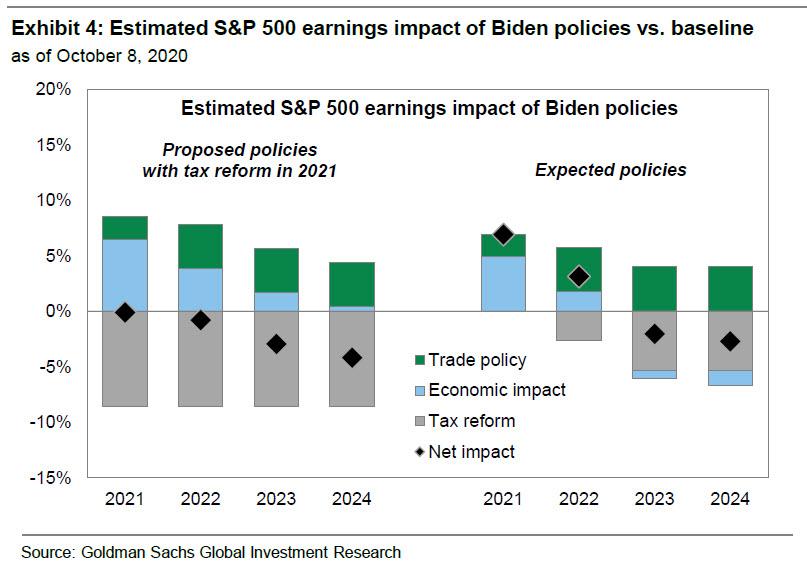
We recently modeled the earnings impact of various election outcomes. Our analysis focused on the proposed and expected policies related to tax reform, fiscal stimulus, and trade. By 2024, we model just a 4% difference between our baseline EPS forecast ($214), which assumes no change in policy, and the potential earnings outlook under policies expected to be enacted in the event of a Democratic sweep ($222). Our analysis suggests that a large increase in fiscal spending, funded in part by increased tax revenue, would boost economic growth and help offset the earnings headwind from high tax rates."
So... the election could be good and bad. Got it. Of course, such a laughable observation would make the Goldman equity strategist the butt of all jokes which is why he elaborates that "sequencing is a key assumption to our forecast that a “Blue Wave” would have a modestly positive net impact on the trajectory of S&P 500 profits." He then notes that Goldman economists "expect that a Biden administration would prioritize fiscal stimulus in the first year of its administration followed by a phasing-in of tax reform in 2022/23. And yetm during Wednesday night’s Vice Presidential debate, Senator Harris stated that a Biden administration would raise taxes “on day one."
Goldman's conclusion, "if the Democrats were to implement both fiscal stimulus and tax reform in 2021, we estimate these polices would have largely offsetting effects, leading to S&P 500 EPS being roughly in line with our status quo 2021E estimate but lower thereafter."
In other words, a Blue Sweep is neither bullish nor bearish. Which again brings us to our parting (rhetorical) question from yesterday: does it even matter who is president as long as we have a Fed?

WSJ : Richard Branson’s Virgin Orbit Seeks $1 Billion Valuation in Fundraising

Richard Branson’s Virgin Orbit Seeks $1 Billion Valuation in Fundraising
British billionaire’s satellite-launch business looking to raise money to support future launches

Richard Branson’s Virgin Orbit is looking to raise up to $200 million in a funding round that could value the satellite-launch business at around $1 billion, according to people familiar with the matter.

The fundraising comes as the British billionaire’s sprawling travel-to-finance empire and the wider commercial space industry have been hit hard by the coronavirus pandemic.

Virgin Orbit said in August it had hired LionTree Advisors LLC and Perella Weinberg Partners LP to look at potential financial transactions. Those banks are now charged with helping it raise between $150 million to $200 million by as early as the end of the year for capital expenditure and to fund satellite launches, according to the people familiar with the plans.

Mr. Branson is among a group of entrepreneurs, including Elon Musk and Amazon.com Inc. founder Jeff Bezos, who have helped kick-start an era of commercially led space exploration.

While the satellite industry has historically been dominated by large vehicles launching large satellites, Virgin Orbit and several other rivals world-wide want to send smaller satellites into lower orbits, targeting civil, military and commercial customers at the lower end of the market.

Analysts say Virgin Orbit’s proposed launches are cheaper and more flexible but have confronted technical issues and still face hurdles. The company, which has yet to put a payload into orbit, initially expected to be launching roughly a dozen times by now.

“In a crowded market, Virgin Orbit is a front-runner,” said Carissa Christensen, founder and chief executive of Bryce Space and Technology, a consulting firm. “But like everyone else, it is facing some challenges.”

Virgin Orbit’s business is partly dependent on a bevy of smaller space startups—producing everything from miniature satellites to compact but powerful Earth-observation sensors—to provide new commercial opportunities and a steady flow of scientific payloads from governments and universities.

But even before the pandemic, many space startups struggled to maintain momentum and find funding. Since Covid-19 struck, projected demand for launches has slumped and some investment has dried up.

More recently, industry officials and consultants have pointed to a gradual resurgence of interest in the sector, prompted by the U.S. military’s support for smaller, less-expensive satellites and more-nimble launch systems.

Virgin Orbit has also had its own problems. In May, the company’s initial demonstration flight failed after a rocket released from a specially outfitted jumbo jet failed to reach low-Earth orbit.

Virgin Orbit officials said at the time that on average one out of two launches of a new rocket design fail.

For Mr. Branson, Virgin Orbit is the third time he has turned to investors amid the pandemic, which has crushed the tourism and travel markets that form the mainstay of his Virgin Group.

In July, Virgin Atlantic Airways secured a financial package worth about $1.5 billion that will allow it to stave off bankruptcy. That included a sale of around 10% in Virgin Galactic Holdings Inc., SPCE -3.12% which left him as a minority owner in the space tourism firm.

Earlier this month, Virgin Group floated a special-purpose acquisition company in New York, raising a more-than-expected $480 million to make investments in the consumer industry.

Over the last decade, Mr. Branson has mainly taken a back seat on management of his companies but remains focused on his two U.S.-based space ventures, Virgin Galactic and Virgin Orbit, according to people familiar with him.

Virgin Orbit started building rockets in Long Beach, Calif., a few years ago and has about 500 employees.

TechCrunch : Public investors stay in love with tech, as Root and Affirm file to

Public investors stay in love with tech, as Root and Affirm file to IPO

Why are there so many tech IPOs right now? Startups are finding that they can get higher valuations from public markets than private ones these days, because so many public investors want to put serious money in tech. Also, the lure of the future, the benevolence of the Fed, the retail investor boom, the sheer number of unicorns that have been waiting for any decent moment to go, the new ways a company can go public… these are some of the reasons Alex Wilhelm found after reviewing the latest listings and quarterly data about tech in public markets.
Various political and economic turmoils threaten to end the run, but the impact to the startup world has arrived. Consider it for a minute before the newsletter dives into stocks, SPACs, emerging industries and other useful startup news.

From this IPO boom, there’ll be another wave of startup employee wealth flooding into adjacent real-world spaces, but spread more broadly outside of the Bay Area than the days of Facebook and Twitter IPOs. Some of those employees will become investors and maybe founders, and the now-public startups will replace those positions with big-company people. The dynamics around tech hiring will be further reshaped in surprising new ways, all combined with the other changes happening like remote work.
Today, if you’re founding a startup now, you can now confidently chart new ways to build your company long-term that previous generations of founders could barely imagine.
This coming decade, we might see a startup go public that raises from pre-seed rolling funds first, pulls in newly legalized crowdfunding, matches with the right VCs from among the thousands that have are operating these days — or perhaps the startup raises debt because it’s doing that well. It could stay private as long as it wants using the various financing and secondary market possibilities that have been figured out over the last decade. Then, when it is ready to go public, it could choose between traditional options, the perfect SPAC and a direct listing, and keep the shareholder pool in favor of the true believers who have been with the company over the course of the journey.
This current group of IPOs also demonstrates something else. Tech is no longer defined as some profitless, highly valued consumer tech startup in San Francisco. It can come from anywhere, it can solve practical problems, it can make real money, and it can keep building and growing — provided you’re okay with some ongoing risk. No wonder public markets like tech these days.
Take a look at Root Insurance, an insurtech unicorn that has already helped define the Columbus, Ohio startup scene. It’s a “startup Rorscach test,” as Alex details this week about its new IPO filing. “You can find things to like (improving adjusted margins! revenue growth!), and you can find things to not like (spiraling losses! negative margins!) very easily.”
Here’s more from the Extra Crunch article:
It appears that the tailwind that many insurance providers have seen during COVID-19 has provided Root with a nice boost (driving fell during the pandemic, leading some insurance providers to return premiums.) Root is taking advantage of the moment by filing when it can show sharply improved economics.
That’s smart. But how do those improved economics bear out in traditional accounting? Let’s find out:
  • Root’s revenue has skyrocketed from $43.3 million in 2018 to $290.2 million in 2019. In the first half of 2020, Root managed $245.4 million in revenue, up 135.73% from what it managed in the first half of 2019.
  • Root’s losses have also shot higher, from a net loss of $69.1 million in 2018 to $282.4 million in 2019. The startup has managed to consistently lose more money over time. This was also true more recently, when its H1 2020 net loss of $144.5 million dwarfed its H1 2019 loss of $97.0 million.
The other filing this week is for Affirm, which provides a point-of-sale credit for customers (without all the tricks of credit cards). It’s also a symbol of how innovation works across the decades, for those future founders who are studying the IPO experiments of unicorns today.
The company is a high-flying unicorn with a practical purpose from serial entrepreneur Max Levchin, who has also helped shape the concept of the modern startup — from cofounding Paypal and making numerous angel investments over the years, to Slide, a profitless, highly valued consumer tech company in San Francisco a decade ago. It’s not widely understood outside of tech, Slide and other social media companies helped pioneer the growth and engagement techniques that subsequent startups applied across SaaS, e-commerce, fintech and real-world sectors. Today, Root and Affirm and many of the other companies in this era of IPOs are standing on the lessons of those years.