FT : Unibail/Xavier Niel: Cuvillier’s travails

Unibail/Xavier Niel: Cuvillier’s travails
What seems like cavalier interference during difficult times for a shopping mall business could actually make a lot of sense

Running a vast shopping mall business in a pandemic is difficult enough. It just got even harder for Christophe Cuvillier, boss of Unibail-Rodamco-Westfield, which is based in Paris. Telecoms billionaire Xavier Niel wants to block a massive €3.5bn rights issue, part of Unibail’s plan to reduce debts by €9bn, just over a third. This will look like cavalier interference to Mr Cuvillier. Worse, Mr Niel may actually have a point.

Yet another entertaining skirmish between French tycoons presages a broader battle across business. Coronavirus-induced drops in earnings will force many companies to shrink their balance sheets. That will leave investors in everything from equity to senior debt scrapping with management — and each other — over the remaining value.

Mr Niel has bought a 4.1 per cent stake in Unibail with Léon Bressler, a formidable former boss of Unibail. They oppose a rights issue plan that favours bondholders. They justifiably argue there is a better way. The shares jumped 11 per cent in response.

Fresh cash is needed to clean up mistakes made on Mr Cuvillier’s watch. The acquisition of Frank Lowy’s Westfield group for $25bn in 2017 was poorly timed and expensive. Since then, the market value of Unibail has dropped over 70 per cent.

Under Mr Cuvillier’s plan, €4bn of disposals would supplement the rights issue to help maintain URW’s investment grade credit rating. Total debts would fall from €24bn to €15bn.

But unlike rival mall operators such as Hammerson of the UK, which conducted its own rights issue in September, liquidity is not a pressing concern. Unibail estimated its reserves at more than €12bn in the first half, including €3.4bn of cash.

That has emboldened Messrs Niel and Bressler to propose scrapping the rights issue and selling off US assets instead.

The disposal would not be easy in the current market. Malls in the US have been in decline for longer than in Europe, with even lower valuations. A book value of €14bn for Unibail’s US assets is optimistic. A price closer to €10bn would be more realistic, thinks Green Street a research group. But a sale would reduce leverage usefully. Unibail’s loan-to-value would fall to a tolerable 30 per cent.

Mr Cuvillier’s actions suggest he wants to protect a big chunk of Unibail’s enlarged portfolio when more radical surgery is required. Minority shareholders should back the Niel/Bressler plan instead

Electrek : Mercedes-Benz unveils rugged EQC 4×4 electric off-road SUV


Mercedes-Benz has unveiled a rugged new EQC 4×4 electric off-road SUV to show that electric vehicles can also be adventure vehicles.

That’s actually very much Rivian’s mission with the R1T electric pickup truck and R1S SUV, which it describes as “adventure vehicles.”
As for Mercedes-Benz, instead of making a new vehicle, they decided to modify their existing EQC electric SUV.
The EQC 4×4² was developed as a “one-off” vehicle by a cross-departmental team under development engineer Jürgen Eberle.
Markus Schäfer, member of the Board of Management of Daimler AG and Mercedes-Benz AG responsible for Daimler Group Research and Mercedes-Benz Cars COO, commented on the vehicle:
Our aim is to combine modern luxury and sustainability with emotional appeal. The EQC 4×4² shows how enjoyable sustainable mobility can be. This is where electromobility high-tech and an intriguing customer experience are transferred to the mountains, thanks to MBUX and over-the-air updates. To put it succinctly, electric, progressive luxury goes off-road. This drivable study clearly shows that alongside a passion for e-mobility, we at Mercedes-Benz lay a strong claim to leadership in this sector and will heighten the emotional appeal of this even further in the future.
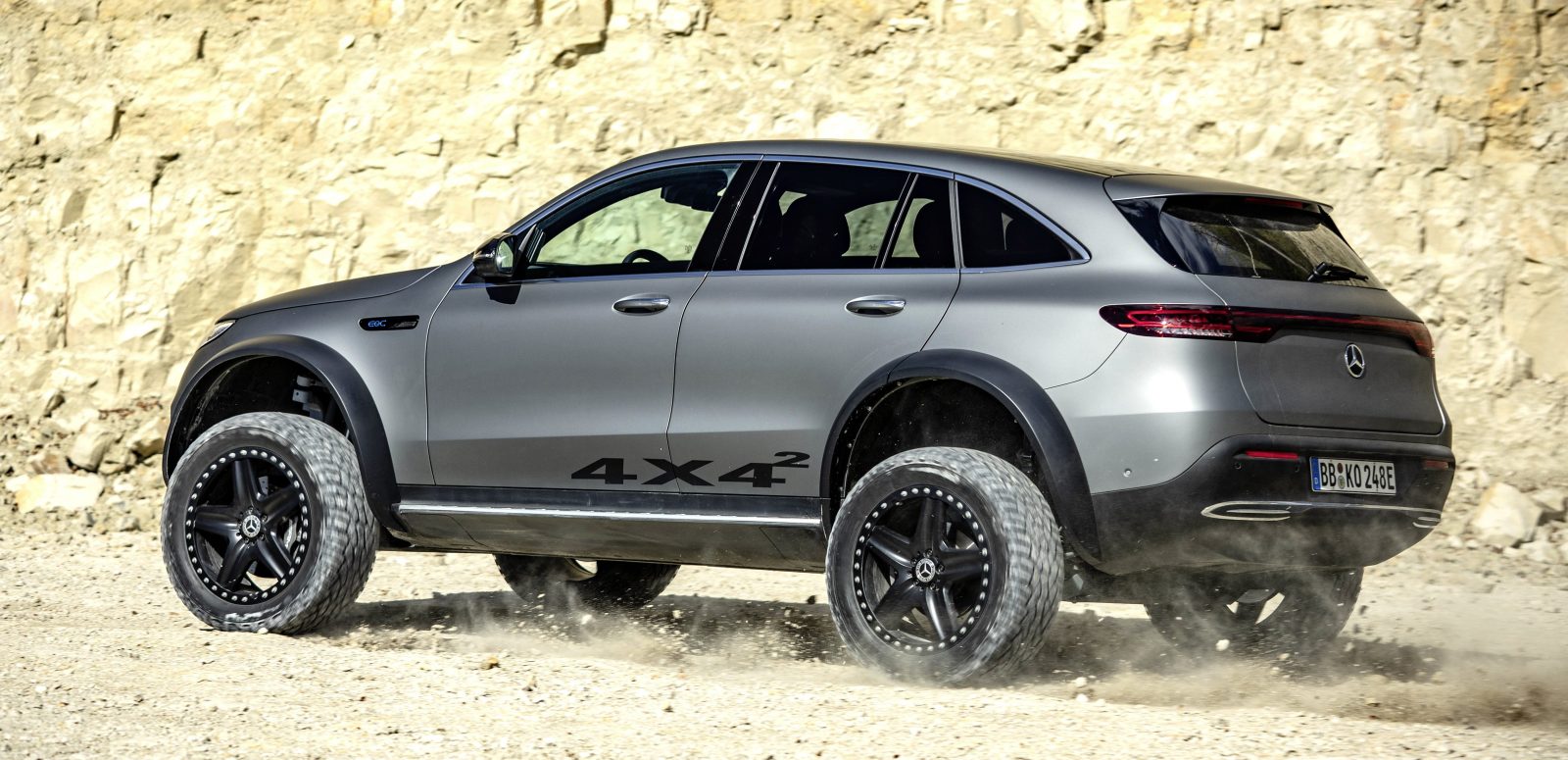
The EQC 4×4² rides more than twice as high as a production EQC, and it is even higher than a G-Class.
Mercedes-Benz has leveraged the off-road drive programs of its GLC models for this electric vehicle:
The reprogrammed Off-Road drive programs take advantage of the high-performance logic of the current GLC models. For example, using targeted brake interventions, this enables an improved torque curve when starting on loose ground. In combination with the tires in size 285/50 R 20, this results in an impressive sure-footedness in terrain. The striking visual appearance is rounded off by the matt metallic gun-metal gray car film and the black wheel arch flares.
Here are the new ground clearance specs compared to the EQC:
EQC 4×4² (study) EQC 400 4MATIC (standard)[2]
Approach angle Degrees 31.8 20.6
Departure angle Degrees 33.0 20.0
Breakover angle Degrees 24.2 11.6
Ground clearance mm 293 140
Fording depth mm 400 250
They have also redesigned the acoustic system for the off-road version of the vehicle:
Another highlight of the EQC 4×4² is the sound experience with its own soundscape. The acoustic production comprises sounds that give the driver feedback on system availability and vehicle parking, as well as an interactive, emotionalizing driving sound. It is influenced by various parameters such as the position of the accelerator pedal, speed, or energy recovery rate. The technology uses intelligent sound design algorithms to calculate the sounds coming from the amplifier of the sound system in real time and the interior loudspeakers to reproduce them.
The automaker didn’t elaborate on the impact of these upgrades to the EQCs efficiency, but they are expected to be significant.
Why making it a one-off? Why not offer the 4×4² as a package on the EQC? What do you think? Let us know in the comment section below.

WSJ : Slim Aarons Immortalized This Richard Neutra Home in ‘Poolside Gossip.’ No

Slim Aarons Immortalized This Richard Neutra Home in ‘Poolside Gossip.’ Now It’s Selling for $25 Million.
The Palm Springs, Calif., property known at the Kaufmann Desert House has become one of the architect’s most recognizable projects

It is one of architect Richard Neutra’s best-known homes, a 1946 Modernist glass, steel and stone house on the edge of Palm Springs, Calif. The low-slung house was immortalized by several important photographers including Slim Aarons, whose popular 1970 photograph “Poolside Gossip” features two fashionable women lounging by the pool in midriff-baring outfits, the house and the silhouette of the desert mountains providing the backdrop. The image can now be seen printed on tote bags, lunchboxes and vintage posters.
Known as the Kaufmann Desert House, the property, which is named for its original owner, American department store entrepreneur and architecture enthusiast Edgar J. Kaufmann, Sr., is coming on the market for $25 million, according to listing agent Gerard Bisignano of Vista Sotheby’s International Realty.
The story of the home provides an insight into the architecture rivalries and shifting tastes of the day. Mr. Kaufmann, who was looking to build a winter getaway, originally considered architect Frank Lloyd Wright, who had designed his home in Mill Run, Penn. Designed in 1935, that home, known as Fallingwater, is an organic Modern that sits directly above a waterfall and has cantilevered terraces of local sandstone. It is one of Mr. Wright’s best-known works.
The house was immortalized by a popular 1970 photograph taken by Slim Aarons named ‘Poolside Gossip.’
PHOTO: SLIM AARONS/GETTY IMAGES
Eventually though, Mr. Kaufmann decided on Mr. Neutra, a younger architect known for his more Modernist approach. Mr. Neutra had worked under Mr. Wright before starting his own practice in 1930.
“Kaufmann’s son Edgar, Jr., an architect, historian and fond disciple of Wright’s, wanted his father to engage Wright again to design the new Palm Springs winter house, but the senior Kaufmann, while a warm admirer of Wright, wanted for the desert house a greater feeling of lightness and openness than Wright had imparted” to Fallingwater, writes Thomas S. Hines in the book, “Richard Neutra and the Search for Modern Architecture.”

The price tag matches the pedigree: The most expensive property ever sold in Palm Springs was a home owned by the late entertainer Bob Hope, which traded for about $13 million in 2016 to investor Ron Burkle, records show.

A Modern Icon in the Palm Springs Desert
Richard Neutra’s Kaufmann Desert House was built from glass, steel and stone.

A property designed by the architect Richard Neutra is coming on the market for $25 million.
DAN SOLOMAN
1 of 10


Built in 1946, Kaufmann House is 3,200 square feet and is cruciform in shape, anchored in the center by the living and dining room.
Separate wings branch out from the center, each with their own separate function, according to Mr. Bisignano. One is home to the guest quarters, another is home to the service wing and one comprises the main bedroom suite.
The five-bedroom house is largely on one level aside from an open-air covered patio on the second level which Mr. Neutra named “the Gloriette,” from the 12th-Century French word “gloire” meaning “little room.” Mr. Neutra was also a fan of the pool. It was completed before the house, and Mr. Neutra “enjoyed critiquing the rest of the construction while splashing and floating in the water,” according to Mr. Hines’s book. The more than 2-acre property also includes a pool pavilion built by the current owner.

The property is a throwback to the early postwar boom of the late 1940s and to the rise of Modernism on the West Coast.
The home was carefully restored in the 1990s.
PHOTO: DAN SOLOMON
“Though many clients still preferred traditional styles, their architects, committed to Modern ideas, championed its cause,” according to a report by the Palm Springs City Council on the postwar period. In one case, singer Frank Sinatra requested a Georgian Revival-style house for a lot he had purchased in the area. His architect E. Stewart Williams instead designed a low-slung Modern house built from stone, stucco and redwood siding, the council report said.
Palm Springs soon became a haven for Modernist architects like Mr. Neutra, John Lautner and Albert Frey, thanks to its bright, dry climate, which is well suited for Modernist design, with its flat roofs, shaded verandas and sliding glass. The Kaufmann home has been captured on camera by several notable photographers, including Julius Shulman, who shot a well-known picture of the home at twilight in 1947. The shot, a time lapse photo, shows a glow behind the desert mountains.

Mrs. Kaufmann helped with the set up by lying down in the garden to block the pool light, and a strange shadowy figure on the grass is the family dog, which sneaked into shot, according to Leo Marmol, managing partner at the architectural restoration firm Marmol Radziner, which worked on a restoration of the home in the 1990s. He calls the shot “one of the seminal definitions of Modern architecture in California,” noting that “it captured the Modern fantasy.”
The pool pavilion.
PHOTO: DAN SOLOMON
In 1970, Mr. Aarons snapped “Poolside Gossip,” which became one of his best-known pictures, according to the book “Slim Aarons: Women.” “Was it the big hair and bare midriffs, the mod 1970s outfits, the dramatic view, or its ‘martini Modern’ aesthetic?,” posited the book.
Palm Springs socialite Nelda Linsk owned the home at the time and is in the photo. She recalled that years later, Mr. Aarons once asked her why she thought the photograph was so famous. She joked, “Slim, it’s because I’m in it.”
“Those were the good days,” added Ms. Linsk, who lived at the property in the 1970s before selling it to Eugene Klein, the late onetime owner of the San Diego Chargers. “Clark Gable, Marilyn Monroe, they were all here in Palm Springs. They came out to the desert because no one would bother them here.”

The home has since cycled through multiple owners over the decades, including singer Barry Manilow, Mr. Bisignano said. The current owner is Brent R. Harris, managing director at Newport Beach, Calif.-based Pacific Investment Management Co. Mr. Harris purchased the property with his then-wife in the early-1990s. The research and restoration took about five years, according to the agent.
Starting in 1993, Marmol Radziner conducted what the agent described as an “architectural dig” to determine the original materials, finishes and colors that the home had been built with. The house had undergone years of alterations, and the architects peeled back the layers to reveal the original materials. They then replaced sections of the home using original manufacturers and craftsmen. They also used archival research in the Neutra archives at the University of California, Los Angeles and Mr. Shulman’s photographs to verify their work.
The team used petrographic analysis—an investigation of the chemical and physical features of a rock sample—to determine the source of the stone used for the house, then persuaded a quarry in Utah to reopen an old section used in the 1940s to secure the original sandstone in the same sunset-pinkish hue to replace sections that had been damaged. Crimped metal trim was produced in Kansas on a machine that had previously been out of work for about 50 years.
The home is a throwback to the early postwar boom of the late 1940s and to the rise of Modernism on the West Coast.
PHOTO: DAN SOLOMON
SHARE YOUR THOUGHTS
What’s your favorite part of the Kaufmann Desert House?
“I think there were many people who thought we’d lost our minds,” said Mr. Marmol. “We were re-creating light fixtures from the 1940s.”
After completing the restoration, Mr. Harris coaxed Mr. Shulman out of retirement to take another set of shots of the house in the 1990s, this time in color, according to the agent.
Mr. Bisignano said his client is selling the property because “he feels like it’s time to pass it on.” The property has since undergone yet another restoration, costing an additional $2.5 million, Mr. Bisignano said.
The property is the “crown jewel,” of the Palm Spring market, said local agent Jeff Kohl of real-estate brokerage The Agency, who is not involved in the listing. He said it is incredibly rare to find a property with such compelling architectural pedigree in such good condition in the area. “It’s insane,” he said.
Mr. Bisignano noted that the property taxes on the house are about $8,000 a year, thanks to a historical designation the property was granted under the Mills Act, which provides tax breaks to California owners who actively participate in the restoration and maintenance of their historic properties.
‘This is not just a home. This is a home that changed how we see architecture today,’ said Leo Marmol, whose firm worked on a restoration of the home.
PHOTO: DAN SOLOMON
“This is not just a home. This is a home that changed how we see architecture today,” Mr. Marmol said.
Mr. Kohl noted that the Palm Springs market has been extremely active over the past few months as buyers from Los Angeles, San Francisco and San Diego, tired of being holed up in denser areas as a result of the coronavirus, fled to the desert to escape the city and play golf and tennis. Before that, the market had been just “plugging along,” he said.
Palm Springs sales data points to a remarkable turnaround in the market this year. Sales in the third quarter skyrocketed by 70% compared with the same quarter one year ago, combined with a median price increase of 14% over the same period, according to data from The Agency. The rapid pace of sales has reduced the number of active properties on the market by 39%.
“The market has exploded,” Mr. Kohl said. “Traditionally the summer months are deader than a doornail. We’ve seen more deals in the last three months than in the last two years combined. Everything has sold—unless it’s really significantly overpriced or needs a lot of work.”
(ZH) Behind The Nasdaq Weakness: Goldman Downgrades Tech To Neutral

Behind The Nasdaq Weakness: Goldman Downgrades Tech To Neutral


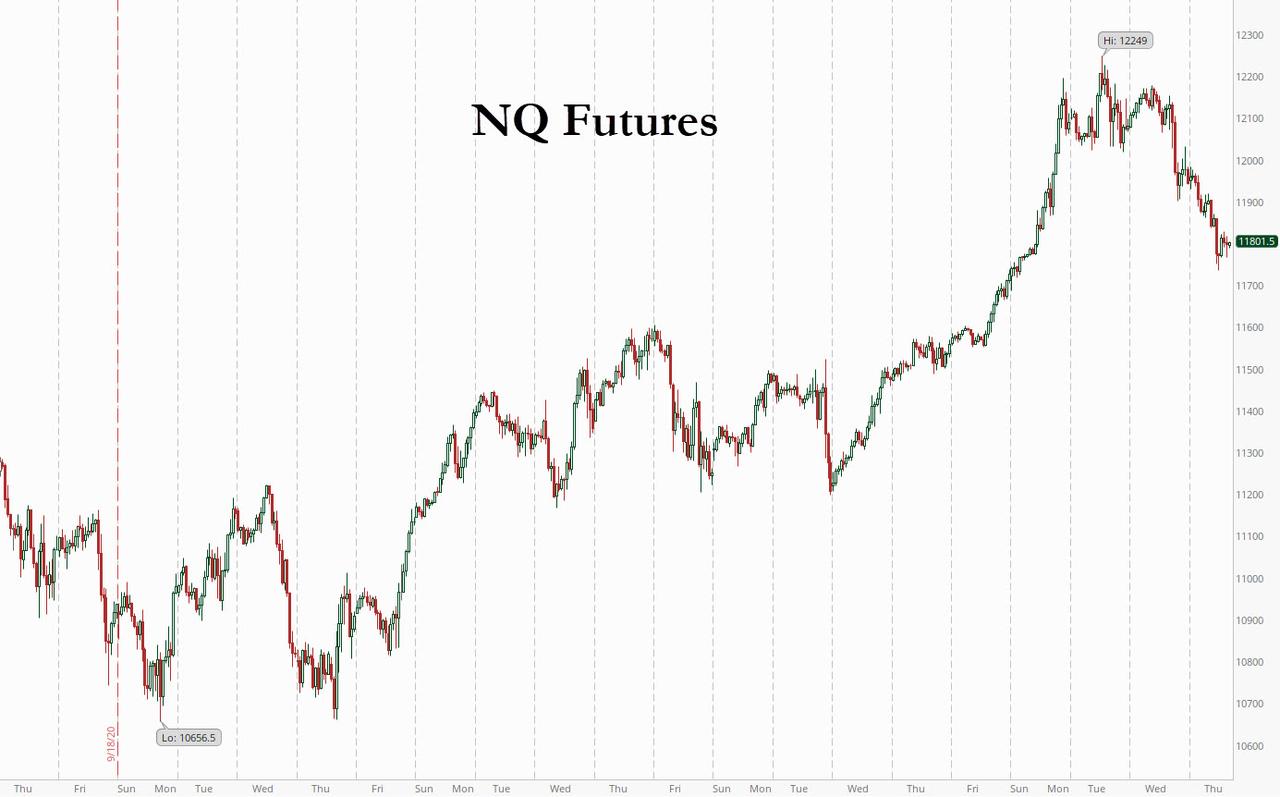
Amid the stock slide this morning, tech is getting hit especially hard, and one key driver for this is the overnight downgrade of the tech sector from Overweight to Neutral by Goldman Sachs, to wit:
We make four sector changes: we upgrade Banks and Autos to Overweight (bothfrom Neutral), and we downgrade Tech to Neutral and Food, Beverages & Tobaccoto UW (from Neutral). We also take off our long-held Long view on our Digital Economy basket(GSSBDIGI). We add a Long recommendation on our Recovery (GSSTRCOV)basket vs. SXXP. This joins our Fiscal Infrastructure spending basket (GSSTFISC),which we continue to recommend.
The reasoning behind the downgrade is hardly a secret, and follows a similar move by Bank of America from two weeks ago when BofA chief equity strategist Savita Subramanian said that "it's time to buy value." While we will share some more details from the Goldman report, which oddly enough shares the BofA title "Time for Value", here are the highlights:

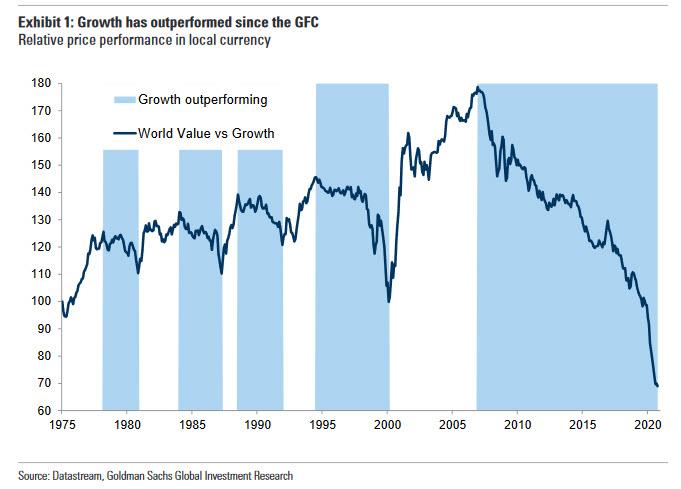
One of the most enduring features of the post-GFC period has been the secular outperformance of Growth vs. Value. There have been rotations, but these have generally been short-lived.
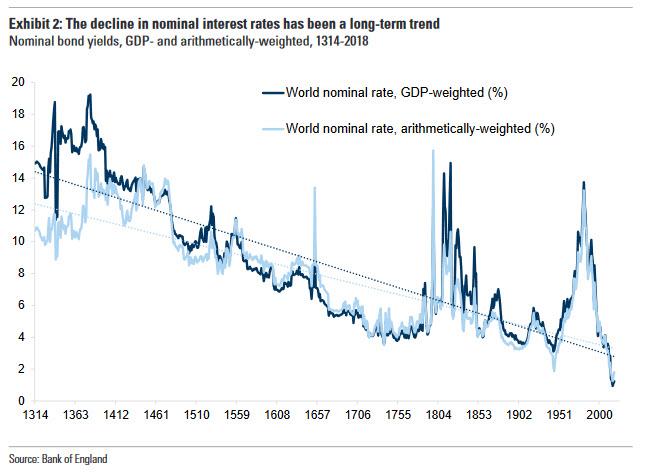
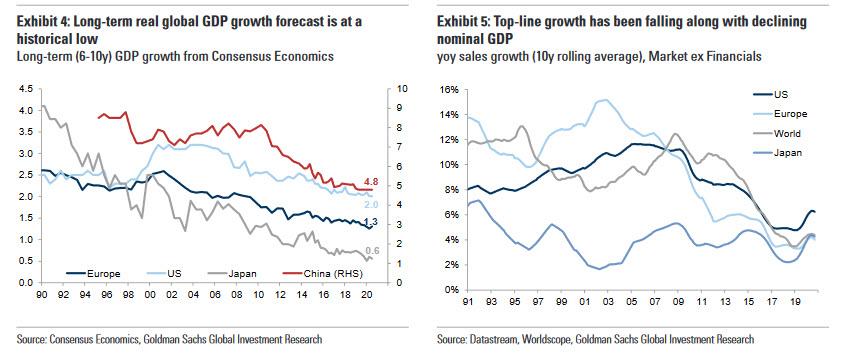
The drivers of this long-term trend are well understood – low rates, low inflation and low economic growth.
We think these drivers for the most part remain in place; the secular trends still favour growth or growth-defensive stocks (such as the GRANOLAS).
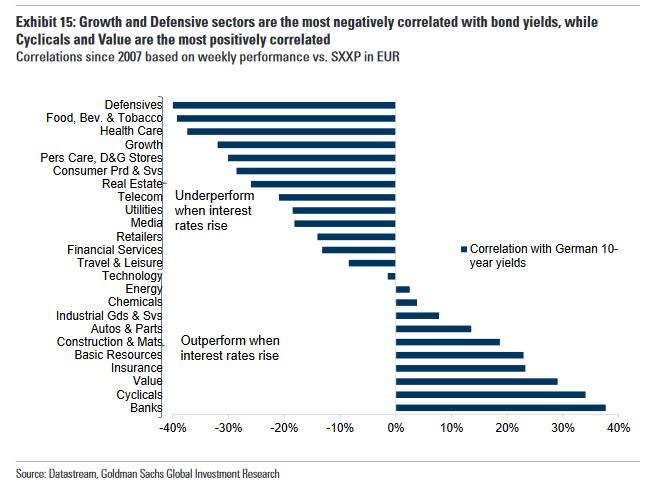
But, in the next few months we expect some policy and economic shifts that support a temporary rotation; and these rotations can be quite large.There have been 15 into Cyclicals and out of Defensives since the GFC, lasting on average 4 months and delivering 15% outperformance for Cyclicals. Value stocks also outperform during these shifts – albeit by less.
These rotations occur when BYs are rising (which GS expects) and when growth is improving (which GS expects).
While highly uncertain, our economists expect that the FDA will approve at least one vaccine this year and that large shares of the US and European populations will be vaccinated by the end of Q2-2021 and Q3-2021, respectively.
A ‘Blue wave’ outcome in the US election and a rise in fiscal spend would also be supportive.Finally, while not a catalyst, we also factor in the extreme valuation discount of Value
Still, putting the recent weakness in context, NQs are down having faded the furious Monday gamma meltup, but remain well above levels seen last Friday.

WWD : Chanel, Paris Lead Fashion Month Social Media Charts, Says Heuritech

Chanel, Paris Lead Fashion Month Social Media Charts, Says Heuritech
Heuritech-produced rankings and a trend report based on its analysis of 60,000 Instagram posts and millions of images from Sept. 12 to Oct. 6.

PARIS — Chanel captured the most attention on Instagram during fashion month, according to a study from Heuritech.

The technology company used artificial intelligence to analyze 60,000 Instagram posts between Sept. 12 and Oct. 6 for its report on the spring 2021 season, spanning New York, London, Milan and Paris.

According to the study, Chanel garnered 9.6 percent of mentions over the period, followed by Dior with 6.7 percent, Louis Vuitton, Prada, Bottega Veneta, Gucci, Fendi and Saint Laurent. Bottega Veneta, Gucci and Saint Laurent all placed despite not having a physical show or virtual presentation this season.

When it came to designers, however, the results were different. J.W. Anderson topped the list, followed by Nicolas Ghesquière, Marc Jacobs (who did not hold a show this season), Maria Grazia Chiuri, Dries Van Noten, Olivier Rousteing, Riccardo Tisci and Virginie Viard.

Paris emerged as the most talked-about city, with 41 percent of posts on social media, up three points from the fall 2020 season, followed by Milan, which accounted for 36 percent of posts, up 12 points. London was down two points to 13 percent, while New York City was negatively impacted by not having large brand names showing, and slid 13 points to a 10 percent share.

“As expected, this fashion week has shown a great turnaround, and the impossibility to travel had a major impact on the visibility of the fashion week cities on social media,” the study noted.

Heuritech also looked at style trends, analyzing millions of images on Instagram to draw up forecasts for next summer, compared with the same season in 2020.

Linen is on the rise compared to last year, often in natural colors like beige, white and pastels. While it is often seen in matching sets, tops and dresses are the most-represented pieces for the material. Cable knits are prevalent, used for edgier looks as well as more mainstream styles. All-beige looks were also very present on the catwalks and in the streets.

Wearing dresses over pants is another styling trend spotted by the firm, which identifies it as part of an overarching theme of seeking comfort.

The search for optimism has turned up an interest in bright orange, seen as a vibrant and energetic color. Tie-dye won’t be disappearing anytime soon, Heuritech said, noting it’s forecast to grow in visibility next summer, mostly for tops and dresses for women, and tops for men.

Metallic looks could be the next hit for edgier consumers, and feathers, a recent runway theme, could resonate with contemporary consumers next summer.

The firm also noted an overall interest in nature, which translated into clothing with pastels, sheer materials, browns and a wave of romanticism, including puffed sleeves, ditzy prints, taffeta and ruffles. Sleek futurism was also present, with a profusion of leather, pinstripes, tailored vests and satin.

Accessories styles ranged from earthy to futuristic, with handbags carrying a “refined handcraft” look, with embossed flowers, weaving and rattan, or unusual, geometric shapes for a sleek, modern look. Playfulness was another bag trend, with attachable minibags, and, in contrast, minimalist carry-all bags.

In the shoe department, the firm singled out chunky soles, kitten heels, comfortable slippers and an array of craft details, like woven leather or knit crochet.

FT : Ligado tests limits of bond markets with highest rate in 9 years

Ligado tests limits of bond markets with highest rate in 9 years
US wireless communications group prepares to pay 17.5% interest rate

Wireless communication company Ligado Networks is preparing to pay a whopping 17.5 per cent interest rate in the US bond market this week, the most any company has shelled out to investors since coronavirus struck and the highest rate on any US corporate bond since 2011.

The deal, which was initially due to close a week ago, has struggled to get over the line. People familiar with the terms said uneasy investors have demanded ever-higher interest rates to finance the company’s efforts to develop a network of 5G wireless spectrum across North America.

The back-and-forth with investors indicates the scale of financial distress at the Virginia-based company. But it also offers a sign that despite a cramdown in borrowing costs since the Federal Reserve cut benchmark interest rates close to zero, portfolio managers are still showing some discretion in doling out funding.

The period since coronavirus struck has already produced strikingly high borrowing costs for deeply strained companies. Viking Cruises set a 13 per cent coupon on its five-year bond in May, while Carnival Corporation and American Airlines also both offered double-digit interest rates. 

But Ligado is going further. In the JPMorgan-led deal, a $1bn bond that would be the first in line to suffer losses if the company fails is being marketed to investors with a coupon of 17.5 per cent — up from the 16 per cent that was touted last week alongside a string of lower-rated companies borrowing cash in corporate bond and loan markets.

That would be the highest interest rate on a corporate bond since North Atlantic Trading Co sold debt with a 19 per cent coupon in July 2011, according to data from Refinitiv. The bond, which matures in about three and a half years, is also expected to be sold at a discount, pushing the yield to investors even higher. 

Another slightly safer chunk of the fundraising — a $2.8bn three-year bond — will pay 16 per cent, up from 13 per cent in the first pitch to investors. The deal is set to close by the end of the week. 

JPMorgan declined to comment. Ligado did not respond to a request for comment.

Ligado has been battling to develop its network, recently receiving clearance from the Federal Communications Commission but still facing opposition from some lawmakers.

The new debt will help make a $700m payment to mobile satellite company Inmarsat that was due this week as well as repaying existing debt due in December, helping Ligado avoid slipping back into bankruptcy. It emerged from its last debt restructuring in 2015, when it changed its name from LightSquared. 

The deal buys the company more time to make money from its wireless spectrum, with all of the interest paid at the end of the bond’s maturity, in what is known as a “payment in kind” structure. 

Even with such a high coupon, the riskier portion of the bonds has garnered interest from just a handful of fund managers specialised in distressed investments.

Despite teething problems, the deal is another example of the availability of capital for companies in need.

“There is a view that the Fed is the backstop still. The underwriting standards are getting pushed,” said Matt Eagen, a high-yield bond portfolio manager at Loomis Sayles. “The risk is that you blow bubbles into the market.”

More broadly, highly risky companies are still able to borrow at shrinking rates. The average yield across triple C rated bonds that sit at the bottom of the ratings ladder has fallen to 11.1 per cent, the lowest level since the end of February.