- Philips (PHI1 TH) +5.6%
- *PHILIPS SAYS EURONEXT TECH ISSUES AFFECTED CLOSING PRICE SHOWN
-
Sartorius (SRT3 TH) +2.5%
- Sartorius Stedim Biotech Raises FY Forecasts
-
Reckitt (3RB TH) +2.3%
- *RECKITT 3Q LIKE-FOR-LIKE SALES +13.3%, EST. +8.57%
- Signify (G14 TH) +1.1%
- Kion (KGX TH) -1.5%
- Lanxess (LXS TH) -1.6%
- ProSieben (PSM TH) -1.6%
- Shell (R6C TH) -1.6%
- Thyssenkrupp (TKA TH) -1.7%
- Gerresheimer (GXI TH) -1.8%
- Lufthansa (LHA TH) -2.2%
- NEL (D7G TH) -2.7%
- Rational (RAA TH) -2.8%
- TeamViewer (TMV TH) -6.9%
- TeamViewer Holder Tigerluxone Sarl to Offer 22m Shrs
DAX:
- Deutsche Post (DPW TH) -1%
- VW (VOW3 TH) -1.1%
- Infineon (IFX TH) -1.2%
- Daimler (DAI TH) -1.2%
- Covestro (1COV TH) -1.4%
MDAX:
- HelloFresh (HFG TH) +0.5%
- Cancom (COK TH) -1.4%
- ProSieben (PSM TH) -1.5%
- Lufthansa (LHA TH) -1.8%
- Airbus (AIR TH) -1.8%
- Gerresheimer (GXI TH) -1.8%
SDAX:
- Tele Columbus (TC1 TH) -2%
- Medios (ILM1 TH) -2.4%
- Leoni (LEO TH) -2.7%
- Kloeckner (KCO TH) -2.7%
- Jenoptik (JEN TH) -9%
- Jenoptik Sees Full Year Ebitda Margin 14.5% to 15%
UBS Profit Doubles on Trading Surge
Strong performance at investment bank and wealth management units as Sergio Ermotti nears end of term in charge
UBS Group AG UBS 1.12% said it set aside $1.5 billion to repurchase shares next year as third-quarter net profit doubled and its loan losses from the coronavirus pandemic remained relatively low.
Net profit rose to nearly $2.1 billion from $1.05 billion a year earlier, thanks mainly to a surge in stock and bond trading and deal making by clients at its investment bank and higher revenue at its wealth management business. Loan losses in the period were $89 million, lower than the $268 million and $272 million provisions taken in the first and second quarters.
UBS and other banks with wealth management arms have been benefiting this year from more client investing and a boost in total global wealth as asset prices have rebounded from the spring. Its investment bank, like others, has also made money from ramped-up client trading and deal making.
Investment bank revenue jumped to $2.49 billion from $1.75 billion a year earlier, while global wealth management revenue rose to $4.28 billion from $4.14 billion.
The results are the last by UBS under Chief Executive Sergio Ermotti, who leaves the job this month after nine years to become chairman at Swiss Re. Under his tenure, UBS downsized its investment bank and refocused around wealth management, in what has been regarded as a largely successful reinvention of the bank.
Ralph Hamers, formerly the CEO of ING Groep NV, started at UBS in September and begins as CEO Nov. 1. Mr. Ermotti on Tuesday said UBS has “all the options open” for more success under Mr. Hamers.
The Swiss banking giant said it would pay a delayed dividend installment from 2019, as planned, after a shareholder meeting next month. It and other Swiss banks were asked by regulators to delay 2019 payouts earlier this year. Other European banks are still waiting for the go ahead from regulators to start paying dividends again.
UBS said the pandemic has been changing the way clients interact with the bank, bringing more of them online through mobile banking applications and other platforms. Its wealthy customers have also been on an “intensified search for returns,” UBS said in a presentation, including by increasing their investments in private markets, an area that includes buying stock and lending money to companies that aren’t publicly traded.
Moderna CEO Expects Covid-19 Vaccine Interim Results in November
Production ramp-up is a challenge, chief executive says: ‘If one ingredient is missing, we cannot make a vaccine’
Moderna Inc. MRNA -4.03% Chief Executive Stéphane Bancel said the federal government could authorize emergency use of the company’s experimental Covid-19 vaccine in December, if the company gets positive interim results in November from a large clinical trial.
Mr. Bancel, speaking during The Wall Street Journal’s annual Tech Live conference Monday, said if sufficient interim results from the study takes longer to get, government authorization of the vaccine may not occur until early next year.
Cambridge, Mass.,-based Moderna has one of the leading Covid-19 vaccines in development, along with a vaccine co-developed by Pfizer Inc. PFE -0.40% and BioNTech SE. BNTX -0.18% Large U.S. trials for two other leading Covid-19 vaccines, from Johnson & Johnson and AstraZeneca PLC, have been paused, while the companies investigate unexplained illnesses among study subjects.
Mr. Bancel’s comments suggest Moderna’s timetable isn’t far off from Pfizer’s, which said last week it expects to seek U.S. authorization of emergency use of its vaccine by late November.
In July, Moderna started a 30,000-person study in the U.S. to test whether the vaccine safely protects people from symptomatic Covid-19 disease, and enrollment is nearly complete.
In the trial, half of the study subjects receive the vaccine and half receive a placebo, and researchers then count how many get symptomatic Covid-19.
The first interim analysis of the vaccine’s efficacy will happen when 53 people in the entire study get symptomatic Covid-19. If there are significantly fewer vaccinated people than unvaccinated people among those 53 cases, the company may deem the results sufficient to seek government authorization of wider use.
That first analysis is likely to occur in November, but “it’s hard to predict exactly which week because it depends on the cases, the number of people getting sick,” Mr. Bancel said.
The company also must monitor the safety of at least half of the study subjects for two months after vaccination before it can seek an authorization for emergency use. Mr. Bancel said Moderna was likely to reach that threshold in late November. If Moderna files for an emergency use authorization soon after, the Food and Drug Administration may take a few weeks to review the application before deciding in December.
If the vaccine doesn’t demonstrate sufficient efficacy at the first interim analysis, the company will conduct a second analysis when 106 cases of symptomatic Covid-19 occur. Mr. Bancel said that would likely happen in December, which could push back any FDA decision to late January or early February.
Moderna codesigned its vaccine with the National Institute of Allergy and Infectious Diseases and began human testing in March while also starting to expand production of doses. Initial studies showed it induced immune responses in study volunteers and was generally safe.
Mr. Bancel said Monday the company continues to expect to produce about 20 million doses by the end of this year and at least 500 million doses next year. He said ramping up production is a challenge.
“Unlike sometimes when you make a recipe at home, if you miss one ingredient, you might decide to still go ahead and make your meal, but in our case we cannot do that,” Mr. Bancel said. “We need all the ingredients to be there on time to be able to make a lot of vaccine. If one ingredient is missing, we cannot make a vaccine.”
Mr. Bancel said Moderna and its contract-manufacturing partner Lonza Ltd. expect to produce enough doses in the U.S. to meet U.S. demand. Lonza also is manufacturing doses in Switzerland to meet demand outside the U.S., he said.
In August, Moderna signed a $1.5 billion contract with the federal government to supply 100 million doses of its vaccine for use in the U.S., with an option to supply more doses.
Factoring in additional federal funding that Moderna has received, the U.S. government is paying $25 per dose, Mr. Bancel said Monday. He said that because Moderna has never turned a profit, it is appropriate to make a reasonable profit but not to maximize profit from a Covid-19 vaccine.
What will China do next?
Three books shed light on the historical forces driving Beijing’s mission for superpower status — and what it means for Asia and beyond
“China ate your lunch, Joe,” was Donald Trump’s one-liner in his televised debate last month against challenger Joe Biden.
As the temperature rises in the run-up to the US presidential election on November 3, the world can expect more of such taunts. Trump’s view is clear: China is a global villain that has visited a “plague” upon the world while stealing US jobs and intellectual property. Biden, for his part, has called Xi Jinping, China’s leader, “a thug”.
What is lost as China is used as a blunt rhetorical instrument to win American votes is any sense of how Beijing sees its own historical mission as the world’s emerging superpower. These three books, each of which is excellent in its own way, help to redress this imbalance.
Two of the books — China’s Good War by Rana Mitter and Superpower Interrupted by Michael Schuman — are about history or, more pertinently, the potency of history in shaping China’s self-image and strategic posture. The other book — The Emperor’s New Road by Jonathan E Hillman — is about how China is projecting its power across the world.
The three are reviewed together because — as each author shows in different ways — in China there is little daylight between historical resonance and future soundings. Echoes and rhymes from the past are played out in the present with an insistence so startling that it can be eerie.
Michael Schuman, a foreign correspondent in Asia for 23 years, makes much of this. He identifies the founder of the Ming dynasty (1368-1644 AD), the Hongwu emperor, as the spiritual kin of Xi Jinping. Not only did both introduce a more personalised rule to the collegial model that prevailed before them, they also nursed a sense of victimhood to fuel fierce nationalism.
The Hongwu emperor, Zhu Yuanzhang, portrayed his dynasty as a renewal of native Chinese rule after a century of discrimination under the Mongols. Xi characterises himself as the champion of the Chinese nation after humiliations brought by western powers. “The narrative of Chinese history that Xi’s propaganda machine drills into the minds of his modern subjects is a tale of national renewal that could easily have been scrawled in a Hongwu edict,” Schuman writes.
The “us versus them” mentality that Xi espouses — and applies increasingly to China’s dealings with the outside world — was clearly stated at a speech he gave in 2014 at Peking University.
“Since the Opium War of the 1840s the Chinese people have long cherished a dream of realising a great national rejuvenation,” Xi said in his speech. “China used to be a world economic power. However, it missed its chance in the wake of the Industrial Revolution and the consequent dramatic changes, and was thus left behind and suffered humiliation under foreign invasion . . . we must not let this tragic history repeat itself . . . China has stood up. It will never again tolerate being bullied by any nation.”
But is China now turning inward again, just as it did in the Ming? It is as if, Schuman says, the country has transitioned from the type of openness seen in the Tang Dynasty (618-907 AD) — when foreigners, their ideas, customs and trade were generally welcome — to a more Ming-esque xenophobia in the space of the past four decades.
While Deng Xiaoping, the architect of China’s free-market reforms in the late 1970s, set in train a period of unprecedented openness and commercial interaction with the outside world, Beijing in recent years has cooled considerably toward the west. Just as the Ming demonstrated its suspicion toward Mongols and other “barbarians” by building the Great Wall, Xi has erected a “Great Firewall” of online censorship to block foreign influences from infiltrating China over the internet. Economic policy has followed; Beijing now openly champions state actors over private enterprises and has imposed a more restrictive regime for foreign investors.
The drawbacks inherent in this mentality become abundantly clear in Jonathan E Hillman’s book. The “Emperor’s New Road” in the title refers to China’s Belt and Road Initiative (BRI), a programme launched in 2013 to build roads, railways, bridges, ports, networks of power cables and other forms of infrastructure costing in excess of $1tn in more than 100 countries. The aim of this grand endeavour is to boost China’s international influence and win overseas markets for Chinese companies.
As Hillman notes, the ambition behind the BRI is unprecedented. Adjusted for inflation, it is set to cost roughly seven times more than the Marshall Plan, through which the US helped rebuild Europe after the second world war. It is also five times more than the Trump administration proposed and failed to persuade Congress to provide for infrastructure within the US.
But size is by no means everything. As the reader follows Hillman on a journey to several countries participating in China’s grand scheme, it becomes clear that the wheels are falling off the BRI. Corruption is rife. Fiascos are piling up. A China so vaunted for planning its own extraordinary development is revealed as largely unable to pull off the same feat abroad.
“Since leaving the station, China’s BRI has become a gravy train without a conductor,” writes Hillman, who works at CSIS, a Washington-based think-tank. “Its fevered pace has already exceeded China’s ability to accurately measure, let alone manage, these activities. Corruption and rent-seeking are thriving in the chaos.”
Overall, the book points up a central, unresolved paradox of China in the world. While Chinese companies are now at the forefront of global technology and its construction giants lead the world, its governance models have progressed little since the Ming dynasty. BRI projects are conceived in secrecy, bankrolled mostly by big state banks and subjected to little or no social, environmental or financial scrutiny by the people of recipient countries.
Hillman’s book is at its most beguiling when he recounts his traveller’s tales. At one point, he finds himself in Aktau, a port on the Kazakhstan side of the Caspian Sea. This is a crucial link for the BRI, a place from which cargo and people cross the huge inland sea on ships that connect Asia with Europe.
But Aktau, it seems, did not get the memo about the BRI’s importance. The place seems to operate according to its own concept of time and with little heed for commerce. At the Caspian Shipping Company, which has a local monopoly on ferry tickets, Hillman asks when the next boat may leave.
“Tomorrow, the day after or maybe the day after that,” he is told.
To be sure, not all BRI projects have failed and many are still under construction — such as a 6,617km high-speed railway from south-west China to Singapore and a $5.8bn hydropower dam in Nigeria. But Hillman’s book highlights a glaring reality: China has yet to find a way to project its influence beyond its borders in a way that enhances its national prestige. For all its grand ambition, the BRI so far has succeeded in demonstrating to the world that its governance model does not travel.
This point is crucial because as long as the BRI goes ahead unreformed it will continue to undercut efforts by China to burnish its image in the world and bolster its claims to be a great power. Rana Mitter, a professor at Oxford university and one of the world’s leading Sinologists, investigates such claims in China’s Good War.
The title of the book, he says, is intended to be somewhat ironic. In human terms, China’s losses fighting Japan in the second world war are estimated to amount to at least 10m Chinese civilians and some 4m Chinese and Japanese soldiers. But the sense in which the war was “good” resides in the fact that China prevailed, allowing Beijing to participate in creating the postwar order.
“Beijing now argues that China was a creator of the order that emerged in 1945, and that the threat to that order comes from the United States, not China,” Mitter writes. “China is creating a circuit of memory to enhance its standing and authority domestically and internationally, as well as to compete with the long-established circuit of memory that nurtures the narrative of the United States liberating the Asia-Pacific.”
Such a narrative represents a rephrasing of China’s recent history and foreshadows potentially big shifts in China’s strategic posture. Until recently, the war years had been a much-neglected aspect of China’s own historical experience, eclipsed by the glow of the Communist party’s founding myth, which coincided with the same period.
But now Beijing is going full throttle to bring back the war into its idea of nationhood. In movies, seminars, mass parades and television documentaries, the second world war is claiming a new significance. Xi himself has amplified the discourse with his statement that China was the first signatory to the UN charter, “essentially defining China as the heir to, and protector of, the post-1945 order”, Mitter writes.
The move also has a very modern strategic purpose. By highlighting its wartime role — and seeking international recognition for its huge sacrifices — Beijing is setting itself up to reinforce territorial claims made by the Nationalist government, which did much of the wartime fighting, to vast tracts of the South China Sea and elsewhere.
“In the future, we will hear more about China’s claims to a greater role in the construction of order in Asia and globally,” Mitter writes. “Some of those claims will undoubtedly be coercive. China is unafraid to wield its power in profoundly nonliberal, noncooperative ways, as in its militarisation of the South China Sea and use of economic boycotts to damage Taiwan’s economy.”
Every country channels its own history in its dealings with the outside world. But China’s history is so long and varied that it can be tricky to know which echoes are sounding the loudest in Beijing at any one time. These three books allow the reader — and the next US administration — to prepare for what China may do next.
U.S. futures edged higher Tuesday as investors held out some hope of a deal on stimulus talks. Asian stocks slipped after a weak session on Wall Street overnight.
S&P 500 Index futures climbed after a spokesman for House Speaker Nancy Pelosi said differences were narrowing in talks. Shares slipped in Japan and Australia. They fluctuated in China, Hong Kong and South Korea. European futures pointed lower. The 10-year Treasury yield steadied around 0.77% and the dollar held losses versus major peers. The yen dipped and the offshore yuan traded around its strongest since July 2018.
Earlier, the S&P 500 Index fell to the lowest in almost two weeks as time draws short to reach agreement on a bill that could pass by Election Day on Nov. 3. The Australian dollar slid after comments from the central bank’s assistant governor that short-term rates could fall below zero. Oil extended losses after an OPEC+ meeting made no mention of any changes to a plan to further ease output cuts from January.
US After Hours IBM -2.8% falls in earnings; HXL -7% also down on earnings, could mean trouble for other aerospace suppliers
Nikkei -0.61% Hang Seng -0.29% CSI +0.32% Shanghai +0.01% Shenzen +0.62%
Eur$ 1.1778 CNH 6.6774 CNY 6.6856 JPY 105.52 GBP 1.2947 CHF 0.9098 RUB 77.6455 WTI$ 40.57 -0.64%
S&P +0.43% Nasdaq +0.63% EuroStoxx -0.65% FTSE -0.42% Dax -0.65% SMI -0.28%
Macro :
- SoftBank Is Said to Amass Over $20 Billion in Public Stock Unit
- The SPAC Buffet Promises Free Lunch to Penny Grabbers: ECM Watch
Keep an eye on :
- ATUS US : Altice Bid for Cogeco Has Under 10% Odds of Occurring, Citi Says
- ANIM IM : Anima Jumps on M&A Speculation Amid Banco BPM-Agricole Review
- ARYN SW : Veraison Asks for Clarity on Possible Elliott Takeover of Aryzta
- ATL IM : TCI Fund Has Built Stake of Over 10% in Atlantia: Radiocor
- ATL IM : Italy’s Cassa Depositi Bids With Funds for 88% of Autostrade
- BMPS IM : Italy Premier Said to Sign Decree Authorizing Paschi Sale
- BMW GY : BMW Prelim. 3Q FCF for Automotive Segment Above Market Views
- CABK SM : *CAIXABANK SEEKS TO SELL EU1B OF TOXIC ASSETS: EL CONFIDENCIAL
- COM GY : Compleo IPO Priced at EU49 Per Share
- ENG SM : Enagas Nine Month Net Income EU348.9 Mln
- ENEL IM : Enel Americas Appoints Morgan Stanley, BTG Advisors For EGP Deal
- ENX FP : Euronext Cancels Trades Made After 5.30PM CET Except Commodities
- FABG SS : Fabege 9M EPRA Net Asset Value Per Share SEK153 Vs. SEK138 Y/y
- FUR NA : Fugro Seeks EU250m in Rights Offering, Private Placement
- GJF NO : Gjensidige Third Quarter Net Income Beats Estimates
- HUSQB SS : Husqvarna Third Quarter Operating Profit Beats Estimates
- ITV LN : ITV Restructuring Reveals Broadcaster's Online Challenge: React
- IVA FP : Inventiva’s Odiparcil Gets FDA Fast Track Designation in MPS VI
- JEN GY : Jenoptik Sees Full Year Ebitda Margin 14.5% to 15%
- KNIN SW : Kuehne + Nagel Nine Month Net Revenue CHF14.84 Bln
- LOGN SW : Logitech Boosts Full Year Sales Forecast
- LOGN SW : Logitech Quarter a ‘Blow Out’, Update ‘Extremely Strong’: Citi
- MERY FP : Mercialys Nine Month Rental Rev. EU138.3 Mln
- ML FP : South America Car OEM Tire Sept. Demand Drops 5%: Michelin
- NELES FH : Neles Board Still Recommends Holders Accept Alfa Laval Offer
- NOKIA FH : Nokia Picked by NASA to Build First Cellular Network on the Moon
- NOD NO : Nordic Semiconductor Third Quarter Ebitda Beats Estimates
- ORNBV FH : Orion Upgrades Sales, Operating Profit Outlook for 2020
- RI FP : Watch Pernod Ricard, Diageo After Remy Raises FY Profit Guidance
- PRS NO : Prosafe 3Q Vessel Utilization 16.4% vs 48.2% Year Ago
- RCO FP : *REMY COINTREAU LIFTS 1H CURRENT OP PROFIT VIEW TO 25%-30% DROP
- RCO FP : Remy Cointreau Sees Smaller Earnings Decline on U.S., China
- SAND SS : Sandvik to Buy U.S. Software Company CGTech For Undisclosed Sum
- DIM FP : Sartorius Stedim Biotech Raises FY Forecasts
- SDSD NO : SD Standard Drilling Holder Saga Tankers to Offer Shares, Offering by Holder Prices at NOK0.65/Share
- STERV FH : Stora Enso Third Quarter Operating Ebit Beats Estimates
- SWEDA SS : Swedbank Third Quarter Net Income Beats Estimates
- SPSN SW : Swiss Prime Site Says Dividend for FY 2020 Will Be Lower
- TMV GY : TeamViewer Holder Tigerluxone Sarl to Offer 22m Shrs
- TEL2B SS : Tele2 Third Quarter Adjusted Ebitda Beats Estimates
- TIETO FH : TietoEvry Restores 2020 Guidance, Sees Growing Operating Profit
- TEEC LN : Triple Point Energy Efficiency Edges Up in London Debut
- UBSG SW : UBS Lines up $1.5 Billion for Buybacks in Ermotti’s Last Quarter
>>> Up
* Edenred Raised to Buy at SocGen; PT 48.20 euros
* EssilorLuxottica Raised to Outperform at RBC; PT 140 euros
* Delivery Hero PT Raised to 130 euros from 115 euros at RBC
* GB Group Raised to Buy at Berenberg; PT 1,020 pence
* Legrand Raised to Hold at Jefferies; PT 68 euros
* Volvo Raised to Hold at SocGen; PT 200 kronor
>>> Down
* Edgeware Cut to Hold at Handelsbanken
* InterContinental Hotels Cut to Reduce at AlphaValue
* Saab Cut to Hold at SEB Equities; PT 245 kronor
* Salmar Cut to Hold at Arctic Securities; PT 525 kroner
>>> Initiation
* Next Reinstated Overweight at Barclays; PT 7,200 pence
>>> Call
* GB Group is a Multi-Year Growth Story, Upgrade to Buy: Berenberg
* Legrand’s Organic Growth Concerns Now in Consensus: Jefferies
* Logitech Quarter a ‘Blow Out’, Update ‘Extremely Strong’: Citi
After Hours Summary: IBM -2.8% falls in earnings; HXL -7% also down on earnings, could mean trouble for other aerospace suppliersAfter Hours Gainers:
Companies trading higher in after hours in reaction to earnings/guidance: CCK +5.7% (also to initiate a dividend), ZION +2.2%, BXS +1.4%, GBDC +0.6%, FNB +0.5%, CDNS +0.1%, ADC +0.1%
Companies trading higher in after hours in reaction to news: APTX +87.7% (reports "positive" top-line data from Phase 2 study of NYX-783), ACIW +3.1% (Starboard Value discloses 9% stake), IVA +1.8% (FDA grants Fast Track designation to odiparcil), HTZ +1.4% (names new Chief Accounting Officer), SYF +1.2% (extends strategic credit card program with WMT's Sam's Club), SNPS +0.4% (sympathy play on strong CDNS earnings), BHP +0.2% (provides SepQ operational update), LH +0.1% (extends laboratory services relationship with Swedish), WHR +0.1% (increases quarterly dividend by 4%)
After Hours Losers:
Companies trading lower in after hours in reaction to earnings/guidance: HXL -7%, IBM -2.8%, PPG -2.6%, STLD -1.9%, LOGI -0.7%, ELS -0.1%
Companies trading lower in after hours in reaction to news: BLU -5.6% (stock offering), PLL -2.7% (ADS offering), PHR -2.4% (stock offering), ACCD -2.2% (stock offering), ZEN -0.1% (adds Instragram for businesses to its customer support offering)
Morgan Stanley: 10% Correction Coming After Failure To Breach 30 Year Resistance
Back on September 2, when stocks hit an all time high, we asked if it "could be this simple" when showing the long-term resistance of the S&P:
Well, at least so far, the answer appears to be yes and is also the reason why in his weekly focus note, Morgan Stanley's chief equity strategist Michael Wilson writes that last week's failure to break through technical resistance for second time "suggests the correction isn't over."
To that point, last month and shortly after our initial observation, Wilson laid out his view that long-term resistance in the S&P500 around the 3550 level would be very difficult to surpass prior to the outcome of the US election and passage of CARES 2. As he explains "this view was based on very strong long-term technical resistance going back to the late 1980s."
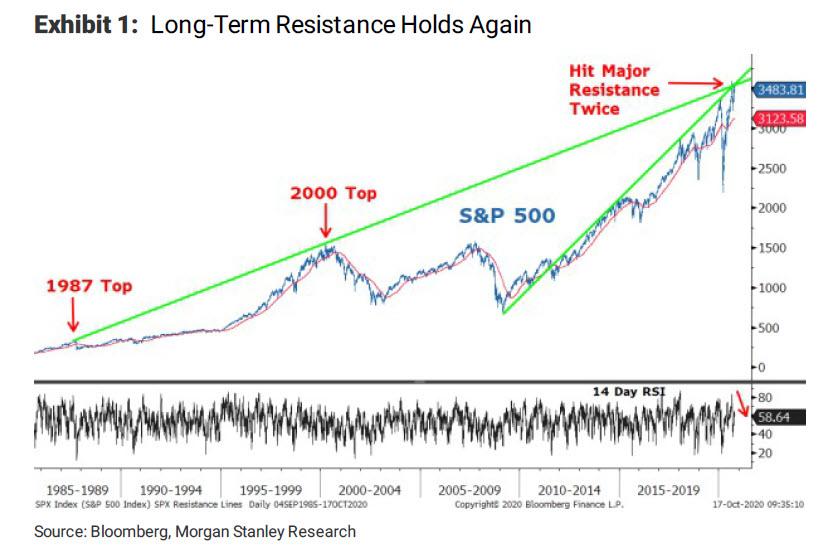
Then, just days later, the index quickly retreated for its first 10% correction in this new bull market, and while last Monday the index once again staged a valiant effort to break through, it was thwarted once again. Of concern to Wilson is that this second attempt occurred on less momentum, "suggesting the correction that began in September is likely not complete."

Furthermore, the Morgan Stanley strategist also highlights the lack of a fiscal stimulus deal, election outcome/timing of final results, and second wave of the virus "as the primary headwinds to higher prices in the near term."
So with both fundamentals drivers and technicals limiting stock upside limited, with so many uncertainties over the next month Wilson says that "another 10% correction from Monday's highs is the most likely outcome in the near term before this bull market can resume, at least at the index level."
Next, to quantify the potential downside, Wilson says that he continues to view the 200-day moving average for formidable support from a technical standpoint, which today is at 3123.
Then, from a valuation perspective, Wilson refers to one of his preferred market indicators, the Equity Risk Premium, which he says "looks too low" given the near-term uncertainties and upside risk to long-term rates we see. As such, he would be more comfortable with a buffer of 50 bps to add risk here. Such an adjustment implies an ERP of ~425bps rather than the 375bps indicated by current level of realized vol and is shown in the next chart.
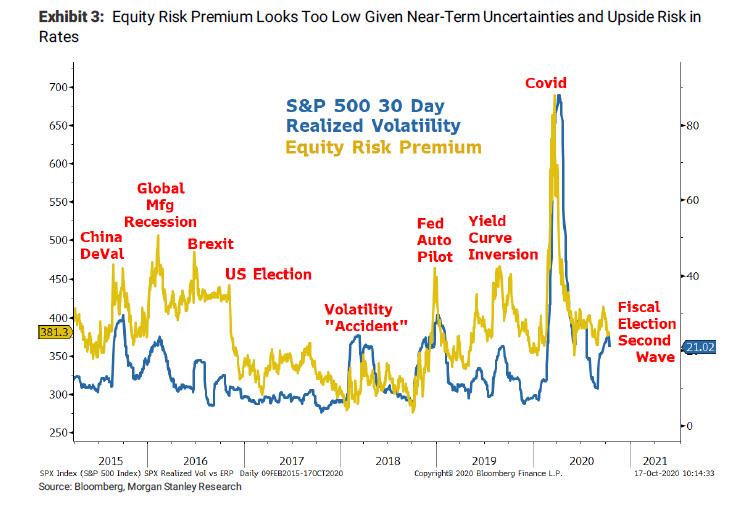
It's also how he gets the 10% downside estimate: at 380 bps and with a 10-year Treasury yield at 0.75%, the current S&P 500 P/E multiple is ~22x. If one add the 50bps buffer noted above to the implied ERP from Exhibit 3 while holding the 10-year yield constant, we get a 2 multiple drop in the P/E to 20x, which implies 10% downside. Coincidentally, this also lines up with the 200-day moving average noted above.
Bottom line, Morgan Stanley urges investors to remain "disciplined" on new money entry points, favoring the low end of our 3100-3550 range we established back in August.
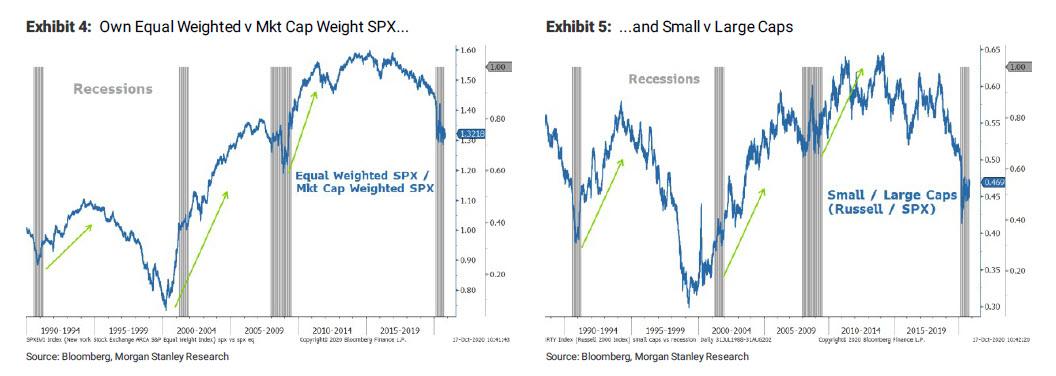
Finally, to avoid any bearish labels, Wilson as usual concludes on a bullish note, writing that the recovery and new bull market "remain on track to resume next year. More importantly, we think the average stock will outperform the major average (SPX), which is now highly concentrated to the top 20 largest stocks." He believes that the best way to express this view is by owning an equal weighted S&P 500 relative to the market cap weighed S&P or by skewing one's portfolio to smaller capitalization stocks that can deliver better operating leverage and earnings growth next year.
Closing Stock Market SummaryThe S&P 500 fell 1.6% on Monday, as risk sentiment was pressured by headlines indicating a stimulus deal doesn't appear imminent. The Nasdaq Composite fell 1.7%, the Dow Jones Industrial Average fell 1.4%, and the Russell 2000 fell 1.2%.
The day did start on a positive note before the major indices quickly embarked on a steady decline on no specific news. In the afternoon, the stimulus news appeared to have an algorithmic effect on the market considering House Speaker Pelosi gave the White House until Tuesday to reach a deal in order to get it done before the election.
The news wasn't necessarily surprising, as both sides had been divided on key issues for some time, but the update combined with the negative price action beforehand kept buyers sidelined. Every sector in the S&P 500 closed lower with losses ranging from 0.9% (utilities) to 2.1% (energy). The information technology sector fell 1.9%.
Moreover, today's slate of positive-sounding news was largely brushed aside. One exception was the airline stocks did rise on news that daily airline passenger levels reached one million for the first time since March. The U.S. Global Jets ETF (JETS 17.68, +0.19, +1.1%) increased 1%.
Other encouraging news included the NAHB Housing Market Index increasing to a new all-time high of 85 in October (Briefing.com consensus 83), China reporting hopeful economic data, and commentary that AstraZeneca's (AZN 52.44, -0.59, -1.1%) vaccine candidate could be available soon after Christmas.
In M&A activity, Intel (INTC 54.58, +0.42, +0.8%) was reported to be nearing a $10 billion agreement to sell its NAND memory unit to SK Hynix (HXSCL), and Concho Resources (CXO 27.26, -1.34, -2.8%) confirmed it will be acquired by ConocoPhillips (COP 32.70, -1.07, -3.2%) in an all-stock transaction valued at $9.7 billion.
Longer-dated Treasuries faced selling pressure despite the weakness in equities, which was reflective of cash-raising efforts. The 2-yr yield finished flat at 0.15%, while the 10-yr yield increased two basis points to 0.76%. The U.S. Dollar Index declined 0.3% to 93.44. WTI crude futures finished little changed at $40.84/bbl.
Looking ahead, the Housing Starts and Building Permits report for September is scheduled to be released on Tuesday.
- Nasdaq Composite +27.9% YTD
- S&P 500 +6.1% YTD
- Dow Jones Industrial Average -1.2% YTD
- Russell 2000 -3.3% YTD