Closing Stock Market SummaryThe S&P 500 gained 0.5% on Tuesday, although it was up as much as 1.5% ahead of a stimulus meeting between House Speaker Pelosi and Treasury Secretary Mnuchin. The Nasdaq Composite increased 0.3%, the Dow Jones Industrial Average increased 0.4%, and the Russell 2000 increased 0.3%.
Yesterday reports suggested a stimulus deal wasn't looking imminent, but comments from the House Speaker after Monday's close provided the market hope that both sides would get something done soon. Senate Majority Leader McConnell said he would bring a presidentially supported bill to the floor if it passes the House but reportedly wants a deal after the election.
Ms. Pelosi and Mr. Mnuchin were still negotiating at market's close, which may have caused some hedging activity for any disappointment. Nevertheless, ten of the 11 S&P 500 sectors still closed higher, led by the energy (+1.1%), financials (+0.8%), and communication services (+0.8%) sectors, while the consumer staples sector (-0.1%) closed lower.
Energy stocks benefited from higher oil prices ($41.51/bbl, +0.67, +1.6%); financial stocks benefited from curve-steepening activity due to selling on the longer-end of the curve; and Alphabet (GOOG 1555.93, +21.32, +1.4%) was a bright spot in the communication services sector despite the Department of Justice filing an antitrust lawsuit against Google.
Other measures of support included commentary that Moderna's (MRNA 71.31, +0.35, +0.5%) COVID-19 vaccine could be available in December, encouraging housing starts and building permits data for September, and better-than-expected earnings reports from Dow components Procter & Gamble (PG 142.48, +0.57, +0.4%) and Travelers (TRV 118.11, +6.27, +5.6%).
Conversely, notable earnings-related laggards included IBM (IBM 117.37, -8.15, -6.5%) and Philip Morris International (PM 73.33, -4.51, -5.8%). Intel (INTC 53.43, -1.15, -2.1%) struggled after confirming it will sell its NAND memory business to SK Hynix for $9 billion.
Recapping the moves in the Treasury market, selling in longer-dated maturities drove yields higher on the prospects that a large stimulus package would spur economic growth/inflation. The 2-yr yield was flat at 0.15%, while the 10-yr yield rose four basis points to 0.80%. The U.S. Dollar Index fell 0.4% to 93.08.
Reviewing Tuesday's economic data:
- Total housing starts increased 1.9% m/m in September to a seasonally adjusted annual rate of 1.415 million units (consensus 1.430 million). Total building permits jumped 5.2% m/m to 1.553 million (consensus 1.510 million).
- The key takeaway from the report is that there was robust growth in both single-unit starts (+8.5% m/m) and permits (+7.8% m/m), which reflects underlying strength in the market for single-family homes.
Looking ahead, investors will receive the weekly MBA Mortgage Applications Index and the Fed Beige Book for September on Wednesday.
- Nasdaq Composite +28.4% YTD
- S&P 500 +6.6% YTD
- Dow Jones Industrial Average -0.8% YTD
- Russell 2000 -3.0% YTD
Quirk In Options Trading Could Lead To "Large, Sharp" Market Drawdown
The 2020 markets have been remarkable for a myriad of reasons but for us there is nothing more remarkable than call option demand. This past week we highlighted huge call induced moves in AMZN & ZM, and this week we came across the data set featured below. This data measures “Customer” flow which is essentially retail and “buy side” trading.
As you can see the premium being spent on single stock call options is heavily outpacing that of ETF’s and Index. There was an initial call buying acceleration into Feb ’20 which at the time was record call volumes. However, following the March market collapse single stock demand soared both to news highs and in relation to ETF & Index.
Whats significant about this is that these call volumes likely force markets higher. This is because when call buyers purchase options it leaves dealers and market makers short calls. In order to hedge they must buy stocks both initially and as the market goes higher. This means that as stocks go up dealers and market makers must keep buying stock. As markets rise it may be more attractive for options speculators to buy more calls, which leads to more long hedges. This is what makes the tweet above from Atremis’ Christopher Cole so important – these call options flows can have a major impact on markets and traders are now shifting to trade these hedging flows.
The lack of ETF/Index call volume is strange given the massive market rebound from March lows. Generally Index options are used by large entities due to higher notional values. It does appear that big players stepped in to buy “macro” index exposure into the March dip. Following that it appears that both retail and large institutions (like SoftBank) have preferred single stocks based on this surge in single stock call premiums.

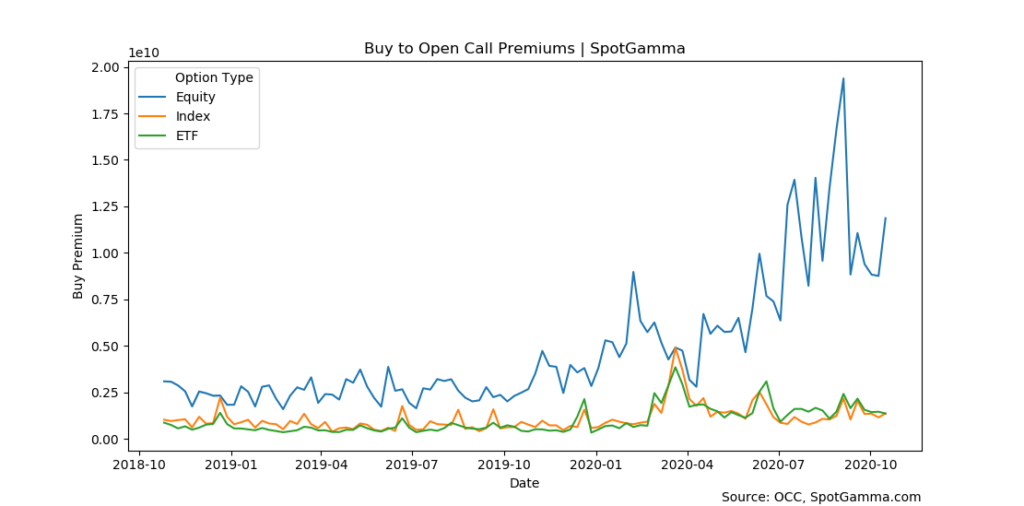
Buy to Open Call Premiums
The put flows present some equally interesting data. You can see that single stock put premium is now a fraction of current call premiums. Whats really fascinating about the March selloff is how Index options premiums outpaced that of ETF & single stock. This is again likely due to large institutions seeking macro hedges to protect against further downside. It also appears those options were bought into the tail end of March, indicating a lot was spent on puts just as the market was rebounding.
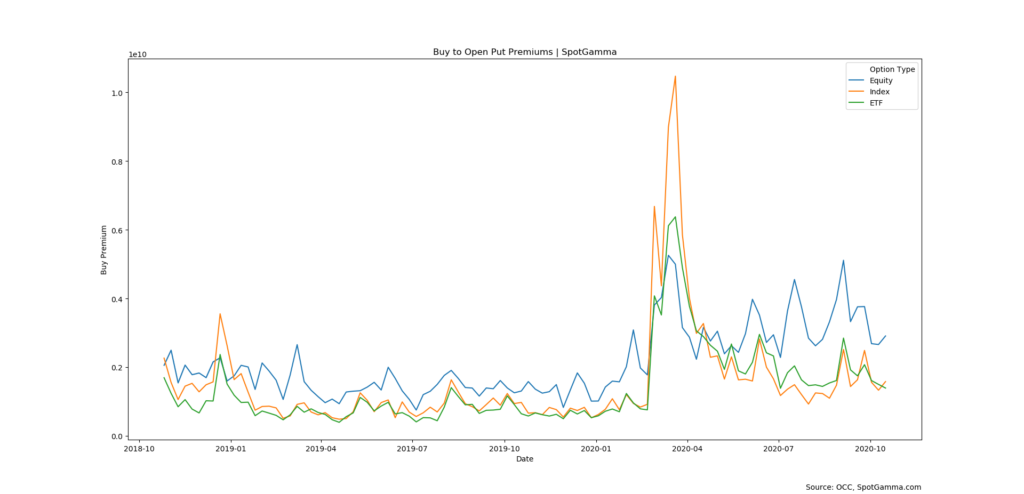
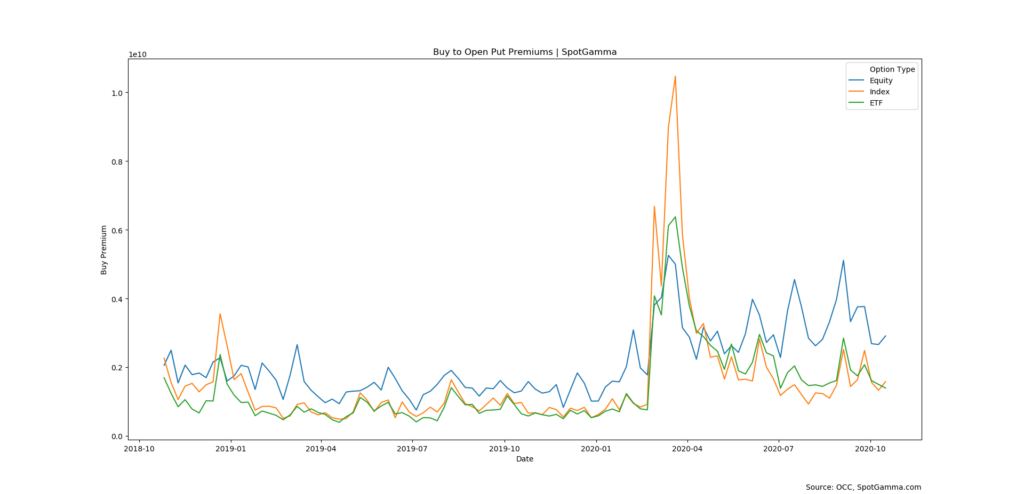
Buy to Open Put Premiums
We see little reason to think the call buying trends change materially. With just weeks to the election we’d note that several brokers have raised margin rates which may deter some buying into 11/3. There seems to be general consensus that a Blue Wave is coming, and along with that massive stimulus. Given the Pavlovian stimulus response call buyers may step up in force and push markets to new highs.
Conversely if we see any type of election issues markets may weaken. There are substantial put positions out in December of 2020, and our concern is that a weak market may lead option dealers to short futures to hedge those put positions. This could lead to a large sharp draw down similar to December of 2018. However, because those hedges are already in place we may not see a substantial put premium spike like we did in March of this year.
Gapping down
In reaction to earnings/guidance:
- HXL -7%, IBM -2.9%, SYF -2.7%, PPG -1.7%, IRDM -0.8%
Other news:
- AMC -5.9% (enters into 15 mln share Class A common stock equity distribution agreement; reports prelim Q3 results)
- PHR -3.1% (stock offering)
- PLL -2.7% (ADS offering)
- SYF -2.7% (extends strategic credit card program with WMT's Sam's Club)
- ACCD -2.3% (stock offering)
- XFOR -0.6% (files for $150 mln mixed shelf offering)
Analyst comments:
- ED -0.5% (downgraded to Sell from Neutral at Goldman)
Gapping up
In reaction to earnings/guidance:
- LOGI +18.1%, CCK +7% (also to initiate a dividend), UBS +6.9%, NGVT +4.9%, ACI +4.2%, IQV +3.6%, CNTG +2.7%, TRV +2.6%, RF +2.5%, PNR +1.8%, CMA +1.6%, CDNS +1.5%, GPK +1.3%, PG +1.3%, BXS +1.2%, MDT +1.1%
Other news:
- APTX +109% (reports "positive" top-line data from Phase 2 study of NYX-783)
- CARA +18.1% (Cara Therapeutics and Vifor Pharma sign US license agreement for IV Korsuva)
- HTZ +10.7% (names new Chief Accounting Officer)
- OESX +6.1% (secures approx. $41 mln in contract extensions)
- IVA +5.6% (FDA grants Fast Track designation to odiparcil)
- ORIC +3.1% (enters into exclusive license agreement with Voronoi)
- XPEV +3% (completed the production of 10,000 units of the P7 smart EV sedan, its flagship model)
- WHR +2.8% (increases quarterly dividend by 4%)
- ACIW +1.9% (Starboard Value discloses 9% stake)
- LAC +1.8% (provides corporate update; establishes US$100 mln at-the-market equity program)
- ZEN +1.7% (adds Instragram for businesses to its customer support offering)
- BLU +1.3% (prices offering of 15,555,556 common shares at $2.25 per common share)
- MDT +1.1% (announces statistically significant 12-month results from a large, multicenter randomized controlled trial)
Analyst comments:
- PLAY +7.7% (upgraded to Outperform from Market Perform at BMO Capital Markets)
- RYAM +4.4% (upgraded to Outperform from Sector Perform at RBC Capital Mkts)
- IHG +4.3% (upgraded to Buy from Neutral at Goldman)
- WDAY +2.8% (upgraded to Overweight from Neutral at Piper Sandler)
- FTNT +2.5% (upgraded to Buy from Neutral at Goldman)
- BC +1.9% (upgraded to Overweight from Neutral at JP Morgan)
- OGE +0.9% (upgraded to Neutral from Sell at Goldman)
- FIZZ +0.7% (upgraded to Hold from Underperform at Jefferies)
Procter & Gamble beats by $0.21, beats on revs; guides FY21 EPS mostly above consensus; ups buyback plan range (141.91)
- Reports Q1 (Sep) earnings of $1.63 per share, $0.21 better than the S&P Capital IQ Consensus of $1.42; revenues rose 8.5% year/year to $19.32 bln vs the $18.38 bln S&P Capital IQ Consensus.
- Reported gross margin increased 170 basis points versus the prior year reported gross margin. Reported gross margin increased 140 basis points versus the prior year core gross margin due to 30 basis points of non-core restructuring charges in the base period.
- Total organic volume up 7%
- Co issues in-line guidance for FY21, raises core EPS growth from 3-7% to 5-8%, which translates to $5.38-5.53, excluding non-recurring items, vs. $5.39 S&P Capital IQ Consensus. The Company raised its outlook for organic sales growth from a range of two to four percent to a range of four to five percent.
- P&G expects to pay approximately $8 billion in dividends in fiscal 2021. The Company increased its outlook for common stock repurchase from a range of $6 billion to $8 billion to a range of $7 billion to $9 billion in fiscal 2021.
Early premarket gappers
- Gapping up:
- APTX +58.2%, LOGI +21.1%, LOGI +21.1%, CARA +8.6%, HTZ +8.4%, CNTG +8.4%, CCK +6.6%, IVA +5.7%, UBS +5.5%, XPEV +3.6%, ACIW +1.9%, BHP +1.8%, ZEN +1.7%, VALE +1.3%, CDNS +1.3%, RF +1.3%, SYF +1.2%, BXS +1.2%
- Gapping down:
- HXL -9.2%, BLU -4.3%, PHR -4.1%, STLD -3.4%, IBM -2.9%, PLL -2.7%, ACCD -2.3%, PPG -1.5%
>>> Up
* Edenred Raised to Buy at SocGen; PT 48.20 euros
* EssilorLuxottica Raised to Outperform at RBC; PT 140 euros
* Delivery Hero PT Raised to 130 euros from 115 euros at RBC
* GB Group Raised to Buy at Berenberg; PT 1,020 pence
* Investor AB Raised to Buy at Pareto Securities; PT 633 kronor (+)
* Legrand Raised to Hold at Jefferies; PT 68 euros
* Naturgy Raised to Buy at Mirabaud Securities; PT 19.40 euros (+)
* PRISA Raised to Hold at Mirabaud Securities; PT 70 euro cents (+)
* Volvo Raised to Hold at SocGen; PT 200 kronor
>>> Down
* Edgeware Cut to Hold at Handelsbanken
* InterContinental Hotels Cut to Reduce at AlphaValue
* Saab Cut to Hold at SEB Equities; PT 245 kronor
* Salmar Cut to Hold at Arctic Securities; PT 525 kroner
>>> Initiation
* Next Reinstated Overweight at Barclays; PT 7,200 pence
* Paion Reinstated Buy at Oddo BHF; PT 4 euros (+)
* Uniphar Rated New Buy at Shore Capital; PT 4 euros (+)
>>> Call
* Adecco PT Boosted at Deutsche Bank on France, U.S. Improvement (+)
* GB Group is a Multi-Year Growth Story, Upgrade to Buy: Berenberg
* Legrand’s Organic Growth Concerns Now in Consensus: Jefferies
* Logitech Quarter a ‘Blow Out’, Update ‘Extremely Strong’: Citi
* Reckitt Shares to React Positively to 3Q Beat: Morgan Stanley (+)
* Remy Beats Expectations Again After ‘Impressive’ 2Q Sales: Citi (+)
* Swedbank 3Q Likely Shows Way for Sector Results, Jefferies Says (+)
* Westwing FY Estimates Raised at Citi After 3Q Sales Beat (+)