WSJ : Pioneer Natural Resources to Buy Parsley Energy for $4.5 Billion

Pioneer Natural Resources to Buy Parsley Energy for $4.5 Billion
Deal is latest combination in hard-hit U.S. shale-oil patch, but some warn consolidation may be limited to top-tier firms

Pioneer Natural Resources Co. PXD -4.04% has agreed to buy Parsley Energy Inc. PE 5.15% for $4.5 billion, the latest in a flurry of U.S. oil tie-ups as companies seek to weather low prices brought about by the coronavirus pandemic.

The all-stock deal, which values Parsley at a 7.9% premium to its closing value Monday, would solidify Pioneer’s place as one of the largest producers in the Permian Basin of Texas and New Mexico, the top American oil field.

The long-anticipated string of transactions is expected to continue for healthier companies in the country’s most prolific oil fields, investors said, while many smaller, debt-burdened companies that are hoping for a deal may draw few offers.

Pioneer Chief Executive Scott Sheffield said in an interview Tuesday that size and scale would be key to surviving as an independent oil-and-gas producer as the world moves away from fossil fuels, and would help his company return more cash to shareholders. But he said additional combinations of industry players may take time.

“I do not see much more coming until these other companies can deliver with excess cash flow over the next two or three years,” he said.

The Wall Street Journal reported Monday that Pioneer and Parsley were in talks to combine. Shares in Parsley increased about 5% on Tuesday, as Pioneer’s stock fell around 4%.

“The combination of Parsley and Pioneer creates an organization set to thrive as we forge a strong new link at the low end of the global cost curve,” Parsley Chief Executive Matt Gallagher said in a statement. He is poised to join the combined company’s board of directors

The deal comes a day after ConocoPhillips COP -0.37% agreed to buy Concho Resources Inc. CXO -0.32% for $9.7 billion. Last month, Devon Energy Corp. DVN 1.24% agreed to a $2.6 billion merger with WPX Energy Inc., WPX 0.88% while Chevron Corp. CVX 0.56% in July agreed to buy Noble Energy Inc. for about $5 billion. All of them were all-stock deals with premiums of 15% or below.

The targets are among a relatively small group of U.S. oil-and-gas companies considered healthy enough financially to attract buyers, investors said.

Only about a quarter of major U.S. shale operators were attractive acquisition or merger targets based on their financial and operational strength, the Deloitte consulting firm said in a recent report. Less-attractive possibilities made up about half of the sector and a significant portion of U.S. oil and gas production. Deloitte deemed the rest as either risky investments or attractive largely to private-equity firms.

In addition to having poor returns, many companies accumulated steep debts during the fracking boom, while only a few have managed to operate with lower costs that allow for better returns when oil prices recover, said Ben Cook, portfolio manager at BP Capital Fund Advisors.

Though the industry is in a consolidation phase that will likely extend beyond the Permian Basin into other parts of Texas as well as North Dakota, Mr. Cook said, “I don’t think [M&A] happens for everyone.”

All told, U.S. shale drillers have generated net negative free cash flows of about $300 billion since 2010, Deloitte said. Since 2015, at least 248 North American oil and gas producers have filed for bankruptcy, according to Dallas law firm Haynes & Boone. The industry’s bankruptcy cases have involved more than $175 billion in debt, the firm said in a recent report.

This year, operators including Chesapeake Energy Corp. , Whiting Petroleum Corp. and California Resources Corp. filed for bankruptcy as the coronavirus pandemic crushed energy demand.

There is no market for about 80% of the roughly 500 oil and gas producers in North America, according to Adam Waterous, the founder of Waterous Energy Fund, a private-equity firm. Mr. Waterous said many companies bought up unproven assets during the boom, most of which have proven to be unprofitable without high oil prices.

“It’s not as simple as smashing together some private equity [oil and gas] companies that have no buyer,” said Mr. Waterous, who was previously the head of investment banking and energy at Bank of Nova Scotia. “The vast majority of these are not good assets.”

Still, absent a jump in prices to $50 or $60 per barrel, deals in the oil patch should continue to flow, said Ben Dell, managing partner at private investment firm Kimmeridge Energy Management Co. U.S. benchmark oil settled around $41 a barrel Tuesday.

“There’s a palpable feeling of being left behind now and that the business model has changed, and resonating with management teams,” Mr. Dell said.

—that’s

Mr. Sheffield, Pioneer’s chief, is the father of Parsley’s executive chairman, Bryan Sheffield. Pioneer Chairman J. Kenneth Thompson said in an interview that neither Scott Sheffield nor Bryan Sheffield was allowed to participate in deal negotiations.

Scott Sheffield said he was also barred from discussing the acquisition with executives.

Pioneer said it expects the combined company to realize roughly $325 million in savings annually by reducing administrative expenses and other costs.

The deal, which is expected to close early next year, is subject to approval from the shareholders of both companies. The companies said that Quantum Energy Partners, Parsley’s largest shareholder, with a 17% stake, backs the combination.
FT : Tesla’s move into mining aimed at energising battery supply chain

Tesla’s move into mining aimed at energising battery supply chain
Elon Musk’s lithium plan seen more as ploy to catalyse output than competitive threat

When Tesla held its socially distanced “battery day” last month at an outdoor parking lot in California, it invited executives from the two big US lithium companies, Livent and Albemarle. 

As they sat in their allotted Model 3s watching Elon Musk on their in-car screens, he dropped a bombshell: the electric car maker was becoming a competitor. 

Tesla, Mr Musk said, had acquired the rights to a 10,000-acre plot in Nevada where it planned to extract the metal using simple table salt, and would build a lithium refinery to supply a new factory in Texas. The next day Albemarle and Livent lost a combined $1.7bn in market value as their share prices plunged.

But industry insiders and observers remain sceptical that the car group can pose a serious competitive threat to established lithium producers. They say Tesla’s plan is unlikely to bear fruit for years and is instead designed to put pressure on the industry, which is dominated by five companies, to ramp up production. 

“He’s put the cat among the pigeons,” said Simon Moores, managing director at consultancy Benchmark Mineral Intelligence. “The message is, ‘we don’t trust you to scale quickly enough for our needs so we’ll do it ourselves’. It’s a slight slap in the face of the upstream mining companies.”

Tesla, which did not respond to requests for comment, is seeking to more than halve the cost of its batteries in a push to produce a $25,000 electric car that can compete with mass-market mid-range petrol vehicles.


To reach an ambitious annual production target of 20m cars by 2030, which would require 3 terawatt hours of batteries a year, the lithium industry would need to grow more than eightfold just to supply Tesla, according to analysts at Citigroup.

Energy consultancy WoodMackenzie says $50bn needs to be invested in lithium over the next 15 years to meet battery demand if the world is to meet the targets of the Paris climate accord.

But lithium producers have struggled to expand in the face of three years of falling prices. The price of lithium hydroxide, the type Tesla uses, has fallen 20 per cent over the past year, according to Benchmark Mineral Intelligence.

Without further investment Tesla risks being short of lithium and facing a potential price spike over the next decade.

In August low prices prompted Albemarle to temporarily shut down its lithium facility in Silver Springs, Nevada. The company has also slowed down spending on a lithium hydroxide refinery in Western Australia.

To bolster new supply Tesla signed an agreement last month with North Carolina-focused mining group Piedmont Lithium to buy five years of their output starting in 2022.

That contract will help Piedmont access finance to bring the mine into production, according to Keith Phillips, its chief executive.

“One of the issues Tesla faces is there’s a duopoly outside of China in lithium hydroxide of Albemarle and Livent,” he said. “But neither of them are growing their upstream capacities, whereas Tesla are growing their requirements every year. If they can help enable others to be successful it brings more material to the market which is good for them.”

Mr Musk said Tesla could lower the cost of lithium production by 33 per cent by producing the lithium from Piedmont and elsewhere at its new refinery in Texas.


But it will only meet a fraction of Tesla’s needs, according to Joe Lowry, a lithium consultant and industry veteran.

He also has doubts over the plan to mine lithium from clay deposits in Nevada — a process Mr Musk summarised at the Battery Day as: “We take a chunk of dirt out the ground, remove the lithium and put the chunk of dirt back where it was.”

“I don’t believe that Tesla is going to be successful in supplying a high percentage of their own lithium requirements,” Mr Lowry said. “I think they’ll struggle like everyone else who enters this industry — it’s not easy to make high quality lithium chemicals, Elon knows that. Was it just a ruse to bring the lithium companies to the table?” 

Kent Masters, chief executive of Albermarle, said the company had looked at extracting lithium from clay in Nevada — an untested process — but had concluded it was not cost competitive with its production in Chile and Australia.

“Our view is that they [clays] are uneconomical given pricing today and how we forecast pricing and the access to the other resources that we have,” he said on a recent call with analysts.

Tesla would also need federal permits to begin mining in Nevada, itself a process that can take years, according to another lithium executive. 

Mr Moores believes the true aim of the Battery Day statement was to kickstart the building of a US-based supply chain for lithium. China refines and processes 80 per cent of the world’s battery materials and also dominates production of battery components such as cathodes and anodes. 

Cutting out China’s role would allow Tesla to integrate supplies completely from basic raw materials to batteries, he said, in a throwback to Henry Ford, who bought up rubber plantations in the Amazon to supply the material used in tyres.

“The sway of industrial power is now swinging back to the US,” he added. “We’ve gone from North America . . . making hardly any batteries and not producing any chemicals and raw materials to having an integrated Tesla battery hub.” 

>>> Europe : Brokers Upgrades & Downgrades - 21st of October 2020 V2(+)

>>> Up
* Alumetal Raised to Neutral at Biuro Maklerskie mBanku (+)
* ASML Raised to Hold at DZ Bank; PT 335 euros (+)
* Bucher PT Raised to 420 Swiss francs at Berenberg
* Chr. Hansen Raised to Neutral at Goldman; PT 660 kroner
* Corem Property Raised to Buy at Kepler Cheuvreux; PT 25 kronor (+)
* IAG Raised to Buy at Goodbody; PT 130 pence
* Jungheinrich PT Raised to 38 euros at M.M. Warburg (+)
* Kuehne + Nagel Raised to Reduce at AlphaValue
* Learning Tech Raised to Buy at Canaccord; PT 150 pence (+)
* Lundbeck Raised to Buy at SEB Equities; PT 230 kroner
* MDxHealth Raised to Buy at KBC Securities; PT 1 euro (+)
* Norma PT Raised to 44 euros from 37 euros at Berenberg
* Ponsse Raised to Accumulate at Inderes; PT 29 euros (+)
* Sartorius PT Raised to 460 euros at Bankhaus Metzler
* Somfy Raised to Buy at Oddo BHF; PT 145 euros (+)
* StanChart Upgraded at Macquarie Amid Limited Consumer Exposure
* Superdry Raised to Add at Peel Hunt; PT 200 pence
* Swedbank Raised to Buy at Arctic Securities; PT 165 kronor
* Yara Raised to Buy at SEB Equities; PT 395 kroner

>>> Down
* Air Liquide Cut to Neutral at Atlantic Equities; PT 142 euros
* Barco Cut to Accumulate at KBC Securities; PT 20 euros (+)
* Galapagos Cut to Sell at Goldman; PT 87 euros
* Kion Cut to Hold at Deutsche Bank; PT 78 euros
* Reply Cut to Hold at UBI Banca (+)
* Saab Cut to Neutral at BofA; PT 240 kronor (+)
* Yara Cut to Neutral at Credit Suisse; PT 340 kroner (+)

>>> Initiation
* AIB Group Resumed Buy at Deutsche Bank; PT 1.20 euros
* Bank of Ireland Resumed Buy at Deutsche Bank; PT 2.50 euros
* DFS Furniture Rated New Buy at Shore Capital; PT 330 pence
* Electrolux Professional Rated New Buy at Pareto Securities (+)
* Entra Reinstated Sell at Pareto Securities; PT 100 kroner
* Metro Bank Reinstated Buy at Jefferies; PT 73 pence (+)
* Permanent TSB Resumed Hold at Deutsche Bank; PT 50 euro cents
* Roche Bobois SAS Rated New Buy at Bryan Garnier; PT 22 euros (+)
* Thales Rated New Buy at Berenberg; PT 90 euros
* Wienerberger Rated New Equal-Weight at Morgan Stanley

>>> Call
* Bucher to Benefit from Recovery, Berenberg PT to New Street High (+)
* Ericsson 3Q ‘Stellar,’ Networks Margin ‘Robust’: Handelsbanken (+)
* Ericsson Could Now Be Upgraded to Investment Grade: Danske Bank (+)
* Handelsbanken 3Q Displays Ongoing Credit Strength: Jefferies (+)
* IAG Upgraded at Goodbody as 3Q ‘Should Give Investors Comfort’ (+)
* Inficon 3Q Slump in Earnings is ‘Significant,’ Mirabaud Says (+)
* Kion Cut at Deutsche Bank on Industrial-Truck Margin Weakness
* Nestle 3Q Sales Beat Led by Emerging Markets, Water: Jefferies (+)
* Segro 3Q Solid and Strong Returns Outlook Intact, MS Says (+)
* Thales ‘Overlooked,’ Organic Growth to Return in 2021: Berenberg
* Wienerberger Initiated Equal-Weight, May Be Value Trap, MS Says

>>> Stoxx 600 Pre-Market Indications

  • Ericsson (ERCB TH) +4.9%
    • Ericsson Third Quarter Adjusted Operating Profit Beats Estimates
  • NEL (D7G TH) +1.9%
    • Everfuel Raises NOK290m; to Start Trading on Merkur on Oct. 29
      • NOTE: Nel holds 19.9% ownership in Everfuel, pre-committed to subscribe shares equal to about EUR0.8m
  • BP (BPE5 TH) +1.5%
  • Thales (CSF TH) +1.5%
    • Thales ‘Overlooked,’ Organic Growth to Return in 2021: Berenberg
  • Corbion (CSUA TH) +0.9%
  • Varta (VAR1 TH) +0.9%
  • Linde (LIN TH) +0.8%
  • Merck KGaA (MRK TH) -0.8%
  • Lufthansa (LHA TH) -1%
  • TOMRA (TMR TH) -1.1%
  • Kion (KGX TH) -4.3%
    • Kion Cut at Deutsche Bank on Industrial-Truck Margin Weakness

>>> TradeGate Pre-Market Indications

DAX:
  • Deutsche Telekom (DTE TH) +0.8%
  • Vonovia (VNA TH) -0.5%
  • Merck KGaA (MRK TH) -0.5%
MDAX:
  • Grenke (GLJ TH) +2.9%
    • Gladstone Boosts Short Position in Grenke to 0.81%
  • Cancom (COK TH) +1.8%
  • Shop Apotheke (SAE TH) +1.2%
  • Varta (VAR1 TH) +1.2%
  • HelloFresh (HFG TH) +1.1%
  • Lufthansa (LHA TH) -1.1%
  • Kion (KGX TH) -3.6%
    • Kion Cut at Deutsche Bank on Industrial-Truck Margin Weakness
SDAX:
  • Bilfinger (GBF TH) +7.5%
    • Bilfinger Said to Draw Interest From Buyout Firms Including CD&R
  • Draegerwerk (DRW3 TH) +1.7%
  • LPKF (LPK TH) +1%
  • Borussia Dortmund (BVB TH) -1.2%

>>> What to look at today - 21st of October 2020

Treasury yields rose and U.S. futures extended overnight gains amid optimism about progress on stimulus talks in Washington. The dollar retreated.
The benchmark 10-year yield climbed above 0.8% to a four-month high after House Speaker Nancy Pelosi said she remains hopeful of a deal before the election. S&P 500 contracts edged higher after the gauge bounced back from Monday’s selloff. Shares saw modest gains in Japan, Hong Kong and South Korea, and slipped in China. European futures pointed higher.
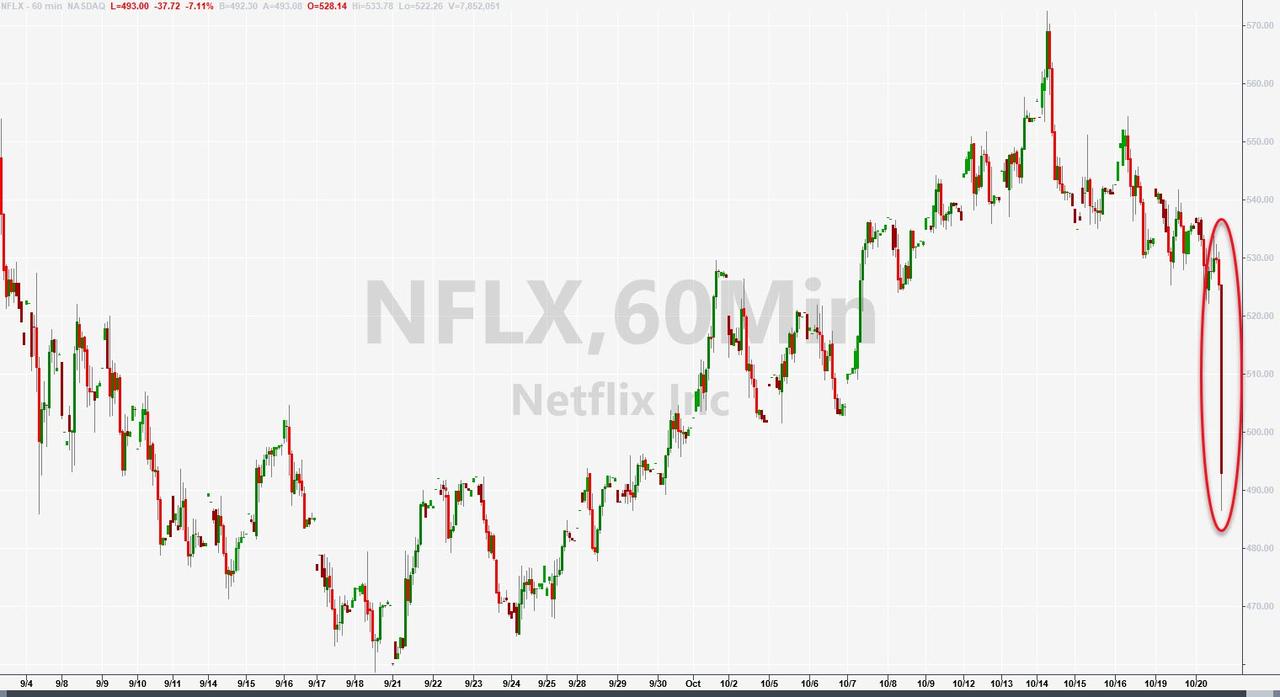
Elsewhere, tech shares mostly shook off the U.S. Justice Department’s decision to sue Google for allegedly abusing its power. Netflix Inc. plunged in late trading after it missed Wall Street estimates. The yuan climbed to the strongest since July 2018 and copper hit its highest in more than two years. Oil slipped.
US After Hours SNAP +22.8% up big on earnings while NFLX -6.1% falls on earnings/net sub adds; TXN +0.8% flat on earnings

Nikkei +0.30% Hang Seng +0.75% CSI -0.49% Shanghai -0.52% Shenzen-1.42%

Eur$ 1.1853 CNH 6.6366 CNY 6.6502 JPY 105.26 GBP 1.2985 CHF 0.9056 WTI$ 41.35 -0.84%

S&P +0.59% Nasdaq +0.49% EuroStoxx +0.22% FTSE -0.04% Dax +0.22% SMI +0.29%

Macro :
- Romney Would Oppose Stimulus Deal at $1.8 Trillion or More
- ECB’s Lagarde Says Virus Resurgence Is a Clear Risk to Economy
- *FED’S EVANS: NOT SURE LONG-TERM RATES CAN GO MUCH LOWER
- EU Carmakers Call on Brussels to Reconsider Brexit Stance: FT

Keep an eye on :
- AB FP : AB Science Says Asthma Treatment Met Endpoint in Phase 3 Study
- ADYEN NA : Adyen Names Matthey as CTO From Jan. 1, 2021, Replacing Schuijff
- AIR FP : EU’s Dombrovskis Rejects U.S. Offer in Airbus-Boeing Spat: SZ
- AKZA NA : Akzo Nobel 3Q Adjusted Operating Income Beats Est.
- APPS SM : Applus to Buy Besikta From Volati for SEK 1.05B
- AST IM : Astaldi Signs EU200m Unsecured Revolving Credit Facility
- AZN LN : AstraZeneca U.S. Trial May Resume as Early as This Week: Rtrs
- ATEA NO : Atea Third Quarter Revenue Misses Estimates
- ATL IM : Atlantia Says CDP Offer Doesn’t Value Autostrade Adequately
- BAR BB : Barco Third Quarter Revenue Misses Estimates
- GBF GY : Bilfinger Said to Draw Interest From Buyout Firms Including CD&R
- BOL FP : Bollore Third Quarter Revenue EU5.92 Bln
- ALCART FP : Carmat Says Allowed To Resume Pivot Study in France
- EQT SS : EQT Third Quarter Total Investments EU6.0 Bln
- ERICB SS : Ericsson Third Quarter Adjusted Operating Profit Beats Estimates
- ERICB SS : Ericsson Profit Surged as Huawei Ban Offset Hit from Pandemic
- ENX FP : Euronext: Status of All Oct. 19 Transactions Now Clarified
- FGR FP : Eiffage’s Highway Unit APRR 3Q Rev. Down 1.6% Y/Y
- FME GY : FMC Sees U.S. ‘Cares Act’ Aid Depleted in Fourth Quarter: FAZ
- SHBA SS : Handelsbanken 3Q Net Interest Income Meets Estimates
- GAM SW : GAM Holding Assets Under Management CHF120.4 Bln
- DRLCO DC : Maersk Drilling Gets $30 Million Three-Well Contract From Total
- NHY NO : Hydro and Lyse to Establish Hydropower Co. Lyse Kraft
- IBE SM : Iberdrola’s Avangrid to Buy PNM Resources for $50.3/Shr
- IFCN SW : Inficon Third Quarter Operating Income Misses Estimates
- IDIA SW : Idorsia Rump Share Placement Demand Exceeds Deal Size: Terms
- IDIA SW : Idorsia Raises Gross CHF535.5m Based on CHF22.50/Shr Offer Price
- IFF US : IFF to Delist From Tel Aviv Stock Exchange in January
- INWI SS : Inwido Third Quarter EPS Beats Estimates
- KLOVB SS : Klovern Nine Month Income From Property Management SEK982 Mln
- LHN SW : LafargeHolcim Eyes Bigger M&A for Solutions Segment: The Market
- LDO IM : Leonardo Says Paschi Conviction Doesn’t Affect Continuity
- LOGN SW ; Poly Jumps on Evercore’s Optimism After Logitech’s Results
- MUX GY : Mutares to Triple Revenue by 2023 as Pandemic Boosts Targets
- NESN SW : Nestle Sees FY Organic Rev. Around +3%, Saw 2%-3%, Est. +2.9%
- NFLX US : Netflix 3Q Streaming Paid Net Change Misses Est.: Snapshot
- NOKIA FH : Nokia to Supply Telia With 5G Radio Access Network in Finland
- PHARM NA : Pharming Receives Orphan Drug Designation From EC for Leniolisib
- RAND NA : Randstad Third Quarter Gross Margin Beats Estimates
- SAGA NO : Saga Tankers Offering Prices 54m Shares at NOK1.30/Share
- SNAP US : Snap 3Q Revenue, Daily Active Users Beat Estimates: Snapshot
- SOW GY : Software AG Maintains FY Adjusted Ebita Margin 20% to 22%
- SO FP : Somfy Sees Full Year Like-for-like Sales +3% to +4%
- STB NO : Storebrand Third Quarter Net Income Beats Estimates
- TKA AV : Telekom Austria Third Quarter Revenue Beats Estimates
- TEL NO : Telenor Divests HQ Property; Sees Accounting Gain of NOK1.3b
- TELIA SS : Telia Third Quarter Adjusted Ebitda Beats Estimates (1)
- URW NA : URW Defers Shrs/CDI Registers Conversions Pending Rights Issue
- VLA FP : Valneva: Phase 2 Study of Lyme Disease Vaccine Meets Endpoints
- DG FP : Vinci Nine Month Like-for-like Sales -13.2%
- VIV FP : Vivendi Recovery Broadens as Music and Television Sales Gain
- VIV FP : Vivendi 3Q Solid, Universal Music the Main Positive: Analysts
- VOW3 GY : VW Gauges Interest in Ducati Brand for Potential Sale: Rtrs
- XSPRAY SS : XSpray Pharma to Offer Up to 1.9m Shrs
- ROSE SW : Zur Rose Nine Month Sales CHF1.25 Bln
- WDP BB : WDP Full Year Adjusted EPS Forecast Beats Estimates

>>> Europe : Brokers Upgrades & Downgrades - 21st of October 202

>>> Up
* Bucher PT Raised to 420 Swiss francs at Berenberg
* Chr. Hansen Raised to Neutral at Goldman; PT 660 kroner
* IAG Raised to Buy at Goodbody; PT 130 pence
* Kuehne + Nagel Raised to Reduce at AlphaValue
* Lundbeck Raised to Buy at SEB Equities; PT 230 kroner
* Norma PT Raised to 44 euros from 37 euros at Berenberg
* Sartorius PT Raised to 460 euros at Bankhaus Metzler
* StanChart Upgraded at Macquarie Amid Limited Consumer Exposure
* Superdry Raised to Add at Peel Hunt; PT 200 pence
* Swedbank Raised to Buy at Arctic Securities; PT 165 kronor
* Yara Raised to Buy at SEB Equities; PT 395 kroner

>>> Down
* Air Liquide Cut to Neutral at Atlantic Equities; PT 142 euros
* Galapagos Cut to Sell at Goldman; PT 87 euros
* Kion Cut to Hold at Deutsche Bank; PT 78 euros


>>> Initiation
* AIB Group Resumed Buy at Deutsche Bank; PT 1.20 euros
* Bank of Ireland Resumed Buy at Deutsche Bank; PT 2.50 euros
* DFS Furniture Rated New Buy at Shore Capital; PT 330 pence
* Entra Reinstated Sell at Pareto Securities; PT 100 kroner
* Permanent TSB Resumed Hold at Deutsche Bank; PT 50 euro cents
* Thales Rated New Buy at Berenberg; PT 90 euros
* Wienerberger Rated New Equal-Weight at Morgan Stanley

>>> Call
* Kion Cut at Deutsche Bank on Industrial-Truck Margin Weakness
* Thales ‘Overlooked,’ Organic Growth to Return in 2021: Berenberg
* Wienerberger Initiated Equal-Weight, May Be Value Trap, MS Says

>>> US After Hours Summary: SNAP +22.8% up big on earnings while N

After Hours Summary: SNAP +22.8% up big on earnings while NFLX -6.1% falls on earnings/net sub adds; TXN +0.8% flat on earnings

After Hours Gainers:

Companies trading higher in after hours in reaction to earnings/guidance: SNAP +22.8%, CALX +15.6%, TCS +11.2%, USNA +5.7%, WDFC +4.8%, REXR +4.6%, HWC +2.8%, PNFP +2.8%, FULT +2.1%, TER +1.1%, TXN +0.8%, AGR +0.4%, WRB +0.3%

Companies trading higher in after hours in reaction to news: PRTA +47.2% (PRTA and RHHBY to advance prasinezumab into late-stage clinical development study in Parkinson's disease), OCX +8.4% (announces DetermaRx testing volumes more than doubled in Q3), XERS +8% (FDA grants Fast Track designation for XP-0863), PINS +6% (in sympathy with SNAP earnings report, also names former DIS exec to board), PSTH +3.7% (Michael Bloomberg in talks to sell minority stake in Bloomberg LP to Pershing Square, according to the NY Post), ATO +1.1% (to join Dow Jones Utility Average), BRO +0.3% (increases dividend), CENX +0.2% (issues WARN notice to employees at SC smelter), LECO +0.2% (increases dividend), GEF +0.2% (announces $50/ton increase on all URB grades)

After Hours Losers:

Companies trading lower in after hours in reaction to earnings/guidance: NFLX -6.1%, NAVI -4%, THC -2.9%, CNI -2.8%, IBKR -2.6%, IRBT -2.5%, NBHC -0.1%

Companies trading lower in after hours in reaction to news: REPL -7.7% (stock offering), CWST -4.2% (stock offering), PE -4% (PXD to acquire PE), APTX -3.4% (stock offering), ROKU -1.4% (in sympathy with weak NFLX earnings report), UNP -1.1% (COO will move to senior advisor role), PXD -0.3% (PXD to acquire PE)

(ZH) "Growth Has Slowed": Netflix Crashes After Huge Miss On EPS, New Subs; Weak

"Growth Has Slowed": Netflix Crashes After Huge Miss On EPS, New Subs; Weak Outlook

While recent earnings reports from streaming giant Netflix have been a mixed bag, missing badly just over a year ago when US subs declined and forecasting the first annual drop this decade, then smashing expectations four quarters ago, then beating expectations three quarters ago but disappointing in its guidance, then smashing expectations with a blowout first quarter three months ago in which it added a record 15.8 million subs thanks to covid, but once again offering a somewhat weak outlook for a post-covid world, then tumbling last quarter when the company reported earnings for its first full "post Corona" quarter and warned that "growth is slowing", investors were on edge today to find out not whether the company would beat or miss expectations, but rather if Netflix, remains a pandemic-proof company and if the slowdown Reed Hastings warned about is for real and has pulled forward even more subscribers due to covid?
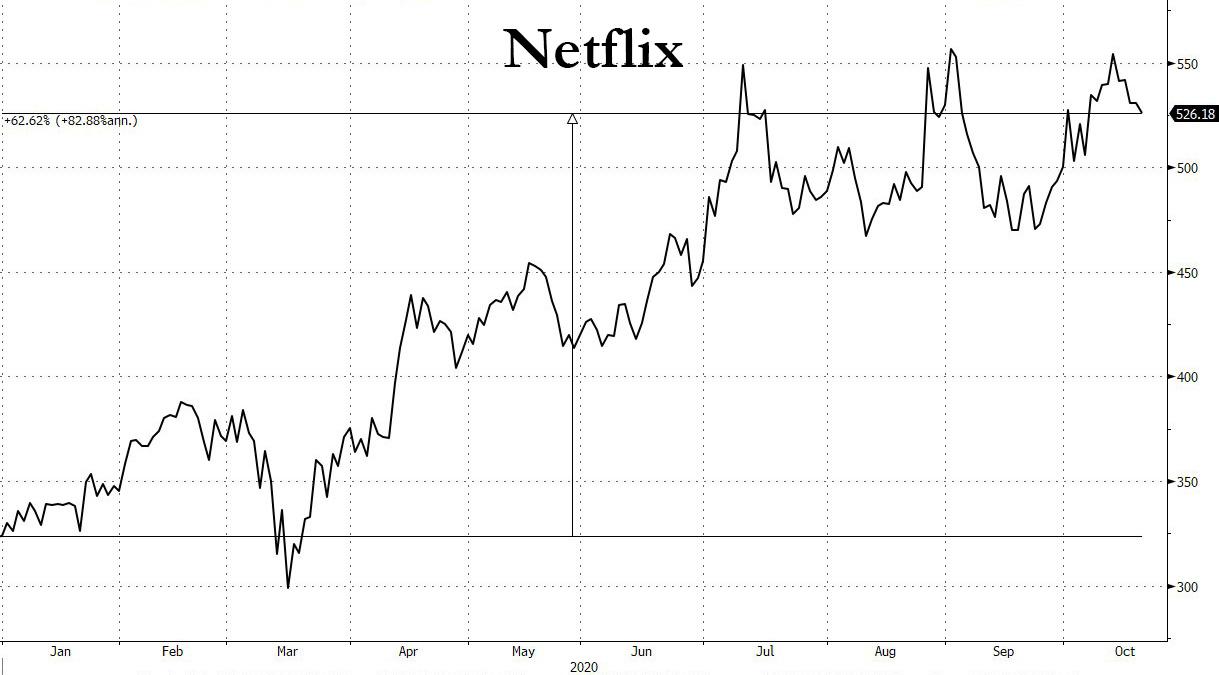
To be sure, the company has been riding a wave of optimism, its stock soaring over 60% this year - putting it in the top 15 for S&P 500 companies, similar to the gains seen by other shutdown beneficiaries Amazon.com and Ebay - and trading just shy of its all time high around $556, with investors pushing the shares to new highs and analysts seeing people download its app in record numbers. Still, after surging to a record high in early July, the stock has traded rangbeound, unable to break out to a new high. And while there’s no doubt that viewership has surged during the Covid-19 lockdowns in the U.S. and much of the world, there are complications: the virus has brought TV and film production to a halt, a situation that may only get more dire for Netflix as the months wear on. But the biggest question remains how many future subs has covid brought to the present?
As Bloomberg writes, options contracts on Netflix expiring this week are heavily skewed toward calls, which on the surface is a bullish indicator for the shares in the run-up to the earnings release (although that could be just SoftBank attempts to manipulate the stock). However, there have been similar setups heading into each of the past three quarterly reports, and the shares fell after the results. This time, calls outnumber puts by a rate of 1.8-to-1. If the most bullish positioning proves prescient, the stock could push back toward the all-time high touched three months ago.

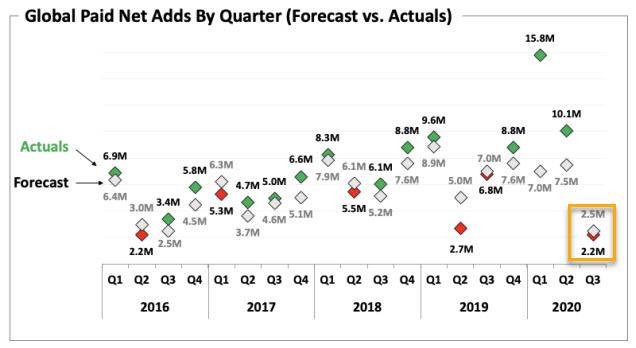
Indicatively, consensus expects 3.32 million new subs this quarter, higher than the company's own guidance of 2.5 million, and a sharp slowdown from the 10.1 million new subs added in Q2. This is as streaming video remains on a hot streak since the pandemic struck. At the same time, the world’s largest paid streaming service is also facing more intense and cutthroat (or rather cut-price) competition than ever. Comcast’s Peacock platform has been rolling out for a few months, along with the short-form video service Quibi. And AT&T’s big bet on streaming, HBO Max is also up and running now while Disney+ has been a massive hit.
So was Q3 the quarter that would unleash another repricing higher for Netflix stock, or has the triple top telegraphed pain ahead? Sadly for the bulls, it's looking very bad with NFLX stock plunging after it reported a huge miss in both EPS and new subs.
  • Q3 Streaming Paid Net Change +2.2MM, Est. +3.3M, down from +10.09MM in Q2 2020 and down from +6.8MM a year ago
While the company's financials are traditionally secondary, the company again beat on the top line but missed on earnings:
  • Q3 Revenue $6.436B, Est. $6.38B
  • Q3 EPS $1.74, Est. $2.37
Q3 average streaming paid memberships rose 25%, while streaming ARPU decreased 1.6% year over
year. Excluding a foreign exchange (F/X) impact of -$158m, streaming ARPU increased 1% vs. prior year.
Revenue was 2% above our beginning-of-quarter guidance primarily due to slightly higher than expected
ARPU (favorable plan mix in our UCAN, LATAM and APAC regions plus intra-quarter appreciation in the
Euro and British pound which helped lift EMEA ARPU). As a result, operating margin of 20% (up 170bps
year over year) exceeded our guidance forecast as well.

Some Q3 more stats:
  • streaming paid memberships 195.2 million, +23% y/y, estimate 196.3 million
  • streaming content obligations $19.1 billion vs. $19.1 billion y/y
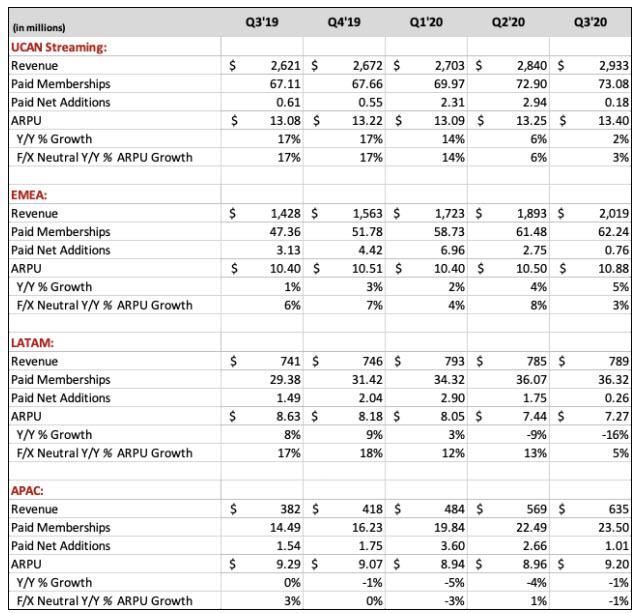
  • UCAN streaming paid net change +180,000, -94% q/q, estimate +260,510
  • EMEA streaming paid net change +760,000, -72% q/q, estimate +1.25 million
  • LATAM streaming paid net change +260,000, -85% q/q, estimate +705,340
  • APAC streaming paid net change +1.01 million, -62% q/q, estimate +1.10 million
  • operating margin 20.4% vs. 22.1% q/q
  • operating income $1.31 billion, -3.2% q/q, estimate $1.27 billion
  • free cash flow $1.15 billion, +27% q/q, estimate $245.9 million
And visually:
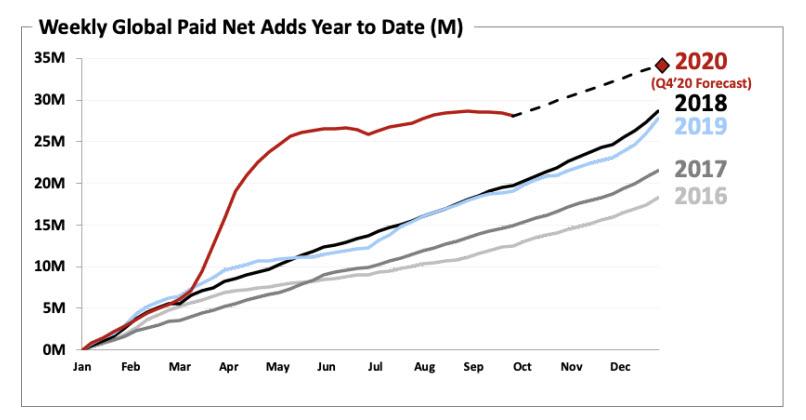
The paltry 2.2 million in new subs means that the company was tied for its worst quarter in the past 5 years. One wonders just how much of this is the backlash over the Cuties scandal?
Confirming the worst case scenario, Reed Hasting started his later in the most dismal way possible: "As we expected, growth has slowed with 2.2m paid net adds in Q3 vs. 6.8m in Q3’19." He continued: "We think this is primarily due to our record first half results and the pull-forward effect we described in our April and July letters. In the first nine months of 2020, we added 28.1m paid memberships, which exceeds the 27.8m that we added for all of 2019. In these challenging times, we’re dedicated to serving our
members."
In short, the worst case scenario where covid pulled a lot of demand forward is materializing. And indeed, the outlook was ugly too:
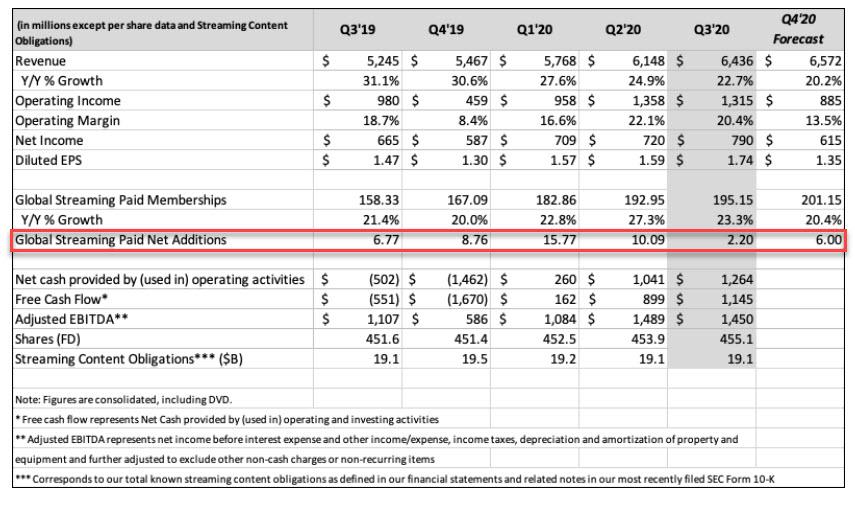
  • Netflix Sees Q4 Streaming Paid Net Change +6.00M, Est. +6.54MM
  • Sees Q4 streaming paid memberships 201.2 million, estimate 202.8 million
  • Sees Q4 operating margin 13.5%, down from 20.4%
The 6 million new subs would also be a disappointment compared to the 8.8MM subs it added a year ago. Still, the company expects a record year in terms of subscriber growth. "If we achieve our forecast, it will put us at a record 34m paid net adds for 2020, well above our prior annual high of 28.6m in 2018."
Explaining why Q4 NFLX forecasts a below consensus 6.0MM paid net adds vs 8.8MM in Q4‘19, it writes that "our record first half paid net additions would result in slower growth in the back half of this year." The company also adds that the state of the pandemic and its impact continues to make projections very uncertain, "but as the world hopefully recovers in 2021, we would expect that our growth will revert back to levels similar to pre-COVID. In turn, we expect paid net adds are likely to be down year over year in the first half of 2021 as compared to the big spike in paid net adds we experienced in the first half of 2020." Predictably, in his letter Reed Hasting wrotes that he continues to view quarter-to-quarter fluctuations in paid net adds as not that meaningful in the context of the long run adoption of internet entertainment.
Here is the full forecast:
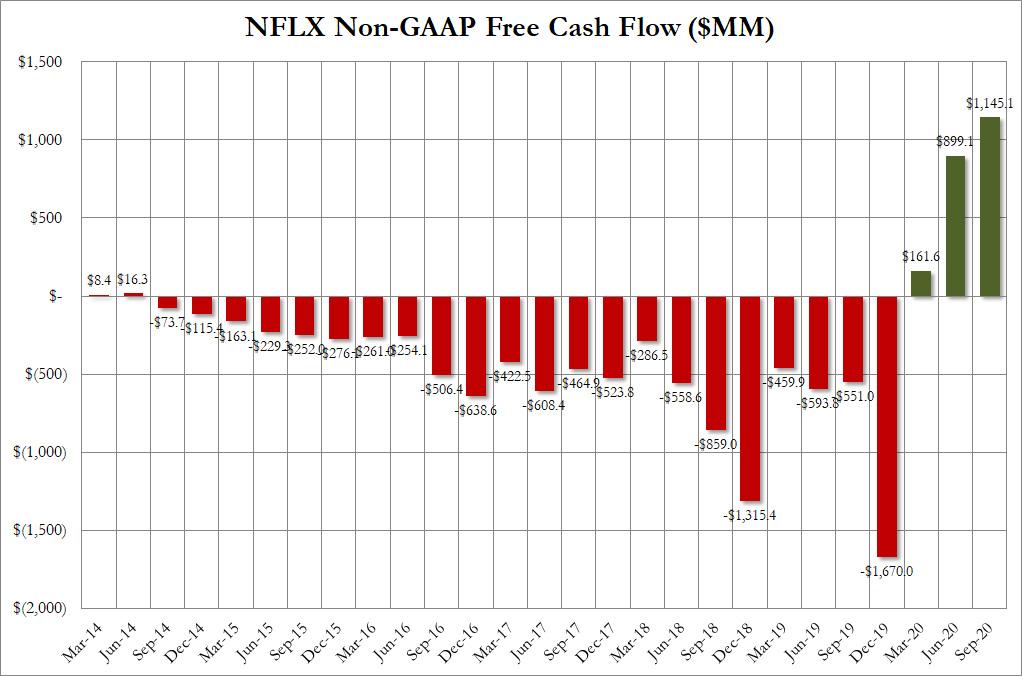
It wasn't all bad news: Netflix reported third quarter cash flow of a record $1.145BN vs. -$502 million in the prior year period. Free cash flow positive for a third consecutive quarter at +$1.1b vs. -$551 million in Q3‘19. Year to date free cash flow is +$2.2 billion vs. -$1.6 billion in the first nine months of 2019.
Looking ahead NFLX said that "as productions increasingly restart, we expect Q4’20 FCF to be slightly negative and therefore, for the full year 2020, we forecast FCF to be approximately $2 billion, up from our prior expectation of break-even to positive. This change is due primarily to our higher operating margin expectation for 2020 and the timing of cash spending on content."
Looking even further out, the company expects its FCF to "continue to improve as we increase our profitability and our transition to the production of Netflix originals (which requires more cash upfront vs. second run content) matures. For 2021, we currently expect free cash flow to be -$1 billion to break-even."
That said, with $8.4 billion in cash plus a $750m undrawn credit facility, Netflix sees no need for external financing and has no plans to access the capital markets this year.
Alas, generating record cash is irrelevant for a company which now has confirmed it is "slowing", and as a result the stock is crashing after hours, down over 6% as we type.