FT : Chinese economy outstrips US despite Beijing bashing

Chinese economy outstrips US despite Beijing bashing
China emerging as the engine of global growth amid the Covid pandemic

The irony is striking. While Donald Trump and Joe Biden have been busy bashing Beijing in the run-up to the presidential election, the Chinese economy has seen a vigorous bounce back. In the midst of the coronavirus pandemic, China is emerging as the engine of global growth. 

China is the only big economy expected to show a positive advance this year, with the IMF projecting growth of 1.9 per cent, followed by 8.2 per cent in 2021. Yet continuing trade friction between the world’s two largest economies means that the US will not benefit from this expansion as it did from China’s huge fiscal and monetary pump priming after the great financial crisis of 2007-08. 

Chad Bown of the Washington-based Peterson Institute for International Economics points out that China’s imports from the US of goods covered by January’s trade deal have failed to catch up to pre-trade war levels, running 16 per cent lower than at the same point in 2017. In contrast, Chinese imports of similar goods from the rest of the world are 20 per cent higher over the same period.

At the same time, Mr Bown says, China’s commitment to buy an additional $200bn of American-made goods and services under president Trump’s self-proclaimed “historic” deal is falling well short, reaching only 53 per cent of the expected purchase target at the end of September.

Perhaps the most telling verdict on the trade war for this president who regards the stock market as the ultimate judge of his performance comes from a study by economists at the New York Federal Reserve and Columbia University. They estimate that the trade war lowered the market capitalisation of US listed companies by $1.7tn, equivalent to a 6 per cent fall in the value of the S&P 500 constituents. That reflects how new tariff announcements reduced profit expectations at exposed firms. The study found no beneficial effects for firms receiving tariff protection.

The reality is that Chinese retaliation has wreaked havoc with US exports. As Ryan Hass and Abraham Denmark note in a paper for the Brookings Institution, US tariffs forced American companies to accept lower profit margins, cut wages and jobs for US workers and raise prices for American consumers. While the bilateral trade deficit with China has shrunk, they add, the overall trade deficit has not come down because US tariffs on China diverted trade flows, causing US deficits with Europe, Mexico, Japan, South Korea and Taiwan to increase as a result.

If the performance of US equities has been remarkable despite trade wars and the pandemic, it is down to ultra loose policy and high performing Big Tech, not mainstream business. Note, too, that tariffs have not delivered much revenue to the US Treasury because the government has had to distribute most of the money in subsidies to placate angry farmers over lost exports to China.

The paradox in all this is that friction is largely absent in US-China financial relations, the only area in which market access for US business has improved. With the Beijing leadership pursuing incremental liberalisation, US banks are now starting to take controlling stakes in existing partnerships. At the same time China is attracting increasing amounts of developed world portfolio capital. As index providers incorporate more of China’s equities and bonds into their indices, passive funds in the US and elsewhere will expand this flow.

Interesting, here, is that the Chinese government bond market, the second largest in the world, offers positive real interest income after allowing for inflation, which is no longer the case with US Treasuries or big European bond markets. At the same time the Chinese equity market is the only one outside the US to offer serious exposure to Big Tech.

It follows that China offers hard pressed US and other developed world pension funds real incomes from which to pay retirement obligations, subject to currency and regulatory risk. While China outgrows the US, and the US pursues ultra loose monetary and even more expansionary fiscal policy, an enduringly weak renminbi scarcely seems unduly threatening.

As for regulatory risk, there are historic grounds for worrying about arbitrary intervention by the Chinese authorities. The prize of more secure pension incomes for the elderly courtesy of China ought to be an incentive for Western policymakers to foster a stable and peaceful financial interdependence. Under a new Trump administration that will not happen. Whether, against the background of aggressive US-China strategic competition, Joe Biden might choose such an option is moot.

WSJ : Bitcoin Is Back Trading Near Three-Year Highs

Bitcoin Is Back Trading Near Three-Year Highs
The digital currency is up 90% this year, outpacing stocks, gold and other assets

While stocks, oil and gold prices careened last week, one asset set new highs for the year: bitcoin.

The price of the digital currency has surged about 90% in 2020 and traded as high as $13,848 on Tuesday, according to CoinDesk. That is the highest level since January 2018, when bitcoin was coming down from its record high of $19,783 set in the previous month.

Many investors agree the renewed surge of interest is tied to bitcoin’s potential as a hedge against inflation.

Bitcoin’s proponents have touted that prospect for years, mainly because the bitcoin network has a set limit on the number of units that can be created: 21 million. With the coronavirus pandemic wracking economies across the globe, governments and central banks have been forced to spend trillions to prop up their economies while sapping the purchasing power of their currencies. That has revived fear that inflation will ramp up in the coming years, and that fear is winning bitcoin new converts.


Some of them include publicly traded companies. Square Inc., which allows users to buy bitcoin on its Cash App, bought $50 million worth of the digital currency in October to use as a hedging instrument in its corporate treasury.

Virginia-based software provider MicroStrategy Inc. made a similar play earlier in the year, buying about $425 million of bitcoin to hold in its corporate treasury. Chief Executive Michael Saylor said in August that the company expected government responses to the pandemic to have a depreciating effect on fiat currencies and saw bitcoin as a viable alternative.

Attracting new investors has been a long-sought goal for the crypto industry. Since the 2017 bubble popped, the bitcoin industry has been trying to build out an infrastructure for professional investors, creating everything from exchange-traded funds to options markets and custody services.


Although the Securities and Exchange Commission has yet to approve a bitcoin ETF, other services are in place. And investors are beginning to embrace them.

“You had all these rails for institutional capital to come in,” said Matthew Hougan, chief investment officer at BitWise Asset Management. “Then you had the sharp catalyst: the response to the pandemic and concerns about inflation.”

BitWise, which offers crypto-based index funds to financial advisers, hedge funds and family offices, saw its assets under management rise to $100 million as of Wednesday from about $70 million in June, Mr. Hougan said.


The largest seller of crypto-based investment products, Grayscale Investments, reported third-quarter inflows of $1 billion into the trust-fund products it sells in the over-the-counter market, raising its total assets under management to $5.9 billion. That growth has accelerated in the current period. The company said Wednesday that its assets under management had grown to $7.6 billion.

Options activity is increasing, too. In late 2019, for example, the number of bitcoin futures contracts traded on the Bakkt platform averaged about 1,300 a day. By September, that average had grown to 8,700.

Bakkt, a bitcoin options market founded by Intercontinental Exchange Inc., has been attracting traditional hedge funds and trading firms and even more recently mainstream brokerage houses, said Bakkt President Adam White.

“They’re taking a hard look at crypto and bitcoin,” he said.

Bitcoin’s potential use as a payment option even got a surprising boost earlier in October when PayPal Inc. said it would allow users to directly buy and sell bitcoin in their digital wallets. In 2021, it plans to expand the service to Venmo and allow the 26 million merchants that use PayPal to accept bitcoin for payment.


These developments together have helped push bitcoin’s total market value up to about $255 billion from about $130 billion in January.

To be sure, those inflows are modest compared with the wider capital markets, where U.S. stocks alone are worth nearly $52 trillion. But for the small digital-currency market, it is notable.

“The market is just not that big,” Mr. Hougan said. “A few institutions making an allocation is significant.”

The question for the bitcoin market is the degree to which those flows will continue to increase. For all the feel-good news, there are still substantial question marks.

For example, even with PayPal opening bitcoin up to merchants, there may not be much demand for it as a means of payment, especially in the U.S. That is because the Internal Revenue Service has stepped up its effort this year to treat bitcoin not like a currency but like a security, forcing users to pay capital-gains taxes on any transaction that results in a gain.

Moreover, bitcoin’s claim as a haven asset or inflation hedge has yet to be proven. For one thing, it has been around for only about 11 years, and for most of that time, it has been ignored by the mainstream and viewed a curiosity for risk takers. It has no record as a wide-scale asset class.

Also, inflation may simply fail to take off no matter what central banks do, much as it has for the past decade or so. That would undercut bitcoin’s use as a hedging tool.

Ultimately, bitcoin is still a risky, speculative asset, said Chris King, founder of crypto-focused investment firm Eaglebrook Advisors, which recommends clients keep no more than 5% of their total assets in crypto.

“Don’t put in more than you can afford to lose,” he said.

>>> Weekend Papers Summary

Weekend Papers Summary

NEW YORK TIMES
Saturday
•American border authorities have been expelling migrant children from other countries into Mexico, violating a diplomatic agreement with Mexico and testing the limits of immigration and child welfare laws.
• Republicans and Democrats are succeeding in one of their chief goals this year: to motivate large numbers of infrequent voters or nonvoters to come off the sidelines for what supporters of both nominees call the most crucial election of a lifetime.
• More than 99,000 coronavirus infections were reported across the US on Friday, setting the single-day record for cases as the nation’s outbreak continues, with Montana, North Dakota, South Dakota, and Wisconsin reporting the country’s highest infection rates.
• The risk of another severe economic downturn in Europe is rising as new lockdowns take effect Germany, France, Belgium, where the authorities are desperate to prevent a surge in coronavirus infections from overwhelming hospitals.
• When Democratic vice presidential candidate Kamala Harris was attorney general of California, she didn’t pursue corporate malfeasance unless the potential impact on residents was strong, highlighting her pragmatism and politician’s knack for recognizing winning issues.
• Investors who buy 10-year MTA bonds right now are capturing a yield of about four percent, roughly three percentage points more in annual interest than they would get buying the safest long-term municipal debt.
Sunday
• Americans are “voting with an urgency never seen before in the approach to a presidential election, as a record 90M people have cast ballots despite an array of challenges: a pandemic, postal delays, long lines and court rulings that have tested faith in the country’s electoral system.”
• Democrats are increasing their outreach to black voters after losing three key states in 2016 primarily because of diminished support from them—and the worry that not enough black men will cast ballots, or that they will decide to vote for Trump.
• British prime minister Boris Johnson announced plans to close pubs, restaurants, and most retail shops throughout England, a stark reversal in the face of projections that the country could face a deadly winter from the coronavirus.
• Joe Biden’s campaign, concerned about any possible perception of foreign meddling in the presidential election or any comparison to Russian interference on Trump’s behalf in 2016, has refused nearly all contact with foreign officials or members of Washington’s diplomatic corps.
• Prodded by anti-tax Republicans, Congress has cut the IRS budget steadily since 2011, but the cuts haven’t saved the government money, says Robert Frank, because fewer audits create more noncompliance, a feedback loop that further drains money from the Treasury.

WALL STREET JOURNAL
• Donald Trump and Joe Biden entered the final week of their campaign “chasing each other through the most competitive states, as polls suggest the Democrat has a broader potential path to victory against a Republican most pollsters and pundits underestimated four years ago.”
• Advances in Covid-19 treatment have shortened hospital stays, easing capacity strains, but the recent surge in hospitalizations reaching deeper into the country is testing some regions’ ability to cope.
• From mid-March to mid-September, Americans spent 60M fewer hours commuting as lockdown orders forced many employees to clock in from home—but instead of using the extra time to enjoy hobbies or happy hour, most funneled it into work and chores.
• Story says Trump “has drawn new voters into the electorate and energized his supporters from 2016, but he has also pushed away others, including some who identify as Republican or even approve of his job performance.”
• China’s official manufacturing purchasing managers index, a key gauge of factory activity, remained in expansionary territory for an eighth consecutive month, pointing to continued recovery across the world’s second-largest economy.
• Secretary of State Mike Pompeo ended an Asian tour focused on criticism of Beijing with a last-minute stop in Vietnam, which is in the midst of several disputes with its neighbor China in the South China Sea.
• Videogames were a multibillion-dollar industry before the pandemic, but with spending on movies and dining out plummeting, spending on videogames and equipment has hit all-time highs every month since March, with people who were already players playing more, and new players increasingly taking up gaming.
• In the music business, many established artists are becoming free agents at a time when, despite the pandemic, revenues are growing, deals are becoming more generous, and the balance of power between labels and artists is tilting toward musicians.
• H.O.T.S.: DIS wants to become a top player in the streaming business, and a studio reorganization could change the way movie franchises like Star Wars and Marvel reach audiences; Airbus will increase production rates of the short-haul workhorse next year, throwing a lifeline to a battered industry; Improving results help XOM justify its dividend policy but it will take a while until it can fund those payouts without getting smaller or borrowing more.

FINANCIAL TIMES
Weekend
• Front page story reports that “Renewed lockdowns across Europe and the final stretch of the presidential campaign have contributed to a rise in market volatility, with Friday’s session again generating big swings.”
• +/- AAPL: In a clear acknowledgment of the political hostility facing big tech companies, Apple’s annual report contained numerous disclosures about the risks facing its businesses, including material financial risk posed by legal challenges to App Store policies.
• Millions of people in Slovakia will participate in an ambitious government experiment that seeks to help the country regain control of the pandemic by testing almost everybody in its 5.4M population over the age of 10 for the coronavirus.
• Big Read story says that “Angered by his management of the pandemic and his election comments, some business leaders have distanced themselves from the president—and the rift could be a long-term problem for Republicans.”
• Lex Column: Third-quarter results at NatWest, formerly known as Royal Bank of Scotland, peg it firmly among its British peers; A $500M vaccine bond raised by US-backed vaccine alliance Gavi and the International Finance Facility for Immunization, underlines the role of capital markets in aid flows; Big tech companies have myriad side hustles—and the biggest is AMZN’s advertising business.
• Comment: Stakeholder capitalism, which seeks to shift the focus of companies from boosting shareholder returns to carrying out various social missions, has grown increasingly popular during the pandemic, says Merryn Somerset Webb, but this “corporate paternalism” can get in the way of succeeding at business.

NEW YORK POST
Saturday
• The Drudge Report posted a 45 percent decline in web traffic in September as the site alienated its core readers by turning against Trump ahead of the 2020 presidential election.
• + MCD: For a limited time, McDonald’s is bringing the McRib sandwich to all of its restaurants on December 2, marking the first nationwide distribution of the oddly beloved barbecue bite since 2012. Sunday
• A federal judge ordered the US Postal Service to take “extraordinary measures” to deliver mail-in ballots to Wisconsin and around Detroit in time to be counted for Election Day, even if that means using a priority mail service.
• + FB: The company’s latest VR headset, the Oculus Quest 2—which at $299 costs $100 less than the original and includes a faster processor—has received five times as many preorders as its 2019 predecessor.

>>> OG: TIMES ARTICLE Ashley Almanza: ‘G4S is not for sale — at least at this pr


From: Nicolas Marmurek (OSCAR GRUSS & SON IN) At: 11/01/20 16:20:36
To: Laurent Chekroun (MAKOR SECURITIES LO )
Subject: OG: TIMES ARTICLE Ashley Almanza: ‘G4S is not for sale — at least at this price’
Ashley Almanza: ‘G4S is not for sale — at least at this price’

G4S’s boss is adamant he will not hand over the security giant’s keys for a lowball takeover bid
Jamie Nimmo
Sunday November 01 2020, 12.01am GMT, The Sunday Times

Ashley Almanza’s first job was as a security guard — not that you would guess it from his appearance. Slim and scholarly-looking, the G4S boss had an unlikely role protecting factories in his native South Africa before heading for the UK. “Life’s full of chance and opportunity, isn’t it?” Almanza offers cryptically.

It could be a throwaway reference to how he ended up running the world’s biggest security company — but he could just as easily be referring to the hostile bidders that have pounced on the FTSE 250 company, whose weak share price has left the door open to predators.

Having once defended factories, Almanza is desperately trying to keep G4S from the clutches of smaller Canadian rival GardaWorld, which is backed by private equity firm BC Partners.

Led by outspoken Stéphan Crétier, the Montreal-based firm has made an audacious £3bn raid on G4S, the biggest of Britain’s listed outsourcers and a magnet for crises and scandals. With the clock ticking, Almanza must convince shareholders his promised turnaround is worth waiting for.

The bitter battle has pitted two very different characters against one another: the aggressive and brash Crétier against the calculated accountant Almanza, something of a corporate journeyman. And so far, Crétier hasn’t held back. The billionaire former baseball umpire has attacked Almanza’s turnaround effort and the £20m he has pocketed in pay since 2013, when he was drafted in to pick up the pieces of a botched takeover bid for Danish rival ISS and the London Olympics fiasco. Crétier says G4S is a “disaster about to happen” and that its bosses are “totally incompetent and unfit to run an important people business like this”.

When Almanza and co responded to the bid by promising shareholders the company was turning the corner, GardaWorld shot back: “After seven years, management’s turnaround strategy is still only at an inflection point. What have they been doing all this time? ... The G4S leadership team has presided over a catastrophic loss of faith and reputation.”

But in his first profile interview, Almanza refuses to rise to the bait. “It doesn’t bother me at all, the personal attacks. We’ve not responded, that’s just not our style. They choose to play the game the way that suits them and we do it our way. And it doesn’t bother me at all,” he says coolly, the hint of a South African accent still present. Does he take responsibility for the poor share price performance? “No, I wouldn’t agree with their commentary,” Almanza says. “I think proper analysis shows it to be quite different. UK equities as a whole are at a historic low relative to global equities. You can look at the UK market and our share price and you can see from February 20, the market started to go into decline — all markets — in the face of the pandemic.”

I point out that the share price had been on the wane since 2017. Almanza isn’t having it. He simultaneously manages to claim credit for the record share price under his watch until 2017 — 337p — while shifting the blame for its subsequent demise quicker than a G4S security guard can shout “Stop!”. “Under the current board and management, the share price of this company has been to an all-time high in the company’s history in 2017 — well above the levels in 2013,” he says.

“The onerous [outsourcing] contracts were all in place before 2013, so you can come to your own conclusion about whether the share price properly reflected all of those legacy issues. The fact of the matter is we had to reveal and resolve those issues and naturally that did have an effect on the share price.”

G4S shares stood at 246p when Almanza took over in 2013. The price sank to 200p before the pandemic hit, then tumbled under 100p. The bid excitement has helped it recover to 204.1p — above Garda’s 190p offer, suggesting investors think a higher offer from Garda or a rival bid from America’s Allied Universal is coming.

Born to an Irish-Italian father who worked as an engineer on the sugar estates, and a French mother, Almanza, 57, followed his two older brothers to Europe in 1990. After an MBA at London Business School, he joined British Gas in 1993 as a finance manager in the exploration and production arm.

He worked on the complex break-up that led to the formation of gas giant BG Group, where he was appointed head of finance in 2002. He became finance director and then executive vice-president before leaving in 2013 to join G4S as chief financial officer, with a succession plan already in mind. Within days, he replaced Nick Buckles, the floppy-haired, marathon-running chief who became the poster boy for botched outsourcing jobs after the Olympics security fiasco in 2012, when the army had to be drafted in to protect athletes and the public.

In 2013, Almanza was faced with sweeping up another Buckles mess when it emerged that G4S and Serco had been overcharging taxpayers for fitting prisoners with electronic tags. In some cases, the Ministry of Justice was paying to track offenders who were dead. After a long-running probe, G4S was fined £44m by the Serious Fraud Office last July in an agreement that saw it avoid prosecution.

Almanza says that in the outsourcing boom under New Labour, which opened the floodgates for huge contracts, G4S — and the industry — lost its way. “The industry pursued growth above all else and were rewarded for it in the stock market,” he says. “It became very much a game of pursuing the next big contract regardless of the risk or the reward. And I think that inevitably led to things going wrong, caused some companies to go out of business and some to go back to shareholders to recapitalise. So it all caught up between 2012 and 2017, a period where all those chickens came home to roost.”

He continues: “I think, temporarily, in the dash for growth, we lost the DNA and the soul of the company.”

G4S traces its roots to 1901 in Copenhagen. It grew through a series of mergers, culminating in a tie-up between Denmark’s Group 4 Falck and Britain’s Securicor in 2004 to form G4S. Earlier this year, G4S sold the bulk of its cash-handling business, returning its focus to security. It still employs 558,000 people around the world, generating £7.8bn in revenues last year.

The government trusts G4S enough to start handing it contracts again. The company has been managing Covid testing sites across the UK, which have so far avoided going the way of the test and trace debacle, managed by rival Serco. Almanza points out that, along with his repair job, G4S has paid out £1.2bn to shareholders — something Garda has conveniently omitted from its attacks. He is also correct to point out improving performance, with 10% growth in North America, and other major markets.

Almanza’s turnaround plan is not what you would call the classic defence strategy. No one could accuse him of being overly exciting. There is no special dividend to entice shareholders — nor does he have any bold acquisition ambitions.

“Our proposition is, you’ve invested in this turnaround and you’re on the point of reaping the rewards of that investment. Why should you hand that on the cheap to somebody else? They [Garda] have figured it out that the heavy lifting’s been done and this company has got an enviable position in the global security market — not just an enviable position, but a position that’s likely to generate a lot of cash flow. I think shareholders see that.”

Yet some of G4S’s top investors, including Schroders, Harris Associates and activist Sachem Head, have all said they are open to a deal at a higher price. Almanza says that as investment managers they have a duty to listen to all offers. As chief executive, does he also have that duty? And if so, what’s his price? “I do. I’m clearly not going to give you a price,” Almanza smiles.

“The board is not trying to sell this company, I’m not trying to sell this company. My job is to lead the management team and execute the strategy. The business is clearly starting to perform.”N Almanza says that Garda needs G4S’s more solid balance sheet for its global assault: “They can’t finance this acquisition on their cash flows and their balance sheet. It just can’t be done.N“They can finance it on our shareholders’ balance sheet and our shareholders’ cash flow. We just disagree with their thesis completely.

“G4S is a far, far superior company on any dimension — size, scale.”

The life of Ashley Almanza
Born: March 27, 1963, in Zululand, South Africa
Status: married to Gillian, three sons
School: Durban High, in South Africa
University: Natal (read commerce) and London Business School
First job: security officer
Pay: £1.5m last year
Home: Surrey
Car: BMW hybrid
Favourite book: First Light, by Geoffrey Wellum
Film: The Shawshank Redemption
Music: Ella Fitzgerald
Gadget: Fitbit
Charity: organisations in the UK and Africa that look after children and the homeless
Last holiday: Isle of Wight

Working day
If he is not travelling, the chief executive of G4S gets up at 6am so he can speak to colleagues in Asia. Ashley Almanza then travels to head office in Victoria, central London, where he spends most of his day dealing with the security giant’s customers and operations, although he always makes time for lunch — usually a working one.

Almanza tries to fit in a walk or run each day, though that is not always possible.

Downtime
Almanza loves playing golf with his sons, running, and watching Liverpool games on catch-up (his family all support different football teams).
DISCLAIMER

This information represents neither an offer to buy or sell any security nor, because it does not take into account the differing needs of individual clients, investment advice. Those seeking investment advice specific to their financial profiles and goals should contact their Oscar Gruss & Son Incorporated sales representative. Oscar Gruss & Son Incorporated believes this information to be reliable, but no representation is made as to accuracy or completeness. This information does not analyze every material fact concerning a company, industry, or security. Oscar Gruss & Son Incorporated assumes that this information will be read in conjunction with other publicly available data. Matters discussed here are subject to change without notice. There can be no assurance that reliance on the information contained here will produce profitable results. A security denominated in a foreign currency is subject to fluctuations in currency exchange rates, which may have an adverse effect on the value of the security upon the conversion into local currency of dividends, interest, or sales proceeds. The value of securities and depositary receipts of foreign issuers that are denominated in United States dollars are also influenced by fluctuations in currency exchange rates. © 2020 Oscar Gruss & Son Incorporated. All rights reserved.

WSJ : President Trump Trails Joe Biden by 10 Points Nationally in Final Days of

President Trump Trails Joe Biden by 10 Points Nationally in Final Days of Election
Biden leads, 52% to 42%, among registered voters in national WSJ/NBC News poll; race in battleground states is narrowing

President Trump trails by 10 percentage points among voters nationally in the final days of his re-election campaign, facing substantial public anxiety over the coronavirus pandemic but with broad approval of his management of the economy, a new Wall Street Journal/NBC News poll finds.

Former Vice President Joe Biden leads Mr. Trump, 52% to 42%, in the poll’s final reading of voter opinion before Election Day, essentially unchanged from Mr. Biden’s 11-point advantage in mid-October. In particular, women and seniors have turned against the president, the poll finds, with both groups favoring Mr. Biden by double-digit margins.

However, the survey finds the race tightening when the landscape is narrowed to a set of 12 battleground states. Mr. Biden holds a 6-point lead in those states, 51% to 45%, compared with a 10-point lead last month.

Mr. Biden’s advantage in swing states is within the poll’s margin of error and corresponds with the many swing-state surveys that show a close race and potential path for Mr. Trump to build an Electoral College majority without winning the national popular vote, as he did in 2016.

“This election is probably the most competitive 10-point race I’ve seen,” said Republican pollster Bill McInturff, who conducted the survey with Democrat Jeff Horwitt. Mr. Trump retains strong support among his base of largely working-class, white voters, who are plentiful in the swing states.

While Mr. Biden holds large leads among people who have voted early or plan to, Mr. Trump holds a big lead among those who say they will vote on Election Day. “If you have historic early vote, I know we’re going to have historic vote on Election Day,” Mr. McInturff said of the size of this year’s voter turnout.

Mr. Horwitt said that Mr. Trump is facing an electorate that holds negative views of his overall job performance. In the 41 Journal/NBC News surveys that measured views of how Mr. Trump has handled his office, he said, “there was not a single poll that produced a result where more Americans approved than disapproved of his performance as president.”
The 2020 campaign is approaching its end amid near-record voter interest and disquiet over the coronavirus pandemic that on Friday reached a high for new cases. Some 83% of voters rate themselves at the highest levels of interest in the campaign, a share unseen since just before former President Barack Obama’s first election in 2008.

Asked which issue was most important to their decision in the election—the economy or coronavirus—voters were divided almost evenly, a sign of how much the pandemic has upended expectations at the start of the election season. Some 41% of voters named the economy as the most important issue, while 38% cited coronavirus—a 3-point gap that narrowed from 8 points last month.

One of Mr. Trump’s strongest advantages is that 55% of voters approve of his handling of the economy, 14 points more than who disapprove. One of his top challenges is that 57% disapprove of his management of the pandemic, 17 points more than who approve. And in a sign of substantial concern about the virus, 55% said the worst of the pandemic was yet to come.

More voters view Mr. Trump unfavorably than favorably, with “very positive” and “very negative” views tying or close to record highs. By a narrow margin, more voters view Mr. Biden in a positive than a negative light.

The Journal/NBC News poll interviewed 1,000 registered voters nationally from Oct. 29-31. The margin of error for that sample is plus or minus 3.1 percentage points. The poll also included interviews with 833 registered voters in swing states. The margin of error for that sample is 3.4 percentage points. The swing states included were Arizona, Florida, Georgia, Iowa, Maine, Michigan, Minnesota, North Carolina, New Hampshire, Nevada, Pennsylvania and Wisconsin.

WSJ : Payments Companies Give Credit Where It’s Due—to Debit

Payments Companies Give Credit Where It’s Due—to Debit
U.S. consumer-spending growth may be soft overall, but use of debit cards is soaring; keeping that volume up will be key for payment companies’ stocks

The question of whether consumers are spending has different answers depending on where you look. Spending on credit cards? Down. Spending on debit cards? Way up.

Debit has been the hero for many payments companies this year. Card networks as well as acquirers that handle payments for merchants have reported similar trends. At Visa V -1.71% and Mastercard, MA -1.55% U.S. debit-card dollar payment and purchase volume collectively rose 23% year over year in the quarter ended in September, more than double the pre-Covid-19 growth rate; the same measure for credit cards was down 8%


Investors should understand the drivers of this to get a sense of whether these volumes are sustainable. For one, payment firms are reporting that people are more often using contactless tap-to-pay when they shop in stores, perhaps to minimize touching amid the coronavirus pandemic. These are often purchases for relatively smaller dollar amounts, which tend to be put on debit cards. There is also more card use in online shopping for everyday things like groceries, which likewise are often debit purchases.

Economic stress plays a role, too. Some consumers may have been cut off from credit by lenders tightening their underwriting. Others simply like to use credit less during times of economic uncertainty. Government stimulus is also a factor: Many stimulus payments are made via prepaid cards that work on debit rails. What’s more, stimulus payments pad people’s checking accounts, which can lead to more debit usage.

Since credit’s stronghold—cross-border travel—isn’t coming back anytime soon, strength in debit will be vital for volumes. Visa and Mastercard are trying to push debit into more realms, for example by linking their instant-payment debit networks with apps such as PayPal Holdings PYPL -4.57% ’ Venmo and Square’s SQ -8.82% Cash App, to help move money faster between digital accounts.

If no additional stimulus arrives, and there is no major rebound in card-based travel-and-entertainment spending, debit-volume growth could come under pressure. One key will be the stickiness of contactless, which helps drive debit’s share gains versus cash. “We’re not going backwards to more cash usage,” said Autonomous Research analyst Craig Maurer, suggesting it is likely that “the majority of new habits will stick.”

This will be important as there is evidence people may not keep buying online quite so much as stores return to normal. Alliance Data Systems, which specializes in offering retailer cards, noted a downtick in certain online spending from the second quarter as more stores were open in the third quarter, while in-store spending jumped.

Notably, Alliance Data said this past week it is acquiring Bread, one of several technology firms that help people use their debit cards kind of like credit cards by spreading out payments over time, something known as “buy now pay later.” Alliance Data Chief Executive Ralph Andretta said Bread’s tools can help draw new, younger customers.

Another thing that may drive debit-card usage among younger customers is that more upstart financial-technology firms are offering them. Even crypto platform Coinbase launched a new debit card last week. One illustrative measure: Cardtronics, CATM -0.72% which partners with fintechs to provide their cards with ATM access, noted that third-quarter withdrawals via those partners were up 200% since the beginning of the year.

Most payment providers won’t mind if the debit habit sticks—so long as people are using their networks in some form. But it could become a long-term drag for banks and lenders that provide credit. For now, lenders and investors may be OK with limiting their credit risk. But eventually they will really need those high-yielding card loans to grow in a low-interest-rate world.

(ZH) Here Is The Result If The Polls Are As Wrong In 2020 As They Were In 2016

Here Is The Result If The Polls Are As Wrong In 2020 As They Were In 2016

While very fluid, we can track the latest results of the electronic prediction markets and polling data.
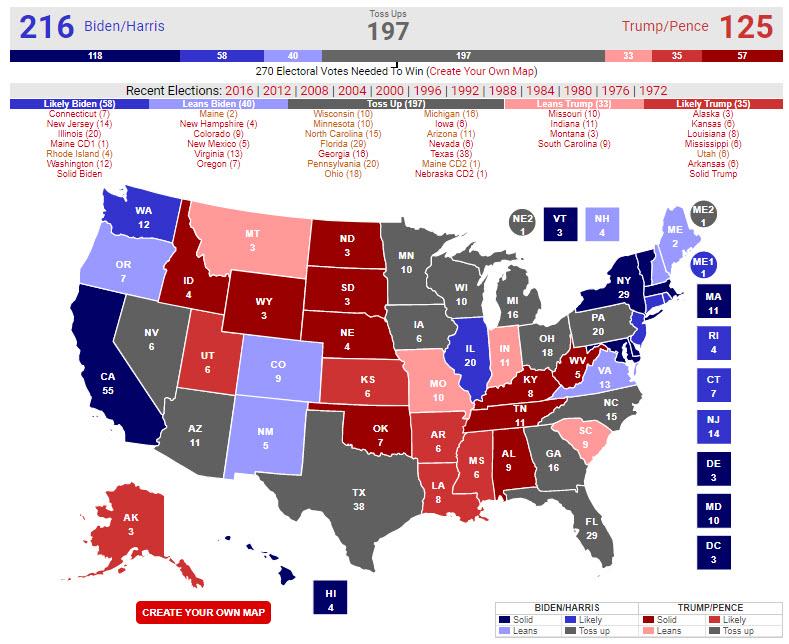
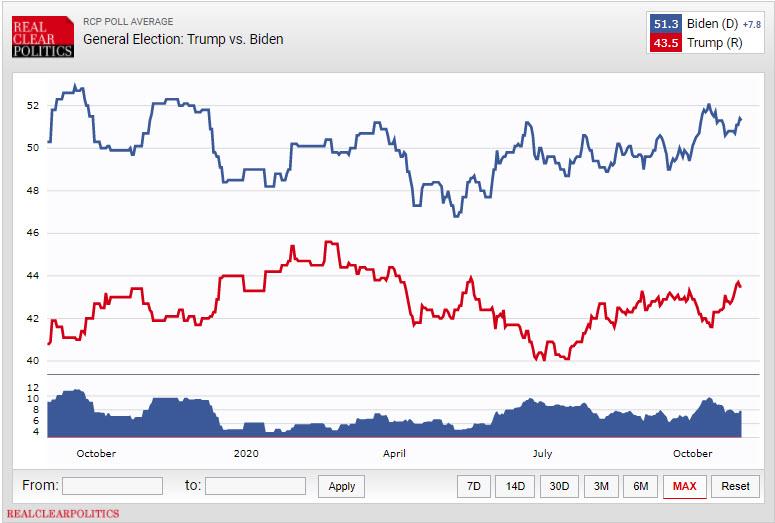
PredictIt currently has a 66% probability for a Biden victory, which is up from a week ago at 62.9% and also higher than four weeks ago, although as usual one has to be aware of just how little capital needs to be deployed to manipulate the illiquid PredictIt market (something every prominent Democratic financier with deep pockets would be well aware of in seeking to manipulate public sentiment in the cheapest possible way). A Trump victory has a roughly 39% probability according to this data, which is up slightly from 37.1% a week ago. The national polls – compiled by Real Clear Politics - suggest a similar tilt in the race with Biden having a 51.3%-43.5% lead against Trump.
Digging into the state polling in competitive states, Biden currently leads in all the battleground, or "toss up" states except for Ohio, Arizona and Texas. This would give him a comfortable Electoral College (EC) victory of 346-192...

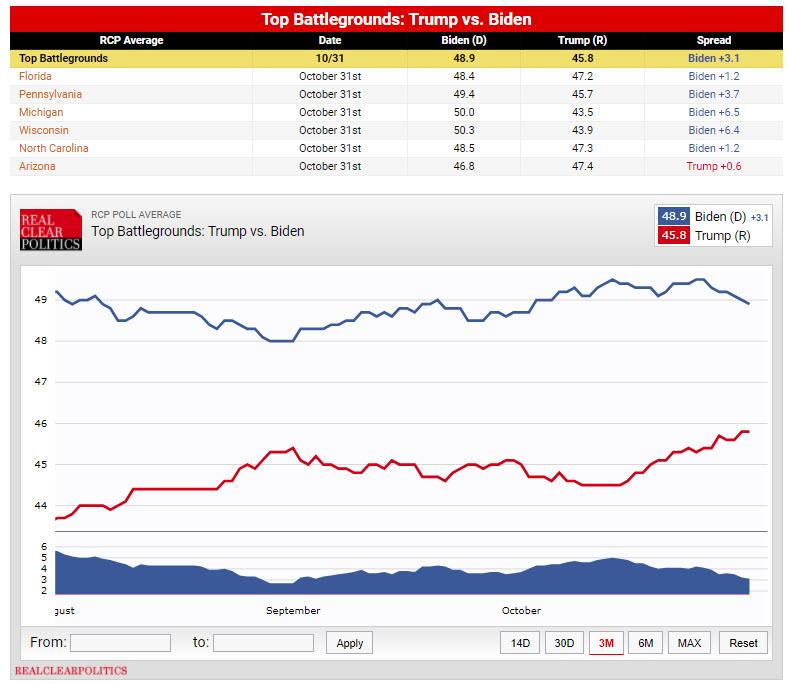
... even though RCP's average polls of Top Battleground states (FL, PA, MI, WI, NC, AZ), is now just +3.1 in Biden's favor and down from 5% to weeks ago, with Arizona just flipping to Trump in the past 24 hours.
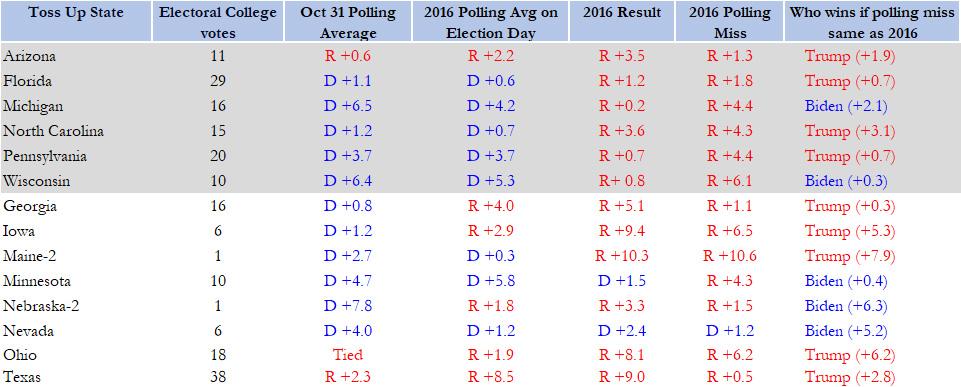
That said, polls are imperfect as 2016 demonstrated – indeed, if we apply the polling miss from 2016 as Bank of America did last week, Florida, North Carolina, Pennsylvania, Georgia, Iowa and and Maine would flip. For this exercise we have used the latest RCP polling average data as of Oct 31:
These numbers are then adjusted by applying the same error rates as were observed during the 2016 polling, and the results are shown in the table below:

Remarkably, if the polls are as wrong as they were in 2016, Trump would win with 279 of the 538 electoral votes, while Biden would get 259.
Still, the margin of victory would be within 0.5 percentage points in Wisconsin (for Biden) and Georgia (for Trump), which would trigger an automatic recount and delay results. In addition, the margin in Pennsylvania and Florida would be less than 1.0%, likely resulting in a bitter post-election night fight and contested outcomes.
In short, no matter what happens on Nov 3, expect recounts and extensive delays before we have a clear winner.
Putting this together, Bloomberg said it best: "All of that means a Trump win on Tuesday would represent a historically staggering failure by public opinion polls, eclipsing even the 2016 miss. While the president’s chances of being re-elected aren’t zero, pollsters say it’s a long shot."
“If Donald Trump wins, in 2020, anything close to a decisive Electoral College win knowable on election night, that would have repercussions for the research profession that would ripple forever -- and deservedly so,” said Jay Leve, chief executive officer of SurveyUSA, a polling firm.
As Bloomberg notes, Level and other pollsters say the election outcomes range from a blowout Biden win to a closely fought contest that could hinge on recounts and court rulings that either candidate could win. They don’t consider a clear, quick and decisive Trump victory among the possibilities.
“It would be astonishing,” Leve said.