Sanofi to produce 100 million doses of Pfizer-BioNTech vaccine, CEO says
- Sanofi will fill and pack millions of doses of Pfizer’s Covid-19 vaccine from July in an effort to help meet the huge demand for the U.S. drugmaker’s shots.
- Last month, Sanofi and Britain’s GlaxoSmithKline said a Covid-19 vaccine they are jointly developing had showed an insufficient immune response in older people, delaying its launch to late this year.
Sanofi will fill and pack millions of doses of Pfizer’s Covid-19 vaccine from July in an effort to help meet the huge demand for the U.S. drugmaker’s shots.
The French company will aim to help supply more than 100 million doses of the vaccine this year from its German plant in Frankfurt, CEO Paul Hudson told Le Figaro newspaper on Tuesday.
Pfizer and its German partner BioNTech are, like other Covid-19 vaccine manufacturers such as AstraZeneca, struggling to meet the huge demand for shots that are the world’s best bet for overcoming the pandemic.
Last month, Sanofi and Britain’s GlaxoSmithKline said a Covid-19 vaccine they are jointly developing had showed an insufficient immune response in older people, delaying its launch to late this year.
The company has been under pressure since to seek ways of helping with Covid-19 vaccines devised by other drugmakers as the pandemic intensifies again in Europe and elsewhere.
“Since our main vaccine is a few months late, we asked ourselves how we could be of assistance now,” Hudson was quoted as saying.
Sanofi is also working on another Covid-19 vaccine candidate with U.S. firm Translate Bio which uses mRNA technology, similar to the approach of Pfizer/BioNTech. Phase I trials are expected to start this quarter.
Hudson confirmed in the interview that Sanofi remains committed to its two vaccines projects.
Antony Blinken, Longtime Biden Aide, Confirmed as Secretary of State
Senate approval came after he gave assurances on tough approach to China and reinforcing ties with allies
WASHINGTON—The Senate on Tuesday confirmed Antony Blinken as secretary of state, filling the post of top U.S. diplomat after receiving assurances that he would preserve a tough approach to China and reinforce ties with U.S. allies.
Mr. Blinken was confirmed on a vote of 78 to 22. He became the fourth member of Mr. Biden’s cabinet to garner Senate approval after Director of National Intelligence Avril Haines, Defense Secretary Lloyd Austin and Treasury Secretary Janet Yellen.
The Biden administration has already taken several foreign policy steps, including rejoining the Paris climate accord and deciding to seek a five-year renewal of the New START nuclear arms control agreement with Russia.
During Mr. Blinken’s confirmation hearing on Jan. 19, Republicans on the Senate Foreign Relations Committee criticized the approach to Iran and China during the Obama administration, when Mr. Blinken served as deputy secretary of state.
“Iran is a very wide disagreement that we have,” said Sen. Jim Risch (R., Idaho), chairman of the Senate Foreign Relations Committee, before Tuesday’s vote. “There are people on both sides of the aisle that have real reservations about going back” into the 2015 nuclear deal with Iran and world powers, he said.
Minutes later, Mr. Risch, who emphasized the nominee’s extensive qualifications for the job and the many areas in which he agrees with him, voted with most Republicans in favor of Mr. Blinken.
Mr. Blinken assured committee members that President Biden is committed to preventing Iran from obtaining a nuclear weapon. He also said he would consult with lawmakers on any U.S. return to the nuclear deal, which former President Donald Trump abandoned.
“We absolutely will consult with you and not only with you…it’s also vitally important that we engage on the takeoff, not the landing, with our allies and with our partners in the region to include Israel and to include the Gulf countries,” Mr. Blinken said in the hearing last week.
Regarding China, Mr. Blinken backed Mr. Trump’s overall tougher approach, though not the tools that the previous administration used.
“We have to start by approaching China from a position of strength, not weakness,” Mr. Blinken said, adding the U.S. should work with allies and international organizations, stand up for human rights and invest in the defense sector to deter any aggression.
In a new administration with widespread foreign policy experience among senior advisers, Mr. Blinken holds a key asset: a nearly two decadelong relationship with Mr. Biden that will enable him to negotiate with allies and adversaries backed by the full authority of the White House.
His close association with Mr. Biden has drawn comparisons to James A. Baker III, the longtime friend and political adviser to President George H.W. Bush.
As secretary, Mr. Blinken faces the task of reviewing, and potentially reversing, a range of policy decisions and sanctions measures instituted by former Secretary of State Mike Pompeo and former Treasury Secretary Steven Mnuchin during their last weeks in office.
“Mr. Blinken’s experience and expertise is necessary to begin to repair the damage and rebuild the State Department,” said Sen. Bob Menendez of New Jersey, the top Democrat on the committee, citing what he called a lack of accountability of the political leadership over the past four years.
During the Trump administration, Mr. Blinken worked at WestExec Advisors LLC, a national-security consulting firm he co-founded that has generated concerns among some Republicans about potential conflicts of interest.
In a letter to State Department lawyers, Mr. Blinken in December agreed to divest his interest in WestExec and said he wouldn’t participate in matters involving former clients for one year.
BofA Warns "Take Profits" Ahead Of Coming Correction
We shared a note on Sunday from Morgan Stanley asking "What To Do About All This Optimism" the bank said that "in November, December and now January, no question or concern has come up more often than 'everyone is optimistic.'" On Monday, screaming most shorted stock rallies and wild speculation is clear evidence the market bubble continues to inflate.
After a dramatic rebound from the coronavirus crash last March, investors are overly optimistic, and perhaps new observations from BofA on Monday can finally answer Morgan Stanley's question of what investors should do with all this optimism, that is, "take some profits or other defensive measures."
BofA's technical analyst Stephen Suttmeier published a note on Monday titled "Correction risk increases moving into February," point out that as January comes to an end, seasonality risks in February may suggest it's now time to "take some profits, or other defensive measures, as several market indices achieve upside counts projected by the 2020 Election breakouts."
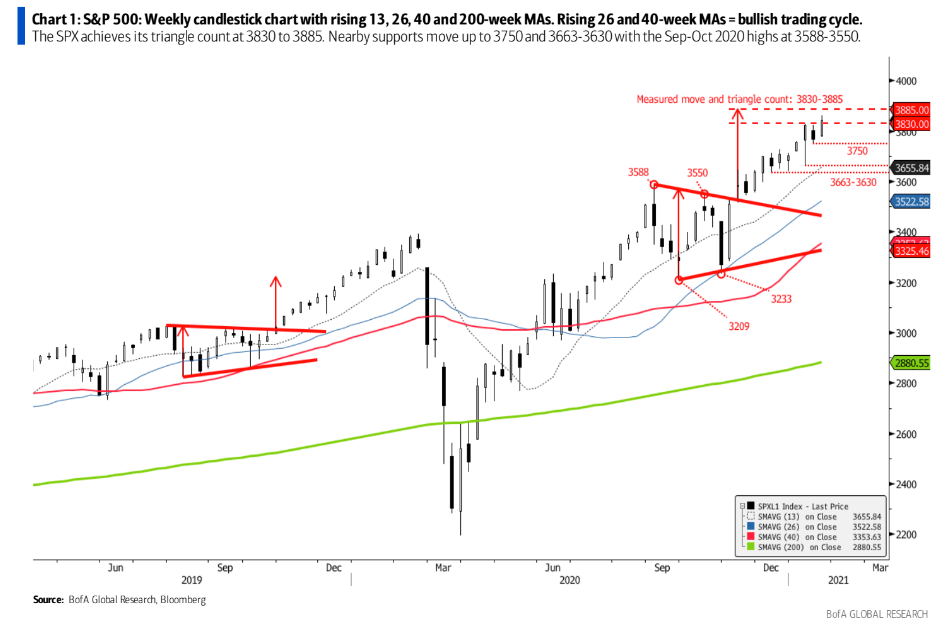
Suttmeier said S&P 500 (SPX) probed the upside target 3,830-3,885 from the bullish triangle constructed ahead of the US presidential election, the Russell 2000 (RTY) has hit its first upside target, the NASDAQ 100 (NDX) tests the 13,500-13,630 target.
BofA's market technician has a yearly bullish view of SPX 4,000+. Still, in the short-term, he envisions a tactical downside risk developing from complacent put/calls and a lack of bullish confirmation of the rally into early 2021 from the percentage of SPX stocks above 10-day and 50-day moving averages, cumulative net up the volume on the SPX, Chicago Fed Financial Conditions and the investment-grade corporate bond ETF (LQD).
Suttmeier adds a weekly Demark upside exhaustion signal was triggered on SPX ahead of the bearish February seasonality. With the risks of a correction mounting next month, he said any downside would be considered a "buyable correction within a larger bullish trend for equities."
In chart one, Suttmeier said SPX has "achieved upside targets" of 3,830 to 3,885 targets. He said, "should upside stall at or near this projected resistance heading into February, which shows weaker seasonality going back to 1928, the key supports are 3,750, 3,663 - 3,620 and the prior highs from September and October 2020 at 3,588 - 3,550."
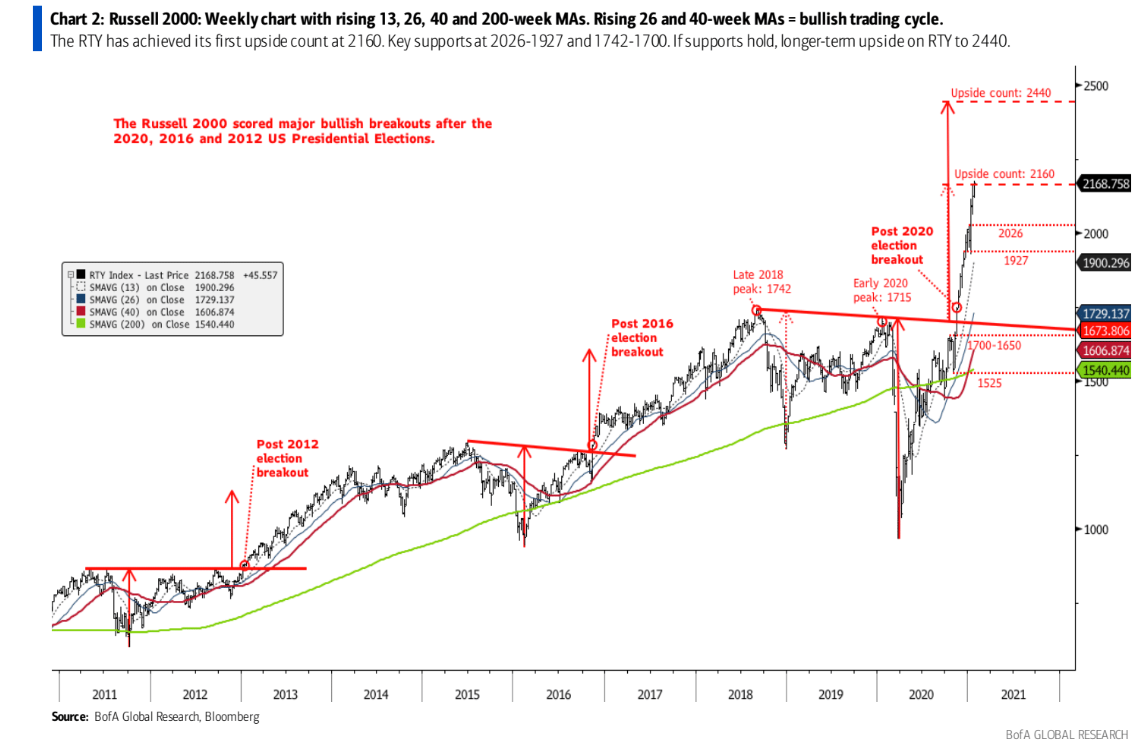
In chart two, BofA's market technician said RTY has achieved "its first upside count at 2,160."
"The last three US Presidential Elections in 2012, 2016, and 2020 saw big bullish breakouts for the Russell 2000. The post - 2020 Election breakout from a 2- year+ base achieved the first upside count on the RTY at 2,160 last week, and we are not ruling out some backing and filling from this projected resistance," he said. If key supports at 2,026 to 1,927 and 1,742 to 1,700 are held, the analyst said 2,440 could be the next upside target.
In chart three, NDX probes the upside target of 13,500 to 13,630. If the index stalls from here, he said, "the immediate support is near 12,530, but the triangle breakout stays intact above support at 12,268 - 12,090 down to 11,800, which is backed up by rising 13 and 26 - week MAs."

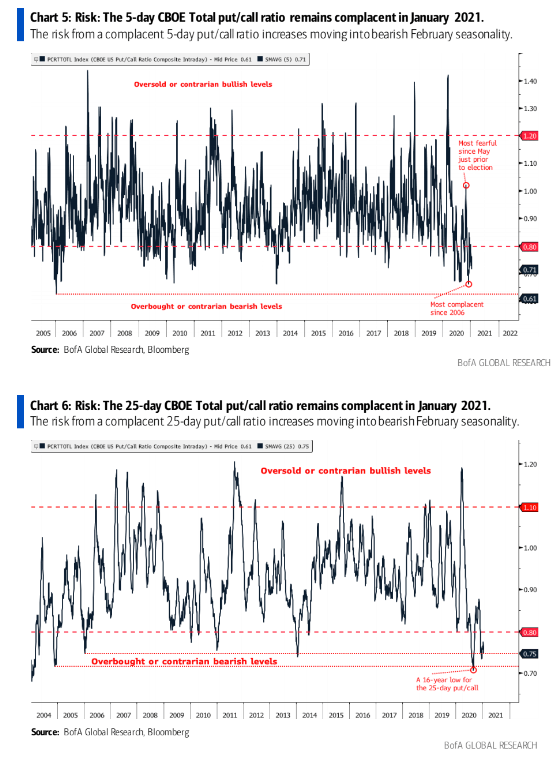
In chart five and six, both the 5-day and 25-day CBOE total put/call ratios are at contrarian bearish overbought levels. The analyst said, "We view this as a risk," something that could interrupt the equity rally next month.
In chart seven, Suttmeier shows the percentage of SPX stocks above 10-day MAs is declining. This is a negative tactical divergence heading into the weaker month of February.
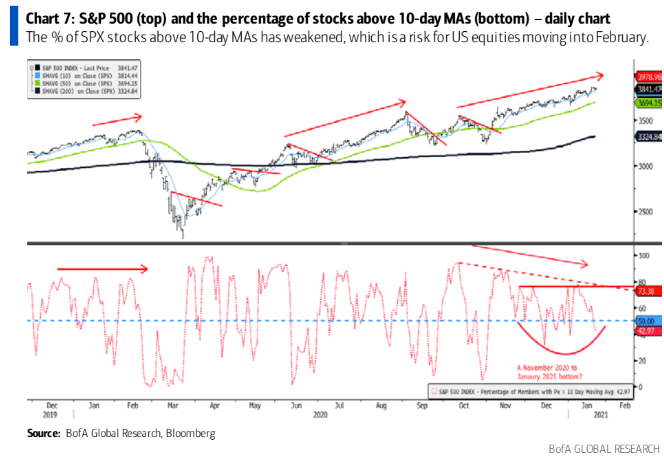
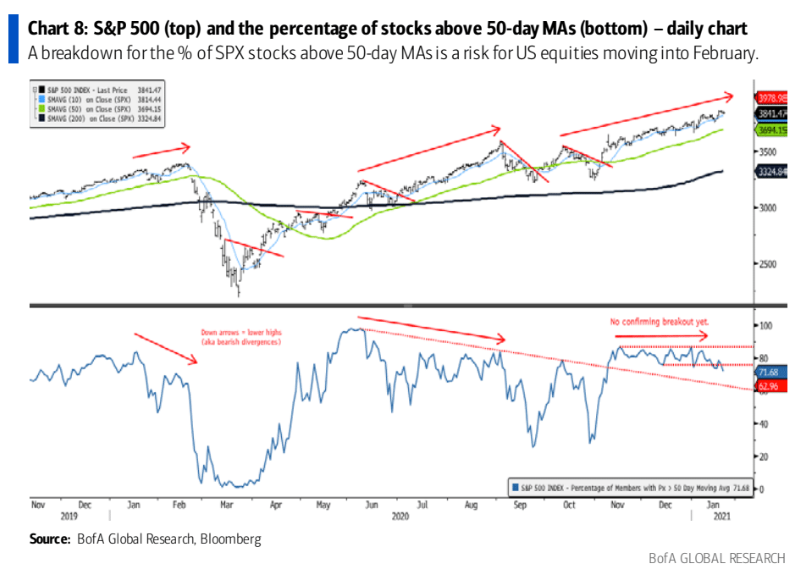
In chart eight, the percentage of SPX stocks above 50-day MA begins to breakdown.
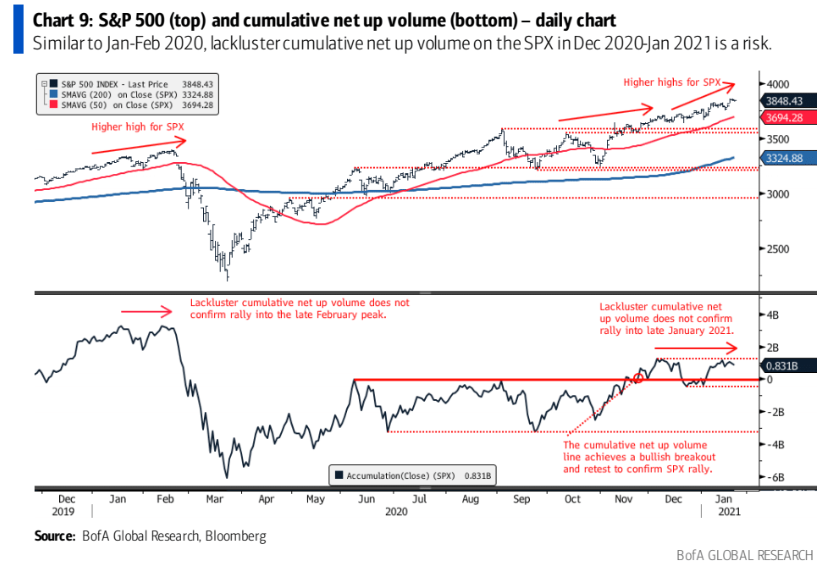
In chart nine, cumulative net up volume on the SPX does not confirm the rally.
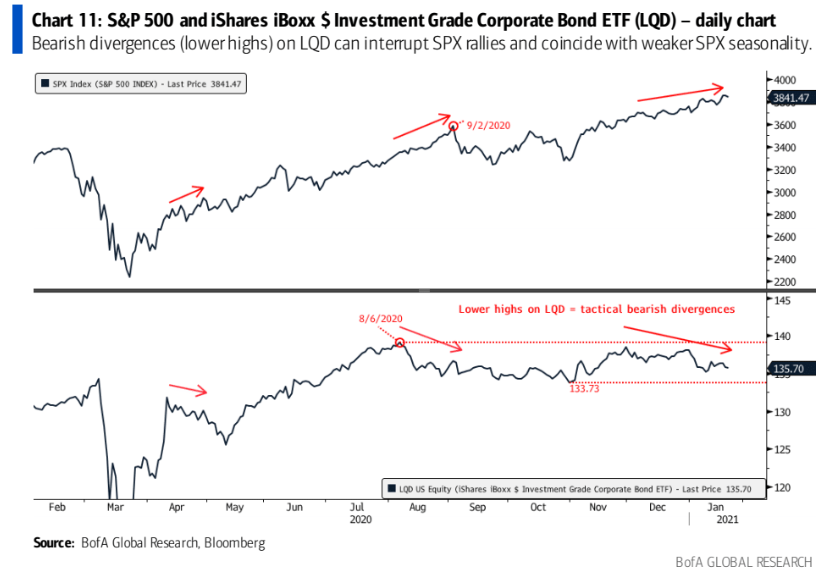
In chart eleven, lower highs on LQD is a significant concern that can interrupt SPX rallies.
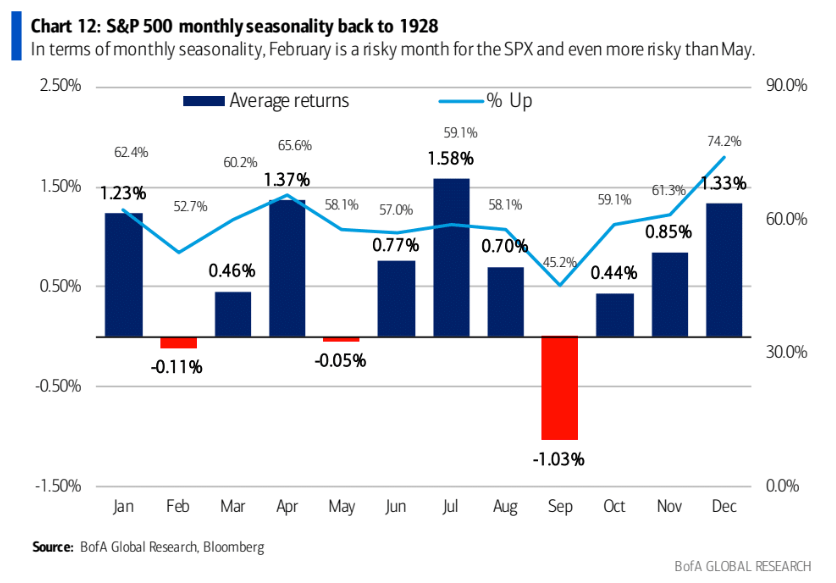
Suttmeier takes SPX monthly seasonal data back to 1928 and outlines how February is a risky month for investors, especially given all the optimism and speculation in the epic bubbles created by no other than the Federal Reserve.
A weekly Demark 13 upside exhaustion signal was recently triggered on SPX. Move evidence suggesting a correction in the index could occur next month.
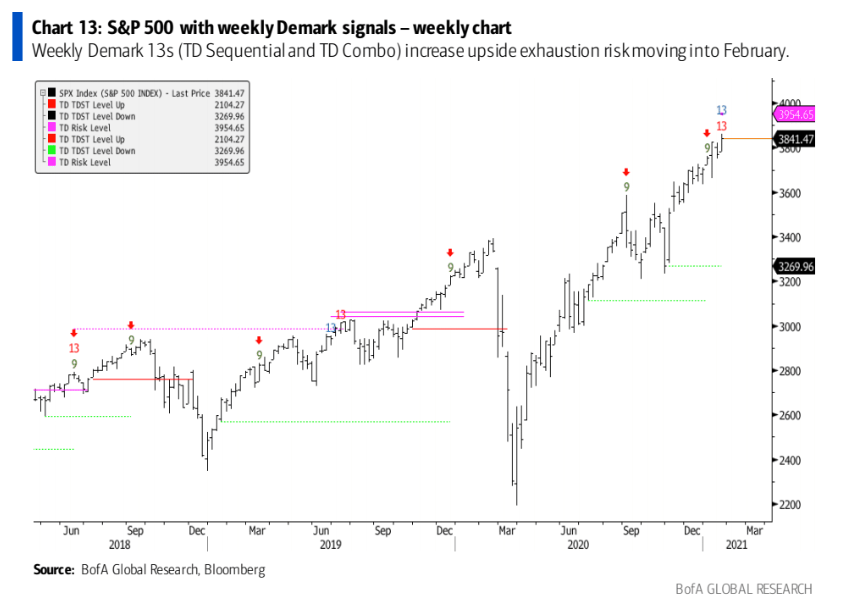
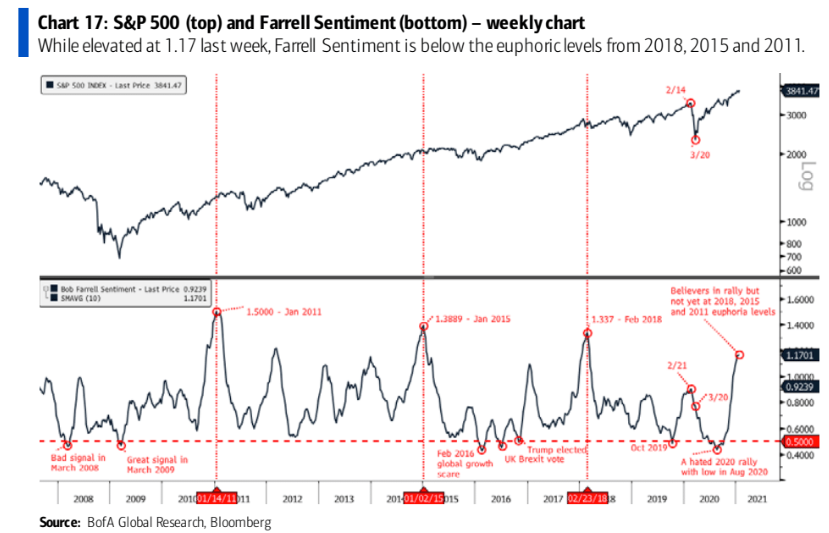
Sentiment indicators for SPX are approaching euphoric levelss from 2018, 2015, and 2011.
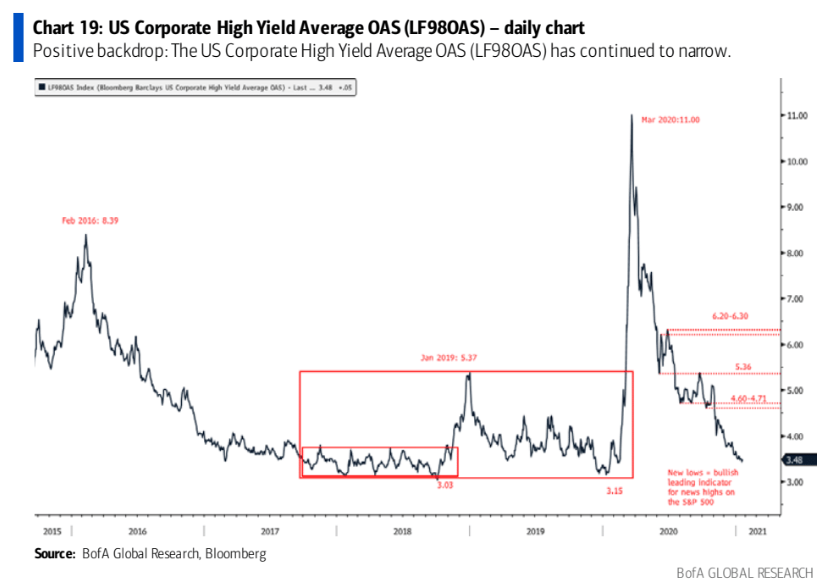
US Corporate High Yield Average OAS has yet to blowout again, back to pre-coronavirus levels.
With BofA suggesting a correction could be approaching in the coming weeks, Morgan Stanley points out investors are overly bullish as Goldman Sach's chief economist outlined days ago in a lengthy note titled "What Could Go Wrong" with the 2021 rebound, other downside risks remain "including uncertainty about how consumers will respond to lingering risks and how new virus mutations will affect virus spread and vaccine efficacy." Some more details on these three risks:
- The first downside risk, according to Goldman, is that consumers remain more cautious than expected, even as mass vaccination and warmer weather greatly reduce virus spread and the risk of infection. While this could restrain the consumption boom, consumer surveys and the resiliency of the consumer thus far suggest such downside is likely limited.
- The second, "more concerning downside risk" is that virus mutations significantly increase the bar for herd immunity, either because they are far more infectious or because they decrease the efficacy of existing vaccines. This would likely delay the consumption boom by pushing back the date when the US reaches herd immunity and virus risks diminish substantially.
- The third, most severe downside risk is the evolution of a vaccine-resistant virus strain that would require a new vaccine and another round of vaccination. Virus-sensitive spending would likely retrench while a new vaccine is developed,and although a new vaccine could be approved in less than five months, the consumption boom would likely be delayed until 2022
With downside risk mounting, RIA Chief Investment Strategist Lance Roberts explained Monday morning why he started selling stocks and raised cash for clients ahead of what he believes could be a market correction.
LVMH shows resilience despite lockdowns (Press Releae)
Biggest brands in demand but pandemic pushes 2020 profit down by a third to €4.7bn
LVMH’s biggest brands, Louis Vuitton and Dior, finished off last year strongly, delivering double-digit sales growth in the fourth quarter, despite Covid-19 lockdowns that closed stores across Europe during the key Christmas shopping season.
The forecast-beating quarterly performance of the group’s fashion and leather goods division, its largest, helped offset steep declines at its duty-free shopping unit and in wines and spirits. Fashion and leather goods sales rose 18 per cent on a comparable basis in the fourth quarter to reach €7.3bn, ahead of analysts’ predictions for 12 per cent growth.
Overall group sales fell 3 per cent on a like-for-like basis in the quarter to €14.3bn.
The strong demand for LVMH’s biggest brands provides further evidence that even as the Covid-19 pandemic rages, people with means are still treating themselves to luxury goods as other types of spending, such as travel or restaurants, remain off limits.
“These numbers reported by LVMH are hugely impressive against a backdrop of an increasingly challenging operation environment,” said Fflur Roberts, an analyst at Euromonitor International.
But the pandemic’s impact on the world’s biggest luxury group has nonetheless been significant: annual net profit fell by roughly one-third to reach €4.7bn in 2020, while annual sales contracted 17 per cent to €44.7bn.
Bain & Co consultants have predicted that it will take up to three years for luxury sector revenues to recover to pre-crisis levels, although some analysts think a rebound could be faster.
Although it does not provide financial guidance, there are signs that LVMH, which is controlled by billionaire founder Bernard Arnault, is feeling more confident than in the early stages of the pandemic. The group said it would pay a dividend of €6 per share for 2020, taking the payout back to pre-crisis levels after having trimmed it to €4.80 last April to preserve cash to cope with Covid-19.
The pandemic has shaken the luxury goods sector by exposing its dependence on free-spending Chinese consumers, who often used to shop for handbags and jewellery while on trips to Europe’s fashion capitals.
With international travel still at a near-standstill, few analysts expect tourism flows to restart in any volumes this year, leaving luxury companies scrambling to meet growing Chinese demand at home, while also trying to attract more local clients in Europe.
Nevertheless, investors piled into the sector last year, pushing up valuation multiples to a 113 per cent premium to the MSCI Europe Index, which is about double the long-term historical premium, according to UBS.
LVMH shares have risen nearly 20 per cent from early January 2020, just before the pandemic, to reach €508 per share on Tuesday. They have outperformed rival Kering, whose shares have fallen 11 per cent over the same period, and Richemont’s 9 per cent rise, but fallen short of the 30 per cent rise for Hermès.
The company’s main task this year will be integrating the $15.8bn acquisition of US jeweller Tiffany and starting to restore the glamour of the well-known US brand. It closed the deal this month, and named a new management team that includes Mr Arnault’s 28-year-old son Alexandre Arnault.
Chief executive and chairman Mr Arnault said in a statement: “In a context that remains uncertain, even with the hope of vaccination giving us a glimpse of an end to the pandemic, we are confident that LVMH is in an excellent position to build upon the recovery.”