FT : Why did Leon Black pay $158m to Jeffrey Epstein?

Why did Leon Black pay $158m to Jeffrey Epstein?
Law firm report sets out services Apollo founder received from convicted paedophile

Jeffrey Epstein was a sexual predator who died in jail while awaiting trial on charges of serial offences against underage girls. But when Leon Black first met him in the 1990s, he saw a different side of the elusive businessman, according to a report this week, viewing him “as someone who was very intelligent and knowledgeable regarding . . . estate planning and taxation”.

Mr Black is one of the most successful financiers of his generation, co-founder of Apollo Global Management, a group that ranks among the most powerful on Wall Street. Yet the billionaire attributes a sizeable part of his family wealth to Epstein, estimating that as much as $2bn in benefits can be traced back to the late paedophile’s financial acumen. By comparison, Forbes magazine estimated Mr Black was worth $7.7bn at the time of Epstein’s 2019 suicide.

On Monday, lawyers for Apollo pointed to that professional relationship to explain why its founder had paid $158m to Epstein over a five-year period ending in 2017 during which the disgraced businessman served as Mr Black’s high-priced adviser on issues ranging from audits by the tax authorities, management of his yacht and private plane, and a dispute over the ownership of a sculpture by Pablo Picasso.

Over two decades, Mr Black confided in Epstein regarding personal matters, leaned on him as an “architect” of, and “strict taskmaster” for, the private office that managed his investments. The men socialised or held meetings at Epstein’s Caribbean island and his other properties in New York, Paris, Florida and New Mexico.

The public reckoning over Mr Black’s ties to a convicted sex offender marks a humiliating coda to a relationship that began to sour years before Epstein’s shocking death in federal custody. “There has been a virtual tsunami in the press on this subject,” Mr Black said in 2019. “It seems to be the gift that never stops giving . . . It’s salacious, it involves elements of politics, of Me Too, of rich and powerful people. And my guess is it will continue for a while.”

Last October, after new revelations of Mr Black’s payments to Epstein prompted a number of top pension funds to freeze further investments with Apollo, Mr Black asked his company to commission an investigation from Dechert, the international law firm.

“Let me be clear, there has never been an allegation by anyone that I engaged in any wrongdoing because I did not,” Mr Black said then. “Any suggestion of blackmail or any other connection to Epstein’s reprehensible conduct is categorically untrue.”

The pair last spoke in 2018, after Epstein sent emails that made what Dechert called “unsubstantiated assertions” about the work he had performed and demanding more cash. Mr Black refused to pay anything more.

As their relationship deteriorated, Epstein was not above invoking his friendship with Black in an attempt to extract more money. According to the report by Apollo’s lawyers, he did so “by referencing personal matters that Black had shared with Epstein in confidence”. Their report added: “There is no evidence that those matters had any relationship to any of Epstein’s criminal activity or to any of Black’s payments to Epstein.”

Second chances
The Apollo founder had known Epstein for roughly a decade when Epstein was convicted in 2008 of soliciting sex from a minor, in a plea bargain that resulted in a 13-month prison sentence.

“Black viewed Epstein as a confirmed bachelor with eclectic tastes, who often employed attractive women,” according to the Dechert report, but he had “no recollection of ever seeing Epstein with an underage woman at any time”.


Rather than severing the relationship after the conviction, the Apollo founder began to formally employ Epstein as an adviser in 2012. Mr Black has characterised himself as someone who “believes in . . . giving people second chances”, according to the Dechert report.

That is in keeping, the lawyers added, with relationships Mr Black has maintained with his former mentor Michael Milken, who served time in prison for securities violations committed at the failed investment bank Drexel Burnham Lambert, and Martha Stewart, who was convicted in 2004 of making false statements and obstruction of justice in relation to a stock trade.

Moreover, Mr Black “believed that the severity of Epstein’s offences was limited to a single instance of soliciting a 17-year-old prostitute that Black believed Epstein had mistakenly understood was older,” the Dechert report said.

A matter of trusts
Epstein’s first and “most valuable” assignment, people familiar with his work told Dechert, was to rectify defects in a trust structure that had been designed to allow Mr Black to transfer some assets to his heirs without paying estate or gift tax.

The structure dated from 2006, and had been created by lawyers recommended by Epstein. But the way they had implemented it meant that, without further action, the trust “would carry a future risk of a large estate tax assessment”. Epstein had a “unique” solution to the problem, which “[he] asserted was proprietary”, and which another of Mr Black’s lawyers called “a ‘grand slam’ [that] met all of Black’s financial and estate planning goals”. Dechert’s witnesses put the tax savings from the plan at between $500m and $1bn.

“Some of Epstein’s ideas were uniquely creative and useful,” people familiar with his work told the Dechert lawyers. In particular, he could “motivate Black to concentrate on certain family office issues in a way that others could not”.

But some of his ideas “were unremarkable or not viable”, the report said, and he had a habit of taking credit for other people’s work. “Some witnesses described a toxic and destructive work environment under Epstein,” the Dechert lawyers wrote, although others “agreed that the pressure that Epstein exerted . . . did [improve] their performance”.

Mr Black on Monday said the Dechert report confirmed “the key facts I have previously disclosed concerning my relationship with Jeffrey Epstein, including that I was completely unaware of Mr Epstein’s abhorrent misconduct that came to light in late 2018”. He added that he would step down as Apollo’s chief executive by July 31, as part of a package of reforms that will hand more power to Apollo’s public shareholders while allowing him to remain as chairman.

In a letter sent to Apollo investors in 2019, Mr Black insisted that he had “never promoted” Epstein to his top colleagues at the company. That statement was “not false”, the Dechert report said, although Mr Black “did positively comment on the substantial value of Epstein’s services”.

Despite that recommendation from Apollo’s billionaire founder, the lawyers added, “it is clear that no Apollo employee other than Black ever seriously considered hiring Epstein”.
(ZH) China Repo Rates Soar To 15 Month High After PBOC Warns Of Asset Bubbles, D

China Repo Rates Soar To 15 Month High After PBOC Warns Of Asset Bubbles, Drains Liquidity

China’s money market rates surged after the People’s Bank of China drained cash from the financial system, just as a central bank adviser warned about bubbles in markets.
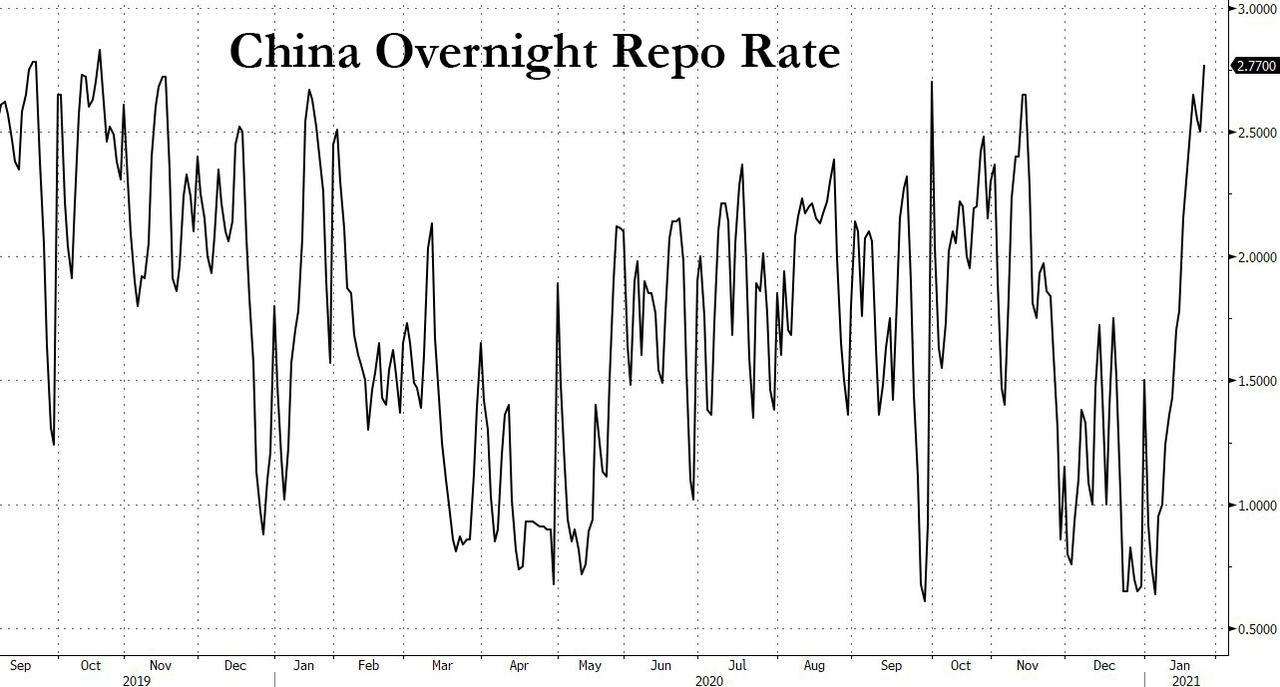
The overnight repurchase rate soared 28 basis points to 2.77%, the highest since October 2019, and just a month after it hit a record low.
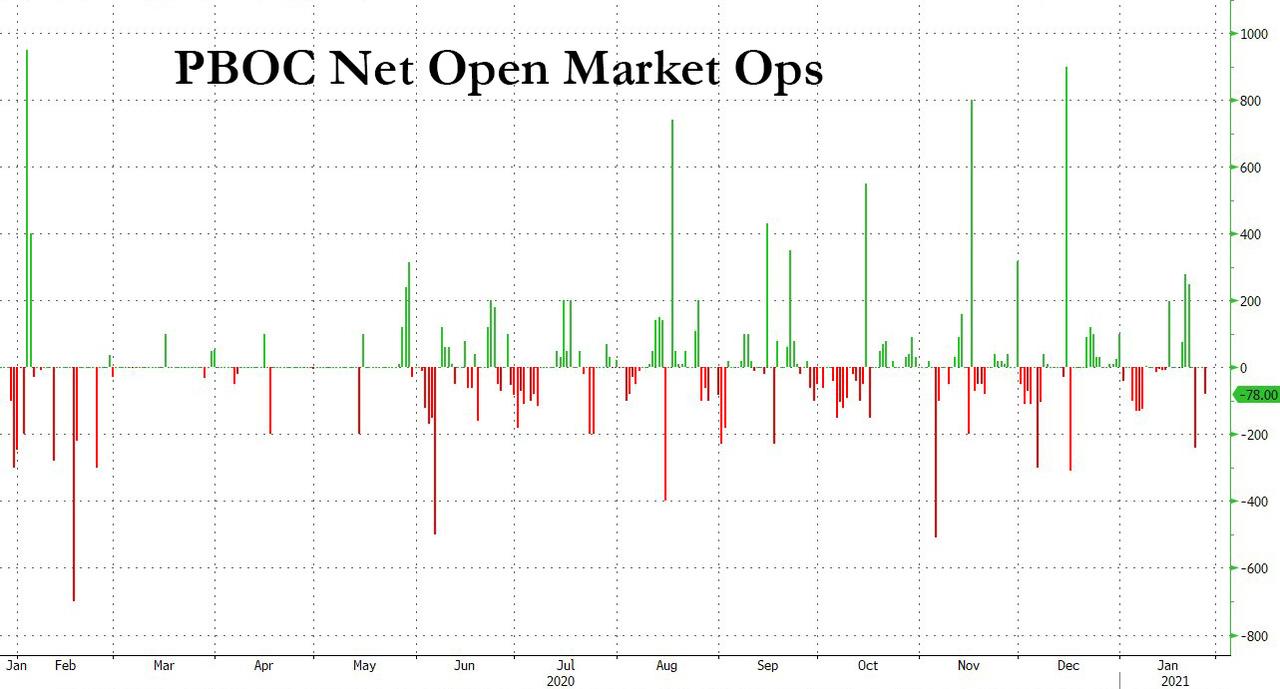
At the same time, the cost on 7-day repurchase agreements jumped 36 basis points to 2.79%. Earlier in the day the PBOC withdrew a net 78 billion yuan via open-market operations, the most in two weeks.
It wasn't just the PBOC's liquidity drain however: the rate spike was also catalyzed by a stark warning from PBOC adviser Ma Jun, who spoke at a wealth management forum where according to the 21st Century Business Herald said bubbles have formed in the stock and property markets, and he proposed a shift in monetary policy.
"Whether this situation will intensify in the future depends on whether monetary policy is appropriately changed this year,” he said. He added that if not, such problems would “certainly continue” and lead to “greater economic and financial risks in the medium- and long-term."
He also said that there will be less demand for monetary expansion as corporate profits will improve, reducing their reliance on debt financing.
To be sure, Chinese regulators have already moved to constrain rising property prices. They limited the amount banks can lend to the sector at the end of last year and are targeting leverage among the country’s vast developers. Individual cities have also introduced measures to curb prices.
In late 2020, PBoC restrictions on short-term liquidity led to a surge in interbank borrowing costs. The three-month Shanghai interbank benchmark more than doubled between May and November to more than 3 per cent — its highest level in two years — before it gradually declined.
Then China’s markets soared at the end of last year from a barrage of liquidity injections by the central bank, helping stocks and the yuan end 2020 on a high note. The benchmark CSI 300 Index has since risen to the highest level since 2008.
“The PBOC is unlikely to loosen its purse strings at least this week, which will make cross-month liquidity very tight,” said Xing Zhaopeng, an economist at Australia & New Zealand Banking Group.
In this context it is hardly a surprise then that after the warning and liquidity drain, Hong Kong's Hang Seng index — which has been boosted this month by record-breaking daily volumes of buying by mainland investors — fell by more than 2.4%. Mainland China’s CSI 300 index of Shanghai- and Shenzhen-listed stocks dropped 2%.
The mood is still totally remaining intact in terms of its positivity,” said Andy Maynard, managing director at China Renaissance Securities. “Although we have a blip today . . . yesterday was kind of euphoric, last week was kind of euphoric.” But, he added, rising borrowing costs were unlikely to undermine positive momentum in China and other emerging markets.
“Where else in the world do you go? Where do you put that money?” he said. “For the global asset allocators who stay in equity, I don’t think you necessarily rush back to the dollar and you definitely are not touching Europe”.
And while the Chinese warning dented some overnight enthusiasm, S&P futures have since reversed and are trading near all time highs.

TechCrunch : Fintechs could see $100 billion of liquidity in 2021

Fintechs could see $100 billion of liquidity in 2021
The Matrix Fintech Index weighs public markets, liquidity and a new e-commerce trend

Three years ago, we released the first edition of the Matrix Fintech Index. We believed then, as we do now, that fintech represents one of the most exciting major innovation cycles of this decade. In 2020, all the long-term trends forcing change in this sector continued and even accelerated.
The broad movement away from credit toward debit, particularly among younger consumers, represents one such macro shift. However, the pandemic also created new, unforeseen drivers. Among them, millennials decamped from their rentals in crowded cities to accelerate their first home purchases to the benefit of proptech companies and challenger mortgage players alike.
E-commerce saw an enormous acceleration in growth rates, furthering adoption of online payments platforms. Lastly, low interest rates and looming inflation helped pave the way for the price of Bitcoin to charge toward $30,000. In short, multiple tailwinds combined to produce a blockbuster year for the category.
In this year’s refresh of the Matrix Fintech Index, we’ll divide our attention into three parts. First, a look at the public stocks’ performance. Second, liquidity. Third, we highlight one major trend in the sector: Buy Now Pay Later, or BNPL.
Public fintech stocks rose 97% in 2020
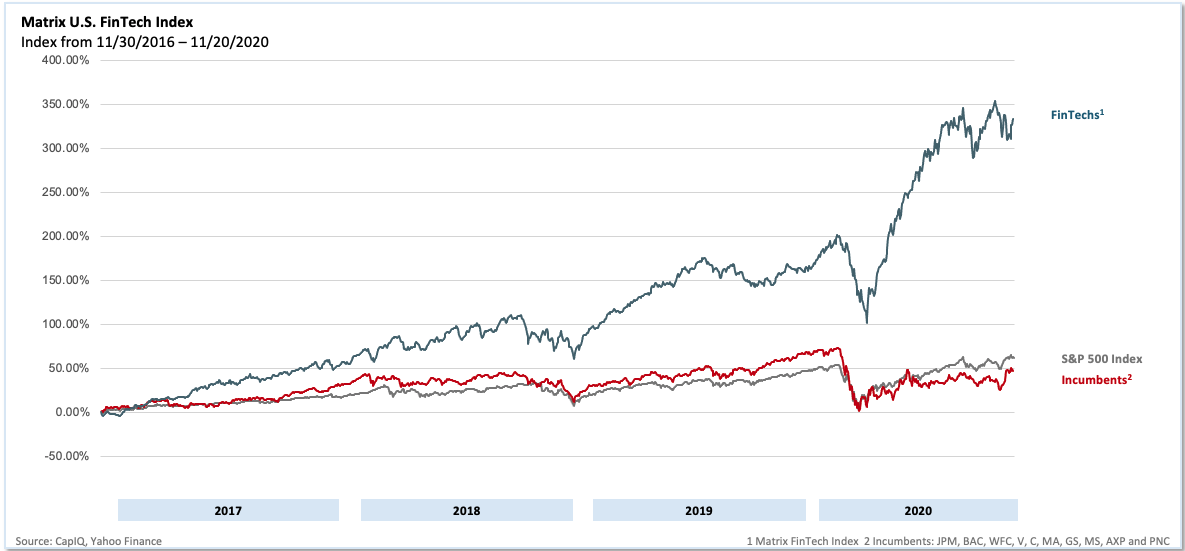
For the fourth straight year, the publicly traded fintechs massively outperformed the incumbent financial services providers as well as every mainstream stock index. While the underlying performance of these companies was strong, the pandemic further bolstered results as consumers avoided appearing in-person for both shopping and banking. Instead, they sought — and found — digital alternatives.

For the fourth straight year, the publicly traded fintechs massively outperformed the incumbent financial services providers as well as every mainstream stock index.

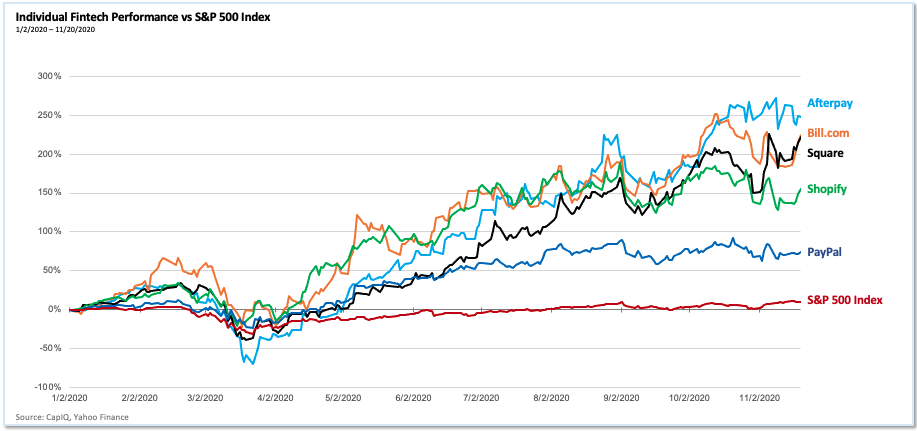
Our own representation of the public fintechs’ performance is the Matrix Fintech Index — a market cap-weighted index that tracks the progress of a portfolio of 25 leading public fintech companies. The Matrix fintech Index rose 97% in 2020, compared to a 14% rise in the S&P 500 and a 10% drop for the incumbent financial service companies over the same time period.

2020 performance of individual fintech companies vs. SPX Image Credits: CapiQ, Yahoo Finance


Matrix U.S. Fintech Index, 2016 -2020 Image Credits: CapiQ, Yahoo Finance

E-commerce undoubtedly stood out as a major driver. As a category, retail e-commerce grew 35% YoY as of Q3, propelling PayPal and Shopify to add over $160 billion of market capitalization over the year. For its part, PayPal in the third quarter signed up 15 million net new active accounts (its highest ever).

>>> US Gapping down

Gapping down
In reaction to earnings/guidance
:

  • KRMD -17.2% (guides FY20 revs below consensus; also announces CEO transition), JJSF -5.7%, NVS -3.8%, BXS -3.1%, AXP -2.6%, BOOT -2.4%, CR -2%, ROK -1.1%, LMT -1.1%, AUY -1%, PPBI -1%, VZ -0.8%

Other news:

  • LPCN -11.4% (stock offering)
  • SEEL -8.3% (stock offering)
  • ASO -2.9% (stock offering)
  • CVAC -2.4% (stock offering)
  • QUMU -2.2% (stock offering)
  • ERF -2.1% (to acquire Bruin E&P HoldCo)

Analyst comments:

  • FVRR -2% (downgraded to Sell from Neutral at MKM Partners)
  • DK -1.9% (downgraded to Sell from Neutral at Goldman)
  • WERN -1.4% (downgraded to Neutral from Positive at Susquehanna)
  • JBHT -1.2% (downgraded to Neutral from Positive at Susquehanna)
  • VIPS -1.1% (downgraded to Sector Weight from Overweight at KeyBanc Capital Markets)
  • PDD -0.5% (downgraded to Sector Weight from Overweight at KeyBanc Capital Markets)

>>> US Gapping up

Gapping up
In reaction to earnings/guidance
:

  • GE +7.4%, AUDC +6.3%, LPG +3.7%, ALV +3.7%, HXL +3.1%, PII +3%, RTX +2.8%, GGG +2.5%, STLD +2.4%, IFF +2.3%, UBS +2%, JNJ +1.7%, ADM +1.7%, FUL +1.5%, DQ +1.4%, DHI +1.3%, EPRT +1.2% (guides FY21 AFFO slightly below consensus), SNV +1.1%, NEE +1%, MMM +0.9%, XLNX +0.7%

Other news:

  • OSTK +13.7% (announces partnership with Pelion Venture Partners to oversee Medici Ventures' blockchain assets)
  • ICLK +10.7% (iClick Interactive Asia Group and Baozun (BZUN) announce equity investment and strategic business cooperation )
  • ICFI +10.2% (selected by EPA for Energy Star Services contract)
  • HTBX +10.1% (has engaged CRS Crossroads Strategies, a bipartisan government relations firm based in Washington DC, to assist in advancing government collaborations related to COVID-19 and other vaccine programs)
  • BB +9.2% (partners with Baidu (BIDU) for next generation autonomous driving technology)
  • TLRY +8.8% (has been selected by the French National Agency for the Safety of Medicines and Health Products to supply Good Manufacturing Processes certified medical cannabis products for experimentation in France)
  • KLDO +7.1% (Kaleido Biosciences' Katharine Knobil will resign from her position as Chief Medical Officer and Head of Research and Development of the Company, effective as of January 29, 2021)
  • CGRO +6.8% (Collective Growth Corporation partners with Macnica, Japan's largest distribution company)
  • MYOV +6.7% (Myovant Sciences and Pfizer (PFE) announce "positive" one-year data from Phase 3 SPIRIT extension study of once-daily relugolix combination therapy in women with endometriosis)
  • BDGE +6% (to be added to S&P SmallCap 600)
  • STAA +5.8% (to be added to S&P MidCap 400)
  • PBH +5.2% (to be added to S&P SmallCap 600)
  • APO +5.1% (new CEO)
  • IAC +3.6% (Vimeo raises $300 mln in primary equity)
  • VLDR +3.5% (signs a multi-year sales agreement to provide Puck LITE sensors to Emesent)
  • WYND +3.2% (to change name to "Travel + Leisure Co.")
  • IMAB +2.8% (IMAB and MOR dose first patient in US Phase 1 study of TJ210/MOR210)
  • ABCL +2.5% (announces bamlanivimab administered with etesevimab reduced risk of COVID-19 hospitalizations and death by 70%)
  • BZUN +2.1% (iClick Interactive Asia Group and Baozun (BZUN) announce equity investment and strategic business cooperation )
  • BP +2% (reduces oil exploration staff to focus more on renewable energy, according to Reuters)
  • REGN +1.4% (reports "positive" initial results from ongoing Phase 3 trial of REGEN-COV antibody cocktail as passive COVID-19 vaccine)
  • TWTR +1.1% (settles pending shareholder derivative lawsuits)
  • LLY +0.9% (reports new data showing treatment with Lilly's neutralizing antibodies bamlanivimab (LY-CoV555) and etesevimab (LY-CoV016) together reduced risk of COVID-19 hospitalizations and death by 70%)

Analyst comments:

  • DKNG +4.3% (upgraded to Buy from Neutral at Goldman)
  • UAA +1.9% (upgraded to Outperform from Market Perform at Cowen)
  • PPG +1.7% (upgraded to Buy from Neutral at BofA Securities)
  • WES +1.1% (upgraded to Neutral from Underperform at BofA Securities)
  • DG +0.8% (upgraded to Buy from Hold at Loop Capital)

>>> USEarly premarket gappers

Early premarket gappers

  • Gapping up:
    • BB +16.8%, OSTK +12.2%, ICFI +10.2%, TLRY +9.9%, ICLK +9.6%, BDGE +7.9%, KLDO +7.1%, STAA +5.8%, PBH +5.6%, AUDC +5.5%, APO +4.7%, CGRO +4.5%, IPAR +4.2%, PII +3.7%, BZUN +3.4%, ALV +3.3%, GGG +3.1%, IMAB +2.8%, IAC +2.6%, UBS +1.8%, HXL +1.5%, FUL +1.5%, BP +1%, LPG +0.9%, MRSN +0.8%, ATNX +0.7%, AZN +0.7%
  • Gapping down:
    • KRMD -17.2%, SEEL -11.3%, LPCN -8.6%, JJSF -5.7%, NVS -4.1%, ERF -3%, ASO -2.9%, BOOT -2.9%, CVAC -2.4%, QUMU -2.2%, CR -2%, AUY -1.6%, DQ -1.2%, PPBI -1%, HTLF -0.7%, BCRX -0.5%

NewsWeek : COVID Lockdowns May Have No Clear Benefit vs Other Voluntary Measures

COVID Lockdowns May Have No Clear Benefit vs Other Voluntary Measures, International Study Shows

study evaluating COVID-19 responses around the world found that mandatory lockdown orders early in the pandemic may not provide significantly more benefits to slowing the spread of the disease than other voluntary measures, such as social distancing or travel reduction.

The peer reviewed study was published in the European Journal of Clinical Investigation on January 5, and analyzed coronavirus case growth in 10 countries in early 2020.

The study compared cases in England, France, Germany, Iran, Italy, Netherlands, Spain and the U.S. – all countries that implemented mandatory lockdown orders and business closures – to South Korea and Sweden, which instituted less severe, voluntary responses. It aimed to analyze the effect that less restrictive or more restrictive measures had on changing individual behavior and curbing the transmission of the virus.

The researchers used a mathematical model to compare countries that did and did not enact more restrictive lockdown orders, and determined that there was "no clear, significant beneficial effect of [more restrictive measures] on case growth in any country."

NEWSWEEK SUBSCRIPTION OFFERS >
"We do not question the role of all public health interventions, or of coordinated communications about the epidemic, but we fail to find an additional benefit of stay-at-home orders and business closures," the research said.

However, the researchers also acknowledged that the study had limitations, and noted that "cross-country comparisons are difficult," since nations may have different rules, cultures, and relationships between their government and citizenry.

The study was conducted by researchers affiliated with Stanford University, and was co-authored by Jay Bhattacharya, a professor of medicine and economics who has been a vocal opponent of coronavirus lockdowns since March.

Bhattacharya was also among a group of scientists who wrote The Great Barrington Declaration, a controversial statement that encouraged governments to lift lockdown restrictions to achieve herd immunity among young and healthy people, while focusing protections on the elderly.

A study published in the journal Nature by researchers at Imperial College London in June found that some 3.1 million deaths had been averted due to lockdowns across Europe early on in the pandemic.

"This data suggests that without any interventions, such as lockdown and school closures, there could have been many more deaths from COVID-19. The rate of transmission has declined from high levels to ones under control in all European countries we study," Dr. Samir Bhatt, an author of the study from Imperial College London said in June, according to the university.

"Careful consideration should now be given to the continued measures that are needed to keep SARS-CoV-2 transmission under control," he added.

A second study published alongside that report in Nature, and led by scientists in the United States, found that 530 million coronavirus infections had been avoided due to early lockdowns in China, South Korea, Italy, Iran, France and the United States, according to the news outlet.

Mandatory lockdown orders have also been a highly politicized issue across the U.S.

Some Republican leaders, including Florida Governor Ron DeSantis and Mississippi Governor Tate Reeves, have vehemently opposed state or nationwide closures to curb the spread of COVID-19. In Democratic states, including New York and California, lockdown orders have been a consistent part of the coronavirus response since March.

According to a poll released by Vox and Data for Progress on December 24, more than half of Americans said they would support a nationwide lockdown for one month.

But President-elect Joe Biden said in an interview in November that he had no intention of implementing a national shutdown when he takes office on January 20.

"I'm not going to shut down the economy. I'm going to shut down the virus," Biden said. "There is no circumstance which I can see that would require a total national shutdown. I think that would be counterproductive."

As of Thursday, the United States had recorded over 23 million COVID cases and 385,178 deaths since the start of the pandemic, according to Johns Hopkins University.

>>> Europe : Brokers Upgrades & Downgrades - 26th of January 2021 - V2(+)

>>> Up
* ADP Raised to Buy at Berenberg; PT 110 euros
* Aker Solutions Raised to Buy at SpareBank; PT 20 kroner
* Compass Raised to Neutral at Exane; PT 1,295 pence
* Credito Emiliano Raised to Outperform at KBW; PT 5.90 euros
* Elior Group Raised to Buy at HSBC; PT 6.70 euros
* ERG Raised to Neutral at Citi; PT 26 euros
* Essity Raised to Buy at Berenberg; PT 313 kronor
* Polypipe PT Raised to 639 pence from 601 pence at Jefferies
* Remy Cointreau Raised to Buy at Deutsche Bank; PT 185 euros
* Watches of Switzerland PT Raised to 800 pence at Jefferies

>>> Down
* Accor Cut to Hold at HSBC; PT 28 euros
* Ashmore Cut to Hold at Canaccord; PT 429 pence (+)
* Carnival Plc Cut to Reduce at HSBC; PT 960 pence
* DNO Cut to Neutral at SpareBank; PT 9 kroner
* Equinor Cut to Sell at SpareBank; PT 160 kroner
* Europcar Cut to Reduce at HSBC; PT 60 euro cents
* FDJ Cut to Neutral at Exane; PT 40 euros
* Genel Cut to Neutral at SpareBank; PT 185 pence
* Hapag-Lloyd Cut to Reduce at Commerzbank; PT 95 euros
* Hochtief Cut to Hold at LBBW; PT 81 euros
* InterContinental Hotels Cut to Underperform at Exane
* Kingspan PT Cut to 58 euros from 65 euros at Barclays (+)
* Neoen Cut to Sell at Citi; PT 43.90 euros
* Puma Cut to Equal-Weight at Morgan Stanley; PT 81 euros
* Puma Cut to Reduce at Baader Helvea; PT 80 euros
* Siltronic Cut to Hold at Stifel; PT 150 euros
* Sparebanken Telemark Cut to Hold at Norne Securities
* Tenaris Cut to Neutral at Goldman; PT 7 euros
* Tenaris ADRs Cut to Neutral at Goldman; PT $14.50
* Trainline Cut to Neutral at JPMorgan; PT 382 pence
* TUI Cut to Reduce at HSBC
* Zurich Airport Cut to Hold at Berenberg; PT 146 Swiss francs

>>> Initiation
* BAT Rated New Buy at Renaissance Capital
* SEC Newgate Rated New Buy at Arden Partners; PT 89 pence (+)
* Valbiotis SAS Rated New Buy at Oddo BHF; PT 13.50 euros

>>> Call
* AB InBev Among Jefferies’ Top Beverage Picks as Road Still Bumpy (+)
* Airports Retain Upside as Reopening Trade, ADP to Buy: Berenberg
* Crest Nicholson FY20 Ahead, Good Progress on Turnaround: Peel (+)
* Essity May Give Opportunities for Positive Surprises: Berenberg
* Greencore’s Sales Update Shows Resilience: Goodbody (+)
* Indivior’s $50M Settlement With Reckitt ‘Welcome News’: Stifel (+)
* Nokia’s Solid Progress Offers Buy Opportunity: Handelsbanken
* Nokia Faces Volatility as Reddit Boards Notice Stock: Inderes (+)
* Novartis May See Small Drop on 4Q, Cautious Outlook: Jefferies (+)
* Puma Downgraded at Baader, Morgan Stanley Ahead of Results
* Remy Raised at Deutsche Bank on Expected ‘Material’ Upgrades (+)
* Rolls-Royce Cash Guidance Makes 2023 Performance Key: Jefferies (+)
* Stadler Rail Order Cancellation Concerns May Be Overdone: Citi (+)
* Trainline Consensus Cuts Likely ‘Unavoidable,’ JPM Downgrades (+)
* UDG May Rise After Better-Than Expected 1Q, Guidance: Peel Hunt (+)