FT Lex : Arnault/Mustier Spac: winging it

Arnault/Mustier Spac: winging it
Pegasus Europe aims to thaw European reserve towards special purpose acquisition vehicles

Hopefully, any takeover featuring Bernard Arnault and Jean Pierre Mustier will be as smart as their suits. The French billionaire — via family office Financière Agache — and the former UniCredit boss are joining forces for that most fashionable of financings, a special purpose acquisition vehicle. These give ex-chief executives the chance to capitalise on fame gained from running big banks without so many restrictions.

Tidjane Thiam, Sergio Ermotti and Martin Blessing, formerly of Credit Suisse, UBS and Commerzbank, have similar plans. The question is whether the new Spac pack can find compelling targets in European financial services. The sector they know best — fragmented, politicised and beset by low rates — looks less buzzy than the US hunting grounds of Wall Street originators.

Spacs are a top-of-the market phenomenon. Investors who buy into the initial public offerings back the reputed deal-doing prowess of Spac co-founders. There is no operating business to scrutinise until a takeover target is identified. Rewards are potentially huge. Spac founders often receive 20 per cent of the listing’s shares for a nominal fee.

What was a backwater within US equity markets a decade ago has become a mainstay for IPO lead managers. Spacs made up 49 per cent of all US listings by value last year, according to Dealogic.

Pegasus Europe, named after the mythical flying horse, aims to thaw European reserve towards Spacs. Issuance has averaged just 2 per cent of all European IPOs in the past decade. Only about five are launched annually — an eighth of the US average.

Pegasus is the vehicle of Arnault, Mustier, former UniCredit executive, Diego De Giorgi and Tikehau Capital. It will list in Amsterdam, the post Brexit market of choice. The partners correctly perceive a lack of European growth capital outside highly-leveraged private equity. This impedes businesses whose cash flow growth lags behind sales or innovation. Piquantly, Amsterdam-listed Tikehau is itself active in private equity.

However, Pegasus’s happy hunting grounds look pretty heavily picked over: asset management, insurance and diversified financials. There is plenty room for consolidation — and to overpay as well. Private equity funds have $2.5tn in so-called dry powder.

In the UK, the most prominent Spac-type deals of recent years involved well-known financier Nat Rothschild. His heavily-hyped natural resources groups Bumi and Genel were fraught with problems. The new breed of European Spac specialists needs to dispel that memory with deals that do better.

FT : First quarantine passengers arrive at UK airport hotels

First quarantine passengers arrive at UK airport hotels
New border rules include requirement for incoming travellers to take two Covid-19 tests

The first passengers arrived in airport hotels in the UK to begin 10 days of isolation as tough new quarantine measures came into force aimed at limiting the spread of more dangerous coronavirus variants.

The Radisson Blu at London’s Heathrow airport was among hotels to take in a small number of travellers coming from high-risk countries on Monday morning. In England anyone returning from 33 countries must book a £1,750 stay in a government-approved hotel.

Matt Hancock, the health secretary, said the system had been working well in its first few hours. “It does appear to be going smoothly this morning,” he told Times Radio.

Ministers and the aviation industry expect the majority of passengers arriving from the so-called red-list countries to land at Heathrow, as several big airlines have moved their few remaining flights to the UK hub airport.

Queues in Heathrow’s arrivals halls took less than an hour on Monday morning, but the airport has warned it might have to cancel some inbound flights if Border Force officers struggle to clear immigration lines while the measures remain in force.

In recent weeks, Heathrow has had queues lasting as long as five hours after the e-gates were closed so immigration officers could ensure all passengers had completed the extra paperwork required for entry into the UK during the pandemic.

“Border Force today has reassured us that they have adequate resource and effective processes at the border to avoid compromising the safety of passengers and those working at the airport, which could necessitate the suspension of some arriving flights,” Heathrow said. 

Accor, whose Novotel near Heathrow is part of the quarantine scheme, said the few guests who had been in the hotel were leaving on Monday and the site was undergoing a deep clean in preparation for arrivals on Tuesday. Marriott, which has two hotels designated to take arrivals under the scheme, said booking numbers were “pretty low”.

Under the rules in England, only UK residents and Irish nationals can enter from the 33 high-risk countries at five airports: Heathrow, as well as London’s Gatwick and City airports, Birmingham and Farnborough, the latter for those using private jets. Direct flights from red-list destinations are banned, so anyone returning from there has to come via a third country.

The new rules apply to England, and the devolved governments in Wales and Northern Ireland are expected to follow suit although neither currently has any international air links.

The Scottish government has applied stricter rules, requiring all arrivals from abroad to quarantine in hotels, regardless of where they are arriving from. Aberdeen, Edinburgh and Glasgow airports will all process returning residents.

Airport and airlines have been in talks with the government for the past fortnight as they rushed to implement the new border requirements.

One airport still did not know on Friday which hotels to use, while the online portal for passengers to book their hotel stays crashed for 24 hours last week.

Unions have warned that the “rushed policy” was putting security guards at the hotels at risk.

“The government has given security companies less than 36 hours’ notice to put staff and plans in place to carry out this policy,” GMB officer Nadine Houghton said.

Passengers can face heavy fines or the threat of jail sentences for deliberately not complying with the rules.

The policy is part of a series of new border rules that also includes a requirement for all arriving passengers to take two tests for Covid-19 — on days two and eight after arrival — in addition to one they must take 72 hours before departure to the UK.

The travel sector has warned that the crackdown has hit the industry in what would normally be the busy half-term week as well as a crucial time for summer bookings.

“The industry simply cannot afford to wait until everyone in the UK is vaccinated before people start to travel again — otherwise insolvencies and redundancies will be inevitable,” ABTA, the trade association for the travel industry, said.

Figures released by the Office for National Statistics on Friday showed that economic output of travel agents and tour operators fell 86 per cent in December 2020 compared with February 2020, while air transport output fell 89 per cent.

FT : Electric vehicles may not be the climate answer after all

Electric vehicles may not be the climate answer after all
As with Covid vaccines, governments should enable scientists to find the best solution, not dictate what it should be

The writer, a former chief executive of Aston Martin and chief operating officer of Nissan, is chairman of Switch Mobility

When the pandemic first hit, many considered the rapid development of an effective vaccine as only a remote possibility. After all, an HIV vaccine has still not been developed. Yet today, only a year later, there is a sliver of light. The flurry of effective Covid-19 vaccines that have emerged from clinical trials — and with other new vaccines in the pipeline to deal with new variants — means there is a real prospect that the pandemic may end soon.

There is an important lesson here for how the world could tackle the next big challenge facing humanity: climate change. 

One of the key components of the success of the vaccine programme has been a lack of interference from politicians. True, the US government’s Warp Speed programme provided some important logistical help. Yet, in many ways, governments everywhere did the bare minimum — and we’re all the better for it. Instead of dictating how the vaccine should immunise, how much it should cost or who should make it, politicians identified the problem that needed solving and wrote the cheques to make it happen. The rest was down to scientists.

Using a similar approach would be a huge step forward in our quest to tackle climate change. Having spent over four decades in the auto industry, I’ve seen my share of well-intended political initiatives having a negative impact on the ultimate objective. Diesel is the most high-profile example.

In the early 2000s, the UK provided incentives to motorists to purchase diesel cars. The reasoning was that they use less fuel than petrol vehicles, therefore they were an environmentally friendly alternative. Less than a decade later, though, and the truth has proved very different. Diesel engines produce several times more nitrogen dioxide than petrol cars, irritating lungs and causing breathing difficulties.

The crux of the diesel saga was that politicians overstepped their mark. Instead of identifying the problem, writing the cheques and leaving much of the rest to scientists and engineers — as they have done with vaccines — they fatefully dictated what they believed to be the solution.

Today, we face a similar challenge. When I worked at Nissan, the Japanese carmaker, I was responsible for the launch of the world’s first mass-market electric vehicle, the Leaf. It will therefore come as no surprise that I am a vocal advocate for electric cars and the role they can and will play in helping to achieve a healthier planet. Yet I also urge caution on policymakers who view electric vehicles as the only way towards a cleaner future — at least for transport, which accounted for a third of the UK’s carbon dioxide emissions in 2019.

The UK government has done its bit by defining the problem and setting the ambitious goals of banning the sale of combustion engine cars by 2030 and a net zero emissions economy by 2050. Now, it has to encourage a competitive environment that sees engineers battle it out to discover and develop multiple technologies to reach that goal. Electric vehicles may not be the best way.

Hydrogen, for example, could outperform batteries for efficiency when it comes to heavy goods vehicles and long-haul buses. Synthetic fuels may well continue to provide the drama, noise and excitement that make sports cars so special. And there will no doubt be engineers and scientists whose research will see them stumble upon the application of an environmentally friendly fuel that no one previously thought possible. In other words, politicians must avoid putting all of their eggs into one glovebox.

If there is one good thing to have come out of this pandemic, it’s the setting of a new precedent for a much healthier and fruitful relationship between politicians and scientists and engineers. Let’s not stop here.

Reuters : Bollore to keep strong grip on Universal after $36 billion listing

PARIS (Reuters) - French tycoon Vincent Bollore will retain strong influence over Universal Music Group as a major shareholder following its planned 30-billion-euro ($36 billion) spin-off on the stock market by media conglomerate Vivendi .

Vivendi is seeking to extract the most value from its crown-jewel asset, the world’s biggest music label and home to singers such as Lady Gaga and Taylor Swift, as the music industry rebounds from a long downturn thanks to streaming revenues.

The French conglomerate outlined plans at the weekend to distribute 60% of Universal’s capital to its current shareholders via a listing in Amsterdam.

The news triggered a rally in Vivendi’s shares in early Paris trading on Monday, valuing the group close to 31 billion euros ($38 billion).

Vivendi’s market value is about the same as the enterprise value that it placed on Universal before it sold two blocs of 10% in the music label to a consortium led by Chinese group Tencent, in March 2020 and January this year.

“The whole transaction is aimed at freeing up the hidden value of Vivendi, whose market value has been inferior to that of Universal’s itself lately,” a source close the matter said.

At the end of this IPO process, which has to be approved by a shareholders meeting at the end of March, Universal’s three biggest shareholders would be Vivendi (20%), the Tencent-led consortium (20%) and Bollore (16%).

As Bollore controls Vivendi via a 27% stake, this means directly and indirectly he will control some 36% of Universal.

Vivendi had previously said that it would list Universal by the start of 2023 at the latest.

However several institutional investors pressed the conglomerate to move more quickly, to take advantage of financial markets flush with cheap money, prompting Bollore to accelerate the timetable, according to the same source.

Bollore chose Amsterdam over other international financial centres, such as New York, to list the company, because it is “neutral” and more attractive to potential investors from China, including Tencent, which had been targeted by the previous U.S. administration, the source close to the matter added.

MUSIC STREAMING BOOM
Universal’s capital distribution will take the form of a special dividend, under the plans to list the music label, which competes with the likes of Warner Music Group and Sony Music Entertainment.

Several analysts welcomed the proposals, citing investors’ unabated appetite for content providers after the listing of Warner, and the revival of the music industry on the back of streaming revenues.

“This is what many shareholders have wanted and is a better outcome than Vivendi selling some of its UMG stake in an IPO,” JPMorgan said in a note, adding that it estimated Universal’s value was about 40 billion euros.

After a 15-year downturn, the music industry has rebounded in the past five years, with global recorded music revenues increasing by 8.2 percent in 2019 to $20.2 billion, according to the latest annual report by record industry trade group IFPI.

Streaming revenues have represented the bulk of the growth over the pas few years, pushing the share of streaming revenues to 56% in 2019, driven by 341 million paid subscribers.

Music streaming Spotify, the market leader, and rival Apple Music are the driving forces behind that trend.

WSJ : The Uberization of Private Jets Might Be Here to Stay

The Uberization of Private Jets Might Be Here to Stay
More executives are flying in business jets than before Covid-19, which could eventually reshape trends in small-aircraft manufacturing

The sharing economy started as a way to fill spare bedrooms and reuse old power drills. It now includes the rich flying around in private jets.

Last week, troubled Canadian manufacturer Bombardier said it would cease production of its storied Learjet before the end of 2021, and would cut 1,600 jobs. The writing had been on the wall for the light-jet line for some time, as buyers shifted toward heavier private planes.

Ironically, some now see better prospects for the Learjet’s market segment than for most in the embattled aviation industry. Analysts at Jefferies expect private aircraft deliveries to rise 10% this year, after a 24% decline in 2020, led by light and medium-size jets. Heavy ones are forecast to keep falling.

This is partly because of travel restrictions on long-range destinations, but it could also be an early sign of yet another transformation within private aviation.

Last week, Dubai-based private-aviation company Vista Global said new members for its VistaJet subscription service, in which customers pay per hour flown and have guaranteed access to a plane within 24 hours, increased 29% last year. Its sister brand XO tripled its sales of new memberships.

Business jets are an infamously cyclical part of the aviation industry, but the Covid-19 crisis is different. Executives have embraced private planes as a way to protect their health and escape cumbersome checks at commercial airports. Individuals are still traveling less, but private-jet trips have rebounded to around 2019 levels because more people are flying. Even some middle managers are taking private jets for the first time, charter firms say.

XO, which Vista Global incorporated after two 2019 acquisitions, is reminiscent of ride-hailing car services like Uber and Lyft : It allows customers to book seats on private-jet flights through a smartphone application, often sharing the plane with others. While this business model never quite took off before, it is thriving in the pandemic.

“Many corporations now have both types of service,” said Vista Global founder andchairman Thomas Flohr. “The chairman or the CEO are subscribing to a VistaJet membership, then the rest of the organization is on the XO level.”

Other companies with more traditional business models are also benefiting. Ohio-based NetJets, which offers fractional ownership of private planes, experienced a threefold increase in new customers last year, almost all of them through card services that allow customers to buy flight hours in 25-hour increments. The firm is owned by Warren Buffett’s Berkshire Hathaway, and famously became a weak spot in its portfolio around the 2008 financial crisis.

Of course, demand could thin out as travel restrictions ease. But a chunk of the new customers are likely to stay. Ride-hailing firms are able to fill and turn their planes around more efficiently, just as low-cost airlines do, reducing costs and even some of the onerous environmental impact.

Because operators aren’t publicly listed, investors don’t have easy access to them, but they should still pay attention to their broader impact. If lower-ranking executives start hitching rides for smaller distances, light and medium-size jets could stage a comeback at the expense of other offerings.

“The new entrants we welcomed in 2020 are definitely more skewed towards the lower end,” said Patrick Gallagher, NetJets’ chief salesperson.

The average Joe may not be getting in a flying taxi any time soon. For the rich and their private jets, though, the Uber model may be the new reality.

(ZH) New Ebola Deaths In West Africa Declared "Epidemic Situation"

New Ebola Deaths In West Africa Declared "Epidemic Situation"

The West African country of Guinea has confirmed its first Ebola deaths since 2016 as the World Health Organization (WHO) is ramping up to combat the new declared outbreak there.
At least three people have died from the deadly disease with another half-dozen people testing positive. On Sunday Guinea's National Health Security Agency called the new outbreak an "epidemic situation".
Health officials are now scrambling to trace the new outbreak's origins, while isolating individuals that had contact with the infected. So far they've narrowed a possible outbreak center to a funeral that was attended by many.
As Reuters describes, "The seven patients fell ill with diarrhea, vomiting and bleeding after attending a burial in Goueke sub-prefecture. Those still alive have been isolated in treatment centers, the health ministry said."
Ebola can kill rapidly and painfully, and is believed spread through bodily fluids. There's growing alarm and panic given the last outbreak in West Africa was so deadly:
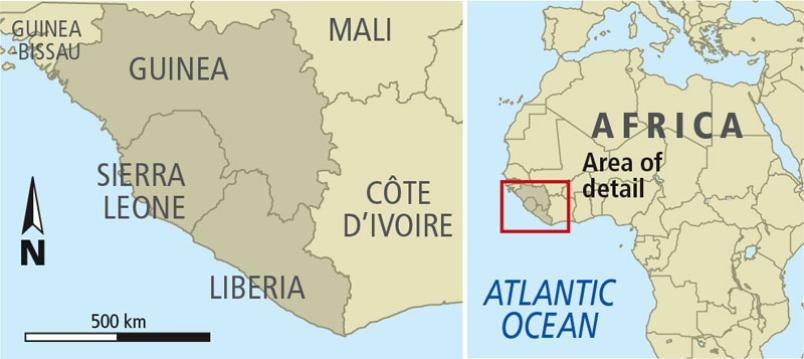
The 2013-2016 outbreak of Ebola in West Africa started in Nzerekore, whose proximity to busy borders hampered efforts to contain the virus. It went on to kill at least 11,300 people with the vast majority of cases in Guinea, Liberia and Sierra Leone.
Sporadic cases have appeared in central Africa in recent years, but currently the health systems of Guinea and other regional countries is already under severe strain given the coronavirus pandemic. Guinea has nearly 15,000 COVID-19 cases out of a country of about 12 million, including 84 deaths.
The WHO issued a weekend statement saying it was "ramping up readiness & response efforts to this potential resurgence" of the virus in the West African coastal region, also with Director-General Tedros Adhanom Ghebreyesus announcing Saturday it is now conducting "confirmatory testing" in the region.

(ZH) "Climate War" Accelerates ESG Craze Sparking Surge In Iridium Spot Prices

"Climate War" Accelerates ESG Craze Sparking Surge In Iridium Spot Prices

While Robinhood pajama traders pump penny stocks, low-float biotechs, and, of course, GameStop and other meme stocks, they seem to be missing the ESG-driven craze in uranium stocks. It's clear that investment flows into cleantech and ESG-related areas are hot under a Biden administration.
The growing interest in ESG is propelling governments to think green and adopt new technologies to power the green economy. Bank of America's equity strategist Haim Israel shared an institutional survey of the mounting interest in ESG investing with clients.
Besides uranium, readers should also check out iridium, the latest rare-earth metal to undergo a massive speculative rally.
Iiridium spot prices have risen more than 160% in two months. It comes "after supply shortages and expectations it will be used to produce hydrogen to power a greener economy," said Reuters.
In hydrogen technology, the metal is used as a catalyst in electrolysis to split water into oxygen and hydrogen, as a possible new power source that could replace fossil fuels in the coming decades.
Iridium CIF North West Europe Spot Price jumped to a record high of $4,390 an ounce last week, up from $1,685 on Dec. 12. This means iridium is worth more than double the weight of gold.
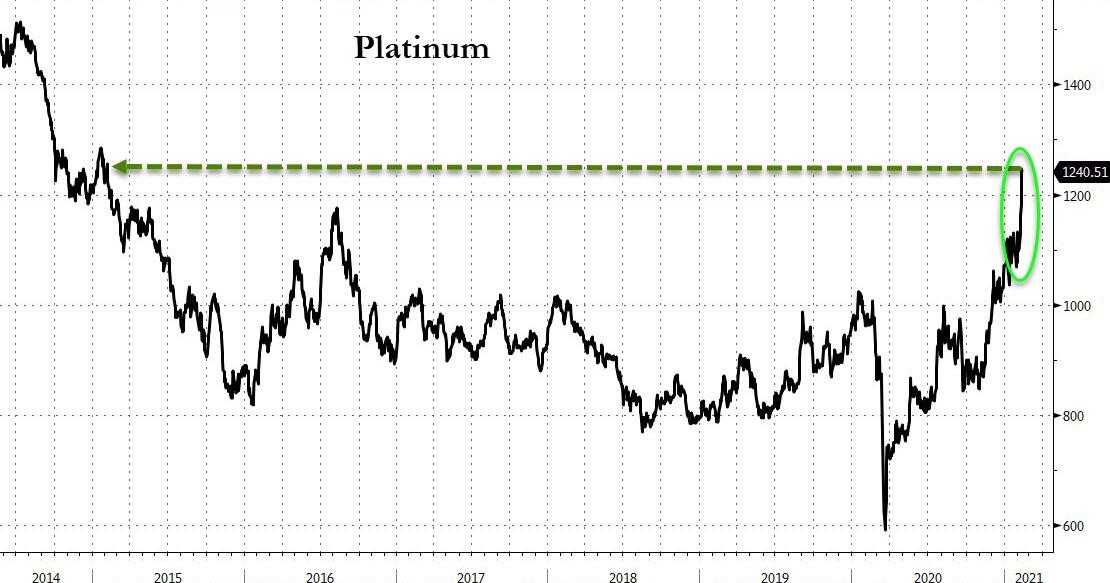
Iridium is a byproduct of platinum and palladium mining; its move higher echoes a similar rise in platinum, driven by rising emissions-control-based demand from ongoing green-energy agendas (and also supply issues).
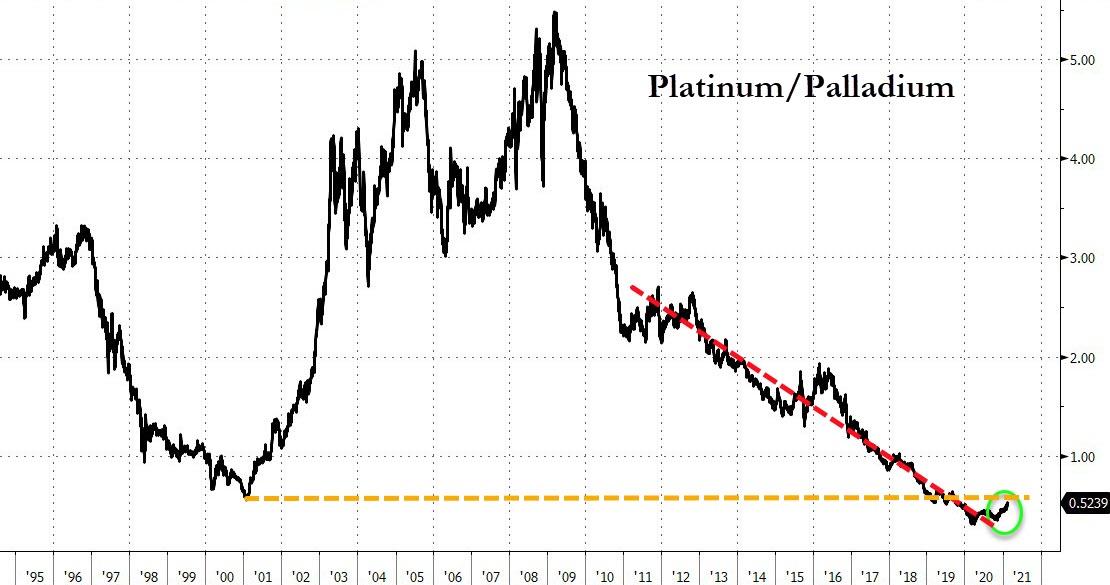
We noted last week that platinum has been trading at a steep discount to palladium (also used in auto catalytic converters).
In a similar vein to platinum, prospects of a green economy and supply woes in South Africa are some of the main drivers in iridium's parabolic up move.
"You've got increasing concerns on supply and very weak liquidity in the market," said Emma Townshend, an executive at Impala Platinum, which mines the metal.
"Iridium supply is not growing. Iridium demand is growing," Townshend said.
As explained by BofA's Israel, a "climate war" between the US and China is unfolding, which means both countries are "racing to deploy renewable energy, clean molecules such as hydrogen, and batteries for electric vehicles and storage at scale will be the key benchmark in this climate war."
BofA's chart shows when the world's superpowers are expected to deploy hydrogen technology to power their respective economies. Europe appears to be the leader with some capacity coming online in 2030.

However, not all is green as we have discussed previously, ESG mania has become a virtue-signaling buzzword on Wall Street that distracts from fundamental analysis and allocative efficiency. Last month, the commissioner for Texas's powerful energy regulator slammed the "woke" ESG fraud and said the newfound popularity of ESG investing could result in record industry bankruptcies and the loss of millions of jobs while doing little to help the environment.
ESG investing is in a speculative mania wrapped in a virtue-signaling package at the moment. Booms and busts are all too familiar in today's markets. Just don't be caught holding the bag.

CNN : Elon Musk invites Vladimir Putin for a conversation on Clubhouse

New York (CNN Business)
Elon Musk wants to have a conversation with Vladimir Putin on his new favorite social media app: Clubhouse.
On Saturday, the Tesla CEO tagged the Kremlin's official account to ask if the Russian president would like to join him in a conversation on the audio-only app.
"Would you like join me for a conversation on Clubhouse?," Musk said in a tweet on Saturday. He then followed up with a tweet in Russian, which translates to: "It would be a great honor to talk to you."

    As of Sunday, there was no reply to Musk's requests from the Kremlin's official presidential account. It's unclear if Putin is interested in speaking with the tech billionaire. Kremlin's presidential office didn't immediately respond to a request for comment.
    Putin isn't the only public figure Musk has tapped for a chat. Musk recently tweeted that he and billionaire rapper Kanye West are set to make an appearance on the platform. No dates have been announced for when the two will join forces for a Clubhouse meeting.
    Musk's move comes shortly after the CEO made his own debut on the buzzy, invite-only social conversation app last month. The conversation spanned everything from memes, crypto and even a surprise discussion with Robinhood CEO, Vlad Tenev following its role in the GameStop (GME) frenzy.