European telecoms: mixed signals
Investors want to see a green light for consolidation
A cynic may view Ericsson chief executive Borje Ekholm’s warnings about low returns as a self-serving jab at regulators. Ekholm’s description of Europe’s telecoms market as “non functioning” is linked to the idea that companies cannot cover their costs of capital and so are not investing in 5G. He is right that Europe’s rollout of faster wireless technology is lagging behind but it is not stagnant.
Consolidation would support profits, however. Rulemakers in the US and European telecoms markets have shaped their respective markets. In Europe, where lower consumer prices are the priority, there are typically four operators per major market. In the US there are three. Mobile price wars in Europe have lowered returns. Average revenues per mobile customer in Europe were less than half those in the US in 2019, according to Analysys Mason.
Rattled European investors have dragged down valuations. At 12 times two-year forward earnings, the European telecoms sector is about as cheap as it has been for seven years. This sets the scene for dealmaking. Low valuations already attract interest. Last year Spain's MasMovil was purchased in a private equity buyout. Cheap debt offers private buyers the chance to boost leverage and returns. A buyer paying a 20 per cent premium on current European average sector multiples, and lifting leverage to five times ebitda, achieves an internal rate of return of almost 15 per cent over six years, thinks Barclays.
European telecoms investors want to see a green light for consolidation. Hopes were raised last year when an EU court rejected the European Commission’s veto of Hutchison’s 2016 bid for UK mobile operator O2. The deal has not been resurrected. But tie-ups between O2 and broadband operator Virgin Media, and Iliad’s bid for Poland’s Play, suggest regulatory appetite for combinations will be tested later this year.
Yet even without M&A the 5G rollout is under way. Plus, telecoms tariffs appear to be joining in the reflation trade. Demand for 5G services should add to pricing power and profits in the sector.
Treasury Yields Surge Above March Spike Highs As Gamma-Selling Kicks In
10Y Treasury yields just surged above the spike high level of March...
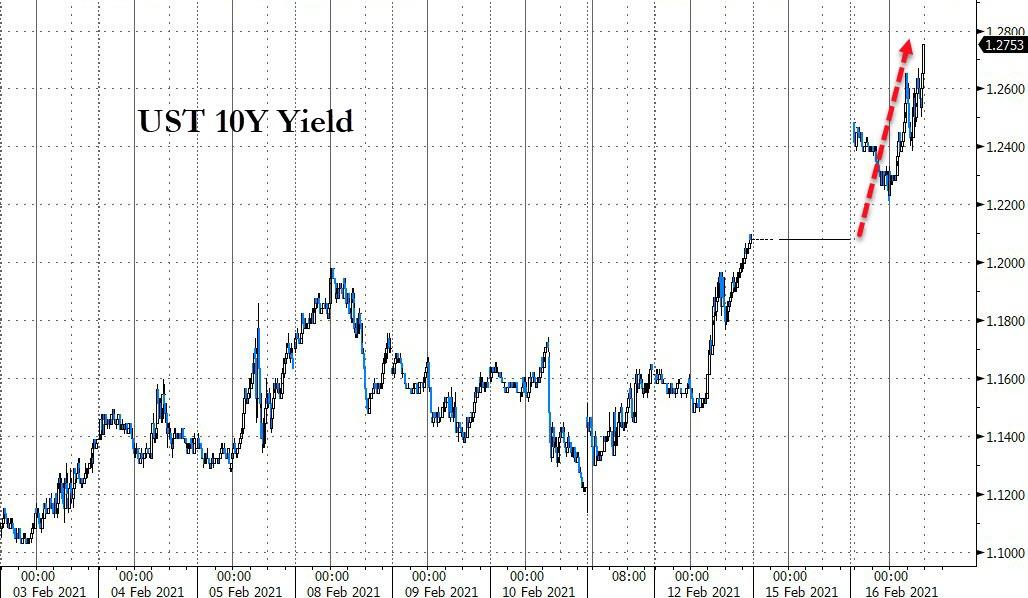
Source: Bloomberg
Back to its highest since February 2020...
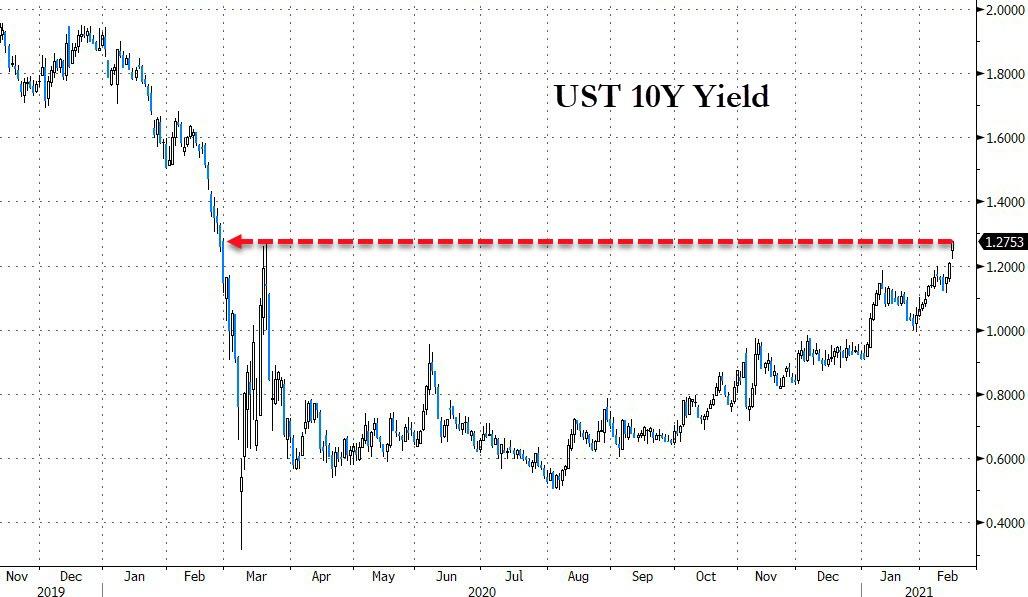
Source: Bloomberg
Additionally, this acceleration in yields is being driven by convexity, gamma-hedging flows. As Bloomberg's Stephen Spratt notes, Treasuries are at risk.
The break higher in yields may kick mortgage accounts into gear and open the door for convexity hedging flows. Meanwhile, the pop in volatility could bring out gamma-hedgers putting further upward pressure on yields.Monday’s sell-off, fueled by bunds and gilts, was in high volume. It’s not Treasuries moving on thin air, it’s real selling in futures by perhaps those who bought at the 1.20% level, widely seen as support, or those who took down $41b in new 10-year bonds last week.So far this year, there’s been no real sign of material convexity paying flows in swaps, though these may come back on the radar now as 10-year yields print the highest levels since March.What’s more, rates volatility on the exchange has popped. That’s bad news for the legions of program gamma-sellers after there’s already been gamma-tied paying flows in swaps as vol has risen. The latest pop in vol leaves the market ripe for another burst.The net result: high yields and wider swap spreads. Swap spreads are already wider across the curve, suggesting some savvy dealers may be already anticipating these flows.

Interestingly, net speculative positioning across bond futures has fallen significantly in recent weeks as yields have surged...
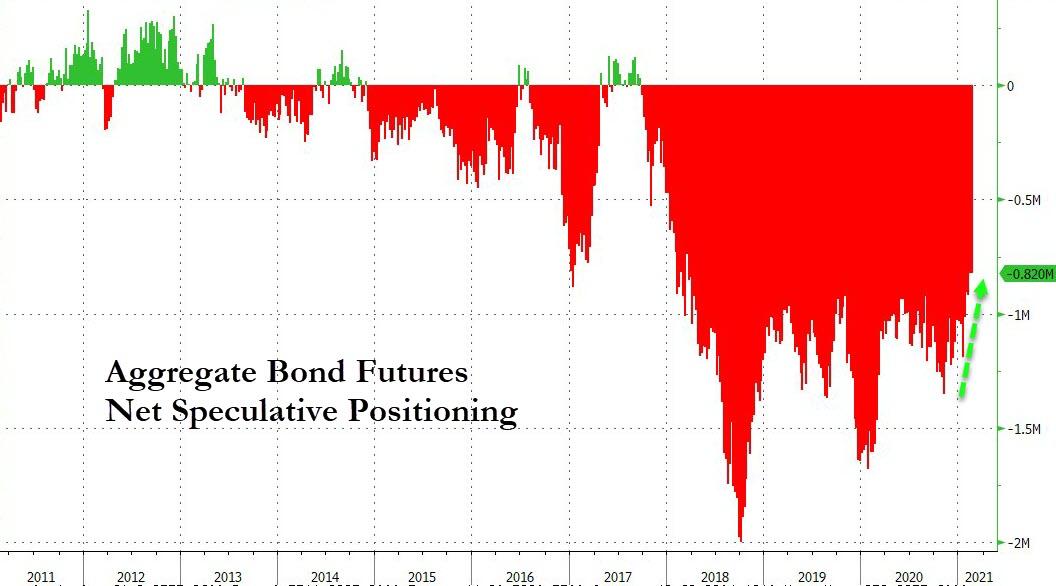
Source: Bloomberg
And it could be set to get worse as the historical relationship between 10Y yields and the Fed-sanctified Adrian Crump & Moench term premium of an equivalent maturity, suggests the 10-year yield needs to be higher than 2%, leaving room for plenty of catch-up. (Term premiums - which represent compensation for investors who take on the risk that the yield curve may not evolve as expected - explain almost 65% of movements in Treasuries.)
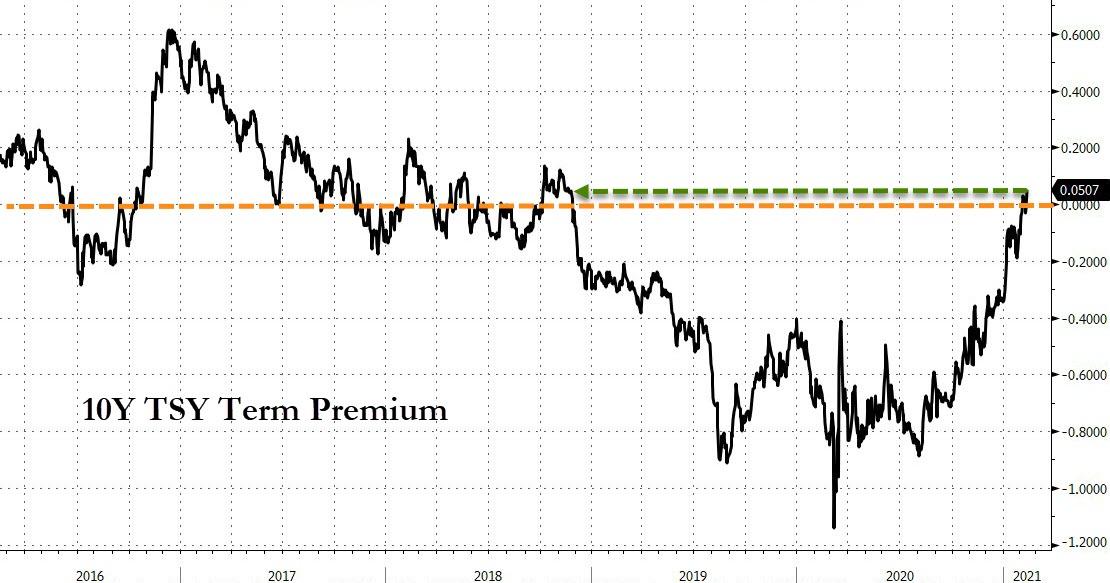
Source: Bloomberg
The projected value by term premiums is at odds with pricing in the swaptions vol market, which sees less than a 20% chance of the 10-year yield exceeding levels that prevailed at the start of 2020.
And if Nasdaq is to be believed, 10Y Yields should be above 3%!

Source: Bloomberg
The question is 0 who will be right? Will The Fed "allow" rates to go that high?
China Blocked Jack Ma’s Ant IPO After an Investigation Revealed Who Stood to Gain
Well-connected Chinese power players, including some with links to political families that represent a potential challenge to President Xi, were behind layers of opaque investment vehicles. The information added to concerns about financial risk and anger at Ma’s outspoken criticism.
When China’s leader Xi Jinping late last year quashed Ant Group’s initial public offering, his motives appeared clear: He was worried that Ant was adding risk to the financial system, and furious at its founder, Jack Ma, for criticizing his signature campaign to strengthen financial oversight.
There was another key reason, according to more than a dozen Chinese officials and government advisers: growing unease in Beijing over Ant’s complex ownership structure—and the people who stood to gain most from what would have been the world’s largest IPO.
In the weeks before the financial-technology giant was scheduled to go public, a previously unreported central-government investigation found that Ant’s IPO prospectus obscured the complexity of the firm’s ownership, according to the officials and government advisers, who had knowledge of the probe. Behind layers of opaque investment vehicles that own stakes in the firm are a coterie of well-connected Chinese power players, including some with links to political families that represent a potential challenge to President Xi and his inner circle.
Those individuals, along with Mr. Ma and the company’s top managers, stood to pocket billions of dollars from a listing that would have valued the company at more than $300 billion.
During his eight years as president, Mr. Xi has sidelined many of his rivals, and his hold on power now compares to that of Mao Zedong.
His initiatives have included campaigns against corruption, real-estate speculation and other high-risk financial activities. Mr. Xi has used the antigraft crusade to target both actual corruption as well as to strengthen his own hold on power. Ant’s IPO plan represented the kind of payday and accumulation of wealth that Mr. Xi has long frowned on.
An Ant spokesman said in a statement that the details of Ant’s shareholding structure were fully disclosed in the group’s prospectus and in its public business registration records.
Before the probe, regulators at the central bank were already worried about Ant’s business model. The company owns a mobile payments app called Alipay that is used by more than a billion people. It gives Ant voluminous data on consumers’ spending habits, borrowing behaviors and bill- and loan-payment histories, which the company has used to build a financial-services giant.
It has made loans to close to half a billion people, operates the country’s largest money-market fund and sells scores of other financial products. But it hasn’t had to follow the tough regulations and capital requirements that commercial banks are subject to. It makes profits from the transactions, while state-owned banks supply the majority of the funding and take on most of the risk.
“On one hand, you got a bunch of individuals potentially amassing large amounts of wealth,” one of the people familiar with the probe into the shareholders said. “Then on the other hand, much of the risk has been transferred to the state side.”
In a late-October speech, Mr. Ma harshly criticized regulators for rules he said were unnecessary and held back technology innovation. He infuriated top financial officials—some of whom were in the room for the speech.
The public blast of the state’s regulatory powers, coupled with the investigation into Ant’s ownership structure—which had started even before Mr. Ma’s speech—formed the basis for Mr. Xi’s decision to shut down Ant’s IPO and force the company to scale back lending and other banklike services, according to the people familiar with the probe.
Mr. Xi at the same time launched a campaign to rein in China’s technology sphere overall to prevent big firms like Ant from using their size and their troves of consumer data to engage in anticompetitive practices.
The moves indicate that after years of using a light hand with tech entrepreneurs, Mr. Xi is making greater demands for them to be aligned with the political priorities of the day.
Alarm bells
Some of Ant’s investors and the way their stakes were structured set off alarm bells as regulators dove into the details of the prospectus, the people familiar with the investigation said.
One is Boyu Capital, a private-equity firm founded in part by Jiang Zhicheng, the grandson of former Chinese leader Jiang Zemin. Many of Mr. Jiang’s allies have been purged in Mr. Xi’s anticorruption campaign, though he remains a force behind the scenes.
Another stakeholder with ties to Mr. Jiang, part of what is called the “Shanghai faction,” is a group led by the son-in-law of Jia Qinglin, a former member of the Politburo Standing Committee, the top echelon of the Communist Party.
Other backers seen as problematic include a real-estate developer who benefited from peer-to-peer lending schemes years earlier—schemes that nonetheless caused scores of investors to lose their life savings when they went bust, the people familiar with the probe said.
Mr. Ma’s connection with Jiang Zhicheng, a Harvard-educated “princeling,” as the offspring of China’s leaders are called, goes back to the years when Mr. Ma was expanding Alibaba Group Holding Ltd. , the e-commerce giant that is the source of his wealth as one of China’s richest people, and that eventually spawned Ant Group.
In 2012, the younger Mr. Jiang, also known as Alvin, helped Mr. Ma negotiate a deal to buy out half of Yahoo’s stake in Alibaba. A consortium of investors consisting of Mr. Jiang’s Boyu, China Investment Corp., and the private-equity arms of China Development Bank and Citic Group, all with strong political ties, financed part of the $7.1 billion needed. The nearly 5% stake in Alibaba the consortium received in return soared in value when the company listed on the New York Stock Exchange two years later.
Boyu became one of the early investors in Ant in 2016—although this time in a more roundabout way. Its base in Hong Kong was a potentially sticky issue at a time when Chinese regulations restricted “offshore,” or outside the mainland, ownership of payment services, a core part of Ant’s business.
According to commercial records viewed by The Wall Street Journal, Boyu first set up a subsidiary in Shanghai, which invested in a Shanghai-based investment firm. That firm then invested in a private-equity firm called Beijing Jingguan Investment Center, which in turn bought shares in Ant.
Beijing Jingguan is listed as one of 16 investors that provided a total of 29.1 billion yuan, or about $4.5 billion, to Ant in 2016. It also joined another group of funds that invested 21.8 billion yuan in Ant in 2018. Both investments gave Beijing Jingguan a nearly 1% stake in the company, according to Ant’s IPO document, putting it among its top 10 shareholders. The prospectus doesn’t mention Boyu’s involvement with Beijing Jingguan.
Mr. Jiang and other Ant investors mentioned in this article declined to comment.
Another stakeholder behind layers of investment vehicles is Beijing Zhaode Investment Group, controlled by Li Botan, the son-in-law of Mr. Jia, the former Politburo Standing Committee member with strong ties to Jiang Zemin.
Among China’s business and political elites, Mr. Li is best known for having helped establish in 2009 the Maotai Club, a private club in a historic house near Beijing’s Forbidden City that had been a haunt for princelings and their patrons until recent years.
Since he took power in late 2012, Mr. Xi has directed his ire at corruption in the party and the tales of members’ lavish banquets and harems of mistresses that had turned ordinary Chinese into cynics. Events like those held by Mr. Li’s Maotai Club were seen by the leader as harmful to the party. “You people, you either eat and drink yourselves into the grave, or die between the sheets,” he said at a meeting with senior officials earlier in his tenure, according to people briefed on the remarks.
Mr. Xi had little interest in having the Ant IPO funnel enormously lucrative financial stakes to well-known Chinese princelings, the people familiar with the probe said. For the leader, that could only widen the income gap and hurt his initiative to reduce poverty.
‘Red capitalist’
To fend off growing regulatory pressure as Ant became bigger, Mr. Ma made stakes in Ant available to an array of state stalwarts such as the national pension fund and China Investment Corp., the country’s massive sovereign-wealth fund, as well as its largest insurers.
Having such “strategic investors” on board—all poised to profit from the IPO—helped Ant’s stock-listing application sail through various levels of securities regulators last summer, the people familiar with the matter said. The application was approved in a month.
“Jack is very politically savvy,” said Gary Rieschel, a venture capitalist who helped manage Softbank’s investments in Asia in the early 2000s. “But if he hadn’t made them all rich, that wouldn’t have mattered.”
Over the years, with the political connections he garnered, Mr. Ma had become one of the most prominent of the “red capitalists”—tycoons with strong links to rulers—that have been a fixture of Communist reign in China.
For instance, after the 1949 takeover, the party turned to wealthy industrialist Rong Yiren to get the war-torn nation back on its feet. Giving business magnates some leeway and support also has worked in Beijing’s favor. Soon after China started to revamp its planned economy in the early 1980s, Liu Chuanzhi founded what is now Lenovo Group, the world’s largest maker of personal computers, with a loan from the government.
Mr. Ma, 56 years old, started Alibaba in 1999 in his apartment in Hangzhou, the capital of economically vibrant Zhejiang province. Softbank’s chief executive, Masayoshi Son, famously invested $20 million in Alibaba after a short meeting with Mr. Ma a year later. “I could smell him,” Mr. Son, known as a risk taker driven by instinct, recalled in a public talk in 2019. “We’re the same animal.”
The value of Zhejiang’s entrepreneurialism wasn’t lost on Mr. Xi, who ran the province from 2002 to 2007 and encouraged companies like Alibaba to expand.
Freewheeling finance
Some backers found among the layers of Ant’s shareholders highlighted the freewheeling attitude to internet finance, or fintech, the people with knowledge of the probe said. One was the real-estate developer Wang Xiaoxing, who raised funds from peer-to-peer lending firms that regulators say channeled the life savings of some mom-and-pop investors into high-risk financing schemes.
When those lending schemes went bust in the past few years, Ms. Wang found her way to invest in Ant through a private-equity fund set up by China International Capital Corp. , or CICC, a leading Chinese investment bank.
Some of Mr. Ma’s longtime friends also gained stakes in Ant through various investment vehicles. They include some of China’s wealthiest individuals, such as property tycoon Lu Zhiqiang ; Shi Yuzhu, chairman of the online gaming firm Giant Interactive; and Guo Guangchang, co-founder of Fosun International Ltd.
Mr. Guo’s Fosun, along with several other highflying private companies that took out large loans to finance overseas buying sprees, landed in hot water a few years ago for taking on too much debt. Regulators launched a series of investigations that curtailed the companies’ ability to borrow, shaking China’s business elite.
At a Beijing forum on Oct. 24—the same day Mr. Ma made his critical remarks at a Shanghai venue—Pan Gongsheng, a deputy governor at the People’s Bank of China, hinted at concerns over the nature of Ant’s owners.
“Some nonfinancial companies have blindly expanded into the financial industry,” Mr. Pan said, according to a transcript of his speech at the forum hosted by the prestigious Peking University. “Their shareholding structure and organizational structure are complex, and there are even prominent problems such as cross-shareholding, false capital injection and huge capital extraction,” he added.
Mr. Pan’s remarks were aimed squarely at Mr. Ma’s Ant, people close to the central bank said.
“Shareholding structure is one reason why we need to regulate firms like Ant,” an official at the central bank said.
For years, the kind of innovation Mr. Ma brought into the Chinese economy was in line with the leadership’s goal of turning China into a tech powerhouse. In recent years, Alibaba has also ventured into artificial intelligence and cloud computing, both deemed as key to China’s future.
There was some grumbling among officials in 2014 that Mr. Ma took Alibaba’s listing to New York, but the political environment was still encouraging, as evidenced by official moves to liberalize China’s currency and boost stock investing.
In 2015, that changed. Chinese stock markets crashed as a slowing economy popped a debt-financed stock boom. In the years since, the policy pendulum has shifted in favor of the state sector.
Mr. Ma had planned to list Ant on the new tech-oriented STAR Market in Shanghai, along with the market in Hong Kong, in an effort to please top leadership, according to people close to the company. The STAR Market was developed at the behest of Mr. Xi to create a Chinese stock market for tech firms that would rival Nasdaq.
The gesture did little to ease officials’ concerns about the billionaire’s plans.
Ant will now be restructured mainly as a financial firm subject to the kind of capital requirements applied to banks. The more stringent rules mean the firm may have to raise funds to beef up its capital base, opening a door for big state banks or other types of government-controlled entities to buy stakes. Existing shareholders’ stakes could be diluted as a result.
Ant’s key shareholders, senior managers and directors are also expected to be vetted by financial regulators, who will focus on examining their qualifications and sources of capital.
The officials close to the probe said it would take some time for Ant’s restructuring to be completed. “Whether the company can revive its IPO or not is not within the scope of the high-level government agenda right now,” one of the officials said.
SEC Signals a More Aggressive Stance Toward Wall Street
The regulator has rolled back a policy that helped companies navigate a risk in settling securities law violations
The U.S. Securities and Exchange Commission’s acting Democratic leadership hasn’t wasted time letting Wall Street know a new cop is on the beat.
SEC Acting Chair Allison Herren Lee last week said the regulator would roll back a policy giving publicly traded companies greater certainty about whether they will be able to maintain access to key regulatory exemptions after settling securities law violations. The move came as the SEC awaits the confirmation of Gary Gensler , President Biden’s nominee to head the agency.
The policy reversal followed another move to return discretion to SEC enforcement staff to approve formal investigation orders. While the practical impact of the policy changes could vary, their symbolic significance is clear, according to white collar defense lawyers.
“The pieces are in place for an aggressive era of enforcement,” said Kara Brockmeyer, a partner at the law firm Debevoise & Plimpton LLP and a former SEC enforcement official.
Under securities law, a company can be automatically disqualified from certain fundraising activities or regulatory exemptions if it is subject to an SEC enforcement action—unless it receives a waiver from the agency. Such so-called disqualification waivers became a controversial topic under the Obama administration, when two of the SEC’s Democratic commissioners accused the regulator of being too soft on repeat offenders.
The SEC under the Trump administration took a more business-friendly approach to the waivers. In a policy created in 2018 by former Chairman Jay Clayton, the SEC said it would notify companies about its decisions to grant waivers when its commissioners approved or denied settlements.
The policy allowed companies to withdraw from settlements if SEC commissioners voted to deny waivers.
Reversing the policy separates processes around negotiating settlements from ones regarding securing waivers, Ms. Lee said in a statement Thursday. While SEC commissioners must sign off on both settlements and waivers, the regulator’s enforcement division is in charge of negotiating the agreements and submitting them for approval. Waiver recommendations, on the other hand, are made by the SEC’s policy divisions.
“This return to the [enforcement] division’s longstanding practice ensures that the consideration of waivers is forward looking and focused on protecting investors, the market, and market participants from those who fail to comply with the law,” Ms. Lee said. Waivers shouldn’t be used as bargaining chips in settlement negotiations, she added.
The change could complicate settlement negotiations, Ms. Brockmeyer said: “It’s kind of like pleading guilty when you don’t know what the judge is going to sentence you to.”
The SEC’s two Republican commissioners on Friday released a statement saying they opposed the reversal. “Insisting that an entity that is willing to settle be left in the dark about whether its waiver application will be granted significantly alters the entity’s settlement calculus because it undercuts the certainty and finality that settlement might otherwise provide,” the commissioners wrote.
Even before Clayton’s policy on waivers, SEC commissioners rarely denied waivers to companies that applied for them, lawyers said. It is unclear whether the SEC under Mr. Gensler will take a harder line on approving waivers.
If the SEC does, some companies might hesitate to enter into settlements with the regulator, said Kyle DeYoung, a partner at the law firm Cadwalader, Wickersham & Taft LLP.
“Most people within the industry thought that Chair Clayton’s change was a good one,” said Mr. DeYoung, a former SEC enforcement official. Companies settling allegations of securities violations could make informed decisions, making the settlement process more efficient, he added.
Morgan Miller, a partner at law firm Paul Hastings LLP, said companies over the near term will have to be more aware of the knock-on effects of settling with the SEC.
“Going forward, companies and other regulated entities and individuals will have to weigh the likelihood of receiving a waiver post-resolution in determining whether or not to accept a particular settlement offer,” said Mr. Morgan, who also is a former SEC enforcement official.
Gapping down
In reaction to earnings/guidance:
- NEPT -21.1%, GILT -10.1%, PLTR -7.9%, USFD -1.9%, TRU -1.7%, APG -0.5%, YNDX -0.4%
Other news:
- CRTX -24.2% (provides regulatory update on development program for Atuzaginstat in Alzheimer's Disease)
- NNDM -8.5% (prices $500 million registered direct offering)
- GLMD -7.4% (announces proposed offering of ordinary shares)
- ARAV -4% (entered into a securities purchase agreement with Eshelman Ventures, LLC to sell 2,875,000 shares of common stock at a price of $7.29/share in a registered direct offering)
- COHR -1.2% (Coherent (COHR) to engage in discussions with II-VI (IIVI))
- VXX -0.8% (trading lower in response to strong US futures)
Gapping up
In reaction to earnings/guidance:
- BHP +7.5%, CEVA +4.5%, TRTN +3.8%, RXN +3.8%, VMC +3.7%, LPX +3.6%, GEO +3.3%, JELD +2.8%, NBEV +2.8% (also entered into a definitive agreement with investors to purchase 14.6 million shares of common stock in a private placement with purchase price for the shares of common stock at $3.96 per share) CTAS +2.2%, AAP +1.9%, AN +1.7%, ARD +1.7%, CVS +1.6%, HP +1.5%, LBTYA +1.3%, ZTS +1.3%, ACM +1.3%, MEDP +1.1%, IAA +1%
Select metals/mining stocks trading higher:
- RIO +5.5%, FCX +4.5%, AG +2.2%, PAAS +2%, SLV +0.8%
Select oil/gas related names showing strength:
- BP +6.5%, RDS.A +4.5%, MRO +4.1%, SLB +2.9%, HAL +2.9%, XOM +2.6%, XLE +2.4%, PSX +1.6%
Other news:
- GTHX +32.1% (receives FDA approval for COSELA)
- SESN +22.5% (FDA accepted for filing the Company's Biologics License Application for Vicineum for the treatment of high-risk, BCG-unresponsive non-muscle invasive bladder cancer, and granted the application Priority Review)
- IMAX +14.8% (reports record-breaking Chinese New Year opening weekend with $25 million, up 45% from previous best)
- STPK +14.6% (Jim Cramer came out very positive)
- AACQ +14.5% (M&A rumor of possible transaction with Origin Materials)
- STIC +13.1% (Northern Star Acquisition Corp.'s merger partner, Barkbox, Inc, announces 3Q21 guidance)
- PDAC +9.7% (Li-Cycle, North America's largest lithium-ion battery resource recycling company, to list on NYSE through transaction with Peridot Acquisition Corp)
- BWA +7.8% (acquires AKASOL AG for €727 mln)
- DPW +7.8% (buys 9.91% equity interest in SilverSun Technologies)
- BFLY +6.3% (closes transaction; sees 2020 full-year revenue of at least $45 million)
- SWAV +6.3% (announces that the company's sonic pressure wave therapy received Pre-Market Approval for severely calcified coronary artery disease from the U.S. Food and Drug Administration)
- IDEX +5.6% (files for 12,589,350 share common stock offering by selling shareholders)
- CLSD +5.2% (details presentation that highlighted several of the key attributes of axitinib and Clearside's suprachoroidal delivery of the agent)
- MT +4% (to commence share buyback program)
- MILE +3.3% (files for 7,846,666 share common stock offering; also files for 50,871,441 share common stock offering by selling shareholders)
- EXEL +2.5% (Announces Final Phase 1 Results from Clinical Trial Sponsored by the National Cancer Institute at ASCO GU for Cabozantinib in Combination with Nivolumab with or without Ipilimumab in Patients with Refractory Metastatic Genitourinary Tumors)
- LUV +2.4% (reports operational results)
- TPR +2.1% (files for mixed securities shelf offering, no amount given)
- IIVI +2.1% (Coherent (COHR) to engage in discussions with II-VI (IIVI))
Analyst comments:
- PLAN +5.2% (upgraded to Overweight from Equal-Weight at Morgan Stanley)
- ALB +3.4% (upgraded to Buy from Hold at Deutsche Bank)
- WISH +1.8% (upgraded to Buy from Hold at Loop Capital)