WWD : Adyen Growth Soars in North America, Teams With Dick’s

Adyen Growth Soars in North America, Teams With Dick’s
Net revenue growth jumped 70 percent in North America.

Last week, global payments solution provider Adyen released its most recent fiscal half-year results that showed net revenue growth swelling 70 percent in North America. Total net revenue for the company jumped 28 percent year-over-year to 379.4 million euros, and processed volume was up 29 percent to 174.5 billion euros.

In a letter to shareholders, the company said, “Amid the constantly shifting environment of the pandemic, we focused on best helping our merchants. We were able to help move volumes online swiftly when stores closed and facilitated safe operations in reopening scenarios, as all our point-of-sale devices enable contactless payments.”

Here, Brian Dammeir, president of North America for Adyen, discusses the company’s growth, what’s driving results and the company’s recent partnership with Dick’s Sporting Goods.

WWD: What do you see driving results moving forward?

Brian Dammeir: While we can’t comment on future predictions, the business has proven to be resilient during the pandemic due to the continuous diversification of our merchant base. We saw substantial growth in verticals like retail, in particular in the area of unified commerce, as well as in digital goods. Regional diversification is also beneficial when looking at growth. Adyen’s North America business saw a 70 percent growth [year-over-year] in net revenue. This reflects Adyen’s focus on merchant solutions that are future-proof and “meeting the moment” during the COVID-19 pandemic.

Adyen has been channel-agnostic from its inception and has been at the forefront of digital enablement for many merchants; these themes were only magnified during the pandemic with more and more merchants putting an emphasis on not only their digital channels but having a unified approach across all channels.

We feel confident that since we are constantly innovating with our merchants, based on changing consumer sentiment, that we will be ready to adapt as the effects of the pandemic on consumer payment preferences becomes clear.

WWD: Do you expect robust online sales and Adyen’s diverse merchant base to continue to bolster topline results?

B.D.: Again, we can’t comment on future predictions, but [last week]’s results have been consistent with past results and we do have a diverse merchant base driving our growth. We expect our merchant base to continue to diversify and expand as we focus on new verticals to innovate with and new markets to expand into.

It’s important to call out that despite the significant impact of the COVID-19 pandemic and related drops in travel and in-store retail volumes, we experienced substantial growth as online retail and digital goods volumes surged. During the closure of physical stores, we helped merchants move volumes online, and in reopening scenario we enabled safe operations as all of Adyen’s POS devices are contactless-enabled.

COVID-19 created relatively few new trends. Rather, it sped up trends that we expected to take five-plus years to manifest. From the shift from cash to cashless, to contactless payments and the digitization of commerce, these changing consumer behaviors were already in the works and we were already focused on helping our merchants achieve success with unified commerce.

We look forward to continuing that focus and being a catalyst for digital transformation with our merchants both now as they quickly adapt under COVID-19 and into the future as new circumstances shift consumer expectations around payments and commerce.

WWD: What was the impetus behind the partnership with Dick’s Sporting Goods? What consumer demands were they looking to address?

B.D.: Customers want a unified commerce experience, and that’s why we are thrilled to be working with Dick’s Sporting Goods to process all U.S. volume across all channels. Dick’s is a technology-first player in the retail space, so it was a natural fit for us to partner together. The clear trend in retail is toward “unified commerce” — taking a holistic approach to technology, payments, and customer experience — to ensure a consistent customer experience across all channels. Dick’s, with its focus on technology and fantastic customer experience, is embracing unified commerce with us.

Working with Adyen will provide Dick’s with a centralized view of transaction data across all channels, which will help them better understand their customers so they can provide personalized experiences. This, paired with Adyen’s unparalleled payment method coverage, POS devices, and online and in-app payment features, means that Dick’s will be able to concentrate more on the customer experience and expand their reach, all while doing so with Adyen’s single platform and integration.

Those experiences are more important than ever for customers who want to be able to pay how they want and wherever they want. Adyen will help Dick’s Sporting Goods set a new standard for consumers across channels and we look forward to seeing what we will accomplish together.

WWD: What do merchants need to know about the consumer demand for cashless and digital payments? Is this a permanent shift in consumer behavior?

B.D.: There are two main trends we are seeing that merchants need to be aware of — digital transformation as a whole and unified commerce. While many consumers may go back to their previous behaviors from before the pandemic, the data shows that large swaths of previously
“digitally hesitant” consumers have adopted these new channels during this time. COVID-19 will have catapulted large groups of people to use digital services as their primary channels and, for a good number of consumers, we expect that to be a permanent shift.

In that same vein, the idea of unified commerce is about offering a consistent platform and experiences to customers regardless of channel. The first change under COVID-19 was that consumers adopted new channels. Importantly, as consumers are getting more comfortable with approaching brands from multiple channels, their expectations around the consistency of experience across those channels has only gone up. This is forcing merchants to not only offer these channels but to evolve past “omnichannel” and toward “unified commerce.”

Consumers expect to have the same level of experience across channels, have their loyalty rewarded across channels, and be able to move seamlessly between those experiences. This is a monumental lift for many merchants to pull off but Adyen’s unified, single platform is there to make that transformation easier.

The focus for merchants should be on continuing to adapt to COVID-19 and what it means now, but also keeping in mind that this is a unique moment to rethink their infrastructure and approach to payments so that they can be future-proofed for the unseen consumer changes to come.

FT : China targets rare earth export curbs to hobble US defence industry

China targets rare earth export curbs to hobble US defence industry
Beijing asks industry executives if proposed restrictions will harm western contractors

China is exploring whether it can hurt US defence contractors by limiting the export of rare earth minerals that are crucial for the manufacture of F-35 fighter jets and other sophisticated weaponry, according to people involved in a government consultation.

The Ministry of Industry and Information Technology last month proposed draft controls on the production and export of 17 rare earth minerals in China, which controls about 80 per cent of global supply.

Industry executives said government officials had asked them how badly companies in the US and Europe, including defence contractors, would be affected if China restricted rare earth exports during a bilateral dispute.

“The government wants to know if the US may have trouble making F-35 fighter jets if China imposes an export ban,” said a Chinese government adviser who asked not to be identified. Industry executives added that Beijing wanted to better understand how quickly the US could secure alternative sources of rare earths and increase its own production capacity.

Fighter jets such as the F-35, a Lockheed Martin aircraft, rely heavily on rare earths for critical components such as electrical power systems and magnets. A Congressional Research Service report said that each F-35 required 417kg of rare-earth materials

The Chinese move follows deteriorating Sino-US relations and an emerging technology war between the two countries. The Trump administration tried to make it harder for Chinese companies to import sensitive US technology, such as high-end semiconductors. The Biden administration has signalled that it would also restrict certain exports but would work more closely with allies.

Beijing’s control of rare earths threatens to become a new source of friction with Washington but some warn any aggressive moves by China could backfire by prompting rivals to develop their own production capacity.

In a November report, Zhang Rui, an analyst at Antaike, a government-backed consultancy in Beijing, said that US weapons makers could be among the first companies targeted by any export restriction.

China’s foreign ministry said last year it would sanction Lockheed Martin, Boeing and Raytheon for selling arms to Taiwan, the self-ruled island that Beijing claims as its sovereign territory.

The proposed guidelines would require rare earth producers to follow export control laws that regulate shipments of materials that “help safeguard state security”. China’s State Council and Central Military Commission will have the final say on whether the list should include rare earths.

Rare earth minerals are also central to the manufacture of products including smartphones, electric vehicles and wind turbines.

Some executives and officials are, however, questioning the wisdom of formally including rare earths in the export control regime. They argue that it would motivate Beijing’s rivals to accelerate their own production capacities and undermine China’s dominance of the industry.

“Export controls are a doubled-edged sword that should be applied very carefully,” said Zhang of Antaike.

The Pentagon has become increasingly concerned about the US reliance on China for rare earths that are used in everything from precision-guided missiles to drones.

Ellen Lord, the top defence official for acquisitions until last year, told Congress in October that the US needed to create stockpiles of certain rare earths and re-establish domestic processing. She said the US had a “real vulnerability” because China floods the market to destroy any competition any time nations are about to start mining or producing.

In recent months, the Pentagon has signed contracts with American and Australian miners to boost their onshore refining capacity and reduce their reliance on Chinese refiners.

The US National Security Council did not respond to a request for comment.

Chinese rare earth miners themselves are worried about the enhanced power the regulations would give MIIT to control their output.

China began setting rare earth production limits in 2007 to keep prices high and reduce pollution but the policy is not legally binding and many miners regularly exceed their output quota. The latest regulations would allow the government to impose steep fines for unapproved sales.

“The new rule is not going to make China stronger in the global supply chain when local mines can’t operate at full capacity and an export ban is easier said than done,” said an executive, who asked not to be identified, at Guangdong Rare Earth Group, one of the nation’s largest rare earth groups.

In a statement, MIIT said the new law would help “protect national interest and ensure the security of strategic resources”.

According to government statistics, China’s demand for rare earths is so high that it has consistently exceeded domestic supply over the past five years, prompting a surge of Chinese imports from miners in the US and Myanmar.

A wide range of industries are driving demand for the strategic resource, including China’s electric vehicle and wind power generation sectors.

“China’s economic planners have failed to predict the surge in rare earth consumption,” said an executive at Gold Dragon Rare Earth Co in south-eastern Fujian Province.

“China’s own rare earth security isn’t guaranteed,” said David Zhang, an analyst at Sublime China Information, a consultancy. “It can disappear when the US-China relationship deteriorates or Myanmar’s generals decide to shut the border.”

While China’s dominance in rare earth mining is under threat, it maintains a near monopoly in the refining process that turns ores into materials ready for manufacturers.

The country controls about four-fifths of global rare earth refining capacity. Ores mined in the US must be sent to China as the US has no refining capacity of its own yet.

Industry executives, however, said China’s strength in refining had more to do with its higher tolerance for pollution than any technological edge.

>>> What to look at today - 16th of February 2021

A global equity rally marched on Tuesday and bonds fell further amid hopes a widening Covid-19 vaccine rollout will help boost the global recovery. Oil held an overnight gain as a U.S. cold snap roiled energy markets.
S&P 500 futures and Asian stocks pushed higher, though the move was pared after a Financial Times report that China is considering limiting rare earth mineral supplies to U.S. defense contractors. Japan’s Nikkei 225 Stock Averagetrimmed an advance of more than 2%, though remained above 30,000, leading gains in Asia with Hong Kong. U.S. markets were closed for Presidents’ Day on Monday and Chinese markets remained shut for the Lunar New Year holiday. The dollar fluctuated.
Ten-year Treasury yields jumped to almost 1.25%, the highest in almost a year, amid this week’s global debt selloff. In the U.S., an Arctic blast threatened to disrupt energy supplies, with crude oil trading around a 13-month high. Elsewhere, Bitcoin reached another record high, coming close to $50,000. Copper climbed to the highest in eight years.

Nikkei +1.28% Hang Seng +1.80% CSI Closed Shanghai Closed Shenzen Closed

Eur$ 1.2139 CNH 6.4120 CNY 6.4582 JPY 105.52 GBP 1.3926 CHF 0.8891 RUB 73.2901 TRY 6.9251 WTI$ 60.22 +1.26% GOLD 1823.34 +0.24% BTC $ 48,966

S&P +0.56% Nasdaq +0.55% EuroStoxx +0.08% FTSE +0.42% Dax +0.06% SMI +0.03%

Macro :
- U.K.’s Johnson Wants Current National Lockdown to ‘Be the Last’
- Europe Auto Sales Resume Steep Decline in January After Reprieve

Keep an eye on :
- AMBEA SS : Ambea 4Q Operating Profit Beats Estimates
- AZN LN : AstraZeneca Covid Vaccine Cleared for Emergency Use by WHO
- BSLN SW : Basilea 2021 Revenue Forecast Misses Estimates
- CARLB DC : Carlsberg Chairman Besenbacher to Step Back From Top Job in 2023
- ALCLS FP : Cytovia, Cellectis Announce Natural Killer Cells Collaboration
- Deliveroo IPO : Deliveroo to Kick Off London Listing in March, Sky News Says
- DNLM LN : Dunelm Holder William Lester Adderley Offers 15m Shares
- DSM NA : DSM 4Q Adjusted Ebitda Beats Estimates
- ERICB SS : Ericsson CEO Says Europe Has Non-Functioning Telecoms Market:FT
- EXS SS : Exsitec Holding Holder Standout Capital Holding Offers Shares, Offering by Holder Prices at SEK112/Share
- FINGB SS : Fingerprint Cards 4Q Oper Loss SEK326.8M Vs. Loss SEK15.3M Y/y
- FRA GY : Fraport Venture Gets Two-Year Extension of Antalya Concession
- LHA GY : Lufthansa Talking with Airbus, Boeing on Move to Smaller Jets
- MRN FP : Mersen Acquires Remainder of Fusetech Capital
- ML FP : Michelin FY Total Segment Operating Income Beats Estimates, Expects Rebound to Pre-Pandemic Level in 2022
- NRS NO : Norway Royal Salmon 4Q Operating Ebit Misses Estimates
- SGO FP : Saint-Gobain Sells Distribution Businesses in Spain and Italy
- FTI FP : TechnipFMC Set to Complete Energies Unit Spinoff Tuesday
- NDX1 GY : Nordex Gets 33MW Order for Netherlands Wind Farm; No Terms
- SZG GY ; Thyssenkrupp, Salzgitter Face Weather-Linked Disruptions: Platts
- SAN FP : Bristol-Myers, Sanofi Ordered to Pay $834 Million Over Plavix
- STMN SW : Straumann FY Ebit Beats Estimates
- SRCG SW : Sunrise Reports Y/Y Adj. Ebitda Growth of 2.2%
- SWEDA SS : Swedbank Chairman Doesn’t Rule Out Process on Damages Claim: DI
- TKA GY : Thyssenkrupp, Salzgitter Face Weather-Linked Disruptions: Platts
- VCT FP : Vicat FY Ebitda Beats Estimates
- WIHL SS : Wihlborgs FY Rental Income Misses Estimates
- ZAPME NO : Zaptec/Norway Holder Valinor Management Offers 7.4m Shares

(ZH) BofA Hints That Weimar 2.0 Could Be Coming

BofA Hints That Weimar 2.0 Could Be Coming
BY TYLER DURDEN
MONDAY, FEB 15, 2021 - 20:05
It's no secret that BofA's Chief Investment Officer has been warning that 2021 - the year of the vaccine - is one where real inflation (as opposed to financial) will run amok sooner or later, and in his latest Flow Show he repeats his two main contentions about how events will play out in the coming months, namely "the velocity of people will rise" and "the velocity of money will (also) rise".
Addressing the first, Hartnett writes that since the core 2021 trends will be "vaccine>virus", and "reopening>lockdown", this means that human mobility will rise & macro data will surge particularly in Q2 when investors should expect US GDP >10%, EPS >20% CPI 3-4% Y/Y, or an economy in fullblown overhating mode.
This taken in conjunction with secular trends of bigger government, economic nationalism, fiscal excess, dollar debasement, War on Inequality, there is little wonder inflation breakevens & lead indicators are surging...
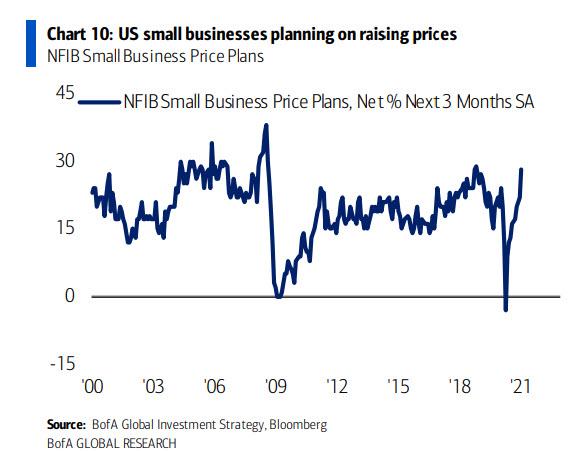
... and that small US business price plans over next 3 months are at highest since Nov’18...
... although whether or not they can actually achieve this is a different matter.
Stepping into the realm of monetary policy, and specifically its velocity, BofA reminds us that in the past 12 months, the US has raked in a $3.5TN (17% GDP) budget deficit, coupled with the injection of $13.3TN in global central bank liquidity (15% GDP).
Then, unafraid anymore to step on anyone's toes, Hartnett admits that "as in pretty much every one of past 12 years, policy stimulus in 2020/21 continues to flow directly to Wall St not Main St, inciting historic wealth inequality via asset bubbles," and to think of the mockery we were subject to (by random idiots) back in 2009 in later years, when we said the Fed's actions would lead to precisely this.
Anyway, Back fo BofA, which expects the "rising velocity of people" (vaccine>virus) in 2021 to engender rise in velocity of money, with the "inflation mutating" from Wall Street to Main Street, resulting in a pop in the nihilistic bubble.
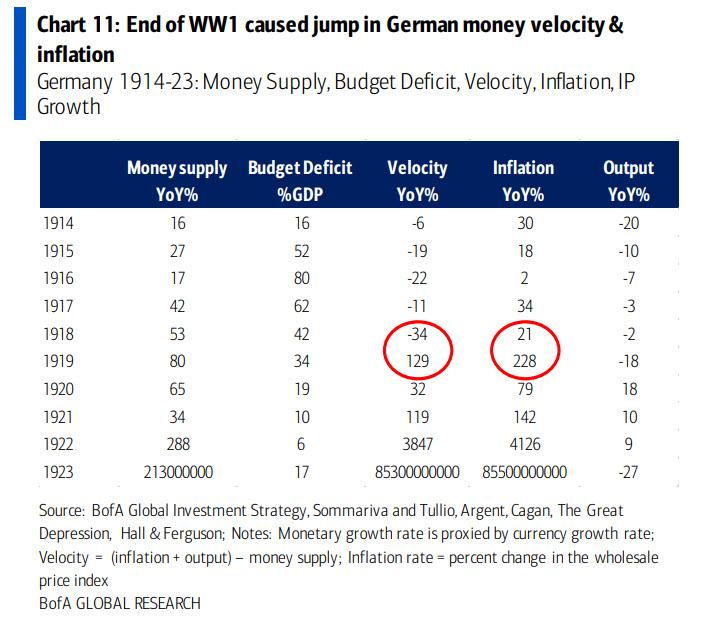
And here is the punchline: BofA reflects back on the post-WW1 Germany (whose armistice was on Nov 1918) as the "most epic, extreme analog of surging velocity and inflation following end of war psychology, pent-up savings, lost confidence in currency & authorities" and specifically the Reichsbank’s monetization of debt, similar of course to what is going on now.
There is, of course, another name for that period: Weimar Germany, and because we all know what happened then, it is understandable why BofA does not want to mention that particular name.
So what does all this mean for investing? Here is how Hartnett is positioned:
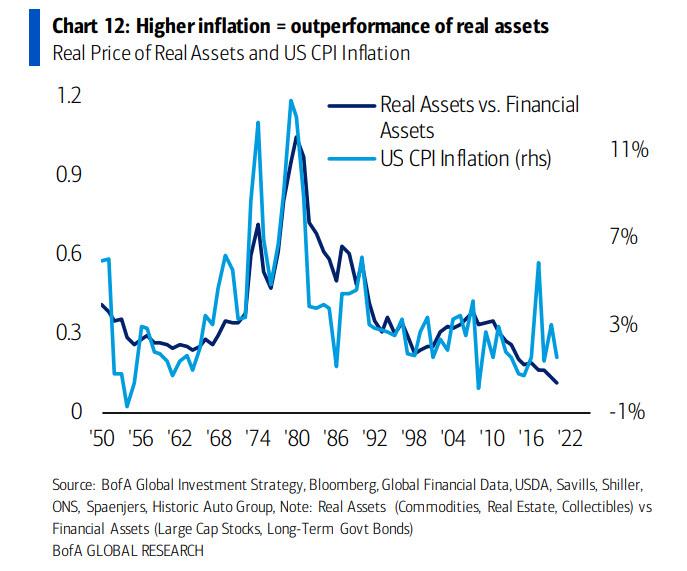
Real assets will outperform financial assets: we believe 2020 marked secular low for rates/inflation, and 2020s likely decade of inflation assets>deflation, and real assets>financial (i.e., buy commodity-linked exposure, sell duration, tech and growth).
And to that point, Hartnett notes that since 1950 real assets (e.g. commodities, real estate, collectibles) have a > 70% correlation with inflation vs. just 5% correlation with financial assets (stocks & bonds).
Translation: Stanley Druckenmiller, and his "thesis trio" of...
  • short long-end Treasuries
  • very long commodities
  • "very very" short the dollar.
... is about to make another killing.

>>> Europe : Brokers Upgrades & Downgrades - 16th of February 2021

>>> Up
* Allegro Raised to Buy at Goldman; PT 91 zloty
* Buzzi Unicem Raised to Equal-Weight at Barclays; PT 25 euros
* Deutsche Boerse Raised to Outperform at Credit Suisse
* Euronav Raised to Buy at Cleaves Securities; PT 9.89 euros
* Fortum Raised to Buy at Commerzbank; PT 26 euros
* Hafnia Raised to Hold at Cleaves Securities; PT 17 kroner
* Hunter Group Raised to Buy at Cleaves Securities; PT 4.40 kroner
* Lanxess Raised to Buy at Baader Helvea; PT 75 euros
* Nordea Bank Raised to Overweight at JPMorgan; PT 95 kronor
* Okeanis Eco Tankers Raised to Buy at Cleaves Securities
* Petropavlovsk Raised to Add at Peel Hunt
* Rotork Raised to Buy at Jefferies; PT 420 pence
* Royal Mail Raised to Hold at Jefferies; PT 450 pence
* Thyssenkrupp Raised to Add at AlphaValue
* Victrex PT Raised to 2,675 pence from 2,475 pence at Jefferies
* Vinci Raised to Buy at Grupo Santander; PT 98 euros

>>> Down
* Air France-KLM Cut to Underperform at Bernstein; PT 1 euro
* Jyske Cut to Hold at ABG; PT 270 kroner
* Legrand Cut to Hold at SocGen; PT 82 euros
* Melia Hotels Cut to Underperform at Oddo BHF; PT 5 euros
* Swedbank Cut to Hold at Deutsche Bank; PT 188 kronor
* Swedbank Cut to Neutral at JPMorgan; PT 180 kronor
* Vivendi SE Cut to Neutral at Citi

>>> Initiation
* Delivery Hero Resumed Overweight at Morgan Stanley; PT 160 euros

>>> Call
* Delivery Hero Overweight at Morgan Stanley, in Top Sector Picks
* Petropavlovsk Earnings Potential Overlooked, Peel Hunt Upgrades
* Rotork Sales Outlook Positive, Valuation Appeals, Jefferies Says
* Royal Mail Raised to Hold at Jefferies as Trends Will Normalize

FT : Ericsson chief slams Europe’s ‘non-functioning’ telecoms market

Ericsson chief slams Europe’s ‘non-functioning’ telecoms market
Swedish telecoms equipment maker is worried the continent is falling far behind China and US in 5G rollout

Europe has a “non-functioning” telecoms market, according to the chief executive of Ericsson, leading to a lack of investment and problems for manufacturers in competing with the US and China.

Borje Ekholm, chief executive of the Swedish telecoms equipment maker, told the Financial Times that it was rational for Europe’s telecoms operators not to invest in next generation 5G networks, because many of them failed to earn their cost of capital.

“The problem is that the guys that are supposed to build out that infrastructure don’t make any money. There is a very big cost to waiting,” he added.

Ericsson is worried that Europe is falling far behind China and the US in the rollout of 5G, which it argues will be crucial for the digitalisation of businesses. It has forecast that 5G could boost the continent’s gross domestic product by 2 percentage points a year.

“Without [5G], general industry will be less efficient and less competitive. Without the infrastructure, it’s hard to develop the digital industry, and that impacts huge value potential and potentially millions of future jobs,” said Ekholm.

The European 5G equipment makers — Ericsson and Finland’s Nokia — also have a big strategic and security role, as the bloc grapples with how much market access to give to their Chinese rival Huawei.

European countries including France, Poland and the UK have placed more restrictions on Huawei’s network access after heavy pressure from Donald Trump’s administration over perceived security risks. European diplomats expect a similar tone from Joe Biden’s government.

Europe has dozens of telecoms operators, but attempts to consolidate in some countries have been blocked by Brussels because of competition worries, leading some to complain their profitability lags far behind bigger US rivals.

Several countries, including Germany and the UK, are pushing for the creation of additional telecom equipment makers, as well as the opening up of networks to other companies.

Ekholm expressed surprise that Europe would do anything to undermine Ericsson and Nokia, as telecoms was one of the few technology sectors where the continent had “strategic autonomy”, he said. He added: “It is interesting to see that now there is a discussion about giving EU subsidies to develop competing companies, mostly they are based in the US and Asia.”

The Ericsson chief executive also renewed his criticism of Sweden’s decision to ban Huawei from its telecoms networks because of concerns about spying and technology theft, warning that doing so ran “significant risk of hurting our ability to compete on a global scale”.

He said he had two concerns about the ban: that other countries could “restrict free trade”, endangering the 99 per cent of group revenues that came from outside Ericsson’s home country; and that it was vital for Ericsson “to be in markets at the forefront of tech development: China and the US”.

He added: “For us to have a presence in both China and the US allows us to be a global tech leader. It is high risk to be only in one ecosystem and not the other. It could ultimately lead to the Chinese ecosystem developing faster thanks to its scale.”

Huawei has always denied it presents a security threat to countries that buy its 5G equipment.

WSJ : Bill Gates Has a Master Plan for Battling Climate Change

Bill Gates Has a Master Plan for Battling Climate Change
The co-founder of Microsoft became obsessed with developing clean tech through his philanthropic work. With a new book, ‘How to Avoid a Climate Disaster,’ and a cadre of billionaire partners, he now has an action plan for ending the world’s carbon dependency.

See pdf attached

WSJ : Ebola Returns to West Africa as Region Battles Covid-19

Ebola Returns to West Africa as Region Battles Covid-19
Authorities and World Health Organization rush to roll out vaccine to halt spread of twin outbreak

Health officials in Guinea are rushing to contain the first outbreak of the deadly Ebola disease in the region since 2016, days after authorities detected new cases of the hemorrhagic fever in the Democratic Republic of Congo, testing a continent that is already battling the coronavirus pandemic.

Guinea was one of the three most-affected countries during the 2014-2016 epidemic. The current outbreak began in late January, but was only identified as the Ebola virus on Sunday, health officials said, suggesting it may have spread substantially in the intervening weeks.

The outbreak four years ago left more than 11,000 dead across West Africa. The new outbreak comes as the continent grapples with a steady rise of coronavirus infection rates, driven at least in part by a more transmissible variant first detected in South Africa.

The outbreak also comes shortly after Congo, which has faced more Ebola outbreaks than any other nation in the world, also detected cases in the restive region of North Kivu. Health experts hope the availability of an Ebola vaccine will help bring the outbreak swiftly under control.

Guinea’s health minister Remy Lamah on Monday said the government was successfully identifying those at risk and was well prepared to combat a new resurgence. “The government calls upon the population in the affected areas to respect prevention measures,” he said.

But aid agencies warned that the upswing in Ebola cases and Covid-19 infections could create a sequence of events that leads to major food insecurity and in the case more violence in the region.

The Ebola virus kills by shutting down the body’s organs and draining victims of the fluids that keep them alive. The virus has historically claimed as many as 9 in 10 patients, but the deployment of new vaccines and experimental treatments reduced death rates to around two-thirds during the last outbreak, according to the World Health Organization.

The WHO has pledged emergency aid and dispatched a team to work with officials from Guinea’s health ministry to the remote region of N’Zerekore, located around 500 miles east of the capital, Conakry, near the border with Liberia.

According to the health ministry the outbreak started after a nurse at a local hospital fell sick and died on Jan. 28. At least two people who attended the nurse’s funeral have also since died after presenting with Ebola-like symptoms, including diarrhea, vomiting and bleeding. At least four infected people were also admitted at isolation units where they are receiving treatment, the health ministry said.

Authorities sent samples from patients to the national laboratory in Conakry, which confirmed the results on Sunday. The second round of tests is being carried out at a specialized laboratory in neighboring Senegal to identify the strain of the virus, the WHO said.

Panic has gripped the region since the outbreak was confirmed. Health authorities in Sierra Leone and Liberia have been placed on high alert and health workers have been dispatched at border crossings to screen travelers and perform surveillance.

Since the end of the 2016 outbreak in West Africa, researchers have discovered new vaccines and drugs that have proved effective against the virus. Last month, the WHO said it was creating a global emergency stockpile of around 500,000 doses of the Ebola vaccine to help quell future outbreaks, although only 7,000 were available at the time of the statement.

The WHO said it would help Guinea to procure the Ebola vaccine, which has proven instrumental in controlling outbreaks in Congo. A vaccination campaign began in eastern Congo on Monday in the city of Butembo after the arrival of 1,200 doses.

But experts warn that the latest outbreak is particularly worrying for Congo, which is seeing a spike in coronavirus cases and is still reeling from the outbreak of Ebola last year.

Congo battled the disease for more than two years until the outbreak, which infected more than 3,500 people and left 2,280 dead, was declared over in June. To suppress the virus, the government had to overcome attacks on clinics and funeral workers, as well as some families that tried to hide sick relatives from authorities.

During the latest outbreak, the first new case in eastern Congo was identified as a woman whose husband survived Ebola during the last outbreak. Health officials are now racing to confirm through genomic sequencing whether the woman may have contracted Ebola from her husband, since the virus can sometimes linger in the bodily fluids of survivors.

“These communities are still trying to rebuild from the impact the last Ebola outbreak had on their health systems, as well as the emotional trauma from an increase in violence, particularly against women—all whilst fighting Covid-19,” said Kate Moger, International Rescue Committee’s regional vice president.

FT Lex : Arnault/Mustier Spac: winging it

Arnault/Mustier Spac: winging it
Pegasus Europe aims to thaw European reserve towards special purpose acquisition vehicles

Hopefully, any takeover featuring Bernard Arnault and Jean Pierre Mustier will be as smart as their suits. The French billionaire — via family office Financière Agache — and the former UniCredit boss are joining forces for that most fashionable of financings, a special purpose acquisition vehicle. These give ex-chief executives the chance to capitalise on fame gained from running big banks without so many restrictions.

Tidjane Thiam, Sergio Ermotti and Martin Blessing, formerly of Credit Suisse, UBS and Commerzbank, have similar plans. The question is whether the new Spac pack can find compelling targets in European financial services. The sector they know best — fragmented, politicised and beset by low rates — looks less buzzy than the US hunting grounds of Wall Street originators.

Spacs are a top-of-the market phenomenon. Investors who buy into the initial public offerings back the reputed deal-doing prowess of Spac co-founders. There is no operating business to scrutinise until a takeover target is identified. Rewards are potentially huge. Spac founders often receive 20 per cent of the listing’s shares for a nominal fee.

What was a backwater within US equity markets a decade ago has become a mainstay for IPO lead managers. Spacs made up 49 per cent of all US listings by value last year, according to Dealogic.

Pegasus Europe, named after the mythical flying horse, aims to thaw European reserve towards Spacs. Issuance has averaged just 2 per cent of all European IPOs in the past decade. Only about five are launched annually — an eighth of the US average.

Pegasus is the vehicle of Arnault, Mustier, former UniCredit executive, Diego De Giorgi and Tikehau Capital. It will list in Amsterdam, the post Brexit market of choice. The partners correctly perceive a lack of European growth capital outside highly-leveraged private equity. This impedes businesses whose cash flow growth lags behind sales or innovation. Piquantly, Amsterdam-listed Tikehau is itself active in private equity.

However, Pegasus’s happy hunting grounds look pretty heavily picked over: asset management, insurance and diversified financials. There is plenty room for consolidation — and to overpay as well. Private equity funds have $2.5tn in so-called dry powder.

In the UK, the most prominent Spac-type deals of recent years involved well-known financier Nat Rothschild. His heavily-hyped natural resources groups Bumi and Genel were fraught with problems. The new breed of European Spac specialists needs to dispel that memory with deals that do better.