>>> Up
* Aggreko Raised to Neutral at Credit Suisse; PT 880 pence
* Coloplast Raised to Equal-Weight at Barclays; PT 890 kroner
* Derwent London Raised to Buy at HSBC; PT 3,770 pence
* Flutter PT Raised to 18,700 pence from 17,500 pence at Jefferies
* Galp Raised to Buy at Goldman; PT 13 euros
* Great Portland Raised to Buy at HSBC; PT 815 pence
* Inchcape PT Raised to 890 pence from 810 pence at Jefferies
* Schouw Raised to Buy at SEB Equities; PT 710 kroner
* Solaria Energia Raised to Buy at Goldman; PT 25.50 euros
* TITC BB Raised to Outperform at Piraeus Securities S.A.
* TITC BB Raised to Outperform at Piraeus Securities S.A.
* Vestas Raised to Hold at HSBC; PT 1,070 kroner
>>> Down
>>> Down
* CGG Cut to Hold at SocGen; PT 1.17 euros
* Corestate Cut to Hold at Jefferies; PT 14 euros
* Corestate Cut to Hold at Jefferies; PT 14 euros
* Covestro Cut to Sell at Citi; PT 57 euros
* Elior Group Cut to Hold at Stifel; PT 7 euros
* Erste Cut to Neutral at JPMorgan; PT 28 euros
* Quadient SA Cut to Add at AlphaValue
* Repsol Cut to Neutral at Goldman; PT 13 euros
* Richter Cut to Hold at HSBC; PT 9,000 forint
* Snam Cut to Neutral at Goldman; PT 5.10 euros
>>> Initiation
* Snam Cut to Neutral at Goldman; PT 5.10 euros
>>> Initiation
* BMO Commercial Property Trust Ltd Rated New Add at Peel Hunt
* Capita Reinstated Neutral at Goldman; PT 60 pence
* Capita Reinstated Neutral at Goldman; PT 60 pence
* LVMH Resumed Buy at Citi; PT 620 euros
* Picton Property Rated New Add at Peel Hunt; PT 100 pence
* UK Commercial Property Rated New Add at Peel Hunt; PT 80 pence
>>> Call
* Citi Now Bearish on Diversified Chemicals, Covestro Cut to Sell
>>> Call
* Citi Now Bearish on Diversified Chemicals, Covestro Cut to Sell
* Flutter Gets Street-High PT at Jefferies on U.S. Growth Scope
Asian stocks fell Monday with U.S. equity futures as higher Treasury yields tempered optimism over President Joe Biden’s $1.9 trillion pandemic relief plan and the growth outlook. Crude oil jumped.
Tech stocks struggled as China and Hong Kong led the regional retreat. Nasdaq 100 futures underperformed while European contracts rose. Ten-year Treasury yields remain in focus, ticking up. U.S. stocks rebounded Friday and the 10-year yield touched 1.6% after jobs data beat estimates.
Oil surged after Saudi Arabia said the world’s largest crude terminal was attacked, though output seemed to be unaffected. Meanwhile, the U.S. spending plan moves to the House following Senate passage of the legislation. The bill’s progress and strong Chinese export data bolstered economic prospects.
Nikkei -0.42% Hang Seng -1.27% CSI -2.78% Shanghai -1.71% Shenzen -2.64%
Eur$ 1.1908 CNH 6.5230 CNY 6.5084 JPY 108.39 GBP 1.3829 CHF 0.9318 RUB 74.1138 TRY 7.5417 WTI$ 67.47 +2.10% GOLD1,706 +0.35% BTC 50,550 -500
S&P -0.39% Nasdaq -1.15% EuroStoxx +0.69% FTSE +0.91% Dax +0.50% SMI -0.93%
Macro :
- Frost Says EU Should Shake Off Remaining ‘Ill Will;’ Telegraph
S&P -0.39% Nasdaq -1.15% EuroStoxx +0.69% FTSE +0.91% Dax +0.50% SMI -0.93%
Macro :
- Frost Says EU Should Shake Off Remaining ‘Ill Will;’ Telegraph
- Coupang’s $3.6 Billion IPO Shows U.S. Remains King for Tech IPOs
- Stimulus-Fueled Risk Bounce Likely to Come With Higher Yields
- Perfect Storm Stares Emerging Markets on Steeper Curves: SocGen
- European ESG Funds Return 1.9% This Year, Outperforming MSCI
Spacs :
- Sportradar SPAC Deal Values Company at $10 Billion: Sportico
- Crowd-Safety Company Evolv Going Public in $1.7 Billion SPAC Merger
- Cazoo Weighs Merger With Blank-Check Firm Ajax I, Sky Reports
- SPAC Mania Missed This EV Boat Startup: Brooke Sutherland
- SPACs May Give Oil Producers an Express Route to Clean Energy
Keep an eye on :
Keep an eye on :
- ADS GY : Options Traders Expect Greater Earnings-Day Moves in Adidas
- AIR FP : Airbus Logs 92 Order Cancellations in February
- AKH NO : Aker Clean Hydrogen Raises NOK3.45b in Private Placement
- AKER NO : Aker Sets Up Seetee to Invest in Bitcoin Projects and Companies
- AAPL US : Apple’s Valuation, Few Catalysts Weighing on Stock: Bernstein
- ATA FP : Atari Setting Up Crypto Casino to Tap Into Nostalgia and NFTs
- BAMI IM : Banco BPM, Cattolica Amend Bancassurance Partnership Terms
- BAVA DC : Bavarian Calls Preclinical Results for Covid Vaccine ‘Strong’
- BEI GY : Siemens Energy to Replace Beiersdorf in DAX Index
- BEAN SW : Belimo FY Ebit Meets Estimates
- CASS IM : Cattolica Tells Regulator That Board Will Present Resignation
- CEC GY : Ceconomy Says Unit CEO Leaving to Run Futbol Club Barcelona
- Deliveroo IPO : Deliveroo IPO Expected to Include GBP50m Share Sale to Customers
- Deliveroo IPO : Deliveroo IPO Expected to Include GBP50m Share Sale to Customers
- DESN SW : Dottikon Says Books Are Fully Covered
- EDP PL : Texas Freeze Cost EDP ‘Low Tens of Millions’ of Dollars
- ELE SM : Endesa Acquires 519MW of Solar Projects from Arena: Expansion
- MC FP : Ralph & Russo Defers Staff Payments Amid Virus: Sky News
- MBB GY : MBB Unit Friedrich Vorwerk Seeks About EU90m in Frankfurt IPO
- MITRA BB : Mithra, Searchlight Pharma Say Estelle Approved in Canada
- MKS LN : Marks & Spencer to Expand Online Reach in Latest Overseas Foray
- NOVN SW : NHS England Agrees to Fund Novartis Gene Therapy Zolgensma
- ORSTED DC : Orsted Chairman Says Green Hydrogen Key Part of Strategy: Borsen
- RLF SW : Relief Board Approves Issuance of 125 Million New Shares
- ROG SW : Roche Withdraws U.S. Indication for Tecentriq in Bladder Cancer
- SEM PL : Semapa’s Board Says Sodim’s Takeover Bid Is ‘Adequate’
- ENR GY : Siemens Energy to Replace Beiersdorf in DAX Index
- SON PL : Sonae to Buy 10% of Sonae Sierra from Grosvenor for EU82.16m
- SEV FP : Suez Won’t Comment on Market Rumors, Renews Call for Talks
- UHR SW : Swatch Group’s Longines Targets 2 Billion Francs in Sales: NZZ
- STLN SW : Swiss Steel Says Finma Rejected Liwet Application for Revision
- TIT IM : TIM Says Cassa Depositi Filed Slate for Statutory Board Renewal
- TRELB SS : Trelleborg Interesting Option Among Industrials, Buy Stock: DI
- TRYG DC : Tryg Plans to Be Carbon Neutral in 2023, Borsen Reports
- VLA FP : Valneva, Pfizer Start Phase 2 Study for Lyme Disease Candidate
- VIFN SW : Vifor, Cara Announce FDA Priority Review of NDA for Korsuva
- VOW GY :
- WALWIL NO : Wallenius Wilhelmsen CEO Craig Jasienski Leaves; Wist Acting CEO
Another Market Paradox: Wall Street Struggles To Explain Record Equity Inflows Amid Stock Turmoil
Something bizarre is happening in the stock market: for the past three weeks stocks - and especially tech - has gotten hammered, with the Nasdaq briefly sliding into a 10% correction while the S&P has also been hard hit (although one can't say the same for reflation stocks such as energy which have soared in recent weeks). Some other notable casualties: Apple has tumbled 15% since late January. Tesla has lost more than a quarter-trillion dollars in market value in three weeks, and more than $1.5 trillion has been wiped off the Nasdaq in less than a month.
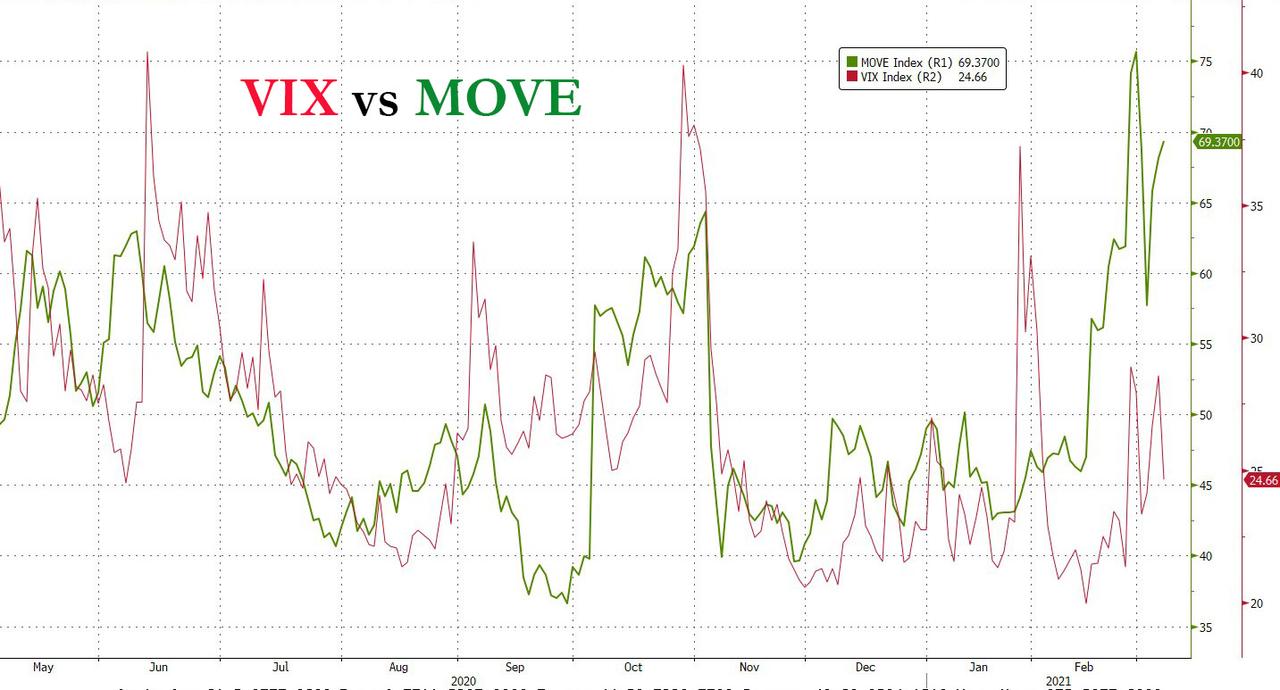
And yet, despite this hit to risk assets on the back of the recent in surge in interest rates, accompanied by a parallel spike in both the VIX, and its bond market equivalent, the MOVE index...
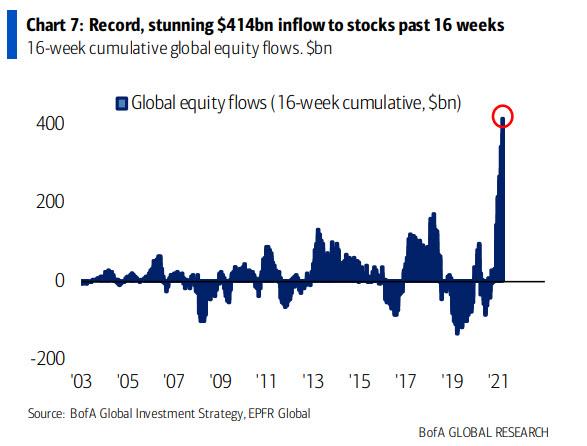
... on Friday we reported that according to the latest EPFR fund flow data, $22.2Bn in new money flowed into equities last week, following the previous week's massive $46.2Bn inflow which was the 3rd biggest on record, bringing the total 16 week inflow to $436BN, a stunning burst of inflows as shown in the chart below.
So bizarre has been this divergence - historically, investors have always pulled money during times of stress and heightened volatility, instead they are plowing record amounts of cash into stocks now - that Goldman's David Kostin dedicated his Weekly Kickstart report to the topic. In a note titled "Rising rate anxiety roils share prices but also supports outlook for strong equity inflows", the Goldman chief equity strategist writes that as "rates rose, and equities fell, long-duration growth stocks plummeted, but equity funds continued to see large net inflows."
Equity mutual fund and ETF inflows have totaled $163 billion since the start of February, the largest five-week inflow on record in absolute dollar terms and third largest in a decade relative to assets. Even though the recent backup in rates has weighed on equity prices broadly, the pace of inflows into equity funds during the last few weeks has accelerated compared with the start of the year.In contrast, weekly flows into bond funds averaged roughly $10 billion in February, 50% less than weekly inflows in January. In addition, money market funds have seen net outflows of $34 billion during the past month.
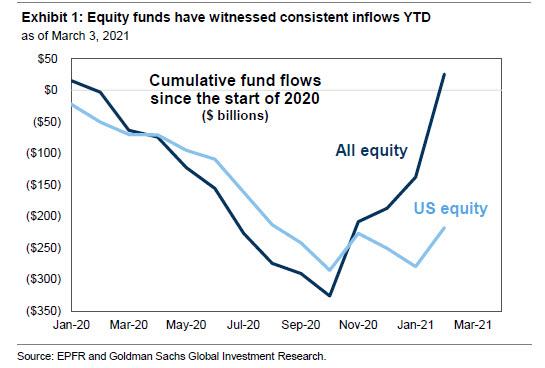
It is worth noting that retail investors are not indiscriminately plowing cash into all stocks, and instead the rotation into equity funds has most favored strategies that benefit from accelerating economic growth, in other words there has been a rotation of new money from growth and to value. Indeed, when looking in absolute dollar terms, while US equity funds have seen large inflows during the past month (+$62 billion), relative to assets, EM, Value, small-cap, and Materials equity funds have seen the largest inflows, consistent with the outperformance of economic growth-sensitive equities.
And here Kostin makes a curious observation in trying to explain this flood of new capital just as stocks - well, mostly tech and growth stocks - get hammered - according to the Goldman strategist, "history shows that equity funds generally experience inflows when real rates are rising. During the past 10 years, the most favorable backdrop for equity fund inflows has been when both real rates and breakeven inflation were rising (Exhibit 2)."
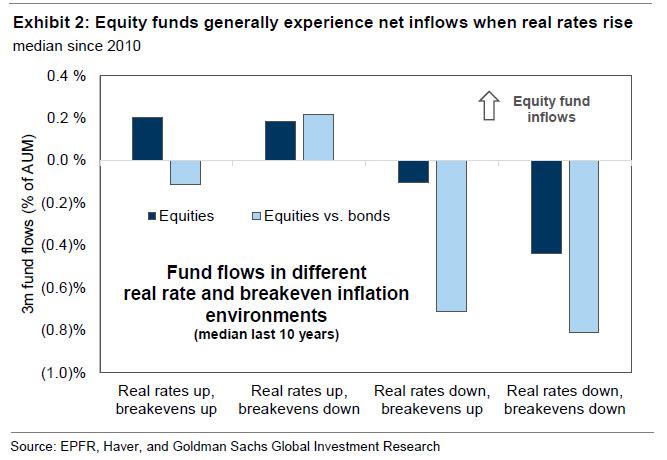
This, Kostin adds, is intuitive given that the dynamic typically occurs when growth expectations are improving. However, equity funds usually experienced inflows when real rates rose and breakeven inflation fell. In short, equity fund flows have been more clearly delineated by the trajectory of real yields than by inflation during the past decade.
This certainly appears to be confirmed by the data: in his latest "Investor Positioning and Flows" report (available to pro subs), Deutsche Bank's Parag Thatte also picks up on this divergence and writes that "bond fund flows slowed sharply this week as rates rose, but equity inflows continue to roll in" and like Kostin, concludes that "the rising rates environment continues to propel large inflows into equity funds (+$22.2bn this week)" although as one would expects, "equity inflows this week went heavily towards cyclical sectors and styles, while Growth funds saw outflows"
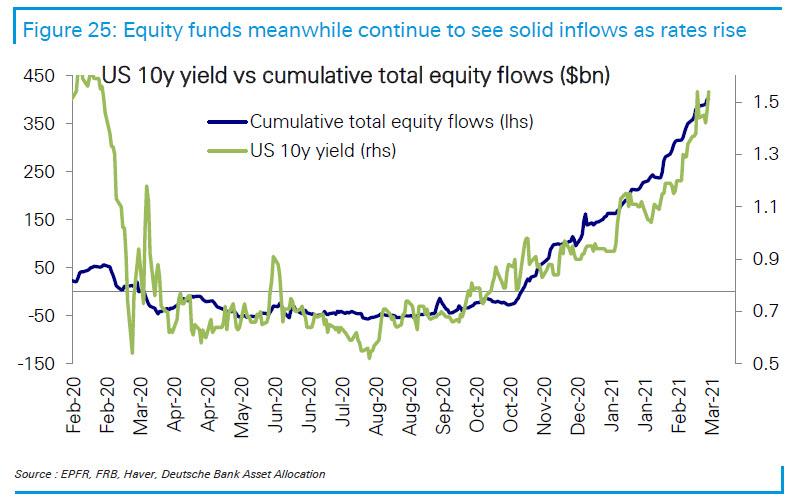
Whether or not the chart above ends in tears will ultimately depend on just how much capital investors have to throw at reflation assets, oblivious of how painful the high duration crash in growth/tech stocks could be (and since FAAMGs still account for about 25% of the S&P500, it could be very painful indeed).
Alternatively, it may well be that yields, inflation or growth concerns have nothing to do with the massive retail inflows we are observing, and it is all due to tidal wave of Robinhood/Reddit investors who have now habituated to buying every single dip. Indeed, as Bloomberg points out over the weekend, no amount of market turmoil has been enough to rattle retail investors who are now so habituated to Fed bailouts, they have yet to find a dip they won't buy.
According to Bloomberg, even though the market peaked almost a month ago, retail traders have plowed cash into U.S. stocks at a rate 40% higher than they did in 2020, which was a record year. Yet one way retail capital allocation differs from the charts above, is that "they're opting for parts of the market that have suffered the most, doubling down in arguably risky ways with triple-leveraged tech funds and options galore."
Could it be that nothing but sheer stupidity and/or certainty in yet another Fed bailout is behind the record inflows? And is Powell to blame?
Retail traders, many of them newbie investors, have consistently held strong, buying virtually every dip during what’s been the best start to a bull market in nine decades. But now the world is wondering how much it’ll take for them to call it quits, especially after a year in which retail traders were right way more often than wrong.
“Historically it’s been a bad signal that retail investors are piling into the market and a signal of a top,” said Art Hogan, chief market strategist at National Securities Corp. And yet, as he admits in the very next sentence, "every time we tried to call a top in 2020 because of retail participation, it was wrong.”
Just how aggressive has retail buying been? According to data from VandaTrack, which monitors retail flows in the U.S. market, retail investors snapped up an average of $6.6 billion in U.S. equities each week, up from an average $4.7 billion in net weekly purchases in 2020 even as stocks swooned over the last three weeks.
They’ve doubled down on areas of the market that have been hit the hardest. Apple, which has plunged 15% since late January, was the most-popular retail buy this past week. NIO Inc., the electric-vehicle maker down almost 40% since Feb. 9, was the second-most popular. Next up were exchange-traded funds tied to the Nasdaq 100, the Invesco QQQ Trust Series 1 (ticker QQQ) and a triple leveraged version (ticker TQQQ).
Because in a centrally-planned "market" where the Fed guarantees no losses ever, why not buy any and every dip? Sure enough, that's what they did and boy did they buy the dip:
On Thursday, when the Nasdaq 100 fell as much as 2.9%, almost 32 million bullish call options traded across U.S. exchanges, the fifth-most on record. The other four have all occurred within the last four months.
There is one fundamental reason why retail investors are buying: the just passed $1.9TN Biden stimulus ensures lots and lots and lots of stimmy checks are about be deposited to daytraders' checking accounts:
“There’s a lot of excess liquidity and we just had this $600 check going to many families in January,” said Jimmy Chang, chief investment officer of Rockefeller Global Family Office. “We’re going to get an additional liquidity injection in the $1,400 check and part of that money is going into risk assets.”
Incidentally, the question of how much of Biden's $1.9TN stimulus will end up in the market is one we discussed last week in the context of a recent Deutsche Bank survey:
"Given stimulus checks are currently penciled in at c.$405bn in Biden’s plan, that gives us a maximum of around $150bn that could go into US equities based on our survey.Obviously only a proportion of recipients have trading accounts, though. If we estimate this at around 20% (based on some historical assumptions), that would still provide around c.$30bn of firepower – and that’s before we talk about any possible boosts to 401k plans outside of trading accounts."
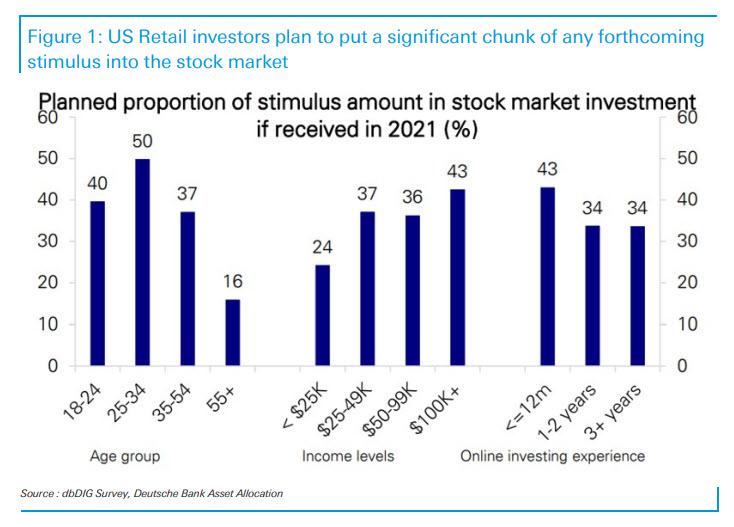
Clearly, frontrunning that number is enough to get retail daytraders to flood the market with yet another round of dip buying for the likes of Karim Alammuri, a 31-year-old marketing strategy manager, who is one of many retail investors who’s been snapping up stocks. In recent days, he bought shares of fuboTV Inc. and SPAC Churchill Capital Corp IV. Fubo TV has plunged more than 50% since a December peak. Churchill Capital has lost almost 60% of its value in 11 trading sessions. He is not giving up however:
“I plan on sticking around because I don’t want to take a loss,” he said by phone from New York. “A lot of very attractive stocks are on crazy discount right now, so I’m just looking to see how I can re-shuffle things to be able to buy them.”
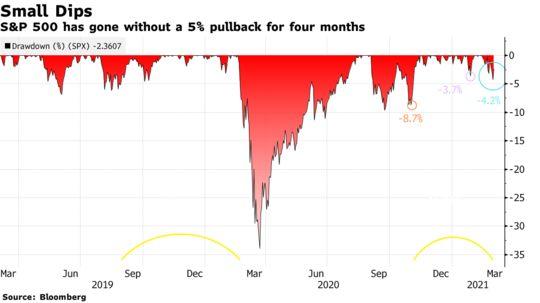
Naturally, with an army of retail investors standing ready to buy any dip, those declines have grown shallower and shallower. As shown in the chart below, the S&P 500 has gone without a 5% pullback since early November, or 83 straight days, the longest streak in a year. The end result of this persistent dip buying, as Bloomberg notes, "is a market with little downside. At its lowest closing level of 2021, the S&P 500 was only down 1.5% year-to-date. That’s the smallest drawdown at this time of a year since 2017."
So is this time different?
Well, as we reported earlier today, Morgan Stanley's Michael Wilson believes that the selloff has more room to go before it's over. Bloomberg agrees and notes that "if past is precedent, that could mean the sell-off has more room to run. Retail investors tend to buy the initial dips, and it’s not until they capitulate and sell that markets ultimately bottom, according to Eric Liu, co-founder and head of research at Vanda Research. The firm’s data show that was the case in both selloffs in 2018, as well as roughly a year ago during the Covid crash."
To Victoria Fernandez, chief market strategist for Crossmark Global Investments, their continued presence in the markets likely means elevated volatility will persist. Still, that doesn’t mean retail investors’ efforts are misguided.
“Is there some dumb money in retail trades? Yes. But not all of it,” she said. “Some of these people are doing their homework, looking for opportunities and trying to take advantage of it. Some win, some lose -- it’s really not that different than what professionals do on an institutional basis.”
Maybe there is dumb money in retail, but that's hardly what matters. What does matter - in our view - is what we reported earlier today, namely that last week we saw the biggest shorting among hedge funds since last May. And with the squeeze having started on Friday and clearly continuing on Sunday, the upcoming "mega squeeze" (which we predicted earlier today) is all that matters.
As such while Wall Street ruminates about the cause (and reflexive effect) of the current record capital inflows into equity stocks amid growing market turmoil, the only thing that matters for this broken, illiquid market is positioning and right now the "max pain" is higher. A lot higher, especially since the Fed will have no choice but to step in if stocks continue to fall as all the careful centrally-planned work of the past 12 years would implode with a massive bang if it does not.
The race to scale up green hydrogen
Long heralded as an alternative to fossil fuels, can the gas really help solve the world’s dirtiest energy problems?
ECB faces headache from ‘unwelcome’ rise in yields
Doves in Frankfurt echo lessons drawn by Fed and urge central bank to keep foot on accelerator
As Covid-19 vaccinations are rolled out, some worry that people will jump the gun, and start taking the dangers of renewed contagion too lightly before the pandemic has been fully beaten back. Similar fears about misplaced economic optimism haunt central bankers — especially in the eurozone.
Like the vaccinated elderly British flouting lockdown rules, rising market interest rates reflect what is fundamentally good news: that the economy is on the cusp of a strong recovery (or in the case of senior parole-skipping, that the danger of exposure to coronavirus has been significantly reduced).
This could be premature anywhere, but especially in continental Europe, where rising bond yields have partly spilled over from US markets reacting to the massive fiscal stimulus that President Joe Biden is seeking to push through Congress.
Chiara Zangarelli, research analyst with Nomura, said that while European nominal yields remain at low levels, the recent rise is “notable . . . with most countries still under lockdown, vaccinations proceeding at a slow pace and inflation rising mainly for temporary reasons”.
In what must be the most dovish recent speech from the European Central Bank, its executive board member Fabio Panetta last week warned that “we are already seeing undesirable contagion from rising US yields . . . that is inconsistent with our domestic outlook and inimical to our recovery”. The market’s effective tightening of financial conditions since December, when the ECB last tweaked its stance, “is unwelcome and must be resisted”, he added.
Analysts have duly noted the logical implication: a looser monetary stance in order to offset the tightening of financial conditions. “Panetta is explicitly calling for additional accommodation to lower bond yields,” noted Frederik Ducrozet, a Pictet strategist.
That is not all. While putting a dovish thumb on the scale in the debate about short-run monetary decisions, Panetta also issued a longer-term challenge to his more hawkish colleagues.
In his speech, he made observations similar to those issued by Federal Reserve policymakers ahead of shifting to a more aggressive monetary policy strategy last year. The previous crisis showed, he said, “that it is hard to lift inflation dynamics without demand testing potential more dynamically” — jargon for keeping the foot on the accelerator until prices are clearly picking up.
He added that “a high-pressure economy helps reabsorb lower-skilled workers into the labour market [as well as] strengthening business investment” — in other words, pushing demand aggressively towards the economy’s potential may itself help boost that potential.
Such remarks echo the lessons former and current Fed chairs Janet Yellen and Jay Powell drew from the last cycle. This evolution in their and their colleagues’ thinking goes a long way to explaining why the ECB’s US counterpart now worries less about overheating and has promised to tolerate above-target inflation after a period of undershooting. Panetta’s similar focus will tug internal discussions in the ECB’s own ongoing policy review in the same direction.
The pandemic, and the widely shared worry that it will permanently “scar” the economy’s supply capacity, make those arguments more urgent. “Policy should not accept [permanent scarring] as a reality which imposes new supply constraints,” Panetta said, “but rather explicitly set out to test those constraints.”
Urgency does not mean the arguments will necessarily get traction, however. Zangarelli cautioned that there was “a big divide within the ECB between dovish and hawkish members”. In the short run, however, she thinks “they have to react” to the “unwarranted” rise in bond yields.
That could bring the central bank very close to something it has officially forsworn: targeting of specific levels of bond yields, or “yield curve control”. Panetta’s speech calls for “anchoring” market yields. “What he is saying is very similar to what yield curve control could look like,” said Zangarelli.
“This could lead to interesting debates” internally, said Ducrozet. For investors, however, action matters more than words: yield curve control by any other name would smell as sweet.
Leonardo prepares to hit acquisition trail
Chief executive of defence group eyes European consolidation after flotation of stake in DRS
Leonardo, one of Europe’s biggest defence companies, is building a war chest to help drive European consolidation after the flotation of its US defence electronics business.
Alessandro Profumo, Leonardo chief executive, told the Financial Times the group was aiming to grow “in core areas where we already have strong business fundamentals”.
“We expect the market will be more dynamic post-Covid as companies reposition and consolidate in response to the new market conditions,” he said.
Profumo’s comments come ahead of the Italian company’s annual results on Tuesday and follow Leonardo’s announcement late last month that it would float in the US a minority stake in DRS, the American defence electronics business it acquired in 2008 for $5.2bn.
The size of the stake and the price at which the shares will be sold will be announced at the end of a bookbuilding exercise, expected to complete at the end of March. However, analysts estimate the group will sell between 20 and 30 per cent for at least $3bn, against a total value for Leonardo of €4bn on last Friday’s close.
DRS relies on the US Department of Defense for 84 per cent of its revenue, which last year came in at $2.8bn, with operating profits of $181m.
Profumo, the former chairman of Italian bank Monte dei Paschi di Siena, refused to give details of the proceeds likely to be raised from the sale of a DRS stake. Yet he insisted that his conviction last year of fraud when he was at the Italian bank in 2015 had not caused any problems for the planned flotation of the business, which in any case had a separate board and governance.
In Italy, convictions are not regarded as final until they have gone through appeal to the Supreme Court. Leonardo’s board has supported Profumo’s continued role as chief executive. “I am sure that we, the board and the chief executive of Monte dei Paschi . . . behaved properly,” he said.
Profumo was brought in to run Leonardo in 2017 after its previous chief executive, Mauro Moretti, was convicted for his alleged role in a train crash in 2009, when he ran Italy’s state-owned rail company. He too is appealing against his conviction.
Profumo said Leonardo, 30 per cent owned by the Italian state, intended to play a part in European defence consolidation, a longstanding ambition that has been thwarted for many years by competing national interests.
“In order to grow, European companies need to win export orders in competition, often against much bigger businesses from the US,” he said. “In the long run this will only be achievable if there is some degree of consolidation between European companies in order to achieve similar scale.”
The proceeds from the DRS sale could also help Leonardo to reduce its debt, a burden it has struggled with since the acquisition of the US business.
In the first nine months of last year the group showed a 37 per cent rise in net debt to €5.9bn, partly because of a sharp drop in free operating cash flow. The group’s debt is rated as non-investment grade by rating agencies Standard and Poor’s and Moody’s, while it is on the brink with Fitch.
According to Fitch, the company ranks among those issuers in the aerospace and defence sector most at risk of a further downgrade this year. The group “retains high leverage and relatively weak cash flow,” the rating agency said in a recent report on the sector.
Profumo said the group’s plans to restore its credit rating to investment grade had been thwarted by the pandemic, which had hit cash flow.
“Without Covid, we would already be in the range,” he said, adding that while it would now take some time to restore an investment-grade rating, “Leonardo was resilient in 2020 and is well positioned to grow”.
Leonardo will offer more details on its plans for the future when it publishes its results on Tuesday.